26 503 résultats
70506London: John Murray. 1853. Dining SECOND EDITION. Octavo 17 x 11cm pp.ii; vi; 37; 1 publisher's advertisements; 2 blank. Contemporary quarter burgundy morocco with brown cloth over boards gilt tooling to boards and spine raised bands to spine gilt lettering. Marbled endpapers all edges marbled. Spotting to preliminaries endpapers and to p.7 infrequent marks throughout toning to pages wearing to leather particularly at joints bumping to corners wearing and toning to cloth. Very good. In this book Hayward touches on everything from the 'brief history of cooking' to 'speculations on touching pies and puddings'. He also includes his 'reflections on Hams and Salads' which records how pig farming was becoming 'a fashionable rural pursuit with the fairer sex'. He recounts how 'an acquaintance . actually placed a pig of more than ordinary promise under the exclusive care of a female attendant with directions to give him a warm bath everyday and the result was eminently prosperous.' A book that holds the charm and wit of the mid 19th century. London: John Murray. 1853 unknown
158464215Antwerp.: Abraham Ortelius. circa1584. Two engraved maps on laid paper each 30.3 x 19.5 cm printed on the one sheet 48 x 60 cm original fold attractive hand colour with related French text on verso slight toning and spotting to the margins but the maps in very good condition preserved in a modern window mount. Attractive maps of the German coast published in Ortelius' great atlas "Theatrum Orbis.". The left-hand map showing the mouths of the Elbe complete with sea monster and Eider Rivers and the coast of Schleswig-Holstein; the right-hand map of the Baltic coast with the Pomeranian islands of Rugen and Usedom. . (Abraham Ortelius). unknown
201409022Munchen, Kunstverlag edition Praeger, 1972 ; in-8, 343 pp., cartonnage de l'éditeur. En bon état avec sa jaquette.
198270550AB1982. Chapel Hill The University of North Carolina 1982. 235 cm x 16 cm. XII 479 pages. Original Hardcover. Very good condition with only minor signs of external wear. Former library copy with library-stamp. Marker signs on edges. Includes for example the following essays: Aristotle's Works and the Problem of Interpretation / The Character of Aristotle's Thought and His Philosophic Method / Explanation and the Teleological Model / Methodological Aspects of Psychology etc etc. Aristotle 384 322 BC was a Greek philosopher and scientist born in the Macedonian city of Stagira Chalkidice on the northern periphery of Classical Greece. His father Nicomachus died when Aristotle was a child whereafter Proxenus of Atarneus became his guardian. At eighteen he joined Plato's Academy in Athens and remained there until the age of thirty-seven c. 347 BC. His writings cover many subjects including physics biology zoology metaphysics logic ethics aesthetics poetry theater music rhetoric linguistics politics and government and constitute the first comprehensive system of Western philosophy. Shortly after Plato died Aristotle left Athens and at the request of Philip of Macedon tutored Alexander the Great starting from 343 BC. According to the Encyclopædia Britannica "Aristotle was the first genuine scientist in history . and every scientist is in his debt." Teaching Alexander the Great gave Aristotle many opportunities and an abundance of supplies. He established a library in the Lyceum which aided in the production of many of his hundreds of books. The fact that Aristotle was a pupil of Plato contributed to his former views of Platonism but following Plato's death Aristotle immersed himself in empirical studies and shifted from Platonism to empiricism. He believed all peoples' concepts and all of their knowledge was ultimately based on perception. Aristotle's views on natural sciences represent the groundwork underlying many of his works. Aristotle's views on physical science profoundly shaped medieval scholarship. Their influence extended into the Renaissance and were not replaced systematically until the Enlightenment and theories such as classical mechanics. Some of Aristotle's zoological observations such as on the hectocotyl reproductive arm of the octopus were not confirmed or refuted until the 19th century. His works contain the earliest known formal study of logic which was incorporated in the late 19th century into modern formal logic. In metaphysics Aristotelianism profoundly influenced Judeo-Islamic philosophical and theological thought during the Middle Ages and continues to influence Christian theology especially the scholastic tradition of the Catholic Church. Aristotle was well known among medieval Muslim intellectuals and revered as "The First Teacher". His ethics though always influential gained renewed interest with the modern advent of virtue ethics. All aspects of Aristotle's philosophy continue to be the object of active academic study today. Though Aristotle wrote many elegant treatises and dialogues Cicero described his literary style as "a river of gold" it is thought that only around a third of his original output has survived. Wikipedia. hardcover
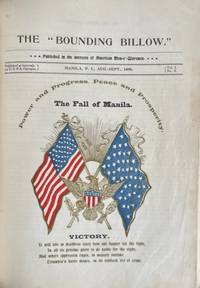
189959607San Francisco & USFS Olympia: The Bounding Billow Printed by Whittaker & Ray Co. Inc. 1899. Eleven parts in one vol. 4to. 2 138 6 pp. With text photos illustrations 2 colour illustrations map photo plates at rear. Original blue publisher’s cloth embossed gilt lettering & shield on front cover edgewear rubbing wear to corners some spotting & wear a few occasional minor closed tears still a G copy from library of Chief Petty Officer William E. Bates 1871-1941 who served in the U.S. Navy for 30 years beginning with the Asiatic Squadron under Admiral Dewey and later during World War I w/ ownership marking on 2nd flyleaf a couple spelling corrections in manuscript. First edition thus of this “cruise book†for the U.S.S. Olympia which served as Admiral Dewey’s flagship during the Spanish-American War and had served as the flagship from 1895 three years prior as flagship of the Asiatic Squadron. This volume opens with an illustrated account of the USS Olympia’s cruises and experiences visiting China Japan Siberia and The Philippines. Included here as well is a reissue including photos colour illustrations and map Vol. 1 Nos. 1-7 of the shipboard periodical published by the seamen of the USS Olympia with place imprints of Nagasaki Hong Kong and Manila. Incorporated are firsthand accounts of shipboard life battle accounts contemporary photos and map prepared by L.C. Passano using sail needles. Of particular interest is the appendix listing the crews of the U.S. Asiatic Squadron including the USS Olympia USS Raleigh USS Boston USS Baltimore USS Concord USS Petrel USS McCulloch. The Bounding Billow, Printed by Whittaker & Ray Co., Inc.], hardcover
23575P., Charles-Lavauzelle, 1949, in 8° broché, VIII-260 pages ; non coupé ; couverture illustrée en couleurs.
1929121451929 P., Rieder (Collection "Maîtres des Littératures"), 1929, in 8° broché, 87 pages ; 59 planches hors-texte ; rares annotations marginales ; signature sur le titre.
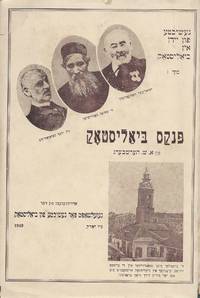
194941480New York Bialystok Jewish Historical Association 1949. HARDBACK. 1st edition. Original Cloth 8vo 380 pages. In Yiddish. The chronicle of Bialystok: basic material for the history of the Jews in Bialystok until the period after the First World War. Very Good ConditionYIZ-10-1A. New York, Bialystok Jewish Historical Association unknown
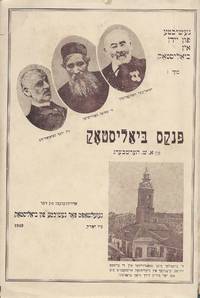
194941479New York Bialystok Jewish Historical Association 1949. HARDBACK. 1st edition. Original Cloth 8vo 480 380 pages. In Yiddish. The chronicle of Bialystok: basic material for the history of the Jews in Bialystok until the period after the First World War. OCLC: 10792576. Very Good ConditionYIZ-10-1. New York, Bialystok Jewish Historical Association unknown
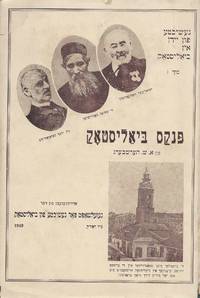
194914335New York Bialystok Jewish Historical Association 1949. HARDBACK. 1st edition. Original Cloth 8vo 480 380 pages. In Yiddish. The chronicle of Bialystok: basic material for the history of the Jews in Bialystok until the period after the First World War. Very Good ConditionYIZ-10-1. New York, Bialystok Jewish Historical Association unknown
201014765Paris, Revue europe mensuelle, 1969 ; in-8, 282 pp., broché, couverture illustr. BON ÉTAT - revue mensuelle juillet aout 1969 n°483/484.
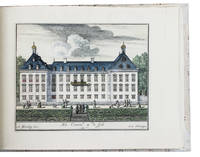
16833691Amsterdam 1683. Oblong 8vo. Modern half vellum floral chintz paper sides. With 16 numbered engraved views ca. 13 x 16 cm tipped onto blank leaves 17 x 23 cm all hand coloured. 16 ll. with engravings. Extraordinary rare first state of a very fine print series of the Honselaarsdijk palace and gardens at Honselersdijk near Naaldwijk complete with all 16 views. They are all signed numbered and captioned in Dutch and have been coloured by hand. We have not been able to find any other copies of the complete series in the first state.The monumental palace of Honselaarsdijk was built between 1621 and 1647 on the orders of the stadholder Frederik Hendrik 1584-1647 who - together with his wife Amalia van Solms and in the context of their ambition to enhance the position and power of the House of the Dutch stadholder possibly to a Royal status - was involved in a project to build a number of new prestigious castles and manor houses in and around The Hague Huis Ten Bosch Rijswijk and Honselaarsdijk as well in the country Soestdijk Het Loo Dieren etc. He financed the building of Honselaarsdijk mainly with the money coming from the "Silverfleet" captured from the Spaniards by Piet Hein in 1629. A number of important architects were involved with the Honselaarsdijk-project among others the famous Jacob van Campen 1596-1657 and Pieter Post 1608-1669. French garden architects were hired for designing the gardens. King William III further embellished the gardens under the direction of the architect Jacob Roman 1640-1716. As early as 1671 William III was personally involved with the rebuilding of the water supply system at Honselaarsdijk as evidenced by a letter of Christiaan Huygens to his brother Lodewijk. The palace later became known as "Little Versailles". After the death of William III in 1702 the estate was neglected and ultimately demolished in 1815. All that still remains is a part of the garden and parts of the coach-houses.Abraham Blooteling 1640-1690 a pupil of Cornelis Van Dalen II 1636-1664 was a Dutch engraver draughtsman and print seller. His dated prints begin to appear in 1665 and they include portraits biblical mythological and genre subjects as well as six views of Amsterdam after Jacob van Ruisdael and two of the Jewish burial-ground in Ouderkerk 1670 also after van Ruisdael. From 1672-78 he worked in London with Gerard Valck. His major contribution was in the development of the new technique of mezzotint specifically the invention of the rocker the tool used in the technique. In England the technique was adopted with such success that it later became known as the "English Manner". Blooteling was again in Amsterdam by September 1678 when he acted as godfather to his nephew Abraham Valck but he kept up his contacts with London.Between 1681 and 1685 his presence in The Hague is recorded. During these years he engraved a major view of Honselaarsdijk 385 x 482 mm after the design by Abraham Begheyn alias Bega 1637-1697. It is likely that he engraved our 16 views in the same year probably also after the drawings by Abraham Bega. However both the 16 views and the bird's eye view are now exceptionally rare. In fact the present 16 views were until now only known in their second state the reissue by Gerard Valck 1651/2-1726 in his Veues et perspectives de Loo Honslardyck et Soestdyck chasteau & maison de plaisance du Roy de la Grande Bretagne 1695. The views in the second state are numbered differently and lack Blooteling's name.Some of the views have been cut a few millimetres short on the right hand side two of the blank leaves with a crease and two pinprick holes in the bottom margin. Otherwise a fine hand coloured copy.l Hunt & de Jong The Anglo-Dutch garden pp. 136-7; cf. Hollstein II p. 216 no. 117 bird's eye view of Honselaarsdijk by Blooteling after A. Bega dated 1683 & XXI p. 267 nos. 95-16 same print-series by G. Valck dated 1695; Thieme/ Becker IV pp. 139-40; not in Springer. hardcover
65857P., L. Allison (Collection "Les Artistes Célèbres"), sans date, grand in 8° relié d'une modeste demi-toile grise, dos lisse avec étiquette de basane bleue, 116 pages ; nombreuses illustrations ; quelques rousseurs ; cachets ; reliure fanée avec frottis.
7502Paris, Les éditions Roger Dacosta, (octobre) 1967. In-4, reliure toilée de l'éditeur, jaquette.
1667131Paris Par A. Bosse 1667 In-8 - 12x18,5cm. Reliure d'époque en plein veau moucheté, dentelle dorée sur sur les coupes. 5ff, 72pp, 10ff.
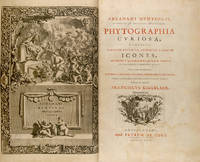
99525Amsterdam Petrus de Coup 1727. . First Latin edition presumed third issue; two parts in one folio 39.2 x 25.4 cm; engraved title-page used here as a frontispiece and 245 engraved botanical plates inserted at rear with allegorical vignette on title-page and two engraved headpieces on ppiii and 25 by Goeree title-page printed in black and red lacking half-title and dedication leaf text somewhat toned frontispiece repaired at inner margin all inserted plates with small circular ink stamp of the Massachusetts Horticultural Society near the bottom their bookplate is present on the front pastedown plates twenty-five and twenty-six are trimmed smaller as most likely supplied some soiling and foxing to text and plates prominent damp staining on plates 144 to 245 plate 32 has small marginal repairs a few leaves with minor marginal worming plates 1 - 48 with neat ink captions in an unknown hand; nineteenth-century quarter calf over marbled boards spine ruled in gilt in compartments black morocco lettering piece gilt edge wear to binding especially at spine and corners upper board detached lower board loose; xxvi 47 1 blank pp.<br /> First Latin edition presumed third issue. A good copy only sold with all faults. 'The illustrations are remarkable for their elegance and originality' Oak Spring Flora 45. This is perhaps the most handsome and influential botanical of its day with its near-dreamlike depiction of plants suspended above cityscapes and other backgrounds.<br /><br />Munting 1626-1683 was a Dutch botanist and botanical artist the son of Henricus Munting 1583-1658. He studied under his father and at the universities of Franeker Utrecht and Leiden also spending two years in France where he obtained an M.D. degree in Angers. Returning to Groningen in 1651 he joined the staff at the Rijkshogeschool Groningen which eventually became the University of Groningen. Here he taught for 24 years as professor of botany and chemistry. On his father's death he assumed management of the Hortus Botanicus Groninganus from 1658 to 1683. His botanist friends sent him seeds from the Dutch East- and West Indies Africa and the Americas. His daughter Hester died after eating Deadly Nightshade from the Garden. Munting subsequently developed a particular interest in the medicinal uses of plants.<br /><br />The present work Munting's best known was first published in Dutch as Naauwkeurige Beschryving Der Aardgewassen 1696. Illustrated were trees shrubs flowers and grasses of temperate zones with some tropical and subtropical plants that had been introduced to the Netherlands.<br /> Nissen BBI 1429; Hunt 404. Amsterdam, Petrus de Coup, 1727. hardcover
160864956Ingolstadt, Gedruckt in der Ederischen Truckerey, durch Andream Angermeyer [Andreas Angermaier], 1608. 4°. Mit Holzschn.-Titelvignette. 1 Bl., 30 S., Geheftet (ausgebunden; ohne Einband).
3059Marseille. Cahiers du Sud. 1953. In-8° broché. 150 pages. E.O. sur papier ordinaire.
186358199Camp near Brooks Station Saturday April 11 1863. Fine original condition. 15-1/2 x 9-3/4 inches. ".Yesterday I witnessed one of the grandest sights that I ever beheld. Our whole corps was reviewed by the President Generals Hooker McLain Howard Steinway Secretary Seward and an innumerable host of Brigadier Generals and it was a sight that has paid me for coming to war." The spectacle is described in great detail. Private Penfield was soon to be captured at Chancellorsville spending 12 days as a prisoner of war before being exchanged. He survived the war to carry on his father's carriage making business in Monroe Connecticut and later founded a small private academy. unknown
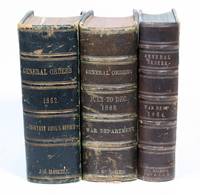
18622923Washington D.C.: War Department 1862. Calf marbled boards. Very Good. FIRST OBTAINABLE PRINTING OF THE PRELIMINARY EMANCIPATION PROCLAMATION setting a date for the freedom of more than three million enslaved in the United States and reframing the Civil War as a fight against slavery. Issued by the War Department to regimental commanders in the field during the Civil War in the week after the completion of President Lincoln’s official manuscript version. Contained is a set of three volumes of General Orders covering the full year 1862 July-Dec 1863 and the full year 1864. History of the Emancipation Proclamation:<br /> <br /> “The proclamation has been called by responsible persons one of the three great<br /> documents of world history ranking with Magna Carta and the Declaration of<br /> Independence†– Eberstadt<br /> <br /> “From the first days of the Civil War slaves had acted to secure their own liberty. The Emancipation Proclamation confirmed their insistence that the war for the Union must become a war for freedom. It added moral force to the Union cause and strengthened the Union both militarily and politically. As a milestone along the road to slavery’s final destruction the Emancipation Proclamation has assumed a place among the great documents of human freedom†– National Archives<br /> <br /> Following the Seven Days Battle and General McClellan’s retreat from the Peninsula at the end of June 1862 President Lincoln realized that there would be no early end to the war and found himself “as inconsolable as it was possible for a human to be and yet live.†Anxious for news from the army and needing to escape the constant interruptions at the White House he frequently visited the telegraph office in the War Department building to await dispatches. It was during one such visit early in July that he asked the chief of the telegraph staff Major Thomas Thompson Eckert for some paper to “write something special†and began the first draft of the Emancipation Proclamation completing it in a few weeks. Lincoln had long hoped to resolve the slavery issue through a congressional act of emancipation compensating slave owners for their loss of “property†but that approach was roundly rejected by representatives from the border states leaving the President who had decided upon the necessity of emancipation with a presidential proclamation as the only option. The extraordinary document he conceived would announce the liberation on January 1 1863 of all slaves in those states still in rebellion against the Union and promised compensation to slave owners in those states that returned to the fold before that time if they adopted “immediate or gradual abolishment of slavery.†This proclamation would be followed by a final proclamation issued on the 1st of January identifying those states still in rebellion and confirming the liberation of all slaves therein.<br /> <br /> On Tuesday July 22 Lincoln presented his draft to the Cabinet telling them that he had resolved firmly upon the course of action it specified and asking them not for advice but suggestions. The only observation he had not anticipated came from Secretary of State Seward who proposed that it might be best to wait for a military victory before issuing the Proclamation as it could otherwise seem like “the last measure of an exhausted government.†Immediately recognizing the wisdom of the suggestion Lincoln held back. On September 17 after an anxious wait of nearly two months he received the victory he needed at the bloody Battle of Antietam. Completing his final draft Lincoln presented it to his cabinet for refinement on September 22. Following the meeting Seward took the amended draft with him to the State Department where a formal manuscript copy was made then signed by Lincoln and Seward. The formal official “Emancipation Proclamation†was of course issued on January 1 1863 the day it became the law of the land.<br /> <br /> Printing History:<br /> <br /> This printing in the War Department’s official “General Orders†is the fourth printing overall but realistically the first obtainable printing. It is preceded by:<br /> <br /> -The first printing Eberstadt #1 a small three-page circular intended for distribution within the government and to the local press likely printed on September 22. At the time that Charles Eberstadt published his study of the Proclamation 1950 he was able to locate only one copy which he himself owned and as nearly as we have been able to determine no other copies have come to light since then.<br /> <br /> -The second printing Eberstadt #2 may be a phantom printing. Charles Eberstadt was not able to locate a copy but he inferred its existence from the standard State Department practice of printing a folio edition consisting solely of the text of the proclamation followed by another printing consisting of the text of a letter of transmittal from the Secretary of State as well as the text of the proclamation. While there may be a copy of Eberstadt #2 in the National Archives as he speculated it is not recorded in their online catalogue nor have we been able to find a copy in any other online catalogue including OCLC the Library of Congress and the Abraham Lincoln Library.<br /> <br /> -Eberstadt’s third printing is of legendary rarity. It consists of Secretary of State Seward’s one-page letter of transmittal addressed “To the Diplomatic and Consular Officers of the United States in foreign countries†and the text of the proclamation. Eberstadt located a total of only five copies in institutions at the Library of Congress the National Archives Yale the Clements Library and Brown. OCLC does not record any additional copies nor is it recorded in Monaghan. There has been one copy at auction $400000 in 2021 and that was described as the only copy in private hands. <br /> <br /> -The present copy General Orders No. 139 is Eberstadt’s fourth printing of the Preliminary Emancipation Proclamation dated in print on September 24. Eberstadt surmises that this field order printing could have been accomplished as late as September 29 or 30. Although it may have been printed in as many as 15000 copies it is very rare in commerce likely due to the ephemeral nature of the printing and distribution.<br /> <br /> Additional General Orders and Provenance:
<br /> <br /> The three volumes once belonged to John G. Haskell A.Q.M. Chief Quartermaster and contain the General Orders for the year 1862 July-December only for the year 1863 and for the full year 1864. John Gideon Haskell 1832-1907 was a resident of Kansas and joined the Union Army when the war broke out. He enlisted with the 14th Kansas Volunteer Cavalry Regiment and later served as Assistant Quartermaster General of Kansas as quartermaster of the Third Kansas and the Tenth Kansas Volunteers as Captain and Assistant Quartermaster on the staff of General James G. Blunt and as Chief Quartermaster of the Army of the Frontier. After the war Haskell was named official state architect and worked on the state house the capitol the State University and more.<br /> <br /> In addition to the preliminary Emancipation Proclamation the three volumes also contain the Acts of Congress on many other subjects including pay discharge recruitment handling of troops etc.<br /> <br /> Washington D.C.: War Department Adjutant General’s Office 1862-64. Three volumes. Small octavo contemporary three-quarter brown morocco two volumes with cloth boards one with marbled boards. Some rubbing and wear to bindings pencil notations on endpapers with collation and highlighting certain orders and some internal pages. Dampstaining to general title of 1862 volume; internal text and Emancipation Proclamation generally fine. RARE AND IMPORTANT.<br /> <br /> References:<br /> <br /> Charles Eberstadt. “Lincoln’s Emancipation Proclamation.†New York: 1950. War Department unknown
195715099Paris, Les Editeurs français réunis, 1957 1 volume In-8° (13,5 x 21,3 cm) Broché sous couverture au 1er plat orné d'une grande photo. 175p. Bon état.
1958120644Europe 1958 In-8 broché 21,5 cm sur 13,5. 158 pages. Bon état d’occasion.
1962120645Europe 1962 In-8 broché 21,5 cm sur 13,5. 314 pages. Illustrations en noir et blanc hors-texte. Bon état d’occasion.
6690Paris, Centre Georges Pompidou, 1985. In-4, broché, iconographie.
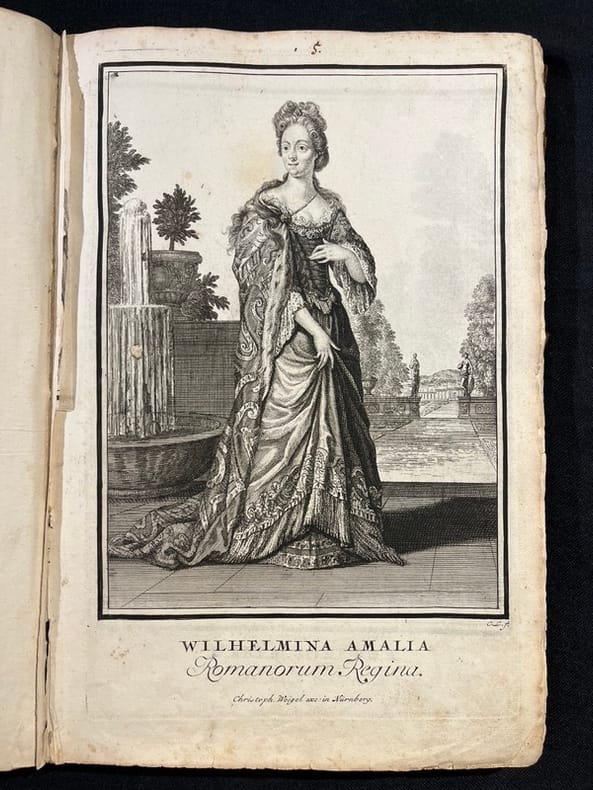
170321520Nuremberg, [1703]. In-folio de 83 planches, pleine basane du temps, dos à nerfs.