400 résultats
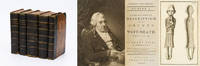
1767JC14337London: Printed by T. Jones. and Sold by T. Payne. / Printed by W. Oliver. and Sold by T. Payne and Son. et al 1767-8. First Edition. Hardcover. Very Good. Contemporary specked calf ornate gilt-stamped border on boards gilt-stamped lettering and ornament in spine compartments 5 raised bands; complete set of 9 volumes published and bound as Volume I Parts i-ii Volume II Parts i-iii Volume III Parts i-iv 8vo; pp. xlvi 384; 384; 315; 335; 540 3 blank errata; 403; 432; 462; 505 1 errata. Volumes I-II bound as the first 5 volumes of this set printed by T. Jones 1768 and with the armorial bookplate of Reverend John St. John of Farley; Volume III the last 4 volumes of this set printed by W. Oliver 1767. Bindings just a bit worn with some bumping and very light chipping along spines and edges of boards. Contents somewhat tanned with some faint foxing here and there but overall tight bright clean and unmarked. A nice set of the rare first edition difficult to find in a straight run. <br/><br/> Printed by T. Jones... and Sold by T. Payne... / Printed by W. Oliver... and Sold by T. Payne and Son... [et al] hardcover books
1768EXP4-B-3London: T. Jones 1768-1778. Leather. Fair. 8.5" by 5". None. A set of five very scarce volumes by Abraham Tucker under the pen name of Edward Search in leather binding. Very important texts and all contemporary editions are extremely rare. As these were published separately they are usually seen individually and a five volume collection is highly unusal. The original work was seven volumes broken in to parts. Not special externally and would really benefit from the attentions of a good binder but we keep them here are entirely original. Bound and marked as an eight volume set this collection comprises Volumes III Volume II Part I- 1768 Volume V Volume II part III-1768 Volume VI Volume III Part I- 1778 Volume VI IV Part II- 1777 and Volume VIII Volume V Part III- 1777 The volumes are major works of eighteenth century philosophy and theology anticipating utilitarianism and holding that "every man's satisfaction" is the ultimate end of any action. Contains the bookplate of one George Phillips to the pastedown of volume III. In calf binding with gilt detailing. Externally there is wear to the boards joints extremities and backstrips with tenderness to hinges. The front board is detached but present to the sixth volume and missing to the eighth. Internally the pages are firmly bound but are somewhat spotted and age-toned with some creasing. Overall: FAIR due to binding though internally presentable. Fair T. Jones hardcover
172730277Amsterdam: Michel Charles le Céne 1727. 2 volumes in 1 small folio. 12 1/8 x 7 5/8 inches. Titles printed in red and black. Engraved portrait frontispiece 44 engraved maps plans and views 31 folding 19 in-text engraved illustrations. Contemporary calf spine with raised bands in seven compartments red and green morocco lettering pieces in the second and third the others with a repeat decoration in gilt marbled endpapers and edges.<br/> <br/>A lovely copy of a noted illustrated work on Asia including maps and views of India China and Japan.<br/> <br/>"Johann von Mandelslo was a friend of Adam Olearius and a former page of the Duke of Holstein-Gottorp. Together Mandelslo and Olearius were sent by the Duke on an embassy to the Russian Czar and to the Shah of Persia for the purpose of initiating trade relations with Russia Tartary and Persia. Mandelslo was authorized to leave the embassy in Persia and to continue his travels to the Far East. He went to Surat Agra and Goa in India where he received great kindness from the English merchants and he also visited Ceylon. He gives long accounts of the other parts of the Far East which he did not visit personally. His return was made to England by sea via the Cape of Good Hope which he visited in 1639" Hill. Mandelslo's narrative contains substantial information on the Far East. "Before his death Mandelslo had entrusted his rough notes to Olearius who subsequently published them bound with his numerous official accounts of the embassy" Howgego. Following the first publication Olearius added additional information to subsequent editions. A new edition in French translated by Wicquefort included still more additional material including an account of the travels of Henri de Feynes to China Formosa and Japan. The present edition published in Amsterdam in 1727 is a re-issue of the Van der Aa edition of 1719 published in Leiden; both are celebrated as the best editions being the most complete and with the largest number of illustrations. The plates include views and plans of London Amsterdam Brussels Antwerp Capetown Goa Surat Jedo Tokyo St. Helena Mauritius Madagascar the Canary Islands Java Congo and elsewhere.<br/> <br/>Brunet IV 178; Cordier Japonica 367-368; Cordier Indosinica 883; Cordier Sinica 2076-77; cf. Hill 1073; Howgego M-38; Lust 342. Michel Charles le Céne unknown books
177874611778 2 Neuchâtel: Chez Samuel Fauche, 1778. 2 vol. in-4.: 19.5 x 25 cm. I/ 3 ff. de fx-t., front. et titre, iv pp. de dédicace et préface, 454 pp., 1 f. d'avis au relieur + 38 pl. grav. et cartes; II/ 3 ff. de fx-t., front. et titre, 391-[1] pp. avec avis au relieur au vo de la p. 391 + 41 pl. grav. et cartes. Première et unique édition in-4°, la plus recherchée, avec les 81 gravures et cartes d'après Merian: 2 frontispices, 67 vues de la Suisse et 12 cartes donc 6 dépliantes. Cette nouvelle édition, la quatrième, entièrement refondue, est plus exacte que les précédentes. (Lonchamp: no. 2560 /Quérard, VIII: 276). Reliures de l'époque en veau granité. Dos à nerfs avec pièces de titre et de tomaison en veau vert et caissons ornés aux petits fers. Trois filets dorés en encadrement des plats. Deux filets aux coupes. Tranches marbrée. Ex-libris: andré Gutzwiller. Traces d'usage aux reliures. Quelques rousseurs. Petite déchirure à la partie sup. de la p. 305 du 1er volume. La figure représentant le plan de Lausanne de Mérian, quelque peu effacée à un endroit: en compensation une figure plus ancienne, également d'après Mérian, a été contrecollée à son recto (Vol I: p. 351).
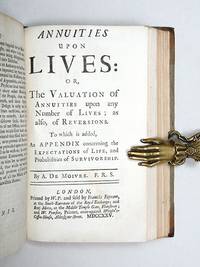
1725153270London: Printed by W. P. and sold by Francis Fayram Benj. Motte W. Pearson 1725. Life expectancy as probability First edition of a founding work of actuarial science de Moivre's influential study of annuities based upon the mortality statistics gathered in the 1690s by Edmund Halley. De Moivre was perhaps the first to develop probability theory extensively and the first to use probability theory to write a comprehensive work on life contingencies. In Annuities upon Lives de Moivre formulated that among a body of persons over a certain age the successive annual decreases by death are nearly equal. He applied the theory of probability to the systematic investigation of problems concerning annuities upon lives. "De Moivre's contribution to annuities lies not in his evaluation of the demographic facts then known but on his derivation of formulas for annuities based on a postulated law of mortality and constant rates on money. Here one finds the treatment of joint annuities on several lives the inheritance of annuities problems about the fair division of the costs of a tontine and other contracts in which both age and interest on capital are relevant. This mathematics became a standard part of all subsequent commercial applications in England" Ian Hacking in the Dictionary of Scientific Biography. The work is bound with five others: i YORKE Charles. Some considerations on the law of forfeiture for high treason. The third edition further corrected and enlarged. London: J. and J. Rivington 1748. Yorke's principal legal work first published in 1745 when his father was Lord Chancellor and is a defence of one of his father's judgments against the Young Pretender. ii STORY Joseph. An essay concerning the nature of the priesthood. Dublin: George Faulkner 1749. First edition. iii ROBINSON Christopher. Considerations on the late bill for payment of the remainder of the national debt in which the occasion of inserting the clause relative to His Majesty's consent and The Arguments in Support of such Right in the Crown are impartially stated. Dublin: n.p 1754. First Dublin edition published in London the same year. iv ROBINSON Christopher. A short essay on the publick judgments of the Romans. Dublin: n.p 1739. First edition. v Anonymous. Considerations on the case of the bakers in Dublin. Dublin: Printed for George and Alexander Ewing 1757. Later edition first published 1752. Six works bound in a single vol. octavo 197 x 120 mm. Contemporary half calf spine lettered in gilt paper sides. Contemporary manuscript contents list to front pastedown early bookplate of Wolfe De Forenaughts to same crossed out early ownership inscription to title page of the first pamphlet. Slight rubbing superficial splits along joints contents fresh. A very good copy. ESTC T33056; Garrison & Morton 1690; Hanson 3492; Institute of Actuaries p. 39; Kress 3595; Norman 1530; McCulloch p. 250; not in Goldsmiths'. unknown
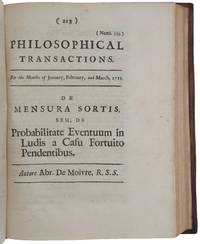
17126431London: Printed for H. Clements . and W. Innys . and D. Brown 1712. First edition. <p>First edition published in the Philosophical Transactions and de Moivre's first published work on probability-the earliest original contribution to the subject to appear in Britain. This pioneering paper laid the groundwork for his later masterpiece The Doctrine of Chances 1718 the definitive English-language textbook on probability theory for over a century. As Hald notes "Nearly all of De Mensura Sortis was later incorporated into The Doctrine of Chances . the most important textbook on probability theory until the publication of Laplace's Théorie Analytique des Probabilités 1812."</p>. <p>THE FOUNDATION OF THE DOCTRINE OF CHANCES</p> . <p>First edition contained in a complete volume of the Phil. Trans. of de Moivre's first published work on probability and the first original work on the subject published in Britain a precursor to his Doctrine of Chances which appeared seven years later. "De Moivre's work on the theory of probability surpasses anything done by any other mathematician except Laplace. His principal contributions are his investigations respecting the Duration of Play his Theory of Recurring Series and his extension of the value of Daniel Bernoulli's theorem by the aid of Stirling's theorem" Cajori p. 245. "The only systematic treatises on probability printed before 1711 were Huygens' De ratiociniis in ludo aleae 1657 and Pierre Rémond de Montmort's Essay d'analyse sur les jeux de hazard 1708. Problems which had been posed in these two books prompted de Moivre's earliest work and incidentally caused a feud between Montmort and de Moivre on the subject of originality and priority" DSB. "Nearly all of De Mensura Sortis was later incorporated into de Moivre's book The Doctrine of Chances 1718 1738 1756 which was the most important textbook on probability theory until the publication of Laplace's Théorie Analytique des Probabilités 1812. In the preface de Moivre states that he began his work on probability theory at the exhortation of Francis Robartes who asked him to solve the division problem for two gamesters playing bowls and also to find the probability of getting certain given faces as the outcome of a given number of throws with a die. He also states that he had previously read the books by Huygens and Montmort 'but these distinguished gentlemen do not seem to have employed that simplicity and generality which the nature of the matter demands.' Furthermore he writes that 'while they suppose that the skill of the gamesters is always equal they confine this doctrine of games within limits too narrow.' Finally his remarks about Montmort may be read as if Montmort had used only the method of Huygens on some new examples. These rash remarks naturally provoked a dispute with Montmort" Hald 1984 pp. 230-1. "The most remarkable of de Moivre's contributions in De mensura sortis are his derivation of the ruin probability in Huygens' fifth problem; his use of the Poisson approximation to solve the binomial equation Bc n p = ½ with respect to n; his solution of the occupancy problem by means of the method of inclusion and exclusion and the algorithm for the continuation probability in the duration of play for the ruin problem. Furthermore he gives without proof the probability of getting a given number of points by throwing any given number of dice and the probability of ruin when one of the players has infinitely many counters. The only contemporary evaluation of these impressive results is the critical review given by Montmort in a letter of 5 September 1712 to Nicholas Bernoulli about a month after Montmort had received a copy of the paper from de Moivre . Montmort recognizes de Moivre's priority to the Poisson approximation to Robartes' problem and to the algorithm for finding the continuation probability in the problem of the duration of play" Hald 2003 pp. 403-4. No copies in auction records.</p> <br /> <p>Provenance: Toft Hall in Cheshire England seat of the Leycester family since the 14th century bookplate on front paste-down.</p> <br /> <p>De Moivre's interest in probability was awakened by Francis Robartes 1649-1718 Member of Parliament and scion of an aristocratic family. In 1692 Robartes wrote a manuscript on two probability problems that he presented to the Royal Society but never published and in the following year he succeeded in publishing another paper on probability. In 1710 Robartes helped John Harris with his article entitled "Play" in Harris's scientific dictionary Lexicon Technicum. Robartes devised an algorithm that Harris used to extract the appropriate terms in a binomial expansion in order to solve the problem of the division of stakes. At some point over the years 1708 to 1710 Robartes received a copy of Montmort's Essay which he showed to de Moivre. He also gave de Moivre three challenge problems of his own devising to work on. "Once de Moivre had solved the first problem within a day of Robartes posing it Robartes gave de Moivre the other two problems to work on while at the same time encouraging him to write on probability. The encouragement proved fruitful. De Moivre finished his manuscript on probability during a holiday that he spent at a country house possibly Robartes's. On June 11 1711 de Moivre submitted his manuscript to the Royal Society. The Society's Journal Book quietly marked the beginning of a new era for probability in England with the note 'Mr. De Moivre presented a Treatise Intituled de Probabilitate Eventum in Ludo Alea This Treatise was Ordered to be printed in the Transactions.' The treatise with the title De Mensura Sortis or 'Of the measurement of lots' comprises an entire issue Number 329 of Philosophical Transactions. At 52 journal pages it is more than three times longer than anything else de Moivre had written to that date" Bellhouse p. 70.</p> <br /> <p>De Moivre begins De Mensura Sortis with two basic definitions from which many of his results are derived. The first comes directly from Huygens's De ratiociniis. For two players A and B contending for a stake of value a A has p chances to win and B has q. The expected value for each player follows what Huygens obtained: ap/ p q for A and aq/ p q for B. The second definition may have come from Edmond Halley or Francis Robartes. If an event can happen in p ways and fail to happen in q and a second event can happen in r ways and fail to happen in s then all the chances for events happening or failing are in the product p qr s or pr qr ps qs. For example pr is the number of ways both events can happen and ps is the number of ways that the first event happens and the second fails. This is the approach that Halley used in evaluating joint life annuities in his 1693 paper on mortality data from the city of Breslau .</p> <br /> <p>"De Moivre finishes the introduction by saying that if the first event is repeated n times then the total number of chances in the game is given in the binomial expression p qn. When this expression is expanded it may be written as a sum containing terms of the form piqn-imultiplied by an appropriate coefficient where i represents the number of times the event happens and n - i represents the number of times it fails the sum of the first c terms of this expansion is denoted Bc n p . The binomial expansion becomes the motif for the paper . At the beginning nine of the first ten problems there are some simple variations on the use of the expansion of p qn and then at the end the last seven problems the expansion is used to solve a very complex problem the problem of the duration of play. In the middle there are several solutions to a number of challenge problems taken from various sources including the three from Robartes" Bellhouse p. 73.</p> <br /> <p>Problems 1 3 and 4 are relatively straightforward applications of the binomial distribution. Problem 1 is to find the chance of throwing an ace two or more times in 8 throws with a single die. Problem 3 is to determine the chances of A and B winning a single game supposing that A can give B two games out of three. Problem 4 is similar.</p> <br /> <p>In problems 5 to 7 de Moivre considers the problem of finding the number of trials that gives an even chance for getting at least one success but fewer than some given number of successes c say. This means he has to solve the equation Bc - 1 n p = ½ for n when c and p are given. De Moivre considers the two extreme cases p = ½ and p tends to 0 of which the first is easy by symmetry. De Moivre shows that as p tends to 0 Bc - 1 n p tends to e-mmultiplied by the sum of the first c terms in the series expansion of em in powers of m where m = np/1 - p de Moivre was not able to express the result this way because our notation for the exponential function had not yet been invented. This result the 'Poisson approximation' to the binomial distribution played a very important role in later developments. "There has been some discussion of whether it is reasonable to contend that de Moivre found the Poisson distribution" Hald 1984 p. 231 more than a century before Simeon-Denis Poisson. </p> <br /> <p>Problems 2 3 4 and 10 are on the division of stakes or 'problem of points'. "Consider a series of games with two players A and B where in each game A has probability p and B probability q = 1 - p of winning a point. If play stops when A lacks a points and B lacks b points in winning how should the stake be divided between them De Moivre proves that A's probability of winning equals the sum of the last b terms of the expansion of p qab-1 and B's probability of winning equals the remaining a terms. This result had already been derived by Johann Bernoulli in 1710 in a letter to Montmort but it was not published until 1713 . In Problem 8 de Moivre generalizes to k players say and gives the solution as the sum of the appropriate terms of the multinomial pl p2 . pknl-k n being the total number of points lacking. He points out that certain terms have to be divided among the players depending on the permutation of the p's.</p> <br /> <p>"In Problems 16 and 17 he gives the solution of Robartes's problem: the division problem for two gamesters playing bowls. In each game B say gets a number of points equal to the number of his bowls which is nearer to the jack than any of A's bowls. By combinatorial methods de Moivre finds the probability of getting i points in a single game assuming that the players have the same number of bowls and are of the same skill. The division problem is then solved by recursion" Hald 1984 pp. 231-2.</p> <br /> <p>Problems 11 12 and 13 are related to the first two of the five problems Huygens posed at the end of his De ratiociniis. "In these problems the players take turns in a specified order until one of them wins. De Moivre gives the solution as the sum of an infinite series" ibid. p. 232.</p> <br /> <p>Problem 15 is 'Waldegrave's problem' James Waldegrave 1684-1741 later the first Earl Waldegrave was a British diplomat living in Paris who himself published nothing in mathematics. "Let there be n 1 players A1 . An1 of equal skill. Players A1 and A2 play a game and the loser pays a crown to a common stock and does not enter the play again until all the other players have played; the winner plays against A3 and the loser pays a crown to the stock and so on. If the winner of the first game beats all the rest the play is finished; if not the play goes on each player coming in again in turn until one player has beaten in succession all the other players and he then receives all the money in the stock.<br /> The problem is to determine</p> <br /> <br /> the probability of each player winning the stock;<br /> the expectation of each player; and<br /> <br /> the probability of a given duration of the play.<br /> <br /> <p>"In a letter to Bernoulli of I0 April 1711 Montmort writes that the problem has been proposed to him and also solved by Waldegrave for three players. Independently de Moivre formulated and solved the problem for three p1ayers in De Mensura Sortis 1712" Hald 2003 p. 378. "De Moivre solves this problem by means of conditional expectations. First he supposes that A beats B in the first game. On this assumption the play may end with A as winner in the second fifth eighth . game. The probabilities of A for reaching these games and winning are ½ ½4 ½7 . Hence the expected stake plus fines may be found and subtracting A's expected fine his conditional expectation results. Under the same assumption B's expectation is obtained. The unconditional expectation is then found as the average of the two conditional expectations" Hald 1984 p. 232.</p> <br /> <p>Problems 18 and 19 are 'occupancy problems' the third type of problem posed to de Moivre by Robartes: Find the probability pn that f specified faces occur at least once in n throws with a die having k faces. De Moivre calculates pn by means of the method of 'inclusion and exclusion'. In Problem 19 he solves the equation pn = ½ under the assumption that f is small compared to k.</p> <br /> <p>Problem 9 is a generalization of the 'gambler's ruin problem' the fifth of Huygens's problems in De ratiociniis. "Consider two players A and B having a and b counters respectively. In each game A has probability p and B has probability q = 1 - p of winning and the winner gets a counter from the loser. The play continues until one of the players is ruined. What is the probability of A being ruined Huygens's fifth problem is obtained for a = b = 12" ibid. Problems 20-26 are a continuation of the discussion of the ruin problem: what is the probability that the play ends at the nth game or before Problem 25 is the case when A has infinitely many counters; de Moivre states the result without proof.</p> <br /> <p>"Although the publication date is given as 1711 De Mensura Sortis was not in print until 1712. Shortly after its publication de Moivre sent copies of the issue to several people in England including Edmond Halley Isaac Newton and de Moivre's fellow chess player at Slaughter's Coffeehouse the Earl of Sunderland. De Moivre's friend Pierre des Maizeaux handled several copies that were bound for the Continent. Using his connections in the Republic of Letters des Maizeaux sent copies of De Mensura Sortis to Abbé Jean-Paul Bignon at that time the French minister of state with responsibility for the Académie Royale des Sciences. Bignon wrote to des Maizeaux on September 24 1712 saying that the copies he received had been distributed. He also enclosed a letter from Montmort to de Moivre thanking him for his treatise; the letter has not survived. Whatever he thought personally about de Moivre's treatise Montmort was adhering to the code of civility in the Republic of Letters by sending the letter of thanks. Other people on the Continent receiving copies were Nicolaus Bernoulli Johann Bernoulli and Pierre Varignon. Johann Bernoulli received his copy via William Burnet a younger son of Gilbert Burnet Bishop of Salisbury; Bernoulli had asked Burnet to obtain a copy for him" Bellhouse p. 71.</p> <br /> <p>Abraham Moivre stemmed from a Protestant family. His father was a surgeon from Vitry-le-François in the Champagne. From the age of five to eleven he was educated by the Catholic Péres de la doctrine Chrètienne. Then he moved to the Protestant Academy at Sedan were he mainly studied Greek. After the latter was forced to close in 1681 for its profession of faith Moivre continued his studies at Saumur between 1682 and 1684 before joining his parents who had meanwhile moved to Paris. At that time he had studied some books on elementary mathematics and the first six books of Euclid's elements. He had even tried his hand at Huygens' 1657 tract without mastering it completely. In Paris he was taught mathematics by Jacques Ozanam who had made a reputation from a series of books on practical mathematics and mathematical recreations. Ozanam made his living as a private teacher of mathematics. He had extended the usual teachings of the European reckoning masters and mathematical practitioners by what was considered fashionable mathematics in Paris. Ozanam enjoyed a moderate financial success due to the many students he attracted. It seems plausible that young Moivre took him as a model he wanted to follow when he had to support himself. After the revocation of the Edict of Nantes in 1685 the Protestant faith was no longer tolerated in France and hundreds of thousands of Huguenots who had refused to convert to Catholicism emigrated to Protestant countries. Amongst them was Moivre who arrived in England in 1687. There he began his occupation as a tutor in mathematics. He also added a 'De' to his name probably because he wanted to take advantage of the prestige of a pretended noble birth in France in dealing with his clients many of whom were noblemen. An anecdote from this time which goes back to de Moivre himself tells that he cut out the pages of Newton's Principia of 1687 and read them while waiting for his students or walking from one to the other - the main function of this anecdote was to demonstrate that de Moivre was amongst the first true and loyal Newtonians and that as such he deserved help and protection in order to gain a better position than that of a humble tutor of mathematics. In 1692 de Moivre met with Edmond Halley and shortly afterwards with Newton. Halley ensured the publication of de Moivre's first paper on Newton's doctrine of fluxions in the Philosophical Transactions for 1695 and saw to his election to the Royal Society in 1697. Newton's influence concerning university positions in mathematics and natural philosophy persuaded de Moivre to engage in the solution of problems posed by the new infinitesimal calculus. In 1697 and 1698 he published the polynomial theorem a generalization of Newton's binomial theorem together with application in the theory of series. In 1704 de Moivre began a correspondence with Johann Bernoulli but Bernoulli's letters showed de Moivre that he lacked the time and perhaps the mathematical power to compete with a mathematician of this calibre in the new field of analysis. De Moivre ceased his correspondence with Bernoulli after he was made a member of the Royal Society commission to adjudicate in the priority dispute between Newton and Leibniz over the invention of calculus - continuing the correspondence may have made him appear disloyal to the Newtonian cause. When the Lucasian chair in mathematics at Cambridge was given in 1711 on Newton's recommendation to Nicholas Saunderson de Moivre realized that this only option was to continue his occupation as a tutor and consultant in mathematical affairs in the world of the coffee houses where he met his clients; additional income he could draw from the publication of books and from translations. He therefore turned to the calculus of games of chance and probability theory which was of great interest for many of his students and where he had few competitors in England.</p> <br /> <p>Hald 'A. de Moivre: De Mensura Sortis or On the Measurement of Chance' International Statistical Review 52 1984 pp. 229-262. Hald History of Probability and Statistics and their Applications before 1750 2003. Bellhouse Abraham de Moivre 2011. Cajori A History of Mathematics 1894.</p> <br/> <br/> 4to 218 x 168 mm pp. vi 555 with 13 plates a little browning and foxing. Contemporary calf sides decorated in blind with corner fleurons a little rubbed joints starting spine label mostly missing. A handsome copy with no restoration. Printed for H. Clements ... and W. Innys ... and D. Brown unknown
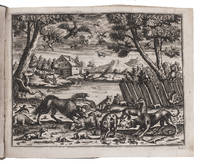
1709KAHFNW706ETUNürnberg 1709. 8vo. Johann Leonhard Buggel Contemporary but not uniform vellum sewn on 3 cords with a hollow back vol. I with dark blue edges with a manuscript title in Latin at the head of the spine: Tractatus de insectis aliisque animalibus nocivis extirpandis; vol. II with a manuscript title in German at the head of the spine: Von schadliechen Ungedierter Außrottung II. Each volume with a folding illustrated engraved title-page and a folding letterpress title-page a larger folding engraved plate in volume II woodcut tailpieces and decorated initials headpieces built up from typographic ornaments. Set in fraktur types with incidental Schwabacher and roman types. 2 volumes. 22 699 = 697 23; 38 944 48 pp. plus 2 folding letterpress title-pages and the 3 engravings. First edition rarely found complete of a detailed account of animals that are harmful to people and to their livestock the treatment of bites illnesses and poisonings they cause and instructions for their extermination. It covers animals on land in water in the air and underground. The large folding plate in vol. II shows 38 insects including 14 caterpillars and the two engraved title-pages for volumes I and II show well over 50 vol. I about 25 vol. II animals not counting a large group of ants and many birds in the distance in the former. The book also provides information about uses of the dead harmful animals for making clothes and medicines and includes many medicinal recipes. The animals discussed include wolves foxes mad dogs birds including birds of prey snakes frogs toads rats mice moles beetles caterpillars bed bugs lice fleas and other insects spiders snails and other molluscs various kinds of worms and even a dragon and basilisk the latter illustrated in the engraved title-page to volume I: it looks more cock-like than snake-like so most people would now call it a cockatrice but the two have long been used almost interchangeably. Krafft notes that dragons are rarely or never found in Germany but says one was found in Bohemia a few years ago and that they are more common in Nubia Libya and the largest ones in "Indien" probably meaning the East Indies and perhaps based on reports of the Komodo dragon.With an owner's inscription of Stefan von Clodt 1674-1737 Vicar General and Provost of Michaelsberg in Fulda on the title-page of vol. I. Somewhat browned vol. I only slightly and with an occasional small stain but still in good condition. The binding of vol. I is in very good condition with only a few small worm holes in the hinges; vol. II is rubbed and damaged lacking the lowest 3 cm of the backstrip. A very detailed source of information on animals regarded as pests from both a medical and a farming and gardening perspective.l Lindner Jagdliteratur 11.1171.01 & 11.1173.01; VD18 11041935 = 90643208 & 90643224; cf. Horn & Schenkling 12340 with 1713 ed. of vol. I. ABE CAT Agriculture hardcover
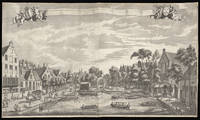
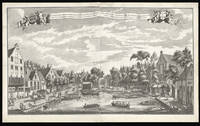
172014400Amsterdam: Leonard Schenk c1720. 550 by 960mm 21.75 by 37.75 inches. Etching with engraving on two sheets joined. A view of the Overtoom in the eighteenth century. By the eighteenth century numerous country villas had been built along the Overtoom one of the main canal's linking Amsterdam with river Schinkel as well as pleasure gardens and numerous ale houses and shops. The Overtoom gained its name from the machine for moving a boat from one body of water to another where the level varied. Rather than with the aid of a lock in other canal systems the boat would be physically pulled across the land. The machine is depicted to the right of the print consisting of two large wheels it can be seen pulling a small boat onto the canal. Proof before letters with part of title in manuscript in a contemporary hand. Leonard Schenk fl.1720-1746 engraver mapmaker and publisher in Amsterdam. Abraham Rademaker 1677 21 January 1735 was an 18th-century painter and printmaker from the Northern Netherlands. Rademaker was born in Lisse. According to the RKD he was a versatile artist who painted Italianate landscapes but is known mostly for his many cityscapes and drawings of buildings that were made into print. R.W.P. de Vries auction 1925: 288. Leonard Schenk, unknown
172014403Amsterdam: Leon Schenk Abraham Rademaker c1720. 560 by 960mm. 22 by 37.75 inches. Engraving with etching on two sheets joined. A view of the Overtoom in the eighteenth century. By the eighteenth century numerous country villas had been built along the Overtoom one of the main canal's linking Amsterdam with river Schinkel as well as pleasure gardens and numerous ale houses and shops. The Overtoom gained its name from the machine for moving a boat from one body of water to another where the level varied. Rather than with the aid of a lock in other canal systems the boat would be physically pulled across the land. The machine is depicted to the right of the print consisting of two large wheels it can be seen pulling a small boat onto the canal. Leonard Schenk fl.1720-1746 engraver mapmaker and publisher in Amsterdam. Abraham Rademaker 1677 21 January 1735 was an 18th-century painter and printmaker from the Northern Netherlands. Rademaker was born in Lisse. According to the RKD he was a versatile artist who painted Italianate landscapes but is known mostly for his many cityscapes and drawings of buildings that were made into print. R.W.P. de Vries auction 1925: 288. Leon Schenk, Abraham Rademaker, unknown
1767JC14337London: Printed by T. Jones. and Sold by T. Payne. / Printed by W. Oliver. and Sold by T. Payne and Son. et al 1767-8. First Edition. Hardcover. Very Good. Contemporary specked calf ornate gilt-stamped border on boards gilt-stamped lettering and ornament in spine compartments 5 raised bands; complete set of 9 volumes published and bound as Volume I Parts i-ii Volume II Parts i-iii Volume III Parts i-iv 8vo; pp. xlvi 384; 384; 315; 335; 540 3 blank errata; 403; 432; 462; 505 1 errata. Volumes I-II bound as the first 5 volumes of this set printed by T. Jones 1768 and with the armorial bookplate of Reverend John St. John of Farley; Volume III the last 4 volumes of this set printed by W. Oliver 1767. Several boards detached. Nevertheless a nice set of the rare first edition difficult to find in a straight run. Images available upon request. <br/><br/> Printed by T. Jones... and Sold by T. Payne... / Printed by W. Oliver... and Sold by T. Payne and Son... [et al] hardcover
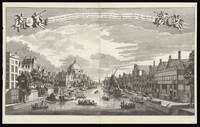
172014409Amsterdam: Leonard Schenk c1720. 558 by 950mm 22 by 37.5 inches. Engraving with etching on two sheets joined. The most prominent feature of the of this view is The Ronde Lutherse Kerk or Koepelkerk is a former Lutheran church. The church was built in neo-classical style and has a characteristic copper dome. It was built in 1671 by Dutch Golden Age architect Adriaan Dortsman who also built Museum Van Loon a magnificent private residence at the Keizersgracht. When the Lutherans left the building in 1935 it became a concert hall. In 1993 the interior and characteristic green-colored copper dome were destroyed by fire. After a renovation period of 16 months the church was fully restored. Further down the canal the imposing Roonports tower can be seen. Leonard Schenk fl.1720-1746 an Jan Schenk 1698-1752 were brothers working as engravers and publisher's in Amsterdam. Abraham Rademaker 1677 21 January 1735 was an 18th-century painter and printmaker from the Northern Netherlands. Rademaker was born in Lisse. According to the RKD he was a versatile artist who painted Italianate landscapes but is known mostly for his many cityscapes and drawings of buildings that were made into print. R.W.P. de Vries auction 1925: 284 Leonard Schenk, unknown
172390242Eugène Henry Fricx Thomam Johnson Mathieu Roguet | Bruxelles La Haye 1723-1725 | 18.5 x 24.5 cm | 3 volumes reliés en 1
175747855London.: Printed for and sold by the author near the George in Portland Street Cavendish Square; by Mr. Brotherton over against the Royal-Exchange; Mr Buckland at the Buck in Pater-Noster Row; H. Piers and Partner at the Bible and Crown in High Holborn. 1757 - 1758. Later calf-backed marbled boards spine with compartments and black morocco label bearing titles in gilt board edges tooled in gilt. 3 vols. in 1. Folio 400 x 260 mm. Two vols with Title page Preface and a Description of the Plates each followed by 60 full page copper plate engravings all plates numbered signed and with imprints dated '1757'; final vol with Title page Introduction iii - viii Description of the plates beginning 'Of the Orders in General' pp. 1 - 16 followed by 65 numbered plates. PROVENANCE: Label of Doddington Library to front pastedown. Abraham Swan's extensive two volume study of domestic architectural designs 'A Collection of Designs' bound here with his seminal work on staircases 'The British Architect . ' .The two volume 'Collection of Designs' - the second of three pattern books published by Swan a carpenter and joiner - was his attempt to provide an inexpensive pattern book of inexpensive designs. Swan made his intentions of quantity over quality clear in his Preface: 'I hope that whatever defects may be observed in any of them will be candidly excused considering what a number of designs are contained in these two volumes and that they are all of my own contriving and drawing.' 'The first volume contains 4 engravings of the staircase at Blair Castle Perthshire which Swan designed for the Duke of Atholl 1757. Two Chinese Bridges for the grounds at Blair appear in the second volume. Swan's designs belong to the 'rococo' taste popular in the mid-18th century'. Weinreb.Swan's comprehensive work 'The British Architect' - first published 1745 here in the 3rd edition - was destined to be the first architectural book published in America. The title page of the earlier edition described the author as 'Abraham Swan Carpenter' later changed to 'Abraham Swan Architect.' The work includes the following: 'I. An easier more intelligible and expeditious Method of drawing the Five Orders than has been hitherto been published by a Scale of Twelve equal Parts free from those troublesome Divisions call'd Aliquot Parts. Shewing also how to glue up their Columns and Capitals.II. Likewise Stair-Cases those most useful ornamental and necessary Parts of a Building though never before sufficiently described in any Book Ancient or Modern; shewing their most convenient Situation and the Form of their Ascending in the most grand Manner: With a great Variety of curious Ornaments whereby any Gentleman may fix on what will suit him best there being Examples of all Kinds; and necessary Directions for such Persons as are unacquainted with the Branch.III. Designs of Arches Doors and Windows.IV. A great Variety of New and Curious Chimney-Pieces in the most elegant and modern Taste.V. Corbels Shields and other beautiful Decorations.VI. Several useful and necessary Rules of Carpentry; with the Manner of Truss'd Roofs and the Nature of a splay'd circular Soffit both in a streight and circular Wall never published before. Together with Raking Cornices Groins and Angle Brackets described.' From the title-page.Across all three volumes the title page imprint has been altered Meadows and Hitch and Hawes erased and replaced in ink manuscript with 'Mr Brotherton' and 'Buckland at the Buck'.'This is one of the books that had great influence on the builders and architects of eighteenth-century America.' Fowler.Park 80 / 79 first edition 1745 but citing other eds. including the present; RIBA Early Printed Books 3220; Fowler 341 second American edition 1794; Weinreb 1:166; Millard Architectural Collection Vol. 2 82; Berlin 2285. Printed for and sold by the author, near the George in Portland Street, Cavendish Square; by Mr. Brotherton, over against the Ro hardcover
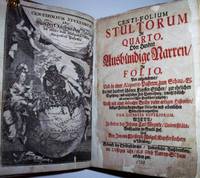
17091Vienna: Christoph Lercher 1709. First edition. Fair. Johann Christoph Weigel. The date of publication is revealed from the chronosticon given on the title page completed here with bracketed letters. Johann Ulrich Megerle July 2 1644 December 1 1709 is also known as Gautentius Hilarion Hilarius von Freudberg Theophilus Mariophilus. First edition emblem book 20.5 cm x 16cm quarto; engraved allegorical frontispiece; title-page in black and red letter; vi; 404; iv 101 leaves of full-page engravings. Johann Christoph Weigel / Kupfferstechern in Nürnberg caption legends engraved or hand-written under each image. Errors of pagination: p. 188 is missing the page number; p. 192 reads as 912; p. 307 reads as 407; p. 318 reads as 218; p. 320 reads as 230; p. 374 reads as 274; p. 376 reads as 176; p. 378 reads as 278; p. 403 reads as 401.This copy is bound in contemporary quarter vellum on light-gray marbled paper boards with a hand-lettered spine. The title-page has been repaired and reinforced with heavier paper as are some of the introductory pages and plates. Plate No. 48 is printed on very heavy paper with a handwritten legend. The other plates have engraved legends. The edges of the first nine pages have been expertly reinforced. Apart from a crack in the uppermost front hinge this binding is in fair condition. Inside the back cover is a triangular stamp reading in part ZUR AUSFUR FREIGEGEBEN. Pencil annotations inside the front cover are a title index of the emblem plates and the calculus of the chronosticon.Extremely rare complete. Old repairs noted this is a good bright tight copy. Not in Praz or Landwehr. See Gerhard Dünnhaupt F5.1.; Bertsch 52a 1; Goedeke III 240 26. See also William Sallochs Catalog 365 Sept. 1980: 100 fools with their occupations preoccupations and vanities described and illustrated by Weigel. An old booksellers catalog entry pasted down on the verso of the initial blank states: In 150 Exemplaren gedruckt als Festgabe für die Gesellschaft der Bibliophilen. The last plate is blank intentionally to provoke the reader. Christoph Lercher hardcover books
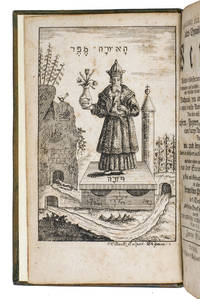
1760ABC_48609Leipzig: Lankischens Buchhandlung 1760. Modern silver- and blind-tooled greenish-brown leather with a red morocco title label lettered in silver on the spine red edges. 8vo. With an engraved frontispiece 15 numbered full-page engravings numerous woodcut illustrations in the text woodcut decorated initials and woodcut head- and tailpieces at the beginning and end of each part. 2 parts in 1 volume. Including: IDEM. Donum dei Samuelis Baruch des Juden Rabbi. Second enlarged edition of a scarce alchemical work supposedly copied from the manuscript from which Nicolas Flamel 1340-1418 gained his skill. The beautifully illustrated work discusses the basics of alchemy and the creation of the philosopher's stone. It also contains 156 rules and canons relating to the philosopher's stone which are exclusive to the second edition. The work rarely appears on the market as we have only been able to find four other copies in sales records of the past hundred years the last complete copy being offered in 1998.In the preface editor Julius Gervasius von Schwarzburg dates unknown states that the present work was transcribed from a highly sought after manuscript known as The Book of Abraham the Jew which was allegedly owned by Flamel. This manuscript was a principal source on alchemy as Abraham de Jew or Abraham Eleazar had copied the notions and illustrations in it directly from the copper tables of Tubal-Cain the first blacksmith from the Bible. However this manuscript has never been found and the current consensus is that the present work was written by Gervasius himself. Both the first 1735 and second edition of his work are relatively scarce especially complete. The beautiful alchemical plates capture the imagination and are therefore often removed and sold separately. The present copy however contains all illustrations.The leather is scratched on the back with a few green stains. The work is somewhat browned throughout with annotations in the margins of some of the leaves lacking the final blank leaf. Otherwise in very good condition.l Brüning 4844; Caillet I 31 part 1 and 32 part 2; Duveen p. 1; Ferguson I pp. 2-3; VD18 10213538 part 1; VD18 1053881X part 2; WorldCat 493643101 5043078 311551310 1046410976. Lankischens Buchhandlung, hardcover
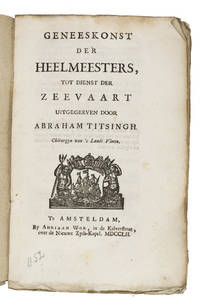
1752ABC_49307Amsterdam 1752. 8vo. Adriaan Wor Contemporary marbled wrappers with a 19th-century paper label on the spine with the author and title in manuscript. With a woodcut vignette on the title page and two decorated woodcut initials. 8 662 pp. First and only edition of a very scarce work on naval medicine. This practical handbook was written by doctors who served on Dutch war ships that sailed from the Netherlands to Curaçao. It includes numerous case studies of sick sailors on these ships during the 1740s along with commentary from Abraham Titsingh 1684-1776 who was a surgeon to the admirality. The work is very rare as it has only been recorded in four libraries and we have only been able to find one other copy in sales records.The numerous case studies presented in the work are incredibly detailed and describe cases on board the ships Middelburg Maarssen Tylingen De Beschermer and Hartekamp primarily in the years 1743 to 1750 but with references to earlier voyages. They give a fascinating picture of illnesses and their treatment during voyages to the Americas. The work covers not only the principal illnesses facing the sailors fevers scurvy diarrhoea dysentery and dropsy but also wounds surgery amputations etc. Each account of sicknesses and treatments during a voyage with names dates and details of the procedures and of the exact composition of medicines given is followed by a lengthy commentary apparently in part by Titsingh who compiled the work. The present copy comes from the library of Dutch physician and zoologist Jan van der Hoeven 1801-1868.With the bookplate of Jan van der Hoeven mounted on the front pastedown. The wrappers are damaged around the spine with some loss of material around the joints the edges of the wrappers are slightly frayed. The work is uncut with a water stain in the head margin throughout not affecting the text. Otherwise in good condition.l Cat. NHSM p. 1020; STCN 314896082 1 copy; WorldCat 907608682 4 copies. unknown
172164835Nürnberg, Christoph Weigel, 1703 (recte um 1721). Fol. Mit 101 Kupfertafeln von Caspar Luyken. 2 nn. Bll., Späterer blindgepr. Lwd.-Bd. m. etw. Rückenverg. u. goldgepr. Deckeltitel.
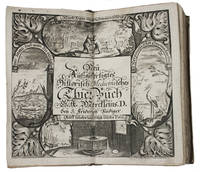
1714A5FCO31WXHODNuremberg 1714. 8vo. Johan Friedrich Rüdiger Contemporary vellum author and title in gold on spine. With a double-page engraved frontispiece engraved by Johan Lorentz Hönnig a double-page letterpress title-page printed in red and black and 95 engraved plates each depicting several animals. 26 732 72 pp. Second edition of a pre-Linnean zoological work describing in 4 parts the names appearance characteristics qualities and habitats of quadrupeds birds fishes and invertebrates together with their medicinal qualities and uses by the German physician Georg Abraham Mercklein 1644-1702. He frequently cites classical authorities in the fields of medicine and natural history like Galenus and Aristotle. Also included are some mythological animals including several kinds of unicorn p. 28 and a dragon p. 611. Ten pages are devoted to the characteristics of the silkworm pp. 678-687. At the end an index of the animals illnesses and cures.With an early owner's inscription on first flyleaf. Slightly browned some marginal thumbing or minor stains but still in very good condition. Binding slightly soiled but in good condition.l Nissen ZBI 2790; VD18 12232300; cf. Krivatsy 1772. hardcover
1728ABC_48146Amsterdam 1728. 4to. Isaak Tirion Contemporary gold-tooled red morocco with the author and title lettered in gold on the spine with an ornamental border on both boards gold-tooled board edges and turn-ins gilt edges marbled endpapers. With an engraved title page in each part and 300 numbered engraved half-page views. 2 parts in 1 volume. 76; 76 ll. Beautifully bound complete copy of Abraham Rademaker's celebrated series of 300 views of famous sights and buildings in the Netherlands and Cleve. These fine engravings include views of Amsterdam Hoorn Egmond Haarlem Rynsburg Leiden Delft with the ruins of Koningsveld Abbey and the Cartusian monastery Spangen Dordrecht Gorinchem IJsselstein Montfoort Utrecht Arnhem Nijmegen Kleve and Emmerik. The plates are predominantly dated between 1573 and 1720. However these dates do not indicate when the plate was made but correspond instead to the condition of the depicted towns and buildings in those respective years.Abraham Rademaker 1679-1735 was a versatile painter and engraver known mostly for his many views he made of villages towns churches monasteries castles and manor houses sometimes in ruins in the Netherlands and the area around Kleve. Apart from the various editions of his Kabinet he also published series of views in De zegepraalende Vecht 1719 and Spiegel van Amsterdams zomervreugd 1728.The present copy was owned by Adam Mansfieldt de Cardonnel Lawson of Cramlington Northumberland; 1746-1820 a historian from Scotland who is the author of a book similar to Rademakers Kabinet: Pituresque antiquities of Scotland 1788-1793 etched by Adam de Cardonnel. The work was then inherited by his granddaughter Lucy Anna de Cardonnel Elmsall.With the bookplates of Adam Mansfieldt de Cardonnel Lawson of Cramlington Northumberland; 1746-1820 and Lucy Anna de Cardonnel Elmsall 1828- after 1867 mounted on the front pastedown and an ownership annotation by the former on the title page "Lawson 1802". The boards are very slightly rubbed. The title page of the first part is somewhat soiled occasional mild soiling in the margins. Otherwise in very good condition.l De Buck no. 584; STCN 300275331 5 copies; cf. Tiele 892 other ed.; Wurzbach II p. 375 other ed. hardcover
17794612Neuchâtel, Chez Samuel Fauche, 1779-1783 / 1787. 18 volumes in-8, [II]ff., XLVIII-363 p. + [II]ff., IV-361 p. 1 ff. d’errata + [II]ff., II-264 p. + [II]ff., 464 p. + [II]ff., 468 p., + [II]ff., 550 p., [II]ff. d’errata + [II]ff., XXVIII-364p., [II]ff. d’errata + [II]ff., 539p. + [II]ff., 644 p. + VI-392 p. + [II]ff., 400 p. + [II]ff., 499 p., [II]ff. d’errata + [IV]ff., 319 p. + [II]ff., XXXVI-340 p. + [II]ff., XIV-496 p., [I]ff. d’errata + [II]ff., 538 p., [I]ff. d’errata + XXXII-352 p., [I]ff. d’errata + [II]ff., 376 p., [I]ff. d’errata, 88 p. (ouf c’est fini!), demi veau brun, dos lisse orné de filets et grecque dorée, étiquette de titres rouge et beige, tranches vertes.
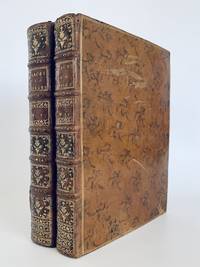
177876402à Neuchâtel: Chez Samuel Fauche 1778. Fine. Chez Samuel Fauche à Neuchâtel 1778 19 x 25 cm 2 volumes reliés First and only quarto edition the most sought-after issue due to its substantial enlargement. The original octavo edition of 1730 was thoroughly revised corrected and enriched with the latest discoveries by the scholarly editor responsible for this edition. Ruchats work was supplemented with Abraham Stanyans Account of Switzerland London 1714 together with additional texts relating to Switzerland. Illustrated with 81 engravings and maps after Merian including 2 allegorical frontispieces 68 plates depicting city views and notable sites and 11 maps. Binders instruction leaf present at the end of each volume. Contemporary full mottled tan calf. Spine with raised bands and gilt decoration. Beige morocco lettering and volume labels. Double fillet border on covers. Small loss of leather at the head of volume II. Lower joint of volume I split at the head with minor loss and split at the foot along the final compartment. Two corners rubbed. A few scratches to the upper cover of volume II. Marginal loss to plate 5 in volume I; on p. 428 plate numbered 33 loss measuring approximately 1.5 x 3 cm affecting the engraving. General rubbing. Ownership stamp of Bibliothèque Jules Barotte on the versos of certain plates and on the title-pages. Good clean and remarkably fresh copies. A celebrated and detailed geographical historical and political monograph on Switzerland. Chez Samuel Fauche hardcover
177031502AB1770. Dublin Thomas Ewing 1770 - 1790. Octavo 135 cm wide x 215 cm high. Pagination: Volume I contains Numbers I II III IV: Frontispiece-Portrait XIV 6 unnumbered pages of "Contents" 636 pages 2 pages with the contents-page misbound 2 and 24 pages on "The Brehon Laws of Ireland" to the rear of the Volume. Volume I includes three illustrations including the Large Folding-Map of Meath/ Volume II contains Numbers V VI VII VIII IX: 562 pages and 10 illustrations including the Large Folding-Plan of the City of Kilkenny / Volume III contains Numbers X XI XII: LXX 682 pages with one illustration being the Large Fold-Out-Map of "Antient Ireland" by William Beauford and VI Tables on two large sheets in the rear of the Volume containing Orthography/Names of Numbers in different Languages Names of Numbers of some of the Indians of America etc. etc. compared to the antient Irish / Volume IV contains Number XIII of Collectanea de Rebus Hibernicis and "A Vindication of the Ancient History of Ireland" by Charles Vallancey": LX 161 pages being the end of Number XIII plus Pagination for "The Vindication of the Ancient History of Ireland": Frontispiece-Map of Europe and Asia XLVIII 551 pages followed by 16 unnumbered pages of an Index for "The Ancient History of Ireland" followed by X 10 Plates mainly fold-out plates with numerous illustrations for the "Ancient History of Ireland" aslo included is a text-illustration "Inscription in the Cave of New Grange page 212. / Volume V of Collectanea de Rebus Hibernicis: 368 pages plus Hardcover / Original 19th century full-leather with gilt lettering and ornament to spine. Very good condition with only minor signs of wear. Spine of Volume Three is coming apart. From the library of Cork Antiquarian Abraham Abell with an inscription and original manuscript letter by his friend and "Brother Antiquarian" John Bennett 9 Academy St. 18th September 1841. Volume One contains Number I of the Collectanea de Rebus Hibernicis: "A Chorographical Description of the County of West - Meath - Written A.D.1682 by Sir Henry Piers of Tristernaght Baronet" This Section on West-Meath has its own 5-page Index Table of Contents for the description of West Meath listing Advantages of Draining Bogs Athlone Ballimore Battle of Rochonnell Brehon Law called "Bearded Owen's Law" Causes why the Irish were not sooner reduced by the English / Connagh worm Deel River / Degenerate English their forstering and marriages / Kilkenny-West / Landlords oppressors / Marriages of the Irish / Swimming of Cattle on the first Sunday in Harvest / Springs running east and west a proof that this country is seated on the highest ground of Ireland / Wakes described / etc. _________________________________________________________________________________________________________ Volume One contains Number II of the Collectanea de Rebus Hibernicis: I.A Letter from Sir John Davis to the Earl of Salisbury II. Original and first Institution of Corbes Erenachs and Termon-Lands. By Archbishop Ussher. III. An Account of two ancient Instruments lately discovered illustrated by a drawing. _________________________________________________________________________________________________________ Volume One contains Number III of the Collectanea de Rebus Hibernicis: "A Critico-Historical Dissertation concerning the Ancient Irish Laws or National Customs called Gavel-Kind and Thanistry or Senior Government" Part I - The Natuire and primitive Intent if these Laws Part II - A short Sketch from the Leabhar na Geeart or Book of Rights" of the Subsidies which were furnished by the Provincial Kings of Ireland etc. The whole intended as an Essay towards furnishing some Lights for future Enquiries into the Origin of the antient Irish Natioin _________________________________________________________________________________________________________ Volume One contains Number III of the Collectanea de Rebus Hibernicis: "A Critico-Historical Dissertation concerning the Laws of the ancient Irish - Part II" - containing: "The Tanistic Law of Senior Succession illustrated in an Historical and Genealogiocal Account of the Kings of Munster" - being "An Essay on the General History of Munster from the beginning of the third century to the year 1541 when Morrogh O Brien surrendered his Title of King of Munster to Henry VIII. and was created Earl of Thomond and Baron of Inchiquin" / _________________________________________________________________________________________________________ Illustrations included in Volume I: Three 3 Illustrations in total: 1. Frontispiece - Portrait of Charles Vallancey 2. The large fold-out "Map of the County of West Meath - Divided into Baronies and Parishes with the Principal Roads" 3. The small fold-out-Illustration: "Antiquities turned up by the plough in a field near Tipperary" hardcover
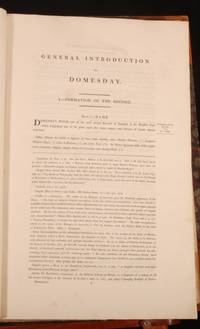
1783SET21-A-1London: Not Stated 1783; 1811-1816. Leather. Good Only. 18" by 11". None. The 1783 Domesday Book with 1816 Additional Volumes. The text of this work is in Latin with 'Introductions' in English. Whilst title pages for Volumes I and II were issued in 1816 these volumes are bound without as usual. Publication Information for Volumes I and II from the ESTC. Citation number: T97297. System Number: 006367139 Volume III includes the informative 1816 'Introduction' by Henry Ellis an English librarian. He was educated at the Mercers' School and St John's College Oxford where he acted as an assistant at the Bodleian Library. He was first appointed to a position at the British Museum in 1800 and was chief librarian from 1827 to 1856. Ellis was knighted in 1833. An important work normally commanding £3000- £4000. We have discounted these to allow for the rebinding they deserve. With two interesting ink inscriptions concerning the text including one from 'the eminent antiquarian' David Turner in Volume III. The Domesday Book is the record of the great survey of England completed in 1086 executed for William I of England otherwise known as 'William the Conqueror'. It was written in Latin although there were some vernacular words inserted for native terms with no previous Latin equivalent and the text was highly abbreviated. Abraham Farley d.1791 was a lifelong civil servant who was appointed deputy chamberlain of the Exchequer in 1736 and soon became involved with the public records at the Chapter House of Westminster Abbey. First amongst these was the Domesday Book of which Farley became custodian granting visiting antiquaries access to the Book and making transcripts for a fee. In later life Farley was to produce the first printed edition of Domesday Book. Following a Parliamentary order in 1767 Farley was appointed co-editor of the Domesday printing project in 1770 alongside Charles Morton of the British Museum. Sir Henry Ellis 1777 1869 was an English librarian. He was educated at the Mercers' School and St John's College Oxford where he acted as an assistant at the Bodleian Library. He was first appointed to a position at the British Museum in 1800 and was chief librarian from 1827 to 1856. Ellis was knighted in 1833. He edited various works on antiques and wrote an Introduction to Domesday Book. In a half calf binding with marbled paper-covered boards. Externally a trifle rubbed resulting in small loss to leather on spine volumes I and IV. Backstrip partially detached to volume II missing to volume III. Boards detached. Internally generally firmly bound. Pages bright and clean with scattered spotting. Pages occasionally age toned to edges. Nameplates and institutional labels to front pastedowns. Good Only Not Stated hardcover
1735EBS100373Erfurt: Augustinus Crusius 1735. 2nd Edition. Hardcover. Good/No Jacket. BREATHTAKING ALCHEMICAL WOODCUTS IN SOUGHT AFTER TREATISE. Claus Priesner Ambix Vol. 63 No. 1 February 2016 pp 1-27 attributes this work to the probably pseudonymous Julius Gervasius who connects the work to Nicolas Flamel. Supposedly the Werckh manuscript was written by a Rabbi Abraham Eleazar while the Donum Dei manuscript is attributed to a Rabbi Samuel Baruch who is supposed to have received his alchemical knowledge from Tubal-Cain said to be the grandson of Adam. BOOK DETAILS AND CONDITION: First Edition 16.5 X 9.5 cm. ½ leather over boards very considerable wear including losses to leather on spine: frontispiece 30 122 14 pp; 2 87 25 1; In the first part Werckh there are 6 of 7 allegorical plates and numerous in-text woodcuts one full-page on p 49 that are both allegorical and depict apparatus; In the second part Donum Dei there 8 allegorical plates the first 7 each divided into 2 figures 1-14 and the final plate is figure15. The frontispiece and the title pages are dusty but the remainder of the book internally is VG-. Missing plate in the Werckh is number 7 and is likely to have been omitted rather than removed. In this copy Figure 7 provided loose in facsimile on antiquarian paper. Gerhard Gruber Catalogue 130 Jan. 2007 has this edition lacking 2 plates. PROVENANCE: From the Arthur C. Greenberg History of Chemistry Library. Bookplate of Women s College of Frederick Maryland inside from board light library stamp on first page of text and small library pocket envelope inside rear board. REFERENCES AND RARITY: The first edition in Duveen collection absent in Neville Cole Ferguson which includes the 1760 edition. Duveen 1f; Ferchl 1; Ferguson I 3 Anm.; Caillet 31 Anm. Bolton p 980: This work is of great rarity. OCLC lists 10 copies in the world's libraries - none in the United States. Nine copies of this work sold at auction in the last century RBH. FULL TITLE: Uraltes Chymisches Werck. Welches ehedessen von dem Autore Theils in Lateinischer und Arabischer theils auch in Chaldaeischer und Syrischer Sprache geschrieben Nachmals von einem Anonymo In unsere Deutsche Mutter-Sprache übersetzt. Erfurt: Augustinus Crusius hardcover
177876402Chez Samuel Fauche | à Neuchâtel 1778 | 19 x 25 cm | 2 volumes reliés