23 962 résultats
191918085GREAT ASSOCIATION COPY THE MOON POOL Liveright Inc. 1919 some fading to the spine else a vg copy. Inscribed by the author to fellow writer "Doc" Smith thusly "For Doc Smith You Skylarks have so often taken me on the most interesting flights thought that maybe you'd like to go to the subterranean again and in the Moonpool with Jon Hetzdorf turned Russian. May your power never lesson and the hand of God and never his fist be over you. Your Sincere Admirer A. Merritt". Adorned with original drawings by the author. Liveright Inc. unknown
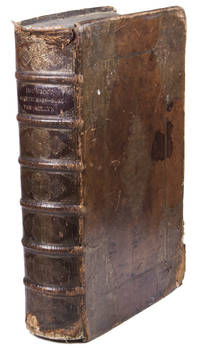
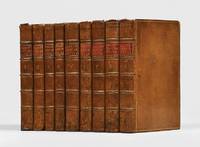
1768150964London: Printed by T. Jones & W. Oliver 1768 & 1777. The complete set of an influential philosophical work First edition a complete set of Tucker's magnum opus which outlined a vast and idiosyncratic philosophical system and which had a noted influence on his philosophical contemporaries. The set pairs the five volumes he published in 1768 with the four-volume continuation posthumously published in 1777 uniformly bound in contemporary calf and very scarce thus. "Although an occasionally eccentric and digressive text The Light of Nature Pursued enjoyed a high reputation from its first appearance. In the introduction to his Moral and Political Philosophy 1785 William Paley emphasized his deep indebtedness to Tucker in expounding his ethical theory. Paley considered Tucker to be a very original thinker. His work was also highly praised by Sir James MacIntosh who had used his ideas in his lectures on ethics. Mildmay had looked to MacIntosh to provide an introduction to his edition of the work but MacIntosh had been too busy to oblige. Hazlitt produced an abridged edition in 1807. Tucker's speculations also had some influence on Malthus whose family were resident in Surrey. Tucker's style is direct conversational and full of deliberately familiar metaphors and analogies. He was very much an amateur metaphysician and The Light of Nature Pursued is noticeably unsystematic and occasionally rambling in tone. His theory of consciousness and knowledge owes a great deal to John Locke though his speculations about the nervous system and the brain are closer to those of David Hartley whom he nevertheless disliked and whose theories he criticized" ODNB. The first five volumes were published under Tucker's pseudonym of "Edward Search" but his daughter Judith discarded this pseudonym when arranging the posthumous publication of the latter four volumes. Together 9 vols octavo 212 x 130 mm. Contemporary calf red morocco labels red speckled edges. Book label of bookseller and bibliographer John Stephens 1948-2006. Some slight wear around extremities occasional light foxing or worming but contents otherwise fresh; a nice set. ESTC T109651 & T153498. unknown
18345037<p>Half brown morocco; ruled raised bands marbled boards. Mouradgea d'Ohsson was a Swedish historian and diplomat of Armenian descent. This important work is a large expansion of his 1824 publication which was the first serious study of Genghis Khan. Kenneth Meyer Setton A History of the Crusades notes "among the general histories of the Mongols d'Ohsson remains unequaled. Avowedly or tacitly most later works rely on it." Two folding genealogical charts; large 1824 folding map of Asia in the thirteenth century to rear of volume four. Previous owner's bookplates removed from front pastedowns. A nice wide-margined set many pages yet uncut in a sound period binding.; lxviii452; 651; 6241; 774.; 8vo 22 x 15 cm; All shipments through USPS insured Priority Mail.</p> Freres van Cleff hardcover
1819805K1London: A. J. Valpy 1819-1830. Hardback. Good. 10" by 7". None. A scarce 136 volume set of the Regent's Edition 'Delphin Classics' based off of a published series used to educate le Grand Dauphin Louis with works by notable thinkers such as Virgil Horace and Cicero. An extensive run of the scarce 'Delphin Classics' very scarce to see a large run of the work like this.This set contains volumes I-CVIII CXIII-CXLI published between 1819 and 1830 a total of 136 volumes.The Regent's Edition of this work.In Latin.'The Delphin Classics' was an extensive series of the Latin classics which reached to 182 volumes this set containing 136 of the volumes.The series printed the prominent works of writers such as Virgil Sallust Pliny the Elder Ovid Horace Cicero and Caesar often printing their complete works in the original Latin.Edited by George Dyer the series was based off a monumental publication of the Latin classics that had been published for the education of le Grand Dauphin Louis the heir to Louis XIV to assist in his education. In fact the title 'Delphin' translates to 'Dauphin'. Le Grand Dauphin was the eldest son of Louis XIV but predeceased him and thus never became the king his grandson succeeding to the throne as Louis XV after the death of Louis XIV.Working off those original Dauphin editions Dyer and the publisher Abraham John Valpy supplemented the texts with the best variorum editions and literary notes from important late eighteenth century editions. These include the Variorum Classics and the Zweibrucken editions.This Georgian edition reached around six hundred subscribers and saw great success. Publisher's adverts to the front of volumes XII XXV XXVII XL and CXXVIII.Subscriber's lists bound in to volumes I and XXXII.With remarks on 'The Review Relative to Stephens' Greek Thesaurus in the Quarterly review No. 48 bound in with vol. XXXI. The Classical Journal No. XLIII bound into the front of no. XX. With 'Delphin Classics with the Variorum Notes' sheet bound in with no. X XXI and LXIV. In the original publisher's paper covered boards. Externally generally sound with shelf wear and bumping to the head and tail of the spine and extremities minor chipping to the extremities of the boards and rubbing to the occasional volume a touch of edge wear; general light soiling to the boards and age toning to the spine. Tears and losses to back strips of XLIV LXXXI XLVII LXXIII and XCIII with back strips of volumes CXLI and LIVII absent. Faint handling mark to the front board of nos. I IV XI XXXIV XXIX XXXII LVI LVII LXIII and LXIV. Minor staining mark to the front board of no. XXXIV. Small library stamps to the front board of the majority of volumes. A little loss to the paper of the front board of volume XLVII LIV and LXXV. Joints to nos. VII XI XXII XXX XXXIII XCIV LXXI and CXXXI starting. Front joint of Volume XI is starting with boards held by cords only. Front joint of volumes CXXXV CXXXIII CXXXVI XLIX starting with boards holding firm. Rear joint is strained to CXIX. Rear joint is starting to Volumes III VI XVIII XXIV XL CXIII and CXV. Rear joint to no. LXXXV strained held by cords only. Rear joint of no. XIX has failed with board held by the front joint. Front joint no. IX XL XXX XXXIX LXXXIV LXXV and CXIX are starting. Front joint of no. LXXXVI cracked binding held by endpapers. Front joints to CXVII CXIII CXX and CXVI have failed front boards are detached but present. CI with cracked joints front and rear board loose but present light soiling to the rear of the text block. Back strip and front board of volume XLVII detached but present both boards and back strip of volumes XCIX LXXXII and LII detached but present. Boards of volumes LIVII and CXXXIX detached. Boards of volumes CXLI and CXXXII loosely held. Minor chipping to the spine of no. II V XIX XI XVII XXXVII XXIX XXXVI LXV LXXXIV LXXXV CI CVI and CVII. Loss to the head and tail of the spine of no. XIX XXI and XXIX. Loss to head of the spine on no. I II IV XIX CXVII CXVIII and CXX and paper to spine is lifting exposing interior of the spine. Tearing to the spines on no. XXV and XL. A few ink marks to the spine of IV and VII. Spine is lifting to XI CXIII CXXI and CXIX. General bumping particularly noticeable to the extremities of XVI XCV CXXX. Volume CXXIV has the odd mark to the front board. Volume CXXIII has some slight loss to the paper of the front board front joint is starting a little to the tail. Volumes LXIX LXVII have slight loss to the paper of the front board. Tidemarks and loss to the front board of volume XCV. Loss to the head of the spine of volumes XIII CXXX XXVII LXXXVI and LXVIII. Small perforation to the tail of the spine of LXXIV. Loss to the tail of the spine of XIV. Loss to the paper of the rear board to volumes LXXXVII and CXXVI. Minor loss to the tail of the spine of no. XXXII minor chipping to the joints holding firm. Backstrip no. LIX laid down. Backstrip is lifting to the tail of volume XCII CXXIV. Backstrip is loose to volumes XXVIII XC. Head of the backstrip of volume XVII is detached but present with the remainder of the backstrip held at the rear board. Backstrips of volumes LXX LXXI LXXXIX are loose. Backstrip lifting to the head of volume LXVII. Front and rear hinges starting to volumes XCIV CXXXVII with boards holding firm. Rear hinge to no. XXV is strained. Rear hinge to II III V VI XXIV starting. Hinges to no. XXX and CXXI have failed and boards are hanging by cords only. Front hinges to no. VIII and XXXIII are starting. Front hinges to no. VII and X are tender. Front hinge of No III XI are weak. Rear hinge to no. III LI and CXV is attached by cords only and may detach with further handling. Hinges to no. XXXIX and CXIV have failed; boards and spine are detached but present. Front hinge to CXVIII has failed front board is detached but present. Rear hinge is held by cords only. Front and rear hinge of volume XCI strained with boards tenderly held. Front hinge strained to volume LXXXVIII and held by two cords only. Front hinge has failed to volumes XC XCIII LXXXIX CXXVII; front boards are loose but present. Textblock is held to the rear board of XC by a cord only. Front board is held by cords only to volume XV XXVIII. Rear hinge starting to LXXXVIII . Rear hinge has failed to XIV XVI XVII with rear boards held by a cord only. Front and rear hinges failed to volumes LXXXIX XCII with rear board held by two cords only paper in the case of XCII. Rear joint starting to CXXVI and LXXXVI. Rear joint starting at the tail of LXVI. Front joint starting to volume LXX and LXVII. Front joint starting at the tail of volume CXII and LXXIII. Front endpaper detached to XCIII. Front free-endpaper of no. CXIV is torn. Tidemark to the head of the front pastedown in no. XL and to rear pastedown of no. XI. Small bookseller sticker to the front pastedown of volumes XVI XVII XIX XX XXII XXIV XXV XXVI XXVII XXVIII XXX XXXII XXXIII XXXIV XXXVI XXXVIII XXXIX LXIII CVIII CXXVIIII and CXXIX. Internally generally firmly bound though some volumes are tender. Binding tender to p. 497 no. LVI holding firm; p. 769 no. LXXXV held by three cords only; p. 3049 of no. CII holding firm; and to p. 5640 no. CVI held by two cords only; p. 5001 no. CV; binding of volume CXLI tender. Binding is tender to LXXXVI noticeably at pages 928 and 929 XCV CXII and LXXII. Binding is tender to Volumes XV XXVIII XIV XVI XVII. Some light spotting or handling marks to the odd leaf particularly to the first and last few otherwise the pages are generally bright and clean throughout. Some leaves unopened. Large mark to top corner of page 1729 of no. XIX. Half title and title page bound in to the rear of no. XXXVII. Half title and title page to vol. I II III IV and V 'Quinti Curtii Rufi' bound in to no. LXXIX. Half title and title page for vols. II - IV of 'P. Papinii Santi' as well as for vol. III 'L. Annaei Flori' and vol. II 'Boethi' vol. III 'Justini' bound in to no. LXIV. Title page to vol. I 'Pub. Terentii Afri' and half titles and title pages for vol. II-IV of 'Pub. Terentii Afri' bound in to no. LXI. Half title and title page for vol. I-III 'D. Magni Ausonii' to no. LVII. With remarks on 'The Review Relative to Stephens' Greek Thesaurus in the Quarterly review No. 48 bound in with vol. XXXI. Subscribers leaflet bound in with no. XXXII. Insert of fifteen pages of the front of No. I with list of 'Subscribers' Names Already Received to the New and Corrected Edition of the Delphin Classics; with the Variorum Notes'. The Classical Journal No. XLIII bound into the front of no. XX. With 'Delphin Classics with the Variorum Notes' sheet bound in with no. X XXI and LXIV. Publisher's advert bound into the front of no. XXV and XL. Publisher's adverts to the front of volumes XII XXVII and CXXVIIII. Good A. J. Valpy hardcover
167376SED10JGA06The Hague 1673. 4to. Jan and Daniel Steucker Contemporary vellum with the gold-stamped and crowned initials "E.F.V.D" on the front board. With 10 scenes on the horrors of war on 8 folding engraved plates ca. 31 x 20 cm by Romeyn de Hooghe. 1 1 blank 202 pp. First edition of a famous Dutch history book vividly describing as well as depicting the cruelties of war committed by the French army of Louis XVI in The Netherlands in the years 1672 and 1673. The illustrations also rank among the best masterpieces of Baroque book-illustration. By their passionate denunciation of the horrors of war Romeyn de Hooghe's illustrations stand comparison with Goya's Desastres de la Guerra. Thieme & Becker calls the artist "the most important and fertile master of the second half of the 17th century in Holland". And Furstenberg judged the present print-series "One of the few and too-little known masterpieces of the period The Book Collector 1960 p. 432.''The text includes a detailed account of the cruelties committed by the French army of Louis XIV in the Dutch villages of Bodegraven and Swammerdam. The work was published anonymously because the author Abraham de Wicqefort 1598-1682 a diplomat and politician was well-known at Paris and the French court. He also wrote an excellent manual for ambassadors: "L'Ambassadeur ses fonctions" published at The Hague in 1682. The present work became popular in The Netherlands and was several times republished in Dutch with the plates reduced.Back hinge loosening. Fine large paper copy with contemporary manuscript owner's entry on the title page. Otherwise in good condition.l Hofer Baroque Book Ill. plate 140; Hollstein Dutch & Flemish IX pp. 90-96 only 7 plates; Landwehr De Hooghe Book Illustrator 30; Nierop Grabowsky etc. Romeyn de Hooghe 1673.19 p. 263; STCN 851219519; Thieme & Becker XVII p. 458; Willems 1874. hardcover
162451428Köln Ioannis Gymnici Antonius Boetzer 1624 a. 1621-1640. Folio. 40 x 26 cm. Bound in 8 thick uniform contemporary full pigskin bindings over wooden boards. Raised bands and richly blind-tooled boards. Title labels with gilt lettering. Clasps missing. Spines a bit rubbed. Wear to some spine-ends. Some upper compartments with nicks one volume having a tear in leather at upper compartment. One volume with a small loss of leather to upper compartement. With engraved title-page engraved portrait of Baronius engraved portrait of pope Urban VII. More than 10.000 pp. Printed in double-columns. In general internally fine. <br/><br/><em>Baronius's monumental work with its continuation by Bzovius up to the year 1565 hailed by Roman Catholic writers as the greatest history of the church ever written and Baronius hailed as the "father of ecclestical history" 1-12 dealt with Anno 1-1198 and volume13 -20 Anno 1198-1565."The Annales were first published between 1588 and 1607. This work functioned as an official response to the Lutheran Historia Ecclesiae Christi History of the Church of Christ. In that work the Magdeburg theologians surveyed the history of the Christian church in order to demonstrate how the Catholic Church represented the Antichrist and had deviated from the beliefs and practices of the early church. In turn the Annales fully supported the claims of the papacy to lead the unique true church."Before Baronius was appointed Librarian of the Vatican in 1597 he had access to material and sources in its archives that were previously unpublished or unused. He used these in the development of his work. Accordingly the documentation in Annales Ecclesiastici is considered by most as extremely useful and complete. Lord Acton called it "the greatest history of the Church ever written"."Graesse I 296. - Brunet I 662-631. </em> hardcover
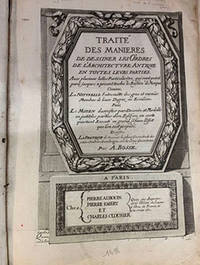
51-6927Paris: Chez P. Aubouin P. Emery et C. Clousier Paris 1688. Folio. 26.5 x 38cm. Contemporary calf covers with new goatskin spine and endpapers by the artisan binder Sasha Mosalov. Part I: 44 leaves title page ttrmmed at bottom; Part II: 11 leaves; Part III: 23 leaves.OCLC Number / Unique Identifier:861558893 microfiche; Fowler Architectural collection pp. 46-53; Brunet I 1127; BAL/RIBA 341 337 340; Berlin Kat. 2378 2379 and 3858; Cicognara 444-446; .3 parties en un vol. in-folio veau du temps dos à nerfs orné. Frontispice titre gravé XLIV ff. de planches et de texte ; titre-frontispice de la 2e partie ff. A à G compris puis ff. S T V soit 10 ff. de texte et planches ; titre de la 3e partie avec encadrement 2 ff. de texte 20 ff. de planches. petites mouillures taches et rousseurs à certains ff. Première et troisième partie complètes. Deuxième partie incomplète : manque la planche sur double page et 10 ff. gravés. Rare nouvelle édition des trois principaux ouvrages théoriques d'architecture d'Abraham Bosse entièrement dessinés et gravés en taille-douce par lui-même. .3 parts in one vol. in-folio contemporary calf decorated ribbed spine. Frontispiece engraved title XLIV ff. of plates and text; title-frontispiece of the 2nd part ff. A to G inclusive then ff. S T V i.e. 10 ff. of text and plates; title of the 3rd part with frame 2 ff. of text 20 ff. of plates. Small water stains stains and foxing on some ff. First and third parts complete. Second part incomplete: missing the double-page plate and 10 engraved ff. Rare new edition of the three main theoretical works on architecture by Abraham Bosse entirely drawn and engraved in intaglio by himself. Paris: Chez P. Aubouin, P. Emery et C. Clousier, Paris, 1688 unknown
186369520Washington D.C.: War Department 1863. CIVIL WAR. War Department General Orders 1863. Washington D.C.: War Department 1863.<br> <br> Full Description:<br> <br> LINCOLN Abraham. CIVIL WAR. Emancipation Proclamation War Department General Orders 1863. Washington D.C.: War Department 1863.<br> <br> The first War Department printing General Orders #1 Jan 2 1863 and fifth overall printing of the final Emancipation Proclamation. The 4 page pamphlet bound together with a nearly complete run of War Department general orders for the year 1863. Two octavo volumes 6 7/8 x 4 5/8 inches; 174 x 119 mm. Volume I comprising General Orders of the War Department Adjutant General's Office Numbers 1-221 2 January 1863 to 16 July 1863 and Volume II comprising Numbers 222-400 16 July 1863 to 28 December 1863. Nearly complete only lacking numbers 55 63 116-119 148 in volume I and 274 352 and 381 in volume II. With 5 copies of number 149 and and 3 copies of number 240.<br> <br> Contemporary half calf over marbled boards. Spine lettered in gilt. All edges speckled brown. Hinges repaired. Some rubbing to board edges. Previous owner's contemporary ink signature Bvt. Col. E.J. Wells on front paste down of each volume. Numerous annotations in the same old ink throughout generally noting when the order was received and dated 1863. Some glue marks to the General Order #1 not affecting text. A small tear to last leaf of text in volume I with no loss. Overall a very good copy.<br> <br> In addition to the very important first War department printing of the Emancipation Proclamation these volumes contain several other very important and interesting General Orders from the War Department as well as President Abraham Lincoln in relation to the military during this year in the Civil War.<br> <br> Notably:<br> <br> No. 100 April 24 "Instructions for the Government of Armies of the United States in the Field." "commonly known as the 'Lieber Code' after its main author Francis Franz Lieber. The Lieber Code set out rules of conduct during hostilities for Union soldiers throughout the U.S. Civil War. Even today it remains the basis of most regulations of the laws of war for the United States. The Lieber Code consists of 157 provisions that deal with a wide range of legal issues that must be considered in armed conflict. It contains general principles but also very detailed rules. Among the issues addressed are whether armed force is justified by military necessity the principle of humanity the distinction between combatants and civilians POW status retaliation and permissible methods and means of warfare." LOC"<br> <br> No. 143 May 22 the establishment of the United States Colored Troops. This authorized the establishment of a bureau regulating the recruitment training and organization of the U.S. Army's first regiments composed entirely of African-American soldiers.<br> <br> Numerous court cases are documented including #17- The sentenced hanging death of a "colored man" for "attempted rape". #346- The trial of George Woolfolk for "Being secretly within lines of the US forces as the same time belonging to the so-called Confederate Army." He was sentenced to be shot to death. And #396- The trial brought by Colonel John Gault against Dr. Aaron James for "Being the captain of a band of guerillas or marauders and shooting at US soldiers." He was sentenced to death but the President disapproved the sentence and directed him to be released.<br> <br> A number of orders of Military discharges both honorable and dishonorable as well as military promotions. #337 announces "Major General U.S. Grant U.S. Army is placed in command of the Military Division of the Mississippi Headquarters in the field." #349 announces "Major General William T. Sherman is appointed to the command of the Department and Army of the Tennessee Headquarters in the field." #194 is the appointment of Major General George Meade as commander of the Army of the Potomac who would defeat General Robert E. Lee at Gettysburg only days later. And #398 honors Ulysses S. Grant for his Mississippi River campaign and presents him a gold medal.<br> <br> Numerous obituaries including #71 which announces the death of Major General E.V. Sumner who fell ill and died on his way to take command of the Department of the Missouri and directs the ways that Department should give him military honors.<br> <br> Important presidential proclamations including #58- Calling to all soldiers who were "absent without leave" urging them to return to their regiments and would not face punishment beside loss of wages for time missed. #252- Orders regarding the treatment of prisoners of war stating that 'if the enemy shall sell or enslave anyone because of his color the offence shall be punished by retaliation upon the enemy's prisoners in our possession'. "President Abraham Lincoln issued an 'eye-for-eye' order warning the Confederacy that Union soldiers would shoot a rebel prisoner for every Black prisoner shot. It also would condemn a rebel prisoner to a life of hard labor for every Black prisoner sold into slavery. AA Registry. #315- Lincoln's suspension of the "writ of habeas corpus." "The doctrine of habeas corpus is the right of any person under arrest to appear in person before the court to ensure that they have not been falsely accused. Lincoln's suspension of the "writ of habeas corpus" was one of the most controversial acts of his administrations. Lincoln defended himself against charges that his administration had subverted the Constitution however arguing that acts that might be illegal in peacetime might be necessary "in cases of rebellion" when the nation's survival was at stake." The Gilder Lehrman Institute of American History. #340- Proclamation by the President calling for three hundred thousand volunteers. "Whereas the term of service of a part of the volunteer forces of the United States will expire during the coming year; and Whereas in addition to the men raised by the present draft it is deemed expedient to call out 300000 volunteers to serve for three years or the war not however. exceeding three years."<br> <br> And numerous other General Orders pertaining to soldiers and the war effort including #35- A list of items that could be sold to soliders by sutlers. #40- The establishment of a Volunteer force for Kentucky. #163- "A resolution to encourage the enlistments in the Regular Army and Volunteer forces." #323- which authorized each enlisted cook "two under-cooks of African descent who shall receive for their full compensation ten dollars per month and one ration per day." #351- This discusses the governance of "The Employment of women nurses in the U.S. General Hospitals." and #364 which discusses the cos of clothing and camp for the U.S. Army and includes a folding chart.<br> <br> Eberstadt 12. Grolier 100 American 71. Streeter 1751.<br> <br> HBS 69520.<br> <br> $7500. War Department unknown
2091202133212055Abraham Ortelius N.A. Soft Cover. Fine. Number of books: 1 Abraham Ortelius paperback
1768EXP4-B-3London: T. Jones 1768-1778. Leather. Fair. 8.5" by 5". None. A set of five very scarce volumes by Abraham Tucker under the pen name of Edward Search in leather binding. Very important texts and all contemporary editions are extremely rare. As these were published separately they are usually seen individually and a five volume collection is highly unusal. The original work was seven volumes broken in to parts. Not special externally and would really benefit from the attentions of a good binder but we keep them here are entirely original. Bound and marked as an eight volume set this collection comprises Volumes III Volume II Part I- 1768 Volume V Volume II part III-1768 Volume VI Volume III Part I- 1778 Volume VI IV Part II- 1777 and Volume VIII Volume V Part III- 1777 The volumes are major works of eighteenth century philosophy and theology anticipating utilitarianism and holding that "every man's satisfaction" is the ultimate end of any action. Contains the bookplate of one George Phillips to the pastedown of volume III. In calf binding with gilt detailing. Externally there is wear to the boards joints extremities and backstrips with tenderness to hinges. The front board is detached but present to the sixth volume and missing to the eighth. Internally the pages are firmly bound but are somewhat spotted and age-toned with some creasing. Overall: FAIR due to binding though internally presentable. Fair T. Jones hardcover
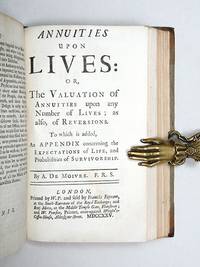
1725153270London: Printed by W. P. and sold by Francis Fayram Benj. Motte W. Pearson 1725. Life expectancy as probability First edition of a founding work of actuarial science de Moivre's influential study of annuities based upon the mortality statistics gathered in the 1690s by Edmund Halley. De Moivre was perhaps the first to develop probability theory extensively and the first to use probability theory to write a comprehensive work on life contingencies. In Annuities upon Lives de Moivre formulated that among a body of persons over a certain age the successive annual decreases by death are nearly equal. He applied the theory of probability to the systematic investigation of problems concerning annuities upon lives. "De Moivre's contribution to annuities lies not in his evaluation of the demographic facts then known but on his derivation of formulas for annuities based on a postulated law of mortality and constant rates on money. Here one finds the treatment of joint annuities on several lives the inheritance of annuities problems about the fair division of the costs of a tontine and other contracts in which both age and interest on capital are relevant. This mathematics became a standard part of all subsequent commercial applications in England" Ian Hacking in the Dictionary of Scientific Biography. The work is bound with five others: i YORKE Charles. Some considerations on the law of forfeiture for high treason. The third edition further corrected and enlarged. London: J. and J. Rivington 1748. Yorke's principal legal work first published in 1745 when his father was Lord Chancellor and is a defence of one of his father's judgments against the Young Pretender. ii STORY Joseph. An essay concerning the nature of the priesthood. Dublin: George Faulkner 1749. First edition. iii ROBINSON Christopher. Considerations on the late bill for payment of the remainder of the national debt in which the occasion of inserting the clause relative to His Majesty's consent and The Arguments in Support of such Right in the Crown are impartially stated. Dublin: n.p 1754. First Dublin edition published in London the same year. iv ROBINSON Christopher. A short essay on the publick judgments of the Romans. Dublin: n.p 1739. First edition. v Anonymous. Considerations on the case of the bakers in Dublin. Dublin: Printed for George and Alexander Ewing 1757. Later edition first published 1752. Six works bound in a single vol. octavo 197 x 120 mm. Contemporary half calf spine lettered in gilt paper sides. Contemporary manuscript contents list to front pastedown early bookplate of Wolfe De Forenaughts to same crossed out early ownership inscription to title page of the first pamphlet. Slight rubbing superficial splits along joints contents fresh. A very good copy. ESTC T33056; Garrison & Morton 1690; Hanson 3492; Institute of Actuaries p. 39; Kress 3595; Norman 1530; McCulloch p. 250; not in Goldsmiths'. unknown
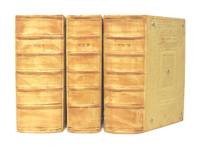
168110510Wittenberg Christian Schrödtern 1681-1682. 3 volumes 52 1189 2378 columns 28 601 1202 columns 1 32 524 1048 columns 28 688 1376 columns 1 48 602 1204 columns 26 751 1502 columns 96 1 p. Blind-stamped Leather with 5 raised bands each board equipped with 5 brass studs Folio Facsimile Edition of the famous Bach Bible in 3 volumes all kept in a perfectly fitting wooden case decorated with gilt. The set contains a true and complete reprint of Bach's Bible being a German Bible with extensive commentaries by Abraham Calovius founded on the writings of Martin Luther. This is the first complete facsimile-edition of Bach's Bible published by the Dutch publisher Uitgeverij Van Wijnen after the original being preserved in Concordia Seminary Library St. Louis. Each volume contains Bach's handwritten monogram on the title page and the set contains a total of 348 additions by Bach. Among which many underlined passages -both in red and black ink- various corrections of typographical and grammatical errors but most importantly his comments in the margins. A unique glimpse into Bach's personal beliefs and how he understood his vocation. Wittenberg, Christian Schrödtern hardcover
16193941Dordrecht & Amsterdam 1619. Folio. Isaack Jansz. Canin & Jan Evertsz. Cloppenburgh 17th- or 18th-century gold-tooled calf sewn on 6 supports with corresponding raised bands on the spine with a red morocco title label lettered in gold in the second compartment. The boards show a very detailed floral patterned lozenge center-piece within a triple fillet frame with large highly detailed corner-pieces with remnants of ties. With an engraved title-page and 106 very vivid woodcut illustrations of tortured and/or executed martyrs several repeats the text alternately set in roman and gothic type. 14 632 46 ll. First edition of the first official Dutch Reformed Protestant martyrologium composed by Abraham Mellinus ca. 1580-1622. Born at Vlissingen Mellinus studied at Leyden and became Minister at St. Anthonispolder and Cellartshoek. The present "first" volume of his "History of Christian Martyrs" runs to 1520 it is the only volume ever published. It was dedicated by the author to Prince Maurits of Orange and to the Synode of Dordrecht who both rewarded the author with a good sum of money. The work showed great learning and was at the time much praised. The author planned to write a second volume but he died before this was really started. In 1622 Balthasar Lydius Minister at Dordrecht then was ordered to write the second volume but he also died so a second volume never appeared. Mellinus' Martyrologium especially enraged the Roman Catholics.With the bookplate of Paul Hildebrandt mounted on the front paste-down and an ownership stamp and inscription of "Ds. H.C. Hopkins militêre kamp Wynberg K. 31. 8. 1965." on the recto of the first flyleaf. The binding shows clear signs of wear the leather around the corners of the boards is somewhat damaged showing the paperboard beneath some loss of material at the head and foot of the spine. Internally fine and clean except for some very slight thumbing at the start of the work and a tear in one leaf. Otherwise in good condition.l Bibl. Belg. M. 317; De la Rue p. 225; De Wind p. 502; Knuttel Ned. Bibliogr. Kerkgesch. p. 215; NNBW VII col. 858; STCN 83335423X 8 copies; USTC 1028377 9 copies incl. 7 also in STCN. hardcover
186425614<p>The second in a series of four racist political cartoons published in 1864 by Bromley & Company which was closely affiliated with the Copperhead New York <i>World</i> newspaper. These prints sought to undermine Abraham Lincoln's chances for reelection by branding him as a "miscegenationist" and playing on white fears of "race-mixing." The cartoon scene pictures several interracial couples enjoying a day at the park eating ice cream discussing wedding plans and a woman's upcoming lecture. Two African American families have white employees a carriage driver and footmen and a babysitter.</p><p>The only other example traced at auction brought $7800 in 2010.</p> <b>ABRAHAM LINCOLN. RACISM.</b>Print. "Miscegenation or the Millennium of Abolitionism." Political Cartoon. New York: Bromley & Co. 1864. 1 p. 20¾ x 13â… in.<p><br /></p><p>American politics had long played on fears of sexual relationships between races. A powerful new word for "race-mixing" was coined in an anonymous December 1863 pamphlet entitled <i>Miscegenation: The Theory of the Blending of the Races Applied to the American White Man and Negro</i> published in New York. Purporting to advocate the virtues of the "blending of the white and black races on this continent" it was a literary forgery prepared by <i>The World</i> managing editor David Goodman Croly and reporter George Wakeman. The authors were unsuccessful in their attempt to trick President Lincoln into endorsing the work.</p><p>At the far left of the image Abraham Lincoln declares "<i>I shall be proud to number among my intimate friends any member of the Squash family especially the little Squashes.</i>" The African American woman to whom he is speaking replies "<i>I'se 'quainted wid Missus Linkum I is washed far her 'fore de hebenly Miscegenation times was cum. Dont do nuffin now but gallevant 'round wid de white gem'men! he-ah! he-ah! he-ah!</i>"</p><p>Senator Charles Sumner says "<i>Mr. President! Allow me the honor of introducing my very dear friend Miss Dinah Arabella Aramintha Squash.</i>" A white carriage driver complains in the background "<i>Gla-a-ang there 240t! White driver white footmen niggers inside my heys! I wanted a situation when I took this one</i>" while a black man in the carriage tells his companion "<i>Phillis de_ah dars Sumner. We must not cut him if he is walking.</i>" A black woman at a table tells a white man with her "<i>Ah! Horace its-its-its-bully 'specially de cream</i>" and he replies "<i>Ah! my dear Miss Snowball we have at last reached our political and social Paradise. Isn't it extatic</i>"</p><p>To the right are two couples embracing each a white woman and an African American man. The first white women tells her partner "<i>Oh! You dear creature. I am so agitated! Go and ask Pa</i>" to which he replies "<i>Lubly Julia Anna name de day when Brodder Beecher shall make us one!</i>" The second white woman says "<i>Adolphus now you'll be sure to come to my lecture to morrow night won't you</i>" to which he answers "<i>I'll be there Honey on de front seat sure!</i>" In the background are various immigrant minorities viewing the scene. One exclaims "<i>Most hextwadinary! Aw neva witnessed the like in all me life if I did dem me!</i>" and another adds "<i>Mine Got vat a guntry vat a beebles!</i>" An Irish girl complains "<i>And is it to drag nagur babies that I left old Ireland Bad luck to me.</i>"</p><p>Manton Marble the editor of <i>The World</i> collaborated with printmaker Bromley & Company to issue a series of four anti-Lincoln "Political Caricatures." The present example was the No. 2 in that series. No. 1 was "The Grave of the Union or Major Jack Downing's Dream"; No. 3 "The Abolition Catastrophe Or the November Smash-up"; and No. 4 "The Miscegenation Ball."</p><p>Republicans responded by trying to turn the "miscegenation" charge against the Democrats. A Republican print "The Political "Siamese" Twins: The Offspring of Chicago Miscegenation" pictures McClellan and Pendleton joined together despite their very different ideas on ending the war.</p><p>Although Abraham Lincoln won New York states' electoral votes in 1860 Stephen Douglas had carried New York City and its environs. Financial elites fearing that civil war would ruin business and recent immigrants fearing competition with free black labor supported Douglas. Lincoln's unpopularity in New York City during the Civil War was a factor in the deadly 1863 Draft Riots.</p><p>In 1864 Lincoln again won the states' electoral votes while New York City favored his Democratic opponent McClellan. In fact Lincoln's majority dropped from 50136 votes in 1860 to only 7373 votes in 1864 with approximately 50000 more total votes cast than in 1860.</p><p>Bromley and Company continued to sell the caricatures after the election as this January 1865 advertisement from an Ohio newspaper makes clear. Another advertisement assured purchasers that the set of four prints available for $1 were "sent on wooden rollers to insure safe carriage."</p><p><b><i>The World</i></b> 1860-1931 a daily independent newspaper was published in New York City. Alexander Cummings founded it as a religious Republican outlet in 1860. August Belmont and others purchased it in 1862 changing the editorial focus. With editor Manton Marble 1834-1917 <i>The World</i> soon became the country's leading Democratic newspaper. In 1864 Union authorities shut down <i>The World</i>and another paper for three days after they published forged documents purportedly written by Lincoln that were really part of a hoax to manipulate the price of gold. The paper actively supported George B. McClellan against Lincoln in 1864.</p><p><b>Condition</b></p><p>Fine for exhibit despite flaws. Cropped with loss of "Political Caricature No. 2" from top edge and part of printed pricing information from bottom edge publisher's name rubbed out from the copyright statement lacking ½" from lower left corners a few short tape repairs by the edges a 2" closed tear through the second dialogue bubble along the top edge and a 3" closed tear parallel to the right edge. Mount remnants on verso.</p>
169555262Amsterdam: Be-veit ha-meshutafim Asher Anshil ben Eliezer ve-Yisakhar Ber ben Avraham Eliezer/ Moses Wiesel 1695. First edition. Hardcover. fair. Small folio 29 by 18.5 cm. Collation: aleph-vav4 zayin2 = 26 numbered leaves. Additional engraved title page engraved folding map at rear; main title with woodcut vignette; 14 half-page engraved illustrations in the text. Contemporary quarter calf over dark brown pastepaper boards skilfully rebacked. Images of Moses and Aaron at engraved title excised the seven small engraved vignettes along with letterpress text of engraved title and imprint mounted on old paper. Old marginal repairs at main title resulting in slight loss of initial letters along right margin and several leaves; slight strictly marginal worming and occasional tears. Stained throughout sometimes heavily though not impairing legibility. Map mounted to reinforce tears with virtually no loss of text or engraved imagery apart from printed border at right side. A fair copy at best; despite all defects the half-page engraved illustrations have survived intact with minimal staining. Housed in new maroon buckram slipcase.<br /> <br /> First edition of this gorgeously illustrated work now referred to simply as the Amsterdam Haggadah. The first such work to be illustrated with copperplate engravings it ranks among the most imitated of the Jewish manuals for the Passover seder. The popularity of these illustrations can be attested by the huge number of reprint editions over the centuries. Fourteen finely printed half-page engravings appear throughout the text. Some of these images illustrate the traditional content of the Passover seder or the Exodus story while others reference other biblical tales. Images include: the Rabbis of Bene Brak discussing the Passover story the four sons Abraham smashing the idols of his father Abraham welcoming the three angels Moses slaying the Egyptian overseer the rescuing Moses from the river Moses and Aaron coming to Pharaoh w/ staves turning to snakes the ten plagues the Egyptian army drowning in the Red Sea the Exodus the receiving of the Ten Commandments at Mt. Sinai the eating of the Pascal Lamb King David composing his psalms and finally an exterior view of the Jewish Temple with the cityscape of Jerusalem in the background. All images are captioned with relevant passages in Hebrew. The engravings were all created by Abraham ben Jacob a German convert to Judaism who had moved to Amsterdam although some sources over the years misattributed them to financier Moses Wiesel 6 of which were adaptations and/or modifications of previous images by Swiss artist Matthäus Merian 1593-1650 from his original work "Icones Biblicae" 1625-30.<br /> <br /> In addition to the in text engravings there is famously fold-out engraved biblical map of the Holy Land in a notable format. Measuring a total of 19.5 by 11.5" the map shows the land of Israel the Wilderness of Sinai and Egypt in landscape orientation looking eastward towards the top of the map. It traces the journey of the Israelites starting with the Exodus from Egypt through the Sinai and into the Land of Israel. The map is detailed showing the areas of the twelve tribes important locations and cities as well as geographic features including the Red Sea Mount Sinai the Dead Sea the Sea of Galilee and many others. Additional illustrations appear near the bottom along with a legend. This beautiful work also by Abraham ben Jacob is considered among the earliest if not the first map of its kind to be printed within a Hebrew publication. It is now known to have been heavily based on the previously printed 1620 map in Hebrew by Jacob ben Abraham Zaddiq and Abraham Goos 1590 - ca. 1643 which itself was based on the map of 1590 by Christian Kruik van Adrichom Adrichem printed in Latin.<br /> <br /> Text throughout is printed in Hebrew with smaller text in Rashi script underneath containing famous commentary on the Passover Haggadah by acclaimed Portuguese Rabbi and scholar Isaac ben Judah Abarbanel 1437-1508. The verso of the title page contains the order of the Passover seder with brief instructions in both Ladino Judeo-Spanish and Yiddish Judeo-German a nod to the subtitle which references both the Ashkenazi and Sephardi traditions.<br /> <br /> Provenance and annotations: Full page of text appx. 1500 words in neat Hebrew cursive at front endleaf which discusses aspects of the Haggadah text; inscription in German at front endleaf by Isidor Adler who mentions his friend Hermann Mechlenburg dated March 1906; old annotations throughout in at least two hands. In one notable instance the Hebrew phrase l'shana ha-ba'ah be-hamburg next year in Hamburg! has been added in fine block characters above the traditional phrase l'shana ha-ba'ah bi-yerushalayim next year in Jerusalem. Hebrew title: סדר הגדה של פסח ×›×ž× ×”×’ ××©×›× ×– וספרד <br /> Alternate transliterations: Seder Hagadah shel Pesah Seder Hagadah sel Pesah<br /> <br /> References: Friedberg 278 Fuks HTN II 521; Yudlov Haggadah 93; Vinograd Amsterdam 627; Ya'ari no. 59; Laor 876 Map; Nebenzahl pp.138-1389 Map; Yerushalmi plate 59-62; Rosenau "Vision of the Temple" p.135 146-7. Be-veit ha-meshutafim [Asher Anshil ben Eliezer ve-Yisakhar Ber ben Avraham Eliezer]/ Moses Wiesel hardcover
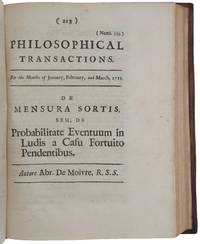
17126431London: Printed for H. Clements . and W. Innys . and D. Brown 1712. First edition. <p>First edition published in the Philosophical Transactions and de Moivre's first published work on probability-the earliest original contribution to the subject to appear in Britain. This pioneering paper laid the groundwork for his later masterpiece The Doctrine of Chances 1718 the definitive English-language textbook on probability theory for over a century. As Hald notes "Nearly all of De Mensura Sortis was later incorporated into The Doctrine of Chances . the most important textbook on probability theory until the publication of Laplace's Théorie Analytique des Probabilités 1812."</p>. <p>THE FOUNDATION OF THE DOCTRINE OF CHANCES</p> . <p>First edition contained in a complete volume of the Phil. Trans. of de Moivre's first published work on probability and the first original work on the subject published in Britain a precursor to his Doctrine of Chances which appeared seven years later. "De Moivre's work on the theory of probability surpasses anything done by any other mathematician except Laplace. His principal contributions are his investigations respecting the Duration of Play his Theory of Recurring Series and his extension of the value of Daniel Bernoulli's theorem by the aid of Stirling's theorem" Cajori p. 245. "The only systematic treatises on probability printed before 1711 were Huygens' De ratiociniis in ludo aleae 1657 and Pierre Rémond de Montmort's Essay d'analyse sur les jeux de hazard 1708. Problems which had been posed in these two books prompted de Moivre's earliest work and incidentally caused a feud between Montmort and de Moivre on the subject of originality and priority" DSB. "Nearly all of De Mensura Sortis was later incorporated into de Moivre's book The Doctrine of Chances 1718 1738 1756 which was the most important textbook on probability theory until the publication of Laplace's Théorie Analytique des Probabilités 1812. In the preface de Moivre states that he began his work on probability theory at the exhortation of Francis Robartes who asked him to solve the division problem for two gamesters playing bowls and also to find the probability of getting certain given faces as the outcome of a given number of throws with a die. He also states that he had previously read the books by Huygens and Montmort 'but these distinguished gentlemen do not seem to have employed that simplicity and generality which the nature of the matter demands.' Furthermore he writes that 'while they suppose that the skill of the gamesters is always equal they confine this doctrine of games within limits too narrow.' Finally his remarks about Montmort may be read as if Montmort had used only the method of Huygens on some new examples. These rash remarks naturally provoked a dispute with Montmort" Hald 1984 pp. 230-1. "The most remarkable of de Moivre's contributions in De mensura sortis are his derivation of the ruin probability in Huygens' fifth problem; his use of the Poisson approximation to solve the binomial equation Bc n p = ½ with respect to n; his solution of the occupancy problem by means of the method of inclusion and exclusion and the algorithm for the continuation probability in the duration of play for the ruin problem. Furthermore he gives without proof the probability of getting a given number of points by throwing any given number of dice and the probability of ruin when one of the players has infinitely many counters. The only contemporary evaluation of these impressive results is the critical review given by Montmort in a letter of 5 September 1712 to Nicholas Bernoulli about a month after Montmort had received a copy of the paper from de Moivre . Montmort recognizes de Moivre's priority to the Poisson approximation to Robartes' problem and to the algorithm for finding the continuation probability in the problem of the duration of play" Hald 2003 pp. 403-4. No copies in auction records.</p> <br /> <p>Provenance: Toft Hall in Cheshire England seat of the Leycester family since the 14th century bookplate on front paste-down.</p> <br /> <p>De Moivre's interest in probability was awakened by Francis Robartes 1649-1718 Member of Parliament and scion of an aristocratic family. In 1692 Robartes wrote a manuscript on two probability problems that he presented to the Royal Society but never published and in the following year he succeeded in publishing another paper on probability. In 1710 Robartes helped John Harris with his article entitled "Play" in Harris's scientific dictionary Lexicon Technicum. Robartes devised an algorithm that Harris used to extract the appropriate terms in a binomial expansion in order to solve the problem of the division of stakes. At some point over the years 1708 to 1710 Robartes received a copy of Montmort's Essay which he showed to de Moivre. He also gave de Moivre three challenge problems of his own devising to work on. "Once de Moivre had solved the first problem within a day of Robartes posing it Robartes gave de Moivre the other two problems to work on while at the same time encouraging him to write on probability. The encouragement proved fruitful. De Moivre finished his manuscript on probability during a holiday that he spent at a country house possibly Robartes's. On June 11 1711 de Moivre submitted his manuscript to the Royal Society. The Society's Journal Book quietly marked the beginning of a new era for probability in England with the note 'Mr. De Moivre presented a Treatise Intituled de Probabilitate Eventum in Ludo Alea This Treatise was Ordered to be printed in the Transactions.' The treatise with the title De Mensura Sortis or 'Of the measurement of lots' comprises an entire issue Number 329 of Philosophical Transactions. At 52 journal pages it is more than three times longer than anything else de Moivre had written to that date" Bellhouse p. 70.</p> <br /> <p>De Moivre begins De Mensura Sortis with two basic definitions from which many of his results are derived. The first comes directly from Huygens's De ratiociniis. For two players A and B contending for a stake of value a A has p chances to win and B has q. The expected value for each player follows what Huygens obtained: ap/ p q for A and aq/ p q for B. The second definition may have come from Edmond Halley or Francis Robartes. If an event can happen in p ways and fail to happen in q and a second event can happen in r ways and fail to happen in s then all the chances for events happening or failing are in the product p qr s or pr qr ps qs. For example pr is the number of ways both events can happen and ps is the number of ways that the first event happens and the second fails. This is the approach that Halley used in evaluating joint life annuities in his 1693 paper on mortality data from the city of Breslau .</p> <br /> <p>"De Moivre finishes the introduction by saying that if the first event is repeated n times then the total number of chances in the game is given in the binomial expression p qn. When this expression is expanded it may be written as a sum containing terms of the form piqn-imultiplied by an appropriate coefficient where i represents the number of times the event happens and n - i represents the number of times it fails the sum of the first c terms of this expansion is denoted Bc n p . The binomial expansion becomes the motif for the paper . At the beginning nine of the first ten problems there are some simple variations on the use of the expansion of p qn and then at the end the last seven problems the expansion is used to solve a very complex problem the problem of the duration of play. In the middle there are several solutions to a number of challenge problems taken from various sources including the three from Robartes" Bellhouse p. 73.</p> <br /> <p>Problems 1 3 and 4 are relatively straightforward applications of the binomial distribution. Problem 1 is to find the chance of throwing an ace two or more times in 8 throws with a single die. Problem 3 is to determine the chances of A and B winning a single game supposing that A can give B two games out of three. Problem 4 is similar.</p> <br /> <p>In problems 5 to 7 de Moivre considers the problem of finding the number of trials that gives an even chance for getting at least one success but fewer than some given number of successes c say. This means he has to solve the equation Bc - 1 n p = ½ for n when c and p are given. De Moivre considers the two extreme cases p = ½ and p tends to 0 of which the first is easy by symmetry. De Moivre shows that as p tends to 0 Bc - 1 n p tends to e-mmultiplied by the sum of the first c terms in the series expansion of em in powers of m where m = np/1 - p de Moivre was not able to express the result this way because our notation for the exponential function had not yet been invented. This result the 'Poisson approximation' to the binomial distribution played a very important role in later developments. "There has been some discussion of whether it is reasonable to contend that de Moivre found the Poisson distribution" Hald 1984 p. 231 more than a century before Simeon-Denis Poisson. </p> <br /> <p>Problems 2 3 4 and 10 are on the division of stakes or 'problem of points'. "Consider a series of games with two players A and B where in each game A has probability p and B probability q = 1 - p of winning a point. If play stops when A lacks a points and B lacks b points in winning how should the stake be divided between them De Moivre proves that A's probability of winning equals the sum of the last b terms of the expansion of p qab-1 and B's probability of winning equals the remaining a terms. This result had already been derived by Johann Bernoulli in 1710 in a letter to Montmort but it was not published until 1713 . In Problem 8 de Moivre generalizes to k players say and gives the solution as the sum of the appropriate terms of the multinomial pl p2 . pknl-k n being the total number of points lacking. He points out that certain terms have to be divided among the players depending on the permutation of the p's.</p> <br /> <p>"In Problems 16 and 17 he gives the solution of Robartes's problem: the division problem for two gamesters playing bowls. In each game B say gets a number of points equal to the number of his bowls which is nearer to the jack than any of A's bowls. By combinatorial methods de Moivre finds the probability of getting i points in a single game assuming that the players have the same number of bowls and are of the same skill. The division problem is then solved by recursion" Hald 1984 pp. 231-2.</p> <br /> <p>Problems 11 12 and 13 are related to the first two of the five problems Huygens posed at the end of his De ratiociniis. "In these problems the players take turns in a specified order until one of them wins. De Moivre gives the solution as the sum of an infinite series" ibid. p. 232.</p> <br /> <p>Problem 15 is 'Waldegrave's problem' James Waldegrave 1684-1741 later the first Earl Waldegrave was a British diplomat living in Paris who himself published nothing in mathematics. "Let there be n 1 players A1 . An1 of equal skill. Players A1 and A2 play a game and the loser pays a crown to a common stock and does not enter the play again until all the other players have played; the winner plays against A3 and the loser pays a crown to the stock and so on. If the winner of the first game beats all the rest the play is finished; if not the play goes on each player coming in again in turn until one player has beaten in succession all the other players and he then receives all the money in the stock.<br /> The problem is to determine</p> <br /> <br /> the probability of each player winning the stock;<br /> the expectation of each player; and<br /> <br /> the probability of a given duration of the play.<br /> <br /> <p>"In a letter to Bernoulli of I0 April 1711 Montmort writes that the problem has been proposed to him and also solved by Waldegrave for three players. Independently de Moivre formulated and solved the problem for three p1ayers in De Mensura Sortis 1712" Hald 2003 p. 378. "De Moivre solves this problem by means of conditional expectations. First he supposes that A beats B in the first game. On this assumption the play may end with A as winner in the second fifth eighth . game. The probabilities of A for reaching these games and winning are ½ ½4 ½7 . Hence the expected stake plus fines may be found and subtracting A's expected fine his conditional expectation results. Under the same assumption B's expectation is obtained. The unconditional expectation is then found as the average of the two conditional expectations" Hald 1984 p. 232.</p> <br /> <p>Problems 18 and 19 are 'occupancy problems' the third type of problem posed to de Moivre by Robartes: Find the probability pn that f specified faces occur at least once in n throws with a die having k faces. De Moivre calculates pn by means of the method of 'inclusion and exclusion'. In Problem 19 he solves the equation pn = ½ under the assumption that f is small compared to k.</p> <br /> <p>Problem 9 is a generalization of the 'gambler's ruin problem' the fifth of Huygens's problems in De ratiociniis. "Consider two players A and B having a and b counters respectively. In each game A has probability p and B has probability q = 1 - p of winning and the winner gets a counter from the loser. The play continues until one of the players is ruined. What is the probability of A being ruined Huygens's fifth problem is obtained for a = b = 12" ibid. Problems 20-26 are a continuation of the discussion of the ruin problem: what is the probability that the play ends at the nth game or before Problem 25 is the case when A has infinitely many counters; de Moivre states the result without proof.</p> <br /> <p>"Although the publication date is given as 1711 De Mensura Sortis was not in print until 1712. Shortly after its publication de Moivre sent copies of the issue to several people in England including Edmond Halley Isaac Newton and de Moivre's fellow chess player at Slaughter's Coffeehouse the Earl of Sunderland. De Moivre's friend Pierre des Maizeaux handled several copies that were bound for the Continent. Using his connections in the Republic of Letters des Maizeaux sent copies of De Mensura Sortis to Abbé Jean-Paul Bignon at that time the French minister of state with responsibility for the Académie Royale des Sciences. Bignon wrote to des Maizeaux on September 24 1712 saying that the copies he received had been distributed. He also enclosed a letter from Montmort to de Moivre thanking him for his treatise; the letter has not survived. Whatever he thought personally about de Moivre's treatise Montmort was adhering to the code of civility in the Republic of Letters by sending the letter of thanks. Other people on the Continent receiving copies were Nicolaus Bernoulli Johann Bernoulli and Pierre Varignon. Johann Bernoulli received his copy via William Burnet a younger son of Gilbert Burnet Bishop of Salisbury; Bernoulli had asked Burnet to obtain a copy for him" Bellhouse p. 71.</p> <br /> <p>Abraham Moivre stemmed from a Protestant family. His father was a surgeon from Vitry-le-François in the Champagne. From the age of five to eleven he was educated by the Catholic Péres de la doctrine Chrètienne. Then he moved to the Protestant Academy at Sedan were he mainly studied Greek. After the latter was forced to close in 1681 for its profession of faith Moivre continued his studies at Saumur between 1682 and 1684 before joining his parents who had meanwhile moved to Paris. At that time he had studied some books on elementary mathematics and the first six books of Euclid's elements. He had even tried his hand at Huygens' 1657 tract without mastering it completely. In Paris he was taught mathematics by Jacques Ozanam who had made a reputation from a series of books on practical mathematics and mathematical recreations. Ozanam made his living as a private teacher of mathematics. He had extended the usual teachings of the European reckoning masters and mathematical practitioners by what was considered fashionable mathematics in Paris. Ozanam enjoyed a moderate financial success due to the many students he attracted. It seems plausible that young Moivre took him as a model he wanted to follow when he had to support himself. After the revocation of the Edict of Nantes in 1685 the Protestant faith was no longer tolerated in France and hundreds of thousands of Huguenots who had refused to convert to Catholicism emigrated to Protestant countries. Amongst them was Moivre who arrived in England in 1687. There he began his occupation as a tutor in mathematics. He also added a 'De' to his name probably because he wanted to take advantage of the prestige of a pretended noble birth in France in dealing with his clients many of whom were noblemen. An anecdote from this time which goes back to de Moivre himself tells that he cut out the pages of Newton's Principia of 1687 and read them while waiting for his students or walking from one to the other - the main function of this anecdote was to demonstrate that de Moivre was amongst the first true and loyal Newtonians and that as such he deserved help and protection in order to gain a better position than that of a humble tutor of mathematics. In 1692 de Moivre met with Edmond Halley and shortly afterwards with Newton. Halley ensured the publication of de Moivre's first paper on Newton's doctrine of fluxions in the Philosophical Transactions for 1695 and saw to his election to the Royal Society in 1697. Newton's influence concerning university positions in mathematics and natural philosophy persuaded de Moivre to engage in the solution of problems posed by the new infinitesimal calculus. In 1697 and 1698 he published the polynomial theorem a generalization of Newton's binomial theorem together with application in the theory of series. In 1704 de Moivre began a correspondence with Johann Bernoulli but Bernoulli's letters showed de Moivre that he lacked the time and perhaps the mathematical power to compete with a mathematician of this calibre in the new field of analysis. De Moivre ceased his correspondence with Bernoulli after he was made a member of the Royal Society commission to adjudicate in the priority dispute between Newton and Leibniz over the invention of calculus - continuing the correspondence may have made him appear disloyal to the Newtonian cause. When the Lucasian chair in mathematics at Cambridge was given in 1711 on Newton's recommendation to Nicholas Saunderson de Moivre realized that this only option was to continue his occupation as a tutor and consultant in mathematical affairs in the world of the coffee houses where he met his clients; additional income he could draw from the publication of books and from translations. He therefore turned to the calculus of games of chance and probability theory which was of great interest for many of his students and where he had few competitors in England.</p> <br /> <p>Hald 'A. de Moivre: De Mensura Sortis or On the Measurement of Chance' International Statistical Review 52 1984 pp. 229-262. Hald History of Probability and Statistics and their Applications before 1750 2003. Bellhouse Abraham de Moivre 2011. Cajori A History of Mathematics 1894.</p> <br/> <br/> 4to 218 x 168 mm pp. vi 555 with 13 plates a little browning and foxing. Contemporary calf sides decorated in blind with corner fleurons a little rubbed joints starting spine label mostly missing. A handsome copy with no restoration. Printed for H. Clements ... and W. Innys ... and D. Brown unknown
2024Adhya-9780323903868ELSEVIER 2024. Hardcover. New. ELSEVIER hardcover
99525Amsterdam Petrus de Coup 1727. . First Latin edition presumed third issue; two parts in one folio 39.2 x 25.4 cm; engraved title-page used here as a frontispiece and 245 engraved botanical plates inserted at rear with allegorical vignette on title-page and two engraved headpieces on ppiii and 25 by Goeree title-page printed in black and red lacking half-title and dedication leaf text somewhat toned frontispiece repaired at inner margin all inserted plates with small circular ink stamp of the Massachusetts Horticultural Society near the bottom their bookplate is present on the front pastedown plates twenty-five and twenty-six are trimmed smaller as most likely supplied some soiling and foxing to text and plates prominent damp staining on plates 144 to 245 plate 32 has small marginal repairs a few leaves with minor marginal worming plates 1 - 48 with neat ink captions in an unknown hand; nineteenth-century quarter calf over marbled boards spine ruled in gilt in compartments black morocco lettering piece gilt edge wear to binding especially at spine and corners upper board detached lower board loose; xxvi 47 1 blank pp.<br /> First Latin edition presumed third issue. A good copy only sold with all faults. 'The illustrations are remarkable for their elegance and originality' Oak Spring Flora 45. This is perhaps the most handsome and influential botanical of its day with its near-dreamlike depiction of plants suspended above cityscapes and other backgrounds.<br /><br />Munting 1626-1683 was a Dutch botanist and botanical artist the son of Henricus Munting 1583-1658. He studied under his father and at the universities of Franeker Utrecht and Leiden also spending two years in France where he obtained an M.D. degree in Angers. Returning to Groningen in 1651 he joined the staff at the Rijkshogeschool Groningen which eventually became the University of Groningen. Here he taught for 24 years as professor of botany and chemistry. On his father's death he assumed management of the Hortus Botanicus Groninganus from 1658 to 1683. His botanist friends sent him seeds from the Dutch East- and West Indies Africa and the Americas. His daughter Hester died after eating Deadly Nightshade from the Garden. Munting subsequently developed a particular interest in the medicinal uses of plants.<br /><br />The present work Munting's best known was first published in Dutch as Naauwkeurige Beschryving Der Aardgewassen 1696. Illustrated were trees shrubs flowers and grasses of temperate zones with some tropical and subtropical plants that had been introduced to the Netherlands.<br /> Nissen BBI 1429; Hunt 404. Amsterdam, Petrus de Coup, 1727. hardcover
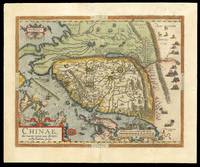
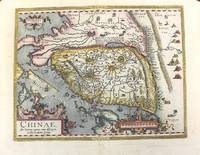
158415641Antwerp: Plantin Press 1584. 450 by 540mm. 17.75 by 21.25 inches. Engraved map with hand colour loss to top right margin skilfully reinstated. The earliest printed map to focus on China and the first to illustrate the Great Wall. It was the first western map of China drawn directly from the findings of the Portuguese mapmaker Luis Jorge de Barbuda or Ludovicus Georgius. Barbuda was a Jesuit and he made a manuscript map of China from information on the area gathered by the Jesuit mission. Arias Montanus passed this map on to Ortelius. He issued this first separately published map of China in 1584 which remained the standard map of China for over fifty years. The map is oriented to the west. Japan is shown on a curved projection borrowing from Portuguese sources. Wind wagons are shown in the north a Chinese invention that also became popular in the Low Countries. The text on the reverse of the map is in Latin and gives an insight into the climate national features inhabitants and economy of China at that time. Abraham Ortelius is one of the most famous of the early mapmakers and publishers. His 'Atlas of the Whole World' 'Theatrum Orbis Terrarum' was first published in 1570 the first uniformly sized systematic collection of maps and hence can be called the first 'Atlas'. These beautiful maps were elegantly engraved by Frans Hogenberg. Plantin Press], unknown
CBS 9781119530305USA Edition . New. Brand New! Fast Delivery US Edition and ship within 24-48 hours. Deliver by FedEx and Dhl & Aramex UPS & USPS and we do accept APO and PO BOX Addresses. Order can be delivered worldwide within 6-10 days and we do have flat rate for up to 2LB. Extra shipping charges will be requested if the Book weight is more than 5 LB. This Item May be shipped from India United states & United Kingdom. Depending on your location and availability. unknown
1612M10204Antwerp 1612. Very Good. Notes: Italian text on verso wide margins. <br>The first map of China to appear in a Western atlas with decorative cartouches.<br>The map is based on the work of Jorge de Barbuda a Portuguese Jesuit also known as Ludovicus Georgius whose manuscript map reached Ortelius by way of Arias Montanus. <br><br> Size : 365x470 mm 14.37x18.50 Inches Coloring: Original Hand Coloring Reference: Marcel P. R. van den Broecke #164 Category: Maps Asia Far East China; unknown
2020062975Burton MI: Subterranean Press 2020. Book. Near Fine. Hardcover. Signed by Authors. Limited Edition. 8 Volume Set comprising books 1-8 of The Expanse series. Special Edition Limited to 574 numbered copies. All volumes are number 378. All volumes are SIGNED by both authors on limited page Daniel Abraham and Ty Franck. Dust-jackets are wrapped in protective mylar. Minor shelfwear. Set is in Near Fine-plus condition. Subterranean Press Hardcover
186595831Davenport Iowa 1865. Original typographic portrait of Abraham Lincoln composed of his Emancipation Proclamation issued on January 1 1863. In near fine condition. Double matted and framed the entire piece measures 26.5 inches by 19 inches. An exceptional piece a rare and desirable piece of Americana. Abraham Lincoln issued the The Emancipation Proclamation or Proclamation 95 on January 1st 1865. The executive order changed the federal legal status of more than 3.5 million enslaved African Americans from slave to free and made the abolition of slavery an explicit goal of the Union war effort. To ensure emancipation Lincoln pushed for passage of the Thirteenth Amendment and insisted that Reconstruction plans for Southern states require abolition in new state constitutions. Congress passed the 13th Amendment by the necessary two-thirds vote on January 31 1865 and it was ratified by the states on December 6 1865 ending legal slavery. unknown
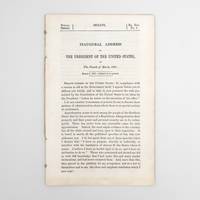
1861377680Washington D.C.: Government Printing Office 1861. Special Session Senate Ex. Doc. No. 1. 10pp. 8vo. Disbound. Housed in a cloth box. Special Session Senate Ex. Doc. No. 1. 10pp. 8vo. Lincoln began drafting his first inaugural in Springfield soon after his election hoping the speech would impart a spirit of reconciliation toward the seceded states. His speech balances his pledge to protect Federal property in the south while insisting that he would not use military force unless attacked first. In all he eloquently argues against secession presenting the United States as undissolvable. Lincoln ends his speech with the memorable lines: "We are not enemies but friends. We must not be enemies. Though passion may have strained it must not break our bonds of affection. The mystic chords of memory stretching from every battle-field and patriot grave to every living heart and hearth-stone all over this broad land will yet swell the chorus of the Union when again touched as surely they will be by the better angels of our nature."<br /> <br /> "Lincoln became President on March 4 1861. Before being sworn in he gave his First Inaugural Address devoting it entirely to the secession crisis. It was the linguistic equivalent of an optical illusion: one could view it two ways. As historians have noted he seemed to placate the South; he would not 'interfere with the institution of slavery in the States where it exists.' This language was the old Lincoln . The new Lincoln was a resolute executive who had no choice but to enforce the Constitution a contract that does not allow states to withdraw from it unilaterally. In his enforcement there would be no bloodshed 'unless it be forced upon the national authority" Mazy Boroujerdi editor Abraham Lincoln: His Life in Print p. 108.<br /> <br /> Lincoln had begun writing his inaugural the month prior before leaving Springfield and once in Washington asked William Seward to review the draft. It was Seward who suggested softening the tone so as not to appear too inflammatory suggesting "a nostalgic call for unity emphasizing the country's shared history. Lincoln embraced the idea but massaged it into near poetry. Seward's prosaic text ended up as Lincoln's oft quoted appeals to the 'mystic chords of memory' and 'the better angels of our nature.' The words did nothing to reverse disunion" Ibid. p. 97.<br /> <br /> This is the official government printing of Lincoln's first inaugural address issued as a document of a special session of the Senate printed by their order four days after its delivery being only the second printing overall of the memorable speech. Monaghan 102; Abraham Lincoln: His Life in Print p. 108 [Government Printing Office] unknown