SANCTA CLARA, Abraham aBiblio.com
23 962 résultats
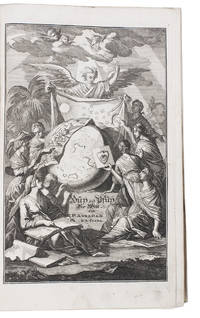
17075C8G6MOZMOJ3Nuremberg Christoph Weigel; 1707. Folio. Würzburg Martin Frantz Hertzen Contemporary vellum with the manuscript title at the head of the spine and a paper shelfmark label at the foot. With an engraved allegorical title-page a letterpress title-page printed in red and black and 100 engraved emblems in the text measuring 10.5 x 12 cm. 10 200 4 pp. & 100 ll. First edition of a German emblem book addressing virtues and vices in 100 emblems compiled by the German preacher Abraham à Sancta Clara born Johan Ulrich Mergerle; 1644 - 1709. As the title states the book's purpose is to refresh the readers virtues and to deter from vices by way of emblems. The concepts are explained in well-known fables and accessible symbols and allegories like the sun moon fire sea weather seasons metals gems animals etc. Each concept is illustrated in an emblem accompanied by a motto in Latin and a poem in German and Latin. The emblems were engraved by Christoph Weigel after illustrations by Caspar and Jan Luyken from the Ethica Naturalis ca. 1700. Each emblem is followed by two pages of text explaining the emblem.With a library inscription on the flyleaf "villae epponis ad bibliothecam". The binding is slightly soiled. Some marginal thumbing occasional foxing and some occasional spots and smudges. Otherwise in good condition.l Landwehr German emblem books 11; Faber du Faur 1125; Goedeke III 25 240. hardcover
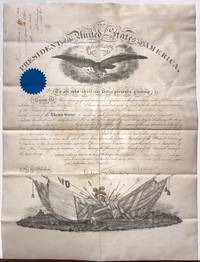
18638703<p>One partly-printed military commisssion on vellum signed by Lincoln as president and countersigned by Edwin M. Stanton as Secretary of War dated May 16th 1863. The document commissions Benjamin H. Geary as Second Lieutenant to the 13th Infantry Regiment on August 13th 1862. Accession note to top left.</p><p>The document measures 14.75 x 19.5 in</p>
169555736Amsterdam: Be-veit ha-meshutafim Asher Anshil ben Eliezer ve-Yisakhar Ber ben Avraham Eliezer/ Moses Wiesel 1695. First edition. Hardcover. g to near fine. Small folio 30 by 18.8 cm. Collation: aleph-vav4 zayin2 = 26 numbered leaves. Full period brown paper boards re-backed with a brown leather spine with raised bands.<br /> <br /> Letterpress title-page with ornate floral woodcut device; additional engraved title-page mounted depicting Moses and Aaron along with six small biblical scenes within round borders all against an architectural background. Engraved folding map at rear mounted; main title with woodcut vignette; 14 half-page engraved illustrations in the text.<br /> <br /> This gorgeously illustrated work is the first edition of the famous and highly influential Passover Haggadah printed in Amsterdam in 1695. Simply known as the Amsterdam Haggadah this edition stands as among the most imitated and copied haggadahs in history and was the first to be illustrated with copperplate engravings. Previous illustrated haggadahs had used woodcuts. The popularity of these illustrations can be attested by the huge numbers of reprint editions over the centuries. There are 14 finely printed large in-text engravings plus the full page engraved title page showing Moses Aaron and Adam in the Garden of Eden. Some of these images illustrate the traditional content of the Passover seder and/or the exodus story while some are other biblical stories less directly related. Images include: the Rabbis of Bene Brak discussing the Passover story the four sons Abraham smashing the idols of his father Abraham welcoming the three angels Moses slaying the Egyptian overseer the rescuing Moses from the river Moses and Aaron coming to Pharaoh w/ staves turning to snakes the ten plagues the Egyptian army drowning in the Red Sea the Exodus the receiving of the Ten Commandments at Mt. Sinai the eating of the Pascal Lamb King David composing his psalms and finally an exterior view of the Holy Temple with the cityscape of Jerusalem in the background. All images are captioned underneath with relevant passages in Hebrew. The engravings were all created by Abraham ben Jacob a German convert to Judaism who had moved to Amsterdam although some sources over the years misattributed them to financier Moses Wiesel 6 of which were adaptations and/or modifications of previous images by Swiss artist Matthäus Merian 1593-1650 from his original work "Icones Biblicae" 1625-30.<br /> <br /> In addition to the in text engravings there is famously a phenomenal fold-out engraved biblical map of the holy land. Measuring a total of 19.5x11.5" the map shows the land of Israel the Sinai desert and Egypt in landscape orientation looking eastward towards the top of the map. It traces the journey of the Israelites starting with the Exodus from Egypt through the desert and into the Land of Israel. The map is detailed showing the areas of the twelve tribes important locations and cities as well as geographic features including the Red Sea Mount Sinai the Dead Sea the Sea of Galilee and many others. The map is decorated with additional illustrations near the bottom and includes a key. This beautiful work also by Abraham ben Jacob is considered among the earliest if not the first map of its kind to be printed within a Hebrew publication. It is now known to have been heavily based on the previously printed 1620 map in Hebrew by Jacob ben Abraham Zaddiq and Abraham Goos 1590 - ca. 1643 which itself was based on the map of 1590 by Christian Kruik van Adrichom Adrichem printed in Latin.<br /> <br /> Text throughout is printed in Hebrew with smaller text in Rashi script underneath containing famous commentary on the Passover Haggadah by acclaimed Portuguese Rabbi and scholar Isaac ben Judah Abarbanel 1437-1508. The verso of the title page contains the order of the Passover seder with brief instructions in both Ladino Judeo-Spanish and Yiddish Judeo-German a nod to the subtitle of Haggadah which references the both Ashkenazi and Sephardic traditions.<br /> <br /> This copy with binding in beautiful condition with being professionally restored includining spine re-backed to style. Book block tight. Interior with some staining to pages throughout from use. Binding in very good to near fine inteiror in good condition overall. Hebrew title: סדר הגדה של פסח ×›×ž× ×”×’ ××©×›× ×– וספרד <br /> Alternate transliterations: Seder Hagadah shel Pesah Seder Hagadah sel Pesah<br /> <br /> References: Friedberg 278 Fuks HTN II 521; Yudlov Haggadah 93; Vinograd Amsterdam 627; Ya'ari no. 59; Laor 876 Map; Nebenzahl pp.138-1389 Map; Yerushalmi plate 59-62; Rosenau "Vision of the Temple" p.135 146-7. Be-veit ha-meshutafim [Asher Anshil ben Eliezer ve-Yisakhar Ber ben Avraham Eliezer]/ Moses Wiesel hardcover
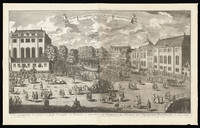
173014402Amsterdam c1730. 565 by 935mm. 22.25 by 36.75 inches. Engraving with etching on two sheets joined. View of the Plantage Muidergracht and the Jonas Daniël Meijerplein. The view shown from the present day Mr. Visserplien the busy intersecti.on in central Amsterdam depicts the Portuguese Synagogue on the left and the High German or Great Synagogue. These momumental buildings now house the Jewish Historical Museum. The first Jews to settle in Amsterdam were the Sephardim who had been expelled from Portugal and Spain in 1493. They were joined in the following decades by the Ashkenazi from Central and Eastern Europe the first of whom had come from Germany in 1600. In those years the only available land for them was at the outskirts of the eastern side of the Centrum the island of Vlooienburg surrounded by the Amstel River and the canals so they settled along the island's main street Breestraat which quickly became known as Jodenbreestraat. The Great Synagogue now the Jewish Historical Museum and the Portuguese-Israelite Synagogue were opened in 1671 and 1675 respectively. The Portuguese Synagogue was the place where Spinoza was placed under the ban by the Sephardic Jewish community in 1656. Pieter Stevensz. van Gunst 1659-1732 also known as Pieter Stevens van Gunst or Petrus Stephani was a Dutch draughtsman copperplate engraver and printmaker active in Amsterdam London 1704 and the Dutch town of Nederhorst 1730-1731. Abraham Rademaker 1677 21 January 1735 was an 18th-century painter and printmaker from the Northern Netherlands. Rademaker was born in Lisse. According to the RKD he was a versatile artist who painted Italianate landscapes but is known mostly for his many cityscapes and drawings of buildings that were made into print. R.W.P. de Vries auction 1925: 295. unknown
17271510220001Amsterdam: Michel Charles Le Cene 1727-01-01. Hardcover. Very Good. Folio. 2 12 439 pp.; 2 pp. 445-808p pagination continuous 43 of 44 plates. 2 Volumes in One Bound in contemporary vellum. 7 raised bands. Leather spine label. Good binding and cover. Spine and hinges restored. Faint soiling to vellum. Pages tanned with a several pages with some offsetting and foxing. Lacks frontis and added title. All 27 plates & 16 maps are present. Brunet IV 178; Cordier Japonica 367-68; Cordier Sinaca 2077; Lust 342 <br><Br> Jean Albert Mandeslo set out in 1636 with the Embassy that the Duke of Holstein sent to Russia and Persia. He visited India Ceylon Madagascar West Africa Congo and returned four years later. His story gives a very vivid picture of luxury vices curiosity and absolute disregard for life under the despotic tyranny of the Moghul Empire under Shah Jahan. In the port of Surat he arrived in April 1638 after he went to Ahmedabad and Agra. Although his observations of life in the capital are useful he apparently did not hear anything about the Taj Mahal which at that time was in the sixth year of building. Amsterdam: Michel Charles Le Cene hardcover
175214421Amsterdam c1752. 565 by 935mm. 21.5 by 36.75 inches. Engraving with etching on two sheets joined. View of the Plantage Muidergracht and the Jonas Daniël Meijerplein. The view shown from the present day Mr. Visserplien the busy intersecti.on in central Amsterdam depicts the Portuguese Synagogue on the left and the High German or Great Synagogue. These momumental buildings now house the Jewish Historical Museum. The first Jews to settle in Amsterdam were the Sephardim who had been expelled from Portugal and Spain in 1493. They were joined in the following decades by the Ashkenazi from Central and Eastern Europe the first of whom had come from Germany in 1600. In those years the only available land for them was at the outskirts of the eastern side of the Centrum the island of Vlooienburg surrounded by the Amstel River and the canals so they settled along the island's main street Breestraat which quickly became known as Jodenbreestraat. The Great Synagogue now the Jewish Historical Museum and the Portuguese-Israelite Synagogue were opened in 1671 and 1675 respectively. The Portuguese Synagogue was the place where Spinoza was placed under the ban by the Sephardic Jewish community in 1656. Pieter Stevensz. van Gunst 1659-1732 also known as Pieter Stevens van Gunst or Petrus Stephani was a Dutch draughtsman copperplate engraver and printmaker active in Amsterdam London 1704 and the Dutch town of Nederhorst 1730-1731. Abraham Rademaker 1677 21 January 1735 was an 18th-century painter and printmaker from the Northern Netherlands. Rademaker was born in Lisse. According to the RKD he was a versatile artist who painted Italianate landscapes but is known mostly for his many cityscapes and drawings of buildings that were made into print. R.W.P. de Vries auction 1925: 295. unknown
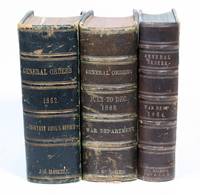
18622923Washington D.C.: War Department 1862. Calf marbled boards. Very Good. FIRST OBTAINABLE PRINTING OF THE PRELIMINARY EMANCIPATION PROCLAMATION setting a date for the freedom of more than three million enslaved in the United States and reframing the Civil War as a fight against slavery. Issued by the War Department to regimental commanders in the field during the Civil War in the week after the completion of President Lincoln’s official manuscript version. Contained is a set of three volumes of General Orders covering the full year 1862 July-Dec 1863 and the full year 1864. History of the Emancipation Proclamation:<br /> <br /> “The proclamation has been called by responsible persons one of the three great<br /> documents of world history ranking with Magna Carta and the Declaration of<br /> Independence†– Eberstadt<br /> <br /> “From the first days of the Civil War slaves had acted to secure their own liberty. The Emancipation Proclamation confirmed their insistence that the war for the Union must become a war for freedom. It added moral force to the Union cause and strengthened the Union both militarily and politically. As a milestone along the road to slavery’s final destruction the Emancipation Proclamation has assumed a place among the great documents of human freedom†– National Archives<br /> <br /> Following the Seven Days Battle and General McClellan’s retreat from the Peninsula at the end of June 1862 President Lincoln realized that there would be no early end to the war and found himself “as inconsolable as it was possible for a human to be and yet live.†Anxious for news from the army and needing to escape the constant interruptions at the White House he frequently visited the telegraph office in the War Department building to await dispatches. It was during one such visit early in July that he asked the chief of the telegraph staff Major Thomas Thompson Eckert for some paper to “write something special†and began the first draft of the Emancipation Proclamation completing it in a few weeks. Lincoln had long hoped to resolve the slavery issue through a congressional act of emancipation compensating slave owners for their loss of “property†but that approach was roundly rejected by representatives from the border states leaving the President who had decided upon the necessity of emancipation with a presidential proclamation as the only option. The extraordinary document he conceived would announce the liberation on January 1 1863 of all slaves in those states still in rebellion against the Union and promised compensation to slave owners in those states that returned to the fold before that time if they adopted “immediate or gradual abolishment of slavery.†This proclamation would be followed by a final proclamation issued on the 1st of January identifying those states still in rebellion and confirming the liberation of all slaves therein.<br /> <br /> On Tuesday July 22 Lincoln presented his draft to the Cabinet telling them that he had resolved firmly upon the course of action it specified and asking them not for advice but suggestions. The only observation he had not anticipated came from Secretary of State Seward who proposed that it might be best to wait for a military victory before issuing the Proclamation as it could otherwise seem like “the last measure of an exhausted government.†Immediately recognizing the wisdom of the suggestion Lincoln held back. On September 17 after an anxious wait of nearly two months he received the victory he needed at the bloody Battle of Antietam. Completing his final draft Lincoln presented it to his cabinet for refinement on September 22. Following the meeting Seward took the amended draft with him to the State Department where a formal manuscript copy was made then signed by Lincoln and Seward. The formal official “Emancipation Proclamation†was of course issued on January 1 1863 the day it became the law of the land.<br /> <br /> Printing History:<br /> <br /> This printing in the War Department’s official “General Orders†is the fourth printing overall but realistically the first obtainable printing. It is preceded by:<br /> <br /> -The first printing Eberstadt #1 a small three-page circular intended for distribution within the government and to the local press likely printed on September 22. At the time that Charles Eberstadt published his study of the Proclamation 1950 he was able to locate only one copy which he himself owned and as nearly as we have been able to determine no other copies have come to light since then.<br /> <br /> -The second printing Eberstadt #2 may be a phantom printing. Charles Eberstadt was not able to locate a copy but he inferred its existence from the standard State Department practice of printing a folio edition consisting solely of the text of the proclamation followed by another printing consisting of the text of a letter of transmittal from the Secretary of State as well as the text of the proclamation. While there may be a copy of Eberstadt #2 in the National Archives as he speculated it is not recorded in their online catalogue nor have we been able to find a copy in any other online catalogue including OCLC the Library of Congress and the Abraham Lincoln Library.<br /> <br /> -Eberstadt’s third printing is of legendary rarity. It consists of Secretary of State Seward’s one-page letter of transmittal addressed “To the Diplomatic and Consular Officers of the United States in foreign countries†and the text of the proclamation. Eberstadt located a total of only five copies in institutions at the Library of Congress the National Archives Yale the Clements Library and Brown. OCLC does not record any additional copies nor is it recorded in Monaghan. There has been one copy at auction $400000 in 2021 and that was described as the only copy in private hands. <br /> <br /> -The present copy General Orders No. 139 is Eberstadt’s fourth printing of the Preliminary Emancipation Proclamation dated in print on September 24. Eberstadt surmises that this field order printing could have been accomplished as late as September 29 or 30. Although it may have been printed in as many as 15000 copies it is very rare in commerce likely due to the ephemeral nature of the printing and distribution.<br /> <br /> Additional General Orders and Provenance:
<br /> <br /> The three volumes once belonged to John G. Haskell A.Q.M. Chief Quartermaster and contain the General Orders for the year 1862 July-December only for the year 1863 and for the full year 1864. John Gideon Haskell 1832-1907 was a resident of Kansas and joined the Union Army when the war broke out. He enlisted with the 14th Kansas Volunteer Cavalry Regiment and later served as Assistant Quartermaster General of Kansas as quartermaster of the Third Kansas and the Tenth Kansas Volunteers as Captain and Assistant Quartermaster on the staff of General James G. Blunt and as Chief Quartermaster of the Army of the Frontier. After the war Haskell was named official state architect and worked on the state house the capitol the State University and more.<br /> <br /> In addition to the preliminary Emancipation Proclamation the three volumes also contain the Acts of Congress on many other subjects including pay discharge recruitment handling of troops etc.<br /> <br /> Washington D.C.: War Department Adjutant General’s Office 1862-64. Three volumes. Small octavo contemporary three-quarter brown morocco two volumes with cloth boards one with marbled boards. Some rubbing and wear to bindings pencil notations on endpapers with collation and highlighting certain orders and some internal pages. Dampstaining to general title of 1862 volume; internal text and Emancipation Proclamation generally fine. RARE AND IMPORTANT.<br /> <br /> References:<br /> <br /> Charles Eberstadt. “Lincoln’s Emancipation Proclamation.†New York: 1950. War Department unknown
CBS-9781119530305John Wiley Np Exclusive. New. John Wiley Np (Exclusive) unknown
CBS-9781119530305John Wiley Np Exclusive. New. John Wiley Np (Exclusive) unknown
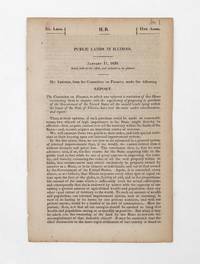
1839373003Vandalia Illinois 1839. First edition. 3 1pp. 8vo. Disbound. Housed in a morocco backed slipcase. First edition. 3 1pp. 8vo. Abraham Lincoln had yet to join the bar when he began his first stint in politics in the Illinois legislature in 1834 serving four consecutive terms in the Assembly through 1841. "This rare printing has the prestige of being the first occurrence of Lincoln's name as the sole author of a work. As a Whig lawmaker he was devoted to his party's program of public works through government financing. After the Panic of 18376 the spending he had advocated for had resulted in massive state debts. To relieve the budgetary burden Lincoln proposed that Illinois acquire land within its borders which the federal government still possessed and then sell the land at a fourfold profit to settlers and speculators resulting in both increased revenues and self-determined land ownership" Boroujerdi. Very rarethoma. Monaghan 1; Boroujerdi et. al. Abraham Lincoln: His Life in Print p. 29 unknown
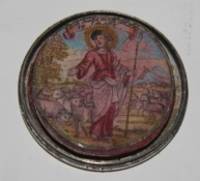
1733004823Amsterdam 1733. The panorama or concertina was made we believe in 1732 or 1733 or close to that date. The silver "shraubthaler" or outer casing we assume was made separately at a later date but not long afterward. unknown
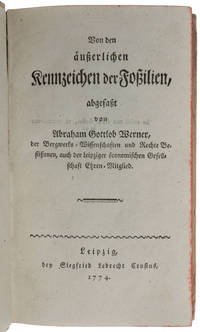
17745615Leipzig: Siegfried Lebrecht Crusius 1774. First edition. <p>First edition rare of Werner's first published work. "This book in which Werner develops a completely new scientific description of minerals is actually the first modern textbook on mineralogy. He was the first to recognize that a true and final classification of minerals should be based on their chemical composition and that it would be possible to identify the various minerals with certainty by their external characters and physical properties" Carozzi. </p>. THE FIRST MODERN TEXTBOOK ON MINERALOGY". <p>First edition rare of Werner's first published work and the first modern textbook of descriptive mineralogy the 'fossils' in the title refer to anything removed from the ground. "Although Werner is best known for his contribution to the founding of geology as a science he first achieved recognition as a mineralogist. He considered mineralogy to be the basis for all study of the earth dividing it into five branches of which geognosy historical geology was one and oryctognosy descriptive mineralogy another. And during all the years in which his theories on geognosy were arousing so much interest and controversy he continued to work on his mineral system the final version of which appeared after his death in 1817. His first important mineralogical work however Von den äusserlichen Kennzeichen der Fossilien was not a mineral system but a classification of external characteristics of minerals designed to aid the worker or the student in the field. In it Werner gave an unprecedented number of external characteristics with definitions usually accompanied by homely examples which could be understood by both the layman and the natural philosopher. He also attempted to establish some standards of quantification and thus to clear away the vagueness in the terminology then in use. As chemistry and crystallography developed mineralogists came to rely more on chemical analysis and less on external characteristics but Von den äusserlichen Kennzeichen der Fossilien published when Werner was twenty-five years old continued to be an important work into the nineteenth century . Werner remained convinced of the importance of external characteristics not only in the identification of minerals but also in the study of their composition. He reasoned that since the appearance of a mineral changes when its chemical composition is changed there should be a correlation between chemical composition and external characteristics" DSB. "Werner was the champion of a geological theory known as Neptunism in which he believed that all minerals precipitated out of water. Neptunists were opposed to believers of Vulcanism a theory that espoused the igneous origin of rocks" Dibner </p> <br /> <p>This book is "one of the most influential writings in the development of the mineralogical sciences. It is the first successful attempt at describing systematically determinative mineralogy. Werner who wrote this book his first as a student at the youthful age of 24 had been around minerals and mining his entire life. He had practical experience in what was needed by the miners to identify minerals and the reasons for identification. Werner had originally intended to publish an annotated translation of the dissertation written by Johann Carl Gehler titled: De Characterivs Fossilivm Externis Lipsiæ 1757. After showing the completed translation to his scientific circle he was advised to that it was better to write a book that was wholly his own. The result was Von den äusserlichen Kennzeichen der Fossilien which took the young Werner only a few months to complete. Based upon this book's merits Werner was appointed to the staff of the Freiberg Bergakademie where he stayed the remainder of his professional life.</p> <br /> <p>"The book is written not as a mineralogical classification system as was then typical but rather as a compendium of external characteristics of a large number of minerals. Werner intended it to be used as a practical guide for mineral identification and proposed that this study be given the name 'oryctognosy' - a term previously applied in a wider sense such as Bertrand's Dictionnaire Oryctologique Universalle Paris 1763. For his book Werner precisely defined an unprecedented number of external characteristics that could be used to accurately identify specimens through hand examination. Included in the distinguishing features identified for use are color luster form streak hardness and specific weight. Werner claimed that determining all of these qualities for a given mineral specimen was enough to identify its species. In fact these same characters are readily found in modern handbooks of determinative mineralogy because in most cases they are enough to distinguish the common species. The landmark character of Werner's work rests on the fact that no one before had so precisely defined the properties used to test minerals and the effect on mineralogical science can be described as revolutionary with many of his former students writing their own texts to spread Werner's theories in a multitude of other languages" Schuh.</p> <br /> <p>"This book in which Werner develops a completely new scientific description of minerals is actually the first modern textbook on mineralogy. He was the first to recognize that a true and final classification of minerals should be based on their chemical composition and that it would be possible to identify the various minerals with certainty by their external characters and physical properties . Upon its publication in 1774 Von den äusserlichen Kennzeichen der Fossilien created an immense scientific interest all over Europe and inspired increased investigations in the particular field it had so brilliantly renovated that is the determination and classification of minerals according to external characters" Carozzi pp. 554-555.</p> <br /> <p>"Werner 1749-1817 was born into a family with a mining tradition; therefore it was expected he should enter the profession. In 1774 as a student at the Freiberg Bergakademie he wrote his first book Von den äußerlichen Kennzeichen der Foßilien and based upon its merit in 1775 Werner was appointed professor of mineralogy at that institution. He remained there the rest of his professional life. He was by accounts an electrifying teacher who devoted himself to developing the sciences of mineralogy and geology. His students many of whom became famous instructors in there own right spread his theories throughout Europe and North America. However Werner's idea that basalt was aqueous in origin sparked the great controversy between his theory and that of Scottish geologist James Hutton 1726-1797. Werner accumulated an extensive personal mineral collection of over 10000 specimens which he sold for 40000 talers to the Freiberg Bergakademie. Today it is together with Werner's library among the earliest of the great collections that still remains intact" Schuh.</p> <br /> <p>Dibner Heralds of Science 81; Norman 2205; Sparrow Milestones of Science 196; Ward & Carozzi 2299. Carozzi 'A Study of Werner's Personal Copy of Von den äusserlichen Kennzeichen der Fossilien 1774' Isis 51 1960 pp. 554-557.</p> <br/> <br/> 8vo 176 x 103 mm pp. 302 2 with 8 folding tables. Contemporary boards a little frayed at head. A fine copy. Custom half leather clamshell box gilt spine. Siegfried Lebrecht Crusius unknown
1718327872London England: W. Pearson for the Author 1718. First edition. Hardcover. Acceptable. London: "Printed by W. Pearson for the Author" MDCCXVIII 1718. Rare first edition of the first textbook on probability. Original boards endpapers and spine. Tooled boards are whole but detached and rubbed heavily at corners. Spine is missing 2 1/2 panels of 6 lightly treated with leather preservative to mitigate flaking. Endpapers are present front endpaper is chipped at front edge. Text block is sound light darkening to edges of pages top and front edges from use- else good copy paper and print quality. Artists engraved creative 'armorial' bookplate of Josiah M.Montague Goodall 1828-1893 of Charles Goodall and Son Card Maker Master Employing 500 People. The book's title came to be synonymous with probability theory and accordingly the phrase was used in Thomas Bayes' famous posthumous paper "An Essay Towards Solving a Problem in the Doctrine of Chances" wherein a version of Bayes' theorem was first introduced. W. Pearson for the Author hardcover
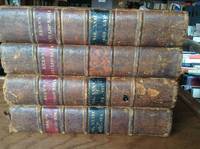
18065649Philadelphia: Samuel F. Bradford and Murray Fairman and Co. Fair. 1806. Leather Bound. Complete set of 41 volumes plus 6 illustrated volumes published between 1806 and 1820 in half-volume jobs. This is the US edition of the British original published between 1802 and 1820. All books appear to be complete except for some blank endpages of Illustrated Volume I. Covers are quite worn and four front covers are detached Volumes I VI X and Illustrated I and two more noticeably loose Volume VIII and Illustrated II. Illustrated I has tapemarks from poor repair work and the title page is torn. On most volumes the title pastedowns on spine have fallen off. Three volumes have a little water damage most extensively on Volume XV -- but even that is isolated mainly to cover and endpages. Volume XVI has child's drawings on one blank endsheet. On Illustrated III the foldouts are worn on the edges but still intact. Some foxing but no mold. Occasional creases and waviness. Ex-owner plate in each volume "The property of Phineas J. Miller bequeathed to him by his uncle Phineas Janney and his aunt Sarah S. Janney. 1852-3." All in all despite the wear to the covers the set is nicely preserved. ; Vol. 1/1/2047 . Samuel F. Bradford, and Murray, Fairman and Co. hardcover
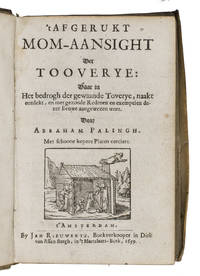
1659ABC_47611Amsterdam: J. Rieuwertz 1659. Contemporary overlapping vellum. Small 8vo. With a woodcut title-vignette showing a witch on a broomstick leaving a house through the chimney 4.3 x 5.2 cm 13 etched full-page illustrations on 8 plates by Salomon Savry. An exceptionally rare first edition of a book focusing on the subjects of witchcraft sorcery demonology and black magic. The author passionately expresses his dissatisfaction with the brutalities inflicted upon individuals accused of being witches using vivid and disturbing illustrations as evidence. Notably the book features a captivating woodcut title vignette depicting a witch's daring escape through a chimney. In the image her legs hang from the opening inside the house while she simultaneously rises on her broom outside the chimney creating a striking visual effect. Abraham Palingh is a somewhat elusive figure in Early Modern Dutch literature and his book provides a fascinating insight into the attitudes of an educated man toward witchcraft. He claims that his 't Afgerukt Mom-aansight Der Tooverye is based on firsthand accounts. Information regarding the occurrence of harmful sorcery and attitudes towards sorcery in Amsterdam and Haarlem has been documented from the initial witchcraft trials to the point where such crimes were no longer a concern for the judiciary. Between 1542 and 1566 trials for harmful sorcery took place in Amsterdam while Haarlem witnessed similar trials in 1549. Historical accounts of both cities as well as Jacobus Scheltema's History of Witch Trials published in Haarlem in 1828 make mention of sorcery trials in Amsterdam. However these references often provide only superficial details despite the potential for valuable insights found in the actual procedural documents. Conversely little information about witchcraft in Haarlem can be gleaned from existing literature. Abraham Palingh author of 't Afrukt Mom-aansight der Tooverye published in Haarlem in 1659 briefly mentions a few cases of sorcery accusations that he claims to have personally known yet his accounts remain vague.The fine and copperplate illustrations were made by Salomon Savry 1594-1683. He was a recognised engraver of his time highly involved with the Amsterdam book industry of the seventeenth century. Some wear to binding. Ex libris from the library of Leontine Buijnsters-Smets. Light browning and foxing. Otherwise in very good condition.l Bibl. Med. Neerl. I p.150; Muller 539 1725 edition; Scheepers I 552; STCN 841091951 12 copies; Waller 1315 1725 edition; WorldCat 56854247 3 copies. J. Rieuwertz, hardcover
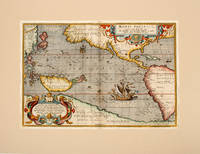
112501Antwerp Christopher Plantin for the author 1598. . Double-page copper engraved map with later hand-colouring centre fold as issued cartouches for title and dedication French text to verso: sheet size: 41.8 x 54 cm. Very minor staining to fold. <br />Mounted size: 52cm by 65.5cm.<br /> Well-preserved example of Ortelius' map of the Pacific taken from the fifth final and most complete French edition of Theatre de l'Univers. Enriched with decorative cartouches and ships.<br /><br /><br />Abraham Ortelius 1527-1598 was a cartographer and publisher he was born and died in Antwerp.<br /> Koeman III Ort 32. Antwerp, Christopher Plantin for the author, 1598. unknown
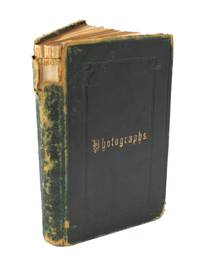
1864175101864. Abraham Lincoln and Civil War Figures Album of pasted oval portraits with signatures underneath each image. 1861. Features most notably Abraham Lincoln with a pasted signature below his image. This mid-nineteenth-century photographic album assembles oval portraits of political and military figures during the Civil War era including a pasted signature beneath an engraved portrait of Abraham Lincoln on the 15th page. Dated inscriptions from 1861 situate the compilation at the outset of national conflict. The inclusion of Lincoln Henry Clay and numerous uniformed figures reflects contemporary practices of collecting and memorializing political leadership through photographic reproduction and autograph acquisition.<br /> <br /> Photographic album measuring approximately 4.5 x 7 inches. Dark green morocco boards with gilt "Photographs" title. Contains 93 black-and-white and sepia portraits most approximately 2.5 x 2.25 inches mounted on pages. Lincoln portrait with separate pasted signature "A. Lincoln"; Henry Clay portrait with pasted signature; additional signatures written directly on album leaves. Spine chipped at head with separation; rubbing along margins; binding intact; photographs generally clear with minor age toning. Overall condition very good. he album reflects nineteenth-century commemorative culture preserving images and autographs of national figures during a transformative political moment. unknown
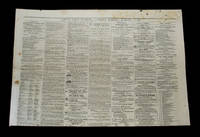
186369186Boston: Boston Daily Courier 1863. Full Description:<br> <br> LINCOLN Abraham. Emancipation Proclamation."President's Proclamation. Emancipation of Slaves in Rebellious States." Boston. Published in: Boston Daily Courier Volume LXXVIII no. 2. Friday Morning January 2 1863.<br> <br> The publication of Lincoln's Emancipation Proclamation in the Boston Daily Courier and one of if not the first official public announcements of the Final Emancipation Proclamation once it was signed and in effect as of January 1 1863. The Proclamation is featured at the top of the center column of page 3.<br> <br> We could find no other copies of this or any other January 2nd edition at auction and it is not mentioned in Eberstadt. Eberstadt's entry for the second edition of the "Final Proclamation" Eberstadt 9 states "Second edition. Apparently the only separate newspaper edition of the final proclamation and the earliest non-official edition. Printed on Friday evening January 2 1863 this Extra in point of chronological sequence was preceded only by the first official edition." Our present copy although not a separate newspaper edition was rushed to press and published in the Friday Morning edition of the Courier placing it's publication prior to Eberstadt 9.<br> <br> According to Eberstadt "A number of newspapers did not issue on January 2nd because of the previous day's holiday but most of those that did carried the final proclamation. Many of the others printed it on January 3rd." pg. 17.<br> <br> Broadsheet folio one large leaf folded along side to make four pages two leaves printed on recto and verso. Seven-column format. 26 x 19 inches; 655 x 490 mm. Light creases down the middle in both directions. A few minor closed tears. A large old ink signature along top margin of front page causing some bleed-through and foxing but not affecting text. Still a very good copy of this important declaration.<br> <br> Abraham Lincoln issued the preliminary Emancipation Proclamation on September 22 1862 stating that if the rebelling states did not cease fighting and rejoin the Union by January 1 1863 the slaves in those states would be set free. Once January 1st 1863 arrived President Lincoln signs and issues the final Emancipation Proclamation freeing the slaves in the Confederate states. The Boston Courier issued this early printing of Lincoln's Proclamation the very next morning January 2 1863. "<br> <br> HBS 69186.<br> <br> $8500. Boston Daily Courier unknown
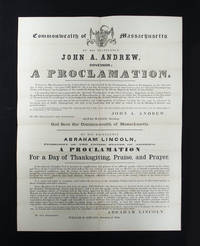
186368373Massachusetts 1863. LINCOLN Abraham. Massachusetts: 1863.<br> <br> Letterpress broadside 27 3/4 x 20 in.; 708 x 508 mm on paper incorporating several display and ornamental fonts as well as the seal of Massachusetts docketed on the verso "Post Office Hanover.' Some light offsetting. Nearly invisible professional repairs to the verso along the folds. A very nice example of this rare and important broadside<br> <br> This original broadside produced in Massachusetts is formatted in two halves with the top half being Governor John A. Andrew's announcement of Lincoln's Proclamation endorsing the observation of this day of Thanksgiving in his state dated July 27 1863 and the bottom half being Lincoln's actual proclamation dated July 15th 1863 and announcing that August 6th shall be set aside as a National Day of Thanksgiving. Though the exact printing date is unknown it can be assumed that it was printed within the week following July 27th.<br> <br> Thanksgiving was observed as a Holiday since colonial times and each state would set aside its own day for celebration. This proclamation was the first time that the Holiday would be celebrated on a set day nation wide making it the first observed Thanksgiving as a National Holiday.<br> <br> Though later the same year on October 3rd 1863 Lincoln made a second proclamation again announcing Thanksgiving as a Holiday but this time in November a date closer to the time most states had been celebrating it in the past. This earlier proclamation is actually the first time Thanksgiving was given national status but because the second proclamation was widely accepted the knowledge of this earlier one has been somewhat forgotten making this piece a rare and important document in the annals of American history.<br> <br> Though this broadside is for the State of Massachusetts no other broadsides from any other states that announce this date are known to exist and only three other copies of this rare document are located through OCLC.<br> <br> HBS 68373.<br> <br> $8500. Massachusetts unknown
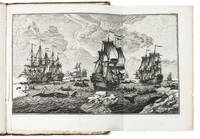
172019012Amsterdam 1720. 4to. Joannes Oosterwyk Contemporary half sheepskin marbled paper sides. With an engraved allegorical frontispiece by J. Folkema after F. Ottens 6 folding engraved maps and 7 engraved plates including 1 folding showing ships at sea by A. Salm after Van der Hem. Further with the title page printed in red and black a small woodcut vignette on the title page some woodcut decorated initials and some large woodcut floral tailpieces. 38 330 14 pp. First edition of the most important early account of whaling in the northern seas. The author a ship's commander in the Dutch Greenland fleet describes the history of the Dutch whaling in the northern seas. Dutch whaling dominating in Europe for most of the 17th and 18th century was not confined to the Greenland waters only but ranged widely across the northern fisheries from the Davis Straits to the Siberian Sea. The work also includes short histories of the northern explorations in Greenland Iceland Spitsbergen Nova Zembla Jan Mayen Island and Strait Davis all accompanied by the newest maps and preceded by a map of the North Pole. The plates show the different whales and ships of the whalers. To Zorgdrager's work detailed lists are added of captains ships equipment and provisions for the ships caught whales the cost of equipment and crew etc. Also the practical and technical aspects of whaling are fully described. The book was used as one of the sources for Melville's Moby Dick.With a printed ex libris bookplate of N. Du Jardin-Van der Avoort mounted on the front pastedown. The spine and boards are somewhat scuffed the corners of the boards are slightly bumped a tear in one leaf some occasional foxing and water staining the edges are slightly frayed. Otherwise a good copy of a rare and interesting work.l Cat. NHSM p. 899; Chavanne 2110; Leclerc 678; Sabin 106374; STCN 201968800 14 copies incl. 1 incomplete; Tiele Bibl. 1241 note; V. Gestel - Van het Schip Maps in books on Russia and Poland 299. ABE CAT Alaska Canada & Greenland hardcover
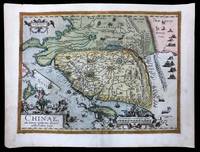
158415208Antwerp: Plantin Press 1584 1595. 440 by 550mm. 17.25 by 21.75 inches. Hand-coloured engraved map with fine original colour. The earliest printed map to focus on China and the first to illustrate the Great Wall. It was the first western map of China drawn directly from the findings of the Portuguese mapmaker Luis Jorge de Barbuda or Ludovicus Georgius. Barbuda was a Jesuit and he made a manuscript map of China from information on the area gathered by the Jesuit mission. Arias Montanus passed this map on to Ortelius. He issued this first separately published map of China in 1584 which remained the standard map of China for over fifty years. The map is oriented to the west. Japan is shown on a curved projection borrowing from Portuguese sources. Wind wagons are shown in the north a Chinese invention that also became popular in the Low Countries. The text on the reverse of the map is in Latin and gives an insight into the climate national features inhabitants and economy of China at that time. Abraham Ortelius is one of the most famous of the early mapmakers and publishers. His 'Atlas of the Whole World' 'Theatrum Orbis Terrarum' was first published in 1570 the first uniformly sized systematic collection of maps and hence can be called the first 'Atlas'. These beautiful maps were elegantly engraved by Frans Hogenberg. Plantin Press], unknown
6509ABRAHAM LINCOLN 1809-1865. Lincoln was the Sixteenth President.DS. 1pg. August 1 1864. Washington. A vellum military commission signed Abraham Lincoln as President and co-signed E.M. Stanton as Secretary of War. The President appointed James Wylie Crawford a First Lieutenant in the Veterans Reserve Corps. Crawford 1832-1910 was from Maine; according to family lore he was badly wounded at Antietam I bought this directly from a descendant. This injury required his enlistment in the Veterans Reserve Corps. The Veterans Reserve Corps allowed wounded soldiers to remain active often performing small tasks and light duty; established in the middle of 1863 it was first known as the Invalid Corps until the official name was changed. The document recently underwent conservation with the vellum stretched and flattened; the top right corner of the vellum has shrunk and the document was once rolled. The Lincoln autograph is a tad light and gets lighter as the autograph gets towards the conclusion; the Stanton is also a bit faint but vellum does not hold ink that well especially compared to paper. hardcover
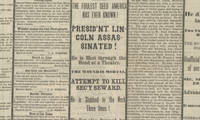
15042913315/04/1865. <blockquote><p>The Assassination:<strong><br /></strong></p></blockquote><p>Abraham Lincoln continues to stand as America’s most beloved President. Of our nation’s historical icons Lincoln is the quintessential embodiment of American possibility in his mythic-like rise from rail-splitter to Chief Executive and Emancipator of the oppressed. The admiration felt by Americans for Lincoln’s humble integrity his performance in office his noble statesmanship and his keen sense of justice is enduring. Lincoln is not given the highest marks just for character but for the transformation of the nation that he left behind which was both profound and long-lasting.</p><p>Polls of historians generally show their belief that Lincoln faced the hardest job of any president. He had to define the issues inspire the people be steadfast in the face of losses win the Civil War free the slaves and lay the groundwork to reunite the nation. All that in the face of determined opposition. He accomplished all this in four years but was assassinated on April 14 1865 and his death left him unable to finish the job a job that quite likely he was the only one with a chance to get completed in a way that would truly bring the nation together.</p><p>The end of the Civil War left the nation with two overwhelming questions: what to do with and do for the millions of freed slaves; and how to reintegrate the South into the Union. On the first point Lincoln was focused on African American access to land economic prosperity and legal rights and had just approved Gen. William T. Sherman’s order distributing parcels of former slave plantations to the slaves themselves. Lincoln wanted black Union veterans to have the right to vote which was a step to ultimately embracing full suffrage for African American males. In what proved to be his final speech three evenings before his death Lincoln had become the first president ever to support black voting. Lincoln’s successor Andrew Johnson was a Southerner uninterested in fair treatment of the liberated slaves. He opposed plans designed to guarantee the civil rights of black Americans and cancelled Sherman’s order granting land to slaves. Johnson accepted the draconian post-Civil War Black Codes which limited the rights and liberties of African-Americans something Lincoln would never have done.</p><p>On the second point the readmission of the Southern states Johnson felt that once Southern states returned their loyalty to the national government they could manage their own affairs. This meant they could pass any Jim Crow laws they liked. He opposed the Republican plan for Reconstruction of the South including provisions designed to guarantee the civil rights of black Americans. The Republican Congress had no rapport with Johnson and the initial four years era of Reconstruction which was a disaster to the nation was essentially a bitter battle between a North and South that remained locked in contention presided over by a weak President Johnson and a Congress at loggerheads with him. Lincoln had enormous power and influence some of which extended into the South. He saw the end of the war as an opportunity to not simply celebrate victory but an opportunity to move the country forward. Johnson had no such feeling. Lincoln would have been much better placed to direct moderate and ease the contentions of Reconstruction.</p><p>John Wilkes Booth was a member of a famous acting family and he enjoyed a phenomenally successful stage career during the Civil War: By 1864 he earned $20000 a year at a time when the average Northern family earned around $300 annually. A Marylander by birth Booth was an open Confederate sympathizer during the war. A supporter of slavery Booth believed that Lincoln was determined to overthrow the Constitution and to destroy his beloved South. After Lincoln’s reelection in November 1864 Booth devised a plan to kidnap the president and spirit him to Richmond where he could be ransomed for some of the Confederate prisoners languishing in northern jails. That winter Booth and his conspirators plotted a pair of elaborate plans to kidnap the president; the first involved capturing Lincoln in his box at Ford’s Theater and lowering the president to the stage with ropes. Booth ultimately gave up acting to focus on these schemes. Neither of the kidnapping plans bore fruit. On the evening of April 11 the President stood on the White House balcony and delivered a speech to a small group gathered on the lawn. Two days earlier Robert E. Lee had surrendered the Army of Northern Virginia at Appomattox Court House and after four long years of struggle it had become clear that the Union cause would shortly emerge from the war victorious. Lincoln’s speech that evening outlined some of his ideas about reconstructing the nation and bringing the defeated Confederate states back into the Union. Lincoln also indicated a wish to extend the franchise to some African-Americans—at the very least those who had fought in the Union ranks during the war - and expressed a desire that the southern states would extend the vote to literate blacks as well. Booth stood in the audience for the speech and this notion seems to have amplified his rage at Lincoln. “That means nigger citizenship†he told Lewis Powell one of his band of conspirators. “Now by God I’ll put him through. That is the last speech he will ever make.â€</p><p>Three days later Booth made good on his promise. Upon learning that Lincoln and his wife intended to see the play “Our American Cousin†at Ford’s Theater Booth used his actor’s connections there to gain access to the President’s box. He shot Lincoln at about 10 pm on April 14 1865 and Lincoln died about after 7 am on the 15th.</p><p>Dr. Charles Leale was in the audience. Leale leapt over theater seats got to the president’s box and announced that he was a doctor. As he entered the President was sitting in a chair with his eyes closed and head slumped. He already looked dead Leale recalled. He felt Lincoln’s right arm for a pulse but couldn’t find one. He and some others eased Lincoln to the floor and Leale began searching for the wound. “I quickly passed the separated fingers of both hands through his blood-matted hair…and I discovered his mortal wound†Leale recalled. “The president had been shot in the back part of the head behind the left ear.†Leale stuck the little finger of his left hand into the hole in Lincoln’s skull. “I then knew it was fatal and told the bystanders†he wrote later. Leale knew he had to get Lincoln out of the theater to treat him. But he believed a carriage ride back to the White House would kill him. He and several other men lifted the president and with Leale holding Lincoln’s head they began to maneuver him outside. Across the street from the theater was the house of William Peterson and Lincoln was taken there. Lincoln was carried to a small back room stripped of his clothes and covered with blankets. His 6-foot-4-inch frame had to be placed diagonally to fit on the bed. Leale ordered the window opened and the wait began. A parade of anguished government officials and family members came and went. The President sank steadily his breathing labored and his pulse nearly undetectable. At 7:22 am on April 15 President Lincoln breathed his last. Leale smoothed the contracted muscles of Lincoln’s features placed two coins over his eyes and pulled a sheet up over his face. Famously Secretary of War Stanton saluted the fallen President and uttered “Now he belongs to the ages.†Stanton further eulogized Lincoln with the apt observation “There lies the most perfect ruler of men the world has ever seen.â€</p><p><strong>Original report</strong> on the assassination printed the very day he died</p><p>The public was hungry for information and the newspapers equally hungry to report the momentous news. One of these was the Binghamton Daily Republican and this is its issue of April 15 1865 with black mourning columns.</p><p>The front page as was routine at the time was taken up by ads. The news then began on page two. There at top left is the headline <em>“The Assassination of President Lincoln! A Nation in Mourning!!!â€</em> It begins <em>“We feel too unfitted by this awful event to allude to the calamity in terms becoming its solemnity and importance! LINCOLN IS DEAD! Struck down by the hands of a brutal assassin in the midst of the triumphs which were commemorating his salvation of the country. A great man indeed has fallen! The foremost man of his time is no more…We dare not contemplate what may follow this sad and inscrutable providence.â€</em> This was followed by a proclamation of the governor of New York. On page three were dispatches from 12:30 AM to noon to 3:00. An early dispatch reports that<em> “the President was shot… and is not expected to liveâ€</em> and told of the events of the assassination then available in detail. It mentioned <em>“The screams of Mrs. Lincoln first disclosed the fact to the audience that the President had been shot.â€</em> Later it reported of Lincoln <em>“At midnight the Cabinet…a few personal friends with Surg. Gen. Barnes and his immediate assistants were beside his bedside…The parting of his family with the dying president is too sad for description.â€</em></p><p>At noon the newspaper had more news and reported <em>“Later concerning the President. He died this morning at 7:20. Two villains engaged in the horrible crime. The murder planned before March 4th.â€</em> At the bottom of the column is a report on the progress of the army of General William T. Sherman saying that in response to Grant’s hope Sherman would pursue the remaining Confederates Sherman said <em>“I think we’ll do it.â€</em> At 3:00 the paper printed the latest from Washington. It contained <em>“Full particulars of the Death of Abraham Lincolnâ€</em> plus <em>“Inauguration of President Johnsonâ€</em> and Johnson’s statement on taking office.</p><p>Original newspapers reporting Lincoln’s assassination have become very scarce this being our first in over a decade. This one is comprehensive and with its black borders and large headlines is evocative of the moment and would be perfect for display.</p><p><img class=""alignnone wp-image-25018 size-post-window"" src=""https://cdn.raabcollection.com/wp-content/uploads/20231204144051/Folder-site-11-1600x1327.jpg"" alt="""" width=""1600"" height=""1327"" /></p> hardcover
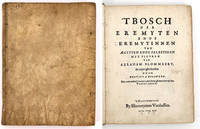
16191516Hantvverpen Antwerp: Hieronymus Verdussen 1619. First Edition in book form. Near Fine. Bloemart Abraham. 4to 8 7/8 x 6 3/4 inches 251 x 171 mm. ix pp 51 sheets on cream laid paper text in Dutch gothic letters. 50 numbered full page copperplate engravings of Christian hermit saints 25 male 25 female printed recto with text pages on verso. Full-page frontispiece for the work and with an additional full-page frontispiece for each of the two sections. Full contemporary vellum untitled with some handling discoloration but the vellum remains supple and the binding is tight. Pages clean and bright with a couple of foxing spots and a small brown stain on the 2nd frontis titled "Sacra Eremus ascetarum"; toned page edges. Previous owner's name and date in ink on front flyleaf and small pencil and ink notations inside back cover; bookplate of Buijnsters Smets pasted inside front cover.<br /> De Backer/ Sommervogel VII 194-5; Hollstein 355-403; Roethlisberger 163 ill. 262-317<br /> <br /> Full title: 't Bosch der Eremyten ende eremilinnen van Aegypten ende Palestinen met figuren van Abraham Blommaert door Ghristophorus a Sichem. Met kort verhael van een yders leven getrocken uyt het Vadersboeck door H. Jan van Gorcum Priesler ende H. R. Societatus sic Jesu. The Forest of the Hermits of Egypt and Palestine with illustrations by Abraham Blommaert engraved by Ghristophorus a Sichem. With brief stories of their lives taken from the book of the Fathers by H. Jan van Gorcum priest of the Society of Jesus. A fine series of engravings of the early Christian male and female hermits living in the Egyptian and Palestinian desert engraved in copper by Boetius A Balswert on drawings by Abraham Bloemart 1566 - 1651 the Dutch painter and engraver know mostly for his historical subjects and for being a central figure and teacher among the Utrecht Caravaggisti. <br /> Provenance: the library of the book- and art-historians Piet Buijnsters and Leontine Smets. Hieronymus Verdussen unknown
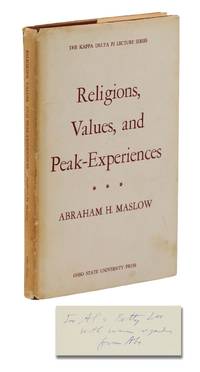
1964140948656Columbus OH: Ohio State University Press 1964. First edition. Very Good/Very Good. First edition first printing. Signed by Abraham H. Maslow on the front free end paper and inscribed to sociologist Alfred McClung Lee and his wife Elizabeth Briant Lee "For Al & Betty Lee With warm regards from Abe." xx 123 pp. Bound in publisher's brick red cloth stamped in blind on the front board with spine lettered in gilt. Very Good with trivial sunning and wear to spine ends light foxing to text-block edges and underlining and marginalia in ink on pp. 42-43. In a Very Good unclipped dust jacket with toning to spine rubbing and light chipping to ends with rubbing and finger soiling to covers. <p>An early work that examines the human need for spiritual expression and articulation by the famed psychologist most famous for creating Maslow’s Hierarchy of Needs. In a series of essays Maslow describes transcendental experiences focusing more on human condition rather than scientific rigidity. Inscribed to American sociologists Alfred McClung Lee and his wife Elizabeth "Betty" Lee who co-wrote The Fine Art of Propaganda 1939 which remained in print for the better part of the 20th century. Alfred was named the executive director of the Institute for Propaganda Analysis during WWII and would pen numerous academic texts including his best known works The Daily Newspaper in America: The Evolution of a Social Instrument 1937 and Principals of Sociology 1946 that endured for two decades as a staple text book for college students; quite uncommon signed. Ohio State University Press unknown