ABRAHAM BAR HIYYABiblio.com
26 503 résultats
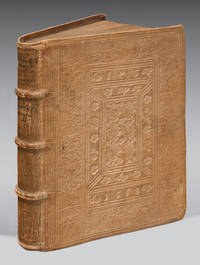
CBF2<p>Basel H. Petri 1546.</p><p>2 texts in 1 volume 4to 195 x 140 mm of : I/ 3 ll. 1 bl. l. 351 pp. 1 p. with mark; II/ 4 ll. out of 5 bound without the Latin title of part 2 1 bl. l. 207 pp. 1 p. with mark. Hebrew and Roman letters illustration: woodcut figures and diagrams.</p><p>Bound in contemporary blind-stamped pigskin over wooden boards. The covers are decorated with a blind-stamped plate with a frieze of biblical scenes forming a frame. The upper cover is monogrammed and dated "I S 1558". Spine ribbed with handwritten title. <i>Magnificent contemporary German binding.</i></p><p><b>Exceedingly rare original edition bilingual Hebrew-Latin of the most celebrated treatise on astronomy by Abraham Bar Hiyya </b>1065-1136 a Spanish Jewish mathematician astronomer and philosopher.</p><p>Adams A-33 ; VD16 ZV-19 ; USTC 661378 ; STC German 1; Zinner 1891; Macclesfield 119; Burmeister <i>Münster</i> 146; Houzeau & Lancaster 1217; <i>IA</i> 100.165; Steinschneider 673.3; Zinner 1891.</p><p><i>Sphaera</i><i> Mundi</i> printed with Mizrahi Elijah <i>Arithmetica</i> translated by O. Schreckenfuchs edited by Sebastian Munster printed in Hebrew and Latin.</p><p>"This beautifully printed volume is both in its Hebrew and Latin parts illustrated by neat Diagrams and Figures cut in wood; and subsequent to a Preface in Latin gives us underneath a short Hebrew Title the following copious Latin Title ….</p><p>The above work of Rabbi Abraham is thus entered in the Bibliotheca Brittanica.</p><p>Abraham R. Fil. Haijae a native of Spain and author of 'Sphaera Mundi Hebraice cim versione Oswaldi Schreckenfuchsii et Notis Sebastiani Munsteri' Basil 1546 4to.</p><p>The Device of Henry Petrus the printer of this finely executed volume appears at the end of both the Hebrew and Latin texts.</p><p>The following extract from the 'General Biography' must necessarily be understood to designate the author of the 'Sphaera Mundi' notwithstanding the variation in spelling his Father's name – 'Abraham Ben Chaila a Spanish Rabbi in the 13th century practiced Astrology and assumed the character of a Prophet. He predicted the coming of the Messiah and fixed for the time of his advent the year 1358 but fortunately died in 1303 fifty-five years before the time when his prediction was to be fulfilled. </p><p>He is also said to have written a Treatise on the Figure of the Earth in Hebrew and Latin which was published at Basel in 1546 4to." A descriptive catalogue of books in the Library of John Holmes.</p><p>The author often known as Savasorda wrote a treatise on practical geometry which contains the earliest account of Arabic algebra written in Europe. This work deals with astronomy and geography. </p><p>He was known by several other names including Savasordia Abraham Judaeus and also Abraham Hispano as in the present work.</p><p>It also includes <i>"Compendium arithmetices"</i> by Elija Orientali also in Hebrew and Latin and <i>"Quos Libros Osvvaldus" </i>by Erasmus Oswald Schreckenfuchs.</p><p>The treatise on arithmetic by Elijah Mizrahi <i>c</i>. 1540-1526 an important figure in Ottoman Jewry was first published in Constantinople in 1533.</p><p>The work printed in Hebrew and Latin includes commentaries and explanations by Sebastian Munster.</p><p>It is illustrated with numerous woodcuts and diagrams in the text as well as the printer's mark repeated at the end of both the Hebrew and Latin versions.</p><p><b>A superb copy preserved in its contemporary blind-stamped pigskin binding over wooden boards.</b></p><br /><u>Français</u><p>Basel H. Petri 1546.</p><p>2 textes en 1 volume in-4 de : I/ 3 ff. 1 f.bl. 351 pp. 1 p. avec la marque ; II/ 4 ff. sur 5 relié sans le titre latin de la 2e partie 1 f.bl. 207 pp. 1 p. avec la marque. Hebrew and Roman letters illustration: woodcut figures and diagrams.</p><p>Reliure en peau de truie de l'époque estampée à froid sur ais de bois. Les plats sont ornés d'une plaque à froid avec une frise comportant des scènes bibliques en encadrement. Le plat supérieur est monogrammé et daté " I S 1558 ". Dos à nerfs comportant le titre manuscrit. <i>Superbe reliure allemande de l'époque.</i></p><p>195 x 140 mm.</p><p><b>Rarissime édition originale bilingue hébreu-latin du plus célèbre traité d'astronomie d'Abraham bar Hiyya</b> 1065-1136 un mathématicien astronome et philosophe juif espagnol.</p><p>Adams A-33 ; VD16 ZV-19 ; USTC 661378 ; STC German 1; Zinner 1891; Macclesfield 119; Burmeister <i>Münster</i> 146; Houzeau & Lancaster 1217; <i>IA</i> 100.165; Steinschneider 673.3; Zinner 1891.</p><p><i>Sphaera</i><i> Mundi</i> printed with Mizrahi Elijah <i>Arithmetica</i> translated by O. Schreckenfuchs edited by Sebastian Munster printed in Hebrew and Latin.</p><p>"This beautifully printed volume is both in its Hebrew and Latin parts illustrated by neat Diagrams and Figures cut in wood; and subsequent to a Preface in Latin gives us underneath a short Hebrew Title the following copious Latin Title ….</p><p>The above work of Rabbi Abraham is thus entered in the Bibliotheca Brittanica.</p><p>Abraham R. Fil. Haijae a native of Spain and author of 'Sphaera Mundi Hebraice cim versione Oswaldi Schreckenfuchsii et Notis Sebastiani Munsteri' Basil 1546 4to.</p><p>The Device of Henry Petrus the printer of this finely executed volume appears at the end of both the Hebrew and Latin texts.</p><p>The following extract from the 'General Biography' must necessarily be understood to designate the author of the 'Sphaera Mundi' notwithstanding the variation in spelling his Father's name – 'Abraham Ben Chaila a Spanish Rabbi in the 13th century practiced Astrology and assumed the character of a Prophet. He predicted the coming of the Messiah and fixed for the time of his advent the year 1358 but fortunately died in 1303 fifty-five years before the time when his prediction was to be fulfilled. </p><p>He is also said to have written a Treatise on the Figure of the Earth in Hebrew and Latin which was published at Basel in 1546 4to." A descriptive catalogue of books in the Library of John Holmes.</p><p>The author often known as Savasorda wrote a treatise on practical geometry which contains the earliest account of Arabic algebra written in Europe. This work deals with astronomy and geography. </p><p>Il était connu sous plusieurs autres noms dont Savasordia Abraham Judaeus et également Abraham Hispano comme dans le présent ouvrage.</p><p>Il comporte aussi " <i>Compendium arithmetices</i> " par Elija Orientali également en hébreu et en latin et " <i>Quos Libros Osvvaldus</i> " par Erasme Oswald Schreckenfuchs.</p><p>The treatise on arithmetic by Elijah Mizrahi <i>c</i>. 1540-1526 an important figure in Ottoman Jewry was first published in Constantinople in 1533.</p><p>L'ouvrage imprimé en hébreu et en latin comporte des commentaires et des explications de Sebastian Münster.</p><p>Il est orné de nombreuses gravures sur bois et diagrammes dans le texte ainsi que de la marque de l'imprimeur répétée à la fin de chacune des deux versions hébreu et latine.</p><p><b>Superbe exemplaire conservé dans sa reliure de l'époque en peau de truie estampée à froid sur ais de bois.</b></p> hardcover
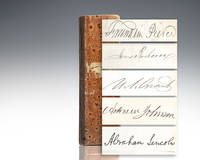
18771465621877-1880. Unique 19th-century autograph album containing the signatures of six American presidents fifteen senators several cabinet members and governors including Abraham Lincoln Ulysses S. Grant James Buchanan and Franklin Pierce. Narrow quarto bound in one quarter period dark brown cloth over stiff marbled wrappers the autograph album is a repurposed 19th-century caucus record dating from ca. 1870. The caucus book is alphabetically tab-indexed and filled out in ink voters are tracked by their name with caucus results appearing in the back. Although this is labeled “Ward 5†in the first page the term "Ward" was flexible in its usage. This could have been for a Ward election precinct caucus legislative congressional or state convention caucus. The autographs are mounted over the caucus records in their respective alphabetical tab. Also mounted at front are 6 printed pieces of 19th-century ephemera. The autograph album was assembled between 1877 and 1880 and can be dated by a contemporary pencil note that John Sherman had transitioned from the Senate to be Secretary of the Treasury. From the collection of a Mr. Boyd a 19th-century Ward politician in the upper Midwest Minnesota or Wisconsin. The Presidential autographs are primarily clipped from Presidential appointments and include: Abraham Lincoln James Buchanan Ulysses S. Grant Andrew Johnson Franklin Pierce and Rutherford B. Hayes. In very good condition. A very rare and unique collection. hardcover
LCS-18054Superbe exemplaire conservé dans sa reliure de l’époque en peau de truie estampée à froid sur ais de bois. Basel, H. Petri, 1546. 2 textes en 1 volume in-4 de : I/ (3) ff., (1) f.bl., 351 pp., (1) p. avec la marque ; II/ (4) ff. (sur 5, relié sans le titre latin de la 2e partie), (1) f.bl., 207 pp., (1) p. avec la marque. Hebrew and Roman letters, illustration: woodcut figures and diagrams. Reliure en peau de truie de l’époque estampée à froid sur ais de bois. Les plats sont ornés d’une plaque à froid avec une frise comportant des scènes bibliques en encadrement. Le plat supérieur est monogrammé et daté « I S 1558 ». Dos à nerfs comportant le titre manuscrit. Superbe reliure allemande de l’époque. 195 x 140 mm.
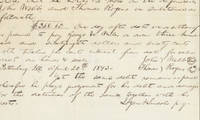
18433570010/1843. <blockquote><p>Miles who was also a prominent Whig politico and part of Lincoln’s political circle used Lincoln’s legal services a number of times</p></blockquote><p>Abraham Lincoln and Stephen T. Logan formed a prominent Illinois law partnership called Logan & Lincoln from 1841 to 1844 during which Logan an experienced attorney mentored Lincoln and introduced him to complex areas of the law. During his partnership with Logan Lincoln also increased his caseload before the Illinois Supreme Court and handled appeals from all areas of the state. Logan and Lincoln handled many cases together not merely at their Springfield office but around the state. This ls because Lincoln had a circuit law practice that involved riding the Eighth Judicial Circuit in Illinois covering 14-15 counties including Menard County on horseback or buggy. Logan remained in Springfield while Lincoln traveled the Circuit. As a general practitioner Lincoln handled diverse cases including property disputes debts torts. slander and criminal law. The Logan & Lincoln partnership ended amicably in 1844 after which Lincoln partnered with William H. Herndon who was a clerk in the Logan & Lincoln law office and whose father had been a Lincoln friend for many years.</p><p>George U. Miles was Herndon’s father-in-law. He came to Illinois in 1816 at age 20 settling first in St. Clair County and then in White County where he married Jane McCoy on November 18 1821. They had three children. Miles removed to Logan County and then in 1836 he went to Sangamon County where he lived on a farm six miles north of Springfield. In 1839 he moved to Petersburg in Menard County where he served as public administrator from 1845 to 1849. Miles was a Whig and a Menard County delegate to conventions that chose Whig candidates. Miles and Lincoln knew each other as neighbors and fellow Whigs and also because of Miles’ family relationship to Lincoln’s friend and partner Herndon. In early 1843 Lincoln sought a nomination for Congress and hoped for Miles’ political support.</p><p>Miles used Lincoln as an attorney a number of times both before and after Herndon became Lincoln’s partner. In late 1843 Miles retained Logan & Lincoln and sued John Webb and Thomas Rogers to collect a $368.60 debt on a promissory note.</p><p><strong>Autograph document signed</strong> all in Lincoln’s hand Menard County Illinois October-November 1843 being a petition in the county court in which Miles asks for judgment for a debt. <em>“George U. Miles plaintiff states that he holds a note on the defendants John Webb and Thomas Rogers in substance as followeth: ‘$368.60. One day after date we or either of us promise to pay George U. Miles or order three hundred and sixty eight dollars and sixty cents with twelve percent interest from date for value received. Our hands & seals: John Webb and Thomas Rogers Petersburg Ill. April 20th 1843.’ Yet the same debt remains unpaid wherefore he prays judgment for his debt and damages for the detention of the same together with his costs. Logan & Lincoln.â€</em></p><p>Lincoln won the case. The defendants were found to have defaulted and the court awarded Miles $392.67 counting costs. The case was decided November 1 1843. It is listed at lawofficeofabrahamlincoln.org.</p><p>After Lincoln’s assassination Miles acted as one of Herndon's key investigators. Miles famously interviewed individuals including Ann Rutledge’s aunt to gather information about Lincoln's early life and relationships serving as a vital source for Herndon's research. Herndon would write a famous biography of Lincoln in the 1880s.</p><p><img class=""alignnone wp-image-25018 size-post-window"" src=""https://cdn.raabcollection.com/wp-content/uploads/20231204144051/Folder-site-11-1600x1327.jpg"" alt="""" width=""1600"" height=""1327"" /></p> unknown
18643560801/08/1864. <blockquote><p>This appointment is listed in War Department General Orders no. 256</p></blockquote><p>According to the National Museum of Civil War Medicine and other sources Lt. Adam Miller of the 2nd Mass. Vols. aged twenty-three years was badly wounded August 9 1862 at the Battle of Cedar Mountain by an elongated musket ball which entered below the right eye socket and traversing the nasal cavity emerged through the left eye socket destroying the globe of the left eye and lacerating the left lower eyelid. He was made a prisoner and taken to a hospital at Charlottesville Va. where his wound ultimately formed a scar with great deformity. After being exchanged he entered the New York Eye Infirmary and on April 10 1863 a plastic surgical operation was performed by Dr. Henry B. Sands for the restoration of the eyelid. The operation was eminently successful and on April 22 1863 the parts were sufficiently healed to permit the insertion of an artificial eye. He thus survived a catastrophic facial wound and underwent pioneering plastic surgery.</p><p>Due to his injuries which made him unfit for active field duty but still capable of light service he was transferred to the Veteran Reserve Corps in August 1863 with his commission dating back to June 27 1863. The Veteran Reserve Corps was a military organization of the Union Army created for partially disabled or otherwise infirm soldiers who could still perform simple duties such as guarding prisoners or patrolling cities. This appointment is listed in War Department General Orders no. 256.</p><p><strong>Document signed</strong> with engravings of an eagle flags and weapons Washington August 1 1864 naming Adam Miller a lieutenant in the Veteran Reserve Corps effective June 27 1863.</p><p>An extraordinary Lincoln appointment of a soldier who made medical history in the Civil War.</p><p><img class=""alignnone wp-image-25018 size-post-window"" src=""https://cdn.raabcollection.com/wp-content/uploads/20231204144051/Folder-site-11-1600x1327.jpg"" alt="""" width=""1600"" height=""1327"" /></p> unknown
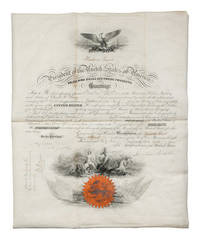
18611571129/03/1861. <p>James E. Harrison though born in Virginia served the Union cause during the Civil War. He received his first appointment as a Second Lieutenant to the 2d U. S. Cavalry in June 1856 and was stationed in Texas and various forts in the West until December 1858 when he was assigned to scouting Indians. He returned East and with the Civil War imminent he was promoted to First Lieutenant 2d U.S. Cavalry in March 1861 and then to Captain 5th U.S. Cavalry in May of that year. Harrison was engaged in the Peninsular campaign and commanded a regiment in the Army of the Potomac from September 1862 to June 1863. During that time he served at the battles of Antietem Chancellorsville and Brandy Station among many others. He was Breveted Major U.S. Army for gallant and meritorious services at the battle of Hanover Court House and Brevet Lieutenant Colonel U.S. Army for gallant and meritorious services at the battle of Antietam. In July of 1864 Harrison was assigned to be Inspector-General of Cavalry in the Department of Arkansas and was later appointed as Special Inspector of Cavalry in West Mississippi.</p><p><strong>Document signed</strong> as President Washington March 29 1861 effective retroactively to February 27 1861 an ornate vignetted commission with an eagle cannons and flags appointing Harrison to the rank of “First Lieutenant in the Second Regiment of Cavalry.†The document is countersigned by Secretary of War Simon Cameron.</p> unknown
14952US President who guided the nation through Civil War and was famously assassinated. 2 page recto verso Manuscript Document Signed by Lincoln on June 19 1862 the same date on which he signed the historic bill abolishing slavery in the U.S. territories. In this document Lincoln extends mercy to an inmate by providing a pardon. Measures 10.75x16.5".Lincoln issued this pardon after several petitions arrived on Lambert's behalf emphasizing his family's financial need as well as the support of two convicting juror at his trial five years prior. <br/><br/>This pardon states in part: "Whereas at the December Term A.D. 1857.Isaac Lambert was convicted on two indictments for Larceny and was sentenced to imprisonment in the Penitentiary for the term of three years under each conviction;-And whereas the said Isaac Lambert has served over three-fourths of his double term of six years in a patient penitent and exemplary manner;-And whereas it appears that the family.are in a destitute condition and that his labor is necessary for their support.I Abraham Lincoln President of the United States of America.grant unto him the said Isaac Lambert a full and unconditional pardon." Boldly signed at the conclusion "Abraham Lincoln" with a white paper seal affixed to the upper left that remains fully intact. <br/><br/>In addition to granting this individual mercy to Lambert on June 19 Lincoln also initiated the process of abolition in the U.S. by signing a historic bill that banned slavery in all current and future U.S. territories. Overturning the controversial Dred Scott decision in which the Supreme Court had denied the federal government regulatory power over the territories' slave trades and policies Lincoln took a public action that helped the nation move closer to emancipation within the states. In cooperation with Lincoln Congress enacted legislation on June 19 emancipating slaves in the territories and banning slavery there hereafter. The law read simply: "Be it enacted by the Senate and House of Representatives of the United States of America in Congress assembled That from and after the passage of this act there shall be neither slavery nor involuntary servitude in any of the Territories of the United States now existing or which may at any time hereafter be formed or acquired by the United States otherwise than in punishment of crimes whereof the party shall have been duly convicted." This straightforward legislation paved the way for the Emancipation Proclamation which Lincoln announced in September 1862 and signed into effect on January 1 1863.<br/><br/>A highly desirable example signed at an important moment in the abolition of slavery.To obtain a signed document or letter directly relating to Emancipation would likely cost over $1 million today. At the height of the financial crisis in 2008 a document by Lincoln affixing the seal of the President "on my Proclamation" without mentioning the word "emancipation" sold for $800000. Repaired separations to intersecting folds one vertical fold passing through a single letter of the signature and scattered toning otherwise fine condition. unknown books
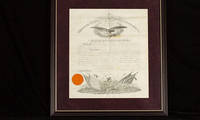
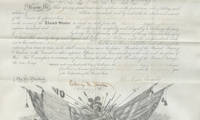
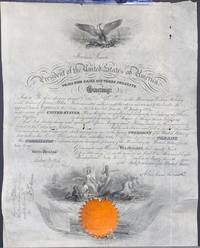
1864132067April 21 1864. American naval commission signed by Abraham Lincoln as President of the United States and Gideon Welles as Secretary of the Navy. Folio partially engraved on vellum the document is dated April 21 1864 and promotes Charles W. Tracy to the rank of Lieutenant. In near fine condition. Matted and framed with a portrait of Lincoln and engraved plate. The Commission measures 19 inches by 16 inches. The entire piece measures 34 inches by 29.5 inches. Abraham Lincoln served as the 16th President of the United States from March 1861 until his assassination in April 1865. He led the United States through the American Civil War the country's greatest moral cultural constitutional and political crisis and in doing so preserved the Union of the United States of America abolished slavery and strengthened the federal government. Lincoln ran for President in 1860 sweeping the North in victory. The South was outraged by Lincoln's election and in response secessionists implemented plans to leave the Union before he took office in March 1861. War began in April 1861 when secessionist forces attacked Fort Sumter in South Carolina just over a month after Lincoln's inauguration and after years of deadly military conflict officially ended on April 9 1865 when Confederate General Robert E. Lee surrendered to Union General Ulysses S. Grant at the Battle of Appomattox Court House. On April 14 1865 just days after the war's end at Appomattox Lincoln was attending a play at Ford's Theatre with his wife Mary when he was assassinated by Confederate sympathizer John Wilkes Booth. Lincoln is remembered as the martyr hero of the United States and is consistently ranked as one of the greatest presidents in American history. hardcover
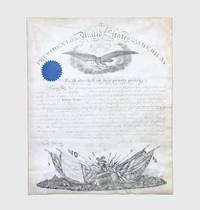
1863172650Washington DC: 10 March 1863. Signed four months before the Battle of Gettysburg A military appointment signed by Abraham Lincoln at the height of the American Civil War. Such documents were instruments of authority and means of identification as soldiers crossed through military lines and took command. The document appoints James Gillette to the position of "Commissary of Subsistence of Volunteers with the rank of Captain". James Gillette 1838-81 enlisted as a private and rose quickly through the ranks. He served as Commissary of Subsistence for the 2nd Division XII Corps under General John W. Geary. For his meritorious service he was breveted lieutenant colonel U.S. Volunteers and for gallantry at the battle of Chancellorsville he was breveted major in the regular Army. A week earlier on 3 March Lincoln signed the Conscription Act mandating the impressment of able-bodied young men into the service of the Union Army. A clause allowing for exemption by paying a fee provoked national fury leading to riots in New York. Engraved military appointment 415 x 340 mm on vellum with the sections accomplished in manuscript attractive cartouche of the American eagle at the head and large trophy of arms at the foot engraved by J. V. N. and O. H. Throop blue wafer seal at left War Department docketing notations at upper left. Mounted and framed with UV conservation glazing framed size 64 x 53 cm. Originally folded into sixths leaving light creases as usual. Slightly discoloured at extremities ink a little faded but still clear. In very good condition. hardcover
1862190938Washington DC: 28 July 1862. Taxing the new state of Oregon to fund the Civil War Lincoln appoints Lawrence White Coe collector of federal taxes for the State of Oregon. In August 1861 Congress passed a new direct tax to fund the Civil War. Oregon's share was $35000 seven eighths of the state's annual revenue Bancroft p. 640. The measure marked both a substantial expansion of federal taxation and a wartime extension of presidential patronage through the appointment of tax officers. Oregon had become a state in 1859. Coe 1831-1897 resident in Wasco County had opened steam navigation on the upper Columbia River with the stern-wheeler Colonel Wright which was contracted to carry army supplies to Fort Walla Walla. His father Nathaniel Coe had been appointed by President Fillmore as the first postal agent in the Northwest. Printed document with manuscript additions 281 x 434 mm embossed seal of the US Treasury. Presented in a wooden frame with conservation acrylic glazing 555 x 425 cm. Minor chipping at extremities tape residue on verso from former framing minor soiling and light spotting. In very good condition. Hubert Howe Bancroft History of Oregon Vol. II 1888. unknown
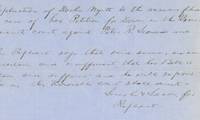
18533514603/11/1853. <blockquote><p>The case is well known and illustrates Lincoln’s penchant for aiding women who had been unjustly treated</p></blockquote><blockquote><p>""Said answers are untrue uncertain and insufficient that her Bill is true certain and sufficient and he Lincoln will so prove it to be""</p><p> </p></blockquote><p>During his 25-year legal career in Illinois Abraham Lincoln was involved in a substantial number of cases involving women as litigants. He was known for seeking to represent women and working to get justice for them in an era when women’s cases were often shunned by lawyers or not taken seriously.</p><p>Lincoln handled some 147 divorce cases about 40% of all divorce cases in his home county of Sangamon. Importantly more than half of the litigants he represented were women. He handled these cases with ""tender consideration"" learning from experience that the law could be a dangerous place for women who had few rights under the legal doctrines of the time. Lincoln also represented women in cases involving land disputes and in slander lawsuits which often involved accusations of adultery and were important for maintaining a woman's community reputation.</p><p>Lincoln was known for taking cases for women where he felt justice was on his client's side. Notable examples include: Nance Legins-Costley - In 1841 Lincoln successfully represented this African American woman to prevent her from being sold into slavery arguing that slavery was illegal in Illinois; Melissa Goings - He defended Mrs. Goings an elderly woman charged with her abusive husband's murder in a case based on self-defense; Doshia Wyatt - In 1853 Lincoln took on the case of Mrs. Wyatt a widow whose claim was that she was being cheated out of her inheritance.</p><p>A petition for dower is a legal request filed by a surviving spouse typically a widow to claim a portion of their deceased spouse's estate such as in real property based on common law dower rights. This is a formal process that requires the surviving spouse to file a petition in court describing the property and naming the heir or person with the next immediate estate of inheritance. The court then holds a hearing to determine the rights to dower and the property.</p><p>Doshia Wyatt widow of Robert Wyatt retained Lincoln and sued for her dower. Thomas Wyatt died in 1847 and left all of his property to his son Robert. Robert Wyatt lost part of the land the Mill Farm to satisfy a judgment against him in the U.S. District Court of Illinois. Robert Wyatt sold another property the Prue Farm to George Brewner. After Robert Wyatt's death in 1852 Doshia Wyatt sued Leonard and Brewner's heirs. Leonard contested the petition claiming that he did not believe Doshia and Robert Wyatt had been legally married. Leonard also claimed that Robert Wyatt had already left Doshia Wyatt land in his will which Leonard claimed was recorded.</p><p>Hearing the case was Judge David Davis a friend of Lincoln whom as President he would appoint to the U.S. Supreme Court. Ward Hill Lamon Lincoln’s co-attorney on the case began his professional association with Lincoln in 1852 when they became law partners. Though they had different styles they remained close personal and professional friends. After the partnership dissolved in 1857 their friendship continued and Lamon would later become Lincoln's bodyguard and U.S. Marshal for the District of Columbia during Lincoln's presidency. As the bodyguard Lamon was not in Washington on the night of Lincoln’s assassination being on assignment in Richmond at Lincoln’s request. In his Recollections of Abraham Lincoln Lamon reveals that before he left for Richmond he implored the President not to ""go out at night after he was gone particularly to the theatre.""</p><p>This document relates to the case of Doshia Wyatt. In a petition to the Court filed by Lincoln Wyatt stated her case: “Your petitioner would further represent to your honor that she your petitioner is the widow of the said Robert Wyatt — that she has never relinquished her dower to the said aforesaid land or any part thereof - nor has her dower ever been set off - or assigned her in said premises - that said Robert Wyatt on or about the 28th of July AD 1852 departed this life leaving her the said Doshia widow as aforesaid…Your petitioner would further pray that this honorable court appoints commissioners to assign her dower in & to all of the above described tracts or parcels of land according to the statue in such cases made and approved. And your petitioner would pray for such & gather relief as may be according to equity and good conscience and as in duly abound your petitioner will ever pray.â€</p><p>This is a pleading in Lincoln’s hand which contains the answer of Wyatt to the defendants’ responses to her allegations. <strong>Autograph document signed</strong> Vermillion County Illinois Circuit Court November 3 1853. <em>“The replication response of Doshia Wyatt to the defendants’ answers filed in the case for her Petition for Dower in the Vermillion Circuit Court against Peter R. Leonard and others. This repliant respondent says that said answers are untrue uncertain and insufficient that her Bill is true certain and sufficient and he Lincoln will so prove it to be as this Honorable Court shall direct. Lincoln & Lamon for Repliant respondent.â€</em> On the verso Lincoln has docketed the document <em>“Dosha Wyatt vs Peter R. Leonard Replication.â€</em> The clerk of court Samuel Craig then notes that the plea was filed on November 3 1853.</p><p>An uncommon document in Lincoln’s hand concerning his representation of women. As for the case the parties likely reached a settlement as Wyatt ended up dismissing the case while Leonard paid the costs.</p><p><img class=""alignnone wp-image-25018 size-post-window"" src=""https://cdn.raabcollection.com/wp-content/uploads/20231204144051/Folder-site-11-1600x1327.jpg"" alt="""" width=""1600"" height=""1327"" /></p> unknown
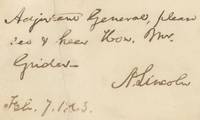
18633619207/02/1863. <blockquote><p>This document has been in a private collection for a generation</p><p> </p><p>Kentucky Unionists were important to Lincoln a Kentucky native as he famously said ""I hope to have God on my side but I must have Kentucky.â€</p><p> </p><p>The Congressman Henry Grider apparently needed to see Thomas to discuss the Act its impact on Kentucky and the details of how the recruitment would be handled</p></blockquote><p>Kentuckian Henry Grider was a Whig who served in Congress from 1843-1847 and then as a Unionist from March 4 1861 until 1865. For the Thirty-ninth Congress 1865–1867 Grider shifted to the Democratic Party but retained his commitment to the Union serving from March 4 1865 until his death in office on September 7 1866. Grider represented a Kentucky pro-slavery but Union-loyal constituency and he retained that point of view throughout the Civil War. Kentucky Unionists like Grider were particularly important to Abraham Lincoln a Kentucky native who had famously said ""I hope to have God on my side but I must have Kentucky.†Lincoln is known to have consulted with Grider about Kentucky affairs and relied on his support and that of the Kentucky delegation to Congress.</p><p>On February 7 1863 Congress passed an Act providing that “the Governor of the State of Kentucky by the consent and under the direction of the President of the United States shall have power to raise and organize into regiments a volunteer force not exceeding twenty thousand rank and file to be raised within the State of Kentucky to serve for the term of twelve months to be employed within the limits of Kentucky in repelling invasion suppressing insurrection and guarding and protecting the public property: Provided That at any time it may be necessary in the discretion of the President of the United States these troops may be employed out of the limits of Kentucky against the enemies of the United States.â€</p><p>Thus the Governor of Kentucky would raise a force of 20000 volunteers to serve in Kentucky but President Lincoln had the authority to order them used outside the state. This Act was received with mixed reviews in Kentucky and on the very day it was enacted Grider’s son Benjamin C. Grider a slave-holding Unionist resigned from the Union Army. From the timing of his resignation one can surmise that he disapproved of the Act. He had commanded the 9th Kentucky Volunteers.</p><p>Lorenzo Thomas was the Adjutant General of the U.S. Army at that time and his job was to maximize operational effectiveness of the army by manning recruiting for and sustaining military operations.</p><p><strong>Autograph note signed</strong> Washington February 7 1863 the day of the Act to Lorenzo Thomas expediting Grider’s ability to see Thomas. <em>“Adjutant General Please see and hear Hon. Mr. Grider. A. Lincoln.â€</em> It seems clear that Grider needed to see Thomas to discuss the Act its impact on Kentucky and the details of how the recruitment would be handled and managed. Not in Basler. A separation running vertically archivally mended.</p><p>This is a very scarce communication involving Lincoln aiding a Kentucky Unionist.</p><p><img class=""alignnone wp-image-25018 size-post-window"" src=""https://cdn.raabcollection.com/wp-content/uploads/20231204144051/Folder-site-11-1600x1327.jpg"" alt=""historical memorabilia dealer"" width=""1600"" height=""1327"" /></p> unknown
18623568928/02/1862. <blockquote><p>He was later promoted to Lt. Colonel for gallantry in action at the Battle of Groveton</p></blockquote><p><strong>Document signed</strong> with fine engravings of an eagle flags and cannons Washington February 28 1862 naming Percy B. Spear a Commissary of Subsistence of Volunteers with the rank of Captain effective November 30 1861. The document is countersigned by Secretary of War Edwin M. Stanton. The appointment is listed in the U.S. Army Register.</p><p>The Civil War Commissary Department was responsible for procuring storing and distributing food to soldiers. The rations managed by the department included such things as pork beef bread coffee and soap.</p><p>But Spear did not serve solely as a Commissary for the entire war. He would soon serve an aide-de-camp in the Fifth Corps in the Gettysburg campaign with Gen. James Barnes mentioning him with distinction in dispatches. Spear ended the war as a Brevet Major. In July 1865 he was appointed Lt. Colonel of Volunteers for meritorious service and for gallantry in action at the Battle of Groveton in 1862. After the war he was again named Commissary of Subsistence this time at the recommendation of Gen. George G. Meade.</p><p><img class=""alignnone wp-image-25018 size-post-window"" src=""https://cdn.raabcollection.com/wp-content/uploads/20231204144051/Folder-site-11-1600x1327.jpg"" alt="""" width=""1600"" height=""1327"" /></p> unknown
173740577London: Chez Jean Brindley Libraire de S. A. R. Monseigeur le Prince de Galles dans New Bond-street 1737. Folio. 17 7/8 x 11 1/4 inches. Complete second edition. 43 double-page engravings after Abraham van Diepenbeke including 42 numbered 1-42 and the unnumbered 1658 title with Anvers imprint. Engraved head-piece to first dedication. Numerous woodcut illustrations throughout the text and woodcut historiated and inhabited initials head- and tail-pieces and printer's ornaments. 12 1-236. 248 pp. Letterpress title with London imprint and four dedications to Henriette Cavendishe-Holles the King of Grande-Bretagne Charles Vicomte de Mansfield and to Cavaliers. Avertissement avant-propos four livres plus an Abbrege de la Cavalerie conclusion additions table des chapitres. Text in French. Contemporary brown full morocco paneled blind with gilt filets on board edges and gilt dentelles seven raised bands forming eight compartments on a richly gilt spine with gilt-lettered red morocco titling-pieces in second and third compartments and gilt foliate tooling in rest marbled endpapers on laid paper all edges gilt<br/> <br/> Cavendish's classic 1737 treatise on equestrianism with 43 splendid double-page engravings: "The illustrations are among the most beautiful to ever grace equestrian literature." Ramsay<br/> <br/> Though considered a country of horse lovers England only produced one early master of classical riding: William Cavendish Duke of Newcastle who was a Royalist living in exile until the restoration of King Charles II. During his exile Cavendish opened a riding school in Belgium and wrote the present work La Méthode et Invention Nouvelle de Dresser les Chevaux. This text was the first of Cavendish's two important books on breeding and training horses and was translated into French from his English manuscript and published in Antwerp in two issues: 1657 and 1658 though many of the 1657 title-pages have been altered by hand to read 1658. The first printing was largely incinerated by a fire in the bookseller's shop and is all but impossible to acquire. Brunet Offered here is the second edition of Cavendish's first book a work long cherished by bibliophiles for its typographical excellence and the masterful quality of its illustrations. It is a work that has been esteemed by countless generations of horsemen and revered by such master riders as La Guérinière Comte d'Aure and Steinbrecht. It is a landmark of equestrianism. Steinkraus Cavendish's book has been called the only really outstanding work on the subject written by an Englishman. Toole-Stott In it Cavendish discusses a wide variety of equine subjects including the recognition of the age and disposition of a horse; the characteristics of various types of horses such as the Spanish the Barb the English horse and the Arabian; methods of maintenance; and instructions on proper riding: "You must in all Airs follow the strength spirit and disposition of the horse and do nothing against nature; for art is but to set nature in order and nothing else." Of the 43 wonderful double-page engraved plates after Abraham van Diepenbeke 24 depict the multiple stages Cavendish and his assistant Captain Mazin employed in training horses in complicated maneuvers. The quality of the impressions in the present 1737 edition surpasses even those of the original edition. Steinkraus This was the first edition of La Méthode et Invention Nouvelle de Dresser les Chevaux to be published in England with engravings pulled from the original 1658 copperplates which were acquired by the publisher Jean Brindley.<br/> <br/> Brunet I 1700. Graesse II 93. Huth 23. Lowndes 1663. Mennessier de la Lance II p. 250. Nissen ZBI 848. Podeschi Mellon Books on the Horse and Horsemanship pp. 26 49. Ramsay "Early Dressage Literature to 1800" IOBA 6.9.03. Steinkraus Introduction to A General System of Horsemanship 2000. Wing N884-87. Chez Jean Brindley, Libraire de S. A. R. Monseigeur le Prince de Galles, dans New Bond-street unknown
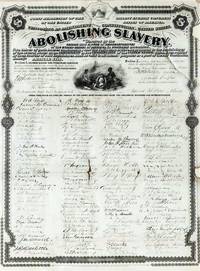
1868019219Chicago: Western Bank Note & Engraving Co. 1868. First Edition. Document. Recently backed with thin paper with several professional repairs of chips and tears. Very Good . Large folio 16-1/4" x 21-3/4" finely engraved and printed on good quality paper with elaborate decorative borders with a "US" monogram to upper corners a bold calligraphic heading with "ABOLISHING SLAVERY" in prominent decorated letters; at top center is a small vignette of the pyramid and all-seeing eye above an oval vignette of a slave family with child mourning over a cameo portrait of Lincoln. This is followed by the engraved signatures of President Lincoln Vice President Hamlin Schuyler Colfax and J. W. Forney Speaker and Secretary of the Senate and 164 Senators and Congressmen. An exceedingly rare and beautiful printing of the Thirteenth Amendment abolishing slavery: "Neither slavery nor involuntary servitude . Shall exist within the United States." This elaborately engraved Reconstruction-era broadside is based on the special "souvenir" copies on parchment signed by Lincoln and the others of which only a handful are known to have been made. The Thirteenth Amendment represents the first substantive change to how America interpreted those liberties guaranteed by the Bill of Rights since its ratification in 1791. The Emancipation Proclamation only freed the slaves in the openly rebellious states. The Amendment effectively put an end to slavery once and for all upon its passage on 1 February 1865. <br/><br/> Western Bank Note & Engraving Co. unknown
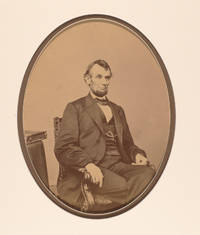
186442820809<p>Oval albumen print 8 x 6 in. original printed mount trimmed at bottom removing caption signed "BRADY & CO. PHOTOGRAPHERS." Browning and offsetting to mount light toning to image. Very good. Matted and framed.</p><p><strong>The classic Brady $5 bill photograph.</strong> This celebrated portrait the basis for the five-dollar bill engraving used for most of the 20th century is one of seven poses taken by Anthony Berger at Mathew Brady's Washington D. C. studio on February 9 1864. The most prolific photographer of Lincoln Brady himself did not actually operate his cameras during the war years instead training and employing men like Alexander Gardner and his successor Anthony Berger who took this picture to operate the camera.</p><p><strong>Lincoln's son Robert Todd Lincoln declared this famous portrait to be "the most satisfactory likeness" of Abraham Lincoln.</strong></p> Mathew Brady Gallery
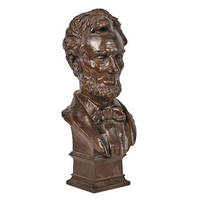
133797Patinated bronze portrait bust of Abraham Lincoln marked "GEO. E. BISSELL Sc GORHAM CO. FOUNDERS copyrighted" and stamped "G 47." This is one of a series of popular desktop busts of Lincoln produced by the Gorham foundry in the early part of the 20th century. In fine condition. The piece measures 18 inches in height. An exceptional piece of American history. unknown
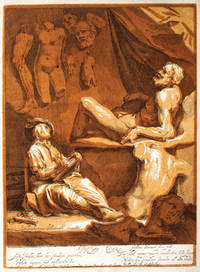
16791669291679. BLOEMAERT Abraham and Frederik. Artis Apellae Liber Tekenboek van Abraham Bloemaart / The Drawing Book of Abraham Bloemaert. Complete set of 160 engravings in eight parts including the chiaroscuro woodcut title-page. Folio 326 x 238 mm bound in contemporary Dutch brown calf blind-tooled spine. Amsterdam: Nicholaes Visscher 1679-1702. First Edition of Abraham Bloemaert's Drawing Book Tekenboek illustrated with engravings by Frederik Bloemaert ca. 1610-1669 after his father's designs. Abraham Bloemaert's original life drawings which were executed mainly between 1625-1635 and 1645-1650 include multiple studies of hands feet arms legs male and female profiles nudes putti and costumed figures seen in various poses from varied angles and under various lighting conditions plus a number of domestic animals. Abraham Bloemaert intended his drawings later converted by his son into engravings to serve as a teaching collection of visual models for practicing artists. The publishing history is as follows: a variant edition containing between 100 and 120 engraved plates was issued by Bloemaert's son Frederik between 1650 and 1656 under the title: Artis Apellae Liber. The 1650-56 edition is so rare it is unobtainable today. It is recorded in only three copies: British Museum 120 plates Bibliothèque Nationale de France 100 plates and Los Angeles County Museum of Art 120 plates. The extreme rarity of all early editions of Bloemaert's Tekenboek reflects the fact that a very limited number were originally printed and that the early printings did not survive the heavy use received by artists and the assistants in the artist's studio. The present copy belongs to the true First Edition Roethlisberger 1a 393 Visscher edition complete with 160 engraved plates plus the chiaroscuro woodcut title all in very good impressions. It is significant that Roethlisberger in his massive catalogue raisonné of the work of Abraham Bloemaert and His Sons Doornspijk 1993 reproduces the entire set of engravings from the 1740 edition. Abraham Bloemaert 1564-1651 was successful as a teacher not only of his four sons but also of the leading Dutch Caravaggisti e.g. Terbrugghen and Honthorst and virtually every Utrecht master painter/artist. Besides Hendrik Goltzius Abraham Bloemaert and his son Frederik were among the earliest to combine the chiaroscuro woodblock technique with the engraved and etched line Hind. Unlike most drawing books "Bloemaert's drawing examples are not derived from other authors" Bolten. Very occasional browning or spotting overall a fine clean copy. PROVENANCE: Illegible signature Nuremberg on front flyleaf. Arthur & Charlotte Vershbow with ex-libris their sale Christie's NY #2800 Lot 402. Roethlisberger 1a 393 reproductions of every plate Roethlisberger II T1-T166. Bolten Method and Practice: Dutch and Flemish Drawing Books 1600-1750 pp. 48-67 and passim 24 reproductions. Hollstein Dutch and Flemish F. Bloemaert 36-155. Strauss Chiaroscuro 346. See: Caroline Fowler Between the Heart and the Mind: Ways of Drawing in the Seventeenth Century Internet Resource Princeton University for long discussion of Bloemaert's Tekenboek. unknown books
600008"Abraham Lincoln" in black ink Washington February 10 1862. Folio. Partially printed document on vellum accomplished in a secretarial hand. Blue wafer seal intact. Lincoln's signature is dark. Appointment of Ethan Allen Hitchcock to the rank of Major General of Volunteers. Boldly co-signed by Edwin Stanton Secretary of War and Adjutant General L. Thomas a few small holes at the folds else fine fresh and dark. Lincoln 1809-65 16th President of the United States 1861-65 and one of the most important figures in American history. Hitchcock 1798-1870 Graduated West Point in 1817; served in Florida war; later with Winfield Scott in Mexico. He was commissioned Major-General of Volunteers as per this document in 1862 and rendered many valuable services to Lincoln's administration and the Union Army see Basler's Lincoln for numerous references to him. Signed by Authors. F. Soft cover. hardcover books
600008"Abraham Lincoln" in black ink Washington February 10 1862. Folio. Partially printed document on vellum accomplished in a secretarial hand. Blue wafer seal intact. Lincoln's signature is dark. Appointment of Ethan Allen Hitchcock to the rank of Major General of Volunteers. Boldly co-signed by Edwin Stanton Secretary of War and Adjutant General L. Thomas a few small holes at the folds else fine fresh and dark. Lincoln 1809-65 16th President of the United States 1861-65 and one of the most important figures in American history. Hitchcock 1798-1870 Graduated West Point in 1817; served in Florida war; later with Winfield Scott in Mexico. He was commissioned Major-General of Volunteers as per this document in 1862 and rendered many valuable services to Lincoln's administration and the Union Army see Basler's Lincoln for numerous references to him. Signed by Authors. F. Soft cover. hardcover
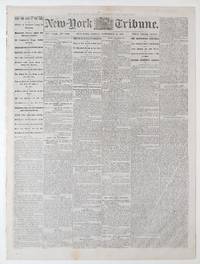
1863372898New York 1863. 8pp. printed in six columns on a single folded sheet. Large folio. Disbound. Natural paper flaw to first leaf not affecting text of the Gettysburg Address. Cloth portfolio. 8pp. printed in six columns on a single folded sheet. Large folio. The complete issue of the New-York Tribune printing the Gettysburg Address on the morning of Nov. 20 1863 the first possible date of the speech's printing. The previous day Lincoln delivered his great address at the dedication of a cemetery on the Gettysburg battlefield four months after the bloody and pivotal battle that turned the tide of the Civil War in favor of the Union. Lincoln's speech was preceded by an address from Edward Everett the most famous orator of his day. Everett's speech took between ninety minutes and two hours to deliver and today is largely forgotten. Lincoln's speech delivered in only a few minutes stands as a supreme distillation of American values and of the sacrifices necessary for the survival of liberty and freedom.<br /> <br /> Much controversy surrounds the circumstances and content of the address as it was actually delivered at Gettysburg. The words spoken in the speech differ in the versions appearing in newspapers and the text which appeared in Washington several days later published as The Gettysburg Solemnities and known in only four copies which is now taken as the closest version to Lincoln's final intent because of its correspondence to the known manuscript versions. Interestingly and according to Carbonell the text of the first appearance of the speech in book form published a few days later as An Oration Delivered on the Battlefield of Gettysburg is taken largely from this New York Tribune printing.<br /> <br /> As it appears here the address corresponds closely to the transcription printed in the same day's edition of the New York Times with slight variations in punctuation and capitalization "Four score and seven years ago our fathers brought forth on this continent a new Nation." in the Tribune versus "Fourscore and seven years ago our Fathers brought forth on this Continent a new nation." in the Times e.g. The address is printed on the first page at the bottom of the fifth column running to the top of the sixth. Significantly it notes the five places during Lincoln's speech where applause broke out thereby providing an important historical record of the reception of the speech as it was delivered by Lincoln. It is noted that the conclusion of the speech was met with "long continued applause" and that "three cheers were here given for the President and the Governors of the States." Lincoln's speech is preceded by the opening prayer of the Rev. Thomas H. Stockton and followed by Everett's speech which occupies the rest of the sixth column and the vast majority of space on page two. War news occupies the other column space on the front page.<br /> <br /> Together with examples from other newspapers of Nov. 20 1863 this issue of the New-York Tribune represents the first appearance of any version of the Gettysburg Address in print although at some variance with the version Lincoln eventually disseminated. The exact order in which the morning editions of November 20 were printed is practically impossible to determine at this point and as Carbonell states "will almost certainly never be known." Rightfully so Carbonell includes all November 20 morning newspaper printings of the Gettysburg Address as his first entry with no priority. Suffice to say this is as early a printing of one of the foundational documents of American life as one can ever encounter.<br /> <br /> "Lincoln's speech composed on the train on the way to Gettysburg and written down according to tradition on scratch-paper and the backs of envelopes comprised ten sentences and took only a few minutes to deliver. From the first words - 'Four score and seven years ago' - to the last - 'that government of the people by the people and for the people shall not perish from the earth' - it is immortal one of the supreme utterances of the principles of democratic freedom" PMM. Carbonell 1. Grolier American 100 72 ref. Streeter Sale 1748 ref. PMM 351 ref. Howes E233 ref. Monaghan 192 ref. Paul M. Angle "Four Lincoln Firsts" in Papers of the Bibliographical Society 36 Spring 1942 pp.13-17 unknown
169640906Leiden and Utrecht: Pieter vander Aa and François Halma 1696. Two volumes folio. 15 5/16 x 10 1/4 inches. Half title title printed in red and black with engraved vignette. Engraved additional title and 243 engraved plates. Contemporary Dutch blindstamped vellum with arabesque design.<br/> <br/> Provenance: Karl Magnussun bookplate – John David Drummond 8th Earl of Perth Viscount Strathallan<br/> <br/> First expanded edition of one of the most attractive Dutch florilegia of the seventeenth century.<br/> <br/> Munting was professor of botany at the University of Groningen and took over and enlarged the botanic garden founded by his father Henricus. The present work depicts some of the exotic and remarkable plants growing in the garden. It is one of the earliest and most important documents concerning Japanese flora and its importation into the West predating Thunbergs works by almost one hundred years. "Munting wrote a number of works on medical-botanical topics but his posthumously published opus magnum the Naauwkeurige enjoyed particular success at least in part due to the novelty of the plates which in a radical departure from the iconography of the traditional florilegium presented its plant species against a charming series of landscape backgrounds . The illustrations are remarkable for their elegance and originality" Oak Spring Flora. The initial botanical line drawings are now known to have been by about ten different but unidentified artists. Some time after Munting's death and in preparation for their publication these line drawings had tone and the pictorial back- and fore-grounds added by Jan Goeree 1670-1731 under the supervision of the publishers. The engraving and etching was then carried out by Jacob Gole and Joseph Mulder engraver of many of plates in Maria Sibylla Merians work on the insects of Surinam.<br/> <br/> Hunt 396; Nissen BBI 1428; Tomasi Oak Spring Flora 45 latin edition; Pritzel 6556; Brunet 1947. Pieter vander Aa and François Halma unknown
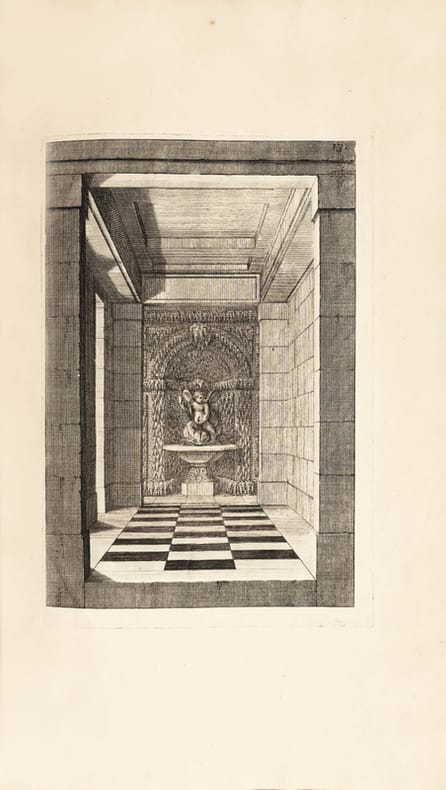
LCS-18326Rare réédition des trois principaux ouvrages théoriques d'architecture d'Abraham Bosse, entièrement dessinés et gravés en taille-douce par lui-même, et imprimés d'un seul côté. Paris, Pierre Aubouin, Pierre Emery et Charles Clousier, s.d. [1688]. In-folio de 1 titre, 1 frontispice, 44 planches. - [Suivi de] : Des Ordres de colones en l’Architecture… [Paris, 1688]. 1 frontispice, 1 planche sur double-page, (20) feuillets gravés. - [Et de] : Représentations Géométrales De plusieurs parties de Bastiments faites par les Reigles de l’Architecture antique Et de qui les mesures sont reduites en Piedz poulces & lignes, Afin de saccomoder a la manière de mesurer la plus en usage parmy le commun des Ouvriers. Paris, 1688. 1 frontispice et 22 feuillets gravés. Soit 3 ouvrages en 1 volume in-folio, veau moucheté, encadrement de filets à la Duseuil sur les plats, dos à nerfs orné de fleurons dorés, roulette dorée sur les coupes, tranches mouchetées rouges, qq. usures aux mors sans gravité. Reliure du XVIIIe siècle. 420 x 263 mm.
18638667<p>One partially printed vellum leaf dated February 21 1863 of the appointment of James Alden Jr. as a Captain in the Navy. Signed by President Abraham Lincoln and the Secretary of the Navy Gideon Welles. Orange embossed seal of the Department of the Navy to bottom. Previous owner's repair to upper right corner see image. Loses at folds see image. James Alden Jr. had an impressive career in the United States Navy having been appointed by Lincoln in aiding to split the Confederacy apart along the Mississippi River ultimately helping in the Battle of Vicksburg. Alden whose direct descendant came to America on the Mayflower assisted in the Mexican-American War before joining the Union during the Civil War.</p><p>The paper measures approximately 14.5 x 17.75 in 37 x 45 cm.</p>
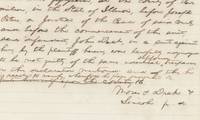
18573563230/10/1857. <p>John V. Drake and John C. Moses practiced law in Danville Illinois. They worked on cases appearing before the Vermilion County Circuit Court. When Abraham Lincoln had a case appearing in that court he would sometimes affiliate himself with Drake and Moses. Lincoln was before that court in October and November 1857.</p><p>Hezekiah Ballah sued John Deck and Zachariah Deck in a case heard in the Vermilion County Circuit Court. This was an action of trespass for castrating seventeen buck sheep and cutting up eight other ewes wethers and lambs. The Decks retained Lincoln who worked together with Drake and Moses in the case in October 1857. The Decks pleaded not guilty. Moreover John Deck also pleaded that he had been acquitted of the charge in Justice of the Peace court. The jury found the Decks not guilty. Hearing the case was Judge David Davis who Lincoln would one day name to the U.S. Supreme Court.</p><p><strong>Autograph document signed</strong> a draft pleading completely in Lincoln’s hand Vermilion County Circuit Court October 1857 being the pleading informing the Court that Deck had previously been acquitted of the same offense. The name of the case was John Deck impleaded with Zachariah Deck ads vs Hezekiah Ballah and it was filed In Trespass. <em>“And the said defendant John Deck comes and defends the force and injury…and says plaintiff actio non fails to act when there is a duty to act because he defendant says he is not guilty in manner and form as is in the declaration alleged; and of this he puts himself upon the country etc. citizens in a court or jury. Moses & Drake & Lincoln p.d.â€</em></p><p>Lincoln adds below: <em>“And for further plea in this behalf defendant John Deck says plaintiff actio non because he says that heretofore to wit on the __ day of __ in the year of our Lord one thousand eight hundred and fifty seven at the county of Vermillion in the state of Illinois before Joseph Peters a Justice of the Peace of said county and before commencement of this suit said defendant John Deck in a suit against him by the plaintiff herein was lawfully judged to be not guilty of the same identical supposed trespass in this declaration mentioned and this he is ready to verify therefore he prays judgment etc. Moses & Drake & Lincoln p.d.â€</em> The case is listed at lawofficeofabrahamlincoln.org.</p><p>An interesting pleading where Lincoln’s client has already been acquitted of the same offense.</p><p><img class=""alignnone wp-image-25018 size-post-window"" src=""https://cdn.raabcollection.com/wp-content/uploads/20231204144051/Folder-site-11-1600x1327.jpg"" alt="""" width=""1600"" height=""1327"" /></p> unknown