Henri Abraham ChatelainBiblio.com

26 503 résultats
171962639/62640<p>original outline-colour copper engravings enhanced hand-colour. EXTREMELY RARE stunning World map in 2 sheets from the extensive multi-volume 'Atlas Historique' vol. 6 no. 30 p. 117; published by Chatelain Amsterdam. One of the most informative decorative and impressive maps centered on the Pacific available. Printed on four large sheets the overall map is of wall-chart proportions and a veritable pictorial encyclopaedia of the World including the Philippines; many famous voyagers' tracks/routes are indicated. A great example of early 18th Century craftsmanship! Condition: 1st sheet - folds as issued small tear on lower centrefold; 2nd sheet - folds as issued; due to imperfect printing the neatlines are not perfectly parallel neither horizontally nor vertically. Otherwise Excellent condition. References: Not in Quirino; Phillips 579; Goss Kartenkunst Taf. 7.5; Ders. North America map 52; Portinaro/Knirsch p. 216/7 all 3 with crude but col. image.; Tooley California No. 80; Tooley Early Maps of Australia No. 66; Wagner NW Coast America Nr. 511; Lowery No. 291 only Northern part; Lietz Insulae India Orientalis p. 132<br /><br /><br /><br /></p> Chatelain, Amsterdam.
1865WRCAM55213N.p. but almost certainly Springfield Il 1865. Broadside 12 x 9 inches. Printed in three columns edged with a printed black border. Old folds center vertical fold with some separation. Moderate staining. Still very good. Framed. Likely a proof copy of the exceedingly rare broadside announcing the funeral procession for President Abraham Lincoln in Springfield in early May 1865. Struck down by assassin John Wilkes Booth on April 15 1865 Lincoln's body lay in state in the White House on April 18 and a ceremonial funeral service took place in Washington D.C. around noon on April 19. Two days later President Lincoln's casket was loaded on a funeral train headed for Springfield Illinois stopping at Baltimore Harrisburg Philadelphia New York City Albany Buffalo Cleveland Columbus Indianapolis Michigan City and Chicago before arriving in Lincoln's adopted hometown early on the morning of May 3. At this time Springfield's population numbered around 15000 but Lincoln's funeral train pulled into a town swollen with over 100000 visiting mourners. Immediately upon arrival Lincoln's coffin was transferred by hearse to Representatives' Hall inside the Illinois Old State Capitol. For the next twenty-four hours from about ten o'clock in the morning on May 3 to the same time the next day about 75000 mourners were allowed to pass by the open coffin of the slain president to pay last respects. <br> <br> According to the present broadside President Lincoln's funeral procession left the Old State Capitol "on Thursday the 4th Inst. at 10 o'clock a.m. precisely." The funeral party of over 10000 people then turned right on 7th Street to pass by the Lincoln family home and then right up Cook Street to proceed past the Governor's Mansion before heading north to Oak Ridge Cemetery. <br> <br> This broadside printing of the order of the procession for Lincoln's Springfield funeral was probably printed the afternoon of May 3 or possibly even the morning of May 4 the day of the funeral. Surrounded by a heavy black band the broadside lists all the persons and units involved in the procession along with their places and the rules for the day. The entire procession was divided into eight divisions with Gen. Joseph Hooker acting as Marshal in Chief. The first three divisions of the military escort represented all the elements of the Army and Navy. After them came the attending clergy and Lincoln's attending physicians. Next was the casket itself the only wheeled vehicle in the procession with the pall bearers to each side followed by Lincoln's horse and then the immediate family. Three more military divisions followed interspersed with government officials ambassadors and state officials followed by delegations from Springfield and other Illinois towns. Next were representatives of various organizations delegations from colleges lawyers doctors and the press Masons Odd Fellows and firemen all interspersed with two more military divisions. The final segment of the funeral procession was designated for "Citizens at large" and "Colored Persons." <br> <br> The broadside gives directions for locations for the forming up of each group. Only marshals were allowed to be on horseback; all others walked. Bands were under the direction of the Committee on Music. Other particular directions follow including regulations for the colors of the various scarves worn by the marshals. The text of the document ends with directions to keep the streets through which the procession passes "clear from sidewalk to sidewalk." <br> <br> This broadside must have been widely distributed to assist the mourners in Springfield but like all such ephemeral pieces few copies have survived. OCLC locates only six at Indiana University the Abraham Lincoln Memorial Library the Boston Athenaeum the Chapin Library at Williams College the John Hay Library at Brown University and the Library Company of Philadelphia. The latter location also attributes the place of printing to Springfield. There is also a copy at the Library of Congress and a copy formerly owned by noted collector James Copley and previously sold by this firm. <br> <br> The present copy is likely an early printer's proof of the broadside as it lacks the first three letters of the word "FUNERAL" in the title. The Library of Congress copy is also likely a proof with its variant title omitting the words "ORDER OF." Both copies also lack the letter "e" in "Order" in the first sentence of text. These errors speak to the haste and stress under which this broadside was surely produced perhaps the day before or the very morning of the day when America's greatest president the Savior of the Union and Illinois' favorite son was laid to rest in a city teeming with seven times its own population in attendance. <br> <br> A remarkable and moving document reflecting a moment of national grief perhaps only approached by the John F. Kennedy funeral and memorializing the day when America's first assassinated president was solemnly committed to the earth. OCLC 5023077 79462381. unknown books
1863WRCAM55251Washington 1863. 20pp. Original printed wrappers. Light toning. A near fine copy in wonderful condition. In a cloth chemise and green half morocco and cloth slipcase spine gilt. The rare pamphlet printing of Lincoln's December 8 1863 proclamation read before Congress the next day offering amnesty to citizens of the Confederacy providing they take an oath that they "will abide by and faithfully support all proclamations of the President made during the existing rebellion having reference to slaves" i.e. the Emancipation Proclamation. When the number of persons in any state taking the oath reached ten percent of the number of voters in 1860 this group of loyal voters could form a state government that could be recognized by the President. The Amnesty Proclamation was issued with President Lincoln's third Annual Message to Congress i.e. State of the Union Address on December 8 1863; the State of the Union Address follows the Amnesty Proclamation here. <br> <br> Toward the close of 1863 with the Confederate Army in full retreat discussions in Congress centered on how to restore the southern states to the Union. "The crisis which threatened to divide the friends of the Union is past" announced Lincoln. Now it was the duty of Congress to ensure that all citizens in the South regardless of race were guaranteed the equal protection of the law. A number of competing proposals emerged from deliberations but in the end during his message to Congress on December 8 1863 Lincoln declared reconstruction of the South a wholly executive responsibility and "offered 'full pardon.with restoration of all rights of property except as to slaves' to all rebels who would take an oath of future loyalty to the Constitution and pledge to obey acts of Congress and presidential proclamations relating to slavery" Donald p.471. <br> <br> Those excluded from taking the oath were the highest ranking members of the Confederacy - government officials judges military and naval officers above the rank of army colonel or navy lieutenant former congressmen and "all who have engaged in treating colored persons or white persons otherwise than lawfully as prisoners of war." Lincoln further encouraged the southern states to make provisions "in relation to the freed people of such State which shall recognize and declare their permanent freedom provide for their education and which may yet be consistent as a temporary arrangement with their present condition as a laboring landless and homeless class." <br> <br> "Lincoln indicated that this was only one plan for reconstructing the rebel South and while it was the best he could think of for now he would gladly consider others and possibly adopt them. He might even modify his own classes of pardons if that seemed warrantable.Afterward almost everybody but die-hard Democrats seemed happy with the plan" Oates p.371. <br> <br> A lovely copy of Lincoln's hugely important Amnesty Proclamation. MONAGHAN 191. SABIN 41162 note. David Herbert Donald LINCOLN New York 1995 p.471. Stephen B. Oates WITH MALICE TOWARD NONE: A LIFE OF ABRAHAM LINCOLN New York 1977 p.371. hardcover books
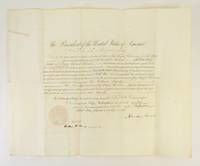
1718ST16605bWashington D.C.: U. S. Government 17 July 1862. 445 x 565 mm. 17 3/4 x 22 1/2". 17 lines of engraved text in copperplate script with names and dates completed in a fine secretarial hand. <br/> Loose as issued in an archival mylar sleeve. ◆Neatly mended two-and-three-quarters-inch tear to one edge well away from text half inch slit to end of one fold three very short separations along two folds only one touching text otherwise A FINE FRESH SPECIMEN clean and bright the signature dark and clear the wax-and-white-paper seal intact.<br/> <br/> This is an excellent example of a presidential document with Lincoln's full signature and with that of his Secretary of State William Henry Seward 1801-72 remembered for negotiating the purchase of Alaska from Russia. The consul appointed in this document Jay Haziel Sherman of Vermont served in Charlottetown Prince Edward Island from 1861 to 1865. It is likely this appointee was Jahaziel Blossom Sherman 1801-65 son of pioneering steamship captain Jahaziel Sherman 1770-1844 and that his unusual Old Testament name was misspelled by the scribe who filled in the appointment form. The younger Sherman died in Nova Scotia in 1865. U. S. Government unknown
15887526At London Imprinted by William How for Thomas Gubbin and T. Newman 1588. 1588 4to. 10 85 2 87-151 leaves. Folding table 'A generall Table of the whole Booke'. Later calf panelled in blind with a two line roll and small corner tools. The spine with four raised bands and blind lines. Evidence of a lost label. The spine darkened and minor rubs on the edges and corners. Internally clean and tight with pinholes of worm to the final three leaves mostly marginal but affecting three letters of text on Rrii. Later signature E. Dawson on the front pastedown. Fraunce was a member of Philip Sidney's circle and all his writings were dedicated to members of that group. His writings were commended both by Thomas Nashe and by Francis Meres. In this work he follows the Ramist principles he also employed in other works providing literary examples to demonstrate principles of logic. Here however he expands the approach by using common law cases from Plowden and others. ESTC S102621 . At London, Imprinted by William How, for Thomas Gubbin, and T. Newman, hardcover
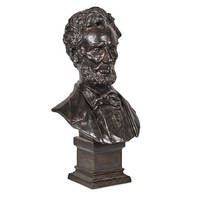
131044Patinated bronze cast of Abraham Lincoln by George Bissell one of only three commissioned by Ralph Newman for THE USS AL. Boldly signed by the artist in the back Geo. E. Bissell Sc. George Bissell was an important American sculptor working in the late 19th and early 20th centuries. He produced two full length statues of Lincoln: one in Edinburgh and one in Clermont Iowa. According to the letter from Lincoln College Curator Paul Beaver the present item is one of three copies made from the school's original Bissell bronze bust of Lincoln by the Van Dyke Galleries of Chicago in the summer of 1989. One copy was presented to the USS Abraham Lincoln commissioned in 1989 one copy was sold to Mel Smith and the third to Barry and Louise Taper. In fine condition. The piece measures 25.5 inches in height. An exceptional piece. unknown
1861690201861. Military commission signed by Abraham Lincoln Washington August 1861. Folio on vellum with vignettes. Light wear along the folds. Countersigned by Simon Cameron. Matted and framed. Abraham Lincoln served as the 16th President of the United States from March 1861 until his assassination in April 1865. He led the United States through its Civil War and in doing so preserved the Union of the United States of America abolished slavery and strengthened the federal government. hardcover books
1863601017in black ink as President Washington D.C. December 23 1863. Six lines plus signature and date on verso of the integral blank of an Autograph Letter Signed from General John M. Schofield Washington D.C. December 23 1863. Octavo. 2 pages. Fine fresh example dark and clean. In his letter Schofield addresses his commander in chief deferentially: "Mr. President I desire simply to ask you if I may be absent from Washington a few days pending the settlement of my affairs I wish to spend Christmas day with my relatives at West Point. If there is any reason for my remaining here of course I do not wish to go." On verso Lincoln writes: "Not the slightest objection to Gen. Schofield's visiting West Point so that he be in call by Telegraph." This letter serves as an interesting footnote to the long-simmering problem in Missouri where Schofield had been in command. A slave state Missouri had seethed with pro and anti-slavery conflicts and was terrorized by armed bands of southern sympathizers. Schofield and the provisional governor had engaged in bitter jurisdictional quarrels until all factions finally united to criticize Schofield for his "high-handed" administration and demand his removal. In early December 1863 a congressman who had visited Missouri told Lincoln first hand of Schofield's increasing difficulties prompting the President on December 11 to telegraph a simple order to Schofield: "Please come see me at once." After his White House interview Lincoln recommended that Schofield be promoted to major general transferred and Rosecrans appointed to take his place. Lincoln's recommendation was quickly approved by the Senate. Schofield 1831-1906 Graduated West Point 1853. In Missouri at the outbreak of the Civil War he became chief of staff to Gen. Nathaniel Lyon and served until Lyon’s death at the battle of Wilson's Creek August 1861. Promoted brigadier-general of volunteers in November he was engaged in field operations in Missouri and later commanded the Department of the Missouri as major-general. Assuming command of XXIII Corps in February 1864 he took part in Sherman's Atlanta campaign as one of the three army commanders and badly shattered Hool's confederate force at the fierce battle of Franlklin Tenn. Moving the XXIII Corps to the mouth of the Cape Fear river He occupied Wilmington N.C. and effected a junction with Sherman at Goldsboro March 23 1865 for the final moves against Gen. J.E. Johnston. In the spring of 1868 served briefly as U.S. secretary of war. Promoted major-general regular army 1869 he commanded several departments successively and made the recommendations that led to the acquisition of Pearl Harbor Hawaii as a naval base. Superintendent at West Point 1876-81. Lincoln 1809-65 16th President of the United States 1861-65 and one of the most important figures in American history. Signed by Authors. F. Soft cover. unknown books
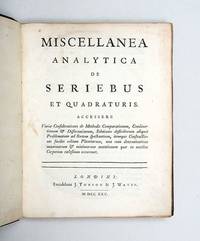
3499Several woodcut diagrams in the text. 6 p.l. 250 pp. one leaf of errata. Large 4to cont. calf two corners a bit worn double gilt fillet round sides spine gilt morocco lettering piece on spine. London: J. Tonson & J. Watts 1730. bound with: -. Drop-title: Miscellaneis Analyticis Supplementum. 22 pp. one leaf of errata. N.p.: n.d. First edition of the de Moivre's "most important book" D.N.B. here bound with the rare Supplementum which is very often missing. The Miscellanea Analytica is the successor to The Doctrine of Chances and contains the first formulation of "De Moivre's Theorem" the formula for determining a normal approximation to a binomial distribution. This became "the most fruitful single instrument of discovery used in probability theory and statistics for the next two centuries."-D.S.B. IX pp. 452-53. The Supplementum was published by de Moivre to answer criticisms made by James Stirling after the appearance of the Miscellanea. A very nice copy from the library of Haskell F. Norman with his bookplate. ❧ Stigler The History of Statistics pp. 70-77. unknown books
2989Engraved vignette on title and engraved head- & tailpieces. 2 p.l. xiv 175 pp. Large 4to cont. mottled calf expertly rebacked & recornered by Aquarius spine richly gilt red morocco lettering piece on spine. London: W. Pearson for the Author 1718. First edition and a fine copy of this classic on the theory of probability; it is dedicated to Isaac Newton who was a personal friend of the author. "His work on the theory of probability surpasses anything done by any other mathematician except P.S. Laplace. His principal contributions are his investigations respecting the Duration of Play his Theory of Recurring Series and his extension of the value of Daniel Bernoulli's theorem by the aid of Stirling's theorem."-Cajori A History of Mathematics p. 230. Nice copy. ❧ Babson 181-"He was among the intimate friends of Newton to whom this book is dedicated. It is the second book devoted entirely to the theory of probability and a classic on the subject." Stigler The History of Statistics pp. 70-85. Tomash M 114. unknown books
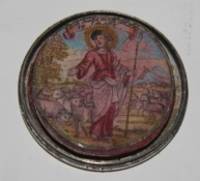
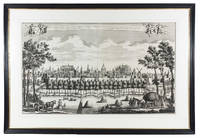
1732004823Amsterdam 1732 or 1733. The panorama or concertina was made we believe in 1732 or 1733 or close to that date. The silver "shraubthaler" or outer casing we assume was made separately at a later date but not long afterward. <br /><br /> books
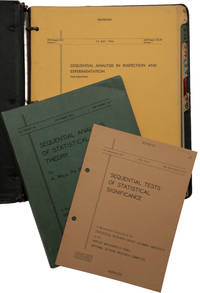
19445180Washington: National Defense Research Committee 1944. First edition. <p>First edition very rare of Wald's seminal invention of 'Sequential analysis' the "notion that in some sense it is economical to observe and analyze data sequentially rather than to observe and analyze a single sample of predetermined fixed size" DSB. It is here offered in the original 'restricted' reports; it was published four years later in his well-known book Sequential Analysis. "It was Wald in 1943 who first formulated mathematically and solved quite generally the problem of sequential tests of statistical hypotheses. He introduced the particular method of the sequential probability ratio test and with Wolfowitz 1948 showed its optimal properties" ibid.</p>. THE INVENTION OF SEQUENTIAL ANALYSIS - THE ORIGINAL RESTRICTED REPORTS. <p>First edition very rare of Wald's seminal invention of 'Sequential analysis' developed while he was in charge of Columbia University's Statistical Research Group in response to the demand for more efficient methods of industrial quality control during World War II. It is here offered in the original 'restricted' reports; it was published four years later in his well-known book of the same title. "Wald's second major achievement in mathematical statistics is sequential analysis. The notion that in some sense it is economical to observe and analyze data sequentially rather than to observe and analyze a single sample of predetermined fixed size was not a new one. Intuitive support for this notion is immediate; if the evidence shown in sequentially unfolding data is sharply one-sided it seems reasonable to believe that the inquiry can be terminated early with lengthier inquiries reserved for those situations in which the issue at hand appears via the sequentially unfolding data to be in greater doubt. This notion and the partial mathematical formulation of it were to be found in the statistical literature; among those who dealt with it before Wald was Walter Bartky of Chicago and among Wald's contemporaries George Barnard working in England. But again it was Wald in 1943 who first formulated mathematically and solved quite generally the problem of sequential tests of statistical hypotheses. He introduced the particular method of the sequential probability ratio test and with Wolfowitz 1948 showed its optimal properties. He found operating characteristic and average sample number functions; he introduced if he did not completely solve the problem of sequential tests of composite hypotheses utilizing weight functions; and he began vital discussions of such basic topics as multivalued decisions and optimal sequential estimation. All this plus many special problems were gathered together in Sequential Analysis 1947 a book surprisingly easy to read less formal and more elementary in structure than his work on decision functions" DSB. No copies listed on ABPC/RBH.</p> <br /> <br /> <p>"Sequential analysis is the branch of statistics concerned with investigations in which the decision whether or not to stop at any stage depends on the observations previously made. The motivation for most sequential investigations is that when the ends achieved are measured against the costs incurred including the cost of making observations sequential designs are typically more efficient than non-sequential designs .</p> <br /> <br /> <p>"The term 'sequential' is occasionally extended to cover also investigations in which various aspects of the design may be changed according to the observations made. For example preliminary experience in an experiment may suggest changes in the treatments being compared; in a social survey a small pilot survey may lead to modifications in the design of the main investigation . In a sequential investigation observations must be examined either one by one as they are collected or at certain stages during collection. A sequential procedure might be desirable for various reasons. The investigator might wish to have an up-to-date record at any stage either for general information or because the appropriate sample size depends on quantities that he can estimate only from the data themselves. Alternatively he may have no intrinsic interest in the intermediate results but may be able to achieve economy in sample size by taking them into account. Three examples will illustrate these points:</p> <br /> <br /> <p>1 An investigator may wish to estimate to within 10 per cent the mean weekly expenditure on tobacco per household. In order to determine the sample size he would need an estimate of the variability of the expenditure from household to household and this might be obtainable only from the survey itself.</p> <br /> <br /> <p>2 A physician wishing to compare the effects of two drugs in the treatment of some disease may wish to stop the investigation if at some stage a convincing difference can already be demonstrated using the available data.</p> <br /> <br /> <p>3 A manufacturer carrying out inspection of batches of some product may be able to pass most of his batches with little inspection but may carryout further inspection of batches of doubtful quality. A given degree of discrimination between good and bad batches could be achieved in various ways but a sequential scheme will often be more economical than one in which a sample of constant size is taken from each batch </p> <br /> <br /> <p>"The most appropriate design and method of analysis of a sequential investigation depend on the purpose of the investigation. The statistical formulation of that purpose may take one of a number of forms usually either estimation of some quantity to a given degree of precision or testing a hypothesis with given size and given power against a given alternative hypothesis. Economy in number of observations is typically important for sequential design" International Encyclopedia of the Social Sciences.</p> <br /> <br /> <p>"The problem of sequential analysis arose in the Statistical Research Group of Columbia University in connection with some comments made by Captain G. L. Schuyler of the Bureau of Ordnance Navy Department. Milton Friedman and W. Allen Wallis recognized the great potentialities and the far-reaching consequences that sequential analysis might have for the further development of theoretical statistics. In particular they conjectured that a sequential test procedure might be constructed which would control the possible errors committed by wrong decisions exactly to the same extent as the best current procedure based on a predetermined number of observations and at the same time would require on the average a substantially smaller number of observations than the fixed number of observations needed for the current procedure. Friedman and Wallis also exhibited a few examples of sequential modifications of current test procedures resulting in some cases in an increase of efficiency. It was at this stage that they proposed the problem of sequential analysis to the author i.e. Wald. This gave the incentive for the author's investigations which then led to the development of the sequential probability ratio test. </p> <br /> <br /> <p>"Because of the usefulness of the sequential probability ratio test in development work on military and naval equipment it was classified Restricted within the meaning of the Espionage Act. The author was requested to submit his findings in a restricted report dated September 1943. In this report the sequential probability ratio test and the basic theory is given. To facilitate the use of this new technique by the Army and the Navy the Statistical Research Group issued a second report in July 1944 which gives an elementary non-mathematical exposition of the applications of the sequential probability ratio test and contains a considerable number of tables charts and computational simplifications to facilitate applications" Wald pp. 2-3.</p> <br /> <br /> <p>The 10 parts are as follows:</p> <br /> <br /> <p>Sequential analysis of statistical data: Theory September 1943.</p> <br /> <br /> <p>Sequential tests of statistical significance April 1944.</p> <br /> <br /> <p>Applications 15 July 1944:</p> <br /> <br /> <p>Sequential analysis in inspection and experimentation Introduction Section 1;</p> <br /> <br /> <p>Sequential analysis when the result of a single observation is a classification as good or bad and when the result of the test is acceptance or rejection Section 2;</p> <br /> <br /> <p>Sequential analysis when the result of a single observation is a classification as good or bad and when the result of the test is a decision between two methods or products Section 3;</p> <br/> <br/> First report: Small 4to 230 x 180 mm original printed wrappers. Upper right corner with a slight bump. Previous owners initials to front wrapper W.L.D. Stamped RESTRICTED. IX 1179 3: blank pp. Second report: 8vo 244 x 153 mm. Original printed wrappers fine. 10 2: blank pp. Third report: Large 4to 285 x 220 mm. Original ring binder containing the six sections in original printed wrappers together with the two appendicies aslo in wrappers: S1:VIII16; S2:II22; S3:II22; S4:II22; S5:II18; S6:II18; A1:II14; A2:II22 pp. In very good condition. Also included is the mimiographed distribution list of the third report: 1 sheet typescript printed on both sides. All three reports are in the rare original issue with the text: "This document contains information affecting the national defense of the United States within the meaning of the Espionage Act 50 U.S.C. 31 and 32 as amended. Its transmission or the revelation of its contents in any manner to an unauthorized person is prohibited by law". OCLC lists 8 copies of the first report 1 of the second National Institute of Standards and Technology and the third report is not located in any library. National Defense Research Committee unknown
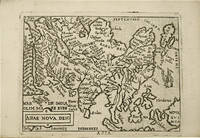
BB17Venetia Per Scipion Banca 1667.<p>16mo 133 x 93 mm of 4 ll. 232 pp. 8 ll. 108 full-page engraved maps.</p><p><b>Bound in contemporary stiff vellum. Handwritten exlibris on the half-title: " </b><i><b>Bibliotheca Neorelli</b></i><b> "</b>.</p><p>Italian pocket-edition of Ortelius' atlas illustrated with 108 full-page engraved maps.</p><p>Philips 478 ; Tooley 31.</p><p>" <i>The commercial success of the pocket-atlas was considerable. It was translated into French and Latin now in prose and was reprinted several times long after Pieter Heyns had moved into the Netherlands together with his son Zacharias in 1588. In the year of Pieter Heyn's death 1598 his son Zacharias then living in Amsterdam repeated the successful best-seller of his father by publishing another Miroir du Monde using woodcut</i>". Koeman.</p><p>The illustration contains a world map and the continents' maps: Europe Asia Africa and America. The 103 other maps represent each country for which a note has been written on the opposite page.</p><p>The first edition in Italian was printed in 1608. </p><p><b>A charming copy preserved in its contemporary vellum binding.</b></p><p><br /></p><p><u>French</u></p><p>Venetia Per Scipion Banca 1667.</p><p>In-16 de 4 ff. 232 pp. 8 ff. 108 cartes gravées à pleine page. </p><p>Relié en vélin rigide de l'époque. Ex libris manuscrit sur le faux titre : " <i>Bibliotheca Neorelli</i> ".</p><p>133 x 93 mm.</p><p><b>Edition de poche italienne de l'atlas d'Ortelius ornée de 108 cartes gravées à pleine page.</b></p><p>Philips 478 ; Tooley 31.</p><p>" <i>The commercial success of the pocket-atlas was considerable. It was translated into French and Latin now in prose and was reprinted several times long after Pieter Heyns had moved into the Netherlands together with his son Zacharias in 1588. In the year of Pieter Heyn's death 1598 his son Zacharias then living in Amsterdam repeated the successful best-seller of his father by publishing another Miroir du Monde using woodcut</i>". Koeman.</p><p>L'illustration s'ouvre sur une carte du monde et se poursuit avec les cartes des continents : l'Europe l'Asie l'Afrique et l'Amérique. Les 103 autres cartes représentent chacun des pays pour lesquels une notice a été rédigée en regard.</p><p>La première édition en italien fut imprimée en 1608. </p><p><b>Seduisant exemplaire conservé dans sa reliure en vélin de l'époque.</b></p> hardcover
LCS-1863L’Atlas de poche d’Ortelius en italien, complet de ses 108 cartes à pleine page, conservé dans sa reliure de l’époque. Venetia, Per Scipion Banca, 1667. In-16 de (4) ff., 232 pp., (8) ff. 108 cartes gravées à pleine page. Relié en vélin rigide de l’époque. Ex libris manuscrit sur le faux titre : « Bibliotheca Neorelli ». 133 x 93 mm.
186421191.99<p>President Lincoln endorses a manuscript petition from border-state Unionists seeking the establishment of a permanent military post at Hickman Kentucky. "<i>Submitted to the Sec. of War who is requested to see the bearer. A Lincoln.</i>"</p> <b>ABRAHAM LINCOLN.</b>Autograph Endorsement Signed as President ca. December 1864 on a manuscript petition with two endorsements from Brigadier General Solomon Meredith. 2 pp. 7 x 9â…› in.<p><b><br /></b></p><p><b>Complete Transcript</b></p><p> <i>Hickman Ky Decr. 6th 1864</i></p><p><i>To the Honr. Abraham Lincoln.</i></p><p><i>President of the United States</i></p><p> <i>Sir</i></p><p> <i>We after an interview with our mutual Friend Brig Genl Meredith commanding the Western district of Kentucky have concluded to commission and empower our friend and fellow citizen Parson N.N. Cowgill to represent our interest before your august presence!</i></p><p> <i>We are suffering from the invatian of the Enemy upon us every day and have no power to repell them we ask of you to instruct our commander Brig Genl Meredith to make a permanant military post at this place</i></p><p> <i>We don't ask it for our protection exclusively but for the great benefit it will be to the Federal Army; We have a district of Country composing some 6 or 8 counties in area about two hundred miles! It being varied in its products offers every inducement to the Federal government to have it protected and let all of its resources be brought forward to</i> 2 <i>sustain our army. Our worthey and truly Union friend Parson N.N. Cowgill can give you a correct topography of our place and country. We would ask of you to extend our most appreciable Commander's district to the Hatchie River as this point is the natural outlet for all the cotton and tobacco raised in that section of the Country!</i></p><p> <i>We trust in Divine Providence you may be awakened to our great necessities and grant us the humble request we have made of you!</i></p><p> <i>Very Respectfully yours.</i></p><p> <i>Many Citizens of Loyalty</i></p><p>on verso in hand of Solomon Meredith: <i>I strongly recomend that a military post may be established at Hickman Ky. by the Secy of War. S Meredith Brig. Genl.</i></p><p><i>Head Qrs Dist of Westn Ky Paducah Ky. Dec 9th 1864</i></p><p><i>I am personally acquainted with Parson NN Cowgill and know him to be an honest patriotic and loyal man. The petition of which he is the bearer asking that Hickman be made a permanent military post I would most earnestly recommend to be granted knowing as I do that it will be of great benefit to the Union cause in this state. The Citizens of Hickman and Fulton Co gave a decided majority for the Union ticker at the late election which gives them a very powerful argument if not a claim for the protection of the government they serve. The government will be benefitted equally with the citizens by adopting the course proposed and the benefit both receive will be so much taken from the enemy who now occupy in little squads of guerrillas the whole country in that vicinity and run off every thing of value to their army which the can lay hands on. S Meridith Brig Genl.</i></p><p>on verso in hand of President Lincoln: <i>Submitted to the / Sec. of War who is / requested to see the / bearer. / A Lincoln</i></p><p><b>Historical Background</b></p><p>Border-state loyalists implore President Lincoln to establish a permanent military post at Hickman. Because of daily raids by rebel forces which the Unionists have no power to repel the citizens of Hickman file their request with the endorsement of General Solomon Meredith commander of the District of Western Kentucky based in Paducah. Meredith who had led the "Iron Brigade" was transferred to a desk command because of a bad shrapnel wound suffered at Gettysburg.</p><p>The town of Hickman is located in extreme southwestern Kentucky near the Mississippi River. Though Unionist in orientation it was a center of cotton cultivation. Even after the Confederate Army of Tennessee commanded by Braxton Bragg retreated from Kentucky in October 1862 the state was beset by guerrilla warfare for the remainder of the conflict. There were famous raids conducted by Confederate cavalrymen John Hunt Morgan and Nathan Bedford Forrest. President Lincoln declared martial law in August 1864 suspending the writ of habeas corpus to empower Union commanders such as Meredith unilaterally to arrest Confederate spies sympathizers and bandits.</p> books
18636046011863. "A. Lincoln" in black ink Washington DC May 12 1863 being 7 lines on the verso of the second leaf of an autograph letter to Lincoln from Robert Chester Buffalo May 9 1863 2 pages; 7 7/8" x 12 3/4" on a bifolium of blue-ruled paper neatly reinforced at folds. Lincoln deals with an officer seeking "An Honorable Discharge & to Avoid a Dishonorable One." Robert Chester who identifies himself as "late Capt. 17th Infantry US Army" petitions the President: "I would most respectfully request a suspension of Special Orders No. 201 Extract 4 by which I am dismissed the service of the United States. The reasons for such request are that my case has not been properly submitted to Your Excellency. I would respectfully ask that the order my be suspended until a Court of Inquiry or Court Martial; can be convened when I may have the opportunity to defend myself." Chester's appeal is joined by ten other prominent citizens of Buffalo including her postmaster one the justices of the city's Superior Court and three Union officers hailing from the Bison City. Lincoln forwarded Chester's petition to Judge Advocate General Joseph Holt directing him to "please examine & report on this case. The officer only seeks an honorable discharge & to avoid a dishonorable one." Nothing further on the case is recorded and Holt - influenced perhaps by the President's none-too-subtle insinuation - evidently found no merit to Chester's claim. See "The Collected Works of Abraham Lincoln" ed. Basler Supplement: 187. Signed by Authors. No Binding. Very Good/No Jacket. unknown books
173741768London: Chez Jean Brindley Libraire de S. A. R. Monseigeur le Prince de Galles dans New Bond-street 1737. Folio. 20 3/4 x 14 1/4 inches. Second edition deluxe large paper issue with wide margins. 43 double-page engravings after Abraham van Diepenbeke including 42 numbered 1-42 and the unnumbered 1658 title with Anvers imprint. Engraved head-piece to first dedication. Numerous woodcut illustrations throughout the text and woodcut historiated and inhabited initials head- and tail-pieces and printer's ornaments. 12 1-236. 248 pp. Letterpress title with London imprint and four dedications to Henriette Cavendishe-Holles the King of Grande-Bretagne Charles Vicomte de Mansfield and to Cavaliers. Avertissement avant-propos four livres plus an Abbrege de la Cavalerie conclusion additions table des chapitres. With incisive manuscript commentary pencilled in the margins in both French and English. Text in French. Bound to style in eighteenth-century half leather over eighteenth-century comb marbled paper-covered boards and marbled endpapers<br/> <br/> Deluxe large paper issue of Cavendish's classic 1737 treatise on equestrianism with 43 splendid double-page engravings: "The illustrations are among the most beautiful to ever grace equestrian literature." Ramsay<br/> <br/> Though considered a country of horse lovers England only produced one early master of classical riding: William Cavendish Duke of Newcastle who was a Royalist living in exile until the restoration of King Charles II. During his exile Cavendish opened a riding school in Belgium and wrote the present work La Méthode et Invention Nouvelle de Dresser les Chevaux. This text was the first of Cavendish's two important books on breeding and training horses and was translated into French from his English manuscript and published in Antwerp in two issues: 1657 and 1658 though many of the 1657 title-pages have been altered by hand to read 1658. The first printing was largely incinerated by a fire in the bookseller's shop and is all but impossible to acquire. Brunet Offered here is the deluxe large paper issue of the second edition of Cavendish's first book a work long cherished by bibliophiles for its typographical excellence and the masterful quality of its illustrations. It is a work that has been esteemed by countless generations of horsemen and revered by such master riders as La Guérinière Comte d'Aure and Steinbrecht. It is a landmark of equestrianism. Steinkraus Cavendish's book has been called the only really outstanding work on the subject written by an Englishman. Toole-Stott In it Cavendish discusses a wide variety of equine subjects including the recognition of the age and disposition of a horse; the characteristics of various types of horses such as the Spanish the Barb the English horse and the Arabian; methods of maintenance; and instructions on proper riding: "You must in all Airs follow the strength spirit and disposition of the horse and do nothing against nature; for art is but to set nature in order and nothing else." Of the 43 wonderful double-page engraved plates after Abraham van Diepenbeke 24 depict the multiple stages Cavendish and his assistant Captain Mazin employed in training horses in complicated maneuvers. The quality of the impressions in the present 1737 edition surpasses even those of the original edition. Steinkraus This was the first edition of La Méthode et Invention Nouvelle de Dresser les Chevaux to be published in England with engravings pulled from the original 1658 copperplates which were acquired by the publisher Jean Brindley.<br/> <br/> Brunet I 1700. Graesse II 93. Huth 23. Lowndes 1663. Mennessier de la Lance II p. 250. Nissen ZBI 848. Podeschi Mellon Books on the Horse and Horsemanship pp. 26 49. Ramsay "Early Dressage Literature to 1800" IOBA 6.9.03. Steinkraus Introduction to A General System of Horsemanship 2000. Toole-Stott Circus and the Allied Arts: A World Bibliography 84. Wing N884-87. Chez Jean Brindley, Libraire de S. A. R. Monseigeur le Prince de Galles, dans New Bond-street unknown
161918555<p>Very Good HC. Text in Dutch blackletter; tekst in het Nederlands gotisch. Full contemporary vellum; untitled; raised bands on spine; red edges; 50 numbered full page copperplate engravings of Christian eremite saints 25 male 25 female printed recto with text pages verso; full page frontispiece for work as well as full page frontispiece for female section. Vellum in very good condition with some handling discoloration remains supple; ties at cover fore edges lacking; tightly bound; few pencil notes on front pastedown; without free end papers; lacking frontispiece for male section leaf A!; facsimile laid in; few leaves with light damp stains or soiling mostly in margins otherwise light and clean interior; one leaf B3 with large chip at top fore corner not affecting portrait but with some text missing from marginal notation on verso see photo; all leaves remain supple. 25 x 18 cm; 51 text pages; 50 numbered plates 2 frontispiece plates; in 4s. Ref OCLC #901301549.</p> Hantvverpen (Antwerp): Hieronymus Verdussen hardcover
109638Rare Civil War era endorsement signed by Abraham Lincoln as President. Dated March 14 1864 the endorsement reads "Submitted to the Sec. of War & Gen. Meade. A. <span class="match">Lincoln</span> March 14 1864." In fine condition. On March 14 1864 Lincoln issued an order for the draft of 200000 men to support the Union effort. Only two days prior General Ulysses S. Grant assumed command of the Union armies. Matted and framed with and engraved portrait of Lincoln and gold biographical plaque. The endorsement measures 3.25 inches by 2.75 inches. The entire piece measures 22.75 inches by 19 inches. Abraham Lincoln served as the 16th President of the United States from March 1861 until his assassination in April 1865. He led the United States through its Civil War and in doing so preserved the Union of the United States of America abolished slavery and strengthened the federal government. In his Address at the Sanitary Fair in Baltimore Maryland in April of 1861 Lincoln stated: "The world has never had a good definition of the word liberty and the American people just now are much in want of one. We all declare for liberty; but in using the same word we do not all mean the same thing. With some the word liberty may mean for each man to do as he pleases with himself and the product of his labor; while with others the same word may mean for some men to do as they please with other men and the product of other men's labor. Here are two not only different but incompatible things called by the same name liberty. And it follows that each of the things is by the respective parties called by two different and incompatible names.liberty and tyranny. unknown books
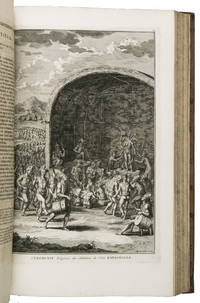
17275737The Hague 1727. Folio. Rutgert Christoffel Alberts vols. 1-3 and Isaac van der Kloot vols. 3-4; Amsterdam Hermannus Uytwerf; Rotterdam Jan Daniel Beman Contemporary gold tooled mottled brown calf with red and black morocco title and volume labels lettered in gold each volume with a central lozenge-shaped ornament on both boards surrounded by two decorative borders gold tooled board edges marbled edges. With an engraved frontispiece 8 title-pages 6 in red and black each with one of 3 different engraved vignettes plus 3 part-titles with a woodcut decoration 224 full-page engraved plates including 1 folding and 38 double-page plates an engraving on the dedication leaf in vol. 1 and a few engravings in the text. Further with several engraved headpieces woodcut tailpieces and a few woodcut decorated initials. 6 volumes vols. 3 4 & 6 in 2 parts each bound as 7. First Dutch edition of Picart's famous and richly illustrated work on religious customs ceremonies and costumes from all over the world. With its six volumes it is the most sumptuous publication ever on the religions of the world richly and beautifully illustrated with large and sometimes double-page or even folding engraved plates by the French engraver Bernard Picart 1673-1733 who lived in Amsterdam from 1708. The text was compiled from a wide range of sources including R. Simon J. Abbadie Dupin Thiers P. le Brun Boulainvilliers and Reland and edited by the Amsterdam publisher Jean Frederic Bernard for a French edition titled Ceremonies et coutumes religieuses de tous le peuples du monde first published in 1723. It was translated into Dutch for the present edition by Abraham Moubach.The first two volumes discuss the religion of the Jews and Roman Catholics including a double-page engraving of the interior of the Portuguese synagoge in Amsterdam. The third and fourth volume deal with the religions of the "heathens" in the Americas including Mexico India Ceylon the Brahmans in India China Japan Africa and the Persians in Iran. The fifth volume concerns the Greek orthodox church and the several groups of Protestants. The last volume describes the Anglicans and smaller groups such as Quakers Mennonites Adamites Freemasons and finally Islam. Altogether the most important 18th-century survey work on the world's religions and their customs lavishly illustrated with very finely executed plates.From the library of Frederick H. Rindge 1859-1905. The boards are somewhat rubbed. The works are slightly browned and foxed throughout with the final leaves of volume 3 affected more than the others. Otherwise in good condition.l Alt-Japan-Katalog 1149; STCN 191420778; cf. Cordier Japonica col. 435; Lipperheide 1808; Sabin 62600 all French ed. hardcover
1954250317003New York: Harper & Brothers 1954. 1st Edition. Hardcover. Very Good/No Jacket. <br /> <br /> Motivation and Personality by Abraham Maslow. <br /> <br /> Finding signed documentation of any kind by Maslow is quite rare. Only a few signed copies of his publications are known. There are no other signed copies of this book Maslow's most important work listed for sale anywhere in the world and no record of a signed copy being sold in the auction record.<br /> <br /> OVERALL condition: VERY GOOD<br /> <br /> IMPORTANCE<br /> <br /> Motivation and Personality is one of the most influential and important psychology books ever written. It is a seminal work on the subject of the nature of human fulfillment and the significance of personal relationships implementing a conceptualization of self-actualization. Underachievers have a need for social love and affection but a self-actualized person has these "lower" needs to be gratified and is able to pursue his or her own path towards self-actualization.<br /> <br /> THE AUTHOR & HIS WORK<br /> <br /> Maslow's book is perhaps the best-known contemporary work on human needs. Maslow postulated a hierarchy of human needs stretching from basic physical needs at the bottom to spiritual or transcendental needs at the top. In Motivation and Personality Maslow argues that in order for individuals to thrive and excel a health-fostering culture must be created. Maslow is among the psychological theorists who believe that when parents fail to provide a safe nurturing environment their children will develop deep feelings of insecurity. Maslow believes that well-being causes people to freely express their inherent potentials. Maslow is most known for his belief that humans possess a hierarchy of needs. While he had been working on this theory and other ideas explored in this book since the late 1930s he first proposed his hierarchy of needs in his 1943 paper "A Theory of Human Motivation" in the journal Psychological Review. The theory is a classification system intended to reflect the universal needs of society as its base then proceeding to more acquired emotions. The hierarchy is split between deficiency needs and growth needs with two key themes involved within the theory being individualism and the prioritization of needs. Maslow's hierarchy of needs is often portrayed in the shape of a pyramid with the largest most fundamental needs at the bottom and the need for self-actualization and transcendence at the top. However Maslow himself never created a pyramid to represent the hierarchy of needs.<br /> <br /> BOOK INFO<br /> <br /> Published in 1954 by Harper & Brothers in New York City. First edition early printing. Inscribed by the author in graphite on the FFEP "To the Fanciest Taxi-driver/ A H Maslow." In original brown cloth covered boards with black lettering and design work on the spine. xiv 411 pp including Appendix and Bibliography. <br /> <br /> The book is in GOOD to VERY GOOD vintage condition. Partially erased pencil writing on a few pages and about half a dozen pages with areas of ink underlining. The cloth is unfaded with a few spots of soiling on back cover. Firm binding. Former owner name in ink on FFEP. Rubbing to extremities and one bumped corner. Harper & Brothers hardcover
1708116863Amsterdam, les Frères Chatelain, 1708-1714, 4 vol. in-folio, (18)-8-(4)82, (16)-(10)-162 (pagination continue) et (12)-98 pp, lettrines, culs-de-lampes, reliures plein veau raciné, dos à 6 nerfs guillochés et caissons très ornés, pièces de titre et de tomaison basane naturelle, coupes guillochées, tranches rouges (rel. de l'époque), pet. travail de ver au tome 1 sans perte de texte, coiffes abîmées, qqs épidermures, 1 mors fendu sur 8 cm au tome 3, intérieurs propres, bon état
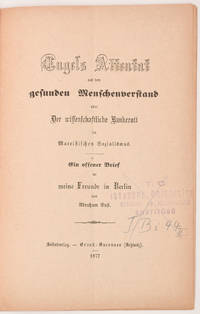
18771812Grand-Saconnex Schweiz: Selbstverlag 1877. First edition. In publisher’s wrappers. Collection stamp and shelfmarks written in ink and pencil on the cover and the title-page. Distributor’s stamp on the cover. With traces of folding. Cover slightly dusted. Pages yellowed due to ageing. First five leaves with minor damage to the lower corners. Overall in fine condition. First edition. In publisher’s wrappers. 24 p. <p><br /> Scarce pamphlet reflecting on the debate on early Marxist communism countering Engels for Anti-Dühring.<br /> <p><p><br /> First and only edition of the socialist theorist Abraham Enss’ pamphlet in which he criticises Marx and his followers for “doing humbug with socialism†and virulently defending Dühring from Engels’ “pseudoscientific†diatribes on him. Since the editors of Berliner Freie Presse refused to accept his writing Enss self-published his open letter dated to February 4 1877 and supplemented by two postscripts dated to March 1 and March 18 respectively in the present pamphlet in Switzerland. In response to the appearance of his writings Engels called Enss the “Sancho Panza†of Dühring who he referred to as “modern Don Quixote†while Liebknecht wrote in his letters to Engels that “Enß is stupid and will soon go to the madhouse†and that he is “generally regarded as a donkey even an idiotâ€.<br /> <p><p><br /> Abraham Enss was a follower and friend of Eugen Dühring. From 1887 he edited Der Antikrat a Dühringian paper with anti-Semitic tendencies which appeared with the subtitle Gegen Parteigewalt und Hebräer-Einfluß. Für selbständige Geistesführung und sociale Gerechtigkeit. Against Party Violence and Hebrew Influence. For Independent Spiritual Leadership and Social Justice.<br /> <p><p><br /> Scarce WorldCat locates only one copy in institutional holding in the US in the Columbia University Library in New York. <br /> <p><p><br /> Literature: Engels F.; Marx K.: Marx & Engels Collected Works. Volume 25. London: Lawrence & Wishart 1987. p. 298.; Firedlaender B.: Der freiheitliche Sozialismus: im Gegensatz zum Staatsknechtsthum der Marxisten. Mit besonderere Berücksichtigung der Werke und Schicksale Eugen Dühring’s. Berlin: Freie Verlagsanschaft 1892. p. 71; Gay J.: The Blind Prometheus of German Social Science. Eugen Dühring as Philosopher Economist and Controversial Social Critic. Universität Erfurt 2012.; Liebknecht W.: Briefwechsel mit Karl Marx und Friedrich Engels. Berlin: Walter de Gruyter 2020. pp. 212–214.; Nettlau M.: Bibliographie de l’anarchie. Année 1897. — N° 8. Bruxelles: Bibliothèque des Temps Nouveaux 1897. p. 41.<br /> <p>. Selbstverlag unknown
1730153282London: J. Tonson and J. Watts 1730. Binomial expansion First edition containing Moivre's first published attempt at approximating the terms of a binomial expansion. "Moivre's discovery greatly clarified the concept of probability in his own time and became the most fruitful single instrument of discovery used in probability theory and statistics for the next two centuries" Norman. Quarto 243 x 191 mm. Contemporary calf red morocco label red speckled edges. 18th-century armorial bookplate of Thomas Turton to front pastedown. Neat restoration to joints and extremities some scratches to covers light running staining in gutter and at head contents otherwise unmarked. A very good copy. ESTC T96683; Norman 1531. unknown
172891I90T01U79OAmsterdam 1728. Leonardus Schenk Framed 82.5 x 121 cm. Large engraved wall print on 2 sheets together 57.5 x 97 cm showing the Leiden city wall between the Koepoort and Zijlpoort with various windmills and prominent buildings in the background identified by name. The title appears in a banderole at the head with putti on either side holding the arms of Leiden and Holland. Leonardus Schenk's name appears as engraver and publisher at the right end of the banderole. Large view of the city of Leiden by the Amsterdam engraver and publisher Leonardus Schenk. The viewer observes the city from the south from between the city's Koe and Zijl gates. In the background several windmills and a few characteristic buildings are identified by name in the engraving including the university the library the Pieterskerk the Town Hall the Mare kerk the "Burcht" the fort and the Hooglandse kerk. On the quay outside the wall groups of people walk sporadically passed by small boats on the nearby city moat. In the foreground we see a typical Dutch landscape with grazing cattle farm workers a loaded hay cart and haystacks in the field. We know of several other wall prints by Schenk depicting local situations with almost photographic detail. Thanks to this detail important socio-historical aspects have been passed on to later generations giving these prints an important cultural meaning today. A few spots formerly folded otherwise in very good condition.l Overvoorde Catalogus van de prentverzameling der Gemeente Leiden 1906 no. 640; Waller Biogr. woordenb. Noord Ned. graveurs p. 287. unknown