775 résultats
186331428New York: Baker & Godwin 1863. 8vo. 9 x 5 5/8 inches. 48pp. Publisher's lettered wrappers publisher's ad on rear wrapper. Repair to paper spine. Within a modern box.<br/> <br/>"Four score and seven years ago.": the earliest publication of the Gettysburg Address in book form preceded only by the exceptionally rare sixteen-page pamphlet The Gettysburg Solemnities known in only three copies.<br/> <br/>Lincoln made his speech at the dedication of a cemetery on the Gettysburg battlefield some four months after the bloody and pivotal battle that turned the tide of the Civil War in favor of the Union. Lincoln's speech was preceded by an address from Edward Everett the most famous orator of his day. Everett's speech took some ninety minutes to deliver and is largely forgotten. Lincoln's speech delivered in only a few minutes is immortal. It is a supreme distillation of American values and of the sacrifices necessary for the survival of liberty and freedom. "The Washington Chronicle of 18-21 November reported extensively on this ceremony and included a verbatim text of 'Edward Everett's Great Oration.' On the fourth day it noted in passing that the President had also made a speech but gave no details. When it came to the separate publication on 22 November Everett's 'Oration' was reprinted from the standing type but Lincoln's speech had to be set up. It was tucked away as a final paragraph on page 16 of the pamphlet The Gettysburg Solemnities. It was similarly treated when the meanly produced leaflet was replaced by a 48-page booklet published by Baker and Godwin of New York in the same year" PMM. Lincoln's address appears on page 40 and parenthetical notes are added indicating "applause" and "long-continued applause." A diagram on page 32 gives the details of the Soldiers' National Cemetery at Gettysburg.<br/> <br/>Howes E232 "b"; Monaghan 193; Grolier American 100 72 note; Streeter Sale 1747; Sabin 23263; cf. Printing and the Mind of Man 351; Garry Wills Lincoln at Gettysburg pp.191-204. Baker & Godwin unknown books
1863WRCAM49250DNew York: Baker & Godwin 1863. 48pp. Publisher's printed wrappers publisher's advertisement on rear wrapper. Spine perished. Very good. In a blue morocco box. The earliest publication of the Gettysburg Address in book form. This edition was preceded only by the exceptionally rare sixteen-page pamphlet THE GETTYSBURG SOLEMNITIES known in only three copies. <br> <br> Lincoln made his speech at the dedication of a cemetery on the Gettysburg battlefield some four months after the bloody and pivotal battle that turned the tide of the Civil War in favor of the Union. Lincoln's speech was preceded by an address from Edward Everett the most famous orator of his day. Everett's speech took some ninety minutes to deliver and is largely forgotten. Lincoln's speech delivered in only a few minutes is immortal. It is a supreme distillation of American values and of the sacrifices necessary for the survival of liberty and freedom. "The WASHINGTON CHRONICLE of 18-21 November reported extensively on this ceremony and included a verbatim text of 'Edward Everett's Great Oration.' On the fourth day it noted in passing that the President had also made a speech but gave no details. When it came to the separate publication on 22 November Everett's 'Oration' was reprinted from the standing type but Lincoln's speech had to be set up. It was tucked away as a final paragraph on page 16 of the pamphlet THE GETTYSBURG SOLEMNITIES. It was similarly treated when the meanly produced leaflet was replaced by a 48-page booklet published by Baker and Godwin of New York in the same year" - PMM. <br> <br> Lincoln's address appears on page 40 and parenthetical notes are added indicating "applause" and "long-continued applause." A diagram on page 32 gives the details of the Soldiers' National Cemetery at Gettysburg. HOWES E232 "b." MONAGHAN 193. GROLIER AMERICAN 100 72 note. STREETER SALE 1747. SABIN 23263. PRINTING AND THE MIND OF MAN 351 ref. Garry Wills LINCOLN AT GETTYSBURG pp.191-204. Baker & Godwin unknown books
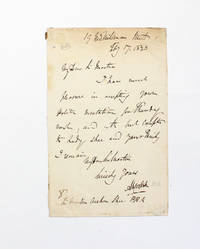
1853031282UK 1853. First Edition . Paper. Very Good. 48mo - over 3" - 4" tall. An Original Handwritten and Signed Letter by Artist Abraham Cooper. Dated 1853. A letter discussing a meeting. Abraham Cooper RA 1787-1868 was a British animal and battle painter. Size is 180 x 115mm. Condition is good. Light folding crease. Age toning and light gum marks to rear. Ref19209 <br/> <br/> unknown
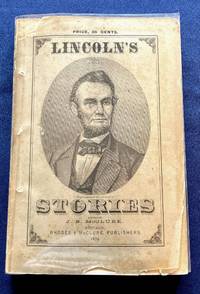
18792355Chicago: Rhodes & McClure Publishers 1879. First Paperback Edition reprinting 1878 hardback. Pictorial wrappers. Good . Lithographic engravings. 8vo tan pictorial wrappers perfect bound with publisher's cord tie and lithographic engraved oval image of bearded Abraham Lincoln illustrated throughout with B&W frontispiece vignette title page & 8 plates; 188 pages 2 Ads. RARE POST-1871 CHICAGO FIRE WRAPPERED & ILLUSTRATED WRAPPERED REPRINT! Covers Lincoln's entire life with illustrations and illustrative anecdotes and many stories. <br /> <br /> Solid copy light to moderate periodic foxing plates generally clean chipping to cover. Mylar added for protection. No previous owner's marks or annotations Rhodes & McClure, Publishers hardcover
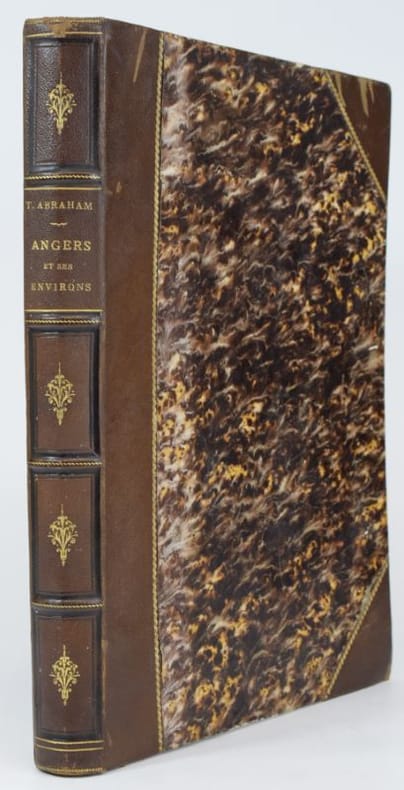
1876174921876 un volume, reliure d'époque demi-chagrin rouge in-folio Editeur à coins (binding half shagreen in-folio with corners Editor)(27,5 x 37,5cm), RELIURE D'EPOQUE, dos 5 nerfs (spine with raised bands), cernés de filets à froid (blind stamping décoration), décoré or (gilt decoration) et à froid (blind-stamping decoration), titres et auteurs frappés or (gilt title), pièce de titre et pièce Auteur sur fond noir (label of title and label of Author) avec filet or (label of title with gilt line and label of volume numbering), filets à froid en tête et en pied (stamping line on top and at the foot of spine), mors et coins décorés or d'un filet et une roulette "chainette" or (joints and corners with gilt decoration), papier percale rouge aux plats (cover with red paper "percale"), toutes tranches non rognée (all edges no smooth), TIRAGE LIMITE à 350 EXEMPLAIRES.......ALBUM orné au titre d'une eau-forte des Ponts-de-Cé + 36 eaux-fortes d'Abraham protégées par des serpentes légendées, sans pagination, [112 pages] + [2 pages de Tables] , 1876 Château-Gontier, J.-B. Bezier.Editeur,
18767020Château-Gontier, Librairie de J.-B. Bezier, 1876. In- 4 (364 x 265 mm), (4) ff. (faux-titre, titre, dédicace et introduction)- 1 vignette gravée sur la page de titre (Les ponts de Cé) et 36 planches gravées à l'eau-forte accompagnées de feuillets de texte, (1) f. de table. Reliure demi-chagrin à coins, dos à faux-nerfs orné de fleurons dorés, traces de griffures aux plats, épidermures et manques au cuir, coupes et coins frottés, bel état intérieur. Tirage à 330 exemplaires numérotés (ici N° 8). Bon exemplaire.
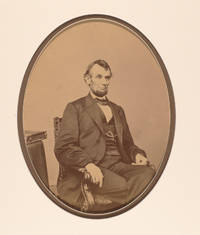
186442820809<p>Oval albumen print 8 x 6 in. original printed mount trimmed at bottom removing caption signed "BRADY & CO. PHOTOGRAPHERS." Browning and offsetting to mount light toning to image. Very good. Matted and framed.</p><p><strong>The classic Brady $5 bill photograph.</strong> This celebrated portrait the basis for the five-dollar bill engraving used for most of the 20th century is one of seven poses taken by Anthony Berger at Mathew Brady's Washington D. C. studio on February 9 1864. The most prolific photographer of Lincoln Brady himself did not actually operate his cameras during the war years instead training and employing men like Alexander Gardner and his successor Anthony Berger who took this picture to operate the camera.</p><p><strong>Lincoln's son Robert Todd Lincoln declared this famous portrait to be "the most satisfactory likeness" of Abraham Lincoln.</strong></p> Mathew Brady Gallery
181555288AB2 Schriften in 1 Band. Bern, Wittib Stämpfli " L.A. Haller. 1815. 8°. 38 S.; 47 S. Pappband der Zeit mit bedrucktem Deckeltitel.
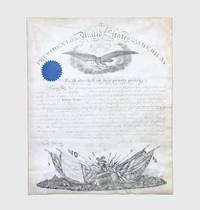
1863172650Washington DC: 10 March 1863. Signed four months before the Battle of Gettysburg A military appointment signed by Abraham Lincoln at the height of the American Civil War. Such documents were instruments of authority and means of identification as soldiers crossed through military lines and took command. The document appoints James Gillette to the position of "Commissary of Subsistence of Volunteers with the rank of Captain". James Gillette 1838-81 enlisted as a private and rose quickly through the ranks. He served as Commissary of Subsistence for the 2nd Division XII Corps under General John W. Geary. For his meritorious service he was breveted lieutenant colonel U.S. Volunteers and for gallantry at the battle of Chancellorsville he was breveted major in the regular Army. A week earlier on 3 March Lincoln signed the Conscription Act mandating the impressment of able-bodied young men into the service of the Union Army. A clause allowing for exemption by paying a fee provoked national fury leading to riots in New York. Engraved military appointment 415 x 340 mm on vellum with the sections accomplished in manuscript attractive cartouche of the American eagle at the head and large trophy of arms at the foot engraved by J. V. N. and O. H. Throop blue wafer seal at left War Department docketing notations at upper left. Mounted and framed with UV conservation glazing framed size 64 x 53 cm. Originally folded into sixths leaving light creases as usual. Slightly discoloured at extremities ink a little faded but still clear. In very good condition. hardcover
1862190938Washington DC: 28 July 1862. Taxing the new state of Oregon to fund the Civil War Lincoln appoints Lawrence White Coe collector of federal taxes for the State of Oregon. In August 1861 Congress passed a new direct tax to fund the Civil War. Oregon's share was $35000 seven eighths of the state's annual revenue Bancroft p. 640. The measure marked both a substantial expansion of federal taxation and a wartime extension of presidential patronage through the appointment of tax officers. Oregon had become a state in 1859. Coe 1831-1897 resident in Wasco County had opened steam navigation on the upper Columbia River with the stern-wheeler Colonel Wright which was contracted to carry army supplies to Fort Walla Walla. His father Nathaniel Coe had been appointed by President Fillmore as the first postal agent in the Northwest. Printed document with manuscript additions 281 x 434 mm embossed seal of the US Treasury. Presented in a wooden frame with conservation acrylic glazing 555 x 425 cm. Minor chipping at extremities tape residue on verso from former framing minor soiling and light spotting. In very good condition. Hubert Howe Bancroft History of Oregon Vol. II 1888. unknown
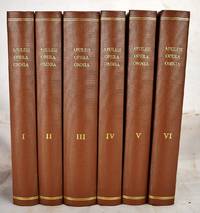
18252101190032Londini curante et imprimente A.J. Valpy 1825-01-01. Hardcover. Good. 0x0x0. 6 volume set. Rebound in modern cloth. Gile lettering head and tail lines. Solid bindings and covers. Text printed in double columns. Contents: v. 1. Metamorphoseon lib. I-X.--v. 2. Metamorphoseon lib. XI. Florida. De deo Socratis. De dogmate Platonis. De mundo.--v. 3. Apologia. Fragmenta. Index.--v. 4-5. Notae variorum.--v. 6. Notae variorum Cont. Notitia literaria. Recensus codicum mss. p. 3333-3345 <br> Scriptores latini in usum Delphini fasc. LXX-LXXV. <br> Clergical bookplate of Bishop John Jebb of Limerick Ardfert and Aghadoe. Jebb 1775-1833 was an important Irish churchman and writer. Marbled end sheets. Brookline library stamps. Londini, curante et imprimente A.J. Valpy hardcover
1884295339Warsaw: Goldman 1884. Boards. Good-. 184_235 pp in two parts in Hebrew tears along edges of first few pages oclc 63161271 Ahavat Zion considered the first Hebrew novel Ashmat Shomron first published 1865 Goldman hardcover
186732457Washington: GPO 1867. xxx 930 pp as issued. Covers absent text block split. Minor soiling. Good.<br/>Monaghan 881. GPO unknown books
1900296402Aroysgegeben fun A. M. Ye alen o e International Library Publishing Company c 1900. Stiff Wrapper. Good. 67 pp.In Yiddish new spine and title page pasted to covers new covers Caspe was an important Socialist and an editor at the Forverts 122762044 Aroysgegeben fun A. M. Ye alen o e International Library Publishing Company unknown
186424202<p>Two tickets to the Great Central Fair in Philadelphia. One admitted a pupil of the public schools of Philadelphia and was used on Saturday June 11 according to the stamp on the verso. The other is an apparently unused "Season Ticket" that admitted the bearer "<i>To All Parts of the Fair</i>" except the Children's Exhibitions but was "<i>Forfeited if Transferred and Not Good unless Endorsed</i>." The verso includes the oath "<i>I hereby promise that this Ticket shall be used to obtain admission to the Fair by myself only</i>" and a blank line for a signature.</p> <b>CIVIL WAR. ABRAHAM LINCOLN.</b>Great Central Fair Tickets June 1864. Pair of passes for the Great Central Fair held in Philadelphia June 7-28 1864. One ticket is for one day's admission for a public school student. The other is a season ticket. 1 p. each 3½ x 2¼ and 3½ x 2 in.<p><b><br /></b></p><p><b>Historical Background</b></p><p>During the Civil War several northern cities hosted sanitary fairs between 1863 and 1865 to raise money for the care of wounded soldiers. The Great Central Fair held at Logan Square in Philadelphia in June 1864 was a fundraiser for the United States Sanitary Commission and was one of the largest fairs. The main exhibit building constructed in forty working days by local volunteer skilled labor enclosed 200000 square feet. It featured nearly one hundred departments offering a broad range of displays from Arms and Trophies to Fine Arts to Umbrellas and Canes. Curiosities included a $1000 doll house a recreated parlor of William Penn with Penn artifacts the boat used by Arctic explorer Elisha Kent Kane and George Washington's carriage.</p><p>Over three weeks the fair welcomed more than 400000 visitors. The season ticket offered here cost $5 a week's pay for a day laborer or a domestic and several days' wages for skilled workers. The fair served more than 9000 meals per day in its restaurant and had a daily newspaper with descriptions of the various departments. During its existence the fair raised approximately $1 million for the Sanitary Commission second only to New York City in money raised.</p><p>President Abraham Lincoln attended the fair with his family on June 16. He also donated forty-eight signed copies of the Emancipation Proclamation printed under the auspices of George Boker of the Union League which were sold for $10 each.</p><p><b>Condition</b></p><p>Both have glue discolored on the reverse sides. The smaller card has a 1" edge tear on the right side neatly repaired with archival tape.</p><br /> books
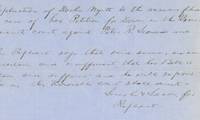
18533514603/11/1853. <blockquote><p>The case is well known and illustrates Lincoln’s penchant for aiding women who had been unjustly treated</p></blockquote><blockquote><p>""Said answers are untrue uncertain and insufficient that her Bill is true certain and sufficient and he Lincoln will so prove it to be""</p><p> </p></blockquote><p>During his 25-year legal career in Illinois Abraham Lincoln was involved in a substantial number of cases involving women as litigants. He was known for seeking to represent women and working to get justice for them in an era when women’s cases were often shunned by lawyers or not taken seriously.</p><p>Lincoln handled some 147 divorce cases about 40% of all divorce cases in his home county of Sangamon. Importantly more than half of the litigants he represented were women. He handled these cases with ""tender consideration"" learning from experience that the law could be a dangerous place for women who had few rights under the legal doctrines of the time. Lincoln also represented women in cases involving land disputes and in slander lawsuits which often involved accusations of adultery and were important for maintaining a woman's community reputation.</p><p>Lincoln was known for taking cases for women where he felt justice was on his client's side. Notable examples include: Nance Legins-Costley - In 1841 Lincoln successfully represented this African American woman to prevent her from being sold into slavery arguing that slavery was illegal in Illinois; Melissa Goings - He defended Mrs. Goings an elderly woman charged with her abusive husband's murder in a case based on self-defense; Doshia Wyatt - In 1853 Lincoln took on the case of Mrs. Wyatt a widow whose claim was that she was being cheated out of her inheritance.</p><p>A petition for dower is a legal request filed by a surviving spouse typically a widow to claim a portion of their deceased spouse's estate such as in real property based on common law dower rights. This is a formal process that requires the surviving spouse to file a petition in court describing the property and naming the heir or person with the next immediate estate of inheritance. The court then holds a hearing to determine the rights to dower and the property.</p><p>Doshia Wyatt widow of Robert Wyatt retained Lincoln and sued for her dower. Thomas Wyatt died in 1847 and left all of his property to his son Robert. Robert Wyatt lost part of the land the Mill Farm to satisfy a judgment against him in the U.S. District Court of Illinois. Robert Wyatt sold another property the Prue Farm to George Brewner. After Robert Wyatt's death in 1852 Doshia Wyatt sued Leonard and Brewner's heirs. Leonard contested the petition claiming that he did not believe Doshia and Robert Wyatt had been legally married. Leonard also claimed that Robert Wyatt had already left Doshia Wyatt land in his will which Leonard claimed was recorded.</p><p>Hearing the case was Judge David Davis a friend of Lincoln whom as President he would appoint to the U.S. Supreme Court. Ward Hill Lamon Lincoln’s co-attorney on the case began his professional association with Lincoln in 1852 when they became law partners. Though they had different styles they remained close personal and professional friends. After the partnership dissolved in 1857 their friendship continued and Lamon would later become Lincoln's bodyguard and U.S. Marshal for the District of Columbia during Lincoln's presidency. As the bodyguard Lamon was not in Washington on the night of Lincoln’s assassination being on assignment in Richmond at Lincoln’s request. In his Recollections of Abraham Lincoln Lamon reveals that before he left for Richmond he implored the President not to ""go out at night after he was gone particularly to the theatre.""</p><p>This document relates to the case of Doshia Wyatt. In a petition to the Court filed by Lincoln Wyatt stated her case: “Your petitioner would further represent to your honor that she your petitioner is the widow of the said Robert Wyatt — that she has never relinquished her dower to the said aforesaid land or any part thereof - nor has her dower ever been set off - or assigned her in said premises - that said Robert Wyatt on or about the 28th of July AD 1852 departed this life leaving her the said Doshia widow as aforesaid…Your petitioner would further pray that this honorable court appoints commissioners to assign her dower in & to all of the above described tracts or parcels of land according to the statue in such cases made and approved. And your petitioner would pray for such & gather relief as may be according to equity and good conscience and as in duly abound your petitioner will ever pray.â€</p><p>This is a pleading in Lincoln’s hand which contains the answer of Wyatt to the defendants’ responses to her allegations. <strong>Autograph document signed</strong> Vermillion County Illinois Circuit Court November 3 1853. <em>“The replication response of Doshia Wyatt to the defendants’ answers filed in the case for her Petition for Dower in the Vermillion Circuit Court against Peter R. Leonard and others. This repliant respondent says that said answers are untrue uncertain and insufficient that her Bill is true certain and sufficient and he Lincoln will so prove it to be as this Honorable Court shall direct. Lincoln & Lamon for Repliant respondent.â€</em> On the verso Lincoln has docketed the document <em>“Dosha Wyatt vs Peter R. Leonard Replication.â€</em> The clerk of court Samuel Craig then notes that the plea was filed on November 3 1853.</p><p>An uncommon document in Lincoln’s hand concerning his representation of women. As for the case the parties likely reached a settlement as Wyatt ended up dismissing the case while Leonard paid the costs.</p><p><img class=""alignnone wp-image-25018 size-post-window"" src=""https://cdn.raabcollection.com/wp-content/uploads/20231204144051/Folder-site-11-1600x1327.jpg"" alt="""" width=""1600"" height=""1327"" /></p> unknown
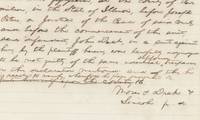
18573563230/10/1857. <p>John V. Drake and John C. Moses practiced law in Danville Illinois. They worked on cases appearing before the Vermilion County Circuit Court. When Abraham Lincoln had a case appearing in that court he would sometimes affiliate himself with Drake and Moses. Lincoln was before that court in October and November 1857.</p><p>Hezekiah Ballah sued John Deck and Zachariah Deck in a case heard in the Vermilion County Circuit Court. This was an action of trespass for castrating seventeen buck sheep and cutting up eight other ewes wethers and lambs. The Decks retained Lincoln who worked together with Drake and Moses in the case in October 1857. The Decks pleaded not guilty. Moreover John Deck also pleaded that he had been acquitted of the charge in Justice of the Peace court. The jury found the Decks not guilty. Hearing the case was Judge David Davis who Lincoln would one day name to the U.S. Supreme Court.</p><p><strong>Autograph document signed</strong> a draft pleading completely in Lincoln’s hand Vermilion County Circuit Court October 1857 being the pleading informing the Court that Deck had previously been acquitted of the same offense. The name of the case was John Deck impleaded with Zachariah Deck ads vs Hezekiah Ballah and it was filed In Trespass. <em>“And the said defendant John Deck comes and defends the force and injury…and says plaintiff actio non fails to act when there is a duty to act because he defendant says he is not guilty in manner and form as is in the declaration alleged; and of this he puts himself upon the country etc. citizens in a court or jury. Moses & Drake & Lincoln p.d.â€</em></p><p>Lincoln adds below: <em>“And for further plea in this behalf defendant John Deck says plaintiff actio non because he says that heretofore to wit on the __ day of __ in the year of our Lord one thousand eight hundred and fifty seven at the county of Vermillion in the state of Illinois before Joseph Peters a Justice of the Peace of said county and before commencement of this suit said defendant John Deck in a suit against him by the plaintiff herein was lawfully judged to be not guilty of the same identical supposed trespass in this declaration mentioned and this he is ready to verify therefore he prays judgment etc. Moses & Drake & Lincoln p.d.â€</em> The case is listed at lawofficeofabrahamlincoln.org.</p><p>An interesting pleading where Lincoln’s client has already been acquitted of the same offense.</p><p><img class=""alignnone wp-image-25018 size-post-window"" src=""https://cdn.raabcollection.com/wp-content/uploads/20231204144051/Folder-site-11-1600x1327.jpg"" alt="""" width=""1600"" height=""1327"" /></p> unknown
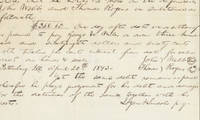
18433570010/1843. <blockquote><p>Miles who was also a prominent Whig politico and part of Lincoln’s political circle used Lincoln’s legal services a number of times</p></blockquote><p>Abraham Lincoln and Stephen T. Logan formed a prominent Illinois law partnership called Logan & Lincoln from 1841 to 1844 during which Logan an experienced attorney mentored Lincoln and introduced him to complex areas of the law. During his partnership with Logan Lincoln also increased his caseload before the Illinois Supreme Court and handled appeals from all areas of the state. Logan and Lincoln handled many cases together not merely at their Springfield office but around the state. This ls because Lincoln had a circuit law practice that involved riding the Eighth Judicial Circuit in Illinois covering 14-15 counties including Menard County on horseback or buggy. Logan remained in Springfield while Lincoln traveled the Circuit. As a general practitioner Lincoln handled diverse cases including property disputes debts torts. slander and criminal law. The Logan & Lincoln partnership ended amicably in 1844 after which Lincoln partnered with William H. Herndon who was a clerk in the Logan & Lincoln law office and whose father had been a Lincoln friend for many years.</p><p>George U. Miles was Herndon’s father-in-law. He came to Illinois in 1816 at age 20 settling first in St. Clair County and then in White County where he married Jane McCoy on November 18 1821. They had three children. Miles removed to Logan County and then in 1836 he went to Sangamon County where he lived on a farm six miles north of Springfield. In 1839 he moved to Petersburg in Menard County where he served as public administrator from 1845 to 1849. Miles was a Whig and a Menard County delegate to conventions that chose Whig candidates. Miles and Lincoln knew each other as neighbors and fellow Whigs and also because of Miles’ family relationship to Lincoln’s friend and partner Herndon. In early 1843 Lincoln sought a nomination for Congress and hoped for Miles’ political support.</p><p>Miles used Lincoln as an attorney a number of times both before and after Herndon became Lincoln’s partner. In late 1843 Miles retained Logan & Lincoln and sued John Webb and Thomas Rogers to collect a $368.60 debt on a promissory note.</p><p><strong>Autograph document signed</strong> all in Lincoln’s hand Menard County Illinois October-November 1843 being a petition in the county court in which Miles asks for judgment for a debt. <em>“George U. Miles plaintiff states that he holds a note on the defendants John Webb and Thomas Rogers in substance as followeth: ‘$368.60. One day after date we or either of us promise to pay George U. Miles or order three hundred and sixty eight dollars and sixty cents with twelve percent interest from date for value received. Our hands & seals: John Webb and Thomas Rogers Petersburg Ill. April 20th 1843.’ Yet the same debt remains unpaid wherefore he prays judgment for his debt and damages for the detention of the same together with his costs. Logan & Lincoln.â€</em></p><p>Lincoln won the case. The defendants were found to have defaulted and the court awarded Miles $392.67 counting costs. The case was decided November 1 1843. It is listed at lawofficeofabrahamlincoln.org.</p><p>After Lincoln’s assassination Miles acted as one of Herndon's key investigators. Miles famously interviewed individuals including Ann Rutledge’s aunt to gather information about Lincoln's early life and relationships serving as a vital source for Herndon's research. Herndon would write a famous biography of Lincoln in the 1880s.</p><p><img class=""alignnone wp-image-25018 size-post-window"" src=""https://cdn.raabcollection.com/wp-content/uploads/20231204144051/Folder-site-11-1600x1327.jpg"" alt="""" width=""1600"" height=""1327"" /></p> unknown
183723104.01<p>Lincoln and John Todd Stuart cousin of Lincoln's future wife Mary Todd had served together in the Illinois House of Representatives from 1834-1836. They formed Stuart & Lincoln on April 12 1837.</p> <b>ABRAHAM LINCOLN.</b>Newspaper. <i>Sangamo Journal</i> Springfield Ill. December 23 1837. 4 pp. 18 x 24¾ in. Double matted and framed with glass on both sides to display pages one and four. Slightly chipped 26 x 33 in. frame.<p>In the upper portion of the first column of the first page appears this five line advertisement: <i>"STUART & LINCOLN / ATTORNEYS and Counsellors at Law will practice / conjointly in the Courts of this Judicial Circuit. – / Office No. 4 Hoffman's Row up stairs. / Springfield april 12 1837."</i> Two ads directly above: <i>"NINIAN W. EDWARDS / ATTORNEY & COUNSELLOR AT LAW / Springfield – Illinois."</i></p><p>Lincoln had moved from New Salem Illinois to Springfield in 1836. He had first met fellow attorney Ninian W. Edwards when both were members of the Illinois State House of Representatives. Edwards married Elizabeth Todd in 1832 and Lincoln met Elizabeth's sister Mary Todd at the Edwards home where Mary had moved in 1839. On November 4 1842 Lincoln and Mary Todd were married in the Edwards mansion.</p><p>The <i>Sangamo Journal </i>started publishing in 1831 shortly after a young Lincoln settled in New Salem. The newspaper faithfully supported Abraham Lincoln and the Whig Party throughout many name changes: the <i>Illinois Journal</i> 1847 shortly after Lincoln left for Congress then the <i>Illinois State Journal</i>1855. As the Whig party broke up the newspaper supported the newly-formed Republican Party and Abraham Lincoln's rising political star.</p><p><b> Condition</b></p><p>Very fine with no visible tears.</p> books
1883FD16-387Wien, Verlag von Carl Konegen/ k.k. Hof- und Staatsdruckerei in Commission bei Karl Gerold's Sohn, 1883/ 1868. Leinenband zu Beginn des 20. Jahrhunderts, 8?, XIV, 135 Seiten, 56 S.; Zustand: stellenweise mit leichten Bleistift-Anstreichungen, sonst sehr gut
1900B6164Berlin: M. Poppelauer’s Buchhandlung. 1900. Binding: contemporary half black publishers’ cloth over marbled paper title on label on flat spine. Notes: Abraham Adolf Berliner 1833 – 1915 was a German theologian and historian born in Obersitzko in the Grand Duchy of Posen Prussia. He received his first education under his father who was a teacher in Obersitzko. He continued his education under various rabbis preparing himself at the same time for the University of Leipzig where he received the degree of doctor of philosophy. Size: 8vo Illustration: Text in German. Category: Book Religious Judaism; M. Poppelauer’s Buchhandlung. hardcover
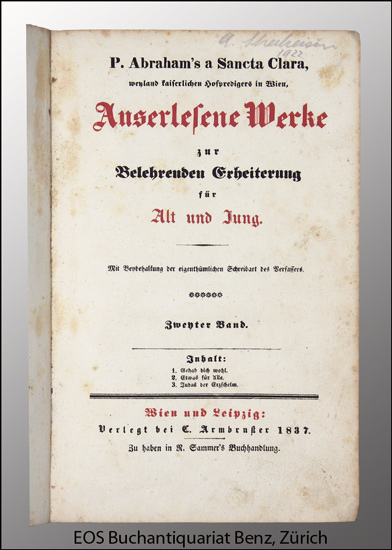
18372016DB1837. Bd. 2 v. 2 Bdn. Wien u. Leipzig C. Armbruster 1837. 8°. 6 140 2 S.; 4 166 2 S.; 4 159 S.; 313 6 S. 4 S. Anzeigen. Pappbd. d. Zt. mit goldgepr. Rückenschild. Vgl. Bautz I Sp. 10-11 für Abraham a Sancta Clara. Die Werkauswahl des volkstümlichen Predigers u. Schriftstellers Abraham a Sancta Clara 1644-1709 erschien in 13 Lieferungen bzw. 2 Bänden. Im 18. u. 20. Jahrh. erschienen mehrere gesammelte oder gesamte Werke. - Mit mehreren Anstreichungen u. Besitzereinträgen von alter Hand. Gebräunt u. stockfleckig. - Einband stärker berieben und bestossen. Gelenke angeplatzt. unknown
18372016DBBd. 2 (v. 2 Bdn.). Wien u. Leipzig, C. Armbruster, 1837. 8°. (6) 140 (2) S.; (4) 166 (2) S.; (4) 159 S.; 313 (6) S., (4) S. (Anzeigen). Pappbd. d. Zt. mit goldgepr. Rückenschild.
1865376410Montauk Montauk Navy Yard Wash D.C. 1865. 4 pp. 8vo. Slight soiling and minor tears along old folds otherwise in very good condition. 4 pp. 8vo. ".About 10:25 P.M. a man came in and walked slowly along the side." <br /> <br /> A remarkably clear and dramatic eyewitness account of the assassination of Abraham Lincoln from a naval surgeon who was close to the President's box at Ford's theater on that fateful night of April 14 1865. In this letter to his brother written the night after the assassination while the details were still fresh in his memory Dr. George B. Todd surgeon aboard the U.S. "Montauk" at anchor in the Navy Yard that day recounts the terrible event with a clarity of observation one might expect of his profession-a rarity among confused eyewitness accounts. The text of Todd's letter one of only 7 eyewitness accounts written within 24 hours of the assassination reads: <br /> <br /> "The few hours that have intervened since that most terrible tragedy of last night have served to give me a little clearer brain and I believe I am now able to give you a clear account up to this hour. Yesterday about 3 P.M. the President and wife drove down to the navy yard and paid our ship a visit going all over her accompanied by us all. Both seemed very happy and so expressed themselves - glad that this war was over or so near its end and then drove back to the White House. In the evening nearly all of us went to the Ford's Theatre. I was very early and got a seat near the President's private box as we heard he was to be there. About half past nine he came in with his wife a Miss Harris and Major Rathburn and was cheered by every one. As soon as there was a silence the play went on and I could see that the "pres." seemed to enjoy it very much. About 10:25 P.M. a man came in and walked slowly along the side on which the 'pres.' box was and I heard a man say "there's Booth" and I turned my head to look at him. He was still walking very slow and was near the box door when he stopped took a card from his pocket wrote something on it and gave it to the usher who took it to the box. In a minute the door was opened and he walked in. No sooner had the door closed then I heard the report of a pistol and on the instant Booth jumped out of the box onto the stage holding in his hand a large knife and shouted so as to be heard all over the house - 'Sic Semper Tyrannis' "so always with tyrants" and fled behind the scenes-I attempted to get to the box but I could not and in an instant the cry was raised 'The President is Assassinated.' <br /> "Such a scene I never saw before. The cry spread to the street only to be met by another 'So is Mr. Seward.' Soldiers had gone. Some General handed me a note and bid me go to the nearest telegraph office and arouse the nation. I ran with all my speed and in ten minutes the sad news was all over the country. Today all the city is in mourning nearly every house being in black and I have not seen a smile. No business and many a strong man I have seen in tears. <br /> "Some reports say Booth is a prisoner others that he has made his escape but from orders received here I believe he is taken as a mob once raised now would know no end. I will not seal this until morning and I may have some more news. <br /> <br /> "April 24th. <br /> "I have had no time to write until now as I have been a detective. We have now 7 that are implicated.<br /> Why don't you write Love to all George" <br /> <br /> Several important facts regarding the movements of both the President and John Wilkes Booth are recorded here: <br /> 1 This appears to be the only eyewitness account of the President's inspection of the "Montauk" earlier that afternoon. <br /> 2 Todd's account of Booth's interaction with the "usher" sitting outside the President's box "took a card from his pocket wrote something on it and gave it to the usher" is especially intriguing and reveals not only something of Todd's powers of observations but also his proximity to the assassin immediately before the shooting. Todd alone among eyewitnesses notes that the "usher" first took the card from Booth then went into the box and that a short time later the door opened and Booth went in. In fact Good finds only 7 other eye-witness accounts of the Lincoln assassination as early as April 15-most of these witnesses record little or nothing regarding the events before hearing the shot itself and none of them noticed Booth's interchange with the usher who was in fact Lincoln's valet Charles Forbes. There are three other accounts by eyewitnesses which partially corroborate Todd's observation of the Forbes and Booth interchange-but they were written much later than Todd's. <br /> 3 Todd's observation of the time he spotted Booth moving toward the box "about 10:25" corresponds to Good's own conclusion that Booth fired the fatal shot close to 10:30 PM. According to James Swanson MANHUNT p. 419 "the exact time of Booth's shot cannot be fixed . Booth may have shot Lincoln as early as 10:13 or as late as 10:30" Todd's account - again one of the freshest and most reliable weighs heavily in favor of Good. <br /> 4 Todd by his own account played a role in alerting the nation by telegraph. <br /> 5 Although he doesn't mention it as a surgeon of the ironclad Montauk Todd was also probably present at the autopsy of John Wilkes Booth on Thursday April 27 in the gun room of his ship. Indeed in an article in the February issue of the Baltimore and Ohio Magazine 1926 where the letter was first published and reproduced Todd is reported to have been "one of the surgeons who performed the autopsy." That as well as the fact that the other prisoners were being held on board the ironclad "Montauk" and "Saugus" may explain his cryptic remark near the end ". I have been a detective .". Todd actually mailed the letter on April 30 3 days after the autopsy and may very have participated in the actual investigation of the captives aboard the "Montauk." <br /> <br /> AN EXTRAORDINARY AND UNIQUE RECORD OF ONE THE NATION'S GREAT TRAGEDIES. Published from a copy in the State Historical Library of Wisconsin in Timothy S. Good WE SAW LINCOLN SHOT U. of Miss. 1995; with the mistaken date of April 30 1865 unknown
186358199Camp near Brooks Station Saturday April 11 1863. Fine original condition. 15-1/2 x 9-3/4 inches. ".Yesterday I witnessed one of the grandest sights that I ever beheld. Our whole corps was reviewed by the President Generals Hooker McLain Howard Steinway Secretary Seward and an innumerable host of Brigadier Generals and it was a sight that has paid me for coming to war." The spectacle is described in great detail. Private Penfield was soon to be captured at Chancellorsville spending 12 days as a prisoner of war before being exchanged. He survived the war to carry on his father's carriage making business in Monroe Connecticut and later founded a small private academy. unknown