ABRAHAM LINCOLNBiblio.com
774 résultats
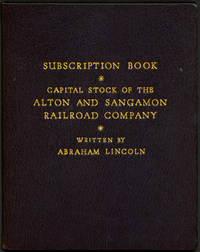
185127561<p>A list of stockholders entirely in Lincoln's hand filed as evidence in his first significant railroad case. Lincoln's own appearance in the shareholder list represents only the second known instance of a stock purchase by the future president. The Illinois Supreme Court's ultimate ruling in favor of Lincoln and the railroad set an important legal precedent upholding the binding nature of a stockholder's contractual and financial obligations. "The decision subsequently cited in twenty-five other cases throughout the United States helped establish the principle that corporation charters could be altered in the public interest and it established Lincoln as one of the most prominent and successful Illinois practitioners of railroad law" Donald p.155.</p><p><strong>ABRAHAM LINCOLN.</strong> Autograph Manuscript Signed by Lincoln in text constituting his official transcript of the "<em>Subscription Book of the Capital Stock of the Alton and Sangamon Rail Road Company</em>" incorporated February 27 1847 transcribed in early 1851. Comprising a cover sheet titled in Lincoln's hand the joint stock subscription statement and list of 91 shareholders with the number of shares subscribed and leaf with Lincoln's legal docket: "<em>Alton and Sangamon Railroad Company vs. James A. Barret. Copy of contents of subscription book</em>." 8 pp. 6 x 8¼ x ¼ in. With Lincoln's original stock certificate for the six shares noted in his manuscript. One of only two instances of his owning a stock and the only certificate of his known to survive.</p><p><strong>Historical Background</strong></p><p>The Alton and Sangamon Rail Road Company was chartered in 1847 to construct a line from Alton via New Berlin to Springfield. In 1850 however the Illinois General Assembly approved a more direct route bypassing the landholdings of some investors. Claiming breach of contract James A. Barret refused to make further installment payments for his 30 shares of stock as did several others who no longer stood to benefit from the new line. In 1851 Lincoln was hired to compel the defaulting shareholders to pay the balance of their promised investment.</p><p>The tactical details are spelled out in a February 19 1851 letter from Lincoln to William Martin a commissioner for the sale of the company's stock. Four suits were to be brought against stockholders who had subscribed to the initial offering but had then failed to make the additional installment payments. In preparation Lincoln listed the essential documents he would need in order to win a judgment. "We must prove" he advised Martin "that the defendant is a Stockholder" "that the calls have been made" and "that due notice of the calls has been given." To show that the defendants were in fact stockholders Lincoln explained he needed to produce "the subscription book with the defendant's name and proof of the genuineness of the signature together with any competent parole or evidence that he made the advance payment" Basler 2:99.</p><p>Lincoln's meticulous transcript of the subscription book was a key piece of the evidence filed in Sangamon Circuit Court on February 22 1851. The book includes Barret's name and the subscription statement transcribed by Lincoln on page two is explicit about the shareholders' obligations.</p><p><em>We the subscribers to the Capital Stock of the Alton and Sangamon Rail Road Company.do hereby agree.to pay the balance of the installments due on said stock by us subscribed when the same may be called for by the board of Directors of said Company when duly organized in conformity with the Charter approved February 27th 1847.</em></p><p>"<em>A. Lincoln</em>" with six shares for $600 is prominent among the 91 subscriber names. The only other known record of a Lincoln stock purchase dates from 1836 when he bought one share in the Beardstown and Sangamon Canal.</p><p>In June of 1847 as head of a committee to promote subscriptions for the projected railroad Lincoln wrote an open letter to the "People of Sangamon County" appealing for their support. Railroad construction was booming and Lincoln anticipated that a line between Springfield and Alton would prove a lucrative investment for himself and his state. "The whole is a matter of pecuniary interest" he argued. "The proper question for us is whether with reference to the present and the future and to direct and indirect results it is our interest to subscribe. If it can be shown that it is we hope few will refuse" Basler 1:396-398.</p><p>The list of subscribers is itself of considerable interest. It includes John Hay 1775-1865 the grandfather of Lincoln's later secretary John Hay 2 shares Ninian W. Edwards 1809-1889 husband of Mary Todd Lincoln's sister 20 shares John T. Stuart 1807-1885 Lincoln's law partner 5 shares Henry Yates 1786-1865 father of Illinois governor Richard Yates 10 shares Noah W. Matheny 1815-1877 clerk of Sangamon County and others. In the subscription book Henry Yates hedging his bets has added a condition beneath his name: "<em>if the Road intersects the M. & S R R at New Berlin.</em>"</p><p>Lincoln was mindful of the critical issues raised by the Alton and Sangamon lawsuits and "took extraordinary pains to construct an airtight case for his client" Donald p.155. To Martin he pointed out the legal issues adding "I have labored hard to find the law" in preparation for the trials. In the end two of the defaulting stockholders paid their delinquent calls. The suits against James A. Barret and Joseph Klein came to trial in the Sangamon Circuit Court in August of 1851 with Lincoln handling both the trials and the appeals for the railroad.</p><p>Lincoln's preparation proved its worth the rulings were in favor of the railroad. "Illinois Supreme Court Justice Samuel H. Treat ruled that public utility superseded private profit. If Barret had won the case other stockholders would balk at fulfilling their obligations. The rule of caveat emptor protected corporate management from stockholder's personal interests and encouraged subsequent investment" <em>Lincoln Legal Briefs</em> Oct-Dec 1990 no. 16 online.</p><p>At the time he transcribed this document Lincoln was an attorney on the 8th Judicial Circuit and also managed a thriving appellate and federal court practice. He handled a number of railroad-related cases representing both private individuals as well as the railroads themselves. He was not as some have argued a hired gun for corporate interests. Rather as his law partner William Herndon described him Lincoln was "purely and entirely a case lawyer."</p><p>The fact that Lincoln despite his commitment to railroading often handled suits against the carriers casts light on his understanding of the lawyer's role in societyHe simply could not afford to take only one side in legal disputes. Nor did Lincoln pursue some political or philosophical agenda through litigation. He was not concerned with developing a consistent legal ideology. His business as Donald reminds us "was law not morality." James W. Ely "Lincoln as Railroad Attorney" Indiana Historical Society Symposium April 15-16 2005</p><p>Though a prominent lawyer Lincoln was still smarting over recent political defeats. Elected to the U.S. Congress in 1846 he had served out his term but his outspoken opposition to the Mexican-American War had cost him any chance at a second term. He subsequently failed in his attempt to become commissioner of the General Land Office. Lincoln declined an appointment as governor of the Oregon Territory instead returning to his law practice with William H. Herndon in Springfield Illinois. He would not attempt a political comeback until 1854.</p><p>The rail line was ultimately highly profitable. Lincoln's overriding belief in the broader benefits of internal improvements is best expressed in a speech he delivered before Congress in 1848.</p><p>Let the nation take hold of the larger works and the states the smaller ones; and thus working in a meeting direction discreetly but steadily and firmly what is made unequal in one place may be equalized in another extravagance avoided and the whole country put on that career of prosperity which shall correspond with it's extent of territory it's natural resources and the intelligence and enterprize of it's people.</p><p><strong>Reference</strong></p><p>"<em>Barret v. Alton & Sangamon Railroad</em>" in Daniel W. Stowell et al. eds. <em>The Papers of Abraham Lincoln: Legal Documents and Cases</em> 4 vols. Charlottesville: University of Virginia Press 2008 2:172-210.</p>
184721117.99<p>A list of stockholders entirely in Lincoln's hand filed as evidence in his first significant railroad case. Lincoln's own appearance in the shareholder list represents only the second known instance of a stock purchase by the future president. The Illinois Supreme Court's ultimate ruling in favor of Lincoln and the railroad set an important legal precedent upholding the binding nature of a stockholder's contractual and financial obligations. "The decision subsequently cited in twenty-five other cases throughout the United States helped establish the principle that corporation charters could be altered in the public interest and it established Lincoln as one of the most prominent and successful Illinois practitioners of railroad law" Donald p.155.</p> <b>ABRAHAM LINCOLN.</b>Autograph Manuscript Signed by Lincoln in text constituting his official transcript of the "<i>Subscription Book of the Capital Stock of the Alton and Sangamon Rail Road Company</i>" incorporated February 27 1847 transcribed in early 1851. Comprising a cover sheet titled in Lincoln's hand the joint stock subscription statement and list of 91 shareholders with the number of shares subscribed and leaf with Lincoln's legal docket: "<i>Alton and Sangamon Railroad Company vs. James A. Barret. Copy of contents of subscription book</i>." 8 pp. 6â… x 8¼ x ¼ in.<p><b><br /></b></p><p><b>Historical Background</b></p><p>The Alton and Sangamon Rail Road Company was chartered in 1847 to construct a line from Alton via New Berlin to Springfield. In 1850 however the Illinois General Assembly approved a more direct route bypassing the landholdings of some investors. Claiming breach of contract James A. Barret refused to make further installment payments for his 30 shares of stock as did several others who no longer stood to benefit from the new line. In 1851 Lincoln was hired to compel the defaulting shareholders to pay the balance of their promised investment.</p><p>The tactical details are spelled out in a February 19 1851 letter from Lincoln to William Martin a commissioner for the sale of the company's stock. Four suits were to be brought against stockholders who had subscribed to the initial offering but had then failed to make the additional installment payments. In preparation Lincoln listed the essential documents he would need in order to win a judgment. "We must prove" he advised Martin "that the defendant is a Stockholder" "that the calls have been made" and "that due notice of the calls has been given." To show that the defendants were in fact stockholders Lincoln explained he needed to produce "the subscription book with the defendant's name and proof of the genuineness of the signature together with any competent parole or evidence that he made the advance payment" Basler 2:99.</p><p>Lincoln's meticulous transcript of the subscription book was a key piece of the evidence filed in Sangamon Circuit Court on February 22 1851. The book includes Barret's name and the subscription statement transcribed by Lincoln on page two is explicit about the shareholders' obligations.</p><p><i>We the subscribers to the Capital Stock of the Alton and Sangamon Rail Road Company.do hereby agree.to pay the balance of the installments due on said stock by us subscribed when the same may be called for by the board of Directors of said Company when duly organized in conformity with the Charter approved February 27th 1847.</i></p><p>"<i>A. Lincoln</i>" with six shares for $600 is prominent among the 91 subscriber names. The only other known record of a Lincoln stock purchase dates from 1836 when he bought one share in the Beardstown and Sangamon Canal.</p><p>In June of 1847 as head of a committee to promote subscriptions for the projected railroad Lincoln wrote an open letter to the "People of Sangamon County" appealing for their support. Railroad construction was booming and Lincoln anticipated that a line between Springfield and Alton would prove a lucrative investment for himself and his state. "The whole is a matter of pecuniary interest" he argued. "The proper question for us is whether with reference to the present and the future and to direct and indirect results it is our interest to subscribe. If it can be shown that it is we hope few will refuse" Basler 1:396-398.</p><p>The list of subscribers is itself of considerable interest. It includes John Hay 1775-1865 the grandfather of Lincoln's later secretary John Hay 2 shares Ninian W. Edwards 1809-1889 husband of Mary Todd Lincoln's sister 20 shares John T. Stuart 1807-1885 Lincoln's law partner 5 shares Henry Yates 1786-1865 father of Illinois governor Richard Yates 10 shares Noah W. Matheny 1815-1877 clerk of Sangamon County and others. In the subscription book Henry Yates hedging his bets has added a condition beneath his name: "<i>if the Road intersects the M. & S R R at New Berlin.</i>"</p><p>Lincoln was mindful of the critical issues raised by the Alton and Sangamon lawsuits and "took extraordinary pains to construct an airtight case for his client" Donald p.155. To Martin he pointed out the legal issues adding "I have labored hard to find the law" in preparation for the trials. In the end two of the defaulting stockholders paid their delinquent calls. The suits against James A. Barret and Joseph Klein came to trial in the Sangamon Circuit Court in August of 1851 with Lincoln handling both the trials and the appeals for the railroad.</p><p>Lincoln's preparation proved its worth – the rulings were in favor of the railroad. "Illinois Supreme Court Justice Samuel H. Treat ruled that public utility superseded private profit. If Barret had won the case other stockholders would balk at fulfilling their obligations. The rule of caveat emptor protected corporate management from stockholder's personal interests and encouraged subsequent investment" <i>Lincoln Legal Briefs</i> Oct-Dec 1990 no. 16 online.</p><p>At the time he transcribed this document Lincoln was an attorney on the 8th Judicial Circuit and also managed a thriving appellate and federal court practice. He handled a number of railroad-related cases representing both private individuals as well as the railroads themselves. He was not as some have argued a hired gun for corporate interests. Rather as his law partner William Herndon described him Lincoln was "purely and entirely a case lawyer."</p><p>The fact that Lincoln despite his commitment to railroading often handled suits against the carriers casts light on his understanding of the lawyer's role in society…He simply could not afford to take only one side in legal disputes. Nor did Lincoln pursue some political or philosophical agenda through litigation. He was not concerned with developing a consistent legal ideology. His business as Donald reminds us "was law not morality." James W. Ely "Lincoln as Railroad Attorney" Indiana Historical Society Symposium April 15-16 2005</p><p>Though a prominent lawyer Lincoln was still smarting over recent political defeats. Elected to the U.S. Congress in 1846 he had served out his term but his outspoken opposition to the Mexican-American War had cost him any chance at a second term. He subsequently failed in his attempt to become commissioner of the General Land Office. Lincoln declined an appointment as governor of the Oregon Territory instead returning to his law practice with William H. Herndon in Springfield Illinois. He would not attempt a political comeback until 1854.</p><p>The rail line was ultimately highly profitable. Lincoln's overriding belief in the broader benefits of internal improvements is best expressed in a speech he delivered before Congress in 1848.</p><p>Let the nation take hold of the larger works and the states the smaller ones; and thus working in a meeting direction discreetly but steadily and firmly what is made unequal in one place may be equalized in another extravagance avoided and the whole country put on that career of prosperity which shall correspond with it's extent of territory it's natural resources and the intelligence and enterprize of it's people.</p> books
1865102324<p>Newspaper 16" x 22" six columns of text small Lincoln engraving 4 pp. Folded at center a few tears and chips at folds and extremities some loss of text at the center fold some aging and browning and a little uneven darkening; despite these faults the paper is in decent condition overall for a newspaper from this period. Dated April 26 1865 this paper provides considerable detail on Lincoln's funeral. The coverage includes an OBIT on Lincoln and a small engraving of the slain president. Most of the coverage is on the second page of the newspaper. The articles include stories on events at the capital to honor Lincoln and the impact of the event on a grieving nation.</p>
1865102324<p> Newspaper 16" x 22" six columns of text small Lincoln engraving 4 pp. Folded at center a few tears and chips at folds and extremities some loss of text at the center fold some aging and browning and a little uneven darkening; despite these faults the paper is in decent condition overall for a newspaper from this period. Dated April 26 1865 this paper provides considerable detail on Lincoln's funeral. The coverage includes an OBIT on Lincoln and a small engraving of the slain president. Most of the coverage is on the second page of the newspaper. The articles include stories on events at the capital to honor Lincoln and the impact of the event on a grieving nation.</p> books
18519832Christen, Aarau u. Thun (1851). LVI, 296 S. mit 1 lithogr. Porträt v. Rudolf Meyer. Kl.-8°. Ppbd. mit Blindprägung. Stärkere Gebrsp. Einband beschabt u. etwas fleckig. Rücken mit größerer Fehlstelle. Innen etwas gebräunt u. teils stärker stockfleckig.
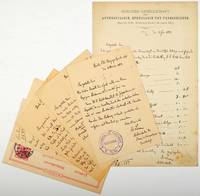
1893538471893. Berlin 18.XI.1893 bis 30.X.1897. 1 Seite gr.-8° 5 Seiten. Der Brief mit gedrucktem Briefkopf "Berliner Gesellschaft für Anthropologie. Ethnologie und Urgeschichte". Teilweises etwas fleckig. Abraham Lissauer 1832-1908 Arzt Anthropologe und Archäologe. - Als Bibliothekar und Kustos der Schädelsammlung der Anthropologischen Gesellschaft an die Buchhandlung Lynge et Söns in Kopenhagen die Bestellung antiquarischer Titel für die Gesellschaft betreffend teilweise mit Bestell-Listen. unknown
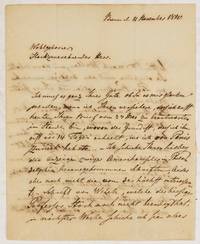
1820594181820. Bremen 4.XI.1820. 3 Seiten 4°. Mit Siegelspur und Adresse Schiffspost-Stempel. Leicht gebräunt an der Siegelstelle ohne Textverlust leicht beschädigt. Johannn Abraham Albers 1772-1821 Stadtphysikus und Geburtshelfer in Bremen machte sich durch seine Croup-Studien einen Namen gründete 1802 die dem amerikanischen Präsidenten Thomas Jefferson gewidmete Zeitschrift "Americanische Annalen der Arzneykunde Naturgeschichte Chemie und Physik". - An den franco-amerikanischen Linguisten Peter Stephen de Ponceau 1760-1844 in Philadelphia Sekretär der American Philosophical Society of Philadelphia. Albers übersendet "Anzeigen zweyer Amerikanischer in Philadelphia herausgekommenen Schriften leider aber noch nicht die von der höchst interessanten Schrift von Welch welche der hiesige Professor Stork noch nicht beendigt hat. In nächster Woche schicke ich sie aber bestimmt nach Halle und dann erhalten Sie dieselbe mit den Anzeigen von noch ein paar Büchern die ich Ihrer Güte verdanke. Das Buch mit welchem sie Herrn Dr. Oelrichs ein gewiss höchst interessantes Geschenk machen werden habe ich ihm nach Mannheim wo er jetzt lebt gesandt ich habe ihn hier sehr ungern verloren denn er war ein höchst interessanter vielseitig gebildeter Mann. Die verlangten Schauspiele von Kotzebue will ich Ihnen besorgen obgleich ich fast mit Ihnen zürnen möchte dass Sie Ihr Geld für so schlechtes Zeug ausgeben ." unknown
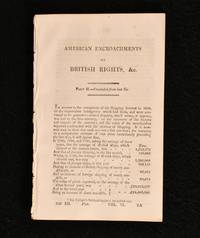
1815725L19London: Gale and Fenner 1815. Disbound. Near Fine. 8" by 5". None. A section from the nineteenth century publication 'The Pamphleteer' regarding American Encroachments of British Rights. Much of this chapter is taken from Nathaniel Atcheson's work 'American Encroachments on British Rights' published in 1808 which is an observation on the importance of the British North American Colonies and looks at the treaties with the United States. This copy is disbound. Lacking the title page as this is one section from this periodical. This work is part II concluded from the last number. This work explores shipping and trade at the turn of the nineteenth century and looks at the relationship of Britain and America following the War of Independence and the Confederation period. A very scarce work which provides an insight into the political state and relationship between Britain its old colonies and the newly formed United States of America. Disbound. Externally very smart with a light spot to the first leaf. Internally firmly bound. Pages are very bright and clean. Near Fine Gale and Fenner unknown
1860158491860. Lincoln Abraham. The Lincoln and Douglas Debates 1860 printed record of the seven public debates between Abraham Lincoln and Stephen A. Douglas during the 1858 Illinois Senate campaign a pivotal series of political confrontations over slavery and the future of the United States. The debates addressed the expansion of slavery into western territories and the constitutional implications of the Supreme Court's Dred Scott decision. Lincoln used the campaign to articulate a moral and political critique of slavery's expansion including the position he expressed in his earlier convention speech that "a house divided against itself cannot stand." Although Lincoln lost the Senate race to Douglas the debates established him as a leading national figure within the Republican Party and played a major role in shaping the political arguments that led to his presidential election in 1860.<br /> <br /> Lincoln Abraham. The Lincoln And Douglas Debates. A Political Debates between Hon. Abraham Lincoln and Hon. Stephen A. Douglas. In the Celebrated Campaign of 1858 in Illinois. Columbus: Follett Foster and Company 1860. First edition third issue identified by the numeral "2" on page 13 and the presence of the publisher's advertisement. Octavo volume containing 268 pages. Bound in publisher's original olive green textured cloth with blind stamped borders and spine lettered in gilt.<br /> <br /> The Lincoln Douglas debates represented one of the most influential series of political exchanges in nineteenth century American history addressing the central constitutional and moral questions surrounding slavery in the years immediately preceding the Civil War. Douglas defended the doctrine of popular sovereignty arguing that territories should decide the legality of slavery for themselves while Lincoln challenged the compatibility of that doctrine with the Dred Scott decision and emphasized the moral consequences of the institution. Although Douglas retained his Senate seat Lincoln's articulate presentation of the issues drew national attention and positioned him as a major political figure within the emerging Republican Party. Slight chipping to the head of the spine fading to boards and gilt minor damp staining with light foxing and toning consistent with age. Overall good condition. unknown
1863WRCAM55251Washington 1863. 20pp. Original printed wrappers. Light toning. A near fine copy in wonderful condition. In a cloth chemise and green half morocco and cloth slipcase spine gilt. The rare pamphlet printing of Lincoln's December 8 1863 proclamation read before Congress the next day offering amnesty to citizens of the Confederacy providing they take an oath that they "will abide by and faithfully support all proclamations of the President made during the existing rebellion having reference to slaves" i.e. the Emancipation Proclamation. When the number of persons in any state taking the oath reached ten percent of the number of voters in 1860 this group of loyal voters could form a state government that could be recognized by the President. The Amnesty Proclamation was issued with President Lincoln's third Annual Message to Congress i.e. State of the Union Address on December 8 1863; the State of the Union Address follows the Amnesty Proclamation here. <br> <br> Toward the close of 1863 with the Confederate Army in full retreat discussions in Congress centered on how to restore the southern states to the Union. "The crisis which threatened to divide the friends of the Union is past" announced Lincoln. Now it was the duty of Congress to ensure that all citizens in the South regardless of race were guaranteed the equal protection of the law. A number of competing proposals emerged from deliberations but in the end during his message to Congress on December 8 1863 Lincoln declared reconstruction of the South a wholly executive responsibility and "offered 'full pardon.with restoration of all rights of property except as to slaves' to all rebels who would take an oath of future loyalty to the Constitution and pledge to obey acts of Congress and presidential proclamations relating to slavery" Donald p.471. <br> <br> Those excluded from taking the oath were the highest ranking members of the Confederacy - government officials judges military and naval officers above the rank of army colonel or navy lieutenant former congressmen and "all who have engaged in treating colored persons or white persons otherwise than lawfully as prisoners of war." Lincoln further encouraged the southern states to make provisions "in relation to the freed people of such State which shall recognize and declare their permanent freedom provide for their education and which may yet be consistent as a temporary arrangement with their present condition as a laboring landless and homeless class." <br> <br> "Lincoln indicated that this was only one plan for reconstructing the rebel South and while it was the best he could think of for now he would gladly consider others and possibly adopt them. He might even modify his own classes of pardons if that seemed warrantable.Afterward almost everybody but die-hard Democrats seemed happy with the plan" Oates p.371. <br> <br> A lovely copy of Lincoln's hugely important Amnesty Proclamation. MONAGHAN 191. SABIN 41162 note. David Herbert Donald LINCOLN New York 1995 p.471. Stephen B. Oates WITH MALICE TOWARD NONE: A LIFE OF ABRAHAM LINCOLN New York 1977 p.371. hardcover books
1828009569This ciphering book measures 8" x 12.5". It contains 92 pages of ciphering work. There is also an additional 36 pages of text in a different hand perhaps by a sister copied from Timothy Shay Arthur's <i>Advice to Young Ladies</i> and the American Tract Society's <i>Helps for Every Hour</i>. Quarter-bound with marbled boards. The owner's label reads "Abraham Rex / Philadelphia / 1828." An 8.5" x 4" pencil drawing copied from <i>The Tours of Dr. Syntax</i> is laid in. <br /><br />Ciphering books were prepared as part of the basic mathematical training of relatively well-off American students usually boys. Most like this one contain examples of the Numeration Addition Subtraction Compound Multiplication Reduction Compound Reduction Rule of Three Indirect Proportion Vulgar Fractions Compound Proportions The Double Rule of Three Avoirdupois Weight Troy Weight Long and Land Measure etc. <br /><br />In addition to providing mathematical basics boys venturing into trades or businesses needed advanced or specialized training in mathematics. In this case Abraham's book includes some work that would prepare him for mercantile positions including Tare and Tret calculating weight adjustments for packing and shipping materials Insurance Commissions and Brokerage Compound Interest Rebate or Discount Equation calculating combined payments Barter Loss and Gain Fellowship calculating complicated partnership percentages etc. <br /><br />Abraham was a member of a prominent and prosperous Pennsylvania Dutch family. Online genealogical records show that the Rüx anglicized to Rex family immigrated to the United States sometime prior to 1720 and settled in Germantown north of Philadelphia. The family soon moved westward to Schaefferston in Lancaster County where it proliferated and prospered with members becoming merchants innkeepers informal bankers brokers pharmacists and physicians. <br /><br />For more information about the Rexes of Schaefferstown see Wenger's <i>Delivering the Goods: The Country Storekeeper and Inland Commerce in the Md-Atlantic</i>. An archive of Rex family business papers is held by the Winterthur Library. <br /><br />For more information about ciphering books see Kilpatrick's <i>Rewriting the History of School Mathematics in North America . . . The Central Role of the Cyphering Books</i> Doer's master's thesis: <i>Cipher Books in the Southern Historical Collection of the University of North Carolina</i> and Andries's "Learning Mathematics in North America" at the University of Pennsylvania's Kaplan Collection of Early American Judaica. <br /><br />18th-century American ciphering books are scarce as the overwhelming majority of extant examples date from the early 1800s into the mid-1850s. hardcover books
1807014892London: Printed for J. Johnson 1807. Book measures 22x14.cm. xlvii 5529pp. Bound in early half calf calf corners flat gilt bands and title lettering. Binding worn missing part of spine joints split boards very loose. Internally light browning to about 40 pages. Pages in good clean condition. A good better than working copy. Half Calf. Good. 8vo. Printed for J. Johnson Hardcover
1807539560London: Printed for J. Johnson … by T. Bensley 1807. Hardcover. Very Good. First edition. Abridged and edited by William Hazlitt. Octavo. xlvii 4 529pp. Bound in tree calf re-backed with the original gilt decorated spine and red leather titling label laid down marbled endpapers gilt and gauffered edges. Armorial bookplate of Belgian politician Sylvain van de Weyer on front pastedown. Intermittent toning and moderate scattered foxing very good. An attractive copy with a notable provenance. Van de Weyer 1802-74 served as Belgian ambassador to the United Kingdom and briefly as prime minister of Belgium under King Leopold I. Printed for J. Johnson … by T. Bensley hardcover
18901034LLondon: Kegan Paul Trench Trubner & Co 1890. Vol. I stated second edition others 1st. editions. Hardcover full leather. very good. Kegan Paul Trench Trubner & Co. 1880 vol. II 1885 vol. 3 1890 Vol 1 second edition. - <br /> 3 volumes. xvi 247; vii 1 399; xii 292 pp. Folding table of comparative genealogy in Vol. I. 8vo 19.8x13 cm 7¾x5¼" 19th century calf ruled in gilt raised spine bands morocco lettering pieces marbled endpapers & edges. Vol. I stated second edition the others apparently first editions.<br /> Forbes 3209.<br /> <br /> We add the separately published "INDEX to the Polynesian Race" with a brief Memoir of Judge Fornander published by Bishop Museum Press Honolulu 1909 hardcover 9.75 x 6.5" 86 pages in very good condition. Comes with the Ex-Libris of Aubrey Penderel Janion a photographer born in London in 1894 died on Maui in 1986.<br /> <br /> Abraham Fornander was a Swedish-born emigrant who became a citizen of the Kingdom of Hawaii swearing an oath of allegiance to Kamehameha III the Hawaiian king after having come to Hawaii by deserting the whaleship Ann Alexander. He became an important Hawaiian journalist judge and ethnologist. With ownership signature in Vol. I on half title "Honolulu in November 1891 H.A. Widemann." Rubbing to spines and extremities; foxing primarily to earlier and later leaves; very good. Kegan Paul, Trench, Trubner & Co hardcover
1878012314London: Trübner 1878. Book. Very Good. Full-Leather. First Edition. 8vo - over 7¾" - 9¾" tall. Volume I is the first edition published 1878 Volume II is the first edition published 1880. xvi 247; vii 399 pages. Folding genealogical table at the end of volume I. Volume I has a newspaper clipping pasted to the front endpaper. Inscription dated Honolulu 1892 on half-tile page. Beautiful original leather bindings marbled endpapers. Abraham Fornander 1812 - 1887 was a Swedish-born emigrant who became an important Hawaiian journalist judge and ethnologist. Please contact us if you want to purchase only one of these volumes. . Trübner Hardcover
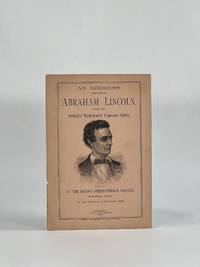
18899003Springfield IL: O. H. Oldboyd 1889. Original Wrappers. Very Good binding. Octavo. 2 14 pp. illus. First edition thus. As issued in printed wrappers with an engraved portrait of Lincoln on the front wrapper and several in-text views within. Light rubbing and separation of the wrappers starting at the spine but generally and exceptionally crisp clean copy. <br /> <br /> A notable speech before the newly formed Washingtonian Society a temperance society that took a different approach for the period attempting to reform individuals rather than reform all of society leaning not on religious rhetoric but on practical benefits of being sober—an approach that agreed with Lincoln. His address follows suit and in sweeping form he equates the temperance revolution for personal freedom from alcohol to the American Revolution for political freedom: "Happy day when all appetites controlled all poisons subdued all matter subjected mind all conquering mind shall live and move the monarch of the world. Glorious consummation! Hail fall of Fury! Reign of Reason all hail!" p. 13. Originally issued by the Society in 1882 the first edition is rare in commerce and with a scant 2 dozen institutional holdings. Even this 1889 reprint is quite uncommon with fewer than 20 institutions holding copies a surprisingly small number for an address by a president particularly one of Lincoln's stature. O. H. Oldboyd unknown
1889108246O.H. Oldroyd 1889. Pamphlet. Very Good. 9x6x0. 1889 O.H. Oldroyd Springfield staple bound pamphlet library stamp to front cover and emboss to title otherwise unmarked. Very light chip to wrappers. 14 pages Please email for photos. O.H. Oldroyd unknown
185211376New-York: Printed by John A. Gray 1852. 35 pp Disbound. Some tanning else Very Good. FIRST EDITION. Sabin 63733. Printed by John A. Gray unknown books
1834602211834. Holmes Abraham 1754-1809. An Address Delivered Before the Members of the Bar of the County of Bristol Mass. At New-Bedford June Term 1834. New Bedford: Press of Benjamin T. Congdon 1834. 24 pp. Octavo 9-1/2" x 5-1/2". Stab-stitched pamphlet in printed wrappers. Some shelfwear and soiling to exterior "26" and later library stamp to head of front wrapper light toning to text internally clean. $75. unknown books
1811001991Boston: Manning & Loring 1811 Bound in period blue-gray wraps 120 pp. from the Second London edition. This copy with chips at spine extremities and corners first several leaves creased and slight rounding of the pages. An early imprint in period wraps in quite decent condition. Manning & Loring paperback
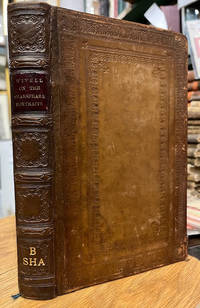
182784953London: by the author and sold by all booksellers 1827. Shakespeare's portraits First edition published three years after James Boaden's work on the same subject. Wivell had risen from impoverished beginnings and an apprenticeship to a wigmaker and hairdresser before reaching public notice as an artist with portraits of the Cato Street conspirators awaiting trial. This led to a commission to draw portraits of the participants in the "trial" of Queen Caroline in the House of Lords thence to abundant portrait commissions from the royal family the aristocracy and leading theatrical figures. This publication however brought his prosperity to a sudden end as its sales failed to cover the expense of producing the plates reducing Wivell "from affluence to comparative poverty" Art Journal 206. He was rescued by an uncle's legacy and his own ingenuity subsequently inventing a rope fire escape that was credited with saving hundreds of lives. Jaggard notes that the edition size was 500 copies of which 50 had plates on India paper and 25 were printed on large paper. Octavo 207 x 135 mm in 2 parts the supplement with separate title. Engraved frontispiece of the Stratford monument 20 engraved plates. Mid 19th-century red half calf contrasting green labels low raised bands attractively gilt marbled sides blue-green endpapers red sprinkled edges. A little stripping to one corner one plate the Gilliland portrait torn across and repaired else a very good copy. Jaggard p. 695. hardcover
182774353London: Published by The Author 1827. 8vo.Ex-Library. Two volumes in one the Inquiry and Supplement. Ex library copy. iv vi 7-254 1; 52 3 ads pp. Vol. 1 has the 8 plates called for most on India paper plus a portrait of Wivell as frontis and a plate of signatures. Volume 2 has 12 plates on India paper. Full brown calf with blind-stamped decoration to boards and spine with raised bands and gilt lettering including library shelfmark. Marbled edges. Rubbing to binding. Label of Croydon Public Libraries to pastedown with library stamp scattered throughout and infrequent foxing. A throughly researched study of portraits of Shakespeare including appraisals of ones uncommonly seen. The sales of this work at the time of publication were quite unimpressive DNB. Jaggard p. 695. . Good. Blind-stamped Full Calf. 1827. Published by The Author 1827 unknown
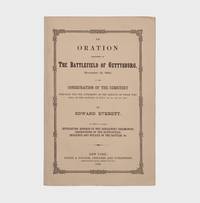
1863376857New York: Baker & Godwin 1863. First edition in book form. 48 pp. 1 vols. 8vo. Original printed wrappers expert restoration to the spine. Housed in a morocco backed box. First edition in book form. 48 pp. 1 vols. 8vo. A lovely copy of the rare first edition of Lincoln's Gettysburg Address delivered at the dedication of a cemetery on the Gettysburg battlefield four months after the bloody and pivotal battle that turned the tide of the Civil War in favor of the Union. Lincoln's speech delivered in only a few minutes stands as a supreme distillation of American values and of the sacrifices necessary for the survival of liberty and freedom.<br /> <br /> Much controversy surrounds the circumstances and content of the address as it was actually delivered at Gettysburg. The words spoken in the speech differ in the versions appearing in newspapers and the text which appeared in Washington several days later published as The Gettysburg Solemnities and known in only four copies which is now taken as the closest version to Lincoln's final intent because of its correspondence to the known manuscript versions. Interestingly and according to Carbonell the text of the first appearance of the speech in book form published a few days later as An Oration Delivered on the Battlefield of Gettysburg i.e. the present printing is taken largely from the New York Tribune printing. Lincoln's address appears on page 40 and parenthetical notes are added indicating "applause" and "long-continued applause." A diagram on page 32 gives the details of the Soldiers' National Cemetery at Gettysburg.<br /> <br /> "Lincoln's speech composed on the train on the way to Gettysburg and written down according to tradition on scratch-paper and the backs of envelopes comprised ten sentences and took only a few minutes to deliver. From the first words - 'Four score and seven years ago' - to the last - 'that government of the people by the people and for the people shall not perish from the earth' - it is immortal one of the supreme utterances of the principles of democratic freedom" PMM. PMM 351; Wills 191-204 261-263; Howes E233; Sabin 23263; Streeter sale 1747; Monaghan 193 Baker & Godwin unknown
1863423266New York: Baker & Godwin Printers and Publishers Printing-House Square opposite City Hall 1863. Softcover. Very Good. The earliest publication of Lincoln’s Gettysburg Address in book form preceded only by the exceptionally scarce 16-page pamphlet The Gettysburg Solemnities. Octavo. Stitched in the original printed wrapper with a publisher’s advertisement on the rear wrap. pp. 1-3 4-48. Modest overall toning and rubbing to the wrapper some fraying at the corners part of the paper along the spine back is perished one vertical stain at the front wrap and title page a very good copy with a few scattered contemporary brown ink markings. Very light contemporary ownership name in pencil at the top of the front wrap. Housed in a fine quarter blue morocco slipcase with gilt spine lettering and two raised bands and with an internal cloth chemise. “Collection of Foreman M. Lebold†stamped in gold on the front cover of the slipcase. Foreman M. Lebold was a noted collector of Lincoln material and the eldest brother of Nathan Leopold one of the infamous Leopold and Loeb teenage thrill killers convicted of the murder of Bobby Franks which captured the attention of the nation. Foreman like much of his family eventually changed his last name to Lebold because of the notoriety of the trial.<br /> <br /> Lincoln delivered his speech at the dedication ceremony of the Gettysburg National Cemetery on November 19 1863 about four months after the pivotal battle that turned the tide of the Civil War in favor of the Union. His speech was preceded by an Oration by Edward Everett the most famous orator of the day. Everett’s oration printed here in full took about two hours to deliver and is now largely forgotten. Lincoln’s address was delivered in only a few minutes and is now celebrated as the supreme distillation of American values and testament to the sacrifices necessary to achieve freedom for all Americans. It is printed on page 40 of this booklet under the title: “The dedicatory remarks were then delivered by the President as follows: / President Lincoln’s Speech. / Four score and seven years ago our fathers brought forth upon this continent a new nation …â€<br /> <br /> A well-preserved copy in the original wrappers.<br /> <br /> Sabin 23263; Printing and the Mind of Man 351. Baker & Godwin, Printers and Publishers, Printing-House Square, opposite City Hall unknown
186332764New York: Baker & Godwin 1863. 8vo. 9 x 5 5/8 inches. 48pp. Publisher's lettered wrappers publisher's ad on rear wrapper. Housed in a blue morocco box.<br/> <br/>"Four score and seven years ago.": the earliest publication of the Gettysburg Address in book form preceded only by the exceptionally rare sixteen-page pamphlet The Gettysburg Solemnities known in only three copies.<br/> <br/>Lincoln made his speech at the dedication of a cemetery on the Gettysburg battlefield some four months after the bloody and pivotal battle that turned the tide of the Civil War in favor of the Union. Lincoln's speech was preceded by an address from Edward Everett the most famous orator of his day. Everett's speech took some ninety minutes to deliver and is largely forgotten. Lincoln's speech delivered in only a few minutes is immortal. It is a supreme distillation of American values and of the sacrifices necessary for the survival of liberty and freedom. "The Washington Chronicle of 18-21 November reported extensively on this ceremony and included a verbatim text of 'Edward Everett's Great Oration.' On the fourth day it noted in passing that the President had also made a speech but gave no details. When it came to the separate publication on 22 November Everett's 'Oration' was reprinted from the standing type but Lincoln's speech had to be set up. It was tucked away as a final paragraph on page 16 of the pamphlet The Gettysburg Solemnities. It was similarly treated when the meanly produced leaflet was replaced by a 48-page booklet published by Baker and Godwin of New York in the same year" PMM. Lincoln's address appears on page 40 and parenthetical notes are added indicating "applause" and "long-continued applause." A diagram on page 32 gives the details of the Soldiers' National Cemetery at Gettysburg. A lovely example in original wrappers.<br/> <br/>Howes E232 "b"; Monaghan 193; Grolier American 100 72 note; Streeter Sale 1747; Sabin 23263; cf. Printing and the Mind of Man 351; Garry Wills Lincoln at Gettysburg pp.191-204. Baker & Godwin unknown books