775 résultats
186124870<p>"<i>The Sanitary Commission is … of direct practical value to the nation in this time of its trial. It is entitled to the gratitude and confidence of the people… There is no agency through which voluntary offerings of patriotism can be more effectively made. A. Lincoln.</i>"</p> <b>ABRAHAM LINCOLN. HENRY W. BELLOWS.</b>Printed Circular Letter to "<i>the Loyal Women of America</i>." Washington D.C. October 1 1861. 3 pp. 8 x 10 in.<p><b><br /></b></p><p><b>Historical Background</b></p><p>The United States Sanitary Commission USSC was a private relief agency to support sick and wounded Union soldiers and sailors. The idea began at a meeting of the Women's Central Relief Association of New York in April 1861 and was modeled on the British Sanitary Commission which operated during the Crimean War. The USSC set up and staffed hospitals and operated thirty soldiers' homes lodges and rest houses for traveling and disabled Union soldiers.</p><p>This circular urges American women to send contributions to the USSC for distribution to suffering servicemen. "<i>Every woman in the country can at the least knit a pair of woolen stockings</i>" the letter declared "<i>or if not can purchase them.</i>" The USSC sought blankets quilts pillows slippers delicacies such as cocoa and dried fruit checker and backgammon boards and books and magazines for convalescing soldiers and sailors. Before it was printed Frederick Law Olmsted wrote to Lincoln requesting "a line from the President recommending the purpose of the Commission to the confidence of the public." Lincoln's response sent the same day is included at the end.</p><p>7000 affiliated local societies held bazaars concerts raffles and plays to raise money. Beginning in the fall of 1863 major cities—including Chicago Cincinnati Brooklyn New York Pittsburgh Philadelphia St. Louis and Boston—held large sanitary fairs that lasted for weeks. With donations from many famous figures and artifacts for sale such as signed copies of the Emancipation Proclamation over the course of the war the USSC raised an estimated $5 million in cash and $15 million in in-kind contributions.</p><p>At first the Army Medical Bureau resented civilian involvement and questioned the use of women as nurses. Similar groups such as the Christian Commission argued that their counterparts were more interested in providing something for the upper classes to do in the war aside from fighting than they were in sympathizing with the plight of soldiers. But its success silenced most critics over time.</p><p>The USSC did provide significant opportunities for women to participate in the war effort. Dorothea Dix Mary Livermore and Mary Ann Bickerdyke held leadership roles. Novelist Louisa May Alcott was a nurse in a USSC hospital. One of its nurses Clara Barton became a founder of the American Red Cross. Many of the Northern women who were its grass roots workers developed an involvement in philanthropic and public affairs including the Civil Rights and Women's Suffrage movements.</p><p><b>Henry W. Bellows</b> 1814-1882 born in Boston graduated from Harvard College in 1832 and Harvard Divinity School in 1837. In 1839 he became the pastor of the First Congregational church in New York City. Gaining a reputation as a pulpit and lyceum speaker he became a leader of the Unitarian Church in America. From 1847 to 1866 Bellows edited the <i>Christian Inquirer</i> a weekly Unitarian newspaper. Bellows planned the United States Sanitary Commission and served as its only president from 1861 to 1878. In 1877 he became the first president of the first Civil Service Reform Association.</p> books
186421191.99<p>President Lincoln endorses a manuscript petition from border-state Unionists seeking the establishment of a permanent military post at Hickman Kentucky. "<i>Submitted to the Sec. of War who is requested to see the bearer. A Lincoln.</i>"</p> <b>ABRAHAM LINCOLN.</b>Autograph Endorsement Signed as President ca. December 1864 on a manuscript petition with two endorsements from Brigadier General Solomon Meredith. 2 pp. 7 x 9â…› in.<p><b><br /></b></p><p><b>Complete Transcript</b></p><p> <i>Hickman Ky Decr. 6th 1864</i></p><p><i>To the Honr. Abraham Lincoln.</i></p><p><i>President of the United States</i></p><p> <i>Sir</i></p><p> <i>We after an interview with our mutual Friend Brig Genl Meredith commanding the Western district of Kentucky have concluded to commission and empower our friend and fellow citizen Parson N.N. Cowgill to represent our interest before your august presence!</i></p><p> <i>We are suffering from the invatian of the Enemy upon us every day and have no power to repell them we ask of you to instruct our commander Brig Genl Meredith to make a permanant military post at this place</i></p><p> <i>We don't ask it for our protection exclusively but for the great benefit it will be to the Federal Army; We have a district of Country composing some 6 or 8 counties in area about two hundred miles! It being varied in its products offers every inducement to the Federal government to have it protected and let all of its resources be brought forward to</i> 2 <i>sustain our army. Our worthey and truly Union friend Parson N.N. Cowgill can give you a correct topography of our place and country. We would ask of you to extend our most appreciable Commander's district to the Hatchie River as this point is the natural outlet for all the cotton and tobacco raised in that section of the Country!</i></p><p> <i>We trust in Divine Providence you may be awakened to our great necessities and grant us the humble request we have made of you!</i></p><p> <i>Very Respectfully yours.</i></p><p> <i>Many Citizens of Loyalty</i></p><p>on verso in hand of Solomon Meredith: <i>I strongly recomend that a military post may be established at Hickman Ky. by the Secy of War. S Meredith Brig. Genl.</i></p><p><i>Head Qrs Dist of Westn Ky Paducah Ky. Dec 9th 1864</i></p><p><i>I am personally acquainted with Parson NN Cowgill and know him to be an honest patriotic and loyal man. The petition of which he is the bearer asking that Hickman be made a permanent military post I would most earnestly recommend to be granted knowing as I do that it will be of great benefit to the Union cause in this state. The Citizens of Hickman and Fulton Co gave a decided majority for the Union ticker at the late election which gives them a very powerful argument if not a claim for the protection of the government they serve. The government will be benefitted equally with the citizens by adopting the course proposed and the benefit both receive will be so much taken from the enemy who now occupy in little squads of guerrillas the whole country in that vicinity and run off every thing of value to their army which the can lay hands on. S Meridith Brig Genl.</i></p><p>on verso in hand of President Lincoln: <i>Submitted to the / Sec. of War who is / requested to see the / bearer. / A Lincoln</i></p><p><b>Historical Background</b></p><p>Border-state loyalists implore President Lincoln to establish a permanent military post at Hickman. Because of daily raids by rebel forces which the Unionists have no power to repel the citizens of Hickman file their request with the endorsement of General Solomon Meredith commander of the District of Western Kentucky based in Paducah. Meredith who had led the "Iron Brigade" was transferred to a desk command because of a bad shrapnel wound suffered at Gettysburg.</p><p>The town of Hickman is located in extreme southwestern Kentucky near the Mississippi River. Though Unionist in orientation it was a center of cotton cultivation. Even after the Confederate Army of Tennessee commanded by Braxton Bragg retreated from Kentucky in October 1862 the state was beset by guerrilla warfare for the remainder of the conflict. There were famous raids conducted by Confederate cavalrymen John Hunt Morgan and Nathan Bedford Forrest. President Lincoln declared martial law in August 1864 suspending the writ of habeas corpus to empower Union commanders such as Meredith unilaterally to arrest Confederate spies sympathizers and bandits.</p> books
186542656Philadelphia: Published by John Dainty 1865. Age-toning to engraving with some discoloration sections to margins especially to left. Minor wear to frame. Very Good. Oval image sepia toned 8" x 6-1/8". Period black oval wood frame 13-7/8" x 11-5/8" <br/><br/>Full-length group portrait of Abraham Lincoln and his family. Mary Todd Lincoln and the president are seated left to right with Robert Todd standing behind them and Thomas to Lincoln's right. A portrait of William Wallace Lincoln hangs on the wall. Published by John Dainty unknown books
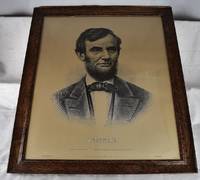
18992111010020Pennsylvania Lancaster County Lancaster: J.P. McCaskey 1899. First Edition. Art Prints & Posters. Good. The Iconography of Abraham Lincoln Large print of Lincoln printed in 1899 from the Lincoln Art series. Mounted under glass in wooden frame. Dimensions in frame: 25 1/2 x 29 1/2 inches. A few light scuffs to print. "Lincoln: Here was a type of the true elder race And one of Plutarch's men talked with us face face. - Lowell." - James Russell Lowell. A line from Lowell's Ode to Lincoln from the Harvard Commemoration July 21 1865. This etching depicts a head and shoulders portrait of President Abraham Lincoln. He wears a dark jacket and vest along with a white collared shirt and black bow tie. There is a slight shadow above Lincoln's shoulders. J.P. McCaskey unknown
1865228501865. No binding. Fine. Broadside. The Nation's Loss. A Poem on the Life and Death of the Hon. Abraham Lincoln. 1865. 1 p. 9 3/4 x 15 1/4 in. 1/2 inch loss at top not affecting text. Headed by an engraving of Lincoln Reverend Peter W. Brister's mourning poem occupies the first two columns and Lincoln's Emancipation Proclamation is printed in full in the third column. Brister's poem addressed what Lincoln meant to the nation during the Civil War how he saved the Union and freed the slaves. Below the image of Lincoln it reads ""Late President of the United States Who departed this life in Washington D.C. April 15 1865."" unknown
1865228501865. No binding. Fine. Broadside. The Nation's Loss. A Poem on the Life and Death of the Hon. Abraham Lincoln. 1865. 1 p. 9 3/4 x 15 1/4 in. 1/2 inch loss at top not affecting text. Headed by an engraving of Lincoln Reverend Peter W. Brister's mourning poem occupies the first two columns and Lincoln's Emancipation Proclamation is printed in full in the third column. Brister's poem addressed what Lincoln meant to the nation during the Civil War how he saved the Union and freed the slaves. Below the image of Lincoln it reads ""Late President of the United States Who departed this life in Washington D.C. April 15 1865."" unknown books
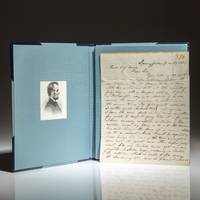
185316994Springfield Ill: Handwritten Letter 1853. ALS. Cloth. Very good. A two-page handwritten letter from Abraham Lincoln to fellow attorney Thomas J. Turner of Freeport Illinois addressing their future legal strategy since ".the Judge has already decided." The letter is dated June 27 1853 and is self-addressed. Octavo 4pp. Previously folded glue remnant along top edge. Several folds of the letter are weakened some partially separated. Small paper loss at intersecting fold with archival tissue repair. The letter is addressed in Lincoln's hand with "Springfield" and "Paid 3" stamped on cover. Housed in custom folding folio quarter blue morocco blue cloth title in gilt on the spine illustration of Lincoln on the front pastedown. This letter concerns the case of Kemper v. Adams & Bovey a land dispute in Freeport Illinois. Lincoln was retained by Adams and Bovey who after a series of losses and appeals prevailed in March 1858 by appealing to U.S. Circuit Court of Northern Illinois. Full letter reads: "Springfield June 27. 1853. / Hon. T. J. Turner: / Dear Sir: Your letter of the 20th. reached me day-before yesterday. I had the day before written to Adams to be on hand with his witnesses- but at the request of Judge Logan who is Kemper's attorney I put in a Post-script saying to Adams if he was agreed the cause should be continued over the summer term. On subsequent reflection I rather wish Adams may not agree. I have the case fresh in my mind and therefore wish to keep it going till it is finished. I have already drafted a Bill of Exceptions and my plan is to put the common lawsuit through the forms of a second trial up to a verdict which must be against us under Judge D's view of the law except & save all the points and then before judgment file our Bill and get an injunction. I shall begin preparing a Bill this afternoon which I which I wish to file during the evening term; and I believe I will do this Mr Adams must come down to swear to the Bill. In no event can we be ready for proof in the chancery suit at this time so that we will need no other witness than the one that was here last summer. I wrote Mr Adams about a Register's certificate & if he can find one or two missing tax receipts let him bring them. I should be glad to see you & shake you by the hand; but as there is no contested jury question I scarcely think you need be at the trouble & expense of coming. All the law questions which can arise at this term the Judge has already decided. Very truly yours A. Lincoln." Provenance: Originally the property of Claribel Mitchell of Freeport Illinois a principal at the Lincoln School until 1916. The letter was sold at auction by the American Art Association on January 30 1923 to Mr. George A. Ball of Muncie Indiana the namesake of the Ball Mason Jar Company. This letter was published in The Collected Works of Abraham Lincoln by Roy Basler New Brunswick NJ: Rutgers University Press 1953 2:199-200. Handwritten Letter unknown
186520323<p><b>ABRAHAM LINCOLN.</b>Currier & Ives. Lithograph New York 1865. In 24 x 29 in. hand-gilt frame. </p><p>From the hairs on Lincoln's head to the fabric of his suit this lithograph is a beautifully detailed rendering and remains even with a few areas of foxing a commanding showpiece.</p><p><b>Historical Background</b></p><p>The copyright date of <i>"1865"</i> along the bottom edge suggests that this oversized portrait was created to honor either Lincoln's second presidential term or his untimely death.</p><p>Lithographer <b>Nathaniel Currier</b> 1813-1888 and artist <b>James Merritt Ives</b>1824-1895 formed Currier & Ives in New York City in 1857 to publish art prints. The company closed in 1907 after the deaths of its founders when business had declined due to new printing technologies and changing artistic tastes.</p><p><b>Condition</b></p><p>There are a few areas of light age toning. It is displayed in a vintage frame not contemporary to 1865 as we bought it so it is not guaranteed to be archival.</p> books
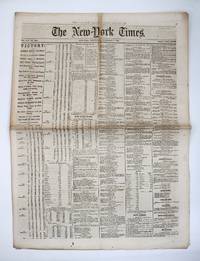
1864369148New York 1864. 8pp. Oblong folio. Central fold with small fading else fine. 8pp. Oblong folio. Reads on left column in part: VICTORY! Glorious rsult Yesterday. Election of Lincoln and Johnson. Terrible Defeat of McClellan." Haedlines show a little editorializing even then. unknown
186625617.02<p>An engraving by Alexander Hay Ritchie commemorates the moment Lincoln first presented the Emancipation Proclamation to his Cabinet.</p> <b>ABRAHAM LINCOLN.</b>Print. <i>The First Reading of the Emancipation Proclamation Before the Cabinet</i>. Engraved by Alexander Hay Ritchie after 1864 painting of Francis Bicknell Carpenter. New York: Alexander H. Ritchie 1866. 36 x 24 in.<p><b><br /></b></p><p><b>Francis Bicknell Carpenter</b> 1830-1900 a New York artist was so impressed with Lincoln's bold act that he recruited Illinois Congressman and abolitionist Owen Lovejoy to arrange a White House sitting. Carpenter met Lincoln on February 6 1864 and was allowed to set up a studio in the State Dining Room. Carpenter set his painting in Lincoln's office which also served as the Cabinet Room. Lincoln reportedly told Carpenter where each person was seated on the day he read them the preliminary Emancipation Proclamation. The artist was delighted that their placement was "entirely consistent with my purpose." To the left of Lincoln were Secretary of War Edwin M. Stanton and Secretary of the Treasury Salmon P. Chase the most radical members of his cabinet. A portrait of former Secretary of War Simon Cameron is also on the left of the painting. To the right of Lincoln around the table are Secretary of the Navy Gideon Welles Secretary of the Interior Caleb Smith Secretary of State William H. Seward Postmaster General Montgomery Blair and Attorney General Edward Bates the more conservative members of Lincoln's advisers. Lincoln sat at the head of the table between the two groups "but the uniting point of both" according to Carpenter.</p><p>After a temporary exhibit in the White House and Capitol in 1864 the fifteen-foot wide painting toured the country. Carpenter offered the painting to Congress which refused to make an appropriation for it. In 1877 Elizabeth Thompson of New York purchased the painting for $25000 and offered it to the nation. Congress formally accepted the gift on the sixty-ninth anniversary of Lincoln's birth. It hangs in the U.S. Senate. In 1866 book Carpenter also published a book <i>Six Months at the White House with Abraham Lincoln</i>.</p><p>This lithographic print by Scottish-born <b>Alexander H. Ritchie</b>1822-1895 captured and popularized Carpenter's painting before Carpenter made a series of alterations to the original most significantly in revising Lincoln's head and moving the quill pen from near Seward to in Lincoln's hand.</p><p>The National Portrait Gallery has a ledger page signed by Lincoln Stanton Chase Seward Wells and other members of Lincoln's administration ordering proof copies of Ritchie's print.</p><p><b>Historical Background</b></p><p>On July 22 Lincoln read a draft of his preliminary Emancipation Proclamation to his entire cabinet. In contrast to the Confiscation Acts of 1861 and 1862 the Emancipation Proclamation addressed only property in slaves and liberated all slaves in areas in rebellion not only those of rebellious masters. At Seward's urging Lincoln agreed to withhold announcing it until the Union forces had achieved a victory so that it did not appear especially to European observers to be the desperate act of a losing war effort.</p><p>Two months later when Union troops stopped Confederate General Robert E. Lee's invasion of Maryland at Antietam Creek Lincoln finally had his opportunity. On September 22 1862 Lincoln issued his Preliminary Emancipation Proclamation giving the South 100 days to end the rebellion or face losing their slaves. On both sides of the Mason-Dixon Line Lincoln's order was condemned as a usurpation of property rights and an effort to start racial warfare.</p><p>When the South failed to acquiesce Lincoln as promised issued the final Emancipation Proclamation on January 1 1863. With this Executive Order he took a decisive stand on the most contentious issue in American history redefined the Union's goals and strategy and sounded the death knell for slavery. The full text of his proclamation reveals the major issues of the Civil War: slave labor as a Confederate resource; slavery as a central war issue; the status of African Americans who escaped to Union lines; courting border states; Constitutional and popular constraints on emancipation; hopes of reunion; questions of Northern acceptance of black soldiers; and America's place in a world moving toward abolition. The President took the action "sincerely believed to be an act of justice" knowing that it might cost Republicans in the fall 1862 elections.</p><p>The final Proclamation showed Lincoln's own progression on the issue of slavery and eliminated earlier references to colonizing freed blacks and compensating slave owners for voluntary emancipation. It also added provisions for black military enlistment. Pausing before he signed the final Proclamation Lincoln reportedly said: "I never in my life felt more certain that I was doing right than I do in signing this paper."</p><p><b>Condition</b></p><p>Toned and slightly cropped.</p> books
1864369149New York: The New-York Times 1864. 8pp. Oblong folio. Central fold elae Fine. 8pp. Oblong folio. <br/><br/> The New-York Times unknown
186423084New York: Sold at 13 Park Row and at all Democratic Newspaper Offices 1864. 8pp caption title disbound a bit of blank margin wear Good. At head of title: 'Document No. 12.' <br /> <br /> This Democratic Party campaign pamphlet portrays President Lincoln as an incompetent military strategist who perpetually "interfered with General McClellan both when he was general-in-chief and afterward when he commanded the brave Army of the Potomac." Worse Lincoln has "The Taint of Disunion." He not McClellan the Democratic presidential candidate supported the Jeffersonian right of revolution in a speech during his single term in Congress. He and other "ultra abolitionists" are the "original secessionists and disunion men." <br /> George McClellan wants the rebel States to return to the Union but Lincoln's policies render that impossible. Lincoln "regards the States as dead and gone. He magnifies and strengthens the position of the Richmond dynasty" by seeking to negotiate "only with Jefferson Davis." <br /> Monaghan 326. Not in LCP. Sold at 13 Park Row, and at all Democratic Newspaper Offices unknown
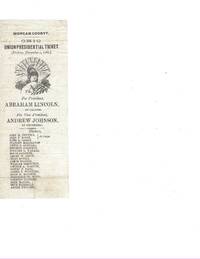
1864156621864. 16th President of the United States. Original Lincoln Union Presidential Ticket dated November 8 1864. A Morgan County Ohio Union Presidential Ticket for the 1864 election listing Abraham Lincoln for President and Andrew Johnson for Vice President together with state electors and local candidates 3 "x 7". Patriotic motif depicts Columbia with a sword labeled "Union." Despite his early fears of defeat Lincoln won strong majorities in the popular and electoral vote partly as a result of the recent Union victory at the Battle of Atlanta. Lincoln's victory made him the first president to win re-election since Andrew Jackson in 1832 as well as the first Northern president to ever win re-election. Lincoln was assassinated less than two months into his second term. In excellent condition. unknown
186122671<p><b>ABRAHAM LINCOLN.</b>Book. <i>Message of the President of the United States to the Two Houses of Congress. Volume 1</i> Washington: Government Printing Office 1861. 839 pp. 5¾ x 8¾ in. </p><b>Excerpt</b><p><i>"A disloyal portion of the American people have during the whole year been engaged in an attempt to divide and destroy the Union. A nation which endures factious domestic division is exposed to disrespect abroad and one party if not both is sure sooner or later to invoke foreign intervention. </i></p><p><i> Nations thus tempted to interfere are not always able to resist the counsels of seeming expediency and ungenerous ambition although measures adopted under such influences seldom fail to be unfortunate and injurious to those adopting them. </i></p><p><i> The disloyal citizens of the United States who have offered the ruin of our country in return for the aid and comfort which they have invoked abroad have received less patronage and encouragement than they probably expected.</i></p><p><i> It continues to develop that the insurrection is largely if not exclusively a war upon the first principle of popular government--the rights of the people. Conclusive evidence of this is found in the most grave and maturely considered public documents as well as in the general tone of the insurgents. In those documents we find the abridgment of the existing right of suffrage and the denial to the people of all right to participate in the selection of public officers except the legislative boldly advocated with labored arguments to prove that large control of the people in government is the source of all political evil. Monarchy itself is sometimes hinted at as a possible refuge from the power of the people. </i></p><p><i> In my present position I could scarcely be justified were I to omit raising a warning voice against this approach of returning despotism."</i></p><p><b>Historical Background</b></p><p>President Lincoln's first message to Congress in 1861 immediately follows the title page. In the first year of both his presidency and the Civil War Lincoln criticizes disloyal citizens who are trying to ruin the country. He acknowledges that the Confederates firing on Fort Sumter ended hope of a peaceful solution and expresses his confidence in General McClellan. Lincoln also expounds on the foreign affairs the relationship of labor to capital and reports on domestic commerce and other affairs. The remainder of the book is over 400 pages of papers relating to foreign affairs and correspondence with other nations and diplomats. The second half of the book is made up of the Reports of the Secretaries of the Interior War Navy and Postmaster General.</p><p><b>Condition </b></p><p>Good. Original cloth boards with U.S. seal and titled spine some slight chipping and wear to boards and spine binding a little loose and front endpaper almost detached hinges a bit weak but still firm some aging but generally clean internally.</p> hardcover books
184822094.01 -.02<p>Lincoln's spot resolution and speech condemns the pretexts for starting the war with Mexico. He requests proof from President Polk that American blood was shed on American soil and that the enemy provoked the Americans and he asks if those Americans present were ordered there by the United States Army.</p> <b>ABRAHAM LINCOLN.</b>Newspaper. <i>National Intelligencer</i> Thursday December 23 1847. Washington: Gales & Seaton . 4 pp. Offered with another issue of the <i>National Intelligencer</i> January 20 1848. 4 pp.<p><b><br /></b></p><p><b>Excerpts:</b></p><p><b>December 23 1847 issue</b></p><p>Page 2 bottom of first column to second column</p><p><i>Mr. LINCOLN moved the following preamble and resolutions which were read and laid over under the rule:</i></p><p><i> Whereas the President of the United States in his message of May 11 1846 has declared that "the Mexican Government not only refused to receive him the envoy of the United States or listen to his propositions but after a long-continued series of menaces have at last invaded </i>our territory<i> and shed the blood of our fellow citizens on</i> our own soil<i>."</i></p><p><i> And again in his message of December 8 1846 that "we had ample cause of war against Mexico long before the breaking out of hostilities; but even we forbore to take redress into our own hands until Mexico herself became the aggressor by invading </i>our soil <i>in hostile array and shedding the blood of our citizens."</i></p><p><i> And yet again in his message of December 7 1847.</i></p><p> Resolved by the House of Representatives<i> that the President of the United States be respectfully requested to inform this House—</i></p><p><i> 1st. Whether the spot on which the blood of our citizens was shed as in his messages declared was or was not within the territory of Spain at least after the treaty of 1819 until the Mexican Revolution.</i></p><p><i> 2d. Whether that spot is or is not within the territory which was wrested from Spain by the revolutionary Government of Mexico. </i></p><p><i> 3d. Whether that spot is or is not within a settlement of people which settlement has existed ever since long before the Texas revolution and until its inhabitants fled before the approach of the United States army.</i></p><p> <i>4th. Whether that settlement is or is not isolated from any and all other settlements by the Gulf and the Rio Grande on the south and west and by wide uninhabited regions on the north and east.</i></p><p><i> 5th. Whether the people of that settlement or a majority of them have ever submitted themselves to the government or laws of Texas or of the United States by consent or by compulsion either by accepting office or voting at elections or paying tax or serving on juries or having process served upon them or in any other way.</i></p><p><i> 6th . Whether the people of that settlement did or did not flee from the approach of the United States army leaving unprotected their homes and their growing crops </i>before<i> the blood was shed as in the messages stated; and whether the first blood so shed was or was not shed within the enclosure of one of the people who had thus fled from it. </i></p><p><i> 7th. Whether our </i>citizens<i> whose blood was shed as in his messages declared were or were not at that time armed officers and soldiers sent into that settlement by the military order of the President through the Secretary of War.</i></p><p><i> 8th. Whether the military force of the United States was or was not so sent into that settlement after Gen. Taylor had more than once intimated to the War Department that in his opinion no such movement was necessary to the defense or protection of Texas. </i></p><p><i> Several resolutions of inquiry were here offered my Messrs. GEORGE S. HOUSTON W.P. HALL PHELPS GREEN McCLELLAND and KAUFMAN which are omitted for want of room.</i></p><p><b>January 20 1848 issue: </b></p><p>Page 2 bottom of 3rd column thru 6th column. In this lengthy address Lincoln questions President Polk's judgment regarding the aims and prosecution of the war in Mexico putting it in the context of the American Revolution: <i>"Texas revolutionized against Mexico and became the owner of something…if she got it in any way she got it by revolution; one of the most sacred of rights—the right which he believed was yet to emancipate the world; the right of a people if they have a government they do not like to rise and shake it off…He talked like an insane man. He did not propose to give Mexico any credit at all for the country we had already conquered; he proposed to take more than he asked for last fall…"</i></p><p>Additional news: page 2 middle of 4th column prints a lively senatorial debate involving Jefferson Davis. Page 3 bottom of 2nd column <i>"Mr. LINCOLN from the same committee reported a bill for the relief of William Fuller and Orlando Saltmarsh. Read and committed." </i>Page 4 middle of 3rd column <i>"By Mr. LINCOLN: A bill to amend an act entitled 'An Act to raise for a limited time an additional military force and for other purposes' approved February 11 1847."</i> This act gave the president permission to raise one regiment of dragoons and nine regiments of infantry to be used in the war with Mexico. In addition the act dealt with the logistics of each regiment such as raising the pay for field surgeons or adding a quartermaster to each regiment.</p> books
186330001.20<p>Contains Lincoln's entire 1863 Message to Congress where he reaffirmed his commitment to emancipation as well as His Proclamation of Amnesty and Reconstruction which laid out a plan to return the rebellious states to the Union fold. Commonly called the "Ten Percent Plan" it allowed for a state to hold new elections when 10% of its 1860 voters took a loyalty oath to the Union.</p> <b>ABRAHAM LINCOLN.</b>Newspaper. <i>New York Times</i> New York N.Y. Dec. 10 1863 with <i>"Supplement to The New York Times"</i> complete with its own masthead. 12 pp. 14¾ x 21 in.<p><b><br /></b></p><p><b>Excerpt</b></p><p>"<i>To now abandon them would be not only to relinquish a lever of power but would also be a cruel and an astounding breach of faith. I may add at this point that while I remain in my present position I shall not attempt to retract or modify the emancipation proclamation nor shall I return to slavery any person who is free by the terms of that proclamation or by any of the acts of Congress.</i>"</p><p><b>Historical Background</b></p><p>Throughout the fall of 1863 eventual Union victory became increasingly clear and on December 8 1863 Lincoln issued his Proclamation of Amnesty and Reconstruction. This lenient plan that offered citizens of the rebellious states full pardons voting and property rights except possession of slaves encouraged the states to begin addressing the issue of the freedmen and women without compromising their rights and allowed a former Confederate state to hold elections and form a pro-Union government once 10% of the number of voters in the 1860 election swore loyalty oaths. Commonly called the "Ten Percent Plan" it reflected both Lincoln's charitable view of Reconstruction as well as the reality that heavy penalties denial of voting and property rights to rebels and impoverishing the South was no way to rebuild a nation after a war fought at least initially to preserve the Union.</p> books
186423084New York: Sold at 13 Park Row and at all Democratic Newspaper Offices 1864. 8pp caption title disbound a bit of blank margin wear Good. At head of title: 'Document No. 12.' <br/><br/> This Democratic Party campaign pamphlet portrays President Lincoln as an incompetent military strategist who perpetually "interfered with General McClellan both when he was general-in-chief and afterward when he commanded the brave Army of the Potomac." Worse Lincoln has "The Taint of Disunion." He not McClellan the Democratic presidential candidate supported the Jeffersonian right of revolution in a speech during his single term in Congress. He and other "ultra abolitionists" are the "original secessionists and disunion men." <br/> George McClellan wants the rebel States to return to the Union but Lincoln's policies render that impossible. Lincoln "regards the States as dead and gone. He magnifies and strengthens the position of the Richmond dynasty" by seeking to negotiate "only with Jefferson Davis." <br/>Monaghan 326. Not in LCP. Sold at 13 Park Row, and at all Democratic Newspaper Offices unknown books
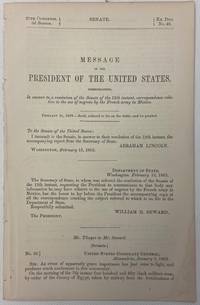
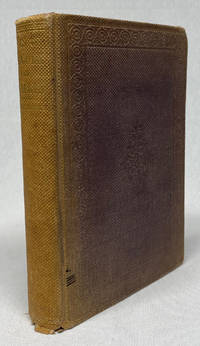
1863175681863. Lincoln Abraham. African Troops Scarce U.S. Senate executive document transmitting a message from Abraham Lincoln and accompanying State Department correspondence concerning the French deployment of Black troops to Mexico during the American Civil War. Issued by the 37th Congress 3rd Session in February 1863 the report reflects the convergence of emancipation-era policy racialized military labor and international imperial strategy.<br /> <br /> U.S. Senate Executive Document No. 40 37th Congress 3rd Session; February 1863. Original printed pamphlet in standard folio format.Prepared under the direction of William H. Seward the document compiles diplomatic intelligence indicating that France transported African troops from Egypt-specifically from regions identified as "Dalfour" and Nubia-to reinforce forces stationed at Veracruz during the French Intervention in Mexico. The stated rationale as recorded in the report was that "the black race is not subject to the yellow fever" revealing the period's racialized medical assumptions and their direct application in imperial military logistics.<br /> <br /> Produced in the immediate aftermath of the Emancipation Proclamation this document is especially significant for situating Black military labor within a global context. While the Union was actively recruiting African American soldiers U.S. officials were simultaneously monitoring European powers deploying African troops across colonial networks. The report thus provides rare contemporary evidence of how race disease theory and military necessity intersected in both American and European wartime policy. This document holds strong research value across multiple fields: African American military history Civil War diplomacy transnational slavery and emancipation colonial medicine and 19th-century imperial warfare. It is particularly notable for documenting the perceived biological resilience of Black soldiers as a strategic asset-an idea central to both colonial and military history. AS per OCLC Scarce in institutional holdings with only a small number of recorded copies including Wyoming North Texas Michigan and Faulkner University. OCLC data should be understood as approximate and subject to revision. Condition: Light dampstaining to the lower right blank corner; otherwise in very good condition and clean legible text. unknown
186454101New York: printed by Thomas R. Dawley 13 Park Row and at all Democratic Newspaper Offices 1864. 8vo. 8 pp unpaginated. bound into mostly blank volume. Half-calf over marbled boards marbled endpapers raised bands on spine red black & gilt morocco spine labels minor scuffing wear to corners still VG copy from the library of noted New York City book collector Thomas Bell with his bookplate designed by Nancy Barnhart on front pastedown who was noted for his impressive library devoted mostly to Americana with many titles on Lincoln and sold at Anderson Galleries Auction in 1917. First edition of this scarce Democratic Party Copperhead influenced presidential campaign pamphlet perpetuating the complaints of mistreatment by Democratic candidate and former Civil War general George B. McClellan. This piece appears to have been published at the height of the Cold Harbor campaigns by the Union Army under command of Lieut. General Ulysses S. Grant which were suffering heavy casualties and significant blows to northern morale during the Civil War. The opening letter from President Lincoln denotes his complete confidence in Grant for the 1864 campaigns. In contrast McClellan has presented all of the attempts by Lincoln to encourage move troops and override orders from General as commander of the Union Army. In addition the Democratic ticket under McClellan wanted to negotiate with the Confederates immediately and place the agreement before the voters. Subsequent Documents included further charges against President Lincoln’s arbitrary arrests corruption and frauds Republican opinions about Lincoln and more. Dawley was self-styled as the Publisher to the Million and established himself at 13 and 15 Park Row as the “cheapest printer in the world†whose most successful Civil War publication was the best seller Incidents of American Camp Life. See: Nicolay & Hay Complete Works of Abraham Lincoln Bibliography No. 271; Philip R. Bishop Princes May Compete For But Only Huntingtons Can Buy Endpapers 2012 pp. 14-16. (printed by Thomas R. Dawley) 13 Park Row, and at all Democratic Newspaper Offices, hardcover
186534970New York: Currier & Ives 152 Nassau St. 1865. Folio broadside 12" x 16". Black and white bust portrait of a well-groomed bearded Abraham Lincoln. He wears a dark jacket and vest with a white button-down collared shirt and dark bow tie. In very small print below the caption appears to be the number 205 or possibly 105. Moderately tanned small white scattered spots. Several closed tears at edges and corners several archival tape repairs on verso. Good. Currier & Ives, 152 Nassau St. unknown books
186010625Columbus OH: Follett Foster & Co 1860. First Hardcover Edition. Hardcover. Very good. Octavo 406pp. illustrated plus advertisements. With half-title and original endpapers. A very good copy complete and unrestored in the publisher's brown cloth. Spine ends with shallow wear one scrunch to the cloth on the front board abrasions to corners and mild internal foxing. Still a nice sound copy with strong inner hinges. All three illustrations present as called for including an uncommonly dashing portrait of the 16th president. Preceded by two issues in wrappers both of which are extremely rare in commerce. Considered to be the first widely read modern campaign biography. This must be quite an early copy as there is no errata slip at p. 74 issued in later copies the error on p. 46 no "i" in "importance" on the last line is present and we even note another typographical error not mentioned in any other catalog description that we found with the last word "triumph" omitted by the printer supplied here in pencil by a contemporary owner. There is a period and colon after the "O" at the imprint though these almost appear to have been added later . Howes H-735. Follett, Foster & Co hardcover
18041188409New York: The Shakespeare-Gallery 1804. Eighth Edition. Hardcover. Approx. 4.5" x 7" VG marbled sandy brown hardcover with no text on spine or cover. Rubbing to corners and spine ends of boards. Mild foxing to edges of text block. Hinges starting at front pastedown which opposes first of two title pages one for each discrete section of this directory. Old hand-calligraphed swooping names penned to first title page. A few internal chips and tears to each title page subtly affecting text of Astronomical Calculations subtitle; and a 1.5" x .25" chip to July/August 1804 astronomical charts with resulting loss to a few calculations across a couple of categories. Foxing throughout; binding remains tight. Shelved in Case 13. 1188409. Shelved Dupont Bookstore. The Shakespeare-Gallery hardcover books
1854181733London : Longman Brown Green and Longmans 1854. First Edition. Hardback. Finely bound in modern aniline half-calf over marble boards. Gilt cross-bands / raised bands with gilt-blocked titling. Minor generalized wear to the bands and panel edges. Remains uncommonly well-preserved overall; tight bright clean and strong. Book has faint marginal scattered foxing and light staining. ; 8vo 8"" - 9"" tall; 124 pages; Physical desc. : 124 p. & 92 p 31 p ; 17 cm. Subject: Chesterfield Philip Dormer Stanhope Earl of 1694-1773 - Biography. Selwyn George - Biography. Notes: Jonathan Swift D. D. By Lord Jeffrey. Samuel Richardson by Lord Jeffrey. Series: Edinburgh review ; 161 166. Originally in pamphlet form. London : Longman, Brown, Green and Longmans hardcover
183435602Rochester Boston MA 1834. A collection of six letters ranging in size from 8-1/2" x 11" to 8-1/2" x 12-3/4" five complete and one partial letter. All in ink manuscript on unlined paper. Old folds light toning occasional light foxing two on untrimmed paper. Most are addressed on final blank page and have wax seal remnants with the usual tear where wax was torn open occasional loss to a few letters. Overall Very Good. <br /> <br /> Abraham Holmes was a Massachusetts legislator and attorney. Opposing ratification of the Constitution he was allied with the Anti-Federalist Otis family of Barnstable and Freeman family of Sandwich. He was an Anti-Federalist delegate from Rochester MA to the Massachusetts Ratifying Convention of 1788. He served as Sergeant in Capt. Barnabas Doty's company Col. Ebenezer Sproat's regiment during the Revolutionary War. He was admitted to the Plymouth County Bar in April 1800 at the age of forty-six. Though he had no formal legal education his admission to the Bar was permitted in consideration of his respectable official character learning and abilities and on the condition that he study three months in an attorney's office. He served as president of the Court of Sessions prior to his bar admission practiced law in Rochester until the early 1830s was a member of the State Constitutional Convention of 1820 and a member of the Executive Council from 1821 to 1823. Davis William T.: BENCH AND BAR OF THE COMMONWEALTH OF MASSACHUSETTS IN TWO VOLUMES VOLUME II. Boston: 1895. Page 235; Daughters of the American Revolution: LINEAGE BOOK VOLUME 12 1900 Page 15. <br /> William Baylies 1776-1865 and Francis Baylies 1783-1852 were brothers and partners in a Massachusetts law firm. William served as a U.S. Representative from Massachusetts in 1809 1813-1817 and 1833-1835; was a member of the Massachusetts House of Representatives from 1808-1809 1812-1813 and 1820-1821; and a member of the Massachusetts Senate from 1825-1826 and 1830-1831. Francis was a Congressman from 1821-1827; a member of the Massachusetts House of Representatives from 1827-1832 and in 1835; and the United States Charge d'Affaires Argentina in 1832. <br /> Holmes's Letters are as follows:<br /> 1 Letter to Francis Baylies Member of Congress dated at Boston January 19 1822. Holmes then member of the Massachusetts Executive Council awaits reports of the State legislative committees the incorporation of Boston "which will serve to procrastinate the session" the "suspense of the acceptance of office of the Judge of the Municipal Court" and issues such as criminal trials and the death sentence. "We pass our time here in Boston. the frequent application for appointments of both proper and improper candidates is rather an uncomfortable circumstance; but not so distressing as in affixing the time when convicts shall live no longer. to determine whether a convict shall die or not. It is probable we shall have the trial of both soon as there has been three capital convictions since I was here; one for murder and two for highway robbery. Those trials I attended; a Mr. Simmons formerly of Taunton as I am told managed the Defence; I can not record him as possessing great oratorical abilities but for integrity of arrangement and strength and argument perhaps no man of his years stands higher." Boston was incorporated March 4 1822 and the same year the Boston Police Court for criminal cases and Justice's Court for the County of Suffolk for civil claims were established. <br /> 2 Holmes's Letter to Francis Baylies dated at Boston March 28 1822. Holmes notes that the State legislative session is coming to a close. He anticipates orations which would "cause Tully to wish that he hadn't ever learned to speak; and all this for the good of the Nation."<br /> 3 Letter to William Baylies Counsellor at Law dated at Rochester MA October 24 1828 docketed October 25. An interesting three pages for lawyers anyway written in small yet legible hand on legal size paper. Holmes discusses with "great anxiety" and detail strategies and implications of the case entitled Rounseville Spooner versus Davis et ux. presentation of which had just concluded in the Massachusetts Supreme Court. Holmes and Baylies had represented Rounseville. Judge Wilde issued his decision on the following day October 25th. <br /> The case involved land in Fairhaven conveyed by Alden Spooner to Walter Spooner which later descended to Humphrey Davis's wife; but Alden Spooner later conveyed it again to Rounseville Spooner. What will be done in the case Holmes says "God only knows." Judge Wilde's Opinion reported at page 147 of Pickering's Reports Boston: 1830 gives the victory to Holmes and Baylies. <br /> 4 Letter to William Baylies Nov. 21 1828. Holmes discusses his excitement over a favorable verdict. "I rode into the yard. Mr. Bassett's son met me and informed me that the verdict of the jury was in favour of our client. Do you think I was sorry My heart jumped to my throat and with some difficulty I prevented my immortal spirit from bursting thro' the clay tenement. I am glad now that we did not use Joshua Vincent's Deposition for they would have objected and the point next word illegible for the Whole Court./ The next enquiry is Compensation. But I must stop with my hearty congratulations." Docketed on final page in part "Thomas v. D. & wife Nov. 21 1828."<br /> 5 Letter to William Baylies dated Rochester MA April 11 1834. A lengthy poignant letter discussing his advanced age and retirement. He no longer views political issues with the same interest; despite his overall good health he is troubled with lameness and currently lives with his son and his son's wife. "Some of my old customers are not willing to apply to anyone else."<br /> 6 Partial Letter to Francis Baylies December 1821. ". I dread the power of some of your colleagues. Mr. Saltonstall whose abilities are competent to make white and black synonymous terms I understand -which God forbid is strongly intrenched in a. Battery of Bankruptcy. unknown
183435602Rochester Boston MA 1834. A collection of six letters ranging in size from 8-1/2" x 11" to 8-1/2" x 12-3/4" five complete and one partial letter. All in ink manuscript on unlined paper. Old folds light toning occasional light foxing two on untrimmed paper. Most are addressed on final blank page and have wax seal remnants with the usual tear where wax was torn open occasional loss to a few letters. Overall Very Good. <br/><br/> Abraham Holmes was a Massachusetts legislator and attorney. Opposing ratification of the Constitution he was allied with the Anti-Federalist Otis family of Barnstable and Freeman family of Sandwich. He was an Anti-Federalist delegate from Rochester MA to the Massachusetts Ratifying Convention of 1788. He served as Sergeant in Capt. Barnabas Doty's company Col. Ebenezer Sproat's regiment during the Revolutionary War. He was admitted to the Plymouth County Bar in April 1800 at the age of forty-six. Though he had no formal legal education his admission to the Bar was permitted in consideration of his respectable official character learning and abilities and on the condition that he study three months in an attorney's office. He served as president of the Court of Sessions prior to his bar admission practiced law in Rochester until the early 1830s was a member of the State Constitutional Convention of 1820 and a member of the Executive Council from 1821 to 1823. Davis William T.: BENCH AND BAR OF THE COMMONWEALTH OF MASSACHUSETTS IN TWO VOLUMES VOLUME II. Boston: 1895. Page 235; Daughters of the American Revolution: LINEAGE BOOK VOLUME 12 1900 Page 15. <br/> William Baylies 1776-1865 and Francis Baylies 1783-1852 were brothers and partners in a Massachusetts law firm. William served as a U.S. Representative from Massachusetts in 1809 1813-1817 and 1833-1835; was a member of the Massachusetts House of Representatives from 1808-1809 1812-1813 and 1820-1821; and a member of the Massachusetts Senate from 1825-1826 and 1830-1831. Francis was a Congressman from 1821-1827; a member of the Massachusetts House of Representatives from 1827-1832 and in 1835; and the United States Charge d'Affaires Argentina in 1832. <br/> Holmes's Letters are as follows:<br/> 1 Letter to Francis Baylies Member of Congress dated at Boston January 19 1822. Holmes then member of the Massachusetts Executive Council awaits reports of the State legislative committees the incorporation of Boston "which will serve to procrastinate the session" the "suspense of the acceptance of office of the Judge of the Municipal Court" and issues such as criminal trials and the death sentence. "We pass our time here in Boston. the frequent application for appointments of both proper and improper candidates is rather an uncomfortable circumstance; but not so distressing as in affixing the time when convicts shall live no longer. to determine whether a convict shall die or not. It is probable we shall have the trial of both soon as there has been three capital convictions since I was here; one for murder and two for highway robbery. Those trials I attended; a Mr. Simmons formerly of Taunton as I am told managed the Defence; I can not record him as possessing great oratorical abilities but for integrity of arrangement and strength and argument perhaps no man of his years stands higher." Boston was incorporated March 4 1822 and the same year the Boston Police Court for criminal cases and Justice's Court for the County of Suffolk for civil claims were established. <br/> 2 Holmes's Letter to Francis Baylies dated at Boston March 28 1822. Holmes notes that the State legislative session is coming to a close. He anticipates orations which would "cause Tully to wish that he hadn't ever learned to speak; and all this for the good of the Nation."<br/> 3 Letter to William Baylies Counsellor at Law dated at Rochester MA October 24 1828 docketed October 25. An interesting three pages for lawyers anyway written in small yet legible hand on legal size paper. Holmes discusses with "great anxiety" and detail strategies and implications of the case entitled Rounseville Spooner versus Davis et ux. presentation of which had just concluded in the Massachusetts Supreme Court. Holmes and Baylies had represented Rounseville. Judge Wilde issued his decision on the following day October 25th. <br/> The case involved land in Fairhaven conveyed by Alden Spooner to Walter Spooner which later descended to Humphrey Davis's wife; but Alden Spooner later conveyed it again to Rounseville Spooner. What will be done in the case Holmes says "God only knows." Judge Wilde's Opinion reported at page 147 of Pickering's Reports Boston: 1830 gives the victory to Holmes and Baylies. <br/> 4 Letter to William Baylies Nov. 21 1828. Holmes discusses his excitement over a favorable verdict. "I rode into the yard. Mr. Bassett's son met me and informed me that the verdict of the jury was in favour of our client. Do you think I was sorry My heart jumped to my throat and with some difficulty I prevented my immortal spirit from bursting thro' the clay tenement. I am glad now that we did not use Joshua Vincent's Deposition for they would have objected and the point next word illegible for the Whole Court./ The next enquiry is Compensation. But I must stop with my hearty congratulations." Docketed on final page in part "Thomas v. D. & wife Nov. 21 1828."<br/> 5 Letter to William Baylies dated Rochester MA April 11 1834. A lengthy poignant letter discussing his advanced age and retirement. He no longer views political issues with the same interest; despite his overall good health he is troubled with lameness and currently lives with his son and his son's wife. "Some of my old customers are not willing to apply to anyone else."<br/> 6 Partial Letter to Francis Baylies December 1821. ". I dread the power of some of your colleagues. Mr. Saltonstall whose abilities are competent to make white and black synonymous terms I understand -which God forbid is strongly intrenched in a. Battery of Bankruptcy. unknown books