FERGUSON, ADAM.Livre Rare Book
387 résultats
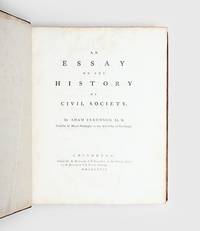
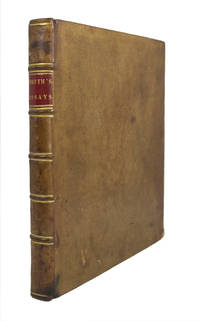
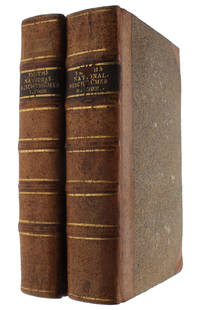
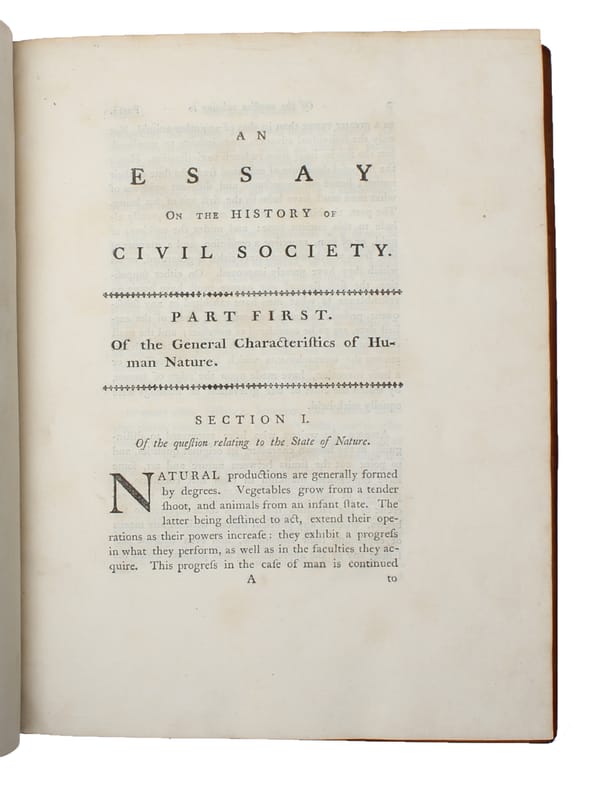
176761031Edinburgh, 1767. Large 4to. Recased preserving the contemporary marbled leather boards with a gilt line-frame over a more recent light brown full calf binding with five raised bands and gilt ornamentations to spine. The contemporary gilt title-label also preserved in second compartment of the spine. A later leather-onlay to the lower compartment, presumably covering an earlier library-marking. All edges of boards gilt. Inner hinges re-enforced. A good, solid, and sturdy copy. Library stamp (Freie Universität Berlin) to verso of title-page, along with a deaccession-stamp, as well as to blank lower margin of p. 48. Apart from the stamps, internally extremely well preserved, clean, and fresh, with only light occasional brownspotting. A very wide-margined copy on good paper. Leaves measuring 27x21 cm. VII, (1), 430 pp.
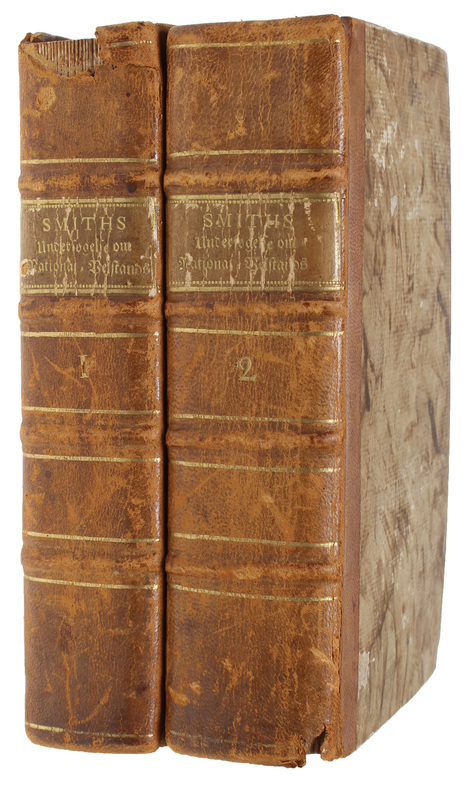
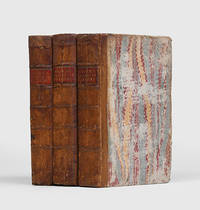
177648982Leipzig Weidmann 1776-78. 8vo. Bound in two nice uniform contemporary half calf bindings with five raised bands and gilt lettering to spine. Ex-libris pasted on to pasted down front free end-papers and a small embossed stamp to front free end paper on volume 1 "Buchhändler u. Antiquar Carl Helf". Stamp to p. 1 of both volumes. Spines with light soiling and capital on volume 1 lacking a small part of the leather. A few light brown spots throught. A fine set. VIII 632 pp; XII 740 pp. <br/><br/><em>First German edition also being the very first overall translation of Adam Smith's ground-breaking main work the "Inquiry into the Nature and Causes of the Wealth of Nations". This seminal first translation of the work was undertaken by J.F. Schiller who finished the first part of the translation in time for it to appear as soon as 1776 the same year as the original English edition. The second part appeared in 1778 the same year as the exceedingly scarce first French translation. This first German translation has been of the utmost importance to the spreading of Smith's ideas throughout Europe and after the true first this must count as the most important edition of the work."The influence of the Wealth of Nations . in Germany . was so great that 'the whole of political economy might be divided into two parts - before and since Adam Smith; the first part being a prelude and the second a sequel." Backhouse Roger E. The Methodology of Economics: Nineteenth-Century British Contributions Routledge 1997."The first review of the translation which appeared in the Göttingische gelehrte Anzeigen for March 10 1777 by J. G. H. Feder professor of Philosophy at the University of Göttingen was very favorable. In the words of the reviewer: "It is a classic; very estimable both for its thorough not too limited often far-sighted political philosophy and for the numerous frequently discursive historical notes" but the exposition suffers from too much repetition." Lai Cheng-chung. Adam Smith Across Nations: Translations and Receptions of The Wealth of Nations Clarendon Press UK 2000.Until 1797 . the work of Adam Smith received scant attention in Germany. While Frederick II was living Cameralism held undisputed sway in Prussia and the economic change which began with the outbreak of the French Revolution had still not gained sufficient momentum to awake the economic theorists from their dogmatic slumber." Lai Cheng-chung. Adam Smith Across Nations: Translations and Receptions of The Wealth of Nations Clarendon Press UK 2000.Various German economist read the german translations and was inspired by it."Christian Garve . must be considered as among the important contributors to the spread of Smith's views. Himself a popularizer of philosophical doctrines he was early attracted by the Scotch writers and became one of their foremost exponents in Germany." In 1791 Garve began a second translation of the Smith's work and in the introduction to the the translation he wrote: "It Smith's work attracted me as only few books have in the course of my studies through the number of new views which it gave me not only concerning the actual abject of his investigations but concerning all related material from the philosophy of civil and social life". Georg Sartorius August Ferdinand Lueder and perhaps the most important economist of the period Christian Jacob Kraus were all important figures in the spread of Smith's thought. "The most significant of Kraus' works and that also which shows his conception of economic science most clearly is the five-volume work entitled State Economy. The first four volumes of this work are little more than a free paraphrase of the Wealth of Nations". Kraus was: "to a large extent responsible for the economic changes which took place in Prussia after 1807 in so far as they can be ascribed to Smithan influence." Lai Cheng-chung. Adam Smith Across Nations: Translations and Receptions of The Wealth of Nations Clarendon Press UK 2000.Kraus wrote of the present volume: "The world has seen no more important book than that of Adam Smith. Certainly since the times of the New Testament no writing has had more beneficial results than this will have. Smith's doctrines form the only true great beautiful just and beneficial system." Fleischacker Samuel A Third Concept of Liberty Princeton University Press 1999._____________Hailed as the "first and greatest classic of modern thought" PMM 221 Adam Smith's tremendously influential main work has had a profound impact on thought and politics and is considered the main foundation of the era of liberal free trade that dominated the nineteenth century. Adam Smith 1723-1790 is considered the founder of Political Economy in Britain mainly due to his groundbreaking work the "Wealth of Nations" from 1776. The work took him 12 years to write and was probably in contemplation 12 years before that. It was originally published in two volumes in 4to and was published later the same year in Dublin in three volumes in 8vo. The book sold well and the first edition the number of which is unknown sold out within six months which came as a surprise to the publisher and probably also to Smith himself partly because the work "requires much thought and reflection qualities that do not abound among modern readers to peruse to any purpose." Letter from David Hume In: Rae Life of Adam Smith 1895 p. 286 partly because it was hardly reviewed or noticed by magazines or annuals. In spite of this it did evoke immense interest in the learned and the political world and Buckle's words that the work is "in its ultimate results probably the most important book that has ever been written" and that it has "done more towards the happiness of man than has been effected by the united abilities of all the statesmen and legislators of whom history has preserved an authentic account" History of Civilisation 1869 I:214 well describes the opinion of a great part of important thinkers then as well as now. Kress S. 2567Goldsmith 11394Menger 521Not in Einaudi </em> hardcover
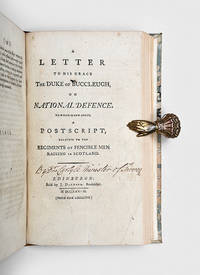
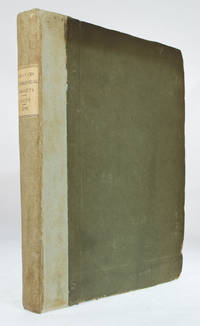
1778152780Edinburgh: J. Dickson 1778. First edition second issue "a re-issue of the London edition of the same year with a cancel title page and the addition of a postscript dated: Lincoln's Inn July 20th 1778" ESTC this copy also retaining the London title page. "This discussion of the bill for extending the militia law of Scotland introduced in 1776 contains a number of passing references to the war in America" Adams. The postscript comments on Burgoyne's defeat. Carlyle is identified as author in a contemporary hand on the Edinburgh title. After studies at Edinburgh Glasgow and Leiden where his classmates included William Robertson Adam Ferguson and John Home Carlyle was licensed to preach in 1746 and was introduced to the parish of Inveresk some five miles south-east of Edinburgh by the duke of Buccleuch the following year receiving his ordination in 1748. A moderate in his support for ecclesiastical patronage and politically conservative issues as well as in his endorsement of Enlightenment cultural principles including liberal education polite learning and religious toleration Carlyle was a familiar figure in the cultural life of what has come to be known as the Scottish Enlightenment. Strong and outspoken in his support for the Scots militia cause having written in 1760 The Question relating to a Scots Militia Considered the present pamphlet attacks Smith's apparent opposition to militias in the Wealth of Nations citing passages from Smith's book and also referring to the opinions of the Encyclopedistes. The other pamphlets included in this volume are: DOUGLAS John William Pulteney and Junius attributed authors. A Letter addressed to two Great Men on the prospect of peace; and on the terms necessary to be insisted upon in the negotiation. London: Millar and A. Kincaid & J. Bell Edinburgh 1760. Howes 6095. DALRYMPLE Sir John. The Rights of Great Britain asserted against the Claims of America: being an answer to the declaration of the General Congress. The third edition with additions. London: T. Cadell 1776. Howes 2564. LIND John. An Answer to the Declaration of the American Congress. The fourth edition. London: T. Cadell J. Walter and T. Sewell 1776. Howes 6167. TOWNSHEND Charles. Remarks on the Letter addressed to two Great Men. I a Letter to the author of that piece. London: printed in the year 1760. Howes 10372. Manuscript attribution to Henry Lord Holland on title. Octavo 209 x 122 mm. Bound fourth with four other pamphlets related to American affairs in contemporary quarter sheep and marbled boards vellum tips spine ruled gilt in compartments red morocco label lettered "Pamphlets" and numbered 2 direct sprinkled edges. Ownership inscription "Binning" to front pastedown dated 1779 with a manuscript list of the volume's contents to front free endpaper. Short tear to head of front joint; a very good copy. Adams The American Controversy 78-56b variant; ESTC T179898 locating copies at the National Library of Scotland and Harvard Business School only. The London imprint ESTC T107064 is slightly more common with copies located at British Library Columbia Harvard JCB and the New York Historical Society only; Vanderblue p. 50. hardcover
1767187228Edinburgh: for A. Millar & T. Cadell London; and A. Kincaid & J. Bell Edinburgh 1767. Synthetizing the Enlightenment First edition of this key text of the Scottish Enlightenment a pioneering precursor of modern sociology. The Essay explores how nations had developed towards the state of commerce refinement and liberty associated with 18th-century Britain. It consequently examines the development of human society from barbarism to civilized refinement and the consequences of that development - both beneficial and detrimental. Widely seen as synthesizing the thought of his times Ferguson followed Montesquieu in emphasizing the great variety of factors informing the historical rise and fall of polities in Europe and beyond. He had much to say on the issues of contemporary society including the thorny question of balancing wealth and virtue. His answer was to challenge the tendency of wealthy commercial men to withdraw from politics and thus from virtuous activities by inculcating a greater civic consciousness among such individuals. Among his contemporaries Ferguson's Essay made a particularly significant impact on the efforts to develop a discipline of social sciences at the University of Göttigen: "They were impressed by his comparative attitude to societies ancient and modern and by his attack on Rousseau's concept of the state of nature. Ferguson's approach inspired a comparative ethnography that went beyond the traditional dichotomy between 'primitive' and 'civilized' and tried to map the varieties of social mores without grading them on a strict ladder of historical progress" ODNB. Quarto 263 x 201 mm pp. viii 430. Contemporary sprinkled calf spine ruled in gilt and with red morocco label edges sprinkled red. Light bumping and wear minor infrequent foxing to otherwise crisp contents: a very good copy indeed. ESTC T76205; Goldsmiths' 10264; Higgs 3973; Kress 6432. unknown
179568261Adam SmithÃs Posthumously Published Essays SMITH Adam. Essays on Philosophical Subjects. To Which is Prefixed an Account of the Life and Writings of the Author; by Dugald Stewart.London: Printed for T. Cadell Jun. and W. Davies. 1795. First edition. Quarto 10 3/4 x 8 1/2 inches; 273 x 215 mm. xcv 1 blank 244 pp. Contemporary speckled calf. Board edges ruled in gilt. Spine ruled in gilt. Red morocco spine label lettered in gilt. Edges speckled brown. Green silk page-marker. Board edges a bit rubbed and corners bumped. Previous owner's old ink signature on title-page not affecting text. Occasional minor foxing or staining. Otherwise an excellent copy. A posthumously published collection of essays mainly of a scientific and philosophical nature. Smith had instructed lis literary editors Joseph Black and James Hutton to destroy almost all of his manuscript material amounting to some sixteen volumes. These essays were exempted because the editors perceived them to ìbe part of a plan he had once formed for giving a connected history of the liberal sciences and elegant artsî even though Smith had to abandon the plan because it was too extensive. The essays illustrate the diversity of Adam SmithÃs interests and comprise: ìThe Principles which lead and direct Philosophical Enquiries; illustrated by the History of Astronomy;î ìThe Principles which lead and direct Philosophical Enquiries; History of the Ancient Physics;î ìThe Principles which lead and direct Philosophical Enquiries; History of the Ancient Logics and Metaphysics; ìOf the Nature of that Imitation which takes place in what are called the Imitative Arts;î ìOf the Affinity between Music Dancing and Poetry;î ìOf the Affinity between certain English and Italian Verses;î ìOf the External Senses.î ESTC T33499 . Goldsmiths' 16218. Kress B. 3038. Rothschild 1902. HBS 68261. $9500 Printed for T. Cadell Jun. and W. Davies, etc. unknown books
179568261London: Printed for T. Cadell Jun. and W. Davies etc. 1795. London: Printed for T. Cadell Jun. and W. Davies. 1795.<br> <br> First edition. Quarto 10 3/4 x 8 1/2 inches; 273 x 215 mm. xcv 1 blank 244 pp.<br> <br> Contemporary speckled calf. Board edges ruled in gilt. Spine ruled in gilt. Red morocco spine label lettered in gilt. Edges speckled brown. Green silk page-marker. Board edges a bit rubbed and corners bumped. Previous owner's old ink signature on title-page not affecting text. Occasional minor foxing or staining. Otherwise a fine copy.<br> <br> A posthumously published collection of essays mainly of a scientific and philosophical nature. Smith had instructed lis literary editors Joseph Black and James Hutton to destroy almost all of his manuscript material amounting to some sixteen volumes. These essays were exempted because the editors perceived them to "be part of a plan he had once formed for giving a connected history of the liberal sciences and elegant arts" even though Smith had to abandon the plan because it was too extensive.<br> <br> The essays illustrate the diversity of Adam Smith's interests and comprise: "The Principles which lead and direct Philosophical Enquiries; illustrated by the History of Astronomy;" "The Principles which lead and direct Philosophical Enquiries; History of the Ancient Physics;" "The Principles which lead and direct Philosophical Enquiries; History of the Ancient Logics and Metaphysics; "Of the Nature of that Imitation which takes place in what are called the Imitative Arts;" "Of the Affinity between Music Dancing and Poetry;" "Of the Affinity between certain English and Italian Verses;" "Of the External Senses."<br> <br> ESTC T33499 . Goldsmiths' 16218. Kress B. 3038. Rothschild 1902.<br> <br> HBS 68261.<br> <br> $9500. Printed for T. Cadell Jun. and W. Davies, etc. unknown
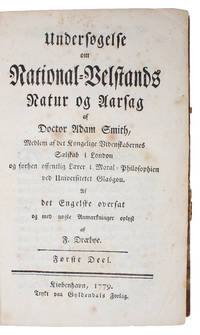
177950523Kiøbenhavn [Copenhagen], 1779-80. 8vo. Two nice contemporary half calf bindings with four raised bands and gilt leather title label to spines. Volume one lacking one cm of upper part of spine. Volume two with a small tear to lower part of spine. Both volumes with light brown spotting throughout, however, mainly affecting first and last five leaves of both volumes. A fine set. (12), 575"" (8), 775, (3, - errata) pp.
177950523Kiøbenhavn Copenhagen 1779-80. 8vo. Two nice contemporary half calf bindings with four raised bands and gilt leather title label to spines. Volume one lacking one cm of upper part of spine. Volume two with a small tear to lower part of spine. Both volumes with light brown spotting throughout however mainly affecting first and last five leaves of both volumes. A fine set. 12 575; 8 775 3 - errata pp. <br/><br/><em>The extremely scarce first Danish edition of Adam Smith's seminal main work "the first and greatest classic of modern economic thought" PMM 221 the main foundational work of the era of liberal free trade. This publication constitutes the first Danish work worth mentioning in the history of economic thought - in spite of the great interest in political economy that dominated Danish political thought in the last quarter of the 18th century. The value of Smith's work was not immediately recognized in Denmark at the time of its appearance and a quarter of a century had to go by for its importance to be acknowledged and for Danish political economy to adapt the revolutionizing theories of Adam Smith. Few copies of the translation were published and sold and the book is now a great scarcity. As opposed to for instance the German translation of the work Smith concerned himself a great deal with this Danish translation. As is evident from preserved correspondence about it he reacted passionately to it and was deeply concerned with the reaction to his work in Scandinavia see "Correspondence of Adam Smith" Oxford University Press 1977.- As an example Smith writes in a letter to Andreas Holt on Oct. 26th 1780: "It gives me the greatest pleasure to hear that Mr. Dreby has done me the distinguished honour of translating my Book into the Danish language. I beg you will present to him my most sincere thanks and most respectful Compliments. I am much concerned that I cannot have the pleasure of reading it in his translation as I am so unfortunate as not to understand the Danish language." The translation was made by Frants Dræby 1740-1814 the son a whiskey distiller in Copenhagen who mastered as a theologian and was then hired by the great Norwegian merchant James Collett as tutor to his son. There can be no doubt that Dræbye's relation to the Collett house had a great impact upon his interest in economics. In the middle of the 1770'ies Dræbye accompanied Collett's son on travels throughout Europe which took them to England in the year 1776 the same year that the "Wealth of Nations" was published for the first time. Through the Colletts Dræbye was introduced to the mercantile environment in England and here became thoroughly acquainted with English economics and politics at the time. It is presumably here that he gets acquainted with Adam Smith's freshly published revolutionary work. When Dræbye returned to Denmark at the end of 1776 he was appointed chief of the Norwegian secretariat of the Board of Economics and Trade. He began the translation of the "Wealth of Nations" that he brought back with him from England immediately after his return."WN i.e. Wealth of Nations was translated into Danish by Frants Dræbye and published in 1779 three years after the first English edition. The translation was initiated by Andreas Holt and Peter Anker who were acquainted with Smith. Dræbye was a Dane who lived mainly in Norway reflecting the fact that Norway was much more British-oriented than Denmark proper Denmark and Norway were united until 1814 when Sweden took Norway away from the Danes; in 1905 Norway became an independent state. Norwegian merchants lived from exporting timber to Britain and tended on the whole to be adherents of a liberal economic policy whereas the absolutist government in Copenhagen was more German-oriented and had economic views similar to those in contemporary Prussia." Cheng-chung Lai edt.: "Adam Smith Across Nations" p. 37. The last quarter of the eighteenth century in Denmark was dominated by a lively discussion of monetary policy and the institutional framework best suited to realize that policy. There was a vital interest in questions of economic concern and contemporary Danish sources refer to the period as "this economic age" and state things such as "never was the world more economically minded" both from "Denmark and Norway's Economic Magazine". During this period Smith's revolutionary ideas did not play a major role however and only at the beginning of the 19th century did Danish politicians and economists come to realize the meaning of Smith's views. "Without exaggeration it can essentially be said that a quarter of a century was to pass from the time of the publication of the book in Denmark before Danish political economy fully made Adam Smith's theories and points of view its own. It took so long a time because the economic conditions as a whole in the years from 1780-1800 did not make desirable or necessary the changing of their concepts. That glorious commercial period had to pass before it was understood that we had altogether too little help in our own natural resources and that a different course was therefore necessary. Only when one had come so far could the new thinking find a nourishing soil so that it could develop strength with which to push aside the old ideas."Hans Degen: "On the Danish Translation of Adam Smith and Contemporary Opinion Concerning It." Translated by Henrietta M. Larson. In: Adam Smith Across Nations p. 51. This first Danish translation is one of the very earliest translations of "Wealth of Nations"; it is only preceded by the German 1776-78 and the extremely scarce French 1778-79. As a comparison the Italian translation does not appear until 1790-91 the Spanish 1792 the Swedish 1800-1804 the Russian 1802 etc.Adam Smith Across Nations: A4 - nr. 1. "All five books were translated; appears to be a complete translation. The long letter from Governor Pownall to Adam Smith 25 Sept. 1776 is added as the Appendix vol. 2 pp. 683 ff." </em> hardcover
17271510220001Amsterdam: Michel Charles Le Cene 1727-01-01. Hardcover. Very Good. Folio. 2 12 439 pp.; 2 pp. 445-808p pagination continuous 43 of 44 plates. 2 Volumes in One Bound in contemporary vellum. 7 raised bands. Leather spine label. Good binding and cover. Spine and hinges restored. Faint soiling to vellum. Pages tanned with a several pages with some offsetting and foxing. Lacks frontis and added title. All 27 plates & 16 maps are present. Brunet IV 178; Cordier Japonica 367-68; Cordier Sinaca 2077; Lust 342 <br><Br> Jean Albert Mandeslo set out in 1636 with the Embassy that the Duke of Holstein sent to Russia and Persia. He visited India Ceylon Madagascar West Africa Congo and returned four years later. His story gives a very vivid picture of luxury vices curiosity and absolute disregard for life under the despotic tyranny of the Moghul Empire under Shah Jahan. In the port of Surat he arrived in April 1638 after he went to Ahmedabad and Agra. Although his observations of life in the capital are useful he apparently did not hear anything about the Taj Mahal which at that time was in the sixth year of building. Amsterdam: Michel Charles Le Cene hardcover
179566518First Edition In Contemporary Boards Uncut SMITH Adam. Essays on Philosophical Subjects. To Which is Prefixed an Account of the Life and Writings of the Author; by Dugald Stewart. London: Printed for T. Cadell Jun. and W. Davies etc. 1795. First edition. Quarto. xcv 244 pp. Contemporary boards rebacked. Small library stamp on title and verso and on last page a small ink smudge on title previous owner's bookplate. Overall a very good large paper copy totally uncut. A posthumously published collection of essays mainly of scientific and philosophical nature. Smith had instructed his literary editors Joseph Black and James Hutton to destroy almost all of his manuscript material amounting to some sixteen volumes. These essays were exempted because the editors perceived them to "be part of a plan he had once formed for giving a connected history of the liberal sciences and elegant arts" even though Smith had to abandon the plan because it was too extensive. HBS 66518. $10000 Printed for T. Cadell Jun. and W. Davies, etc. hardcover books
179566518London: Printed for T. Cadell Jun. and W. Davies etc. 1795. First edition. Quarto. xcv 244 pp.<br> <br> Contemporary boards rebacked. Small library stamp on title and verso and on last page a small ink smudge on title previous owner's bookplate. Overall a very good large paper copy totally uncut.<br> <br> A posthumously published collection of essays mainly of scientific and philosophical nature. Smith had instructed his literary editors Joseph Black and James Hutton to destroy almost all of his manuscript material amounting to some sixteen volumes. These essays were exempted because the editors perceived them to "be part of a plan he had once formed for giving a connected history of the liberal sciences and elegant arts" even though Smith had to abandon the plan because it was too extensive.<br> <br> HBS 66518.<br> <br> $10000. Printed for T. Cadell Jun. and W. Davies, etc. unknown
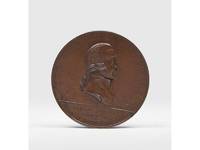
1797179182Scotland: Boog junior des. P. Kempson fecit 1797. A very good example of the one ounce Penny of Scotland commemorating Adam Smith. The portrait of Smith is after the Tassie medallion of 1787 which is described by John M. Gray as follows: 'The head which appears turned in pure profile to the right of the spectator shows a particularly full forehead a full nose slightly aquiline in its curve; a long thin upper lip and a lower lip that protudes a little; and a firm well-shaped chin and jaw. The eyebrow is strongly curved the upper eyelid heavy and drooping the eyeball particularly prominent; and beneath the lower eyelid the skin is loose and wrinkled. A wig is worn tied behind in a bag with ribbons showing small curls in front and two large curls at the side which cover and conceal the ear' quoted in Bonar A Catalogue of the library of Adam Smith 1932 p. xxi. The reverse of the penny entitled 'Wealth of Nations' depicts the various elements of commerce; in the foreground of a harbour scene are a plough and a spinning wheel along with other symbols of agriculture and industry in addition to which there are a wool-pack and a barrel standing on the quayside with two three-masted ships sailing out of the harbour. Penny token cast in bronze 35 mm in diameter with portrait of Adam Smith after Tassie on the obverse and scene entitled 'Wealth of Nations' depicting various elements of commerce on the reverse. Housed in a red leatherette velvet-lined case. In very good condition. Scott Adam Smith as Student and Professor 1937. Dalton and Hamer Fifeshire no. 1. hardcover
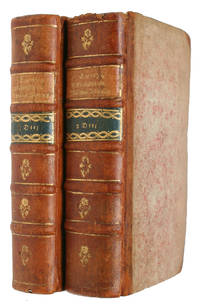
177947455Kiøbenhavn [Copenhagen], 1779-80. 8vo. Two very nice contemporary brown half calf bindings with raised bands, gilt ornamentations and gilt leather title- and tome-labels. Volume two with a bit of wear to upper capital. Corners slightly bumped. Pencil annotations to verso of title-page in volume one" title-page in volume two mounted to cover up a small hole caused by the removal of an old owner's name. Internally very clean and bright. All in all a very nice, clean, fresh, and tight copy. Engraved (by Weise, 1784) armorial book plate to inside of front boards (Gregorius Christianus Comes ab Haxthausen). (12), 575" (8), 775, (3, - errata) pp.
177947455Kiøbenhavn Copenhagen 1779-80. 8vo. Two very nice contemporary brown half calf bindings with raised bands gilt ornamentations and gilt leather title- and tome-labels. Volume two with a bit of wear to upper capital. Corners slightly bumped. Pencil annotations to verso of title-page in volume one; title-page in volume two mounted to cover up a small hole caused by the removal of an old owner's name. Internally very clean and bright. All in all a very nice clean fresh and tight copy. Engraved by Weise 1784 armorial book plate to inside of front boards Gregorius Christianus Comes ab Haxthausen. 12 575; 8 775 3 - errata pp. <br/><br/><em>The extremely scarce first Danish edition of Adam Smith's seminal main work "the first and greatest classic of modern economic thought" PMM 221 the main foundational work of the era of liberal free trade. This publication constitutes the first Danish work worth mentioning in the history of economic thought - in spite of the great interest in political economy that dominated Danish political thought in the last quarter of the 18th century. The value of Smith's work was not immediately recognized in Denmark at the time of its appearance and a quarter of a century had to go by for its importance to be acknowledged and for Danish political economy to adapt the revolutionizing theories of Adam Smith. Few copies of the translation were published and sold and the book is now a great scarcity. As opposed to for instance the German translation of the work Smith concerned himself a great deal with this Danish translation. As is evident from preserved correspondence about it he reacted passionately to it and was deeply concerned with the reaction to his work in Scandinavia see "Correspondence of Adam Smith" Oxford University Press 1977.- As an example Smith writes in a letter to Andreas Holt on Oct. 26th 1780: "It gives me the greatest pleasure to hear that Mr. Dreby has done me the distinguished honour of translating my Book into the Danish language. I beg you will present to him my most sincere thanks and most respectful Compliments. I am much concerned that I cannot have the pleasure of reading it in his translation as I am so unfortunate as not to understand the Danish language." The translation was made by Frants Dræby 1740-1814 the son a whiskey distiller in Copenhagen who mastered as a theologian and was then hired by the great Norwegian merchant James Collett as tutor to his son. There can be no doubt that Dræbye's relation to the Collett house had a great impact upon his interest in economics. In the middle of the 1770'ies Dræbye accompanied Collett's son on travels throughout Europe which took them to England in the year 1776 the same year that the "Wealth of Nations" was published for the first time. Through the Colletts Dræbye was introduced to the mercantile environment in England and here became thoroughly acquainted with English economics and politics at the time. It is presumably here that he gets acquainted with Adam Smith's freshly published revolutionary work. When Dræbye returned to Denmark at the end of 1776 he was appointed chief of the Norwegian secretariat of the Board of Economics and Trade. He began the translation of the "Wealth of Nations" that he brought back with him from England immediately after his return."WN i.e. Wealth of Nations was translated into Danish by Frants Dræbye and published in 1779 three years after the first English edition. The translation was initiated by Andreas Holt and Peter Anker who were acquainted with Smith. Dræbye was a Dane who lived mainly in Norway reflecting the fact that Norway was much more British-oriented than Denmark proper Denmark and Norway were united until 1814 when Sweden took Norway away from the Danes; in 1905 Norway became an independent state. Norwegian merchants lived from exporting timber to Britain and tended on the whole to be adherents of a liberal economic policy whereas the absolutist government in Copenhagen was more German-oriented and had economic views similar to those in contemporary Prussia." Cheng-chung Lai edt.: "Adam Smith Across Nations" p. 37. The last quarter of the eighteenth century in Denmark was dominated by a lively discussion of monetary policy and the institutional framework best suited to realize that policy. There was a vital interest in questions of economic concern and contemporary Danish sources refer to the period as "this economic age" and state things such as "never was the world more economically minded" both from "Denmark and Norway's Economic Magazine". During this period Smith's revolutionary ideas did not play a major role however and only at the beginning of the 19th century did Danish politicians and economists come to realize the meaning of Smith's views. "Without exaggeration it can essentially be said that a quarter of a century was to pass from the time of the publication of the book in Denmark before Danish political economy fully made Adam Smith's theories and points of view its own. It took so long a time because the economic conditions as a whole in the years from 1780-1800 did not make desirable or necessary the changing of their concepts. That glorious commercial period had to pass before it was understood that we had altogether too little help in our own natural resources and that a different course was therefore necessary. Only when one had come so far could the new thinking find a nourishing soil so that it could develop strength with which to push aside the old ideas."Hans Degen: "On the Danish Translation of Adam Smith and Contemporary Opinion Concerning It." Translated by Henrietta M. Larson. In: Adam Smith Across Nations p. 51. This first Danish translation is one of the very earliest translations of "Wealth of Nations"; it is only preceded by the German 1776-78 and the extremely scarce French 1778-79. As a comparison the Italian translation does not appear until 1790-91 the Spanish 1792 the Swedish 1800-1804 the Russian 1802 etc.Adam Smith Across Nations: A4 - nr. 1. "All five books were translated; appears to be a complete translation. The long letter from Governor Pownall to Adam Smith 25 Sept. 1776 is added as the Appendix vol. 2 pp. 683 ff."PMM 221 - first edition </em> hardcover
177860523Leipzig Weidmann 1776-78. 8vo. Bound in two nice uniform contemporary half calf bindings with five raised bands black title-label and gilt lettering to spine. Small paper-label to upper compartment Catalogue-number from an estate-library. Light wear to extremities otherwise a very nice set. VIII 632 pp; XII 740 pp. <br/><br/><em>First German edition also being the very first overall translation of Adam Smith's ground-breaking main work the "Inquiry into the Nature and Causes of the Wealth of Nations". This seminal first translation of the work was undertaken by J.F. Schiller who finished the first part of the translation in time for it to appear as soon as 1776 the same year as the original English edition. The second part appeared in 1778 the same year as the exceedingly scarce first French translation. This first German translation has been of the utmost importance to the spreading of Smith's ideas throughout Europe and after the true first this must count as the most important edition of the work."The influence of the Wealth of Nations . in Germany . was so great that 'the whole of political economy might be divided into two parts - before and since Adam Smith; the first part being a prelude and the second a sequel." Backhouse Roger E. The Methodology of Economics: Nineteenth-Century British Contributions Routledge 1997."The first review of the translation which appeared in the Göttingische gelehrte Anzeigen for March 10 1777 by J. G. H. Feder professor of Philosophy at the University of Göttingen was very favorable. In the words of the reviewer: "It is a classic; very estimable both for its thorough not too limited often far-sighted political philosophy and for the numerous frequently discursive historical notes" but the exposition suffers from too much repetition." Lai Cheng-chung. Adam Smith Across Nations: Translations and Receptions of The Wealth of Nations Clarendon Press UK 2000.Until 1797 . the work of Adam Smith received scant attention in Germany. While Frederick II was living Cameralism held undisputed sway in Prussia and the economic change which began with the outbreak of the French Revolution had still not gained sufficient momentum to awake the economic theorists from their dogmatic slumber." Lai Cheng-chung. Adam Smith Across Nations: Translations and Receptions of The Wealth of Nations Clarendon Press UK 2000.Various German economist read the german translations and was inspired by it."Christian Garve . must be considered as among the important contributors to the spread of Smith's views. Himself a popularizer of philosophical doctrines he was early attracted by the Scotch writers and became one of their foremost exponents in Germany." In 1791 Garve began a second translation of the Smith's work and in the introduction to the the translation he wrote: "It Smith's work attracted me as only few books have in the course of my studies through the number of new views which it gave me not only concerning the actual abject of his investigations but concerning all related material from the philosophy of civil and social life". Georg Sartorius August Ferdinand Lueder and perhaps the most important economist of the period Christian Jacob Kraus were all important figures in the spread of Smith's thought. "The most significant of Kraus' works and that also which shows his conception of economic science most clearly is the five-volume work entitled State Economy. The first four volumes of this work are little more than a free paraphrase of the Wealth of Nations". Kraus was: "to a large extent responsible for the economic changes which took place in Prussia after 1807 in so far as they can be ascribed to Smithan influence." Lai Cheng-chung. Adam Smith Across Nations: Translations and Receptions of The Wealth of Nations Clarendon Press UK 2000.Kraus wrote of the present volume: "The world has seen no more important book than that of Adam Smith. Certainly since the times of the New Testament no writing has had more beneficial results than this will have. Smith's doctrines form the only true great beautiful just and beneficial system." Fleischacker Samuel A Third Concept of Liberty Princeton University Press 1999._____________Hailed as the "first and greatest classic of modern thought" PMM 221 Adam Smith's tremendously influential main work has had a profound impact on thought and politics and is considered the main foundation of the era of liberal free trade that dominated the nineteenth century. Adam Smith 1723-1790 is considered the founder of Political Economy in Britain mainly due to his groundbreaking work the "Wealth of Nations" from 1776. The work took him 12 years to write and was probably in contemplation 12 years before that. It was originally published in two volumes in 4to and was published later the same year in Dublin in three volumes in 8vo. The book sold well and the first edition the number of which is unknown sold out within six months which came as a surprise to the publisher and probably also to Smith himself partly because the work "requires much thought and reflection qualities that do not abound among modern readers to peruse to any purpose." Letter from David Hume In: Rae Life of Adam Smith 1895 p. 286 partly because it was hardly reviewed or noticed by magazines or annuals. In spite of this it did evoke immense interest in the learned and the political world and Buckle's words that the work is "in its ultimate results probably the most important book that has ever been written" and that it has "done more towards the happiness of man than has been effected by the united abilities of all the statesmen and legislators of whom history has preserved an authentic account" History of Civilisation 1869 I:214 well describes the opinion of a great part of important thinkers then as well as now. Kress S. 2567Goldsmith 11394Menger 521Not in Einaudi </em> hardcover
177860523Leipzig, Weidmann, 1776-78. 8vo. Bound in two nice uniform contemporary half calf bindings with five raised bands, black title-label and gilt lettering to spine. Small paper-label to upper compartment (Catalogue-number from an estate-library). Light wear to extremities, otherwise a very nice set. VIII, 632 pp" XII, 740 pp.
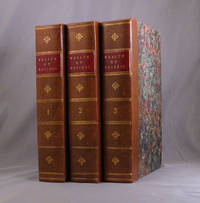
178620767London: for A. Strahan and T. Cadell 1786. 3 volumes. An especially early printing the fourth only the second of the octavo editions the last edition with any changes includes a new preface never before printed issued only 10 years after the first 2 vol. quarto edition. 8vo beautiful three-quarter polished calf in fine antique style over marbled paper covered boards red morocco lettering labels gilt the spine in compartments separated by gilt bands gilt central devices in the compartments. viii 499 errata; vi 518 5 Appendix errata; v errata 465 47 index 1 ad pp. A remarkably fine and handsome set the text blocks completely untrimmed and with the original deckled edges as issued from the printer. Bindings in excellent condition. A BEAUTIFUL SET OF THIS EXTRAORDINARY WORK. Smith's classic work was begun at Toulouse in 1763-64 where he had travelled as guardian of Henry Scott the young duke of Buccleuch and in the company of David Hume historian and fellow professor at Glasgow University. The work took shape over the next ten years and was finally published in 1776. At one point during its composition Hume wrote that Smith was "cutting himself off entirely from human society." But his labors however severe his methods yielded the "first and greatest classic of modern economic thought" Printing and the Mind of Man.<br> "It may be said that the WEALTH OF NATIONS certainly operated powerfully through the harmony of its critical side with the tendencies of the half-century which followed its publication to the assertion of personal freedom and 'natural rights.' It discredited the economic policy of the past and promoted the overthrow of institutions which had come down from earlier times but were unsuited to modern society. As a theoretic treatment of social economy and therefore as a guide to social reconstruction and practice in the future it is provisional not definitive. But when the study of its subject comes to be systematized on the basis of a general social philosophy more complete and durable than Smith's no contribution to that final construction will be found so valuable as his" Britannica.<br> The fourth edition contains a special ‘advertisement’ first appearing here in which Smith declares that he is now ‘at liberty to acknowledge my very great obligations to Mr. Henry Hop of Amsterdam. To that gentleman I owe the most distinct as well as liberal information concerning a very interesting and important subject the Bank of Amsterdam’. Eighteenth century editions of Smith’s magnum opus are now becoming very scarce. for A. Strahan and T. Cadell hardcover
1786173725London: printed for A. Strahan; and T. Cadell 1786. An uncut copy Fourth edition of "the first and greatest classic of modern economic thought" PMM an uncut and partly unopened copy in a contemporary binding a reprint of the third edition of 1784 with minor variations. In his Wealth of Nations Smith "begins with the thought that labour is the source from which a nation derives what is necessary to it. The improvement of the division of labour is the measure of productivity and in it lies the human propensity to barter and exchange The Wealth of Nations ends with a history of economic development a definitive onslaught on the mercantile system and some prophetic speculations on the limits of economic control" PMM. "The Wealth of Nations had no rival in scope or depth when published and is still one of the few works in its field to have achieved classic status meaning simply that it has sustained yet survived repeated reading critical and adulatory long after the circumstances which prompted it have become the object of historical enquiry" ODNB. "The 'Advertisement to the Fourth Edition' announces that no alterations of any kind have been made. Cannan noted some small variations which can be attributed to small misreadings or unauthorised corrections by the printers. The division between volumes is identical to that in the 3rd Edition and Vol. II Bk. IV Ch. 8 is this time included in the Table of Contents" Tribe. Provenance: engraved armorial bookplate of Talbot of Gonvile's Hall in Wymondham Norfolk to each front pastedown; earlier ownership signature of B. C. Hingham dated June 1787 above. Binder's note in ink on front blank endpaper of vol. I: "3 V. 0.18.0 in hf bind." 3 vols octavo 228 x 138 mm pp. Complete with the conjugate blank leaf before title in vol. III the top edge unopened. viii 499 1; vi 518 6; v iv-v 1 465 1 50 index. Contemporary half calf and marbled boards red morocco spine labels. Housed in a brown leather entry slipcase by the Chelsea Bindery. Spines with some surface wear and vertical cracks consolidated at the head one joint partly cracked but sound minimal loss of the marbled paper covering; very occasional light spotting and the odd short marginal tear; a lovely example of a modest provincial binding entirely uncut and partly unopened. Goldsmiths' 13148; Kress B.1129; Tribe 30; Vanderblue p. 3. See Printing and the Mind of Man 221; Loudon J. H. James Scott and William Scott bookbinders Scolar Press 1980. hardcover
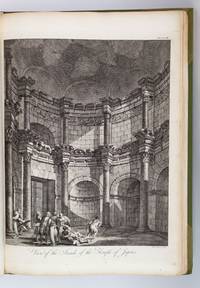
1764ST17496-042London: Printed for the Author 1764. FIRST EDITION. 520 x 365 mm. 20 3/4 x 14 1/4". iv 8 subscribers list 33 pp. <br/> Attractive modern light green half morocco gilt by J. F. Newman of Dublin his ticket on front pastedown raised bands spine panels with central patera ornament two darker green morocco labels reinforced hinges edges untrimmed. WITH 61 SPLENDID ENGRAVINGS 14 plans and elevations 47 views ON 54 PLATES eight double-page six folding by Bartolozzi and others. Front flyleaf with ink signature of Francis D. Bedford dated October 1886. Cicognara 3567; Fowler 2. Spine sunned to a light olive shade one corner bumped one plate with a little browning along the fold occasional mild marginal foxing or trivial smudges but A FINE COPY--fresh bright and clean internally with deep impressions of the type rich impressions of the plates and generous margins in a binding with few signs of wear.<br/> <br/> This is an extremely appealing copy of one of the great architectural books of the 18th century described by Cicognara as a "magnificent and grandiose work." Scottish architect Robert Adam 1728-92 was a product of the Scottish Enlightenment and moved in intellectual circles that included historian William Robertson who wrote the introduction here David Hume and Adam Smith. His interest in architectural drawing was stimulated by books in his father's extensive library which DNB tells us contained "a working collection of illustrated architectural books in English French and Italian and a series of manuals on architectural draughtsmanship." This curiosity developed into a passion during his 1755-57 tour of Italy which "was in every way a period of intense professional training during which the skills learned in Scotland were tested and given an international gloss by the Roman circle in which he now moved." DNB At the center of this circle was French architect antiquarian and artist Charles-Louis Clérisseau 1721-1820 the leading authority on Roman antiquities and architecture who introduced Adams to among others the great Piranesi. With Clérisseau as guide and tutor he explored and sketched various sites before arriving at the un-surveyed fortress palace built by the former emperor Diocletian at Spalatro the modern-day Croatian city of Split. Adam undertook a survey of the building and drew the architectural plans and elevations for this work while Clérisseau sketched views of the ruins. Adam planned this book as a way of promoting his career as an architect and worked with Clérisseau to have engravings made for it. According to Thom "while the traditional plans elevations and sections--what Robert Adam called the 'Geometricals'--were generally supplied by English engravers like Rooker Patton and Walker the all-important picturesque views and perspectives which Adam thought were essential to convey the emotional impact of the remains of Diocletian's Palace were engraved in Italy mostly by Bartolozzi Paolo Santini and Zucchi." Adams also wrote the architectural commentary. The publication was a success praised by the "Critical Review" in October 1864 as possessing "a taste and execution that has never been equalled in England." As DNB observes "during these two Roman years Adam succeeded in transforming himself from a provincial and rather green Scottish architect into a cosmopolitan figure ready indeed to put into effect 'the Antique the Noble & Stupendous.'" Now based in London he embarked on a distinguished career specializing in country houses and townhomes that reflected the deep influence classical architecture and his Italian sojourn had on his work. Our copy was once owned by another artist Francis Donkin Bedford 1864-1954 who exhibited landscapes at the Royal Academy and illustrated books during the Golden Age of children's book illustration in the late 19th and early 20th century. Printed for the Author unknown
1756163096Amsterdam & Leipzig: Arkstée and Merkus 1756. We grow weary of the grave pedantic and long-sentenced love of Cowley and Petrarca. but the gaiety of Ovid and the gallantry of Horace are always agreeable" TMS I. ii. 2.1. A hitherto unrecorded volume from Adam Smith's library with his bookplate centrally positioned on the front pastedown volume 3 of an 8-volume set of Horace's poems the text in French and Latin on facing pages with the extensive remarks and critical notes of Noël-Étienne Sanadon of the Society of Jesus. Horace was clearly a favourite author of Smith's with thirteen different editions listed by Mizuta in his Catalogue of Smith's library 81-823 all but one of which are in Latin the only other entry being a ten-volume set in French of Horace's works equally with parallel Latin and French texts and notes and commentaries by Dacier. This single volume was purchased by its previous owner in the basement of Holleyman and Treacher booksellers of Brighton several decades ago. Duodecimo 168 x 95 mm. Woodcut vignettes and tailpieces title printed in red and black. Contemporary calf spine with five raised bands ruled in gilt black morocco label numbered direct in gilt. Housed in a dark brown quarter morocco solander box by the Chelsea Bindery. Spine ends chipped and corners worn spine label with slight loss free endpapers with burn marks from the leather turn-ins around the edges somewhat browned and brittle contents crisp and clean; a very good copy. Not listed in Mizuta or Yanaihara. hardcover
1779158759Copenhagen: Gyldendal 1779-80. Adam Smith in Danish First edition in Danish of The Wealth of Nations translated from the first edition of 1776 by Frants Draebye published together with a translation of Thomas Pownall's critical Letter. to Adam Smith of the same year. Draebye had been in England in 1776 as part of his role of tutor on a continental tour to two sons of a Norwegian merchant James Collett. Smith acknowledged the translation in two letters of 1780 the first written to Andreas Holt Commissioner of the Danish Board of Trade and Economy to whom he wrote "it gives me great pleasure to hear that Mr Dreby has done me the distinguished honour of translating my book into the Danish language." the second to Peter Anker Consul General of Denmark in Great Britain sending him three copies of the second edition of 1778 and asking him to forward them to Draebye and Holt. 2 vols octavo 192 x 114 mm pp. xii 575 1; viii 775 3. Contemporary sprinkled sheep spines decorated in gilt between five raised bands yellow paper labels lettered in gilt marbled paper pastedowns red edges. Joints of vol. I strengthened head and tail of both vols repaired gilt decoration to vol. II largely eroded; marginal tear to one leaf occasional light spotting; a very good set. Tribe 19: Vanderblue p. 23. Mossner & Ross The Correspondence of Adam Smith 1987. hardcover
17951169901795. First Edition. SMITH Adam. Essays on Philosophical Subjects To Which Is Prefixed an Account of the Life and Writings of the Author by Dugald Stewart. London: for T. Cadell Jun. and W. Davies et al. 1795. Large quarto 9 by 11-1/4 inches period-style full speckled brown calf raised bands red morocco spine label; pp. i-iii iv v-vi vii-ix x-xcv blank 1-3 4-93 94-97 98-111 112-115 116-129 130-133 134-184 185-187 188-194 195-197 198-244; slipcase. $13800.First edition of this core volume of Smith's essays issued posthumously featuring the important first publication of History of Astronomy that seeks ""to explain what drives 'philosophers' to ask the questions they do"" an impressive wide-margined volume handsomely bound.Though Essays on Philosophical Subjects appeared five years after Smith's death most were likely written before the publication of his Theory of Moral Sentiments in 1759. Essays was compiled by his literary executors physicist Joseph Black and geologist James Hutton. Prior to his death Smith ""instructed them to destroy his manuscripts but allowed them at their discretion to publish a set of essays"" Berry Cambridge Companion 116. As noted herein Smith had begun work early in his career on ""a connected history of the liberal sciences and elegant arts"" but ""found it necessary to abandon that plan as far too extensive."" These writings thus represent Smith's longstanding attempts at such a ""connected history"" and range over philosophy aesthetics and the history of science. A biographical Account of Smith and his work is followed by the extensive History of Astronomy which was the only writing Smith did not want destroyed; indeed he specifically arranged for its posthumous publication. Black and Hutton used their authority to incorporate its momentous first publication into this collection. Astronomy ""was probably begun decades before Smith's death perhaps as early as 1746 and was at one time intended to form a chapter of a much larger work Astronomy purports to explain what drives 'philosophers' to ask the questions they do and to seek explanations for the things they observe"" Otteson Adam Smith 22-3. Astronomy ""has occasioned much scholarship Just as The Wealth of Nations was titled an enquiry into its 'natures and causes' so Smith says at the end of the preliminary section of Astronomy that the design of the essay is to consider the 'nature and causes of the three sentiments""identified by him as ""Wonder Surprise and Admiration."" Citing Galileo Copernicus Kepler Newton Descartes and others Astronomy aims ""to illustrate how philosophy is an activity that addresses itself to the imagination"" Berry 116-117 123. Also included in this volume are his essays on ""Ancient Physics"" ""Ancient Logics and Metaphysics"" and the ""Imitative Arts"" along with a concluding essay on perception in the five ""External Senses."" One of 1000 copies. Containing the first publication in book form of Dugald Stewart's Account of the Life and Writings of Adam Smith which had appeared in the Transactions of the Royal Society of Edinburgh in 1794. Stewart's Account ""formed the basis upon which everyone drew for biographies of Smith that began to appear in the early 19th century"" Tribe 55. Without initial blank. Goldsmith 16218. Kress B3038. Rothschild 1902. Trace of early owner signature above title page.Interior very fresh period-style calf fine. An elemental Adam Smith work. hardcover
17641721551764. ADAM Robert. Ruins of the Palace of the Emperor Diocletian at Spalatro in Dalmatia. vi 8 33 1 pp. with 61 engraved plates on 54 sheets some double-page. Folio 525 x 370 mm. bound in full contemporary calf. London: For the author 1764. First edition. "The book incorporated the first encyclical of Britain's most popular architect of the day who had now been in practice for several years with an immense patronage. Adam makes it quite plain that the great palace of Diocletian forms the source of his ideas upon domestic building and he modestly claims that it is the first private dwelling-house of the Romans to have been illustrated and described." Adam's account was based on his five-week visit to Spalatro in Croatia now known as Split; the sixty-one superb plates were executed after Clerisseau Zucchi and others some of the drawings survive at the Hermitage St. Petersburg. In his introduction Adam expresses his conviction that Diocletian had revived a taste in Architecture superior to that of his own times. Adam's "observance on unusual detail throughout is remarkable. Nothing is too minute to escape his notice. A careful reading of the descriptions shows whence Robert Adam derived his theories for the planning of his domestic buildings on a monumental scale like Syon and Kedleston" James Lees-Milne The Age of Adam pp. 67-69. A fine copy of this landmark book. Millard British 1. Harris British Architectural Books 4. Fowler 2. Berlin Katalog 1893. Cicognara 3567. John Fleming Robert Adam and His Circle 1962 pp. 235-240. Georg Kowalczyk Denkmäler der Kunst in Dalmatien 1910 reproducing 22 plates. unknown
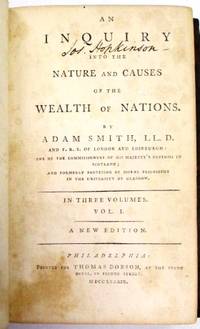
178932679Philadelphia: Thomas Dobson 1789. viii 9-412; vi 7-430; v 1 blank 7-387 55 pp. Volumes I and II with the ownership signature of Joseph Hopkinson prominent Philadelphia and Jersey lawyer who defended Justice Samuel Chase in his impeachment trial and the Whiskey Rebellion defendants; son of the Signer Francis Hopkinson. Volume III with the ownership signature of "J.P. Cilley 1873". The three volumes bound in original calf the first two volumes with gilt borders rebacked with gilt-lettered morocco spine labels. Minor wear clean text Very Good.<br/><br/> The first American edition. 'Printing and the Mind of Man' describes this work as "the first and greatest classic of modern economic thought." <br/>Evans 31196. PM 221 London 1776. Kress 3288. Thomas Dobson unknown books
1767324743London: A Millar 1767. Third. hardcover. good/no dustjacket. 8vo. pp.478 half title page missing boards starting to detach A Millar hardcover