Smith AdamABAA
387 résultats
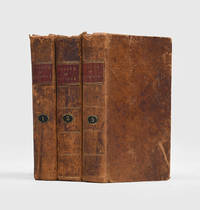
179630670Philadelphia: Thomas Dobson 1796. 412; 430; 387 1 blank 53 1 blank pp. Contemporary tree calf some chipping rebacked with remnants of original spines laid down. Scattered toning generally light foxing lightly worn. Good. <br/><br/> The second American edition the first having issued in 1789 also published by Dobson. 'Printing and the Mind of Man' describes this work as "the first and greatest classic of modern economic thought." <br/>Evans 31196. PMM 221 London 1776. Kress 3288. Thomas Dobson unknown books
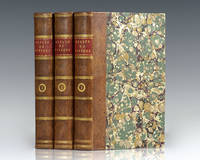
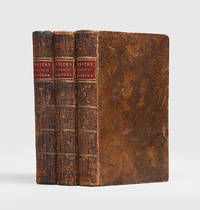
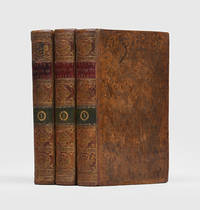
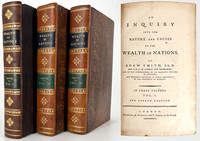
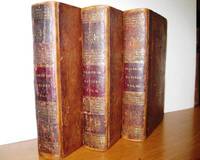
1793124986London: A. Strahan and T. Cadell 1793. Rare 18th century edition of Adam Smith's magnum opus and cornerstone of economic thought. Octavo 3 volumes bound in half calf over marbled boards gilt titles to the spine morocco spine labels. In near fine condition. A very nice set of this classic work. Adam Smith's masterpiece first published in 1776 is the foundation of modern economic thought and remains the single most important account of the rise of and the principles behind modern capitalism. "The history of economic theory up to the end of the nineteenth century consists of two parts: the mercantilist phase which was based not so much on a doctrine as on a system of practice which grew out of social conditions; and the second phase which saw the development of the theory that the individual had the right to be unimpeded in the exercise of economic activity. While it cannot be said that Smith invented the latter theory.his work is the first major expression of it. He begins with the thought that labour is the source from which a nation derives what is necessary to it. The improvement of the division of labour is the measure of productivity and in it lies the human propensity to barter and exchange.Labour represents the three essential elements-wages profit and rent-and these three also constitute income. From the working of the economy Smith passes to its matter -'stock'- which encompasses all that man owns either for his own consumption or for the return which it brings him. The Wealth of Nations ends with a history of economic development a definitive onslaught on the mercantile system and some prophetic speculations on the limits of economic control.The Wealth of Nations is not a system but as a provisional analysis it is complete convincing. The certainty of its criticism and its grasp of human nature have made it the first and greatest classic of modern economic thought" PMM. A. Strahan and T. Cadell hardcover books
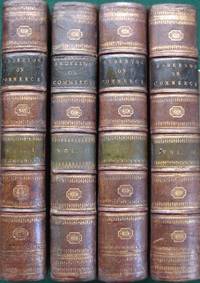
178755106IMPORTANT HISTORY OF COMMERCE - THE BEST EDITION - GREATLY EXPANDED & REVISED<br />first edition thus revised and expanded second overall 4 vols. 4to. 2 title v-lxxxviii 556; 2 title 647 1 blank; 2 title 508 59 chronological index 1 blank 11 index & appendix 1 blank; 2 title iv 4 list of subscribers 718 43 alphabetical & chronological index 1 blankpp. 2 folding maps 1 frontispiece plate 1 folding table contemporary speckled calf sides with a decorative gilt rolled border spines panelled by gilt highlighted raised bands panels gilt tooled black morocco title labels and olive green morocco numbering labels labels on vol. 2 renewed very close match to originals minor old worm trace in a few early gatherings of vol.2 very skillfully repaired minor damps stains to margins of some leaves mainly of terminal leaves some minor cracking of joints sometime very skillfully refurbished. Overall a nice and a handsome copy.<br /><br />ESTC t79287 SABIN 1382 <br />Anderson's work was first published in 2 folio vols. in 1764. A prospectus for this greatly extended edition was issued on January 21 1787 and it was thereafter issued in parts. Vols. 1-3 are dated 1787 and vol. 4 1789. There is a list of subscribers in vol. 4.Attractive copy of this "monument of industry in the form of annals treating specially Great Britain and Ireland" Palgrave <i>Political Economy</i> v.1 p.39. The initial work of 1764 is here greatly extended by Coombe and especially in this later form it has long been valued by economic historians as an important source. Anderson worked for many years in the South Sea Company and this work is particularly notable for its accurate account of that company and the great crash of 1720. There is also considerable information on aspects of American and Canadian economic affairs such as the history of the fur trade the fisheries of Nova Scotia and Newfoundland and John Law's Mississippi scheme. Printed at the Logographic Press, by J. Walter and sold by [many listed booksellers in London, Dublin, Edinburgh & Glasgow] hardcover
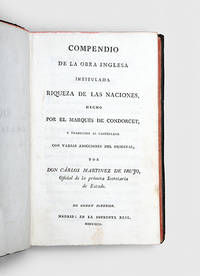
1792164946Madrid: en la Imprenta Real 1792. THE FIRST APPEARANCE OF ADAM SMITH IN SPANISH First Spanish translation of Condorcet's summary of Smith's Wealth of Nations the first appearance of any of his work in Spanish prior to the complete translation by J. A. Ortiz in 1794. The translator of the present summary is the young marqués de Casa Carlos Martinez de Yrujo y Tacón 1763-1824. "This is a translation of the Roucher/Blavet condensation of Wealth of Nations in the Bibliothèque de l'homme publique. to which Condorcet lent his name. The translator restores to the text a summary of Smith's Digression on the Bank of Amsterdam WN IV iii. b 479-88 a five-line qualification of the argument for free trade. The criticism of Catholic clergy is omitted." Tribe. Octavo 174 x 108 mm. Contemporary tree sheep flat spine ruled and decorated in gilt red morocco label marbled endpapers red edges. 19th-century ownership inscription to front free blank leaf extremities lightly rubbed one corner slightly worn; a crisp clean copy in fine condition. Palau 59126; Tribe 47. This edition not listed in Goldsmiths' Kress or Vanderblue. unknown
17862442London: A. Strahan and T. Cadell 1786. Fourth edition. Contemporary calf. Very Good. HANDSOME EIGHTEENTH-CENTURY EDITION OF THE "GREATEST CLASSIC OF MODERN ECONOMIC THOUGHT.". This classic work of the Scottish Enlightenment - originally published in the same year as the Declaration of Independence and Gibbon's History of the Decline and Fall of the Roman Empire - is a magisterial study of the sources of national wealth and of the political and institutional arrangements that foster or suppress it. Based on a 2016 analysis of data from Google Scholar The Wealth of Nations is the second only to Marx's Das Kapital as the most-frequently cited among books in the social sciences published before 1950. And while Smith recognized the economic benefits that flow from voluntary transactions between individuals and is as a result sometimes thought of as the apostle of laissez faire capitalism he supported several forms of government intervention in the economy either to create and maintain the necessary conditions for economic growth or to ameliorate the incidental harms that such conditions could create.<br /> <br /> The Wealth of Nations proposed that "no society can surely be flourishing and happy of which the far greater part of the members are poor and miserable. It is but equity besides that they who feed cloath and lodge the whole body of the people should have such a share of the produce of their own labour as to be themselves tolerably well fed cloathed and lodged." WN this edition vol. 1 page 119. Smith believed that this condition of society could be achieved only through the higher productivity that is made possible by the division of labor. As an example of the division of labor Smith offered the example of the "trade of the pin-maker" which he apparently learned about from Diderot and d'Alembert's Encyclopédie in which "one man draws out the wire another straights it a third cuts it a fourth points it a fifth grinds it at the top for receiving the head ." and so forth. WN this edition vol. 1 pages 7-8.<br /> <br /> In a famous passage Smith explains that such arrangements arise naturally from voluntary transactions between individuals based on their common recognition of the benefits that division of labor creates:<br /> <br /> This division of labour from which so many advantages are derived is not originally the effect of any human wisdom which foresees and intends that general opulence to which it gives occasion. It is the necessary though very slow and gradual consequence of a certain propensity in human nature which has in view no such extensive utility; the propensity to truck barter and exchange one thing for another.<br /> <br /> . Man has almost constant occasion for the help of his brethren and it is in vain for him to expect it from their benevolence only. He will be more likely to prevail if he can interest their self-love in his favour and shew them that it is for their own advantage to do for him what he requires of them. Whoever offers to another a bargain of any kind proposes to do this. Give me that which I want and you shall have this which you want is the meaning of every such offer; and it is in this manner that we obtain from one another the far greater part of those good offices which we stand in need of. It is not from the benevolence of the butcher the brewer or the baker that we expect our dinner but from their regard to their own interest. We address ourselves not to their humanity but to their self-love and never talk to them of our own necessities but of their advantages. WN this edition vol. 1 pages 19-21.<br /> <br /> "Throughout the book Smith's 'system of natural liberty and justice' . plays a pervasive role as explanatory model and regulatory ideal though the famous image of an 'invisible hand' appears late and only once in the whole work . It appears at volume 3 page 181 of this edition. A quasi-Newtonian treatment is given to those forces which act like gravity when market price departs from natural price and it always carries with it a normative implication that policies or practices that prevent these forces from acting are detrimental to the public interest. Monopolies special privileges informal combinations by merchants or employers to raise prices and keep down wages import duties export bounties as well as institutions such as apprenticeships and restrictions on labour mobility . are all condemned from this perspective." Dictionary of National Biography.<br /> <br /> Smith was not unmindful of possible deleterious consequences of the division of labor: "The man whose whole life is spent in performing a few simple operations of which the effects too are perhaps always the same or very nearly the same has no occasion to exert his understanding or to exercise his invention in finding out expedients for removing difficulties which never occur. He naturally loses therefore the habit of such exertion and generally becomes as stupid and ignorant as it is possible for a human creature to become." WN this edition vol. 3 pages 182-83. Smith believed that public elementary education would compensate for this tendency.<br /> <br /> Edition: This copy of The Wealth of Nations is the fourth edition 1786 issued ten years after the first. It was the penultimate edition published during Smith's lifetime the last being the fifth edition of 1789. It carried forward the significant changes made in the third edition of 1784 without making any material additional changes of its own as Smith specifically admitted in the prefatory Advertisement to this edition. A detailed collation of the first five editions is provided in Edwin Cannan's 1904 edition of Smith's work.<br /> <br /> Provenance: With the armorial bookplate of Thomas Howitt bearing the motto "Aquila Non Capit Muscas" "Eagles do not catch flies" on the front pastedown of each volume. Howitt may have been the Lancaster physician of that name 1785-1832; see archives of the Royal College of Surgeons of England ref no. GB 0114 MS0092 the entry for Howitt's son also named Thomas Howitt. It is possible that Howitt's son Thomas Jr. 1830-1922 was responsible for the additions to these volumes described below.<br /> <br /> Volume 2 is bound with additional pages at the end on which a prior owner has pasted articles on the California gold rush of 1849 citing a discussion on page 354 of the volume in which Smith argues that "of all those expensive and uncertain projects however which bring bankruptcy upon the greater part of the people who engage in them there is none perhaps more perfectly ruinous than the search after new silver and gold mines." Another extract pasted at the beginning of volume 1 from an unknown source recommends the reduction of taxes.<br /> <br /> London: A. Strahan and T. Cadell 1786. Octavo contemporary full calf with elaborately gilt-decorated spines; vol 1 rebacked with original spine laid-down. Bound without half-titles. Vol 1 spine darker more toned than the other two. Light flaking to spines a little chipping to leather at extremities. Some foxing to title and first few leaves of each volume; otherwise text clean. A lovely early set of Smith's masterpiece. A. Strahan and T. Cadell unknown books
1787000055Göttengen: J. C. Dieterich 1787. Half Calf. Very Good . Folio 39.2 x 24.6 cm Large paper copy bound in later half calf and marble boards. Collation: 2 iii-xlv 1 Err. 1-124 8 pp. 31 3 folding engraved plates. The present half calf binding replaced the original green-paper boards. The new binding has raised bands and gilt decorated panels with brief gilt title and author stamped into red morocco label in upper panel. The boards and corners are in very good condition. There is upper edge paper repair to front free end paper and title page presumably replacing removed early ownership information. The text proper including the half title not mentioned by Sabin is very clean and bright. The personal circular stamp of previous owner Inz. Mgr. M. Kubiak is in the blank area of the fore edge on p. xxxix and the lower right corner of Tab. III. The plates are generally very clean except for Tab XVIII XXVI XXIX and XXXI where there is striking from the printing of the plate or minor spot in center area away from image Tab. XXXI. Plate XXVI has the most striking near the stub area. It is also the only plate that was placed on the stub too high and the upper edge with Tab number was trimmed during the rebinding with number unreadable. The table on pp. xxxviii- xlv lists properties of 21 North American trees with aspects of growth roots base location/habitat bark wood/lumber leaves sex flowering time seeds seed maturity beginning of growth life span propagation and uses of timber. <br/><br/>Each tree illustrated is discussed separately in the text portion of this work. Wangenheim gives the German Latin and English name for each tree along with Latin description and cites authors who have named and described the tree previously. Several of the trees were new and are described by Wangenheim who cites Linneaus Species Plantarum and Gronovius Flora Virginiana for the other trees. This is one of the first systematic treatment of North American trees with illustrations that would be suitable for a climate outside North America other than Catesby's 1763 Hortus britanno-americannus… and predates Michaux's first illustrated work on oakes by 14 years. There was an earlier publication by Wangenheim that was more of a catalog of trees he observed in his travels as an Hessian soldier with the British troops during the War of Independence. All of the plates were made from field drawings done by Wangenheim although none of them is signed. Johnston notes Cleveland Collection p. 537 that Wangenheim returned to "Prussia where he engaged in forestry. This is the first edition of this work on introducing North American trees into Germany. This is the first edition of this work on introducing North American trees into Germany." Cleveland 574; Lib. Arnold Arboretum p. 730; Nissen BBI 2105; Rehder I 304; Sabin 101238 J. C. Dieterich unknown books
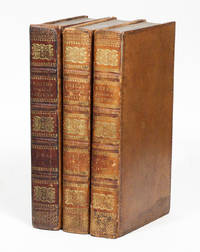
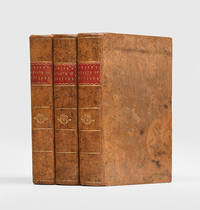
1796180931Philadelphia: Printed by Thomas Dobson 1796. In an unrestored binding from the early years of the republic Second American edition of the "greatest classic of modern economic thought" PMM a key influence on the founding fathers and the development of the young republic. First published in 1776 the Wealth of Nations includes several sections focusing on specifically American concerns. The work analyses the deteriorating British-American relationship at length and reflects approvingly on several aspects of American life most particularly the colonial separation between church and state. The work consequently won praise and attention from the founding fathers: Madison included it in his list of core items for the proposed congressional library while Jefferson judged it "the best book extant" on political economy quoted in Fleischacker p. 903. For Fleischacker the influence was still more fundamental: "America has a Constitution that in the functions it gives to government the structure its sic provides for the military and the strict separation it proclaims between religious and secular powers fits Smith's conception of politics better than any government of his day" p. 924. 3 vols duodecimo 172 x 103 mm. Contemporary tree sheep spines ruled in gilt and with red and green morocco labels. Light wear slight loss to spine ends minor browning foxing and offsetting to contents: a very good copy. ESTC W13002; Evans 31196; Kress B3288; Vanderblue p. 20; not in Tribe. Samuel Fleischacker "Adam Smith's Reception among the American Founders 1776-1790" William and Mary Quarterly Vol. 59 No. 4 Oct. 2002. unknown
1796187836London: Printed for A. Strahan; and T. Cadell jun. and W. Davies 1796. The foundation of modern economics Eighth edition of Smith's masterpiece "the first and greatest classic of modern economic thought" PMM following its first publication in 1776. "The Wealth of Nations had no rival in scope or depth when published and is still one of the few works in its field to have achieved classic status meaning simply that it has sustained yet survived repeated reading critical and adulatory long after the circumstances which prompted it have become the object of historical enquiry" ODNB. 3 vols octavo 206 x 126 mm. Contemporary tree calf red morocco spine labels board edges tooled in gilt. Ownership stamps and signatures of historian Kenneth Porter Kirkwood 1899-1968. Spines dry and cracked restoration to ends loss to head of vol. II printing error to vol. II sig. T7r loss to outer margins of vol. II sig. Z3 and vol. III sig. G7: in very good condition. Goldsmiths' 16558; Kress B.3289; Tribe 58; Vanderblue p. 4. unknown
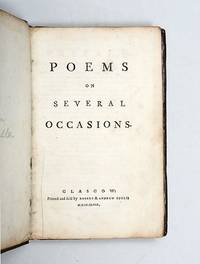
1748152859Glasgow: Robert & Andrew Foulis 1748. Adam Smith's first appearance in print First edition of Hamilton's poems edited and with a preface by Adam Smith marking his first appearance in print. Hamilton 1704-1754 had been an army officer in the Jacobite risings during which time his poetry aroused considerable interest. His poem 'Ode to the Battle of Gladsmuir' set to music by McGibbon became a popular Jacobite ballad. Hamilton went into exile in France after the failure of the risings. A group of his friends likely including Adam Smith's patron Lord Kames feared that his sudden fame would lead to pirated and shoddy editions and consequently prepared the current collection see preface. Smith then twenty-five years old was entrusted with its editorship his first enterprise in publication which indicates that his circle held his literary taste in high regard following his lecture series of 1748-9 lectures given at the suggestion of Kames. When Hamilton was pardoned and returned to Scotland in 1750 he and Smith became intimate friends. In 1758 Foulis published a second edition giving the author's name for which Smith added the dedication to the poet's great friend the Glasgow merchant William Crawford. Octavo 158 x 98 mm. Contemporary calf red morocco label. Bookplate and shelflabel to front pastedown. Joints and extremities neatly restored light rubbing. Front endpaper with small chips at foot repaired 7 cm closed tear at foot of title contents otherwise fresh; a good copy. ESTC T42625; Gaskell 110; Vanderblue p. 46. See Rae Life 3841; Simpson Ross Life p. 96. unknown
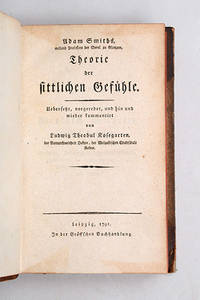
1791104689Leipzig: In der Gräffschen Buchhandlung 1791-95. First complete German translation of Smith's Theory of Moral Sentiments the second German translation overall volume II providing a translation of the additional material contained in the English sixth edition published shortly before Smith's death in 1790. The first German translation of 1770 was made from the third edition of 1767. "The Kosegarten translation of 1791 had more impact than the 1770 one partly because of its timing and also because it did provide some contextualization for work and author" Tribe. 2 vols bound in one octavo 197 x 120 mm. Contemporary half sheep and sprinkled boards spine ruled gilt in compartments morocco spine label edges stained red. Corners and extremities slightly rubbed occasional light spotting; an excellent copy. Tribe 40 & 54; Vanderblue p. 42 listed but not apparently held although Harvard locates 3 copies in its various libraries. hardcover
1794177518Breslau: Wilhelm Gottlieb Korn 1794-96. The Wealth of Nations in the German Enlightenment First edition of the German translation by Garve 1742-1798 the second overall after Schiller's edition of 1776-8. Of the two this second was arguably the more influential in disseminating Smithian economics throughout the German-speaking world as it built on a wider overall familiarity with Scottish philosophy. Garve was a prominent Enlightenment philosopher in his own right and a respected opponent of Kant. 4 vols bound in 2 octavo 204 x 119 mm. Tables in the text woodcut headpieces. Contemporary half sheep spines ruled and lettered in gilt and with yellow morocco labels marbled sides and pastedowns edges green. Light wear to extremities minor browning and foxing short tear to head of spine of first volume contents otherwise clean: a very good copy. Tribe 52. Vanderblue p. 26. Kenneth E. Carpenter: Dialogue in Political Economy 1977 p. 46. unknown
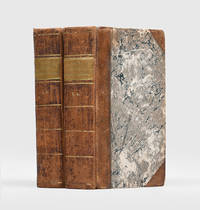
176455358E-08: A. Millar Et Al. Very Good. 1764. Hardcover. Leather. Folio 10-1/2 by 17 inches. A. Millar et al London. 1764. Two volumes. Xxxiv 500 pages; 434 pgs. With large folding hemispheric map of the world and two other maps. Bound in contemporary full brown calf leather with burgundy morocco spine labels raised bands. Boards have wear present to the extremities of the boards. No ownership marks present. Text is clean and free of marks. Binding tight and solid. First edition of this important authoritative history of commerce with a focus on Britain's acquisition of "new American markets" as well as the greater consequences of "the very extraordinary actions of the year 1720" when the South Sea Bubble burst. Within this impressive two-volume work are extensive references to treaties parliamentary acts the substantive contributions of economic texts and thorough statistical accounts of currency population and wealth. "In the year preceding Anderson's death appeared his great and only work An Historical and Chronological Deduction. Coming down from the earliest times to the year 1762 Anderson's work is a monument of stupendous industry. Composed in the form of annals it is not merely a record of commercial progress and colonial enterprise but a history of the political industrial and social development of all civilised countries and especially of Great Britain and Ireland. Abstracts of all treaties acts of parliament and pamphlets in any way bearing on commerce or kindred matters are added together with statistical accounts of the national finances of prices currency and population. In the introduction to his work Anderson showed himself in advance of his time and exposed several of the fallacies of the mercantile system. He condemned industrial monopolies and advocated the naturalisation of foreign protestants and a uniformity of weights measures and coinage for all the nations of Christendom." E-08; Folio 13" - 23" tall . A. Millar, Et Al, hardcover
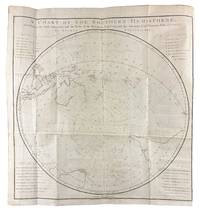
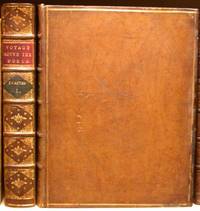
177741959London: Printed for B. White Fleet-Street; J. Robson Bond Street; P. Elmsly Strand; and G. Robinson Pater-noster Row 1777. Two volumes. 4to. 11 3/16 x 8 1/2 inches. First edition. Volume I: A4 a4 b2 B-4G4 4H2. i-xviii 2 1-602 2. 624 pp. Title Preface Contents Engraved Folding Chart Chapters I-IV Errata. Volume II: A2 B-4H4. 4 1-607 1. 612 pp. Title Contents Errata Chapters V-VIII. Contemporary tan calf maroon morocco lettering pieces marbled endpapers<br/> <br/> First edition with Forster's large folding chart of the Southern Hemisphere.<br/> <br/> This the first published account of Cook's second voyage 1772-1775 was published six weeks before Cook's official version. Forster's work is substantial even though it was speedily produced to rival Cook's work. The German naturalist Forster and his father Johann Reinhold Forster 1729-1798 had served as the official botanists aboard the HMS Resolution during the second voyage. When the Royal Admiralty decided to withdraw their offer to have the elder Forster contribute to the official report due to a controversy over his emoluments George produced his own publication. The Admiralty had commissioned Cook to undertake his second voyage in the wake of the success of his first. It was perhaps the most important of Cook's three voyages. The purpose of the second voyage was to circumnavigate the globe as far south as possible searching for any unknown southern landmasses which the Royal Society still believed could exist. But Cook proved beyond a doubt that a fabled Terra Australis Incognita which was supposed to lie between South America and New Zealand did not exist. His two ships became the first to traverse the Antarctic Circle doing so three times discovering and re-discovering islands in the Pacific including New Zealand New Caledonia Palmerston the Norfolk Islands Easter Island the Marquesas New Hebrides Tonga and the Sandwich Islands. An enormous amount of scientific and ethnographic information was garnered from the expedition and as a result of the new techniques Cook employed not one crew member died of scurvy a remarkable achievement for which Cook was awarded the Royal Society's Copley Medal. Forster though young proved a knowledgeable and adept observer; his book is the essential supplement to the literature of the second voyage. The lively elegant prose and critical detail of his account based loosely on both his father's journal and though unacknowledged Cook's own work make it one of the finest examples of eighteenth-century travel literature. It is of prime importance too in the history of European contact with Pacific peoples. The Forsters' publications reveal the sophistication and enthusiasm they brought to their interactions with Polynesian peoples as well as a sensitivity to the moral ambiguities of contact. "For all the controversy A Voyage Round the World is an interesting and important account that complements the official one with facts and astute observations on the human side of the voyage." Rosove Its confident visionary style incorporates a good deal of polemic particularly in its criticism of the treatment of islanders by Cook's crew. It is a thrilling account of life aboard one of Cook's vessels.<br/> <br/> BCJC 1247. Beddie 1247. Cox I p. 60. Davidson pp. 61-62. ESTC T155479. Hill 625. Hocken pp.16-17. Holmes 23. Kroepelien 450. O'Reilly-Reitman 382. Rosove Antarctic 132. Sabin 25130. Spence 464. Printed for B. White, Fleet-Street; J. Robson, Bond Street; P. Elmsly, Strand; and G. Robinson, Pater-noster Row unknown
1797AQ20001Cambridge: Printed by Benjamin Flower: for J. Deighton et al. 1797. 4 290pp 2. With a final publisher's advertisement leaf not recorded by ESTC. Contemporary dark green calf-backed marbled boards ruled and lettered in gilt. Extremities worn loss to head of spine. Head of title page shaved sadly to remove an early ownership inscription foxed. The rare first edition of the first work of economics in English consciously intended for use as a textbook. As the author himself notes in a preliminary 'advertisement' which heaps justifiable praise on the magnum opus of Adam Smith the work was designed to be 'found convenient as a text book in those institutions of liberal education in which the "Wealth of Nations" makes an essential branch of their letters'. A lucid abridgement by English radical Jeremiah Joyce 1763- 1816 of Scottish philosopher Adam Smith's monumental Wealth of nations it condensed the two thick quartos of the original edition London 1776 - or the by then well-known bulky triple-decker octavo editions of the late eighteenth-century - into a single convenient octavo volume. As Joyce himself notes in a footnote to the final page of text the developments suggested by Smith relating to alleviating the national debt by introducing the British system of taxation to 'all provinces of the empire' were superseded by events in America during the 1770s and any hope for the 'discharging of the national debt' brought even more into doubt by the 'present melancholy situation of Ireland'. ESTC locates only 11 copies in the UK and just 12 further elsewhere. ESTC T95379. First edition. 8vo. Printed by Benjamin Flower: for J. Deighton et al. hardcover
1791188047London: Printed for A. Strahan; and T. Cadell 1791. An appealing copy in tree calf Sixth edition of Smith's magnum opus and the first to be published after his death in 1790. "The first and greatest classic of modern economic thought" PMM first published in 1776 offers a persuasive manifesto for free markets and free trade. It is no exaggeration to say that all major economic works which followed were written to advance or challenge the principles of Smith. 3 vols octavo 208 x 129 mm pp. 2 x 499 1; 2 vi 518 6; 2 v 1 465 51: collates complete with initial blanks. Contemporary tree calf red morocco labels volume numbers in gilt to spines. Joints and extremities neatly restored a few marks to calf splash mark to volume I p. 19 scattered light foxing else clean and fresh. A very attractive copy. ESTC T95383; Goldsmiths' 14612; Kress B.2209; Tribe 41; Vanderblue p. 3. See Printing and the Mind of Man 221 first edition. unknown
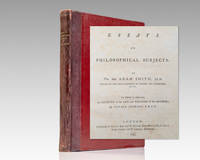
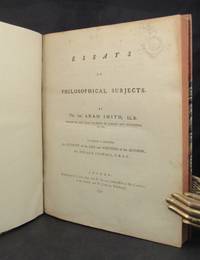
1795151270London: Printed for T. Cadell Jun. and W. Davies 1795. First edition of this important collection of Smith's essays featuring the important first publication of his History of Astronomy. Quarto bound in quarter calf with gilt titles to the spine. One of 1000 copies. Containing the first publication in book form of Dugald Stewart's Account of the Life and Writings of Adam Smith which had appeared in the Transactions of the Royal Society of Edinburgh in 1794. Stewart's Account "formed the basis upon which everyone drew for biographies of Smith that began to appear in the early 19th century" Tribe 55. Goldsmith 16218. Kress B3038. Rothschild 1902. In very good condition. Though Essays on Philosophical Subjects appeared five years after Smith's death most were likely written before the publication of his Theory of Moral Sentiments in 1759. Essays was compiled by his literary executors physicist Joseph Black and geologist James Hutton. Prior to his death Smith "instructed them to destroy his manuscripts but allowed them at their discretion to publish a set of essays" Berry Cambridge Companion 116. As noted herein Smith had begun work early in his career on "a connected history of the liberal sciences and elegant arts" but "found it necessary to abandon that plan as far too extensive." These writings thus represent Smith's longstanding attempts at such a "connected history" and range over philosophy aesthetics and the history of science. A biographical Account of Smith and his work is followed by the extensive History of Astronomy which was the only writing Smith did not want destroyed; indeed he specifically arranged for its posthumous publication. Black and Hutton used their authority to incorporate its momentous first publication into this collection. Astronomy "was probably begun decades before Smith's death perhaps as early as 1746 and was at one time intended to form a chapter of a much larger work… Astronomy purports to explain what drives 'philosophers' to ask the questions they do and to seek explanations for the things they observe" Otteson Adam Smith 22-3. Astronomy "has occasioned much scholarship… Just as The Wealth of Nations was titled an enquiry into its 'natures and causes' so Smith says at the end of the preliminary section of Astronomy that the design of the essay is to consider the 'nature and causes of the three sentiments"—identified by him as "Wonder Surprise and Admiration." Citing Galileo Copernicus Kepler Newton Descartes and others Astronomy aims "to illustrate how philosophy is an activity that addresses itself to the imagination" Berry 116-117 123. Also included in this volume are his essays on "Ancient Physics" "Ancient Logics and Metaphysics" and the "Imitative Arts" along with a concluding essay on perception in the five "External Senses." Printed for T. Cadell Jun. and W. Davies unknown
1789178702London: Printed for A. Strahan; and T. Cadell 1789. Political economy at the time of the French Revolution Fifth edition the last to be published in Smith's lifetime of this foundational work of political economy. "The Wealth of Nations had no rival in scope or depth when published and is still one of the few works in its field to have achieved classic status meaning simply that it has sustained yet survived repeated reading critical and adulatory" ODNB. The work "begins with the thought that labour is the source from which a nation derives what is necessary to it. The improvement of the division of labour is the measure of productivity and in it lies the human propensity to barter and exchange. The Wealth of Nations ends with a history of economic development a definitive onslaught on the mercantile system and some prophetic speculations on the limits of economic control" PMM. Smith's ultimate aim was to provide legislators with a set of principles to guide their regulation of commerce. Some of these principles advocated improvements in existing policies others aimed to alter the overall climate within which these policies operated. 3 vols octavo 205 x 126 mm. Tables in the text. Contemporary tree calf spines ruled and decorated in gilt and with red and green morocco labels edges yellow. Extremities professionally restored and labels replaced. With 20th-century bookplate of "T & M James" to front pastedowns. Light rubbing and scuffing very minor foxing and offsetting to contents: a very good copy. Goldsmiths' 13794; Kress B.1722; Tribe 33 Vanderblue p. 3. See Printing and the Mind of Man 221 first edition. unknown
172730277Amsterdam: Michel Charles le Céne 1727. 2 volumes in 1 small folio. 12 1/8 x 7 5/8 inches. Titles printed in red and black. Engraved portrait frontispiece 44 engraved maps plans and views 31 folding 19 in-text engraved illustrations. Contemporary calf spine with raised bands in seven compartments red and green morocco lettering pieces in the second and third the others with a repeat decoration in gilt marbled endpapers and edges.<br/> <br/>A lovely copy of a noted illustrated work on Asia including maps and views of India China and Japan.<br/> <br/>"Johann von Mandelslo was a friend of Adam Olearius and a former page of the Duke of Holstein-Gottorp. Together Mandelslo and Olearius were sent by the Duke on an embassy to the Russian Czar and to the Shah of Persia for the purpose of initiating trade relations with Russia Tartary and Persia. Mandelslo was authorized to leave the embassy in Persia and to continue his travels to the Far East. He went to Surat Agra and Goa in India where he received great kindness from the English merchants and he also visited Ceylon. He gives long accounts of the other parts of the Far East which he did not visit personally. His return was made to England by sea via the Cape of Good Hope which he visited in 1639" Hill. Mandelslo's narrative contains substantial information on the Far East. "Before his death Mandelslo had entrusted his rough notes to Olearius who subsequently published them bound with his numerous official accounts of the embassy" Howgego. Following the first publication Olearius added additional information to subsequent editions. A new edition in French translated by Wicquefort included still more additional material including an account of the travels of Henri de Feynes to China Formosa and Japan. The present edition published in Amsterdam in 1727 is a re-issue of the Van der Aa edition of 1719 published in Leiden; both are celebrated as the best editions being the most complete and with the largest number of illustrations. The plates include views and plans of London Amsterdam Brussels Antwerp Capetown Goa Surat Jedo Tokyo St. Helena Mauritius Madagascar the Canary Islands Java Congo and elsewhere.<br/> <br/>Brunet IV 178; Cordier Japonica 367-368; Cordier Indosinica 883; Cordier Sinica 2076-77; cf. Hill 1073; Howgego M-38; Lust 342. Michel Charles le Céne unknown books
176455620London: for the Author 1764. First edition. Modern full morocco. Very good. Large folio 53.0 by 38.0 cm. iv 7 subscribers' list 1 blank 33 1 blank pp; 53 of 54 leaves comprising 60 of 61 engraved plates 7 double-suite 6 folding each numbered according to the descriptive list on pp. 19-33. Plate I serves as frontispiece; five leaves each contain two or three smaller plates. Plate VI a floor plan of the palace restored is lacking. Recent full speckled light brown morocco boards lightly rubbed at extremities gilt dentelles spine with raised bands and gilt morocco lettering piece. A touch of mild soiling at the title; light foxing and staining almost exclusively confined to the margins throughout; adhesive at the joins in the large folding plates sometimes a bit darkened. A very good amply-margined copy.<br /> <br /> First edition of this magnificently illustrated work with views elevations sections and architectural details of the emperor Diocletian's palace at Spalato today known as Split. While the modern town was built into the ruins of the palace precinct the two temples the inner peristyle and most of the encircling walls remain. <br /> <br /> The origin story of the work is notable. Upon the death of William Adam 1689-1748 the leading architect in Scotland Robert Adam 1728-1792 and his two brothers succeeded to their father's practice. In order to remedy his deficiencies in architectural understanding Robert decided upon a Grand Tour of the monuments of classical antiquity so as "to acquire a proper manner and taste and an elegant style of drawing" Millard. Being the only significant unexplored classical sites in southern Europe Spalato would prove ideal for such a project. After meeting Charles-Louis Clérisseau 1721-1820 in Florence in 1755 Adam chose to engage the young French architect as guide and drawing instructor for the next two years. Clérisseau accompanied Robert Adam during the five weeks of the summer of 1757 devoted to exploring Spalato. The engravings were probably based on drawings by Clérisseau six of which are preserved in the Hermitage Museum who would also go on to supervise much of the engraving. The Critical Review October 1764 offered high praise for these illustrations which exhibited "a taste and execution that has never been equalled in this country." In his Decline and Fall chap. 12 Edward Gibbon offered a pithy critique: "There is reason to suspect that the elegance of his designs and engravings has somewhat flattered the objects which it was their purpose to represent."<br /> <br /> Adam clearly hoped the project would generate publicity as he sought to emulate the success of such works as Dalton's Antiquities and Views in Greece and Egypt 1751-1752 and Robert Wood's The Ruins of Palmyra 1753. The format of the present work is in fact modeled on Palmyra though Adam has included a far greater proportion of picturesque views than appear in Wood's opus. "The plates engraved by F. Bartolozzi E. Rooker F. Patton P. Santini A. Walker K. Cunego J. Bassire and Antonio Zucchi are of interest not only as fine examples of architectural engraving but as showing the source of some of the motives of the Adam style" Fowler. Adam's cousin the scholar and historian William Robertson wrote the proposal the dedication and the preface. Digital Cicognara Library 3567; ESTC T46923; Fowler 2; Millard British Books 1. for the Author unknown
178667London: A. Strahan and T. Cadell 1786. 4th edition. Near Fine. 3 volumes 4to; 8 1/4 x 5 inches 210 x 140 mm; Vol. 1: vii 499 errata; Vol. 2: vi 518 5 Appendix errata; Vol. 3: v errata 465 49 Index 1 ad pp. Printed on handmade cream laid paper pages clean supple and unmarked with some offset; small wormhole on bottom corner of latter sheets in vol. 3 not affecting the text; offset to edges of flyleaves. Contemporary full mottled brown calf bindings darker for vol. 1; all 3 volumes professionally rebacked with gilt decorations on spines and gilt title on morocco labels; bindings square and tight. <br /> Armorial bookplate of John Pitcairn pasted inside front cover of each volume. A indecipherable snippet of manuscript with a date 1793 was as a bookmark between pages 204 and 205 of vol. 2. <br /> <br /> PMM 363; ESTC T96679. A BEAUTIFUL SET of this SEMINAL WORK on ECONOMICS "The first and greatest classic of modern economic thought." Printing and the Mind of Man 221 "Although Adam Smith did not create the study of political economy The Wealth of Nations coming at a point when 'natural liberty' was being widely debated had a decisive influence both on the study of national economy and on the freeing of economic policy from the artificial restraint of the mercantilist system. Smith's statement that labour is the source of a nation's commodities and that the variations in 'stock' values are due to the interaction of wages profits and rent formulated the doctrine of the classic school of economic thought and round it all modern economic discussion has revolved." <br /> <br /> This set is an early printing and only the second in 8vo format issued only 10 years after the first two-volume quarto edition; this is the last edition with any changes and includes a new preface never before printed. In the 'Advertisement' leaf in volume I to this edition Adam Smith writes 'In this fourth edition I have made no alterations of any kind. I now however find myself at liberty to acknowledge my very great obligations to Henry Hop of Amsterdam. To that Gentleman I owe the most distinct as well as liberal information concerning a very interesting and important subject the Bank of Amsterdam; of which no printed account had ever appeared to me satisfactory or even intelligible.' Adams seems to have been very involved with this printing of his work. He wrote to his publisher Andrew Strahan in February 1786 'I beg you will employ one of your best compositors in printing the new edition of my book. I must likewise beg that a compleat copy be sent to me before it is published that I may revise and correct it. You may depend upon my not detaining you above a week.'. A. Strahan and T. Cadell unknown
179619158Neuchâtel, Samuel Fauche, 1779, [et] Genève, Barde, Manget et Compagnie, 1786 [et] Neuchâtel, Louis Fauche-Borel, 1796. 4 volumes in-4 de [4]-XXXVI-540-[2]; [4]-XVI-641-[3]; [4]-XX-532-[2]; [4]-594-[4] pages. Demi-veau brun à coins, dos à nerfs ornés de filets dorés, pièces de titre et tomaison beiges et vertes, tranches mouchetées.
179523048London: For T. Cadell Jun. and W. Davies and W. Creech in Edinburgh 1795. First Edition. 4to in a handsome and correct period style binding of three-quarter calf over marbled boards. The spine with raised bands gilt ruled and with chain device in gilt red morocco label ruled stippled and lettered in gilt additional gilt lettering in two other compartments edges dyed. xcv 244 pp. xcv 1 blank 244 pp. A4 a4-l4 B4-Z4 AA4-II2 A fine fresh copy quite clean and crisp the binding in excellent condition small and unobtrusive blank embossed exlibris on the top corners of several signatures. SCARCE FIRST EDITION of the posthumously published essays of Adam Smith. Though thought of today primarily as an economist due to the fame of his WEALTH OF NATIONS these essays demonstrate the diverse range of philosophical sciences to which Smith applied himself. They were arranged and edited by his close friends James Black and William Hutton. Black and Hutton had attended to Smith in his old age and had made his literary executors. Shortly before his death Smith had forced them to burn the vast majority of his unpublished papers over sixteen volumes worth of manuscripts. These few which remained were intended according to the editors as “parts of a connected history of the liberal sciences and elegant arts" but that Smith had "long since . found it necessary to abandon that plan as far too extensive". The range over fields as diverse as philosophy aesthetics the history of science astronomy physics metaphysics music and sensory perception. Most of them were originally written prior to 1759 long before his remarkable success with WEALTH OF NATIONS.<br> Stewart’s account of Smith’s life was the first biography written of him and remains an important source. It was originally delivered as a series of lectures at the Royal Society of Edinburgh. For T. Cadell Jun. and W. Davies, and W. Creech in Edinburgh hardcover
1777elala682London: Printed for B.White J.Robson P.Elmsly and G.Robinson 1777. 1777. 2 Volumes. 4to. pp. xviii 2 602; 2 p.l. 607. without the errata leaf at the end of Vol. I. folding engraved map frontis. An attractive set in contemporary sprinkled calf neatly rebacked corners renewed spines tooled in gilt Vol. I title-leaf professionally remargined at lower edge & upper outer corner with small repair marginal repair to GG2-3 affecting part of headline occasional spotting. First Edition of this important account of Cooks second voyage which preceded the publication of the official record by some six weeks. The author and his father Johann Reinhold served as naturalists on the expedition. While the elder Forster was originally to have written the account he was forbidden to do so because of a dispute with the Admiralty concerning his emoluments. It is based on his journal and also draws from Cooks own although no acknowledgement is given. Humboldt said that he was indebted to this work more so than to any other for his early love of nature and tropical beauty. On his second and historically most important voyage Cook determined that the Terra Australis Incognita which supposedly lay between New Zealand and South America did not exist and accomplished the first crossing of the Antarctic Circle. Cook revisited New Zealand and discovered or re-explored and charted many of the islands in the Pacific including Easter Island the Marquesas Tahita and the Society Islands the Tonga Islands the New Hebrides and New Caledonia. A vast amount of scientific and ethnographical information was gathered and as a result of new techniques developed by Cook not one crew member on the voyage died from scurvy a remarkable achievement for the time and for which Cook was awarded the Copley gold medal. Beddie 1247. Cox I p. 60. Hill p. 108. Hocken pp. 16-17. Holmes 23. Kroepelien 450. OReilly-Reitman 382. Sabin 25140. Spence 464. 1st Edition. Hardcover. Very Good. London: Printed for B.White, J.Robson, P.Elmsly, and G.Robinson, 1777. hardcover
177648982Leipzig, Weidmann, 1776-78. 8vo. Bound in two nice uniform contemporary half calf bindings with five raised bands and gilt lettering to spine. Ex-libris pasted on to pasted down front free end-papers and a small embossed stamp to front free end paper on volume 1 (""Buchhändler u. Antiquar Carl Helf""). Stamp to p. 1 of both volumes. Spines with light soiling and capital on volume 1 lacking a small part of the leather. A few light brown spots throught. A fine set. VIII, 632 pp"" XII, 740 pp.
176761031Edinburgh 1767. Large 4to. Recased preserving the contemporary marbled leather boards with a gilt line-frame over a more recent light brown full calf binding with five raised bands and gilt ornamentations to spine. The contemporary gilt title-label also preserved in second compartment of the spine. A later leather-onlay to the lower compartment presumably covering an earlier library-marking. All edges of boards gilt. Inner hinges re-enforced. A good solid and sturdy copy. Library stamp Freie Universität Berlin to verso of title-page along with a deaccession-stamp as well as to blank lower margin of p. 48. Apart from the stamps internally extremely well preserved clean and fresh with only light occasional brownspotting. A very wide-margined copy on good paper. Leaves measuring 27x21 cm. VII 1 430 pp. <br/><br/><em>The uncommon first edition of this pioneering classic of the Enlightenment a magnum opus in the history of political thought. The Essay became extremely influential and established Ferguson’s reputation in Britain and the rest of Europe. The work was also taught at the University of Moscow causing Voltaire to praise Ferguson for “civilizing the Russiansâ€. Marx was also directly influenced by the work as were numerous of the great political and sociological theoreticians. “Adam Ferguson's Essay on the History of Civil Society first published in 1767 is a classic of the Scottish - and European - Enlightenment. Drawing on such diverse sources as classical authors and contemporary travel literature Ferguson offers a complex model of historical advance which challenges both Hume's and Smith's embrace of modernity and the primitivism of Rousseau. Ferguson combines a subtle analysis of the emergence of modern commercial society with a critique of its abandonment of civic and communal virtues. Central to Ferguson's theory of citizenship are the themes of conflict play political participation and military valour. The Essay is a bold and novel attempt to reclaim the tradition of active virtuous citizenship and apply it to the modern state.†Cambridge University Press. â€A pioneering work of the Scottish Enlightenment in the field of “philosophical history†or what we would today call sociology. It deals with the social political economic intellectual and legal changes which accompanied societies as they made the transition to modern commercial and manufacturing society.†OLL – Online Library of Liberty </em> hardcover