42 895 résultats
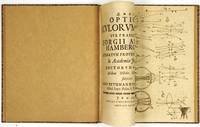
1707524801707. Jena : Literis Gollnerianis 1707 Kl.-4° 2 64 pp. mit 1 Kupfertafel feiner Pappband im Stil d. Zeit. Rare - Second Edition of the first monograph on refractive errors ! "Physiology in general and physiologic optics in specific made great progress during the 18th century. These advances were at first made not by practicing ophthalmologists but the mathematicians and physicists. This situation is therefore similar to that of the 17th century when progress was achieved by Kepler Scheiner Kircher Mariotte Hooke Rohault Deschales Huygens and others. The mathematician Georg Albrecht Hamberger 1662-1716 was the author of a most curios monograph which was printed toward of the end of the 17th century. Modern historian did not know about it and it is not mentioned by A. Hirsch not by Helmholtz in the second edition of his Physiological Optik. It is difficult to determine how much this book influenced the thought progress of the 18th century. It is only mentioned in the review of the literature by Julius Beer in his first 'Augenheilkunde' of 1792 and Haller quotes it in his 'Elementa physiologiae humani' ." The book is called: Optica oculorum vitia sub praesidio Geogrii Alberti Hambergeri . This is the first monograph on refractive errors - the root so to speak from which 170 years later the classical book by Donders evolved; the monograph is for its time extraordinarily clear strictly mathematical and physical written in an entirely different spirit from the scholastic descriptions of the fourth book by Plempius "Opthalmographia" 1632 and also far superior to the corresponding remarks in Boerhaave's lectures on ophtahlmology 1708 printed in 1746 to 1771. These two publications are usually regarded as the beginning of physiologic optics. . Also Modern ocular hygiene was created by Professor Hamberger in Jena in 1696 . Only the reform of ophthalmology during the middle of the 19th century which was based on the ophthalmoscope and the correct recognition of refraction changed the situation." Hirschberg/Blodi IV pp.284-291 "Es ist dies die erste Sonderschrift über die Fehler der Einstellung des Auges . für die damalige Zeit außerordentlich klar streng mathematisch-physikalisch . geschrieben . Die Hygiene des Auges . ist in den zahllosen Schriften über diesen Gegenstand die um die Wende des 18. zum 19. Jahrhundert . erschienen sind nur wenig verbessert und erweitert worden " Hirschberg unknown
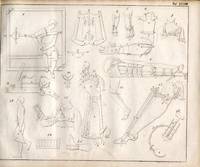
1844246231844. Jena Mauke 1844-47 8° ca. 3000 pp. Atlas in Quer-Folio mit 40 lith. Taf. ohne Tit.; schönes uniform gebundenes Exemplar in feinen Halbledereinbänden mit reicher Romantiker-Rückenvergoldung; Atlas Pappband d.Zt. Erste Auflage - Selten vollständig angeboten! Adam Kaspar Hesselbach 1788-1856 Sohn des berühmten Franz Kaspar Hesselbach 1759-1816 machte sich als Prosektor von früh auf in der Würzburger Anatomie unentbehrlich. Später war er als Professor der Chirurgie an der chirurgischen Schule in Bamberg und Oberwundarzt des dortigen Krankenhauses tätig. Beide Hesselbachs haben Bedeutendes auf dem Gebiet der Hernienlehre geleistet. unknown
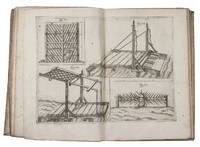
1640I4BEEA14RQO2Paris 1640. Folio. Toussainct Quinet Contemporary vellum. With an integral engraved title-page with 3 allegorical figures of Ares/Mars Labore and Industria military surveying and building attributes and a fortification plan divisional titles for the second and third "livre" 35 double-page engraved illustration plates lettered A-Mm containing 185 numbered figures 8 double-page letterpress tables labelled I-VII and "Table du profil". 8 179 1 pp. Third French edition the first one published outside the Netherlands of the best most detailed best illustrated and most influential handbook of fortification from the Dutch golden age. Besides numerous fortification plans profiles sections and perspective views the plates show bridges gates barriers shelters tools for digging construction and demolition a level a battering ram a windlass a wheelbarrow artillery fences and a horse-powered Archimedes's screw for pumping water while three plates show the arrangement of troops' quarters in camp. While some of the fortification plans are theoretical others show the fortifications of cities of the Low Countries and Rheinland during the Eighty Years' War including Antwerp Wesel and Heusden. The text is divided into three "books" the first covering the origins development and most recent Dutch improvements in the art of fortification the second systematically presenting the various forms of fortification in a wide variety of shapes and the third on offensive and defensive tactics of siege warfare as well as the furnishing and maintenance of fortifications.With some manuscript notes in French on paste-down. Browned with some minor foxing and spotting. Bookblock loosly attached to spine binding with some stains. Reasonable copy.l Jordan 1303; cf. Jähns p. 1111; this edition not in Sloos Warfare. hardcover
196438656Monaco Editions du Parnasse 1964 Fort volume in-4, vlin crme orn sur les plats et le dos de compositions en couleurs dessines par Gradassi, dos sans nerfs; doublures et gardes de sire moire rouge fonc, tte dore, non rogn. Bote-tui (reliure de l'diteur).15 miniatures de Gradassi (8 en pleine page dont certaines regroupent 3 5 miniatures et 7 in-texte), ainsi que 67 lettres ornes. Le texte de chaque page est dispos dans un encadrement enlumin. Tirage limit 810 exemplaires numrots sur pur chiffon de Lana. Un des 50 exemplaires accompagns d'une aquarelle originale en couleurs ddicace et signe par l'artiste.
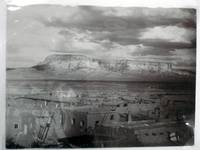
02146220.4 cm x 15 cm. Photograph by Adam Clark Vroman Thunder Mountain Looking across the Zuni village toward The Mesa of Tâaaiyalana or Thunder Mountain to which the Zuni retreated after attack on by Coronado in 1540. Vroman ca.1898. Photographed at direction of Anthropologist Frederick W. Hodge. Between 1895 and 1904 Adam Clark Vroman photographed the landscape and native peoples of the American Southwest. He photographed the Hopis Zunis and Pueblos among other tribes. His portraits of Native Americans humanize rather than romanticize his subjects. The process he used most frequently was the platinotype or platinum print known for its non-reflective surface rich detail broad tonal range and permanence. The platinum process was widely used in the United States and Europe from 1880 through the 1930s when the cost of platinum became prohibitive and the silver-based processes gained prominence. Vroman moved to Pasadena California in 1892. He soon opened a book stationery and photo-supply shop there in November of 1894. He traveled through southern California Arizona and New Mexico on seven separate trips from 1895 to 1904 to document the area's landscape Indians and Indian communities. Vroman was employed as a photographer by the Bureau of American Ethnology a research unit of the Smithsonian Institution for two separate trips to the Southwest the former involving a climb to the Enchanted Mesa in central New Mexico to prove the existence of Indian habitation and the latter a documentation of Southwestern pueblos and cliff dwellings. unknown
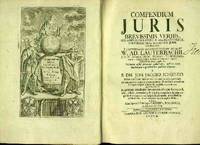
1722950613Tübingen Frankfurt & Leipzig: Cotta ca. 1722. hardcover. Gut. 8 Blatt 745 Seiten 7 Blatt. Halbpergament der Zeit mit Pergamentecken und handschriftlichem Rückenschild. Oktav 215 x 175 cm Rücken mit Fehlstelle im Pergament Einband berieben bestoßen und etwas fleckig Besitzvermerk von alter Hand auf Titel sehr zahlreiche zeitgenössische Marginalien innen wenig fleckig im Ganzen ordentlich erhalten. "Wolfgang Adam Lauterbach 1618 - 1678 war einer der bedeutendsten Juristen des usus modernus pandectarum in Württemberg. Im November 1648 erhielt er an der Universität Tübingen einen Lehrstuhl für Pandekten. . Neben der Lehrtätigkeit hatte Lauterbach auch mehrfach Ämter in der Universitätsverwaltung inne er wurde achtmal zum "rector magnificus" und oft zum Dekan der juristischen Fakultät gewählt. . Sein bekanntestes Werk ist das >Compendium Juris<. Dieses Werk wurde aber nicht von ihm selbst sondern von seinem Schüler Johann Jacob Schütz Pietist und Jurist 1640 - 1690 herausgegeben. Das Buch war eine der verbreitetsten Erläuterungen der Pandekten es wurde von 1679 bis 1744 vielfach aufgelegt." vgl. wikipedia. Seine besondere Bedeutung bekommt das vorliegende sehr breitrandige Exemplar durch die überbordenden Marginalien von Johann Friedrich Anton Meier Hildesheim 1724 - 1796 Paderborn der seinen vollen Namen selbstbewußt auf dem Vorsatz zu wissen gibt. Der Eintrag ist "Erfurt 1745" datiert Meier war damals dort Student. Später wurde er einer der angesehensten Juristen in Paderborn wo er Hofrichter Geheimer Rat und Kanzler war. vgl. Zeitschrift für vaterländische Geschichte und Alterthumskunde Westfalens 1843 Seite 311 ff. - Weitere Bilder auf Anfrage oder auf unserer Homepage. Wegen Urlaub kann Ihre Bestellung / Anfrage erst nach dem 21.06.2026 bearbeitet werden. - Because of holidays your order / question can be handled only after 06/21/2026. Cotta hardcover
2008Adhya-9781599048437IGI PUBLISHER 2008. Hardcover. New. IGI PUBLISHER hardcover
2008Adhya-9781599048437IGI PUBLISHER 2008. Hardcover. New. IGI PUBLISHER hardcover
007942Tokyo: Yushudo Booksellers Ltd. 1976. Limited Numbered Finally Bound Bicentennial Edition. Full leather. This large lovely finely bound edition of one of the most important works of economics is compellingly handsome intriguing in origin and a perfectly-preserved half-century old time capsule. Per the limitation statement: This facsimile edition is issued to commemorate the bicentenary of the first edition of The Wealth of Nations. Planned cooperatively by English American and Japanese firms it is published by Yushodo Booksellers Ltd. Tokyo 1976. One thousand copies have been printed of which 981 are for sale. <br /> <br />These two-volume sets are magnificently substantial each volume measuring 11.75 x 9.75 x 1.75 inches 29.8 x 24.8 x 4.5 cm and together in their slipcase weighing 9 pounds 4 ounces 4.2 kg. The bindings are full pebble grain reddish-brown Morocco goatskin with raised spine bands bracketed by double gilt rules with gilt printed and gilt decorated compartments. The contents are printed on laid paper and bound with silk head and tail bands and marbled endpapers. The two volumes are housed together in a rigid blue cloth-covered slipcase the interior lined with white felt. <br /> <br />This set is number 36 so identified by 36 hand-written on the Volume 1 limitation statement. Condition is as-new owing to the fact that the set has spent the half-century since publication sealed in the publishers original stout two-piece cardboard shipping box which features a label printed in both English and Japanese with the set number number 36 handwritten thereon. This shipping box is in rather remarkable condition clean and intact with only minor scuffs and bumps. Within the books are essentially as they were when placed within by the publisher; the bindings contents and slipcase are all immaculate with no signs of wear soiling spotting or handling. <br /> <br />Accompanying this set are two items attendant to original publication. The first of these documents a small folding brochure measuring 7.25 x 5.25 inches 18.4 x 13.3 cm featuring a front cover illustration of Smith is the original publication party announcement and invitation held at 4:00 p.m. Monday October 4th 1976 at Hotel Grand Palace. This was apparently a major event including a film. The second item is a 44-page perfect-bound book in strikingly-textured gray card wraps and measuring 8.25 x 5.75 inches 21.6 x 14.6 cm. This book is the Bibliographical Story of The Wealth of Nations with authorship credited to W. R. Todd and K. E. Carpenter and a Japanese author the contents printed almost entirely in Japanese. The 1976 copyright specified on the title page verso is held by the publisher Yushodo Booksellers Ltd. <br /> <br />The Wealth of Nations was first published in 1776 strikingly coincident to the Declaration of Independence by the fledgling American republic that would in time become the standard bearer for the development potential of market forces. Wealth has gone through innumerable editions in the ensuing quarter of a millennium. <br /> <br />The Wealth of Nations had no rival in scope or depth when published and is still one of the few works in its field to have achieved classic status meaning simply that it has sustained yet survived repeated reading critical and adulatory long after the circumstances which prompted it have become the object of historical enquiry. ODNB Wealth has been recognized as the first work of political economy. As philosopher Smith had taken up the challenge of providing an imaginary machine that would render coherent the everyday appearances of an emerging world. In contrast to the existing systems agricultural and mercantile he advanced a system of natural liberty capable of supporting a branch of the science of a legislator or statesman Smith WN 428 which had grown in significance in all modern societies where commerce was beginning to dominate their domestic and international economic relations. The object of the science was to amend the related practical art by providing legislators with a set of principles to guide their actions and inactions partly by advocating improvements in existing policies and institutions partly by altering the general climate of opinion within which these matters were discussed. ODNB <br/><br/> Yushudo Booksellers Ltd. hardcover
MC01A-00016The St. Hubert Guild. Collectible - Acceptable. Akron Ohio: The St. Hubert Guild 1897. Academy edition. 8vo Hardcover. Red cloth with faded gilt lettering on spine. 316pp. Color frontispiece. Poor book. Reading copy only. Covers soiled scuffed edgeworn corners bumped and nearly detatched. 3 inch tear to bottom hinge of back cover with a half inch tear to the top. Owner's name on front pastedown. Tissue guard foxed. Page 7 dog-eared. Two small holes to pages 9 without loss of text. In polypropylene bag. united states history french and indian war 1754-1763 fiction Inquire if you need further information. The St. Hubert Guild hardcover
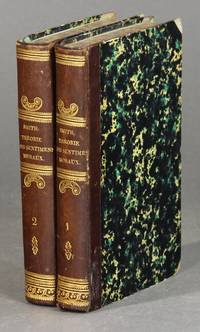
179854493Paris: F. Buisson 1798. 2 volumes 8vo pp. viii 466; 4 51 1; sporadic foxing; pencil notes in the top margins of C6v and C7r in volume I and K5r in volume II; paper flaw in C4 of the second volume affecting 4 or 5 letters; F1 in volume II with blank corner torn no loss and the second A gathering in volume II substantially toned; all else quite nice in contemporary brown calf-backed marbled boards with vellum tips; smooth gilt-decorated spine laid out in three compartments gilt-lettered direct in 1; very pretty marbled edges green silk bookmarkers; near fine. There's a wonderful abstract of an article on line compliments of Laurie Breban and Jean Dellemotte at the Sorbonne which "aims at providing a critical analysis of Sophie de Grouchy's translation and commentary of Adam Smith's Theory of Moral Sentiments . This paper focuses on Sophie de Grouchy's translation of the Theory of Moral Sentiments 1759 published in 1798." At that time her translation was not the first attempt to spread Adam Smith's moral philosophy in France. However the two previous translations did not succeed there. The first one from Marc-Antoine Eidous and entitled Metaphysique des moeurs 1764 was unanimously criticized because of its bad quality. Smith himself looked at it as responsible for the bad reception of his work across the Channel. As for the second translation 1774-75 from Jean-Louis Blavet it seems to have been poorly disseminated. This contrasts with the reputation of Grouchy's translation which was praised from the very moment of its publication for its accurateness with respect to the original text. The success was such that it has been viewed for two centuries as the definite French translation of the Theory of Moral Sentiments. And Grouchy is even sometimes considered as "Smith's best-known contemporary translator." <br/><br/> F. Buisson hardcover books
194514742Paris, La Lithographie, 1945 ; in-folio en ff., chemise caramel à rabats illustrée_; (4) pp. (texte de Jacques-Noir, poésie de René Fauchois et table) ; frontispice, couverture et 41 planches lithographiées sur vélin fort, numérotées à la main, la plupart avec titre manuscrit et signature autographe.
183841123Paris, Armand Robin, 1838. 2 vol. grand in-8 de (4)-VIII-224 pp., 36 planches lithographiées coloriées hors texte ; (4)-227-(2) pp., XVI pp. (supplément), 36 planches lithographiées coloriées hors-texte, demi-chagrin brun à coins, dos muet à quatre nerfs, non rogné (reliure moderne).
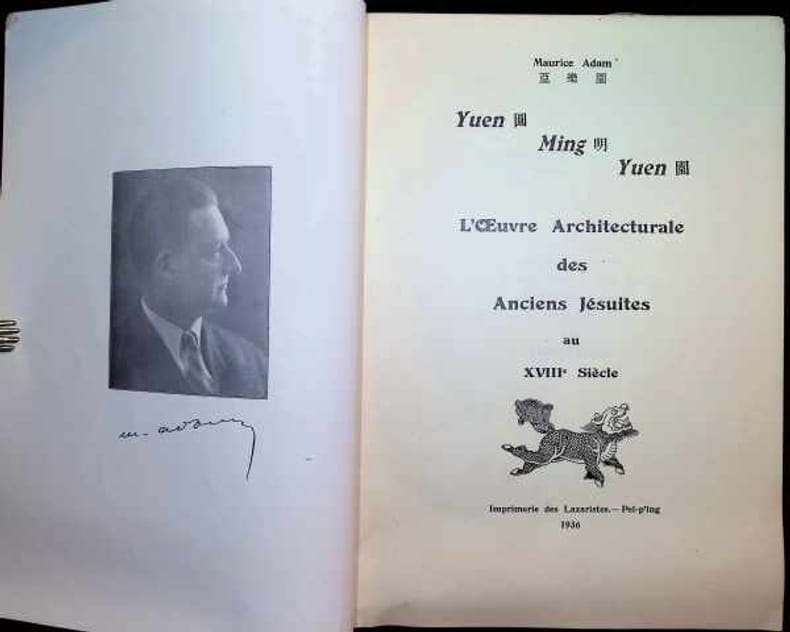
1936030110Pei-p'ing 1936 imprimerie des Lazaristes Soft cover 1st Edition
1797009266Paris: Agasse 1797. Due volumi in 8vo 12x20 cm di 4-283 pp e 4-316 pp. Ritratto inciso di Smith all'antiporta del primo volume. Graziosa legatura ottocentesca in mezza pelle avana dorso dorato e ornato piatti con carta marmorizzata. First edition in French of Smith's "Essays on philosophical subjects 1795. Traduits de l'anglais par P. Prevost. Ottime condizioni. Agasse unknown
1788018056Paris Londres: Duplain 1788. Due volumi in 8° di 4-IV-503pp-4; e 4-496pp. Bella legatura coeva in piena pelle del tempo dorso liscio ornato e dorato. Bell'esemplare di questa traduzione che contribuì non poco alla diffusione delle idee di Smith in Francia. La traduzione è di Jean-Louis Blavet anche se a lungo circolò la voce che in realtà fosse di Morellet che stava in effetti pensando in quello stesso tempo di procedere ad una sua versione. "The Blavet's version appeared at Yverdon in 1781 in 6 volumes 12mo and at Paris in the same year in 3 volumes 12mo and again at London and Paris in 1788 in 2 volumes 8vo the present edition. He had no intention of publishing it until his friend M. Ameilhon happened to complain of scarcity of interesting articles for his Journal de l'Agriculture du Commerce des Arts et des Finances which had just come under the control of the Mercantilist. It struck him that he might offer it to him which he did with the explanation that it was far from perfect. It was accepted and appeared in the issues of the Journal between January 1779 and December 1780. He did not anticipate that it would go further. The edition of 1788 likewise appeared without his knowledge or consent and was still more marred by errors than that of Yverdon". Lai Cheng-chung. Adam Smith Across Nations. Duplain unknown
55153Kraków: self-published 1984. Quarto 19.5 × 14.3 cm. Original side-stapled black card wrappers; 8 leaves of text and illustrations to rectos only. Light wear to spine; else very good. An artist book by the founding members of Åódź Kaliska Andrzej Kwietniewski and Adam Rzepecki narrating the history of the performance art group with short satirical texts and drawings. The neo-Dadaist art collective was founded in 1979 with this book describing the group's activities including their first street performance titled "partitioning the street with a black ribbon to create confusion and distract attention in order to throw a white sheet over a group of people tie them up and hit them on their asses." The group's first manifesto written by Marek Janiak and Andrzej Kwietniewski appeared in 1980. The text typed in Polish and English self-consciously parodied the manifesto as the signature genre of the avant-garde. Numerous mock-manifestos appeared throughout the 1980s using logical errors to articulate gibberish ethical codes. Art historian Piotr Piotrowski writes: "The concept of anarchism was key for this particular formation since the artists involved were mainly interested in rejecting any form of authority: political opposition ideological nationalism and religion as well as cultural institutions and grand art historic narratives. By relying on humor pastiche parody and coarse eroticism their performances and short films were supposed to strip art of its pathos knock it off its pedestal and tear it out of the frame provided by the historical discourse" see Art and Democracy in Post-Communist Europe pp. 130-131. In keeping with the group's principles most of the members had no formal training in fine arts. Members of the group included Marek Janiak Andrzej Kwietniewski Adam Rzepecki Andrzej Åšwietlik Andrzej Wielogórski with Zofia Åuczko joining in 1983. Creating a limited edition and signing the item was part of Kwietniewski's joke on the circulation of art.<br /> <br /> No. 9 of 10 numbered copies. <br /> <br /> As of May 2025 not in KVK OCLC. unknown
22263Monaco Editions du Parnasse 1964 in 8 (18,5x12) 1 volume broché en faux-feuillets, couverture rempliée illustrée en couleurs, sous boitage toilé rouge de l'éditeur. 15 miniatures en couleurs de Jean Gradassi, dont 8 à pleine page, nombreuses lettres historiées ou ornées. Les enluminures et les illustrations, toutes originales, ont été conçues, dessinées et mises en couleurs par l'artiste Jean Gradassi. Pages de texte dans un riche encadrement enluminé. Les couleurs au pochoir ont été appliquées à la main dans les ateliers de Edmond Vairel. Tirage à 810 exemplaires numérotés, celui-ci un des trente exemplaires hors-commerce sur pur chiffon de Lana numérotés de I à XXX. Envoi autographe signé de l'illustrateur (non du dédicataire soigneusement effacé). Très bel exemplaire ( Photographies sur demande / We can send pictures of this book on simple request )
10061Mensuel dont le n° 1 est paru en Juillet 1966 18 rue Royale (Paris 8°) Directeur général : Claude Perdriel Directeur de la rédaction : Guy Sitbon Rédacteurs en chef : Pierre Bénichou et Michel Friedman Directeur artistique : Robert Delpire - Directeur littéraire : Bernard Frank - Format 22 x 28,5 de 96 pages - Couvertures photos couleurs - Je propose la série complète en 51 numéros du n° 1 (Juillet 1966) au n° 51 (Novembre 1973) - Le tout en très bon état
2 parts in 1 volume in-4to; (22), 346 cc; (72) cc.; frontespizio allegorico all'inizio di entrambe le opere, stampato entro elaborata cornice xilografica con i busti di Laura e Petrarca; 6 incisioni su legno a mezza pagina per ognuno dei Trionfi, belle iniziali xilografica istoriate; legatra in vitello marmorizzato del secolo XVIII, filetti e dorso dorati. Leggere macchie, titloo rifilato ma senza mancanze, numarazione talvolta erronea ma testo completo. Nota di possesso irriconoscibile. Bella e fascinosa copia.
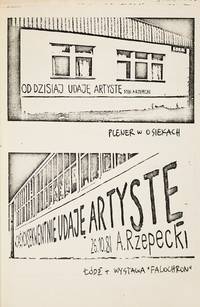
55152Kraków: self-published 1984. Octavo 20.5 × 14.5 cm. Original side-stapled black card wrappers; 4 leaves of text and illustrations to rectos only interleaved with two calques. Light wear to spine; else very good. An artist book by one of the founding members of Åódź Kaliska Adam Rzepecki with xerox reproduced photographs of the various messages he graffitied at outdoor art festivals in Poland in the early 1980s. Working under the slogan "I pretend to be an artist" Adam Rzepecki b. 1950 studied Art History at the Jagellonian University in Kraków his later artistic work continually referring to the history of art re-working tweaking and thereby commenting on artistic practice. In his student days Rzepecki created a series of photographs titled "Living Images" re-staging famous paintings from the history of art a signature practice of Lódź Kaliska the group he co-founded in 1979 after meeting Marek Janiak a year earlier at the PoznaÅ„ art festival. Their banner "Temple of embarrassing art" stretched over the festival grounds at Osieki 81 would be the first direct attack on the Polish neo-avant-garde and signaled the arrival of neo-Dada. The present book contains images of his 1981 Osieki graffiti "I pretend to be an artist" and "With difficulty however consistently I pretend to be an artist" from an exhibition in Åódź. <br /> <br /> No. 9 of 11 numbered copies. Creating a limited edition and signing the item was part of Rzepecki joke on the circulation of art.<br /> <br /> As of May 2025 not in KVK OCLC. unknown
Die einzige bedeutende Veröffentlichung über die Münchener Künstlerfamilie Adam. Von größter Seltenheit.
187723337New York: Virtue & Yorston 1877. First edition. Hardcover. fair. Quarto. 3 vols. complete. VI 446 405 CCXCpp. Original red buckram with title vignettes laid on spines. Colored frontispiece in each volume. Numerous steel engraved plates some being colored. Hundreds of b/w illustrations in text. Popular account of the structure habits and classification of the various departments of the animal kingdom quadrupeds birds reptiles fishes shells and insects including the insects destructive to agriculture. Bindings rubbed and soiled. Corners bumped and worn. Spines edges and title labels chipped and worn. Hinges starting. Small closed tears and chipping on edges of few pages. Sections of pages detached from book block on volume I and II but present. Text in English. Overall binding in poor interior in good condition. Virtue & Yorston hardcover
1791286London: A. Strahan and T. Cadell 1791. First edition. 1/2 near contemporary calf. Very Good. <p>VERY RARE. Reprinted numerous times throughout the late 1700s and into the 1800s this is the impressively hard to find first edition. WorldCat only identifies six institutions with a copy including the British Library. RareBookHub shows only later editions coming to a recorded auction including the scarce second edition but never the first edition.<br /> <br /> Condition: VG. Complete including errata leaf.<br /> <br /> Roman antiquities ; or an account of the manners and customs of the Romans; Respecting Their Government Magistracy Laws Judicial Proceedings Religion Games Military & Naval Affairs Dress Exercises Baths Marriages Divorces. Funerals Weights & Measures Coins Method of Writing Houses Gardens Agriculture Carriages Public Buildings &c. &c. Designed chiefly to illustrate the Latin classics. By Alexander Adam LL. D. Rector of the High School of Edinburgh<br /> <br /> </p> <br /> <p>BOOK INFO<br /> <br /> Published in 1791 by A. Strahan and T. Cadell in London. First edition. Bound in near contemporary 1/2 fine calf over finely woven cloth. Spine with gilt ruled compartments separated by raised bands; gilt-lettered spine label in compartment two. All edges marbled. Duodecimo 12mo 6 3/4" x 4 3/8". Collated and complete: xiii 1 594 2 pp.<br /> <br /> ABOUT THE AUTHOR<br /> <br /> Alexander Adam June 1741 – December 1809 was a Scottish teacher and writer on Roman antiquities. His popularity and his success as a teacher are strikingly illustrated by the great increase in the number of his pupils many of whom subsequently became distinguished men among them being Walter Scott Lord Brougham and Francis Jeffrey. Roman Antiquities is his best work which passed through a large number of editions and received the unusual compliment of a German translation.<br /> <br /> CONDITION REPORT<br /> <br /> The book is in Very Good antiquarian condition. Complete. Refreshed endpapers.<br /> <br /> Exterior and binding: Firmly bound with joint ends starting to crack. Slight loss of leather at head of spine. Rubbed edges wear and bumping to corners. Spine sunned dry and cracking a bit. Top edge darkened per usual.<br /> <br /> Interior: VG. Pages are mostly clean bright and lightly toned with some slightly darker toning in a few sections an infrequent spot of foxing on occasion or light sign of handling. The endpapers and blanks are a little toned and grubby and there are a previous owner's bookplate and a couple of inked previous owners' names. One leaf with some slight insect nibbling to fore-edge not affecting text. <br /> <br /> All in all a lovely collectible copy of an exceedingly rare first edition of an influential work on antiquarian Roman history and culture by a favorite teacher of Sir Walter Scott.</p> . A. Strahan, and T. Cadell unknown
178534376Dublin: W. W. Colles R. Montcrieffe G. Burnet Et Al. Near Fine with no dust jacket. 1785. Fourth Edition. Hardcover. 8vo 8" - 9" tall; 4894 59 pages; Rebound in rich full calf leather. Contents clean and bright with minor water stains at inner upper spine. Vol II of 2 4th edition but 2nd Dublin edition. Light owner name at top of title. Exceptional. . W. W. Colles, R. Montcrieffe, G. Burnet, Et Al. hardcover