Kulmus, Johann Adam =Biblio.com
386 résultats
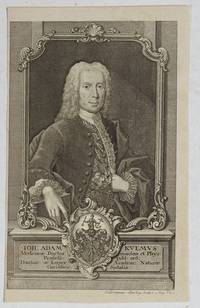
1741277431741. Hieronymus Sperling Sculps. Aug. Vind Leipzig bey Caspar Fritsch 1741 121 x 202 cm. Kulmus practised at Danzig and his Tabulae anatomicae were very popular and have been repeatedly reprinted and translated. The "Anatomische Tabellen" were even translated into Japanese after a Japanese physician named MAYENO had satisfied himself by a dissection of a Japanese woman Aocha-Baba that they presented the true anatomical relations and thus demonstrated that such anatomy as had been taught in Japan up to that time was absoltely false. cf. Hirsch-H. III 632; Choulant-Frank p.34. unknown
1740647551740. Kupferstich I.Wessel pinx 1740. Dantzig; J.Houbraken sculp. 1743. Amsterdamm 192x144 auf 10ßx133 mm. mm. Johann Adam Kulmus was born on Danzig in 1689 and studied medicine at Halle Strassburg and Basel. In 1725 he became a lecturer in medicine at the Gymnasium in Danzig where he died in 1745. His most noted work was the anatomical textbook Anatomischen Tabellen first published in Danzig 1722. The work was extremely popular and was translated into Latin French Dutch and eventually Japanese. Most of the illustrations are imitations of those in Philippe Verheyen's Corporis humani anatomia which are themselves heavily patterned after Vesalius. By 1770 Japan had been cut off from the rest of the world for well over a century with the exception of limited trade with the Netherlands and China. About that time a group of Japanese physicians led by Maeno Ryotaku 1733-1803 and Genpaku Sugita 1733-1817 undertook the study of Dutch medicine and in 1771 managed to obtain copies of the Dutch translation of Kulmus' anatomical work entitled Ontleedkundige tafelen published in Amsterdam in 1734. Taking the book with them to the dissection of an executed criminal's corpse they were enthralled by the accuracy of the Dutch work and decided to translate it into Japanese. After years of work which involved finding a new vocabulary in Japanese for many anatomical terms the work was published under the title Kaitai shinsho in Tokyo in 1774. Kaitai shinsho is considered to be the first Western book published in Japan in the Japanese language. It was also a large step in the development of European medicine in Japan mainly because it called into question the Chinese anatomical theories of Japan's kampo medicine. -cf. NLM unknown
17992080502106912477Not Available 1799. Soft Cover. Fine. The book is in fine condition. Not Available paperback
1755AQ20641London: Printed for C. Hitch and L. Hawes 1755. vi 1 118pp 2. With a final leaf of publisher's advertisements. Handsomely bound in ninetenth-century polished calf tooled in gilt and blind contrasting red morocco lettering-piece marbled edges. Lightly rubbed. Marbled endpapers internally clean and crisp. A choice copy of the second edition and first to appear with a London imprint of a set of 10 'lectures' on Christian teaching stressing the importance of personal devotion by Yorkshire-born English clergyman Thomas Adam 1701-1784. A popular reprinted throughout the eighteenth- and into the nineteenth-centuries especially in the provinces these lectures are said to have profoundly influenced the Liverpudlian evangelical divine William Romaine 1714-1795. As with the Lincoln printed first edition rare: ESTC records copies of this edition at two locations in the British Isles BL and Manchester and none elsewhere. ESTC T88403. Second edition. 12mo. Printed for C. Hitch and L. Hawes unknown
1750529781750. Jenae : Litteris Ritterianis 1750 4° 8 pp. Rückenbroschur. Erstdruck - Georgii Erhardi Hambergeri . programma inavgvrale de perversa valetvdinis cvra altervm dissertationi solenni . Caroli Adami Iannav de inflammationibvs febre acvta stipatis sive de febribvs inflammatoriis in genere praemissvm Hamberger Georg Erhard 1697-1755 Praes.; Jannau Karl Adam 1724-1760 Resp. Carl Adam Jannau "geb. zu Riga 1. Jan 1724. stud. 1745 bis 50 in Jena praktiz. 1750-60 in Riga wo er verstarb 7. Januar 1760. ." . J. Brennsohn: Die Ärzte Livlands. 1905. Enthält u.a. die Vita von Karl Adam Jannau. unknown
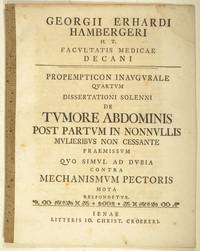
1746529801746. Jenae : Litteris Christ. Croeckeri 1746 4° 8 pp. Rückenbroschur. Erstdruck - Georgii Erhardi Hambergeri propempticon inaugurale . dissertationi . de tumore abdominis post partum in nonullis mulieribus non cessante praemissum quo simul ad dubia contra mechanismum pectoris mota respondentur Hamberger Georg Erhard 1697-1755 Praes.: Reichart Johann Adam 1711- Resp. Enthält u.a. die Vita von Johann Adam Reichart. unknown
178842376Londres, Pierre J. Duplain, 1788. 8vo, Two nice uniform contemporary full calf bindings with gilt spines. Some loss of leather to back hinge and lower capital of volume one and minor loos of leather to spine of volume two, all due to worming. Worming is not bad and does not affect anything but outer layer of small parts of the bindings. Apart from the worming a very nice, fresh and clean copy indeed. (8), IV, 503" (4), 496 pp. With both half-titles, the advertisment, both prefaces and the table of contents.
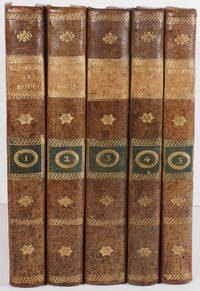
179210781792 Neuchatel, L. Fauche-Borel, 1792, 5 vol. in 12 de (2)-XII-(2)-384 pp. ; (4)-406 pp.; (4)-400 pp., (4)-437 pp., (4)-432 pp., rel. d'ép. demi-veau brun moucheté à coins, dos lisse orné de roulettes dorées, pièces de titre beiges, et tomaisons dans des écussons de maroquin vert, bel exemplaire.
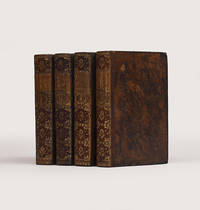
17867893Chez Poinçot 9,5 x 17 A Londres et Se Trouve à Paris, Chez Poinçot 1786 Six volumes in-12, reliure plein veau raciné de l'époque, dos lisse orné de quatre fleurs/grenades encadrées de palmettes et de filets dorés, pièces de titre de maroquin rouge, et de tomaison de maroquin vert, titre et tomaison dorés, tranches rouges, filets dorés sur les coupes, gardes à la coquille, [4]-VIII-298, [4]-266, [4]-292, [4]-239, [4]-310, [4]-368 pp. Le célèbre traité d'Adam Smith (1723-1790) avait paru en Angleterre en 1776. Notre exemplaire en est l'édition pirate, qui est la remise en vente, sous couvert d'une édition londonienne, de l'édition suisse d'Yverdon de 1781 en 6 volumes in-12. Cette dernière était la première traduction française de "La richesse des nations" publiée initialement, en feuilleton et sans nom de traducteur, dans le "Journal de l'agriculture, des arts et du commerce et des finances", en 1779 et 1780. Le traducteur en était en fait l'abbé Jean-Louis Blavet, qui était en relations avec Adam Smith pour avoir traduit sa "Théorie des sentiments moraux" (1774), par l'intermédiaire du salon anglophile de la marquise de Bouffers, maîtresse du prince de Conti, dont Blavet était le bibliothécaire. Le libraire Poinçot était établi à Versailles. Selon Robert Darnton (Editer et pirater, Gallimard, 2021), il était " coriace" en affaires et semblait jouer un rôle de "mouchard", tout en ayant des relations commerciales suivies avec la Société typographique de Neuchâtel (S.T.N.), dont l'habitude était de pirater les éditions françaises. (cf. Darnton, p. 442, note 22). Contrefaçon peu fréquente, notre exemplaire participe pleinement à l'histoire de la diffusion en France de "La richesse des nations" au XVIIIe siècle.. Agréable reliure, petit manque au bas du plat supérieur du tome 3, quelques très légères épidermures, partie inférieure de la page de titre du tome 6 absente, galerie de vers en queue du tome 4. Très bon exemplaire. (Bbis6)PHOTOS NUMERIQUES DISPONIBLES PAR EMAIL SUR SIMPLE DEMANDE-DIGITAL PHOTOGRAPS MAY BE AVAILABLE ON REQUEST.
17867893Chez Poinçot 9,5 x 17 A Londres et Se Trouve à Paris, Chez Poinçot 1786 Six volumes in-12, reliure plein veau raciné de l'époque, dos lisse orné de quatre fleurs/grenades encadrées de palmettes et de filets dorés, pièces de titre de maroquin rouge, et de tomaison de maroquin vert, titre et tomaison dorés, tranches rouges, filets dorés sur les coupes, gardes à la coquille, [4]-VIII-298, [4]-266, [4]-292, [4]-239, [4]-310, [4]-368 pp. Le célèbre traité d'Adam Smith (1723-1790) avait paru en Angleterre en 1776. Notre exemplaire en est l'édition pirate, qui est la remise en vente, sous couvert d'une édition londonienne, de l'édition suisse d'Yverdon de 1781 en 6 volumes in-12. Cette dernière était la première traduction française de "La richesse des nations" publiée initialement, en feuilleton et sans nom de traducteur, dans le "Journal de l'agriculture, des arts et du commerce et des finances", en 1779 et 1780. Le traducteur en était en fait l'abbé Jean-Louis Blavet, qui était en relations avec Adam Smith pour avoir traduit sa "Théorie des sentiments moraux" (1774), par l'intermédiaire du salon anglophile de la marquise de Bouffers, maîtresse du prince de Conti, dont Blavet était le bibliothécaire. Le libraire Poinçot était établi à Versailles. Selon Robert Darnton (Editer et pirater, Gallimard, 2021), il était " coriace" en affaires et semblait jouer un rôle de "mouchard", tout en ayant des relations commerciales suivies avec la Société typographique de Neuchâtel (S.T.N.), dont l'habitude était de pirater les éditions françaises. (cf. Darnton, p. 442, note 22). Contrefaçon peu fréquente, notre exemplaire participe pleinement à l'histoire de la diffusion en France de "La richesse des nations" au XVIIIe siècle.. Agréable reliure, petit manque au bas du plat supérieur du tome 3, quelques très légères épidermures, partie inférieure de la page de titre du tome 6 absente, galerie de vers en queue du tome 4. Très bon exemplaire. (Bbis6)PHOTOS NUMERIQUES DISPONIBLES PAR EMAIL SUR SIMPLE DEMANDE-DIGITAL PHOTOGRAPS MAY BE AVAILABLE ON REQUEST.
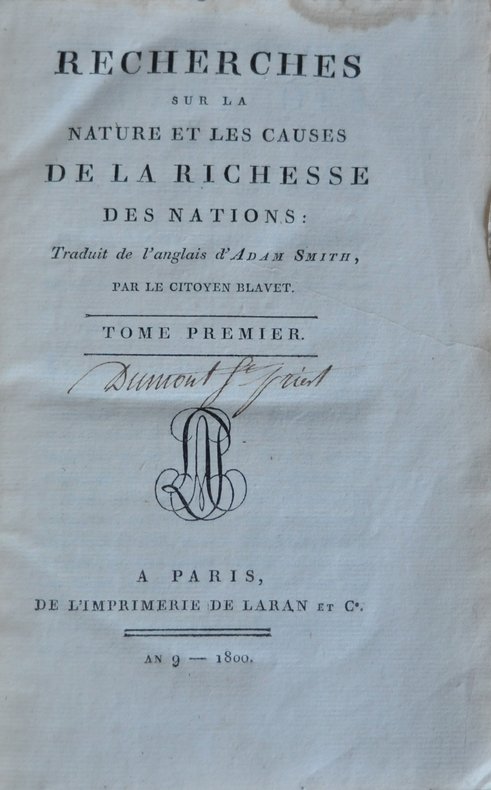
180046405353Paris, Impr. de Laran et Cie, 1800-1801 ; 4 vol. in-8, veau granit brun, encadr. guirl. dor., dos ornés de caissons, fleurons et rosaces dor., tr. marbr. (Reliure de l’époque) 2 ff., 500 pp. - 2 ff., 521 pp. - 2 ff., 460 pp. - 2 ff., 436 pp.La traduction de Blavet avait d’abord paru par fragments dans le Journal d’Agriculture, des Arts et du Commerce d’Ameilhon, puis réimprimé à part à Yverdon en 6 vol., puis à Paris en 1788. Cette nouvelle édition, revue et corrigée est la seule reconnue par Blavet, et la seule à porter son nom.Exemplaire de François DUMONT-SAINT-PRIEST, magistrat et homme politique né à Eymoutiers (Haute-Vienne) en 1785, mort à Limoges en 1855. Il fut député de la Haute-Vienne en 1830-31 en soutenant la monarchie de Juillet, puis procureur général de Limoges et conseiller général du canton d’Eymoutiers de 1833 à 1855. Sa SIGNATURE AUTOGRAPHE figure sur les 4 pages de titre. Mouillures sur les marges supérieures de 3 vol.
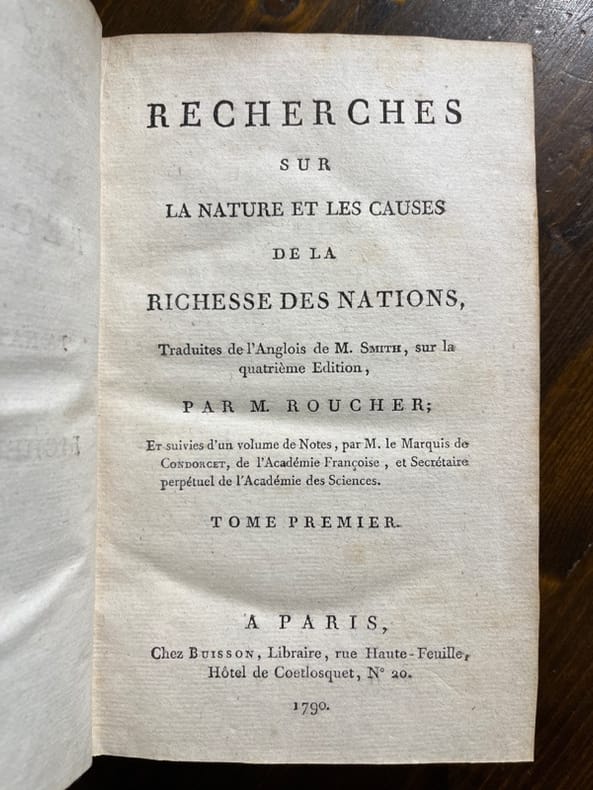
179020118Paris, chez Buisson, 1790. 4 volumes in-8 XI-[1]-570; [4]-312; [4]-602 et [4]-591 pages, demi-chagrin vert à grains longs, à coins, dos lisses ornés de filets dorés, pièce de titre et tomaison fauve (et ovale pour ces dernières), tranches jaunes.
179250300<p>This 1792 Neuchatel edition of Adam Smith's "Recherches sur la Nature et les Causes de la Richesse des Nations" is an early French translation by Jean-Antoine Roucher a poet and political writer associated with Enlightenment thought who later died during the French Revolution. Issued in five volumes this edition contributed to the spread of Smith's economic ideas across continental Europe. It is noted that the volume containing Condorcet's commentary was likely never published adding bibliographic interest. The work examines labor trade and national wealth and remains a landmark in economic literature. Near Fine. Full leather bindings remain tight and secure with gilt retained on the spines pages clean and free of tears or stains and corners showing minimal wear. 12mo 5 volumes. Collation: each volume separately paged. Illustrations: none stated. Edition: French edition 1792. References: PMM 221; Goldsmith 14106. Item Number SKU: 50300. PHOTOS AVAILABLE UPON REQUEST.</p> Jean-Antoine Roucher hardcover
1792018054Neuchatel Hambourg Leipzig: Fauche-Borel 1792. Cinque volumi in 8° piccolo di 4-XII-384pp.; 4-406pp.; 4-400pp; 4-437pp; 4-432pp. Il primo volume ha un faux-titre non gli altri. Legatura in mezza pelle marrone dei primi dell800. Seconda edizione della traduzione di Jean Antoine Roucher 1745-1794 poeta e letterato che aderì alla Rivoluzione ma venne ghigliottinato durante il Secondo Terrore dopo essere stato in cella con André Chenier. Jammes Cat2001: "Deuxième édition peu connue". Fauche-Borel unknown
1788018056Paris Londres: Duplain 1788. Due volumi in 8° di 4-IV-503pp-4; e 4-496pp. Bella legatura coeva in piena pelle del tempo dorso liscio ornato e dorato. Bell'esemplare di questa traduzione che contribuì non poco alla diffusione delle idee di Smith in Francia. La traduzione è di Jean-Louis Blavet anche se a lungo circolò la voce che in realtà fosse di Morellet che stava in effetti pensando in quello stesso tempo di procedere ad una sua versione. "The Blavet's version appeared at Yverdon in 1781 in 6 volumes 12mo and at Paris in the same year in 3 volumes 12mo and again at London and Paris in 1788 in 2 volumes 8vo the present edition. He had no intention of publishing it until his friend M. Ameilhon happened to complain of scarcity of interesting articles for his Journal de l'Agriculture du Commerce des Arts et des Finances which had just come under the control of the Mercantilist. It struck him that he might offer it to him which he did with the explanation that it was far from perfect. It was accepted and appeared in the issues of the Journal between January 1779 and December 1780. He did not anticipate that it would go further. The edition of 1788 likewise appeared without his knowledge or consent and was still more marred by errors than that of Yverdon". Lai Cheng-chung. Adam Smith Across Nations. Duplain unknown
1790018055Paris: Buisson 1790-91. Quattro volumi in 8° di XI-570pp; 4-312pp; 4-602pp; 4-591pp. Legatura in piena pelle del tempo cornice dorata ai piatti; dorso liscio ornato. Mancanza al piatto del vol I; spellature e mancanze a piatti angoli e cuffia al vol II; spellature e mancanze ai piatti cerniera spaccata al vol. III; spellature e mancanze ai piatti al vol IV. Prima edizione di questa traduzione del Roucher la terza in lingua francese. Il titolo annuncia suivi d'un volume de Notes par M. le Marquis de Condorcet ma queste note non furono mai stampate. Einaudi 5338. Buisson unknown
17958592a<p>Smith's Wealth of Nations had first appeared in French in 1778-9 in an anonymous translation followed by a second by Jean-Louis Blavet in 1781. Roucher's translation first appeared in four volumes in 1790-1. Jean-Antoine Roucher 1745–94 was a poet from Montpellier friend and admirer of J.-J. Rousseau. He welcomed the Revolution but was arrested in the Terror and went to the guillotine.</p><p>Rochedieu 304; Goldsmiths 14106; Kress B 1986. K. E. Carpenter The Dissemination of The Wealth of Nations in French and in France New York 2002 pp. 85-87.</p><p>5 vols 8vo 195 × 110 mm pp. 6 vi 438; 4 494; 4 624 4 411 1; 4 370 one leaf of index in final vol pp. 211-2 bound out of order complete with half-titles the first with printed facsimile of Buisson's signature. Very occasional paper flaws with very minor losses of a few letters here and there. Contemporary quarter sprinkled sheep spines gilt with tan and green labels. A very good set.</p> Buisson ... An 3e [
1778184198A La Haye though Zweibrücken: no publisher stated though the ducal French press of Deux-Ponts 1778-79. The first foreign-language appearance of a milestone in economics Very rare first edition in French of the Wealth of Nations the first translation following its publication in English in 1776. "This translation of the 1776 English edition of WN has remained a mystery. Was it printed in The Hague If not where was it printed Who was M identified on the title pages as the translator Copies are rare within French libraries" Carpenter p. 20. Carpenter & Sabbagh's recent scholarship identifies the printer as the ducal press of Deux-Ponts now Zweibrücken. Though a commercial venture the press used a fictitious imprint to avoid problems when printing French-language works that risked running afoul of the censor. The translator was Jean-Louis Carra 1742-1793 an active contributor to the Encyclopédie d'Yverdon later in the French Revolution to join the Jacobins where he was appointed joint head of the Bibliothèque nationale but clashed with Robespierre and was guillotined in 1793. The text follows the original closely omitting a section on religious instruction alongside other minor religious changes. The edition was preceded in French translation only by an extract Fragment sur les colonies en général et sur celles des anglois en particulier translated by Reverdil which had been published in Lausanne and Basel earlier in 1778 to test public demand for the work. 4 vols duodecimo in 4s and 8s 162 x 95 mm collates complete with half-titles and blank "table des matieres" bound following title pages rather than at rear. Contemporary calf twin brown and green labels smooth spines with gilt floral decoration marbled endpapers red edges. Contemporary ownership signature of Mats Zachrisson to front free endpaper. Light rubbing and insect abrasion with some loss to lettering on labels bindings otherwise with little wear and without repair staining to Vol. IV and a few leaves in Vol. I else fresh. A very good copy. Goldsmiths' 11664; Kress B155; Tribe 16; Vanderblue 24. Kenneth E. Carpenter The Dissemination of the Wealth of Nations in French and in France 2002; Kenneth Carpenter & Gabriel Sabbagh "Unveiling the First French Translation of Adam Smith's Wealth of Nations" in Oeconomia vol. 14 no. 1 2024. unknown
1781159019Yverdon: De Felice 1781. An attractive set Second edition in book form of Blavet's translation of The Wealth of Nations the earliest obtainable. Jean-Louis Blavet 1719-c.1809 was librarian for the prince du Conti; he had already published a translation of The Theory of Moral Sentiments in 1774-75. Blavet later claimed that Smith personally requested he translate The Wealth of Nations and sent him a copy. Blavet's translation was first published periodically in the Journal de l'agriculture from February 1779 to December 1780 and in book form in Paris earlier in 1781 in an edition of only 20 copies offprinted from the Journal de l'agriculture appearance. Only two copies of that edition are now known Carpenter p. 33. This edition was printed in Switzerland and apparently distributed largely outside France. Blavet claimed to not have been involved but "evidence suggests otherwise" ibid. p. 36. The Wealth of Nations was first published in French in 1778-79 by an unknown translator; Carpenter notes it as full of errors. Blavet's translation marks the second appearance in the language. 6 vols duodecimo 161 x 95 mm. Contemporary mottled calf twin orange and green spine labels marbled endpapers red edges. Contemporary annotation to vol. V p. 240. Slight wear at extremities slight worming to spines still a very attractive set contents clean. Tribe 24. Kenneth E. Carpenter The Dissemination of the Wealth of Nations in French and in France 1776-1843 2002. unknown
178842376Londres Pierre J. Duplain 1788. 8vo Two nice uniform contemporary full calf bindings with gilt spines. Some loss of leather to back hinge and lower capital of volume one and minor loos of leather to spine of volume two all due to worming. Worming is not bad and does not affect anything but outer layer of small parts of the bindings. Apart from the worming a very nice fresh and clean copy indeed. 8 IV 503; 4 496 pp. With both half-titles the advertisment both prefaces and the table of contents. <br/><br/><em>Rare early French translation of Adam Smith's political and economic classic the "Wealth of Nations". Translated by Blavet. The present edition constitutes the third reprint of the second French translation. The second French translation was done by Blavet and is the first translation into French of which the translator and publisher are known. "The reprint of Blavet's version appeared at Yverdon in 1781 in 6 volumes 12mo and at Paris in the same year in 3 volumes 12mo and again at London and Paris in 1788 in 2 volumes 8vo the present edition and revised and corrected with Blavet's name as translator at Paris An ix 1800-01 in 4 volumes 8vo.He Blavet had no intention of publishing it until his friend M. Ameilhon happened to complain of scarcity of interesting articles for his Journal de l'Agriculture du Commerce des Arts et des Finances which had just come under the control of the Mercantilist. It struck him that he might offer it to him which he did with the explanation that it was far from perfect. It was accepted and appeared in the issues of the Journal between January 1779 and December 1780. He did not anticipate that it would go further. The edition of 1788 likewise appeared without his knowledge or consent and was still more marred by errors than that of Yverdon". Lai Cheng-chung. Adam Smith Across Nations: Translations and Receptions of The Wealth of Nations Clarendon Press UK 2000. Hailed as the "first and greatest classic of modern thought" PMM 221 Adam Smith's tremendously influential main work has had a profound impact on thought and politics and is considered the main foundation of the era of liberal free trade that dominated the nineteenth century. Adam Smith 1723-1790 is considered the founder of Political Economy in Britain mainly due to his groundbreaking work the "Wealth of Nations" from 1776. The work took him 12 years to write and was probably in contemplation 12 years before that. It was originally published in two volumes in 4to and was published later the same year in Dublin in three volumes in 8vo. The book sold well and the first edition the number of which is unknown sold out within six months which came as a surprise to the publisher and probably also to Smith himself partly because the work "requires much thought and reflection qualities that do not abound among modern readers to peruse to any purpose." Letter from David Hume In: Rae Life of Adam Smith 1895 p. 286 partly because it was hardly reviewed or noticed by magazines or annuals. In spite of this it did evoke immense interest in the learned and the political world and Buckle's words that the work is "in its ultimate results probably the most important book that has ever been written" and that it has "done more towards the happiness of man than has been effected by the united abilities of all the statesmen and legislators of whom history has preserved an authentic account" History of Civilisation 1869 I:214 well describes the opinion of a great part of important thinkers then as well as now. Considering the groundbreaking views presented in "Wealth of Nations" it comes as no surprise that the work was considered part of the revolutionary cultural development in France. As Adam Smith's friend the Marquis of Lansdowne said after quoting Smith's work: "With respect to French principles as they had been denominated those principles had been exported from us to France and could not be said to have originated among the population of the latter country." Quoted in: Rae p. 291. The ideas of Adam Smith were often considered so dangerously closely connected with French ideas at the time that the term "political economy" almost became synonymous with questions concerning the constitution of governments. "The French Revolution seems to have checked for a time the growing vogue of Smith's book and the advance of his principles in this country just as it checked the progress of parliamentary and social reform because it filled men's mind with a fear of change with a suspicion of all novelty with an unreasoning dislike of anything in the nature of general principle." Rae p. 293. There can be no question that this seminal work greatly influenced French opinion at the time. </em> hardcover
174827496B1748. Prague: Franciscus Carolus Hladky. 1748. 16cm x 10cm. 12 415 2 p. Zeitgenössisches Leder auf Bünden. Leder etwas berieben und beschabt kleine Fehlstelle unteres Kapital bestoßen und mit etwas Materialverlust. Vorsätze stärker sonst nur leicht gebräunt. Zeitgenössische Notizen auf Vorsatz und Vorwort-Titel. Insgesamt guter Zustand. / Contemporary calf with raised bands. Calf with some rubbing and partly with minimal worming. Inside slightly foxed contemporary handwritten markings to end-papers and to title of preface. Overall stable and still in good condition. Seltenes Buch in lateinisches Sprache mit 2 Stichen: 1 ganzseitiges Kupfer eines Wappen und eine halbseitige Schlußvignette auf S. 2 / Rare book of 1748 with two engravings. Text in Latin. hardcover
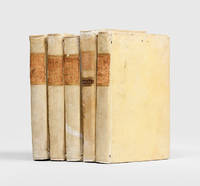
1790189815Naples: Giuseppe Policarpo Merande 1790-91. Adam Smith in the birthplace of political economy First edition in Italian of the Wealth of Nations among the scarcest of the 18th-century translations. Barring certain insubstantial references in journals "Smith's ideas did not reach Italy until 1790" Gioli p. 153. The translation was a quintessential product of the Neapolitan Enlightenment which had seen the development of political economy itself by Galiani and Genovesi in the 1750s. According to the preface the anonymous translator had corresponded with Smith and had received advice as to his translation. The edition takes its wider lead from Blavet's French translation which appeared from 1779 to 1780 while adapting various phrases and concepts to an Italian context. The second edition in Italian was not published until 1851. 5 vols octavo 173 x 114 mm. Complete with all half-titles and index leaves; vols. I III and V lacking rear free endpaper final leaf of vol. II fixed as rear pastedown. Contemporary vellum spines with orange calf label vol. IV with additional brown calf label edges sprinkled blue and red. Light soiling slight foxing and damp staining to contents paper flaw to leaf E2 of vol. III touching several words: a very good copy. Einaudi 5343; Goldsmiths' 14107; Kress B.1987; Tribe 39; Vanderblue p. 29 but lacking the fifth volume. Gabriella Gioli "The Knowledge of Adam Smith's Wealth of Nations in Italy in the Eighteenth Century shortened and translated by the author" in Cheng-chung Lai ed. Adam Smith Across Nations: Translations and Receptions of The Wealth of Nations 2000. hardcover
179735232Edinburgh: A. Strahan and T. Cadell. Very Good with no dust jacket. 1797. Fourth Edition. Hardcover. Full leather binding with innner denteles. Provenance-armorial bookplate John Martin Cripps ad collectore's J W Marsden. ". A guide to Roman government and culture with continuous references to classical literature. ." Contents unusually clean and bright. "Explaingin words and phrases from rites and customs. Government Magistacy Military Dress Exercises Gardens etc etc." 5.75" x 8.75". Marbled eps with matching text block edges. Nice copy. . A. Strahan and T. Cadell. hardcover
1797013285Edinbugh: A. Strahan and T. Cadell 1797 Edinburgh: Strahan and Cadell 1797. Fourth edition with improvements. Full-leather binding. 8vo. 616 pp. including index. Alexander Adam was the noted rector of the High School at Edinburgh Royal High School that educated Henry Lord Brougham the Lord Chancellor of England and many other notables of the Scottish Renaissance. Edinburgh High School which brought together students from all social classes is one of the bright spots of early educational institutions. It became the model for the first public school in the United States - Boston Latin School. This was a textbook of Adam's own devising written in English a guide to Roman government and culture with continuous references to classical literature. It caused some controversy when first published but with the support of Principal Robertson of Edinburgh University it was adopted by the High School. Laid paper no foxing. Second free front endpaper clipped likely to remove previous owner name. Rebacked with leather spine and spine label. Very good. A. Strahan and T. Cadell hardcover
1791286London: A. Strahan and T. Cadell 1791. First edition. 1/2 near contemporary calf. Very Good. <p>VERY RARE. Reprinted numerous times throughout the late 1700s and into the 1800s this is the impressively hard to find first edition. WorldCat only identifies six institutions with a copy including the British Library. RareBookHub shows only later editions coming to a recorded auction including the scarce second edition but never the first edition.<br /> <br /> Condition: VG. Complete including errata leaf.<br /> <br /> Roman antiquities ; or an account of the manners and customs of the Romans; Respecting Their Government Magistracy Laws Judicial Proceedings Religion Games Military & Naval Affairs Dress Exercises Baths Marriages Divorces. Funerals Weights & Measures Coins Method of Writing Houses Gardens Agriculture Carriages Public Buildings &c. &c. Designed chiefly to illustrate the Latin classics. By Alexander Adam LL. D. Rector of the High School of Edinburgh<br /> <br /> </p> <br /> <p>BOOK INFO<br /> <br /> Published in 1791 by A. Strahan and T. Cadell in London. First edition. Bound in near contemporary 1/2 fine calf over finely woven cloth. Spine with gilt ruled compartments separated by raised bands; gilt-lettered spine label in compartment two. All edges marbled. Duodecimo 12mo 6 3/4" x 4 3/8". Collated and complete: xiii 1 594 2 pp.<br /> <br /> ABOUT THE AUTHOR<br /> <br /> Alexander Adam June 1741 – December 1809 was a Scottish teacher and writer on Roman antiquities. His popularity and his success as a teacher are strikingly illustrated by the great increase in the number of his pupils many of whom subsequently became distinguished men among them being Walter Scott Lord Brougham and Francis Jeffrey. Roman Antiquities is his best work which passed through a large number of editions and received the unusual compliment of a German translation.<br /> <br /> CONDITION REPORT<br /> <br /> The book is in Very Good antiquarian condition. Complete. Refreshed endpapers.<br /> <br /> Exterior and binding: Firmly bound with joint ends starting to crack. Slight loss of leather at head of spine. Rubbed edges wear and bumping to corners. Spine sunned dry and cracking a bit. Top edge darkened per usual.<br /> <br /> Interior: VG. Pages are mostly clean bright and lightly toned with some slightly darker toning in a few sections an infrequent spot of foxing on occasion or light sign of handling. The endpapers and blanks are a little toned and grubby and there are a previous owner's bookplate and a couple of inked previous owners' names. One leaf with some slight insect nibbling to fore-edge not affecting text. <br /> <br /> All in all a lovely collectible copy of an exceedingly rare first edition of an influential work on antiquarian Roman history and culture by a favorite teacher of Sir Walter Scott.</p> . A. Strahan, and T. Cadell unknown