ADAM FITZ-ADAMLivre Rare Book
386 résultats
1782RO80096141DODSLEY J.. 1782. In-12. Relié plein cuir. Bon état, Couv. convenable, Dos satisfaisant, Intérieur acceptable. 338 pages. Relié plein basane. Pièces de titre. Titre, tomaison et roulettes dorés sur le dos lisse. Ouvrage en anglais. Quelques épidermures sur les plats et le dos.. . . . Classification Dewey : 420-Langue anglaise. Anglo-saxon
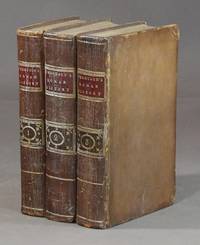
1783100134605Printed for Moffin Paice Whittetone Collis Moncrieffe Jerkin Walker Esshaw Beatty White Burton Ryrie Caine and Sleator 1783 in8. 1783. Relié. 3 volume(s).
1791015762London: Printed for John Stockdale Piccadilly. 1791. Hardcover. Very Good. Volume I only. Full leather with gilt title on spine; gilt ruled borders; dentelle. Spine scuffed; corners lightly worn. Starting crack to inner front hinge. Marbled endpapers. Armorial bookplate on front pastedown. Interior is clean with some occasional light foxing. pp. 2 3-271. A volume of letters by Anne Berkeley c. 1707-1786 wife of philosopher Bishop Berkeley George Berkeley addressed to Adam Gordon c. 1745-1817. The matter includes her arguments against the free-thinkers who here husband also attacked and references Shaftesbury Hume Voltaire Bolingbroke and Rousseau. In addition to addressing various theological and philosophical matters Anne largely waxes upon the importance of Christian education and morality. According to the Berkeley scholar Stefan Gordon Storrie Anne's correspondence here started around 1764 when Anne was approaching her sixties and Adam Gorden was still a young man. Volume I is divided into two parts: a the Preface by the editor Rev. Adam Gordon Rector of Hinxworth which is dated December 18 1790; and b 31 of the 41 letters by Anne Berkeley. For reference Volume II which is not offered included a the final ten letters by Anne b the ''Anniversary Addresses from a father to his son on his birthday'' by Adam Gordon and c ''Six letters to a Lady of Quality'' by the historian and Christian mystic Nathaniel Hooke. Printed for John Stockdale, Piccadilly. hardcover
1777c1907London: Printed for G. Kearsley; et al. G: in good condition. Cover rubbed and scuffed. Handwritten list of contents on pastedown with heraldic bookplate. Occasional notation within. Loss to two leaves impinging on text but content in overall good condition. 1777. First Editions and Reprints. Half-leather hardback with marbled boards. 260mm x 220mm 10" x 9". iv 24pp 16pp iv 38pp iii 23pp 22pp 68pp 42pp 38pp. Title page engraving for 'The Senators'. . 'a Very Satirical Copy of Verses Highly Reflecting on Mrs 's Poetical-Assembly at Bath-Easton'. An interesting selection of 18th century satire erotica and horticulture. Published 1772-7. . Printed for G. Kearsley; et al hardcover
1783100134605Printed for Moffin Paice Whittetone Collis Moncrieffe Jerkin Walker Esshaw Beatty White Burton Ryrie Caine and Sleator 1783. Bon état de conservation bords un peu frottés tranches ternies rousseurs aux abords des plats intérieurs intérieurs propre par ailleurs. in8. 1783. Relié. 3 volumes. Printed for Moffin Paice Whittetone Collis Moncrieffe Jerkin Walker Esshaw Beatty White Burton Ryrie Caine and Slea unknown
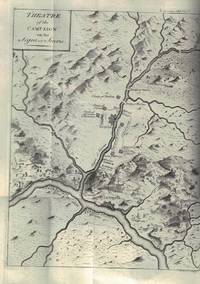
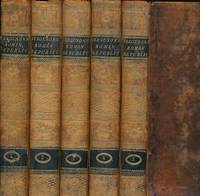
1799241669Bell & Bradfute 1799. Hardcover. Very Good. Five volumes small 8vo original or contemporary full calf red leather spines with gilt titles and devices six folding maps Very Good: rubbing at the corners spine ends and gutters; bindings tight and firm text blocks mildly toned with minimal offsetting. Bell & Bradfute hardcover
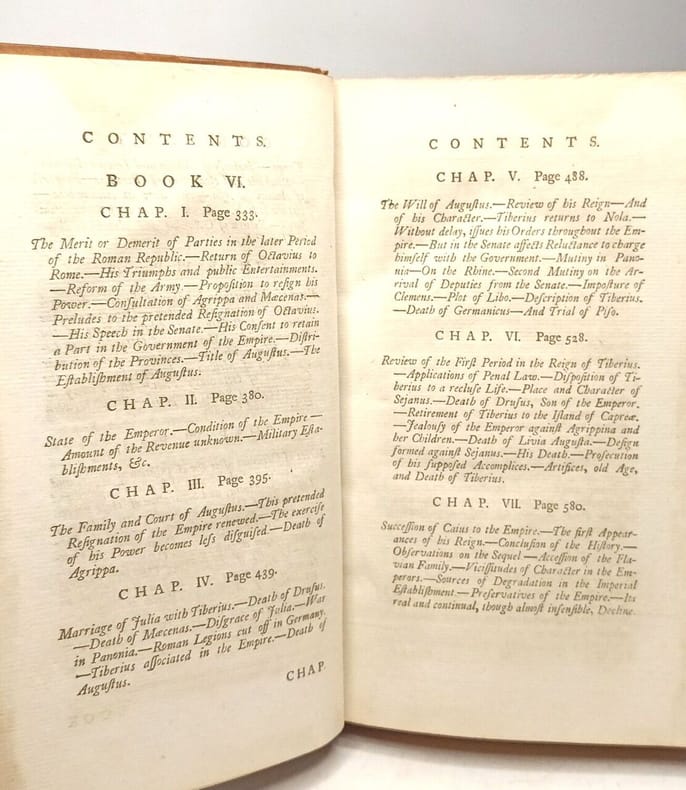
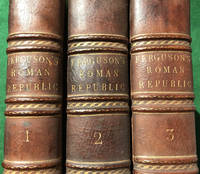
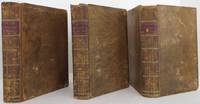
178358904<p>FINE COPY IN A CONTEMPORARY BINDING - PROBABLY BY HENRY WALTHER</p><p>first edition 3 vols. large 4to. 28.3 x 23.5 cms. 12 461 1 blank; 4 548; 8 574pp. 6 engraved maps 4 folding contemporary rich tan lightly-diced russia calf over thick boards gilt fillet border on sides spines panelled by double gilt bands highlighted by gilt fillets and with a twisted gilt roll between them one panel with a dark brown morocco title label and another direct gilt numbered deep turn-ins on the doublures decoratively gilt rolled board edges with a double gilt line and twining frond gilt roll marbled endpapers edges dyed yellow minor paper flaw in the lower marginal corner of vol. 3 L4 slight rubbing to joints and a circa 6 cm. crack at foot of joints of vol. I a few minor scuffs at spine ends else a remarkably well preserved and internally fresh copy.</p><p>Ferguson 1723-1816 Professor at Edinburgh first of Natural Philosophy and later of Moral Philosophy was a significant member of the important eighteenth century Scottish school of enlightenment philosophers. He was a friend of such as David Hume Adam Smith Dugald Stewart and Black.<br />Ferguson's 'An Essay on the History of Civil Society' 1767 established his "reputation as a British and a European historian with a Scottish edge. It enabled him to deal with questions which concerned Enlightenment thinkers throughout Europe: the nature of political society differences between nations reflecting temporal and geographical variations patterns of progress and decline types of government and the tension between the 'private' man involved in commerce and polite conversation and 'public' man the politically active citizen. It made its author famous throughout Europe" O.D.N.B.<br />His "'History of the Progress and Termination of the Roman Republic' narrating the rise and fall of the republic as a story of civic virtue and its corruption appeared in 1783 . It won praise from Edward Gibbon and went through two more English-language editions in 1799 and 1813. In the mid-nineteenth century it was still favourably mentioned by John Stuart Mill and reissued in the United States where Ferguson's spirited discussion of Rome's republican heyday appealed to two generations of readers. Two French translations appeared in Paris in 1784–91 and in 1803–10. A German translation appeared in Leipzig in 1784–6. . Although the fame of his Roman Republic was short-lived . it did more than any of Ferguson's books to determine its author's image as latter-day Roman a worthy if somewhat quaint lover of virtue and liberty in their classical republican sense. Contemporaries and posterity came to view him as a moralist of stout but old-fashioned Stoic convictions" O.D.N.B.<br />The binding is not signed but is certainly a contemporary English one probably the work of Henry Walther fl. 1775-1815 as it has his very characteristic double raised bands on the spines. Walther was one of the group of highly skilled emigré German binders' who worked in Britain at this period. He had in his earlier years in London worked for J. Baumgarten another member of that group before he set up there on his own as a high quality binder. In this binding the boards project about 7 to 8 mm. beyond the text block at the top and bottom to expose the gilt rolled tooling on the turn-ins. The double raised bands themselves are separated by 8 mm. are defined by a gilt fillet above and below the pair have a narrow gilt roll along their tops and have a twisted-pair gilt roll in the space between the two bands. The binding was probably intentionally designed to echo the spirit of its content - serious sombre magisterial and definitely not showy.</p> Printed for W. Strahan, T. Cadell ,,, and W. Creech in Edinburgh hardcover
1799r4450bcLondon: Bell & Bradfute; G G & J Robinson. G : in good condition without dust jacket. 1799. New edition. Brown hardback leather cover. 210mm x 140mm 8" x 6". vi 416pp maps. 3 fold-out maps. . Bell & Bradfute; G G & J Robinson hardcover
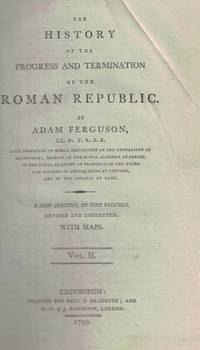
1799r4450bbLondon: Bell & Bradfute; G G & J Robinson. G : in good condition without dust jacket. 1799. Revised edition. Brown hardback leather cover. 210mm x 140mm 8" x 6". vii 449pp. . Bell & Bradfute; G G & J Robinson hardcover
1799r4450bLondon: Bell & Bradfute; G G & J Robinson. G : in good condition without dust jacket. 1799. Revised edition. Brown hardback leather cover. 210mm x 140mm 8" x 6". xxx 422pp; vii 449pp; vi 416pp; vi 451pp; vi 420pp maps. 6 b/w fold-out maps. Heraldic bookplate on front paste-downs. Heavy item - shipping supplement may apply for overseas. . Bell & Bradfute; G G & J Robinson hardcover
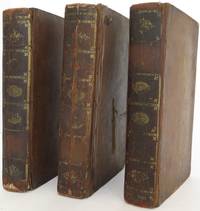
178328002Dublin: printed for Price Whitestone Colles et al. 1783. First Dublin edition 3 vols. 8vo pp. 10 492 2; 8 608; 8 600; first page of table of contents in vol. I misbound at the back; all else very good in contemporary full calf red and brown morocco labels on spines. This edition is printed the same year as the first London edition. printed for Price, Whitestone, Colles, [et al.] unknown
178328002Dublin: printed for Price Whitestone Colles et al. 1783. First Dublin edition 3 vols. 8vo pp. 10 492 2; 8 608; 8 600; first page of table of contents in vol. I misbound at the back; all else very good in contemporary full calf red and brown morocco labels on spines. This edition is printed the same year as the first London edition. <br/><br/> printed for Price, Whitestone, Colles, [et al.] unknown books
17889261Edinburgh; London; J. Dickinson and W. Creech; G. Robinson and T. Cadel. 1788. 1788. Hard Cover. FIRST EDITION. Octavo 2 vols. pp. 9 x-xxiii 1 527 1; vi 2 494. Engraved plate at p. 390 in vol.1. Bound in contemporary full speckled calf gilt fillets to spine red Morocco spine label with gilt rolls and gilt titles. Joits cracked but holding save for upper board to vol.1 which is held on by feps alone. Minor loss at spine tips and corners. Some light scattered foxing to half titles leaves are clean bright and tight and free of annotations or ownership inscriptions. Overall Very Good. ESTC: T36875 Edinburgh; London; J. Dickinson and W. Creech; G. Robinson and T. Cadel. 1788. hardcover
1788d022R.981GB: J. Dickson Etc 1788. Contemporary full leather. Spine with raised bands and gold on burgundy titel label. Half title 24 and 528 pages. NO PLATES. Fairly clean tight text in worn but sound covers. A few minor marsk etc. Book is in good double plus condition with noticeable signs of wear and/or age. . 1st Edition. Hardback. G/No DW. J. Dickson Etc Hardcover
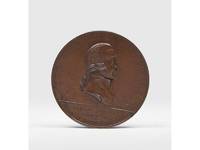
1797179182Scotland: Boog junior des. P. Kempson fecit 1797. A very good example of the one ounce Penny of Scotland commemorating Adam Smith. The portrait of Smith is after the Tassie medallion of 1787 which is described by John M. Gray as follows: 'The head which appears turned in pure profile to the right of the spectator shows a particularly full forehead a full nose slightly aquiline in its curve; a long thin upper lip and a lower lip that protudes a little; and a firm well-shaped chin and jaw. The eyebrow is strongly curved the upper eyelid heavy and drooping the eyeball particularly prominent; and beneath the lower eyelid the skin is loose and wrinkled. A wig is worn tied behind in a bag with ribbons showing small curls in front and two large curls at the side which cover and conceal the ear' quoted in Bonar A Catalogue of the library of Adam Smith 1932 p. xxi. The reverse of the penny entitled 'Wealth of Nations' depicts the various elements of commerce; in the foreground of a harbour scene are a plough and a spinning wheel along with other symbols of agriculture and industry in addition to which there are a wool-pack and a barrel standing on the quayside with two three-masted ships sailing out of the harbour. Penny token cast in bronze 35 mm in diameter with portrait of Adam Smith after Tassie on the obverse and scene entitled 'Wealth of Nations' depicting various elements of commerce on the reverse. Housed in a red leatherette velvet-lined case. In very good condition. Scott Adam Smith as Student and Professor 1937. Dalton and Hamer Fifeshire no. 1. hardcover
1767324743London: A Millar 1767. Third. hardcover. good/no dustjacket. 8vo. pp.478 half title page missing boards starting to detach A Millar hardcover
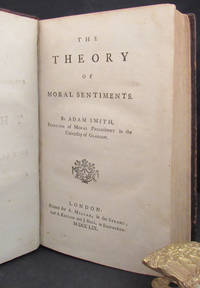
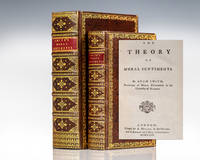
175931208London: Printed for A. Millar in the Strand and A. Kincaid and J. Bell in Edinburgh 1759 1759. First Edition. Thick 8vo 202 x 123 mm. bound in its original contemporary binding of full calf neatly and very sympathetically and skillfully restored at the back with the original spine panel laid down preserving all but ca. 2cm at the foot a nearly invisible sophistication the original morocco label replaced free endleaves renewed sympathetically with antique paper. xii 551 1 errata uncorrected in the text with an error: 412 should read 413; pp. 317-336 omitted from pagination as usual; complete with the half-title pp. A very handsome copy crisp and unpressed clean throughout the binding strong and in good order the occasional spot as to be expected but truly a pleasing copy of this monumental work. THE ESPECIALLY RARE FIRST EDITION IN ORIGINAL CONTEMPORARY BINDING OF ADAM SMITH'S FIRST BOOK PUBLISHED IN 1759. A TRULY RARE BOOK AND ONE OF THE MOST IMPORTANT WORKS IN ALL OF ENGLISH PHILOSOPHY. <br> 'THE THEORY OF MORAL SENTIMENTS was a true scientific breakthrough. It shows that our moral ideas and actions are a product of our very nature as social creatures. It argues that this social psychology is a better guide to moral action than is reason. It identifies the basic rules of prudence and justice that are needed for society to survive and explains the additional beneficent actions that enable it to flourish.<br> As individuals we have a natural tendency to look after ourselves. That is merely prudence. And yet as social creatures explains Smith we are also endowed with a natural sympathy – today we would say empathy – towards others. When we see others distressed or happy we feel for them – albeit less strongly. Likewise others seek our empathy and feel for us. When their feelings are particularly strong empathy prompts them to restrain their emotions so as to bring them into line with our less intense reactions. Gradually as we grow from childhood to adulthood we each learn what is and is not acceptable to other people. Morality stems from our social nature.<br> So does justice. Though we are self-interested we again have to work out how to live alongside others without doing them harm. That is an essential minimum for the survival of society. If people go further and do positive good – beneficence – we welcome it but cannot demand such action as we demand justice.<br>Virtue. Prudence justice and beneficence are important. However the ideal must be that any impartial person real or imaginary – what Smith calls an impartial spectator – would fully empathize with our emotions and actions. That requires self-command and in this lies true virtue.<br> Morality says Smith is not something we have to calculate. It is natural built into us as social beings. When we see people happy or sad we feel happy or sad too. We derive pleasure when people do things we approve of and distress when we believe they are doing harm.<br> Of course we do not feel others’ emotions as strongly as they do. And through our natural empathy with others we learn that an excess of anger or grief or other emotions distresses them. So we try to curb our emotions to bring them into line with those of others. In fact we aim to temper them to the point where any typical disinterested person – an impartial spectator says Smith – would empathise with us.<br> Likewise when we show concern for other people we know that an impartial spectator would approve and we take pleasure from it. The impartial spectator is only imaginary but still guides us: and through experience we gradually build up a system of behavioural rules – morality.<br> Punishments and rewards have an important social function. We approve and reward acts that benefit society and disapprove and punish acts that harm it. Nature has equipped us with appetites and aversions that promote the continued existence of our species and our society. It is almost as if an invisible hand were guiding what we do.<br> For society to survive there must be rules to present its individual members harming each other. As Smith comments it is possible for a society of robbers and murderers to exist – but only insofar as they abstain from robbing and murdering each other. These are the rules we call justice.<br> If people do not help others when they could or fail to return a good deed we may call them uncharitable or ungrateful. But we do not punish people to force them to do good: only for acts of real or intended harm. We force them only to obey the rules of justice because society could not otherwise survive.<br> But nature has given us something even more immediate than punishment namely our own self-criticism. We are impartial spectators not only of other people’s actions thanks to conscience. It is nature’s way of reminding us that other people are important too.<br> In the process of making such judgments on a countless number of actions we gradually formulate rules of conduct. We do not then have to think out each new situation afresh: we now have moral standards to guide us.<br> This constancy is beneficial to the social order. By following our conscience we end up surely but unintentionally promoting the happiness of mankind. Human laws with their punishments and rewards may aim at the same results; but they can never be as consistent immediate or effective as conscience and the rules of morality engineered by nature.<br> Smith ends THE THEORY OF MORAL SENTIMENTS by defining the character of a truly virtuous person. Such a person he suggests would embody the qualities of prudence justice beneficence and self-command.<br> Prudence moderates the individual’s excesses and as such is important for society. It is respectable if not endearing. Justice limits the harm we do to others. It is essential for the continuation of social life. Beneficence improves social life by prompting us to promote the happiness of others. It cannot be demanded from anyone but it is always appreciated. And self-command moderates our passions and reins in our destructive actions.<br> Freedom and nature Smith concludes are a surer guide to the creation of a harmonious functioning society than the supposed reason of philosophers and visionaries.' The Adam Smith Institute <br> The phrase that he is especially known for is first used here and would be repeated in THE WEALTH OF NATIONS: that the rich ".led by an invisible hand to make nearly the same distribution of the necessities of life which would have been made had the earth been divided into equal portions among all its inhabitants and thus without intending it without knowing it advance the interest of the society and afford means to the multiplication of the species." Part IV Section 1 pp. 350.<br> Both THE THEORY OF MORAL SENTIMENTS Adam Smith's first book and his later WEALTH OF NATIONS demonstrate "a great unifying principle.Smith's ethics and his economics are integrated by the same principle of self-command or self-reliance which manifests itself in economics in laissez faire" Spiegel.<br> "The fruit of his Glasgow years The Theory of Moral Sentiments would be enough to assure the author a respected place among Scottish moral philosophers and Smith himself ranked it above the Wealth of Nations. Its central idea is the concept closely related to conscience of the impartial spectator who helps man to distinguish right from wrong. For the same purpose Immanuel Kant invented the categorical imperative and Sigmund Freud the superego" Niehans 62 Printed for A. Millar, in the Strand and A. Kincaid and J. Bell, in Edinburgh, 1759 unknown
1759150275London: For A. Milar and A. Kincaid and J. Bell 1759. Rare first edition of Adam Smith's first book with a recorded “print run of 1000 copies†Sher “Editions of Adam’s Smith’s Books†13. Octavo bound in full calf gilt titles and tooling to the spine front and rear panels morocco spine label marbled endpapers. In near fine condition. Housed in a custom full calf clamshell box. Rare. Adam Smith's Theory of Moral Sentiments his first book is "one of the truly outstanding books in the intellectual history of the world" Amartya Sen. First published in 1759 it laid the foundation for Wealth of Nations and proposed the theory repeated in the later work: that self-seeking men are often "led by an invisible hand… without knowing it without intending it to advance the interest of the society." "The fruit of his Glasgow years… Moral Sentiments would be enough to assure the author a respected place among Scottish moral philosophers and Smith himself ranked it above the Wealth of Nations… Its central idea is the concept closely related to conscience of the impartial spectator who helps man to distinguish right from wrong. For the same purpose Immanuel Kant invented the categorical imperative and Sigmund Freud the superego" Niehans 62. Basing moral sentiment on "the power one man has of putting himself in the place of another" in contrast to Hume's idea of self-interest "Smith was henceforth recognized as one of the first authors of the day" DNB. With Moral Sentiments and Wealth of Nations Smith created "not merely a treatise on moral philosophy and a treatise on economics but a complete moral and political philosophy in which the two elements of history and theory were to be closely conjoined" Palgrave III:412-13. To Smith when man pursues "his own private interests the original and selfish sentiments of Moral Sentiments he will in the economic realm choose those endeavors which will best serve society. Herein lies the connection between the two great works which make them the work of a single and largely consistent theorist" Paul "Adam Smith" 293. In his Theory of Moral Sentiments Smith develops an ethics based on a “unifying principle—in this case of sympathy—which would shed light on the harmonious and beneficial order of the moral world. As such it was of considerable interest to Smith’s contemporaries who were groping for an ethics that would flow from man’s impulses or sentiments rather than from his reason from ‘innate ideas’ or from theological precepts. If Smith had written only The Theory of Moral Sentiments he would enjoy in the philosophers hall of fame a niche not unlike that reserved for Shaftesbury or Hutcheson.†Both Moral Sentiments and Wealth of Nations reflect Smith’s “attempt to anchor the new science of political economy in a Newtonian universe mechanical albeit harmonious and beneficial in which society is shown to benefit from the unintended consequences of the pursuit of individual self-interest. There is thus a considerable affinity between the structure of The Theory of Moral Sentiments and that of The Wealth of Nations. Each work is integrated by a great unifying principle. What sympathy accomplishes in the moral world self-interest does in the economic one. Either principle in its respective realm is shown to produce a harmony such as the one that characterizes Newton’s order of nature… Smith’s ethics is one of self-command or self-reliance just as is his laissez faire economics…. Smith’s ethics and his economics are integrated by the same principle of self-command or self-reliance which manifests itself in economics in laissez faire†Spiegel Growth of Economic Thought 229-231. For A. Milar, and A. Kincaid and J. Bell unknown
179234586London: A. Strahan T. Cadell and others 1792. 2 volumes 8vo. iii-xv 1 488; iii-viii 462pp. Lacks half-titles. Expertly bound to style in half russia and period marbled paper covered boards.<br/> <br/>Eighteenth century edition of Adam Smith's first published work.<br/> <br/>Adam Smith's first published work first printed in 1759 would lay the basis for The Wealth of Nations and establish his reputation as a philosopher of note.<br/> <br/>ESTC T121726; Alston III.829; Goldsmiths 15514. A. Strahan, T. Cadell [and others] unknown books
17912406110London: Printed for A. Strahan and T. Cadell 1791. 6th. hardcover. 6th edition as stated on title page 1791. One of 2000 sets published. All 3 books are in very good condition. Vol.1 has paper tape repair to front and rear gutters. All volumes have foxing soiling discoloration some water stains former owner's name on end papers or title page. Printed for A. Strahan and T. Cadell unknown
17912306072London: Strahan 1791. 6th edition. hardcover. Very good. A handsome three volume set of the 6th edition. One of only 2000 copies published. Spines repaired but appear to be the original covers. The greatest work in the history of economics. Recounts not just the concept of the "invisible hand" but redefined national wealth in terms of products labor and productivity instead of government stashes of gold. Identical To The Last Revision By Smith And The First Published After His Death in 1790. Strahan unknown
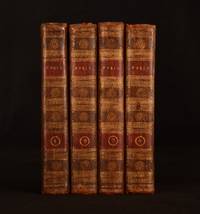
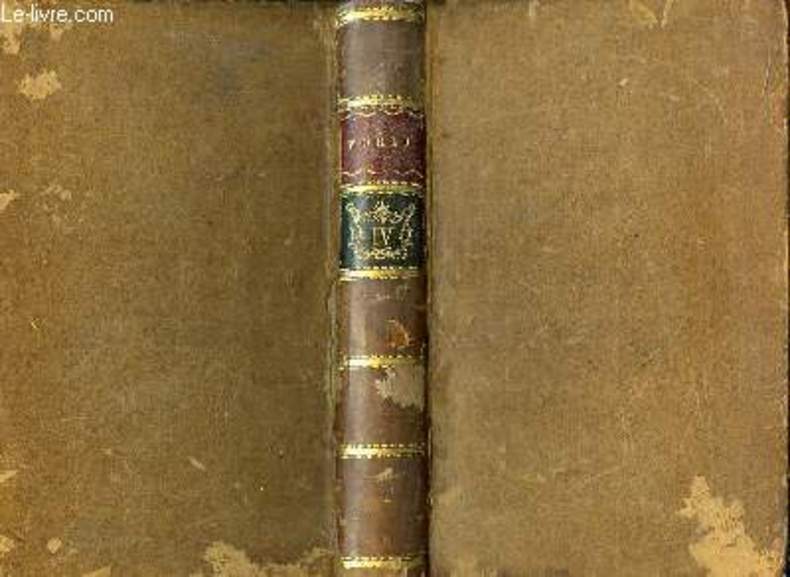
1794643P40London: P. Dodsley R. Owen 1794. Leather. Very Good. 7" by 4". None. A complete set of Edward Moore's fashionable satirical periodical 'The World'. Complete in four volumes.Each volume is bound with the half-title.A collection of the weekly newspaper 'The World' which was published from 1753 to 1756 with a total of two-hundred and nine publications.The newspaper saw contributions from people such as Horace Walpole E. S. Dallas Edward Lovibond and Charles Hanbury Williams. It was devoted to the satirising the follies and vices of the fashionable society of the eighteenth century.The publication typically saw a circulation that averaged from two to three thousand copies.Edited by Edward Moore under the pseudonym 'Adam Fitz-Adam'. He became the editor through the influence of Lord Lyttelton. Moore was a dramatist who wrote 'The Foundling' 'Gil Blas' 'Fables From the Female Sex' and more. In a full calf binding. Externally generally smart. A little loss to the head and tail of the spines. Minor bumping to the extremities. Rubbing to the rear board of Volume I. Front hinge of Volume I is starting but firm. Hinges of Volume IV are starting but firm. Volume IV is lacking the endpapers. Prior owner's ink inscription to the recto to the front free endpaper and to the verso to the rear endpaper of Volume I. Ink mark to the rear pastedown of Volumes II and IV. Internally firmly bound. Pages are very lightly age-toned with the occasional mark. Very Good P. Dodsley, R. Owen hardcover
1772122749J. Dodsley 1772. New Edition. Full Leather. Acceptable. Slight rubbing but a handsome set. Rear cover to vol. 4 detached but present. J. Dodsley hardcover
1755125050Dodsley 1755-1757. Good. 6 vols. Original leather. Some chipping to some of the heads and heels of spines. Front boards to vols. 1 and 6 detached but present.Handsome bookplates from Dauntesey Agecroft Hall seem to be contemporary with books. Dodsley hardcover