Antiquariat.de

929 résultats
2008207906Meitingen, Kyrios-Verlag 1954-2008. 8°, sauber und fachmännisch eingebunden in Bibliotheks-Leinen / -Halbleinen,
492-Eo.J. Bleistift, auf grautonigem Papier, rechts unten monogrammiert und datiert ?825 GF (ligiert)?, unter der Darstellung bezeichnet ?Entwurf zum ersten Altarbild für einen Grafen Erdödi in Ungarn?. 22,8:18 cm. Literatur: Thieme/Becker, Bd. XII, S. 77. In dem eigenhändigen Werkverzeichnis wird das Altarbild ?St. Georg? an erster Stelle aufgeführt.
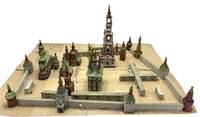
18601753Sergiyev Posad. c.1860-1900. A set of 40 hand-carved and painted wooden buildings forming a toy model of the Trinity Lavra of St. Sergius the tallest piece measuring 26cm in height with the original block-printed guide sheet showing how the pieces should be laid out also showing walkways 63.5 x 48.5cm. The set is apparently lacking four wall sections and several smaller pieces however the numbering system is somewhat hard to discern with the ink numbers on the bases of the pieces often obscured and the numbering on the guide sheet being slightly erratic/mismatched to the pieces so it is difficult to be certain. It is however also possible to arrange the set in a slightly more compact manner in order to complete the walls as the example sold at Christies mentioned below was presented which also appeared to lack a couple of wall sections and other pieces and where the pieces were fixed in place to a board with the guide sheet lacking. There are some small losses and repairs to several of the pieces but broadly the set is in good condition; the guide sheet is very fragile and has several holes two affecting the printed plan and some splitting along the folds but remains a remarkable survival. A very charming vibrantly hand-painted late nineteenth-century toy model of the Trinity Monastery of St. Sergii the most important monastery in Russia and the spiritual centre of the Russian Orthodox Church.</p><p>The monastery was founded in 1337 by Sergius of Radonezh later one of the most venerated Russian saints and a spiritual patron of the nation. Its first stone cathedral was built in 1422 by a group of refugee Serbian monks which decorated with frescoes painted by the greatest icon painters of medieval Russia Andrei Rublev and Daniil Chyorny came to serve as the place of baptism for Muscovite royals. In 1476 Ivan III commissioned the church of the Holy Spirit now one of the few remaining examples of a Russian church topped with a belltower and in 1559 Ivan the Terrible ordered the construction of the six-pillared Assumption Cathedral ultimately completed after twenty-six years. During the sixteenth century the monastery grew into one of the wealthiest landowners in Russia. It was also a notable centre of chronicle-writing and icon painting and housed an eminent library of manuscripts and books. Its stone walls were constructed in the 1550s helping it to withstand the famous sixteen-month Polish-Lithuanian siege of 1608-1610. Throughout the seventeenth century during which Peter the Great twice took refuge in the monastery numerous buildings were added including the Church of John the Baptist's Nativity commissioned by the Stroganovs. In 1744 Empress Elizabeth conferred on the cloister the dignity of a Lavra and also oversaw the construction of a further church as well as the belltower the tallest building in the present set.</p><p>The monastery is situated in the town of Sergiyev Posad which itself grew alongside the monastery just over 40 miles northeast of Moscow. From the eighteenth century Sergiyev Posad developed into a centre of toy-making and by the following century the town was home to hundreds of independent artisans and workshops making all manner of wooden toys including the famous nesting dolls. Toy models of the Trinity Lavra of St. Sergius such as the present example were produced by local craftspeople from around the 1860s with the Sergiyev Posad Toy Museum holding another similar model in its collections.</p><p>A near-identical model from the collection of Alexandra Tolstoy was also sold at Christies in 2020 25th November lot 90. [Sergiyev Posad]. unknown
16010400Augsbourg, Augustae Vindelicorum Ad Insigne Pinus, 1601. Édition princeps de l’œuvre de Photios Ier de Constantinople par l'humaniste allemand David Hœschel, portant mention de primus edidit sur la page de titre. Fort volume (338 x 234 mm pour 105 mm d'épaisseur) en sexternions, (xi) 985 pp. Relié plein vélin, plats muets, dos lisse, mention calligraphiée "Photius Bibliotheca" en partie effacée près de la coiffe, cinq coutures apparentes aux charnières en plus des coutures de tête et de queue. Toutes tranches teintes en rouge. Un signet bicolore en tissu épais est fourni. Mention à la plume sur la première garde blanche datée de 1777. Page de titre, dédicace en latin à Marco Velsero, une page en grec, liste "Eruditorum Aliquot de Photio" en latin, élégie en vers latins à Janus Gruter ("Ianus Gruteri"), page dédiée à Isaac Casaubon ("Isaacus Casaubonus"), l'ensemble formant 11 pages non paginées. Commence ensuite le texte grec de l’œuvre de Photius, bien paginé, avec de nombreuses notes aux marges. Page de note en latin de David Hœschel à la p. 919, la suite étant consacrée aux notes de bas de page en grec jusqu'au colophon, en latin, qui clôt le livre p. 985. Gravures sur bois à la page de titre et au colophon. Nombreux bandeaux, lettrines et culs-de-lampe à travers l'ouvrage. "La Bibliothèque (Βιβλιοθήκη) ou Myriobiblos (Μυριόβιβλος), œuvre de Photios, patriarche de Constantinople de 858 à 886, est une collection de 280 notices (appelées traditionnellement « codex », parfois au pluriel « codices ») sur des textes littéraires de genres variés lus par le recenseur. L'ouvrage fut commencé vers 843. Les « codices », de longueur très variable, vont de la simple mention d'un nom d'auteur avec un titre à une analyse de plusieurs dizaines de pages. Ils traitent des auteurs, du contenu des textes, du jugement porté par Photios sur eux, et comprennent souvent des citations plus ou moins longues. Selon Karl Krumbacher (Die griechische Lit., 1905, p. 274.), il s'agit du « plus important ouvrage d'histoire littéraire du Moyen Âge »" (Wikipédia) Si Hœschel publia de nombreux textes de Pères de l'église en grec et latin, dont plusieurs furent des éditions princeps, le Myriobiblios reste considéré comme sa plus importante contribution à la philologie. Il fit l'objet d'une traduction en latin, publiée par le jésuite André Schott également à Augsbourg en 1606, ainsi que de plusieurs rééditions du vivant même d'Hœschel. Ouvrage rarissime et d'une grande valeur historique. Taches et frottements aux plats, légères craquelures en certains points du dos juste avant les charnières, coin inférieur avant frotté et émoussé, coiffes baillant légèrement avec débuts de craquelure au milieu, extrémités haute et basse des charnières avant craquelées. Trous de mite importants sur la marge intérieure des 9 premières et des 16 dernières pages, avec très légers manques au milieu de la colonne gauche de la p.969 au colophon p.985, quelques petits trous épars, rousseurs éparses surtout marginales sans perte. ************************************************** Augsburg, Augustae Vindelicorum Ad Insigne Pinus, 1601. Editio Princeps of the work of Photius I of Constantinople by the German humanist David Hœschel, with mention of primus edidit on the title page. Large volume (338 x 234 mm for 105 mm thickness) in sexternions, (xi) 985 pp. Bound in full vellum, blank covers, flat spine, calligraphic mention "Photius Bibliotheca" partly erased at the top of the spine, five visible stitches at the hinges in addition to the head and tail stitches. All edges dyed red. A two-tone bookmark in thick cloth is provided. Pen note on the first white guard dated 1777. Title page, dedication in Latin to Marco Velsero, one page in Greek, list "Eruditorum Aliquot de Photio" in Latin, elegy in Latin verse to Janus Gruter ("Ianus Gruteri"), page dedicated to Isaac Casaubon ("Isaacus Casaubonus"), this being 11 unpaginated pages. Then begins the (paginated) Greek text of Photius' work, with numerous notes in the margins. Page of note in Latin by David Hœschel on p. 919, the rest being devoted to footnotes in Greek until the colophon, in Latin, which closes the book on p. 985. Woodcuts on the title page and colophon. Numerous headpieces, initials and tailpieces throughout. "The Bibliotheca (Βιβλιοθήκη) or Myriobiblos (Μυριόβιβλος), the work of Photios, patriarch of Constantinople from 858 to 886, is a collection of 280 notices (traditionally called "codex", sometimes in the plural "codices") on literary texts of various genres read by the census taker. The work was begun around 843. The "codices", of very variable length, range from the simple mention of an author's name with a title to an analysis of several dozen pages. They deal with the authors, the content of the texts, the judgment made by Photios on them, and often include more or less long quotations. According to Karl Krumbacher (Die griechische Lit., 1905, p. 274.), it is the "most important work of literary history of the Middle Ages"." (Wikipedia) While Hoeschel published many texts by the Fathers of the Church in Greek and Latin, several of which were first editions, the Myriobiblios remains considered his most important contribution to philology. It was translated into Latin, published by the Jesuit André Schott also in Augsburg in 1606, as well as several reissues during Hoeschel's own lifetime. A very rare work of great historical value. Stains and rubbing on the covers, slight cracking in some places on the spine just before the hinges, lower front corner rubbed with a slight defect, spine extremities slightly gaping with the beginnings of cracking in the middle. Upper and lower ends of the front hinges crackled. Significant moth holes on the inside margin of the first 9 and last 16 pages, with very slight losses in the middle of the left column from p.969 to the colophon p.985), some small scattered holes, scattered foxing mainly marginal without loss.