PETROLE HAHN.Livre Rare Book

10 681 résultats
1960244771960 Affiche PLV, Paris, Draeger, (1960), 49.2 x 61.5 cm.
- Lucien Vogel éditeur, Paris 1922, 18x24cm, une feuille. - Original color print, printed on vergé paper, signed in the plate. An original print used to illustrate the Gazette du bon ton, one of the most attractive and influential 20th century fashion magazines, featuring the talents of French artists and other contributors from the burgeoning Art Deco movement. A celebrated fashion magazine established in 1912 by Lucien Vogel, La Gazette du bon ton appeared until 1925, with a hiatus from 1915 to 1920 due to the war (the editor-in-chief having been called up for service). It consisted of 69 issues printed in only 2,000 copies each and notably illustrated with 573 color plates and 148 sketches of the models of the great designers. Right from the start, this sumptuous publication "was aimed at bibliophiles and fashionable society," (Françoise Tétart-Vittu, "La Gazette du bon ton", in Dictionnaire de la mode, 2016) and was printed on fine vergé paper using a type cut specially for the magazine by Georges Peignot, known as Cochin, later used (in 1946) by Christian Dior. The prints were made using stencils, heightened in colors, some highlighted in gold or palladium. The story began in 1912, when Lucien Vogel, a man of the world involved in fashion (he had already been part of the fashion magazine Femina) decided, with his wife Cosette de Brunhoff - the sister of Jean, creator of Babar - to set up the Gazette du bon ton, subtitled at the time: "Art, fashion, frivolities." Georges Charensol noted the reasoning of the editor-in-chief: "'In 1910,' he observed, 'there was no really artistic fashion magazine, nothing representative of the spirit of the time. My dream was therefore to make a luxury magazine with truly modern artists...I was assured of success, because when it comes to fashion, no country on earth can compete with France.'" ("Un grand éditeur d'art. Lucien Vogel" in Les Nouvelles littéraires, no. 133, May 1925). The magazine was immediately successful, not only in France but also in the United States and Latin America. At first, Vogel put together a team of seven artists: André-Édouard Marty and Pierre Brissaud, followed by Georges Lepape and Dammicourt, as well as eventually his friends from school and the School of Fine Arts, like George Barbier, Bernard Boutet de Monvel and Charles Martin. Other talented people soon came flocking to join the team: Guy Arnoux, Léon Bakst, Benito, Boutet de Monvel, Umberto Brunelleschi, Chas Laborde, Jean-Gabriel Domergue, Raoul Dufy, Édouard Halouze, Alexandre Iacovleff, Jean Émile Laboureur, Charles Loupot, Chalres Martin, Maggie Salcedo. These artist, mostly unknown when Lucien Vogel sought them out, later became emblematic and sought-after artistic figures. It was also they who worked on the advertising drawings for the Gazette. The plates put the spotlight on, and celebrate, dresses by seven designers of the age: Lanvin, Doeuillet, Paquin, Poiret, Worth, Vionnet and Doucet. The designers provided exclusive models for each issue. Nonetheless, some of the illustrations are not based on real models, but simply on the illustrator's conception of the fashion of the day. The Gazette du bon ton was an important step in the history of fashion. Combining aesthetic demands with the physical whole, it brought together - for the first time - the great talents of the artistic, literary, and fashion worlds; and imposed, through this alchemy, a completely new image of women: slender, independent and daring, which was shared by the new generation of designers, including Coco Chanel, Jean Patou, Marcel Rochas, and so on... Taken over in 1920 by Condé Montrose Nast, the Gazette du bon ton was an important influence on the new layout and aesthetics of that "little dying paper" that Nast had bought a few years earlier: Vogue. [FRENCH VERSION FOLLOWS] Estampe originale en couleur, tirée sur papier vergé, signée en bas à gauche de la planche. La Gazette du bon ton, l'une des plus belle
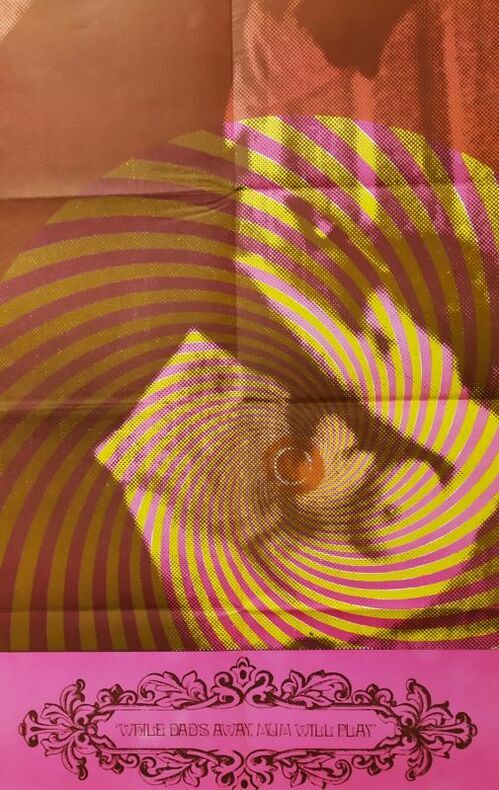
2386Impression en offset. Janvier 1968. Au recto affiche psychédélique, au verso, Che Guevara, tirée du magazine Oz n°8. Pliures d'origine. Dim : 795 x 650 mm.
2386Impression en offset. Janvier 1968. Au recto affiche psychédélique, au verso, Che Guevara, tirée du magazine Oz n°8. Pliures d'origine. Dim : 795 x 650 mm.
2004RO80078863IMP. BICHON. 2004. In-12. Broché. Bon état, Couv. convenable, Dos satisfaisant, Intérieur frais. Affiche évènementielle, en couleurs de 30 / 42 cm.. . . . Classification : 300-Affiches Divers
2005RO80078865ARTDELINE. 2005. In-12. Broché. Bon état, Couv. convenable, Dos satisfaisant, Intérieur frais. Affiche évènementielle, en couleurs de 30 / 42 cm.. . . . Classification : 300-Affiches Divers
65132CBo.J. [2 Warenabbildungen] (Rolf Escher, geb. 1936 in Hagen. 1956 bis 1962 Studium an der Kunstakademie Düsseldorf).
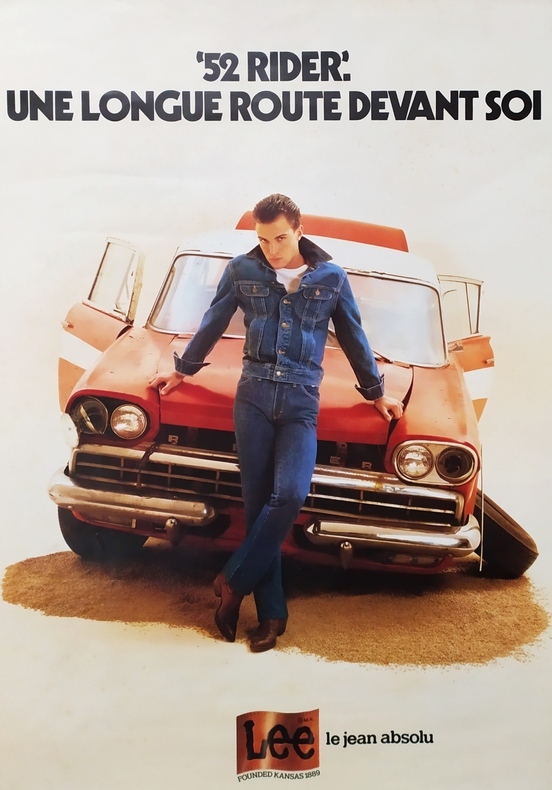
2453Lee Cooper. Printed in Belgium, ca. 1980. Imprimée en offset. Dimensions : 594 x 420 mm. Quelques rousseurs sinon très bon état.
2453Lee Cooper. Printed in Belgium, ca. 1980. Imprimée en offset. Dimensions : 594 x 420 mm. Quelques rousseurs sinon très bon état.
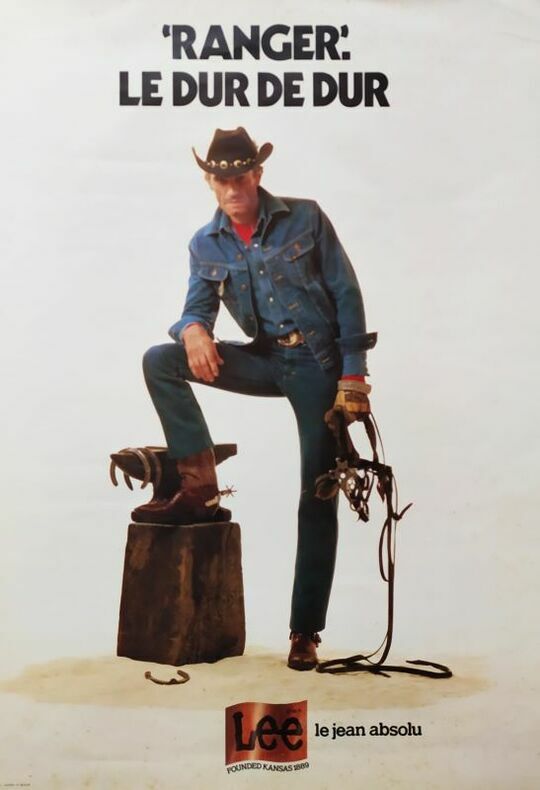
2454Lee Cooper. Printed in Belgium, ca. 1980. Imprimée en offset. Dimensions : 594 x 420 mm. Pliures angle droit supérieur. Quelques rousseurs sinon très bon état.
2454Lee Cooper. Printed in Belgium, ca. 1980. Imprimée en offset. Dimensions : 594 x 420 mm. Pliures angle droit supérieur. Quelques rousseurs sinon très bon état.
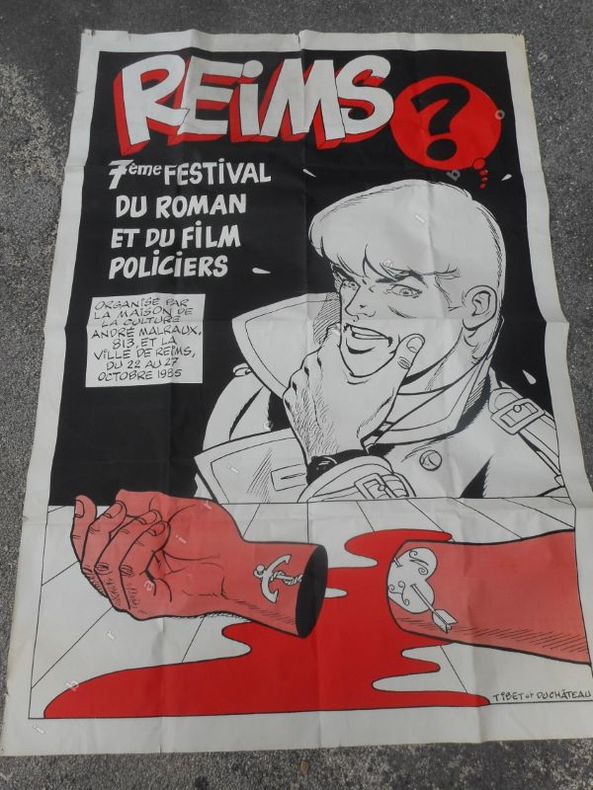
1985442871985. Format 120x180 cm environ. Des plis et quelques fentes en marge, pas de manque. Bon etat.
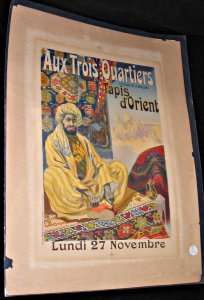
bf2633Imprimerie Chaix Affiche Affiche (env. 30x40), magnifique composition signée par René Péun, en couleurs, proposant un vendeur de tapis, assis en tailleur, avec une caravane partant dans le désert en arrière plan, impression par l'Imprimerie Chaix ; quelques petits manques aux bords de l'affiche, bel état. Livraison a domicile (La Poste) ou en Mondial Relay sur simple demande.
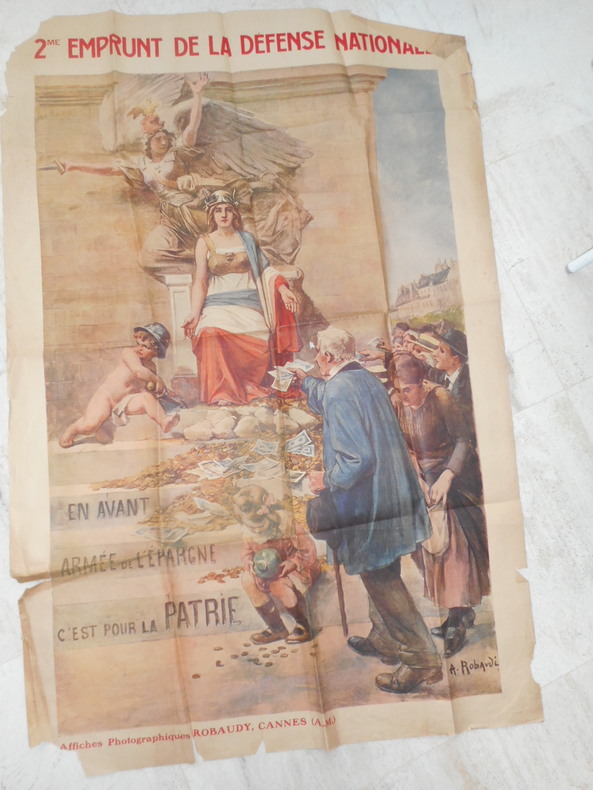
191649374Affiche au format 80x120 cm. Nombreux plis et fentes, mais exemplaire en état satisfaisant.
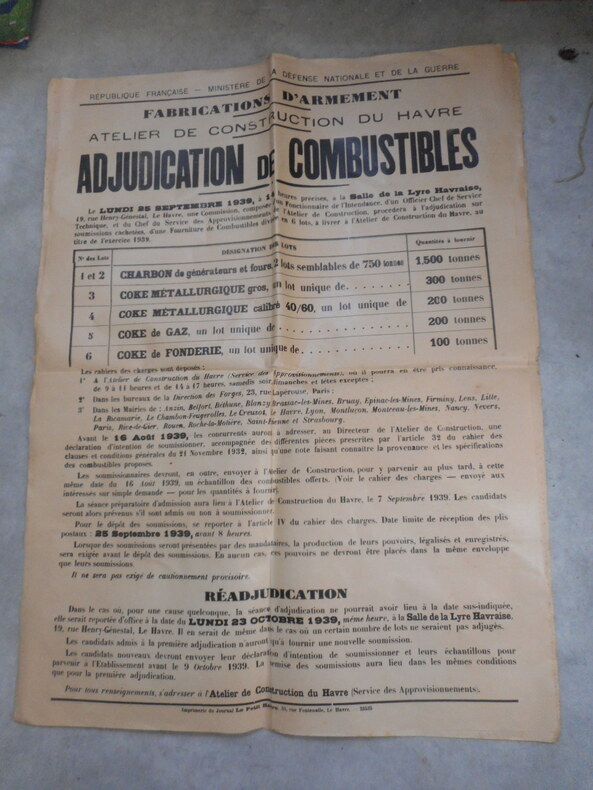
49008Affiche typographique. Format 60x80 cm, uniface. Pliee en 4 (voir les photos).
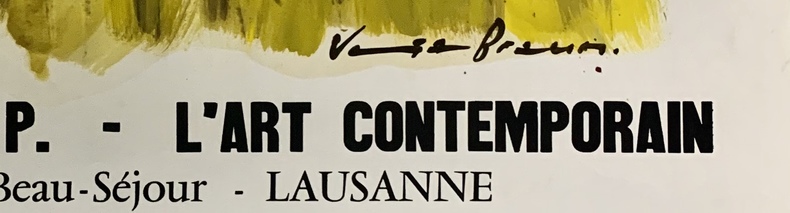
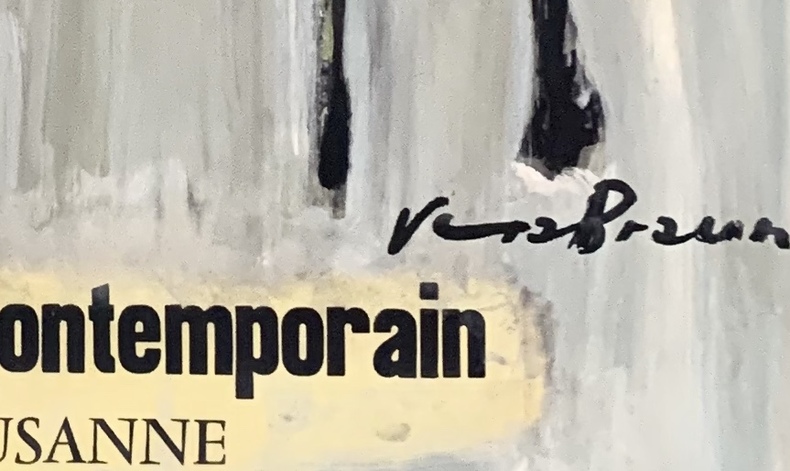
awd-185Lausanne, galerie U. N. I. P., L’Art contemporain. Affiche imprimée de l’exposition Vera Braun Budaï, du samedi 5 mai au mercredi 23 mai 1973. Enrichie d'une composition à la peinture à l'huile en jaune et noir dans la partie supérieure. Signée (64/100 cm). Trace de pli central, petite déchirure sans gravité sur le côté gauche.
awd-184Lausanne, galerie UNIP, 1976. Peinture à l'huile sur une affiche imprimée. Exposition du 18 septembre au 6 octobre 1976. Signée en noir à droite. 64/100 cm. Bon état, discrète trace de pli central.
18956Valence, Préfecture de la Drôme, 1925, 1 pliée. affiche de 50 cm x 63 cm ;