10 427 résultats
biblio18<p>Hand-drawing Chinese propaganda poster: "Holding highly the flags of Maoism Thought to eliminate leptospirosis thoroughly." 1971. 89cm x 62cm. All of the painting and red Chinese characters are hand-drawing only the below black Chinese characters were typed on a paper and then adhered to the painting. Have slight fold which probably can be recovered because the fold is formed by whole put together with others.</p><p>The soldier worker and peasant are holding a red books with title "Maoism Thought" . The three banners are captioned with "Ready for Battle Ready for Famine For People" "Long Live For the Victory of the hygienism Route of Chairman Mao’s Proletariat Revolution" and "Put the emphasis of the work of hygienism and Health into Rural Area" respectively. The two plates are captioned with "Must Demolish thoroughly the remaining toxin of the hygienism Route of Anti-revolutionary Revisionism" and "Must eliminate leptospirosis thoroughly " respectively.</p><p>At the bottom the adhered small paper was typed "printed by Revolutionary Committee of Epidemic Prevention of Yunnan Province printed in June 1971" so it is the original hand-drawing poster for printing in 1971 but do not know if its printed counterpart had been publised later because as far as I know I have not seen its printed counterpart.</p>
- s.d. (ca 1937), 9x12,9cm, un dessin. - Eva, original drawing signed [ca 1937] | 9 x 12,9 cm | one drawing Original drawing signed by Constantin Brâncu?i in brown ink on cream paper, from the collection of Ion Alexandrescu, a stone mason who worked with the sculptor in 1937-1938 on the creation and installation of the monumental ensemble at Târgu Jiu, and more specifically on The Door of the Kiss and The Table of Silence. Brâncu?i's preparatory drawings for his sculptures are extremely rare, as opposed to most of the few drawings by the artist seen on auctions, which are mainly figurative (women and anatomical studies). We submitted this unpublished work to renowned Brâncu?i specialist Dr Doïna Lemny who authenticated and dated it with precision. As an honorary curator of the Musée National d'Art Moderne, Georges-Pompidou in Paris where she was in charge of the Brâncu?i collection for thirty years, she is the author of numerous monographs and essays on the artist. She provided the drawing's analysis: "This small drawing traced in ink with a quick hand on small paper calls out by the novelty of the composition of geometric forms: two superimposed cubes supporting an oval head framed in a square acquire a caryatid posture supporting an architrave, clearly drawn at the top of the figure. The quick, firm line indicates the artist's intention to note elements for a more complex composition that he would have intended to make." Although undated, this drawing can be related to two other similar compositions made on 3 November 1937. The first, of the same size (9 x 13 cm), bears the title "Eva" and is enriched on the reverse with a drawing of the Kiss and a message addressed to Ion Alexandrescu. The second is larger (22 x 32 cm) and has the same composition as our drawing, but with proportions that more explicitly evoke a female figure (see opposite). In these two other drawings, Brâncu?i indicates the materials he plans to use for this future set of sculptures: wood (in Romanian: lemn) and plaster (gips). The drawing we offer is untitled and does not bear indications regarding the materials, but is in coherent with the tangible research of the other two compositions, and could be a stylisation of the original drawing for a more abstract sculpture project. The interest in this biblical female figure crossed Brâncu?i's artistic career. As early as 1916, he sculpted a curvaceous, Africanising wooden figure to which he gave the title "Ève". Reworking it, he finally created a more totemic sculpture in 1921: Adam and Eva. As a "constructed" work, Adam and Eve already announced Brâncu?i's intention to take up the theme of the original woman, mother and protector, who is here pruned of male attributes and made into an elevation of primary and matrix forms: the block, the egg and the surface. Provenance: collection of the stone mason Ion Alexandrescu, friend and close collaborator of the Romanian sculptor. [FRENCH VERSION FOLLOWS] Dessin original signé de Constantin Brancusi à l'encre brune sur papier crème, provenant de la collection d'Ion Alexandrescu, tailleur de pierre ayant été le collaborateur du sculpteur en 1937-1938, pour la réalisation et l'installation de l'ensemble monumental de Târgu Jiu, plus particulièrement pour La Porte du Baiser et La Table du silence. Les rares dessins passés en vente sont essentiellement figuratifs (femmes et études anatomiques), mais les travaux préparatoires à ses sculptures sont d'une excessive rareté. Nous avons soumis au docteur Doïna Lemny, conservatrice honoraire du Musée National d'Art Moderne où elle eut la charge du fonds Brâncu?i durant trente années, et autrice de nombreuses monographies et essais sur l'artiste, cette uvre inédite qu'elle a pu authentifier et dater avec précision : « Ce petit dessin tracé à l'encre d'une main rapide sur un papier de petites dimensions interpelle par la nouveauté de la composition de formes géométriques : deux cubes superposés supportant une
- Chez Meynal, Paris 1920-1924, 44,5x31cm, en feuilles sous couverture de l'éditeur. - Le Bonheur du jour ou Les Grâces à la Mode Chez Meynal | Paris 1920-1924 | 44,5 x 31 cm loose leaves under publisher's cover and custom slipcase First edition complete with its 21 color copper-engravings and pochoirs by H. Reidel colored after the drawings of George Barbier: one on the cover, one on the title, 3 in the text and 16 plates. The work was printed with 300 copies, all printed on vellum paper. Embossed stamp in the bottom right of the title page. Our copy is presented in a blue calf custom slipcase, fans-pattern paper boards, title piece in blue calf and titled in palladium in the center of the first board; lambskin velvet lining, slipcase signed by Thomas Boichot. Rare and superb copy, complete with all its plates, of this magnificent and monumental Art Deco work that required four years of work. [FRENCH VERSION FOLLOWS] Édition originale bien complète de ses 21 compositions en couleurs gravées sur cuivre par H. Reidel et coloriées au pochoir d'après les dessins de George Barbier?: une sur la couverture, une sur le titre, 3 dans le texte et 16 hors texte. L'ouvrage fut tiré à 300 exemplaires, tous imprimés sur papier vélin. Notre exemplaire est présenté dans un étui en veau bleu, plats de papier à motif d'éventails, pièce de titre en veau bleu et titrée au palladium au centre du premier plat, doublure en velours d'agneau, étui signé Thomas Boichot. Timbre à sec en bas à droite de la page de titre. Rare et superbe exemplaire, complet de toutes ses planches, de ce magnifique et monumental ouvrage Art Déco qui nécessita quatre années de travail.
- s.d. (1946-1947), 25x34cm, une feuille. - Henri MICHAUX [Meidosems] Untitled. Ink and watercolor drawing [1946-1947] | 25 x 34 cm | one drawing Original ink on cartridge paper, signed in ink on the lower right with Henri Michaux's monogram "HM." A tiny tear, causing no effect, at the top of the leaf. The drawing has been authenticated by M. Franck Leibovici, Henri Michaux's beneficiary, and will be entered into the catalogue raisonné in preparation. The work appeared in the Michaux exhibition catalogue at the Galerie Drouin in 1948, and belongs to Michaux's "Meidosem" or "psychologism" period, an artistic pseudo-movement of which he was both the initiator and the only follower. "It is in 1946, in the preface to Peinture et Dessins, entitled 'Thinking about the phenomenon of painting ,' that Michaux explains the rules of this art, aiming to paint 'the portrait of temperaments 15.'" Indeed, for him, to paint a face is to project the essence on to the paper or canvas: "There is a certain inner ghost that you should be able to paint and not just the nose, the eyes, the hair that we can see on the outside... often as tough as old boots." (In Rosaline Deslauriers, Les Meidosems d'Henri Michaux : émergences du dedans, résurgences orientales, Littérature et mathématiques, Numéro 68, Winter 2002). Beautiful and rare ink drawing, perfectly preserved. [FRENCH VERSION FOLLOWS] Dessin original à l'encre et à l'aquarelle, sur papier fort, signé à l'encre en bas à droite du monogramme d'Henri Michaux «?HM?». Un infime accroc sans manque en tête de la feuille. Le dessin a été authentifié par M. Franck Leibovici, ayant-droit d'Henri Michaux, et sera intégré au catalogue raisonné en préparation. L'uvre apparaît au catalogue de l'exposition Michaux à la Galerie Drouin de 1948, et appartient à la période «?Meidosem?» ou «?psychologisme?» de Michaux, pseudo-mouvement artistique dont il était à la fois l'initiateur et l'unique disciple. «?C'est en 1946, dans la préface de Peintures et dessins intitulée «?En pensant au phénomène de la peinture?», que Michaux explique les règles de cet art visant à faire «?le portrait des tempéraments 15?». En effet, pour lui, peindre un visage consiste à projeter, sur le papier ou sur la toile, l'essence?: «?Il y a un certain fantôme intérieur qu'il faudrait pouvoir peindre et non le nez, les yeux, les cheveux qui se trouvent à l'extérieur... souvent comme des semelles.?» (in Rosaline Deslauriers, Les Meidosems d'Henri Michaux?: émergences du dedans, résurgences orientales Littérature et mathématiques Numéro 68, hiver 2002) Provenance : Henri Michaux puis Jean Sainjon. Beau et rare dessin à l'encre, parfaitement conservé.
- Encre sur papier fort, s.l. s.d. (circa 1942-1944), 8,x12cm & 8,4x12,2cm & 14,1x14,8 & 9x11,8cm & 12,6x13,1cm, 5 feuilles. - Ensemble de cinq belles et rares encres de Chine réalisées sur papier fort selon le procédé de "La décalcomanie sans objet préconçu" inventé par l'artiste en 1935 et repris notamment par Max Ernst ou Hans Bellmer. Cette technique, également nommée "décalcomanie du désir", consiste en une pression d'une feuille (ou d'une plaque de verre) encrée ou gouachée sur une autre. André Breton, dont L' Anthologie de l'humour noir est illustrée de telles décalcomanies, y voit le point de départ de "l'automatisme absolu" si cher au Mouvement Surréaliste. "La découverte d'Oscar Dominguez porte sur la méthode à suivre pour obtenir des champs d'interprétations idéaux dans les images qui suivent... Il s'agit, une fois de plus, d'une recette à la portée de tous qui demande à être incorporée aux 'secrets de l'art magique surréaliste." (A. Breton in Le Surréalisme et la peinture). Sans titres, les cinq oeuvres sont une variation autour du thème du Renne représenté dans un style rupestre sur des compositions abstraites pouvant évoquer des paysages divers, l'une des encres étant totalement abstraite.Nous joignons à ces uvres, non signées, les cinq certificats d'authenticité délivrés par Ana Vasquez de Parga, experte mondiale d'Oscar Dominguez. Provenance : Collection particulière. [ENGLISH DESCRIPTION ON DEMAND]
- Aubert et Cie, Paris s.d. (1840), 27x34cm, 52 lithographies reliées en un volume. - Fourberies de femmes Aubert et Cie | Paris [1840] | 27 x 34 cm 52 lithographs bound together in half shagreen Full sets of 52 original lithographs enhanced by hand with colour and varnish, first printing. These engravings were initially published in La Caricature. Contemporary binding in half brown shagreen, spine lightly faded and decorated with gilt fillets and fleurons, black morocco library label at the foot, glued paper endpapers, the first with a title label framed with a double gilt fillet, caillouté marbled endpapers. Upper corners lightly damaged, margins and spine ends a little rubbed. Some discreet foxing mainly on the first board. A worm hole filled with a piece of paper on the lower margin of the twenty-first print. Plate 38 is little shorter than the others on the external margin. [FRENCH VERSION FOLLOWS] Série complète de 52 lithographies originales rehaussées en couleurs et gommées, toutes en premier tirage. Ces gravures sont primitivement parues dans La Caricature. Reliure de l'époque en demi chagrin marron, dos lisse légèrement éclairci orné de filets et fleurons dorés, étiquette de bibliothèque de maroquin noir en queue, plats de papier à la colle, le premier comportant une étiquette de titre encadrée d'un double filet doré, gardes et contreplats de papier caillouté. Coins supérieurs légèrement accidentés, coupes et coiffes un peu frottées. Quelques discrètes rousseurs essentiellement sur la première planche. Une galerie de ver comblée à l'aide d'une pièce de papier en marge basse de la vingt-et-unième estampe. La planche 38 est un peu plus courte que les autres en marge extérieure.
- s.n. 13 mai 1921, Affiche : 32x24cm / Cadre : 45;5x37,5cm, une affiche encadrée sous verre. - Original poster: «Charges against and trial of M. Maurice Barrès by Dada» 13 May 1921 | Poster: 32 x 24 cm / Frame: 45.5 x 37.5 cm | poster, framed and glazed An original Dadaist poster entitled «Charges against and trial of M. Maurice Barrès by Dada» framed and glazed on both sides. On the verso is an «Extract from the charge sheet» written by André Breton, followed by a list of the contributors. A manuscript annotation «VI n°47» to left-hand corner of verso. One small repair using a strip of paper not touching text to verso. Folds, otherwise a well-preserved poster with vibrant yellows. A poster announcing the fictitious criminal trial of Maurice Barrès by the Dadaists, held on Friday 13th May 1921 at the Salle des sociétés savantes, 8 rue Danton, Paris. This happening marked a significant divergence between - on the one hand - the team behind the review Littérature (Breton, Aragon, Soupault...) and, on the other, Tristan Tzara and his friends. Charged with «crimes against the security of the spirit», Barrès was sentenced to the cruel and inhuman punishment of twenty years of forced labor by a jury of twelve spectators. The trial was transcribed in issue 20 of Littérature. [FRENCH VERSION FOLLOWS] Affiche originale dadaïste intitulée «?Mise en accusation et jugement de M. Maurice Barrès par Dada?», encadrée sous verre permettant d'en voir les deux faces. Au verso «?Extrait de l'acte d'accusation?» rédigé par André Breton, suivi de la liste des contributeurs. Une annotation manuscrite «?VI n°47?» à l'angle gauche du verso. Une petite restauration, à l'aide d'une bande de papier et sans atteinte au texte, au verso. Pliures, sinon document bien conservé au jaune éclatant. Affiche annonçant le procès pénal fictif de Maurice Barrès par les dadaïstes qui se déroula le vendredi 13 mai 1921 à la Salle des sociétés savantes, 8 rue Danton à Paris. Cette manifestation marque une divergence importante entre, d'une part, les animateurs de la revue Littérature (Breton, Aragon, Soupault...) et, d'autre part, Tristan Tzara et ses amis. Poursuivi pour «?crime contre la sûreté de l'esprit?», Barrès fut condamné à la peine afflictive et infamante de vingt ans de travaux forcés par un jury composé de douze spectateurs. Ce procès a été retranscrit dans le numéro 20 de la revue Littérature.
19356911935 - reliure - Sanjian Shuwu 三閒書屋 - Yinyu ji 引玉集 (« Recueil pour attirer le jade ») 木刻五十九幅 - Deuxième tirage, avril 1935 - In-8 (19,5 × 15,5 cm) reliure cartonnée de l'éditeur, dos noir, pièce de titre contrecollée sur le premier plat - 68 pages - 59 reproductions de gravures sur bois soviétiques imprimées au procédé collotype (珂羅版) d'après les tirages originaux fournis par les artistes - Comprend un texte de Chen Jie (陳節), traduction abrégée d'un essai de A. D. Chegodaev consacré à la gravure soviétique contemporaine - Tirage limité à 215 exemplaires, dont 15 exemplaires hors commerce - Diffusion assurée par la librairie Uchiyama (內山書店), Shanghai - Ouvrage en chinois - Avec des œuvres de Dmitri Isidorovich Mitrokhin, A. Kravchenko, N. Piskarev, Vladimir Andreevich Favorsky, P. Pavlinov, A. Goncharov, M. Pikov, Sergei Mikhalovich Mocharov, L. Khizhinsky, Nikolai Vasilievich Alekseev et Sergei Mikhailovich Pozharsky - A PROPOS : Rare anthologie consacrée à la gravure soviétique moderne, publiée à Shanghai par 三閒書屋 et diffusée par la librairie Uchiyama (內山書店). L'ouvrage réunit cinquante-neuf reproductions en collotype de gravures sur bois réalisées par plusieurs figures majeures de l'école russe et soviétique de la gravure des années 1920-1930, parmi lesquelles Vladimir Favorsky, Dmitri Mitrokhin, Alexei Kravchenko et Pavel Pavlinov. Accompagné d'une traduction abrégée par Chen Jie d'un essai de l'historien de l'art soviétique A. D. Chegodaev, ainsi que d'une préface, d'un catalogue des planches et d'une postface, le volume fut conçu comme une introduction à l'estampe contemporaine soviétique pour le public chinois. Témoignage remarquable des échanges artistiques sino-soviétiques dans le Shanghai républicain des années 1930, il s'inscrit dans le contexte du mouvement de la Nouvelle Gravure (新興木刻運動), alors en plein essor sous l'influence des milieux intellectuels de gauche et des réseaux culturels gravitant autour de la librairie Uchiyama et de la figure de Lu Xun. Les reproductions furent réunies à partir de documents et publications soviétiques découverts au début des années 1930, notamment par l'intermédiaire de la revue Graphika. /// ENGLISH: Sanjian Shuwu (三閒書屋) - Yinyu ji (引玉集, “Collection to Draw Forth Jade”): Fifty-Nine Woodcuts (木刻五十九幅) - Second printing, April 1935 - Octavo (19.5 × 15.5 cm), publisher's boards with black spine and mounted title label on upper cover - 68 pages - 59 collotype (珂羅版) reproductions of Soviet woodcuts printed from original impressions supplied by the artists - Includes a text by Chen Jie (陳節), an abridged translation of an essay by A. D. Chegodaev on contemporary Soviet printmaking - Limited edition of 215 copies, including 15 non-commercial presentation copies - Distributed by Uchiyama Bookstore (內山書店), Shanghai - Text in Chinese - Featuring works by Dmitri Isidorovich Mitrokhin, Alexei Kravchenko, Nikolai Piskarev, Vladimir Andreevich Favorsky, Pavel Pavlinov, Aleksandr Goncharov, Mikhail Pikov, Sergei Mikhailovich Mocharov, Leonid Khizhinsky, Nikolai Vasilievich Alekseev and Sergei Mikhailovich Pozharsky. ABOUT: Rare anthology devoted to modern Soviet wood engraving and printmaking, published in Shanghai by Sanjian Shuwu and distributed through Uchiyama Bookstore (內山書店). The volume gathers fifty-nine collotype reproductions of woodcuts by several leading figures of the Russian and Soviet printmaking revival of the 1920s and 1930s, including Vladimir Favorsky, Dmitri Mitrokhin, Alexei Kravchenko and Pavel Pavlinov. Accompanied by Chen Jie's abridged translation of an essay by Soviet art historian A. D. Chegodaev, as well as a preface, plate catalogue and postface, the work was conceived as an introduction to contemporary Soviet printmaking for Chinese readers. A remarkable testimony to Sino-Soviet artistic exchanges in Republican-era Shanghai, it belongs to the context of the New Woodcut Movement (新興木刻運動), then flourishing under the influence of left-wing intellectual circles and cultural networks associated with Uchiyama Bookstore and the figure of Lu Xun. The reproductions were assembled from Soviet books, periodicals and documentary sources discovered in the early 1930s, notably through the journal Graphika. /// 中文:三閒書屋出版 — 《引玉集:木刻五十九幅》 — 1935年4月再版 — 32開(19.5 × 15.5厘米)精裝本,黑色書脊,封面貼書名籤 — 68頁 — 收錄蘇聯木刻作品59幅,以珂羅版工藝依據藝術家提供之原拓本複製印製 — 附陳節摘譯 A. D. Chegodaev(契戈達耶夫)論蘇聯現代版畫藝術之文章 — 限印215部,其中15部為非賣贈送本 — 上海內山書店代售 — 中文版 — 收錄 Dmitri Isidorovich Mitrokhin、Alexei Kravchenko、Nikolai Piskarev、Vladimir Andreevich Favorsky、Pavel Pavlinov、Aleksandr Goncharov、Mikhail Pikov、Sergei Mikhailovich Mocharov、Leonid Khizhinsky、Nikolai Vasilievich Alekseev 及 Sergei Mikhailovich Pozharsky 等藝術家作品。關於本書:本書為三閒書屋於上海出版、由內山書店代售之珍稀蘇聯現代木刻版畫選集。全書收錄59幅以珂羅版精印之蘇聯木刻作品,作者均為1920至1930年代俄羅斯及蘇聯版畫復興運動的重要藝術家,其中包括弗拉基米爾·法沃爾斯基(Vladimir Favorsky)、德米特里·米特羅欣(Dmitri Mitrokhin)、阿列克謝·克拉夫琴科(Alexei Kravchenko)及帕維爾·帕夫利諾夫(Pavel Pavlinov)等人。書中除收錄陳節摘譯之蘇聯藝術史家 A. D. Chegodaev 論文外,尚附序言、圖版目錄及後記,旨在向中國讀者介紹蘇聯當代版畫藝術。本書不僅是研究俄蘇版畫的重要文獻,亦是1930年代上海中蘇藝術交流的珍貴見證。其出版背景與中國新興木刻運動(新興木刻運動)密切相關,反映了左翼知識界、內山書店文化網絡以及魯迅所倡導之版畫思想的深遠影響。書中圖版主要彙集自1930年代初傳入中國之蘇聯書籍、期刊及藝術資料,其中包括《Graphika》等重要出版物。
- Paris Mercredi 26 mai 1920, 27,2x37cm., une feuille. - Dada Poster - Dada Festival at the Salle Gaveau, Wednesday 26 May 1920 Paris Wednesday 26 May 1920 | 27.2 x 37 cm | single sheet First edition of this program leaflet announcing the festival of the Paris dadaist group at the Salle Gaveau on Wednesday 26 May 1920. The first draft of this poster was designed by Tzara and Picabia. Superimposed mechanical illustration by Picabia. Catalogue of Sans pareil publications on the verso. Contributions by Breton, Draule (anagram of Éluard), Picabia, Tzara, etc. Very beautiful copy of great quality and having preserved its fragile green color. [FRENCH VERSION FOLLOWS] Édition originale de ce tract programme annonçant le festival du groupe dadaïste de Paris à la Salle Gaveau le mercredi 26 mai 1920. La maquette de cette affiche a été conçue par Tzara et Picabia. Illustration mécanique en surimpression de Picabia. Catalogue des publications du Sans pareil au verso. Participations de Breton, Draule (anagramme d'Éluard), Picabia, Tzara, etc. Très bel exemplaire d'une grande fraîcheur et ayant conservé sa fragile couleur verte.
- L'Estampe Moderne, Imprimerie Champenois pour CH. Masson & H. Piazza, Paris s.d. (Mai 1897), sujet : 22x38cm, planche : 40,8x55cm, une feuille et une serpente. - "L'incantation" (Salammbô) - Original lithograph on Japan paper - L'Estampe Moderne L'Estampe Moderne, Imprimerie Champenois for C H Masson & H Piazza | Paris (june 1897) | subject: 23.5 x 33 cm, plate: 40.8 x 55 cm | one leaf and one guard Rare original color lithograph heightened in gold by Alphonse Mucha for L'Estampe Moderne, 'The free first prize reserved to subscribers to a whole annual run of L'Estampe Moderne'. One of 50 grand luxe proofs printed on Japan paper with wide margins, signed by the artist in the plate, publisher's embossed stamp showing a child in profile to lower margin, numbered stamp of the de luxe printing to verso, upper margin of proof slightly sunned; the print itself preceded by a silk paper guard with the name of the artist, the title of the work and an extract from itlateral tear without loss, not touching text. A lithograph inspired by Gustave Flaubert's Salammbô, an excerpt from which is reproduced on the guard sheet of the print: "[And Salammbô went out onto the balcony of his palace]". A magnificent monthly French publication that appeared between May 1897 and April 1899, L'Estampe moderne comprised unpublished chromolithographs that, unlike those in other magazines like Les Maîtres de l'Affiche and as is stipulated on the guard sheets, were specially made by each artist for the magazine. There are thus 100 prints that appeared in total, covering the major artistic currents of the late 19th Century: Symbolism, Art Nouveau, the Pre-Raphaelites, Orientalists and the Belle époque. Each fascicule of four prints was printed in 2,000 copies and sold for 3.50F, with 100 on Japan paper sold at 10F. Henri Piazza also planned a very luxurious secret printing of 50 copies on Japan paper with wide margins and 50 in black and white on China paper at the considerable price of 30F. This well-sized print is superbly printed in colors on the most prestigious of papers: Japan. Thick, creamy, satin and with a nice sheen, it contributes to making each page a work of art in itself. Its absorptive qualities for ink and its affinity for colors make it the ideal support for these lovely lithographs. The interest of French collectors for artistic posters grew from the beginning of the 1890s. Octave Uzanne invented a term for this growing interest: affichomanie, or poster mania. The poster, originally not rare and posted up in the streets of the capital, thus became a work of art and its ephemeral background became precious and essential for conservation. Piazza decided to extract the poster from its advertising role and to elevate it to a form of art, similarly to luxury illustrated artists' books. He thus put together a prestigious collection of entirely original works by the most fashionable European artists of the age: Georges de Feure, Eugène Grasset, Henri Detouche, Emile Berchmans, Louis Rhead, Gaston de Latenay, Lucien Lévy-Dhurmer, Gustave-Max Stevens, Charles Doudelet, Hans Christiansen, Henri Fantin-Latour, Steinlen, Ibels, Engels, Willette, Henri Meunier, Evenepoël, Bellery-Desfontaines, Charles Léandre, etc. He also included in this project a Czech artist freshly arrived in Paris, Alfonse Mucha "who has only recently become active in France but who has immediately carved out for himself the affection of the public. Like in his posters, which everyone knows and covets, he shows us here the varied resources of his multifaceted talents as accomplished draughstman, decorator and colorist" (from the notes printed on the guard for Salomé). The two first special numbers of the review were in fact dedicated to him, and were given to "all the subscribers for all twelve annual numbers of L'Estampe moderne" as well as the famous illustration of the covers. A fine signed plate by the master of Art nouveau. [FRENCH VERSION FOLLOWS] Rare lithographie ori
- L'Estampe Moderne, Imprimerie Champenois pour CH. Masson & H. Piazza, Paris s.d. (Juin 1897), sujet : 23,5x33cm, planche : 40,8x55cm, une feuille et une serpente. - "Salomé" - Original lithograph on Japan paper - L'Estampe Moderne L'Estampe Moderne | Imprimerie Champenois for C. H. Masson & H. Piazza | Paris [june 1897] | subject: 23.5 x 33 cm | plate: 40.8 x 55 cm | one leaf and one guard Rare color lithograph heightened in gold by Alphonse Mucha for L'Estampe Moderne, series number 2, published in June 1897. One of 50 grand luxe proofs printed on Japan paper with wide margins, signed by the artist in the stone, publisher's embossed stamp showing a child in profile to lower margin, numbered stamp of the de luxe printing to verso, upper margin of proof slightly sunned; the print itself preceded by a silk paper guard with the name of the artist, the title of the work and an introduction to the work as well as a blank guard leaf. A magnificent monthly French publication that appeared between May 1897 and April 1899, L'Estampe moderne comprised unpublished chromolithographs that, unlike those in other magazines like Les Maîtres de l'Affiche and as is stipulated on the guard sheets, were specially made by each artist for the magazine. There are thus 100 prints that appeared in total, covering the major artistic currents of the late 19th Century: Symbolism, Art Nouveau, the Pre-Raphaelites, Orientalists and the Belle époque. Each fascicule of four prints was printed in 2,000 copies and sold for 3.50F, with 100 on Japan paper sold at 10F. Henri Piazza also planned a very luxurious secret printing of 50 copies on Japan paper with wide margins and 50 in black and white on China paper at the considerable price of 30F. This well-sized print is superbly printed in colors on the most prestigious of papers: Japan. Thick, creamy, satin and with a nice sheen, it contributes to making each page a work of art in itself. Its absorptive qualities for ink and its affinity for colors make it the ideal support for these lovely lithographs. The interest of French collectors for artistic posters grew from the beginning of the 1890s. Octave Uzanne invented a term for this growing interest: affichomanie, or poster mania. The poster, originally not rare and posted up in the streets of the capital, thus became a work of art and its ephemeral background became precious and essential for conservation. Piazza decided to extract the poster from its advertising role and to elevate it to a form of art, similarly to luxury illustrated artists' books. He thus put together a prestigious collection of entirely original works by the most fashionable European artists of the age: Georges de Feure, Eugène Grasset, Henri Detouche, Emile Berchmans, Louis Rhead, Gaston de Latenay, Lucien Lévy-Dhurmer, Gustave-Max Stevens, Charles Doudelet, Hans Christiansen, Henri Fantin-Latour, Steinlen, Ibels, Engels, Willette, Henri Meunier, Evenepoël, Bellery-Desfontaines, Charles Léandre, etc. He also included in this project a Czech artist freshly arrived in Paris, Alfonse Mucha "who has only recently become active in France but who has immediately carved out for himself the affection of the public. Like in his posters, which everyone knows and covets, he shows us here the varied resources of his multifaceted talents as accomplished draughstman, decorator and colorist" (from the notes printed on the guard for Salomé). The two first special numbers of the review were in fact dedicated to him, and were given to "all the subscribers for all twelve annual numbers of L'Estampe moderne" as well as the famous illustration of the covers. A fine signed plate by the master of Art nouveau. [FRENCH VERSION FOLLOWS] Rare lithographie originale en couleurs réhaussée à l'or, exécutée par Alphons Mucha pour L'Estampe Moderne, série numéro 2 publiée en juin 1897. Une des 50 épreuves de grand luxe tirées sur Japon à grandes marges, signature de l'artiste dans la planche, timbre à sec de l'é
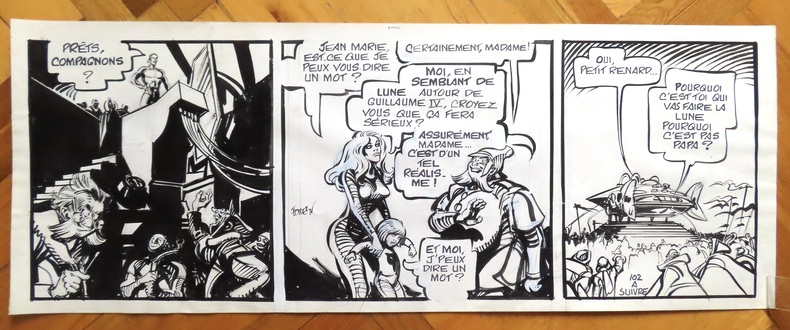
24400Encre de Chine, rehauts et corrections de gouache blanche. Au format imposant et atypique de 95 x 36 cm. (tout de même !). Vraisemblablement réalisé pour la prépublication dans France-Soir et, plus tard, pour la page 35 de l'album « Le Semble-Lune », publié en 1977 chez Pierre Horay. Présence centrale de Barbarella à la 2e case, dans son look iconique de combinaison moulante. Encrage dense et parfaitement lisible, papier légèrement gondolé par endroits (lié au grand format et à l'encrage), quelques traces ou frottements marginaux sans impact sur l'image.
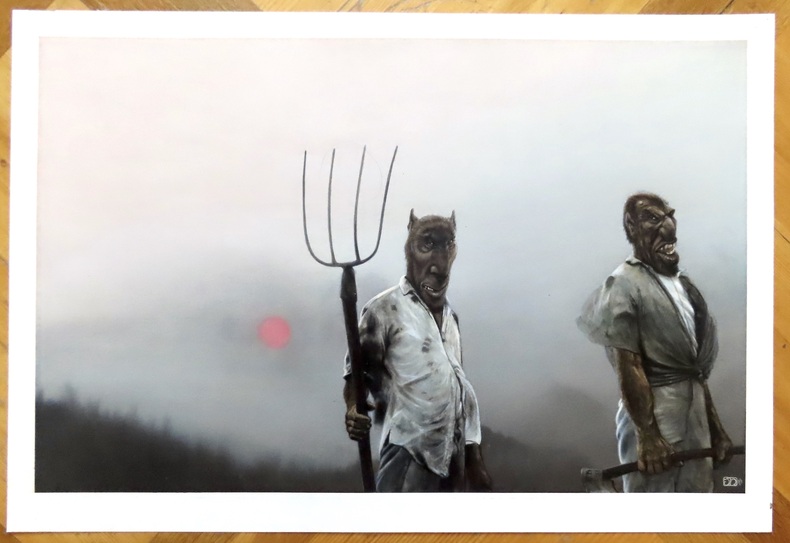
1980244271980 Remarquable composition originale en couleurs, inspirée de l’univers de Lovecraft. Réalisée à la gouache, avec probable emploi d’aérographe pour les effets atmosphériques caractéristiques du style de John Howe au début des années 1980. et détails au pinceau fin, notamment pour les figures inquiétantes au premier plan. Format : 58 40 cm (dimensions de la feuille). Monogrammée et datée 1983 en bas à droite. Très bon état général, à l’exception de traces de scotch au verso (anciennes fixations d’encadrement).
- 1890, 7x10,2cm, autre. - Recueil composé de 10 peintures sur double page à la manière traditionnelle japonaise : peinture à la colle sur soie. Ces 10 peintures représentent des fleurs, oiseaux et insectes. Elles sont toutes légendées de titres poétiques et chacune porte un ou plusieurs sceaux rouges qui permettent d'identifier le nom du peintre ; certains sont une partie du nom du peintre, d'autres le nom complet. Reliure japonaise en accordéon avec plats d'orme laqué. Etiquette de titre avec titre manuscrit et un sceau. Une légère trace de mouillure en marge basse sur la première garde, sinon superbe état général. Le papier au dos des contreplats légèrement soulevé et portant des fentes. Maître du Kachoga (peintures de fleurs et d'oiseaux), Bunrei (1837-1917) est né à Kyoto et fut dès son jeune âge enseigné par son père qui était un membre de l'école Shijo dont il devint lui-même membre. Son style est délicat et réaliste et il porte une grande attention à la maîtrise des couleurs. L'oeuvre originale présente est un manifeste de son art et de sa technique très sûre, le peintre semble avoir déployé au travers de ces 10 peintures miniatures l'essence même de la peinture japonaise. [ENGLISH DESCRIPTION ON DEMAND]
- Imp. Crémieu, Paris 1921, 21x27cm, une feuille. - [Dada Poster] Soirée Dada à la Galerie Montaigne le vendredi 10 juin 1921 à la Galerie Montaigne [Dada Evening on Friday 10 June 1921 at the Galerie Montaigne] Imp. Crémieu | Paris 1921 | 21 x 27 cm | one single sheet First edition of this rare leaflet announcing the Dada evening on Friday 10 June 1921 at the Galerie Montaigne. Two small, minor signs of folding. Precious invitation to this evening organised as part of the "Salon Dada," installed at the Galerie Montaigne during the month of June 1921. Tristan Tzara, for the first time, performed his play Le Cur à gaz and most of the movement's protagonists joined in, with the notable exception of Picabia and Duchamp who refused to be part of it. Participation from Madame E. Bujaud, Philippe Soupault, Louis Aragon, Valentin Parnak, Georges Ribemont-Dessaignes, Paul Eluard, Benjamin Péret and Tristan Tzara. We have only been able to find three copies in libraries: at Yale University Library, at the Art Institute of Chicago and the Kunsthaus Zürich Bibliothek. One of the rarest Dada leaflets. [FRENCH VERSION FOLLOWS] Édition originale de ce rare tract annonçant la soirée Dada du vendredi 10 juin 1921 à la Galerie Montaigne. Deux fines traces de pliure sans gravité. Précieuse invitation pour cette soirée organisée dans le cadre du «?Salon Dada?», installé à la galerie Montaigne pendant le mois de juin 1921. Tristan Tzara y joua pour la première fois sa pièce Le Coeur à gaz et réunit la plupart des protagonistes du mouvement, à l'exception notable de Picabia et de Duchamp qui refusèrent d'en faire partie. Participation de Madame E. Bujaud, Philippe Soupault, Louis Aragon, Valentin Parnak, Georges Ribemont-Dessaignes, Paul éluard, Benjamin Péret et Tristan Tzara. Nous n'avons pu dénombrer que trois exemplaires en bibliothèque à la Yale University Library, à l'Art Institute of Chicago et à la Kunsthaus Zürich Bibliothek. Un des tracts dada les plus rares.
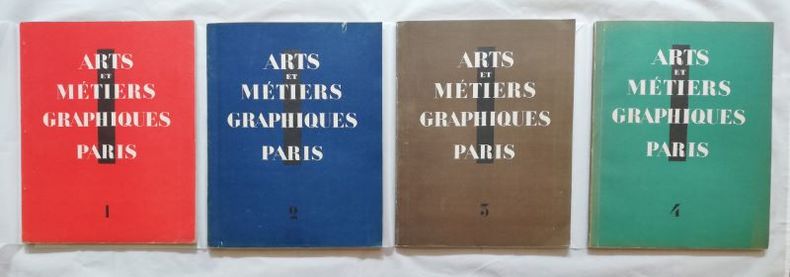
100069Paris Arts et Métiers Graphiques 0 245x310mm N° 1 à 68: collection complète 1927-1939. Volumes brochés dos carré, couvertures typographiques très élaborées, 70pp en moyenne pour les numéros ordinaires. Les huit numéros spéciaux thématiques sont consacrée à : La Photographie (n°16), La Publicité (n°42), Victor Hugo (n°25), Le Livre d'Art International (n°26), Arts et Techniques Graphiques (n°59), Les Plus Beaux Manuscrits de La Bibliothèque Nationale (n° 60), Paris 1937-New York 1939 (n°62).Charles Peignot, fondateur et directeur de la revue jusqu'à la fin, avait de son propre dire l'ambition de faire d'Arts et Métiers Graphiques la revue la plus luxueuse du monde, et la vitrine de prestige des productions françaises liées à l'imprimerie: Publicité, Affiche, Livre d'Art, Typographie, Photographie; pour cette dernière il avait par ailleurs un studio spécial dont la direction avait été confiée au photographe Maurice Tabard. Les collaborateurs: Affiche, publicité et typographie: Jean Carlu, A.M.Cassandre, Brodovitch, Tschichold, Jacno, Maximilien Vox. Textes: Paul Valéry, Léon-Paul Fargue, André Suares, Claude-Roger Marx, Paul Léautaud Philippe Soupault, Jean Cocteau, Paul Eluard, Pierre Mac Orlan. Photographie: Germaine Krull, Sougez, Tabard, Man Ray, Laure Albin Guyot, Brassaï. Défauts minimes à quelques numéros, sinon très bon état. Bibliographie: Arts et Métiers du Livre n°188 nov-dec 1994 qui contient une étude sur AMG abondamment illustrée, des articles analytique et une table générale de la revue . Quelques défauts.(100069)
190090039s. d. [circa 1890-1900] | 100 x 140 cm | Une feuille entoilée
24136Pars Imprimerie Chaix 1897 Planche N°94, format 29 x 40 cm (toutes marges). Chromolithographie d'époque avec le timbre à sec de l'Imprimerie Chaix (Lugt 1777c). Notre exemplaire est une des très rares épreuves imprimées sur papier Japon (Our plate is one of the few copies printed on Japanese paper, original plate in good condition). LES MAITRES DE L'AFFICHE, prestigieuse publication d'art, éditée par l'atelier de lithographie Chaix, dont la parution s'étala de décembre 1895 à novembre 1900. Chaque livraison comportait 4 planches en lithographie, des plus belles affiches illustrées des grands artistes français et étrangers. Chaque livraison comportait 4 planches de reproduction en chromolithographie d'une remarquable qualité d'impression des plus belles affiches illustrées des grands artistes français et étrangers (auxquelles il faut ajouter 16 planches de lithographies originales données en prime aux abonnés). Lors de l'Exposition universelle de 1889, fut organisée la première exposition rétrospective dévolue à l'affiche, celle-ci devait valider la reconnaissance officielle d'appartenance de l'affiche au monde de l'art. Jules Chéret (1836-1932) y sera sacré '' Maître de l'affiche '', c'est aussi à cette date que Seurat commencera à collectionner les affiches de Chéret. Bel exemplaire d'une des très rares épreuves imprimées sur papier Japon, du tirage de tête (Our plate is one of the few copies printed on Japanese paper) ( Photographies sur demande / We can send pictures of this book on simple request )
Manifesto litografico originale (mm 1930x1400), telato. Firmato nell'angolo superiore destro: "Romano". Nel margine inferiore sinistro sono presenti nelle note tipografiche: "Milano, off G. Ricordi, Printed in Italy-n. 2021-XII-927-10.000, a destra la dicitura Affissione autorizzata dalla R. questura di Milano, 20 luglio 1927. Conosciuto con il nome di "Arco di Trionfo", esempio di grafica 'monumentalistica' tipica del periodo fascista. Bellissimo manifesto, compendia in un'unica immagine classicismo e modernità trasformando la sigla FIAT in una fabbrica-tempio d'impatto assiro-babilonese, sormontata da statue greco-romane come negli archi di trionfo; un cielo rosso e giallo produce spirali vorticose come a voler compensare, coi suoi effetti dinamici, la rigida ponderosità dell'edificio; dagli archi trionfali fuoriescono berline e torpedo. Maestoso manifesto di non facile reperibilità ben conservato. Giuseppe Romano di origine siciliana (Caltagirone 1905-Firenze 1967) , inizia l'attività di disegnatore pubblicitario a Torino nel 1925, collaborò a lungo con la Fiat. Per l'azienda torinese realizzò manifesti, bozzetti per pubblicità su giornali e riviste, illustrando con il suo stile preciso e dettagliato tutta la gamma della produzione Fiat (in particolare le 'sei cilindri'). Gino Pestelli, direttore dell'ufficio Pubblicità Fiat, lo incarica di coordinare le proposte pubblicitarie dell'azienda con quelle dei concessionari: nasce così la rivista periodica "Fiat Publicitas" (1925-1928). Beautiful lithographic affiche backed on linen, shows cars speeding through a gigantic Roman triumphal arch as the sunshine beams down. The arch spells out the company's name. Fiat created images that conveyed the optimism of a new golden age of Rome. The company hired the greatest names in Italian poster art to bring excitement to its automobiles. . Cat., Il manifesto FIAT 1899 - 1965, a cura di A. C. Quintavalle, mostra GAM Torino, Ed. GAM, Torino 2001.
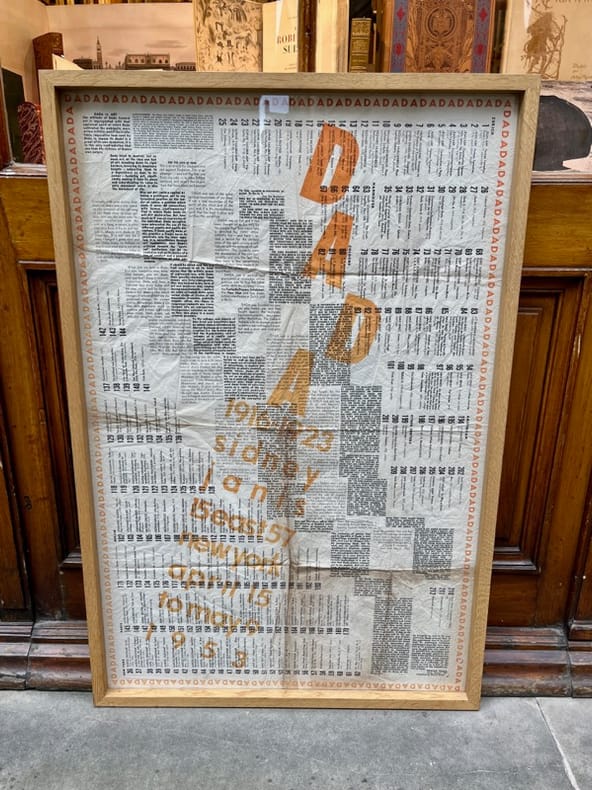
4481New York, Sydney Janis, 1953. Affiche-catalogue 97 x 64 cm., impression lithographique sur papier bible.
24137Pars Imprimerie Chaix 1897 Planche N°27, format 29 x 40 cm (toutes marges). Chromolithographie d'époque avec le timbre à sec de l'Imprimerie Chaix (Lugt 1777c). Notre exemplaire est une des très rares épreuves imprimées sur papier Japon (Our plate is one of the few copies printed on Japanese paper). Original plate in good condition). LES MAITRES DE L'AFFICHE, prestigieuse publication d'art, éditée par l'atelier de lithographie Chaix, dont la parution s'étala de décembre 1895 à novembre 1900. Chaque livraison comportait 4 planches de reproduction en chromolithographie d'une remarquable qualité d'impression des plus belles affiches illustrées des grands artistes français et étrangers (auxquelles il faut ajouter 16 planches de lithographies originales données en prime aux abonnés). Lors de l'Exposition universelle de 1889, fut organisée la première exposition rétrospective dévolue à l'affiche, celle-ci devait valider la reconnaissance officielle d'appartenance de l'affiche au monde de l'art. Jules Chéret (1836-1932) y sera sacré '' Maître de l'affiche '', c'est aussi à cette date que Seurat commencera à collectionner les affiches de Chéret. Alfons Maria Mucha, 1860-1939. Bel exemplaire d'une des très rares épreuves imprimées sur papier Japon, du tirage de tête (Our plate is one of the few copies printed on Japanese paper) ( Photographies sur demande / We can send pictures of this book on simple request )
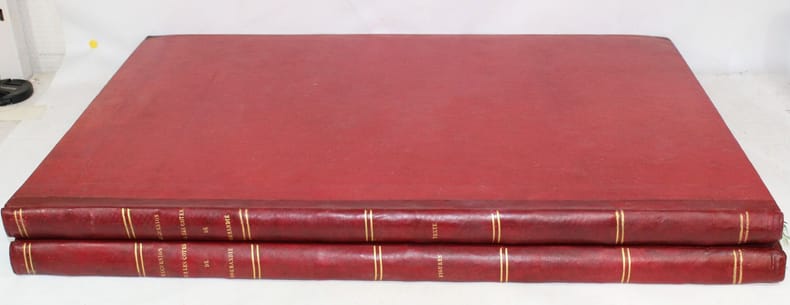
22963Paris, Ostervald, s.d. (1823-1825). Deux volumes in-folio dont l'un des 40 planches sous serpentes en gravure au lavis dite aquatinte précédées d'un titre, et l'autre d'un titre et 54 feuillets de texte. Déchirure réparée à une planche sans atteinte au sujet (Rouen. Vue de la Petite Chaussée). Rares rousseurs, très légères traces de mouillure en haut des volumes. Demi-maroquin rouge à long grain d'époque à coins, dos plats soulignés par des filets dorés (une coiffe restaurée).
2014238032014 Affiche plastifiée, titrée et signée dans la planche en bas à droite "Salon d'Automne 2014 - Champs-Élysées 16-19 octobre" , 2014, 400 x 400 cm., et joint le catalogue de l'exposition, fort in-8 oblong, 560 pages.
- 1946, 20x26cm, en feuilles. - Six dessin érotiques avec rehauts d'aquarelle, crayon blanc sur papier crème type canson. Ces réalisations appartiennent à la dernière manière de l'artiste, certainement la plus aboutie en matière d'inspiration, de virtuosité et de technique. Ces dessins n'ont pas été retenus pour l'illustration du Doctorat impromptu, et n'ont donc pas été gravés pour l'ouvrage. Enveloppe de percaline lie-de-vin, doublée à l'intérieur de papier gris contenant les dessins. Superbe état. Rare ensemble érotique de Paul-Emile Bécat. [ENGLISH DESCRIPTION ON DEMAND]
15298DBo.J. [3 Warenabbildungen] Herbert Zangs, geboren am 27. März 1924 in Krefeld, gestorben am 26. März 2003 ebenda. Deutscher Maler und Objektkünstle