[EURE] JOLY (A.).Livre Rare Book
10 681 résultats
19846Lith. Engelmann, signée en bas à gauche A. Joly, 1822. Lithographie originale tirée sur Chine et montée sur vélin fort, 430 x 295 mm (rares rousseurs).
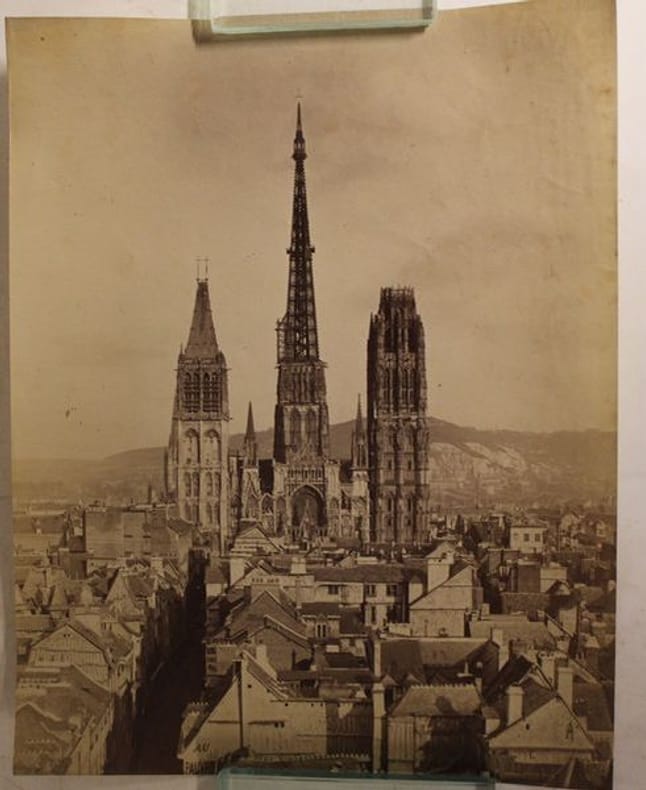
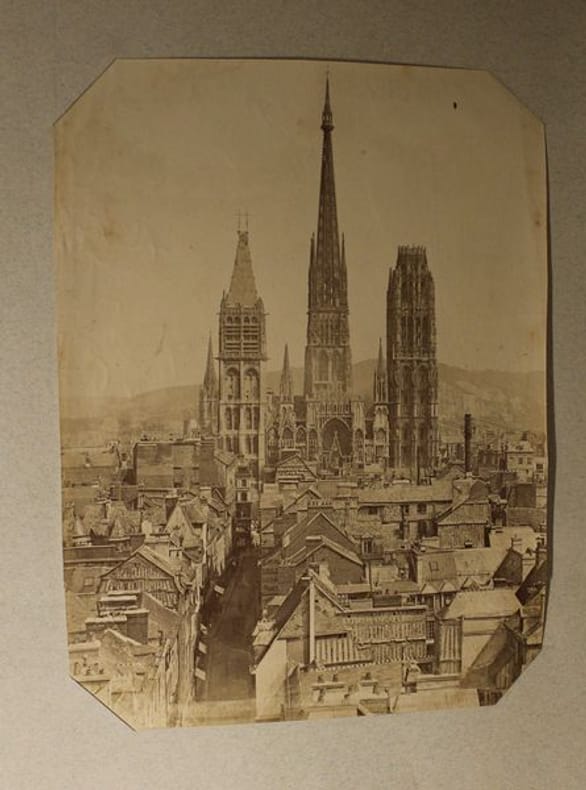
23281Sans nom, circa fin 1880. Tirage sur papier, 220 x 275 mm, bon état. Un mention au verso indique:" 0,60 F chez Saffroy le 17 juillet 1919".
23283Sans nom, circa avant 1900, tampon à l'encre violette au dos: Rouen n° 1009. Tirage sur papier, 280 x 380 mm, manque de papier dans un angle, petites déchirures en pied. Un mention au verso indique:" 1 F chez Paul Prouté le 6 mait 1925".
23284Witz et Cie, Phot. Rouen. Cachet à froid sur le carton, début 1881. Tirage sur papier contrecollé sur carton bleu, 160 x 275 mm, bon état. Un mention au verso indique la provenance:" Pelay, 7 bre 1922".
23285Titré en bas du tirage: 2155 Rouen Cathédrale, la flèche. N.D. Phot., sans date (circa fin 19 ème). Tirage sur papier, 205 x 275 mm, bon état.
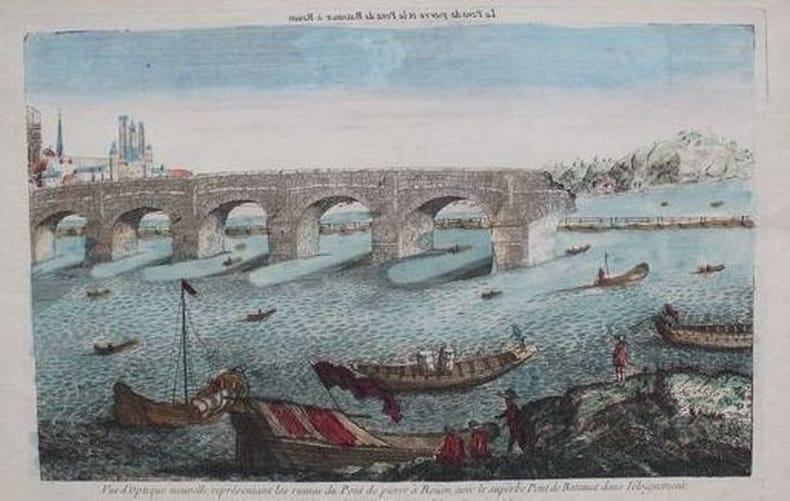
13276Paris, Basset, sd.( fin XVIIIe). Vue d'optique coloriée (49 x 35 cm). Bel exemplaire.
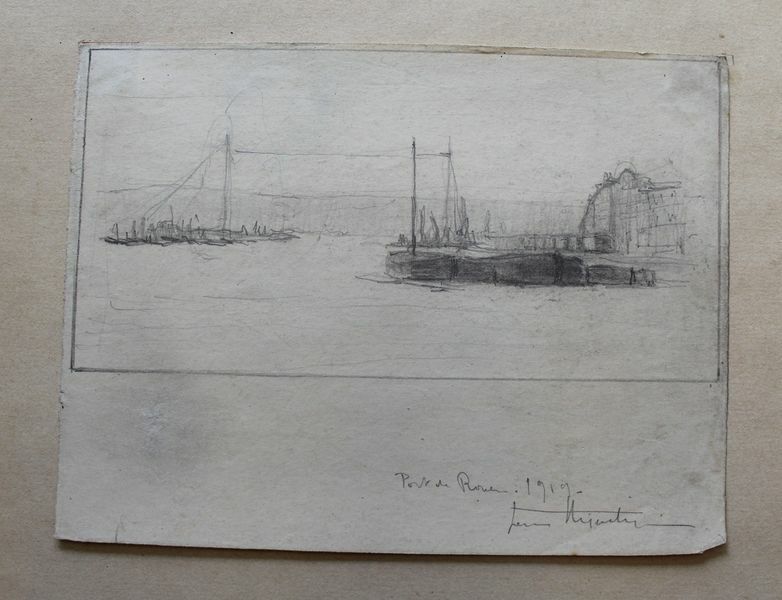
21283Signé, daté 1919. Dessin original au crayon du port (185 x 95 mm), au verso: femme nue assise.
21284Signé en bas à gauche, situé Veulette, l'éboulement, daté 26 août 1877. Dessin original au crayon du port (210 x 137 mm), déchirure réparée en bordure.
16773Paris, Veuve Chapoulaud, s.d. (fin XVIII ème siècle). Vue d'optique gravée et mise en couleurs, 51 x 32,5 cm, bon état.
187127826BORDEAUX A. BELLIER & Cie 1871-73 une affiche Lithographiée en noir sur fond jaune et papier brillant et entoilée : format : 36 cm de haut par 53 cm de large, sans date (1871-1873 car cet imprimeur a créé son activité en 1971 et est mort en 1873) BORDEAUX A. BELLIER & Cie . IMPRIMEUR, 16, rue Cabirol Editeur,
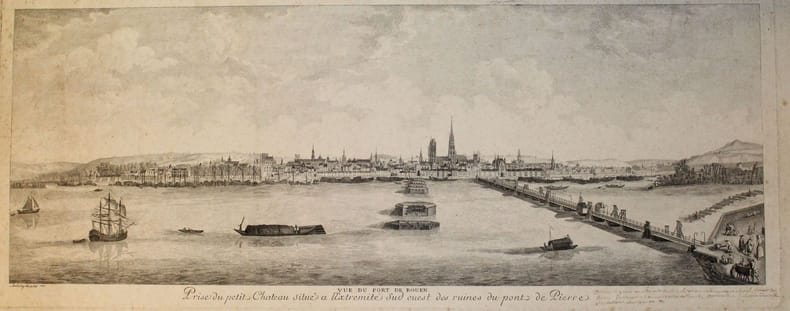
19459Bachelay del et sculp., 1765. Ecrit en bas à droite: Dessiné et Gravé aux depends de M. Le Cat pour son ouvrage sur le climat de Rouen contenant 14 années d'observations de météorologie et des maladies de ses habitants, leur cure etc, etc... Rousseurs. Gravure (63,5 x 29 cm). Quelques salissures.
21626Bachelay del et sculp., 1765. Ecrit en bas à droite: Dessiné et Gravé aux depends de M. Le Cat pour son ouvrage sur le climat de Rouen contenant 14 années d'observations de météorologie et des maladies de ses habitants, leur cure etc, etc... Rousseurs. Gravure (63,5 x 29 cm). Parfait état.
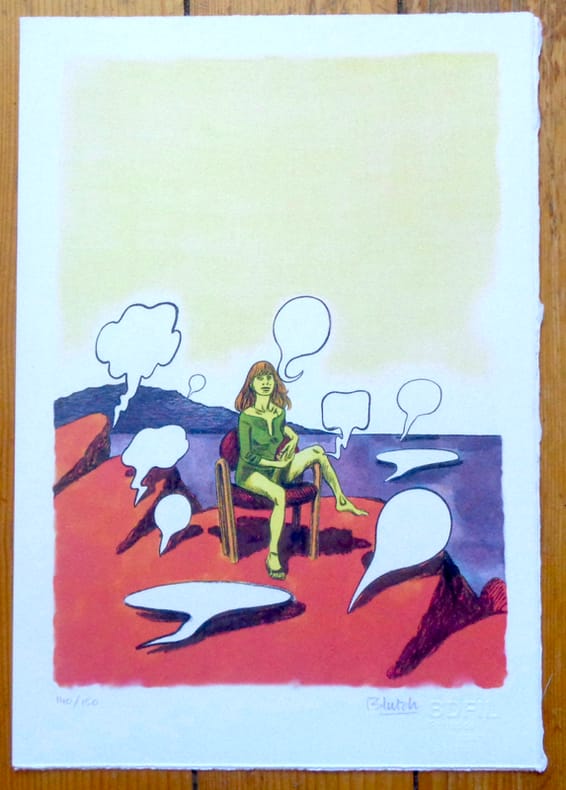
26270Illugraphie sur Arches, tirage limité à 150 exemplaires, justifiée et signée par l'artiste. Format 32,5 x 26,5 cm.
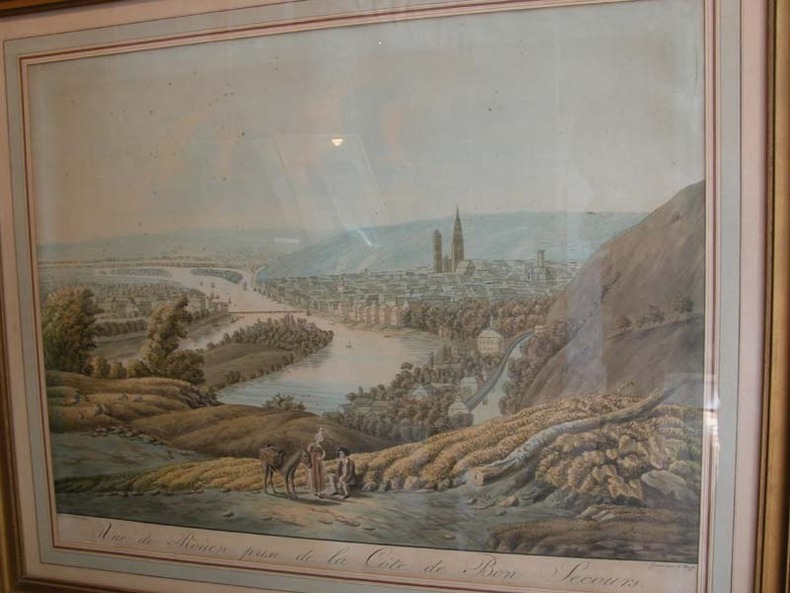
9930S.l.,Joseph Buffa, 1824. Grande gravure (62 x 50 cm) exécutée d'après la célèbre vue de Bonington, rehaussée en couleurs, signée et datée: Jos. Buffa fecit, 1824. Quelques rousseurs, encadrement sous-verre dans une baguette dorée.
19840Lith. Par Bichebois, Fig. Par V. Adam, s.d. (circa 1840). Lithographie sépia, quelques rousseurs, 445 x 335 mm., cachet à froid de Hanri Jeannin, marchand d'estampes à Paris.
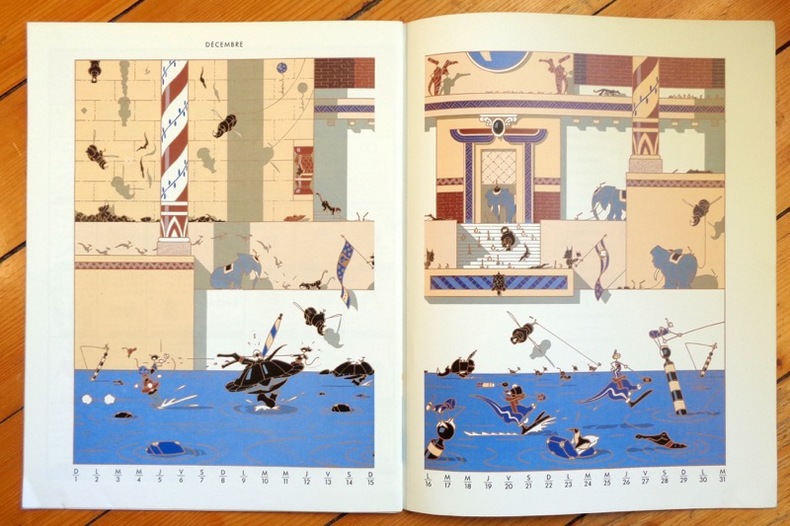
19901720Agence Vues sur la Ville / Typelec Photocomposition / S.c.r.o Photogravure / Cid Editions Impression, 1990. Rarissime et magnifique calendrier, en feuille sous couverture bleue imprimée, au format 36,5 x 28 cm. Très légers frottements à la couverture, 2 petits plis au coin inférieur courant sur tout le volume.
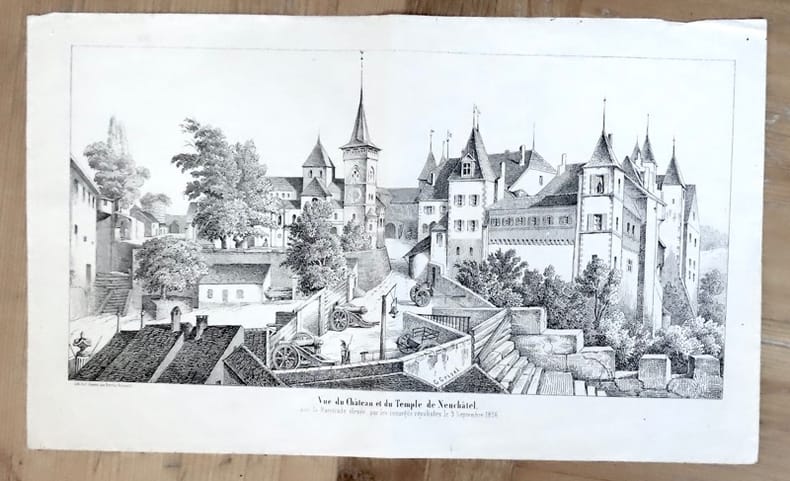
24950Aux Bercles, à Neuchâtel, Lithographie F. Gendre, sans date. Vue au format 38 x 23 cm. Légères traces de plis, pliée en deux.
23349Peinte par J.F. Hue Peintre du Roi, et de son Académie de Peinture et Sculpture. Gravé par F. Godefroy de l'Académie Impériale de Vienne. Sans date (vers 1780). Gravure sur cuivre, à l'eau-forte; 515 x 420 mm (cuvette), 640 x 540 mm hors-tout, contrecollée sur un carton. Bon état, quelques salissures dans la marge. Baguette noire avec filet doré.
187018670Toulouse imprimerie Régionale du Midi, auguste Olivier, Barthe & Cie 1870 une Affiche lithographiée en noir entoilée sur toile et Canson, Format : 67 x 44,5 cm, sans date (1870) Toulouse Imprimerie Régionale du Midi, auguste Olivier, Barthe & Cie Editeur,
- Lucien Vogel éditeur, Paris Juin 1920, 18x24cm, une feuille. - Original color print, printed on vergé paper, signed in the plate. An original print used to illustrate the Gazette du bon ton, one of the most attractive and influential 20th century fashion magazines, featuring the talents of French artists and other contributors from the burgeoning Art Deco movement. A celebrated fashion magazine established in 1912 by Lucien Vogel, La Gazette du bon ton appeared until 1925, with a hiatus from 1915 to 1920 due to the war (the editor-in-chief having been called up for service). It consisted of 69 issues printed in only 2,000 copies each and notably illustrated with 573 color plates and 148 sketches of the models of the great designers. Right from the start, this sumptuous publication "was aimed at bibliophiles and fashionable society," (Françoise Tétart-Vittu, "La Gazette du bon ton", in Dictionnaire de la mode, 2016) and was printed on fine vergé paper using a type cut specially for the magazine by Georges Peignot, known as Cochin, later used (in 1946) by Christian Dior. The prints were made using stencils, heightened in colors, some highlighted in gold or palladium. The story began in 1912, when Lucien Vogel, a man of the world involved in fashion (he had already been part of the fashion magazine Femina) decided, with his wife Cosette de Brunhoff - the sister of Jean, creator of Babar - to set up the Gazette du bon ton, subtitled at the time: "Art, fashion, frivolities." Georges Charensol noted the reasoning of the editor-in-chief: "'In 1910,' he observed, 'there was no really artistic fashion magazine, nothing representative of the spirit of the time. My dream was therefore to make a luxury magazine with truly modern artists...I was assured of success, because when it comes to fashion, no country on earth can compete with France.'" ("Un grand éditeur d'art. Lucien Vogel" in Les Nouvelles littéraires, no. 133, May 1925). The magazine was immediately successful, not only in France but also in the United States and Latin America. At first, Vogel put together a team of seven artists: André-Édouard Marty and Pierre Brissaud, followed by Georges Lepape and Dammicourt, as well as eventually his friends from school and the School of Fine Arts, like George Barbier, Bernard Boutet de Monvel and Charles Martin. Other talented people soon came flocking to join the team: Guy Arnoux, Léon Bakst, Benito, Boutet de Monvel, Umberto Brunelleschi, Chas Laborde, Jean-Gabriel Domergue, Raoul Dufy, Édouard Halouze, Alexandre Iacovleff, Jean Émile Laboureur, Charles Loupot, Chalres Martin, Maggie Salcedo. These artist, mostly unknown when Lucien Vogel sought them out, later became emblematic and sought-after artistic figures. It was also they who worked on the advertising drawings for the Gazette. The plates put the spotlight on, and celebrate, dresses by seven designers of the age: Lanvin, Doeuillet, Paquin, Poiret, Worth, Vionnet and Doucet. The designers provided exclusive models for each issue. Nonetheless, some of the illustrations are not based on real models, but simply on the illustrator's conception of the fashion of the day. The Gazette du bon ton was an important step in the history of fashion. Combining aesthetic demands with the physical whole, it brought together - for the first time - the great talents of the artistic, literary, and fashion worlds; and imposed, through this alchemy, a completely new image of women: slender, independent and daring, which was shared by the new generation of designers, including Coco Chanel, Jean Patou, Marcel Rochas, and so on... Taken over in 1920 by Condé Montrose Nast, the Gazette du bon ton was an important influence on the new layout and aesthetics of that "little dying paper" that Nast had bought a few years earlier: Vogue. [FRENCH VERSION FOLLOWS] Estampe originale en couleur, tirée sur papier vergé, signée en bas à gauche de la planche. Gravure originale réalisée pour l'illustration de
- Didot, Paris 1803, 40,5x54cm, une feuille. - Original print folio untrimmed extracted Travellers in Lower and Upper Egypt Vivant Denon. Board composed of two views as described by the author: No.1 View of a mosque with its minaret. Each province has its own particular taste in these kinds of monuments Moorish architecture having no fixed rules or principles, lightness and elegance are the only laws and, consequently, the productions are infinitely varied; the superabundant ornaments are never inconsistent, and keep them a harmony that is never devoid of grace. These domes were built very quickly, are raised with regularity by masons who have only a few tools, and employ these constructions as plaster, supported by some small pieces of wood. The minaret has no other purpose than to do perceive by far the mosque in which he holds, and to bring this gallery where imams, every four hours, call the Muslim faithful to prayer, singing hymns to Yahweh and his prophet. Each mosque, there is a tank, a basin for washing, and, whenever possible, a small enclosure with trees for prayer in the shade. One shown here is located at the southern end of Rosetta; Smoke can be seen on the right is perpetually produced by a coal factory, which is a rare commodity in the country: the import of wood, which in peacetime is Syria Rosetta is an article particular trade in this city. No.2 view of a portion of the port of Rosetta. Mills that are represented, owned by the Franks, and most built by them, are a mix of buildings that look more like our homes as the fourteenth century Eastern factories of other cities of Egypt; where is the pavilion that belonged to the house Varsi where was housed General Menou. The stage shown was that of the swearing in of the government of the country in the hands of the general: the blows distributed leftover Eastern practice generally set aside for the crowd, ennobling function, and warn the weak presence power, and the distance in which it is considering it. We never arrived in a village, the sheikh, our honor, not should order a distribution, which did not cease at our requisition, and when it believed that on the evidence of his respect was to sufficiently demonstrated. Right, the Nile, where we see an armed sloop, and in the background, the island of Varsi. Light foxing, otherwise good condition. Published for the first time in two volumes, an atlas of engravings, Didot, in 1802, the 'Journey to the Lower and Upper Egypt proved so successful that it was translated in 1803 into English and German, and a few years later in Dutch and Italian, among others. Almost all boards are designed by Denon, who also engraved himself a few, including portraits of the inhabitants of Egypt, who still kept the freshness of sketches taken on the spot (our 104-111 ). Two dozen writers have also collaborated on the creation of which Baltard, Galen, Reville and other etchings. Dominique Vivant, Baron Denon says Vivant Denon, born in Givry January 4, 1747 and died in Paris April 27, 1825, is a writer, author, diplomat and French administrator. At the invitation of Bonaparte, he joined the expedition to Egypt in shipping from May 14, 1798 on the frigate "La Juno." Protected by French troops, he had the opportunity to travel the country in all directions in order to gather the material that was the basis for his artistic work and the most important literary. It supports in particular General Desaix in Upper Egypt, which he refers to numerous sketches, ink wash and other drawings in pen, black chalk, or chalk. He draws constantly, usually on his knee, standing or on horseback, and sometimes even under enemy fire. After a journey of 13 months during which he draws thousands of drawings, Vivant Denon returned to France with Bonaparte, and became the first artist to publish the story of the expedition. The 141 boards that accompany his diary retrace its entire journey from the coast of Corsica to the pharaonic monuments of Upper Egypt. Bonapa
- Didot, Paris 1803, 39,5x54cm, une feuille. - Original print folio, taken from Travels in Upper and Lower Egypt Vivant Denon. Board decorated with an engraving subdivided into eight figures, and described by the author: No.1 The eastern face of the obelisk which was before the temple of Luxor (see Plate L, No. 1). I should desiré have time to draw the four sides which differ between them, except for the First figures of the summit, which is probably a kind of protocol of the dedication of the monument; I thought it would be advantageous to have this inscription to add further to those that we have that are obelisks in Rome and elsewhere. The work of these is such a franchise, we must believe that the Egyptians had a particular caliber tools for cutting granite; whole sculpture is hollow and relief, two inches deep, and a wonderful conservation. No.2 This fragment is the torso of a colossal statue, in white marble, placed inside one of the gates of the great temple of Karnak; He has the distinction of having a belt in which is going dagger in Eastern way: I put at the bottom the small inscription on the medallion that adorns this belt. No.3 Registration taken on the doorpost of a small temple in black granite monolith, which are the remains to Apollinopolis parva or Kus. This fragment, if we can read it, the usage of these small shrines; the letter A indicates the beginning of registration, which extends in a straight line to the letter B, and continues with the letter C to a D, No. 3a that the monument is broken; perfection of these hieroglyphics is such, either by the drawing style; either by the precision of the execution, that, but we thought it only fragment in Egypt, there would be no reason to doubt that the nation that was formerly inhabited had not known the arts, and do had turned their perfection in a high degree. No. 4 An inscription found at Thebes on a fragmented statue. No.5 A major figure in low relief on the ceiling of the room where the celestial planisphere, in the small apartment which is on the great temple of Tentyra (see map, board CXXX, No. 1); this figure takes all the diameter of the ceiling of this room; though fragmented as we can see, it still offers a good rolling contour and well proportioned; his feet, preserved, are the most beautiful style; it has no attribute, except a necklace, I have often seen in the figures of Isis; Curly hair is shaped corkscrew; the two side entries are accurate. No. 6 A monumental inscription, engraved deeply and carefully on the rock of granite is from the island of Philée (see the view, board LXXII, No. 3, and the situation in the card, letter L board LXX). There were several species of these entries; the few that were only run; others who were monumental, like these engraved nearly an inch deep: these inscriptions were probably consecrations or dedications. This extraordinary rock that nature had given the form of a gigantic siege, and to which we had added the job of a staircase into the mass, was perhaps dedicated to the five deities whose images are plotted above registration. No. 7 A similar entry as above, engraved on the upper arm of the Colossus reversed, which is near the Memnoniura at Thebes (see Plate XLII, No. 5, and board XLV, No. 2). This inscription, which is carved an inch deep, and has more than 4 feet tall, is no more effect on the total mass of such a gigantic figure number tattooed on the arm of someone alive. If it were possible to read this dedication, it can be all questions aplaniroit and leveroit all doubts about the situation of statues, palaces, tombs, and temples of Memnon and Ossimandue. Light foxing, marginal tear, otherwise good condition. Published for the first time in two volumes, an atlas of engravings, Didot, in 1802, the 'Journey to the Lower and Upper Egypt proved so successful that it was translated in 1803 into English and German, and a few years later in Dutch and Italian, among others. Almost all boards are designed by Denon
- Didot, Paris 1803, 40,5x54cm, une feuille. - Original print folio, taken from Travels in Upper and Lower Egypt Vivant Denon. Board composed of three views as described by the author: No.1 Serpents which psyllids use to their juggling; when irritated they stand, as shown in this figure, their throat swells, expands, collapses; moreover they are neither bad nor dangerous: we can see in the newspaper, Volume I, page 211, use of that modern psyllids. Pliny says that the tomb of their king Psyllus still subsisted in his time; He added that psyllids guérissoient bite with their simple saliva or by touch alone, at least they publioient. The same author these people were cut to pieces by Nasamons, neighbors, who seized their homes; but some escaped the general defeat; and his time there that still had these old psyllids were going down. No.2 Three heads of Arabs. I thought that a sequence of heads of the various nations that inhabit Egypt pouvoit interested curiosity of observers; these heads, drawn quickly and without having to ask the characters, maintained the simplicity of nature, they may have lost auroient gaining more over; difficult to read in light of such sketches, who has not seen the models, I was determined to burn myself these heads with the same freedom with which they were drawn. These three characters were brothers, the richest and most powerful Kéné, very reasonable and very intelligent; they were very attached to us, and we were coming continuously communicate their ideas about their personal conduct and advise us on what might we be more advantageous: I was going to their house every day, and I ate there several times familiarly arriving at mealtime; no interpreter we were able to agree and establish us joy and cordiality: the middle one, I loved her more, told me to be more free device it was necessary that we establish a relationship: I proposed it to be his father; he accepted with emotion, and, ranking from that time to his duty, he took the excuse to send me anytime few flirtations like fruit until they were rare perfumes, exquisite coffee and that we could not find elsewhere; acceptoit it back with a lot of grace things of no value, always telling me that I ought to him that protection and tenderness. The delicate spirit dictates the right tone and the same ways as in Africa in the most popular courses of Europe. No.3 heads merchants of Mecca, I have drawn Cosseir; their turbans in yellow and red silk, with long fringes, and coiffent a patriarchal way, and give them all to actually imposing air; they add to the ordinary dress of Muslim Beniche a wide long wool wide black and white stripes. Some foxing mainly marginal, otherwise good condition. Published for the first time in two volumes, an atlas of engravings, Didot, in 1802, the 'Journey to the Lower and Upper Egypt proved so successful that it was translated in 1803 into English and German, and a few years later in Dutch and Italian, among others. Almost all boards are designed by Denon, who also engraved himself a few, including portraits of the inhabitants of Egypt, who still kept the freshness of sketches taken on the spot (our 104-111 ). Two dozen writers have also collaborated on the creation of which Baltard, Galen, Reville and other etchings. Dominique Vivant, Baron Denon says Vivant Denon, born in Givry January 4, 1747 and died in Paris April 27, 1825, is a writer, author, diplomat and French administrator. At the invitation of Bonaparte, he joined the expedition to Egypt in shipping from May 14, 1798 on the frigate "La Juno." Protected by French troops, he had the opportunity to travel the country in all directions in order to gather the material that was the basis for his artistic work and the most important literary. It supports in particular General Desaix in Upper Egypt, which he refers to numerous sketches, ink wash and other drawings in pen, black chalk, or chalk. He draws constantly, usually on his knee, standing or on horseback, and som
- Didot, Paris 1803, 39x54cm, une feuille. - Original print folio, taken from Travels in Upper and Lower Egypt Vivant Denon. Board decorated with an engraving subdivided into 10 figures, and described by the author: Strips of different iconic Egyptian temples. No.1 hieroglyphics that decorate the exterior cornice of the nave of the great temple of Tentyra; this ornament, repeating, toured this part of the monument. The middle figure is the head of Isis with its attributes; it is found repeatedly throughout this temple, which was dedicated to him probably. The two big birds head vulture, without feathers, leaving a kind of egg that serves as the body: this bird is often repeated in all kinds of attitudes in ceilings, wings spread, holding in the paws the sort of stick with the palm as seen here before; He also accompanied the heroes and kings in the bas-reliefs depicting the victories and triumphs, and then seems a protective spirit. No. 2 is the inner frieze of the temple near the island of Philée (see Plate LXXII, No. 1). No.3 Friesland Typhonium of Tentyra (see Plate XXXVIII, No. 3), or the temple dedicated to Isis, winner of Typhon, the evil genius or the west wind; it has a head of an old, fat body and shape to that of a child, a tail that is magnifying and that is as long as the legs; it's still wearing the same ornament: one that makes him laying is a deity of the same kind; the head at the same time the character of the dog, the pig, and the crocodile; he's hanging breasts like the Egyptian women, a big belly, and legs of a lion: this figure also repeated the other and accompanying for the most part, seemed to me to be the deity of the temple Hermontis (see Plate CXX, No. 4). Are frequent figures of these two gods as amulets, pulp colored glass and porcelain: I reported that I designed life-size (see pl XCVI, No. 37 and 38. ). They were highly revered, either for good in that waited for either the evil that pouvoit fear or also for two causes; because I think the emblem of the two winds that produce flooding, and can make or insufficient or too large. It is assumed that the figure is in the middle of these two monsters sitting on a lotus flower blooming half is that of Isis, or the good god, who got these two formidable gods water balance , which bloom lotus in the channels when the flood is perfect. No. 4 is the ornament of the frieze of small temple of the Isle of Philée; the effect in nature is as rich and enjoyable: Egyptian artists with a special art successfully combined the meaning of the emblem in tasteful decoration. No. 5 is still in evidence; it is the decoration of the interior base of the middle room of the small temple which is located behind the great temple of Tentyra (see plan Tentyra board XL, No. 1). This decoration is the lotus in three moments of the development of the flowering of this plant. The hawk is taken on an altar to Osiris or the sun; the other side of the moon; ibis on a lotus, another emblem of the flood or the entry into the channels of the Nile; because the lotus did report that channel, since only grows in stagnant water, and is never found in the river current. No. 6, ornament of the inner frieze of Typhonium Apollinopolis magna, a small temple, located near the big temple (See Plate LVII, No. 1), he must have the same meaning as above, No. 3 . There are three more figures that, given the repeated use most often when it comes to flooding, I should think be vessels of holy water or offerings of Nile water during its growth. No. 7 Rich and lovely frieze decorating the open room that is near the one where the celestial planisphere, in the small apartment on the great temple of Tentyra (see map, p. CXXX, No. 1, letter C). The globe is at the center must be the sun, from which the beam of light coming down on earth I was so often the case make sure that opinion on these two figures, I believe able to give as irrevocable: this sort of rain triangular cells decorates the doorway of almost
- Didot, Paris 1803, 40x54cm, une feuille. - Original print folio untrimmed extracted Travellers in Lower and Upper Egypt Vivant Denon.Planche composed of two views as described by the author: No.1 view of Ajaccio, a town now famous for being the cradle of a great man; I represented our arrival (see Journal, Volume II, page 341) 2 · N ° view of Frejus, near the Porte d'Aix; I represented when the two frigates that relate Bonaparte in France entered the port of this city; event is history, and it will become by a monument more lasting than the Roman amphitheater which we see the ruins on the front of the estampe.Rousseurs, otherwise good conservation.Publié for the first time in two volumes including an atlas of engravings, Didot, in 1802, the 'Journey to the Lower and Upper Egypt proved so successful that it was translated in 1803 into English and German, and a few years later in Dutch and Italian, for example. Almost all boards are designed by Denon, who also engraved himself a few, including portraits of the inhabitants of Egypt, who still kept the freshness of sketches taken on the spot (our 104-111 ). Two dozen writers have also collaborated to create etchings which Baltard, Galen, Reville and autres.Dominique Vivant Denon Baron says Vivant Denon, born in Givry January 4, 1747 and died in Paris on April 27 1825 is a writer, author, diplomat and French administrator. At the invitation of Bonaparte, he joined the expedition to Egypt in shipping from May 14, 1798 on the frigate "La Juno." Protected by French troops, he had the opportunity to travel the country in all directions in order to gather the material that was the basis for his artistic work and the most important literary. It supports in particular General Desaix in Upper Egypt, which he refers to numerous sketches, ink wash and other drawings in pen, black chalk, or chalk. He draws constantly, usually on his knee, standing or on horseback, and sometimes even under enemy fire. After a journey of 13 months during which he draws thousands of drawings, Vivant Denon returned to France with Bonaparte, and became the first artist to publish the story of the expedition. The 141 boards that accompany his diary retrace its entire journey from the coast of Corsica to the pharaonic monuments of Upper Egypt. Bonaparte then appointed Director General of the Central Museum of the Republic, which became the Napoleon Museum and the Royal Louvre and arts administrator. In 1805, Vivant Denon revival project of the Vendome column, which had been suspended in 1803 then organizes expeditions across Europe to raise imperial works of art which are plundered to be carried away to the Louvre. In 1814, Louis XVIII confirmed as head of the Louvre, one wing of which still bears his name today. It is considered a great precursor of museology, art history and Egyptology. --- Please note that the translation in english is done automatically, we apologize if the formulas are inaccurate. Contact us for any information! [FRENCH VERSION FOLLOWS] Gravure originale in folio non rognée, extraite du Voyage dans la Basse et la Haute Egypte de Vivant Denon. Planche composée de 2 vues ainsi décrites par l'auteur:N° 1. Vue d'Ajaccio, petite ville devenue célebre pour avoir été le berceau d'un grand homme ; j'y ai représenté notre arrivée (voyez le Journal, tome II, page 341). N° 2. Vue de Fréjus, du côté de la porte d'Aix ; j'y ai représenté le moment où les deux frégates qui rapportent Bonaparte en France entrent dans le port de cette ville ; événement qui appartient à l'histoire, et deviendra par elle un monument plus durable que l'amphithéâtre romain dont on voit la ruine sur le devant de l'estampe. Rousseurs, sinon bel état de conservation. Publié pour la première fois en deux volumes, dont un atlas de gravures, chez Didot, en 1802, le 'Voyage dans la Basse et la Haute Égypte' connut un tel succès qu'il fut traduit dès 1803 en Anglais et en Allemand, puis quelques années plus tard en Hollandais et en I