10 681 résultats
- Didot, Paris 1803, 40x54cm, une feuille. - Original print folio, taken from Travels in Upper and Lower Egypt Vivant Denon. Board composed of two views as described by the author: No.1 View Apollinopolis magna Etfu taken from west to east of the temple on hills that dominate, and where we see everything both its external development and some parts of its interior. I made a trip of more than fifty leagues in the thought of adding this drawing to your collection, to make known to complete this magnificent building; and yet arrived at Etfu I was at the time to leave without being able to draw it, by the inability to withstand the heat of the sun that it was necessary that I should be exposed to this view. I have the intelligence of Baltard citizen for making the imperfect sketch, I had done as I had been tormented by my eyes glare éprouvoient liveliness of the day, and those in my blood Boiling occasioned me every moment: this print is one of many obligations that I have at Baltard citizen, who is on loan to the execution of my work with accuracy, a zeal and friendship, which equaled the talent that it was so easy to put it. In the development of this great monument we can see right into the front door; between two large stones advancing two piers on the doorframe, which were coming against arguably support the heads of two statues in the shape of caryatids; the four long niches before which had to be obelisks, as I'm allowed to think by repeating the same niches behind obelisks that I found to Philée; on the walls of moles three orders of hieroglyphics, becoming ever more gigantic, and ending up having twenty-five feet of proportion; courtyard decorated with a gallery of columns, with two terraces, leading to two doors through which we reach the stairs going up to the platforms of moles; in the courtyard modern buildings, which are part of the village of Etfu which we perceive the other party beyond the temple; from under the porch which I made the drawing, pl. LVII, No. 1; following probably contains different apartments, and the sanctuary of the temple buried, and now cluttered with garbage, except for a few gaps that serve as store built on the platform of the temple houses; the leveling a wall of circumvallation, decorated inside as outside countless hieroglyphics, executed with a sought care; while the left side of the print Arab tombs encountered on the road to Etfu NSHS; the Nile in the third level, and in the background the Arabian chain; on the front of the mound of rubble, under which are the remains of the ancient city of Apollinopolis; and the group of figures, the frugal meal of an Arab family. No.2 view of the situation of the temple of Apollinopolis magna taken several leagues; This temple, built on a hill in the middle of the valley, looks like a fortress, well placed to control the country. Marginal foxing, marginal tear skilfully restored with a piece of Filmoplast, otherwise good condition. Published for the first time in two volumes, an atlas of engravings, Didot, in 1802, the 'Journey to the Lower and Upper Egypt proved so successful that it was translated in 1803 into English and German, and a few years later in Dutch and Italian, among others. Almost all boards are designed by Denon, who also engraved himself a few, including portraits of the inhabitants of Egypt, who still kept the freshness of sketches taken on the spot (our 104-111 ). Two dozen writers have also collaborated on the creation of which Baltard, Galen, Reville and other etchings. Dominique Vivant, Baron Denon says Vivant Denon, born in Givry January 4, 1747 and died in Paris April 27, 1825, is a writer, author, diplomat and French administrator. At the invitation of Bonaparte, he joined the expedition to Egypt in shipping from May 14, 1798 on the frigate "La Juno." Protected by French troops, he had the opportunity to travel the country in all directions in order to gather the material that was the basis for his artistic work and the most
- Didot, Paris 1803, 40x54cm, une feuille. - Original print folio, taken from Travels in Upper and Lower Egypt Vivant Denon. Board composed of three views as described by the author: No.1 ruins of a temple near Chnubis, seven or eight hundred yards from the walls of the city: this little monument, like the Hermitage, the edge of the desert, has a very imposing character; a sanctuary of ancient times was surrounded after a rotating gallery, which was completed by two portals that are destroyed. Desired I should make more views because all its aspects were equally noble and picturesque; nudity soil round the monument leaves no doubt about the isolation in which he was all the time, and there ought not to look for the existence of a lost city in the mists of time. No. 2 View of the ruins of Ombos, capital of the prefecture of the same name, built in a theatrical situation, overlooking the Nile and the entire region of the valley; debris out of its monuments still lavishly bricks and shards of its particular buildings: you can see right into the wall of his circumvallation, with a door that is still understood; the only time I've encountered this life: the two piers, which served probably entrance to the enclosure of the great temple can be seen behind, built on shaky ground, or reported, had foundations that were going down to the level of the river; the temple, very conveniently located, was to produce the most impressive when it was surrounded by all its accessories effect; ruin is still admirable. I never saw that to have to regret not being able to make a view that could give an idea of ??its splendor. On the left, on a mound of red bricks, which are the remains of the ancient city, we perceive some factories, which are the homes of Arab pastoralists who live miserably on the sumptuous ruins of ancient dwellings. I regretted not being able to find within its walls if there would have remnants of some basins where auroient fed crocodiles that we adored in Ombos. No.3 view of the ruins of Chnubis, one of the cities whose remains, though many, are arguably the least idea of ??his plan and the layout of its buildings; it will probably have been built or rebuilt at various times: we see very small monuments close to the large, and also treated in detail. I saw Chnubis twice, and both in the most inconvenient manner (see the newspaper, Volume II, page 170). The ruins are right, small forms, and could belong to very small monuments; which the ends, is a group of two figures side by side and granite reversed: where the two isolated characters is a parapet surrounding a basin around which was a gallery columns. There is still water in the location where we see a hunter who shoots a gun on one of the birds that were in the swamp. The monument to the men on horseback is a gallery of two species of high columns at two periods, however, united by the same flowerbed: seroient is the remains of a temple which we would have done increases? Nearby are two parallel doors, less large, and that belonged to another monument, all beautifully covered many hieroglyphics; but there was more particular in the ruins of this city is the great wall of unbaked bricks whose monuments are still enceints; we see everything left an opening, which was probably a door, which can follow the line along the second plane; is behind the Libyan chain; in front of the Nile landscape changes, before which there had a dock, which there are some ruins. Very discrete foxing, two tiny marginal holes, a tiny trace of angular creases, otherwise good condition. Published for the first time in two volumes, an atlas of engravings, Didot, in 1802, the 'Journey to the Lower and Upper Egypt proved so successful that it was translated in 1803 into English and German, and a few years later in Dutch and Italian, among others. Almost all boards are designed by Denon, who also engraved himself a few, including portraits of the inhabitants of Egypt, who still kept the freshness of sket
- Didot, Paris 1803, 40,5x54cm, une feuille. - Original print folio untrimmed extracted Travellers in Lower and Upper Egypt Vivant Denon. Board composed of two views as described by the author: No.1 A karavanseray. See the explanation I gave another board XXVII, No. 1 The dum palm, Hene, and the date palm, joined the Arab style of the building, give this one a print Oriental aspect, which I thought we sauroit me will provide the table. In a country where everything is extraordinary, the reader sometimes likes to surprise the traveler in circumstances which seem most real to him, for the very reason that they are the least important and unexpected; these are portraits done quickly without having to ask the model is: they hit truth, and they still have all the grace. It is in the same thought as I drew a sheet # 2, a district of the city of Girgeh, where I put, as I happened to see a kiachef surrounded by the splendor of his house: Presidents' walk Bdtonniers riding, walking in front of him to ward off those who would approcheroient; he is followed by his Mamelukes. It is these kinds of scenes, with the portrait of where they are going, who acquainted the physiognomy of a country. For a player to hear a good traveler, he must walk with him, the traveler can say: When I was there, that's what I faw; this is the tree under which I was sitting species; this is a house of a particular country. The corner of a street at random gives more the idea of ??such a city as drawing to claim its main buildings; is often better acquainted with a character quoting him a sentimental word, distributed, except by making a long and pompous eulogy. Foxing, otherwise good condition. Published for the first time in two volumes, an atlas of engravings, Didot, in 1802, the 'Journey to the Lower and Upper Egypt proved so successful that it was translated in 1803 into English and German, and a few years later in Dutch and Italian, among others. Almost all boards are designed by Denon, who also engraved himself a few, including portraits of the inhabitants of Egypt, who still kept the freshness of sketches taken on the spot (our 104-111 ). Two dozen writers have also collaborated on the creation of which Baltard, Galen, Reville and other etchings. Dominique Vivant, Baron Denon says Vivant Denon, born in Givry January 4, 1747 and died in Paris April 27, 1825, is a writer, author, diplomat and French administrator. At the invitation of Bonaparte, he joined the expedition to Egypt in shipping from May 14, 1798 on the frigate "La Juno." Protected by French troops, he had the opportunity to travel the country in all directions in order to gather the material that was the basis for his artistic work and the most important literary. It supports in particular General Desaix in Upper Egypt, which he refers to numerous sketches, ink wash and other drawings in pen, black chalk, or chalk. He draws constantly, usually on his knee, standing or on horseback, and sometimes even under enemy fire. After a journey of 13 months during which he draws thousands of drawings, Vivant Denon returned to France with Bonaparte, and became the first artist to publish the story of the expedition. The 141 boards that accompany his diary retrace its entire journey from the coast of Corsica to the pharaonic monuments of Upper Egypt. Bonaparte then appointed Director General of the Central Museum of the Republic, which became the Napoleon Museum and the Royal Louvre and arts administrator. In 1805, Vivant Denon revival project of the Vendome column, which had been suspended in 1803 then organizes expeditions across Europe to raise imperial works of art which are plundered to be carried away to the Louvre. In 1814, Louis XVIII confirmed as head of the Louvre, one wing of which still bears his name today. It is considered a great precursor of museology, art history and Egyptology. [FRENCH VERSION FOLLOWS] Gravure originale in folio non rognée, extraite du Voyage dans la Basse et la Haute E
- Didot, Paris 1803, 40,5x54cm, une feuille. - Original print folio, taken from Travels in Upper and Lower Egypt Vivant Denon. Board composed of two views as described by the author: No.1 The remains of a coated near Etfu dock; two staircases were going down the Nile; none other ruins will accompany this fragment, which, however, indicate the ancient neighborhood of a city, since the stairs announce that dock still had a purpose other than to retain water; the river barefoot abutment of this construction, and currently happening behind. This interesting in itself, but offering little fragment picturesque forms, I thought I should add a group of young characters called Goubli or beyond, or Barabra, which is the generic name for all the peoples of Egypt which are beyond the cataracts; their costume for men is the absolute nudity, what they add a piece of cloth or cotton cloth they roam at will on what they want to cover their person; their hair long enough, though frizzy, curly and still curly long way to ancient Egyptian figures; they anoint their hair with oil of cedar, they like the smell, and at the same time prevents the inconvenience of vermin, which would otherwise be an indestructible établiroit way in impossible to comb hair. Women and children wear two earrings in each ear, one above and one below, necklaces with fringes formed small leather thongs, completed by grains of colored glass; a belt of the same material, finished well, and that happens to them until the middle of the thighs, enough to calm their modesty, until they become marriageable. Women beyond, are well made, are round and firm muscles, have thin skin, cool touch, and it has particular merit appreciated by men whose love is palpable, and voluptuousness any material which calculate and evaluate the physical, and are buying in women beyond the summer pleasures, kind of luxury we still acquainted for clothes: the Russians are building their homes for winter Italians for the summer, Orientals, like Kamchadals, believe they need a winter home and a home for the time of great heat. No. 2 A view of the last pyramids, one hundred and thirty leagues from those of Giza, near a village built in the desert beyond Etfu; this pyramid, much smaller than the others, constructed masses more divided, did not put the same weather resistance, or belongs to an earlier era; collapsed in all its parts, it seems more than a pile of rubble, that however we see that have been shaped and placed on the regular bases. To give some interest in this view if dry by itself, I added the house, taken from life too, an Arab farmers on the edge of the desert family; I wanted to give the image of this monotonous tranquility that is not distracted by the shock of no novelty; This calm that leaves a long time between each life event; that tranquility where everything succeeds peacefully in the soul, where little by little becomes a feeling an emotion, a habit that becomes a principle, where finally the lightest impression is analyzed; so that in conversation with this species of men, we are astonished to find him in the most delicate distinctions, and the finest sense next to the most absolute ignorance. Some sections of earthen walls, which they add a straw cover, sufficient to their homes. The factory is in the middle is a dovecote, built in terracotta in the sun; it is divided into small boxes in the interior for each family of pigeon; the door is round; this is what is seen below the loft; there is a small opening in the middle to let the air; it is applied every night to put the colony safe against the jackals. To the right is the barn, lower, smaller, because he has no inner division; left the main apartment, the women, where one fears a cold night when removed; above are dogs, which are nothing in the friendly society, living apart as defensive allies; a deer, a hawk, which are also free partners; chickens and pigeons are the only domestic: the bardaks, which are the pots to drink the
19724434Paris ARC 2, Musée d'art moderne de la ville de Paris 1972 aucune reliure Paris, ARC 2, Musée d'art moderne de la ville de Paris, 1976. 48 x 32,5 cm, sur papier kraft, affiche en noir au recto, texte de présentation de l'exposition (par Carole Naggar) imprimé au verso.
200063784Thomas Cook 2000 In-4 relié. 160 pages. Très bon état d’occasion.
1961104023Paris Les Arts Plastiques Modernes 1961 1 vol. broché plaquette in-8, agrafée, sous couverture imprimée, 4 pages, une reproduction en noir. Plaquette d'invitation à l'exposition du peintre grec Charis Voyatzis (1924-1981) à la Galerie Les Arts Plastiques Modernes de MM. Mouradian et Vallotton. Texte de Waldemar-George. Exemplaire provenant de la bibliothèque de Georges Bataille avec tampon à l'encre noire sur le premier feuillet "Bibliothèque de Georges Bataille".
1961104023Paris Les Arts Plastiques Modernes 1961 1 vol. broché plaquette in-8, agrafée, sous couverture imprimée, 4 pages, une reproduction en noir. Plaquette d'invitation à l'exposition du peintre grec Charis Voyatzis (1924-1981) à la Galerie Les Arts Plastiques Modernes de MM. Mouradian et Vallotton. Texte de Waldemar-George. Exemplaire provenant de la bibliothèque de Georges Bataille avec tampon à l'encre noire sur le premier feuillet "Bibliothèque de Georges Bataille".
- Lucien Vogel éditeur, Paris Avril 1920, 18x24cm, une feuille. - Original color print, printed on vergé paper, signed in the plate. An original print used to illustrate the Gazette du bon ton, one of the most attractive and influential 20th century fashion magazines, featuring the talents of French artists and other contributors from the burgeoning Art Deco movement. A celebrated fashion magazine established in 1912 by Lucien Vogel, La Gazette du bon ton appeared until 1925, with a hiatus from 1915 to 1920 due to the war (the editor-in-chief having been called up for service). It consisted of 69 issues printed in only 2,000 copies each and notably illustrated with 573 color plates and 148 sketches of the models of the great designers. Right from the start, this sumptuous publication "was aimed at bibliophiles and fashionable society," (Françoise Tétart-Vittu, "La Gazette du bon ton", in Dictionnaire de la mode, 2016) and was printed on fine vergé paper using a type cut specially for the magazine by Georges Peignot, known as Cochin, later used (in 1946) by Christian Dior. The prints were made using stencils, heightened in colors, some highlighted in gold or palladium. The story began in 1912, when Lucien Vogel, a man of the world involved in fashion (he had already been part of the fashion magazine Femina) decided, with his wife Cosette de Brunhoff - the sister of Jean, creator of Babar - to set up the Gazette du bon ton, subtitled at the time: "Art, fashion, frivolities." Georges Charensol noted the reasoning of the editor-in-chief: "'In 1910,' he observed, 'there was no really artistic fashion magazine, nothing representative of the spirit of the time. My dream was therefore to make a luxury magazine with truly modern artists...I was assured of success, because when it comes to fashion, no country on earth can compete with France.'" ("Un grand éditeur d'art. Lucien Vogel" in Les Nouvelles littéraires, no. 133, May 1925). The magazine was immediately successful, not only in France but also in the United States and Latin America. At first, Vogel put together a team of seven artists: André-Édouard Marty and Pierre Brissaud, followed by Georges Lepape and Dammicourt, as well as eventually his friends from school and the School of Fine Arts, like George Barbier, Bernard Boutet de Monvel and Charles Martin. Other talented people soon came flocking to join the team: Guy Arnoux, Léon Bakst, Benito, Boutet de Monvel, Umberto Brunelleschi, Chas Laborde, Jean-Gabriel Domergue, Raoul Dufy, Édouard Halouze, Alexandre Iacovleff, Jean Émile Laboureur, Charles Loupot, Chalres Martin, Maggie Salcedo. These artist, mostly unknown when Lucien Vogel sought them out, later became emblematic and sought-after artistic figures. It was also they who worked on the advertising drawings for the Gazette. The plates put the spotlight on, and celebrate, dresses by seven designers of the age: Lanvin, Doeuillet, Paquin, Poiret, Worth, Vionnet and Doucet. The designers provided exclusive models for each issue. Nonetheless, some of the illustrations are not based on real models, but simply on the illustrator's conception of the fashion of the day. The Gazette du bon ton was an important step in the history of fashion. Combining aesthetic demands with the physical whole, it brought together - for the first time - the great talents of the artistic, literary, and fashion worlds; and imposed, through this alchemy, a completely new image of women: slender, independent and daring, which was shared by the new generation of designers, including Coco Chanel, Jean Patou, Marcel Rochas, and so on... Taken over in 1920 by Condé Montrose Nast, the Gazette du bon ton was an important influence on the new layout and aesthetics of that "little dying paper" that Nast had bought a few years earlier: Vogue. [FRENCH VERSION FOLLOWS] Estampe originale en couleur, tirée sur papier vergé, signée en bas à droite de la planche. Gravure originale réalisée pour l'illustration
- Lucien Vogel éditeur, Paris Avril 1920, 18x24cm, une feuille. - Estampe originale en couleur, tirée sur papier vergé, signée en bas à droite de la planche. Gravure originale réalisée pour l'illustration de La Gazette du bon ton, l'une des plus belles et des plus influentes revues de mode du XXème siècle, célébrant le talent des créateurs et des artistes français en plein essor de l'art déco. Célèbre revue de mode fondée en 1912 par Lucien Vogel, La Gazette du bon ton a paru jusqu'en 1925 avec une interruption durant la Guerre de 1915 à 1920, pour cause de mobilisation de son rédacteur en chef. Elle se constitue de 69 livraisons tirées à seulement 2000 exemplaires et est illustrée notamment de 573 planches en couleurs et de 148 croquis représentant des modèles de grands couturiers. Dès leur parution, ces luxueuses publications « s'adressent aux bibliophiles et aux mondains esthètes » (Françoise Tétart-Vittu « La Gazette du bon ton » in Dictionnaire de la mode, 2016). Imprimées sur beau papier vergé, elles utilisent une police typographique spécialement créée pour la revue par Georges Peignot, le caractère Cochin, repris en 1946 par Christian Dior. Les estampes sont réalisées grâce à la technique du pochoir métallique, rehaussées en couleurs et pour certaines soulignées à l'or ou au palladium. L'aventure commence en 1912 lorsque Lucien Vogel, homme du monde et de la mode - il a déjà participé à la revue Femina - décide de fonder avec sa femme Cosette de Brunhoff (sur de Jean, le père de Babar) la Gazette du bon ton dont le sous-titre est alors « Art, modes et frivolités ». Georges Charensol rapporte les propos du rédacteur en chef : « En 1910, observe-t-il, il n'existait aucun journal de mode véritablement artistique et représentatif de l'esprit de son époque. Je songeais donc à faire un magazine de luxe avec des artistes véritablement modernes [...] J'étais certain du succès car pour la mode aucun pays ne peut rivaliser avec la France. » (« Un grand éditeur d'art. Lucien Vogel » in Les Nouvelles littéraires, n°133, mai 1925). Le succès de la revue est immédiat, non seulement en France, mais aussi aux Etats-Unis et en Amérique du Sud. À l'origine, Vogel réunit donc un groupe de sept artistes : André-Édouard Marty et Pierre Brissaud, suivis de Georges Lepape et Dammicourt ; et enfin ses amis de l'École des beaux-arts que sont George Barbier, Bernard Boutet de Monvel, ou Charles Martin. D'autres talents viennent rapidement rejoindre l'équipée : Guy Arnoux, Léon Bakst, Benito, Boutet de Monvel, Umberto Brunelleschi, Chas Laborde, Jean-Gabriel Domergue, Raoul Dufy, Édouard Halouze, Alexandre Iacovleff, Jean Émile Laboureur, Charles Loupot, Charles Martin, Maggie Salcedo. Ces artistes, inconnus pour la plupart lorsque Lucien Vogel fait appel à eux, deviendront par la suite des figures artistiques emblématiques et recherchées. Ce sont ces mêmes illustrateurs qui réalisent les dessins des publicités de la Gazette. Les planches mettent en lumière et subliment les robes de sept créateurs de l'époque : Lanvin, Doeuillet, Paquin, Poiret, Worth, Vionnet et Doucet. Les couturiers fournissent pour chaque numéro des modèles exclusifs. Néanmoins, certaines des illustrations ne figurent aucun modèle réel, mais seulement l'idée que l'illustrateur se fait de la mode du jour. La Gazette du bon ton est une étape décisive dans l'histoire de la mode. Alliant l'exigence esthétique et l'unité plastique, elle réunit pour la première fois les grands talents du monde des arts, des lettres et de la mode et impose, par cette alchimie, une toute nouvelle image de la femme, élancée, indépendante et audacieuse, également portée par la nouvelle génération de couturiers Coco Chanel, Jean Patou, Marcel Rochas... Reprise en 1920 par Condé Montrose Nast, la Gazette du bon ton inspirera largement la nouvelle composition et les choix esthétiques du « petit journal mourant » que Nast avait racheté quelques années auparavant : le magazine Vogue. [ENGLISH DESCR
- Lucien Vogel éditeur, Paris 1920, 19,5x25cm, une feuille. - Original color print, printed on vergé paper, the signature does not let identify the artist. An original print used to illustrate the Gazette du bon ton, one of the most attractive and influential 20th century fashion magazines, featuring the talents of French artists and other contributors from the burgeoning Art Deco movement. A celebrated fashion magazine established in 1912 by Lucien Vogel, La Gazette du bon ton appeared until 1925, with a hiatus from 1915 to 1920 due to the war (the editor-in-chief having been called up for service). It consisted of 69 issues printed in only 2,000 copies each and notably illustrated with 573 color plates and 148 sketches of the models of the great designers. Right from the start, this sumptuous publication "was aimed at bibliophiles and fashionable society," (Françoise Tétart-Vittu, "La Gazette du bon ton", in Dictionnaire de la mode, 2016) and was printed on fine vergé paper using a type cut specially for the magazine by Georges Peignot, known as Cochin, later used (in 1946) by Christian Dior. The prints were made using stencils, heightened in colors, some highlighted in gold or palladium. The story began in 1912, when Lucien Vogel, a man of the world involved in fashion (he had already been part of the fashion magazine Femina) decided, with his wife Cosette de Brunhoff - the sister of Jean, creator of Babar - to set up the Gazette du bon ton, subtitled at the time: "Art, fashion, frivolities." Georges Charensol noted the reasoning of the editor-in-chief: "'In 1910,' he observed, 'there was no really artistic fashion magazine, nothing representative of the spirit of the time. My dream was therefore to make a luxury magazine with truly modern artists...I was assured of success, because when it comes to fashion, no country on earth can compete with France.'" ("Un grand éditeur d'art. Lucien Vogel" in Les Nouvelles littéraires, no. 133, May 1925). The magazine was immediately successful, not only in France but also in the United States and Latin America. At first, Vogel put together a team of seven artists: André-Édouard Marty and Pierre Brissaud, followed by Georges Lepape and Dammicourt, as well as eventually his friends from school and the School of Fine Arts, like George Barbier, Bernard Boutet de Monvel and Charles Martin. Other talented people soon came flocking to join the team: Guy Arnoux, Léon Bakst, Benito, Boutet de Monvel, Umberto Brunelleschi, Chas Laborde, Jean-Gabriel Domergue, Raoul Dufy, Édouard Halouze, Alexandre Iacovleff, Jean Émile Laboureur, Charles Loupot, Chalres Martin, Maggie Salcedo. These artist, mostly unknown when Lucien Vogel sought them out, later became emblematic and sought-after artistic figures. It was also they who worked on the advertising drawings for the Gazette. The plates put the spotlight on, and celebrate, dresses by seven designers of the age: Lanvin, Doeuillet, Paquin, Poiret, Worth, Vionnet and Doucet. The designers provided exclusive models for each issue. Nonetheless, some of the illustrations are not based on real models, but simply on the illustrator's conception of the fashion of the day. The Gazette du bon ton was an important step in the history of fashion. Combining aesthetic demands with the physical whole, it brought together - for the first time - the great talents of the artistic, literary, and fashion worlds; and imposed, through this alchemy, a completely new image of women: slender, independent and daring, which was shared by the new generation of designers, including Coco Chanel, Jean Patou, Marcel Rochas, and so on... Taken over in 1920 by Condé Montrose Nast, the Gazette du bon ton was an important influence on the new layout and aesthetics of that "little dying paper" that Nast had bought a few years earlier: Vogue. [FRENCH VERSION FOLLOWS] Estampe originale en couleur tirée sur papier vergé, la signature ne permet pas d'identifier l'artiste. Gravure orig
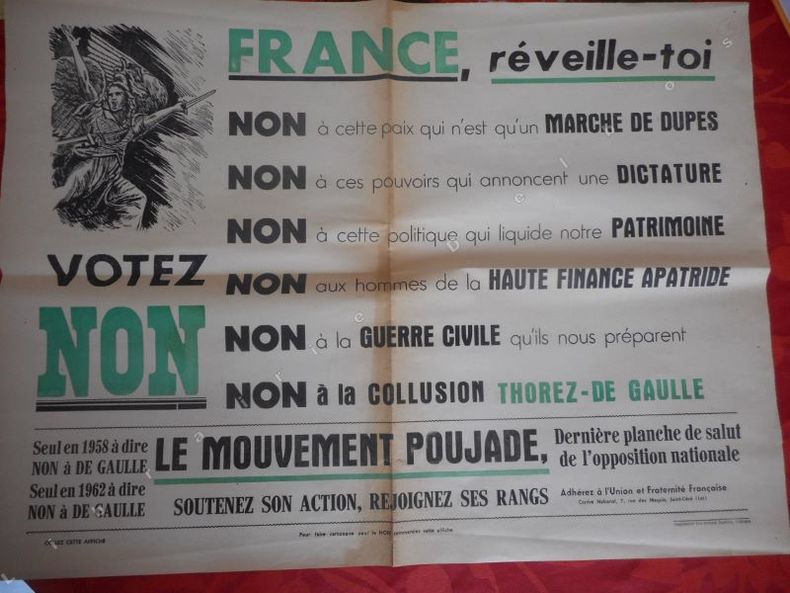
43064s.d.. Affiche politique au format 60x40 cm, non datee. Pliee. Tres bon etat.
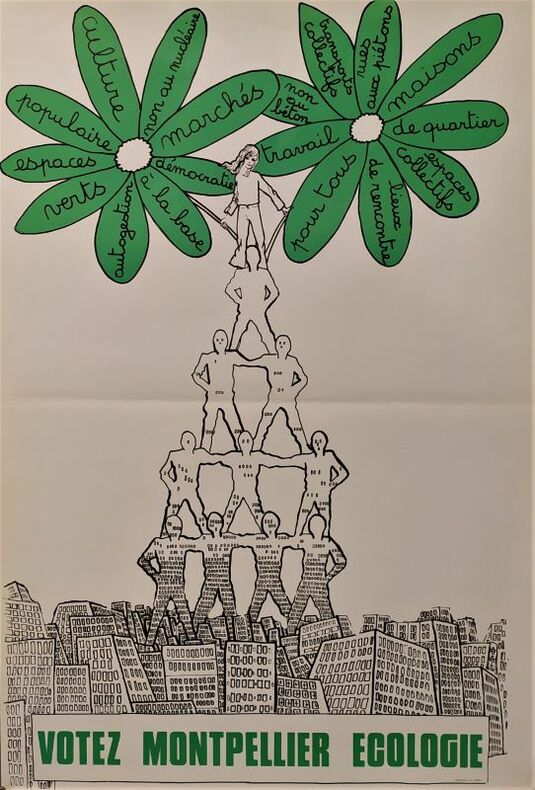
3136Imprimerie de la charité. Impression en offset. ca.1978. Dim: 720 x 658 mm. Pliure centrale, mais très bon état.
3136Imprimerie de la charité. Impression en offset. ca.1978. Dim: 720 x 658 mm. Pliure centrale, mais très bon état.
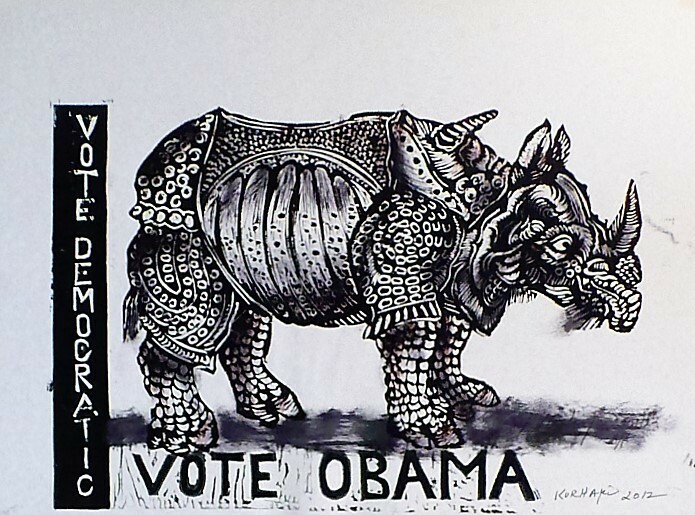
716Gravure originale sur Linoléum sur papier glacé. Dimensions: 32 x 43 cm. Signée et datée "2012".
716Gravure originale sur Linoléum sur papier glacé. Dimensions: 32 x 43 cm. Signée et datée "2012".
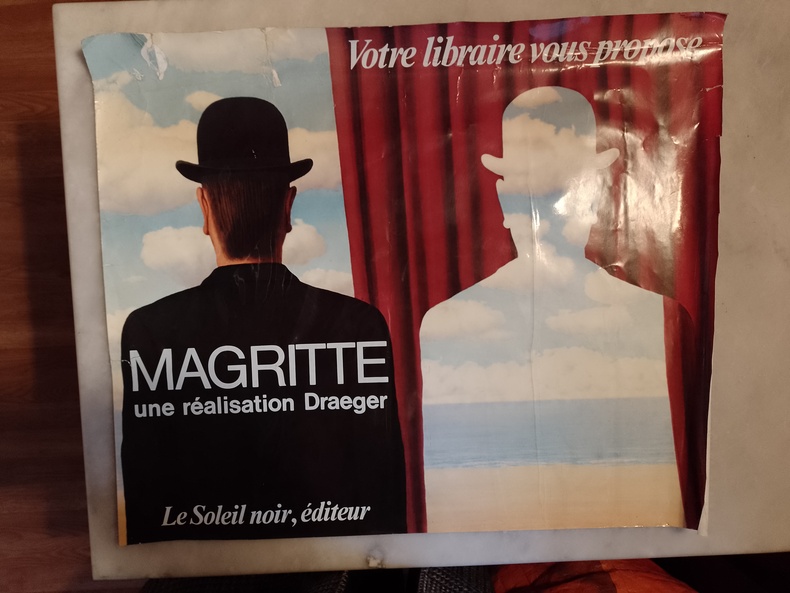
1977AFFICHE79461300124Paris, Le Soleil Noir éditeur, 1977, 62 x 52 cm. PLV pour la sortie en librairie de la monographie d'Harry Torczyner.
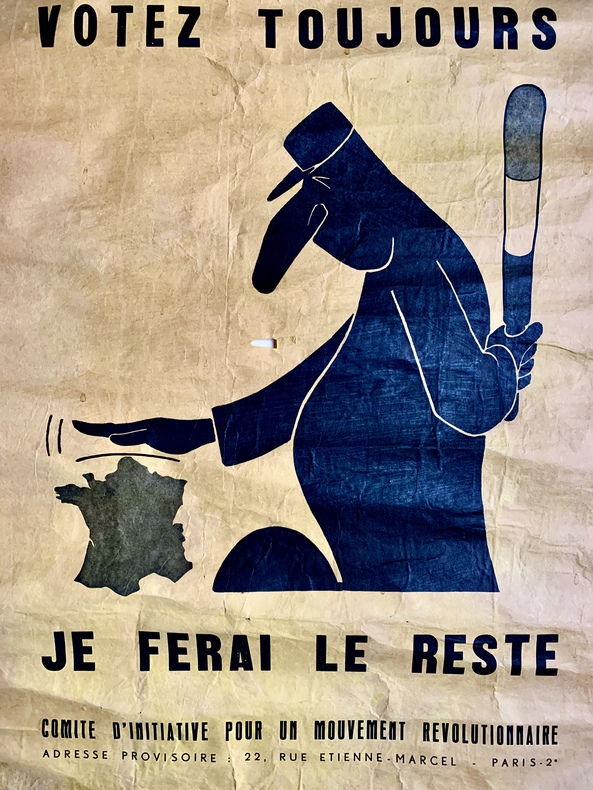
awd-422Paris, Comité d’initiative pour un mouvement révolutionnaire. Imprimerie Robert et Cie, mai 68. Affiche d'époque imprimée en noir sur un papier légèrement brun. Décollée avec traces de plis et restes de colle ancienne. Minces déchirures avec légers manques (55,4/75,4 cm).
20142broché- 20x 30 - 216pp - éditions LES AFFICHES - DATE ????
62638BBo.J. (Horst Janssen, geboren am 14. November 1929 in Wandsbek bei Hamburg, gestorben am 31. August 1995 in Hamburg. Zeichner, Grafiker, Autor, Plakatkünstler, Illustrator und Fotograf, einer der herausragendsten und produktivsten Zeichner und Grafiker des 20. Jahrhunderts). [2 Warenabbildungen]
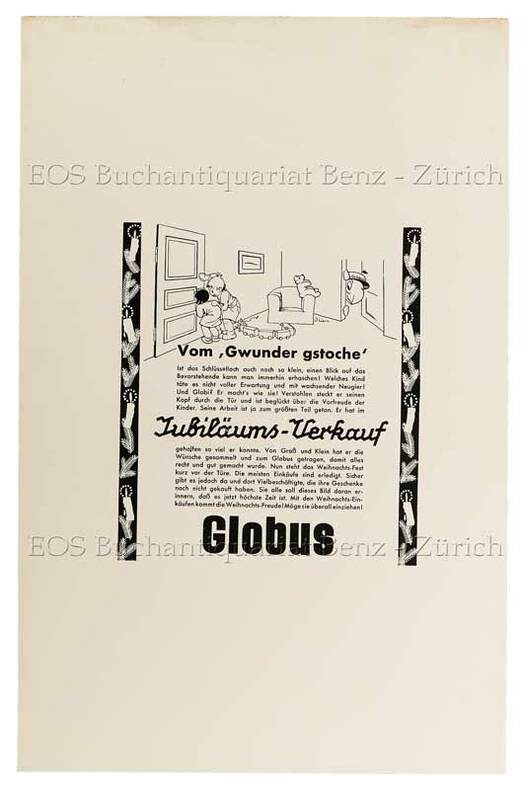
1932416BGZürich, Globus, um 1932. Blattgrösse: 39 x 25 cm. + Wichtig: Für unsere Kunden in der EU erfolgt der Versand alle 14 Tage verzollt ab Deutschland / Postbank-Konto in Deutschland vorhanden +, bild
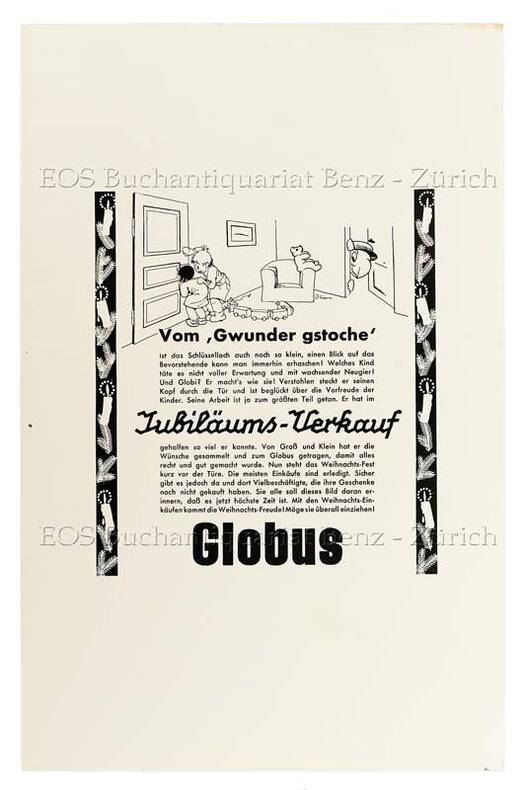
1932417BGZürich, Globus, um 1932. Blattgrösse: 38,5 x 25 cm. + Wichtig: Für unsere Kunden in der EU erfolgt der Versand alle 14 Tage verzollt ab Deutschland / Postbank-Konto in Deutschland vorhanden +, bild
1932417BGZürich, Globus, um 1932. Blattgrösse: 38,5 x 25 cm.
1932416BGZürich, Globus, um 1932. Blattgrösse: 39 x 25 cm.
1990022648Marval, Paris 1990. Broschiert Neuwertig