Boilet Frédéric:Livre Rare Book

10 681 résultats
3625Affiche au format 50 x 70 cm., à l'état de neuf.
- Lucien Vogel éditeur, Paris 1915, 37,6x24,2cm, une feuille. - Original color print, printed on vergé paper, signed in the plate. An original print used to illustrate the Gazette du bon ton, one of the most attractive and influential 20th century fashion magazines, featuring the talents of French artists and other contributors from the burgeoning Art Deco movement. A celebrated fashion magazine established in 1912 by Lucien Vogel, La Gazette du bon ton appeared until 1925, with a hiatus from 1915 to 1920 due to the war (the editor-in-chief having been called up for service). It consisted of 69 issues printed in only 2,000 copies each and notably illustrated with 573 color plates and 148 sketches of the models of the great designers. Right from the start, this sumptuous publication "was aimed at bibliophiles and fashionable society," (Françoise Tétart-Vittu, "La Gazette du bon ton", in Dictionnaire de la mode, 2016) and was printed on fine vergé paper using a type cut specially for the magazine by Georges Peignot, known as Cochin, later used (in 1946) by Christian Dior. The prints were made using stencils, heightened in colors, some highlighted in gold or palladium. The story began in 1912, when Lucien Vogel, a man of the world involved in fashion (he had already been part of the fashion magazine Femina) decided, with his wife Cosette de Brunhoff - the sister of Jean, creator of Babar - to set up the Gazette du bon ton, subtitled at the time: "Art, fashion, frivolities." Georges Charensol noted the reasoning of the editor-in-chief: "'In 1910,' he observed, 'there was no really artistic fashion magazine, nothing representative of the spirit of the time. My dream was therefore to make a luxury magazine with truly modern artists...I was assured of success, because when it comes to fashion, no country on earth can compete with France.'" ("Un grand éditeur d'art. Lucien Vogel" in Les Nouvelles littéraires, no. 133, May 1925). The magazine was immediately successful, not only in France but also in the United States and Latin America. At first, Vogel put together a team of seven artists: André-Édouard Marty and Pierre Brissaud, followed by Georges Lepape and Dammicourt, as well as eventually his friends from school and the School of Fine Arts, like George Barbier, Bernard Boutet de Monvel and Charles Martin. Other talented people soon came flocking to join the team: Guy Arnoux, Léon Bakst, Benito, Boutet de Monvel, Umberto Brunelleschi, Chas Laborde, Jean-Gabriel Domergue, Raoul Dufy, Édouard Halouze, Alexandre Iacovleff, Jean Émile Laboureur, Charles Loupot, Chalres Martin, Maggie Salcedo. These artist, mostly unknown when Lucien Vogel sought them out, later became emblematic and sought-after artistic figures. It was also they who worked on the advertising drawings for the Gazette. The plates put the spotlight on, and celebrate, dresses by seven designers of the age: Lanvin, Doeuillet, Paquin, Poiret, Worth, Vionnet and Doucet. The designers provided exclusive models for each issue. Nonetheless, some of the illustrations are not based on real models, but simply on the illustrator's conception of the fashion of the day. The Gazette du bon ton was an important step in the history of fashion. Combining aesthetic demands with the physical whole, it brought together - for the first time - the great talents of the artistic, literary, and fashion worlds; and imposed, through this alchemy, a completely new image of women: slender, independent and daring, which was shared by the new generation of designers, including Coco Chanel, Jean Patou, Marcel Rochas, and so on... Taken over in 1920 by Condé Montrose Nast, the Gazette du bon ton was an important influence on the new layout and aesthetics of that "little dying paper" that Nast had bought a few years earlier: Vogue. [FRENCH VERSION FOLLOWS] Estampe originale en couleur tirée sur papier vergé, signée en bas à droite dans la planche. Robes de Callot, Jenny, Paquin, Martia
- Lucien Vogel éditeur, Paris Eté 1915, 36,5x24cm, une feuille. - Double original color print heightened with gold, printed on vergé paper, signed in the plate. An original print used to illustrate the Gazette du bon ton, one of the most attractive and influential 20th century fashion magazines, featuring the talents of French artists and other contributors from the burgeoning Art Deco movement. A celebrated fashion magazine established in 1912 by Lucien Vogel, La Gazette du bon ton appeared until 1925, with a hiatus from 1915 to 1920 due to the war (the editor-in-chief having been called up for service). It consisted of 69 issues printed in only 2,000 copies each and notably illustrated with 573 color plates and 148 sketches of the models of the great designers. Right from the start, this sumptuous publication "was aimed at bibliophiles and fashionable society," (Françoise Tétart-Vittu, "La Gazette du bon ton", in Dictionnaire de la mode, 2016) and was printed on fine vergé paper using a type cut specially for the magazine by Georges Peignot, known as Cochin, later used (in 1946) by Christian Dior. The prints were made using stencils, heightened in colors, some highlighted in gold or palladium. The story began in 1912, when Lucien Vogel, a man of the world involved in fashion (he had already been part of the fashion magazine Femina) decided, with his wife Cosette de Brunhoff - the sister of Jean, creator of Babar - to set up the Gazette du bon ton, subtitled at the time: "Art, fashion, frivolities." Georges Charensol noted the reasoning of the editor-in-chief: "'In 1910,' he observed, 'there was no really artistic fashion magazine, nothing representative of the spirit of the time. My dream was therefore to make a luxury magazine with truly modern artists...I was assured of success, because when it comes to fashion, no country on earth can compete with France.'" ("Un grand éditeur d'art. Lucien Vogel" in Les Nouvelles littéraires, no. 133, May 1925). The magazine was immediately successful, not only in France but also in the United States and Latin America. At first, Vogel put together a team of seven artists: André-Édouard Marty and Pierre Brissaud, followed by Georges Lepape and Dammicourt, as well as eventually his friends from school and the School of Fine Arts, like George Barbier, Bernard Boutet de Monvel and Charles Martin. Other talented people soon came flocking to join the team: Guy Arnoux, Léon Bakst, Benito, Boutet de Monvel, Umberto Brunelleschi, Chas Laborde, Jean-Gabriel Domergue, Raoul Dufy, Édouard Halouze, Alexandre Iacovleff, Jean Émile Laboureur, Charles Loupot, Chalres Martin, Maggie Salcedo. These artist, mostly unknown when Lucien Vogel sought them out, later became emblematic and sought-after artistic figures. It was also they who worked on the advertising drawings for the Gazette. The plates put the spotlight on, and celebrate, dresses by seven designers of the age: Lanvin, Doeuillet, Paquin, Poiret, Worth, Vionnet and Doucet. The designers provided exclusive models for each issue. Nonetheless, some of the illustrations are not based on real models, but simply on the illustrator's conception of the fashion of the day. The Gazette du bon ton was an important step in the history of fashion. Combining aesthetic demands with the physical whole, it brought together - for the first time - the great talents of the artistic, literary, and fashion worlds; and imposed, through this alchemy, a completely new image of women: slender, independent and daring, which was shared by the new generation of designers, including Coco Chanel, Jean Patou, Marcel Rochas, and so on... Taken over in 1920 by Condé Montrose Nast, the Gazette du bon ton was an important influence on the new layout and aesthetics of that "little dying paper" that Nast had bought a few years earlier: Vogue. [FRENCH VERSION FOLLOWS] Estampe double originale en couleur rehaussée à l'or, tirée sur papier vergé, signée en bas à droite
1967015633Iolas 1967 En feuilles
1985015661Paris Galerie Samy Kinge 1985 En feuilles
015662Paris Galerie Samy Kinge 0 En feuilles
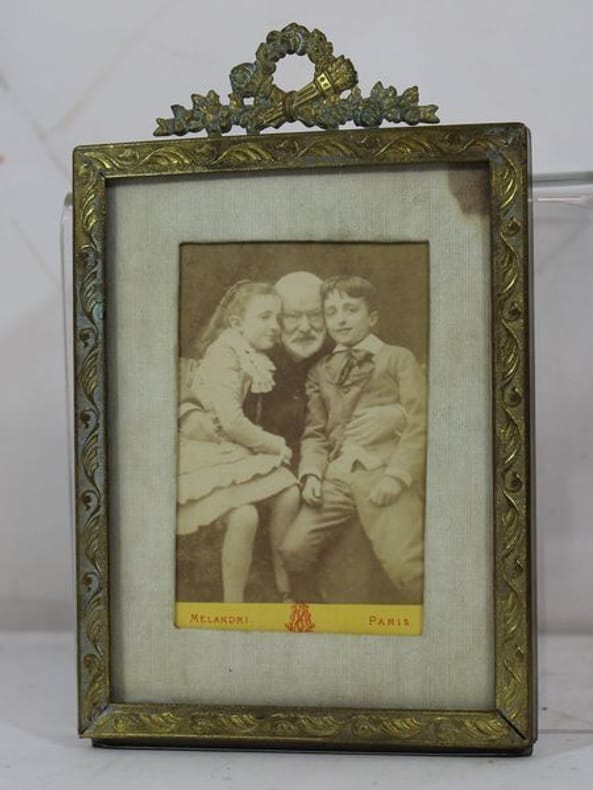
23390Mélandri, Paris, (1881). Tirage sur papier albuminé contre-collé sur un carton fort de la maison Villandry à Paris, 90 x 60 mm. Légèrement insolé. Au verso: "MELANDRI / 19, Rue Clauzel / PARIS / SPECIALITE DE PHOTO- AQUARELLES" (en partie effacé par de l'adhésif). Petit cadre en laiton avec son verre.
199220656Museum für Kunst und Gewerbe, Hamburg 1992 Grand In-8, broché couv. illustrée, illustrations en couleurs, 143 pp. En allemand. Très bon état d’occasion.
Cupra, (1982), manifesto stampato a col. cm. 60 x 35 (Argonauta argo con sole al tramonto)
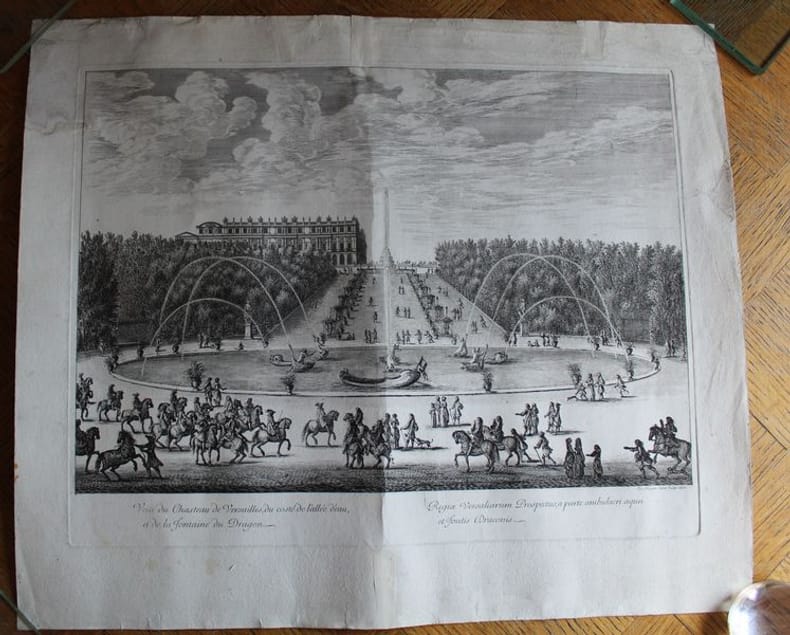
23510Isr. Silvestre del. Et sculp. 1676. Gravure à l'eau-forte au burin sur papier vergé épais, 485 x 585 mm., titre en bas à gauche. A droite, il y a la même inscription en latin. Quelques déchirures réparées aux marges, le motif de la gravure en bon état malgré une tache d'ancienne mouillure en haut à gauche.
6797S.l.s.n., (Rouen, Adeline, 1874). Gravure (18 x 9 cm + marges).
198069421ABKöln., Galerie Michael Werner., 1980. 119 x 83,3 cm. [1] unpaginiertes Blatt., 69421A Sehr gutes Exemplar.
19601101971960. 3 single leaves 11 x 9 inches b&w photos on monocxhrome ground with white lettering two machines portrayed photographically recto / specs verso except for "Spiral bevel" third image which recto an entirely lavender field with briefest lettering white on black band . Bright scarcely handled mostly by this cataloguer scarcely aged respectively lavender semigloss black and matte-cinnnamon. unknown books
19601101971960. 3 single leaves 11 x 9 inches b&w photos on monocxhrome ground with white lettering two machines portrayed photographically recto / specs verso except for "Spiral bevel" third image which recto an entirely lavender field with briefest lettering white on black band . Bright scarcely handled mostly by this cataloguer scarcely aged respectively lavender semigloss black and matte-cinnnamon. unknown
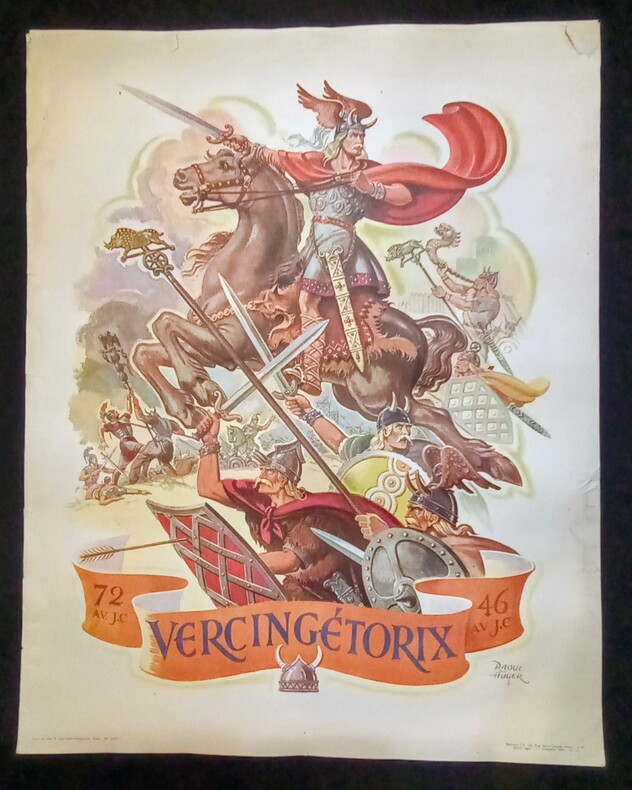
1944WOC-2431Affiche originale de Raoul Auger 1944. Hauteur: 57,5cm. Largeur:46cm. Gravure et Imprimerie E. Desfossés-Néogravure, Paris – N° 32.0017. Éditions G.P., 80. Rue Saint-Lazare , Paris – 2-44. Depôt légal – 1er trimestre 1944 – N° 10.
2795Affiche au format 69 x 72 cm., à l'état de neuf.
104359MAGMA / VERTIGOAffichette offset 380x288mm, maquette J.L. Petit.Promotion pour le label Vertigo.Magma est un groupe de rock progressif français, originaire de Paris. Il est formé en 1969 par le compositeur-batteur-chanteur Christian Vander et Laurent Thibault. Cette formation est à l'origine du genre musical baptisé Zeuhl, mélangeant rock, jazz, avant-garde et chant choral. L’image est celle de la couverture du double LP Kobaia, sorti en 1970.(104359)
61176BBo.J. (Rolf Escher, geboren 1936 in Hagen. Studium 1956 bis 1962 an der Kunstakademie Düsseldorf). [2 Warenabbildungen]
Vendre. 1956. In-4 Carré. Broché. Etat d'usage. 1er plat abîmé. Dos satisfaisant. Intérieur acceptable. Plaquette de 16 pages illustrée de nombreuses photos en noir et blanc. Supplément au n° 326 de la revue 'Vendre'. Couverture de Savignac.
13373Tournon, imp. Cot, 1853, 1 pliée. affiche de 41 x 60 cm, texte sur fond vert ;
1912241941912 Affiche entoilée, Nice, Imprimeries Nouvelles Réunies G. Mathieu, 1912-1913, 106 x 76 cm.,
1956RO40235015Vendre. 1956. In-4. Broché. Etat d'usage, 1er plat abîmé, Dos satisfaisant, Intérieur acceptable. Plaquette de 16 pages illustrée de nombreuses photos en noir et blanc.. . . . Classification Dewey : 741.67-Illustrations des affiches
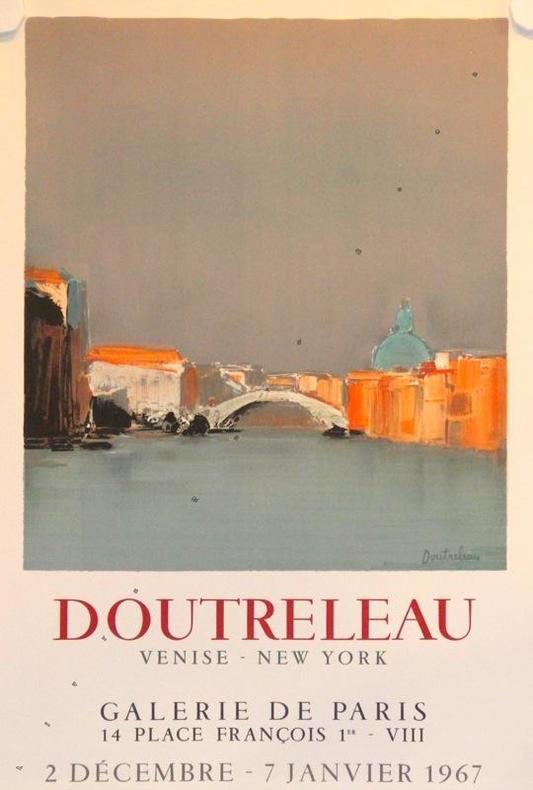
7797Affiche, lithographie 50,5 x 75.
3724Archives internationales, collection Archives secrètes. Rare sérigraphie au format 32 x 43 cm., à l'état de neuf.