RUSSELL MULCAHYLivre Rare Book

10 681 résultats
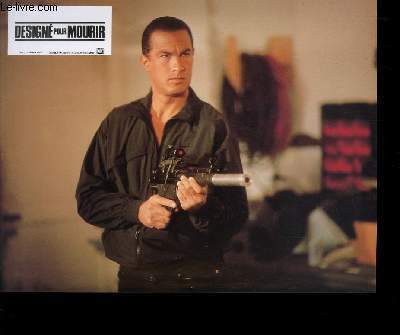
1991R100000493METROPOLITAN FILMEXPORT. 1991. In-12. Broché. Bon état, Couv. convenable, Dos satisfaisant, Intérieur frais. 1 lot de 8 photos en couleurs.. . . . Classification : 0-Affiches Cinéma
199864539Flammarion 1998 In-folio broché 38,2 cm sur 28,2. Bon état d’occasion.
1991R100000500DWIGHT H. LI. 1991. In-12. Broché. Bon état, Couv. convenable, Dos satisfaisant, Intérieur frais. 1 lot de 7 photos en couleurs.. . . . Classification : 0-Affiches Cinéma
62633BBo.J. (Horst Janssen, geboren am 14. November 1929 in Wandsbek bei Hamburg, gestorben am 31. August 1995 in Hamburg. Zeichner, Grafiker, Autor, Plakatkünstler, Illustrator und Fotograf, einer der herausragendsten und produktivsten Zeichner und Grafiker des 20. Jahrhunderts). [2 Warenabbildungen]
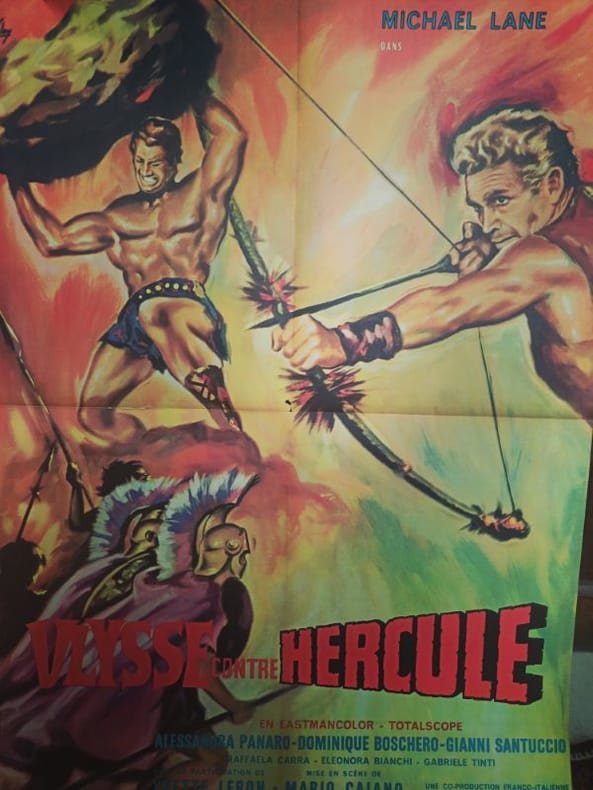
1962LCI-65611962 60 x 80 LE CHOC DES TITANS : Affiche originale (1962) du film Ulysse contre Hercule. Mario Caiano orchestre l'affrontement épique entre l'intelligence et la puissance. Une composition graphique d'une intensité rare, capturant toute la démesure de la mythologie grecque. Présentée dans un état de conservation irréprochable, cette affiche est une pièce maîtresse pour tout collectionneur de l'âge d'or du péplum.
Une affiche sur papier couché fort; de dimensions 50 x64 cm; impression offset de l'imprimerie Lescaret, Paris.sur papier Bel état. Voir photo. Peu fréquente.
196515794Paris à la Galerie 1965 1 Une affiche sur papier couché fort; de dimensions 50 x64 cm; impression offset de l'imprimerie Lescaret, Paris.sur papier
Milano, Vallardi, 1978, manifesto con dis. di uccelli a col. su fondo bianco.
- Lucien Vogel éditeur, Paris 1922, 18x24cm, une feuille. - Original color print, printed on vergé paper, signed in the plate. An original print used to illustrate the Gazette du bon ton, one of the most attractive and influential 20th century fashion magazines, featuring the talents of French artists and other contributors from the burgeoning Art Deco movement. A celebrated fashion magazine established in 1912 by Lucien Vogel, La Gazette du bon ton appeared until 1925, with a hiatus from 1915 to 1920 due to the war (the editor-in-chief having been called up for service). It consisted of 69 issues printed in only 2,000 copies each and notably illustrated with 573 color plates and 148 sketches of the models of the great designers. Right from the start, this sumptuous publication "was aimed at bibliophiles and fashionable society," (Françoise Tétart-Vittu, "La Gazette du bon ton", in Dictionnaire de la mode, 2016) and was printed on fine vergé paper using a type cut specially for the magazine by Georges Peignot, known as Cochin, later used (in 1946) by Christian Dior. The prints were made using stencils, heightened in colors, some highlighted in gold or palladium. The story began in 1912, when Lucien Vogel, a man of the world involved in fashion (he had already been part of the fashion magazine Femina) decided, with his wife Cosette de Brunhoff - the sister of Jean, creator of Babar - to set up the Gazette du bon ton, subtitled at the time: "Art, fashion, frivolities." Georges Charensol noted the reasoning of the editor-in-chief: "'In 1910,' he observed, 'there was no really artistic fashion magazine, nothing representative of the spirit of the time. My dream was therefore to make a luxury magazine with truly modern artists...I was assured of success, because when it comes to fashion, no country on earth can compete with France.'" ("Un grand éditeur d'art. Lucien Vogel" in Les Nouvelles littéraires, no. 133, May 1925). The magazine was immediately successful, not only in France but also in the United States and Latin America. At first, Vogel put together a team of seven artists: André-Édouard Marty and Pierre Brissaud, followed by Georges Lepape and Dammicourt, as well as eventually his friends from school and the School of Fine Arts, like George Barbier, Bernard Boutet de Monvel and Charles Martin. Other talented people soon came flocking to join the team: Guy Arnoux, Léon Bakst, Benito, Boutet de Monvel, Umberto Brunelleschi, Chas Laborde, Jean-Gabriel Domergue, Raoul Dufy, Édouard Halouze, Alexandre Iacovleff, Jean Émile Laboureur, Charles Loupot, Chalres Martin, Maggie Salcedo. These artist, mostly unknown when Lucien Vogel sought them out, later became emblematic and sought-after artistic figures. It was also they who worked on the advertising drawings for the Gazette. The plates put the spotlight on, and celebrate, dresses by seven designers of the age: Lanvin, Doeuillet, Paquin, Poiret, Worth, Vionnet and Doucet. The designers provided exclusive models for each issue. Nonetheless, some of the illustrations are not based on real models, but simply on the illustrator's conception of the fashion of the day. The Gazette du bon ton was an important step in the history of fashion. Combining aesthetic demands with the physical whole, it brought together - for the first time - the great talents of the artistic, literary, and fashion worlds; and imposed, through this alchemy, a completely new image of women: slender, independent and daring, which was shared by the new generation of designers, including Coco Chanel, Jean Patou, Marcel Rochas, and so on... Taken over in 1920 by Condé Montrose Nast, the Gazette du bon ton was an important influence on the new layout and aesthetics of that "little dying paper" that Nast had bought a few years earlier: Vogue. [FRENCH VERSION FOLLOWS] Estampe originale en couleur, tirée sur papier vergé, signée en bas à droite de la planche. Gravure originale réalisée pour l'illustrat
19801028631980 915x610, 1980. (102863)
19701029751970 affiche Leo Castelli New York 24 October to 14 November 1970Affiche pliée et envoyée par la poste cachet de New York 22 Oct. 1970. (102975)
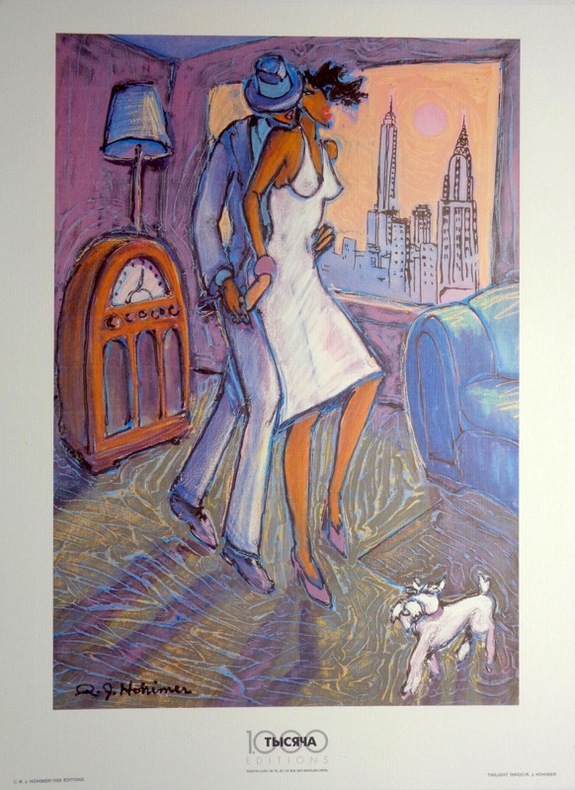
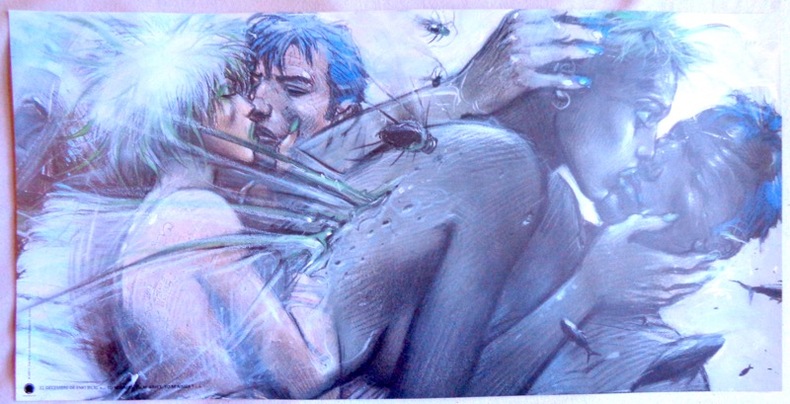
30101000 Editions. Affiche au format 50 x 68, à l'état de neuf.
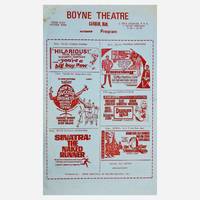
19593604Various Carman Winkler Morden St. Pierre Jolys: Privately Printed; Parkon Products Ltd.; Rehab Industries of Western Manitoba Inc.; Theatre Poster Service Ltd. Calendar Program; Cinema Services 1959-1991. Softcover. Our offering comprises of a rare selection of twelve double -sided illustrated period posters printed in a calendar-style format for various rural Manitoba drive-in theatres advertising their respective monthly film selections between the years of 1959 through to 1991 dates having been determined by the release date of the advertised films. Printed in various sizes and colours light blue white yellow pink with varied measurements: 8 at 8.5" x 11" // 2 at 10" x 8" // 2 at 14" x 8.5". Theatres represented amongst the selection include: 1. The Historic Boyne Theatre Carman Qty. 3 Winkler Theatre Winkler Qty. 1 Stardust Drive-In Theatre Morden Qty. 5 Cinema Jolys St. Pierre Jolys Qty. 2 Cinema Morden Morden Qty. 2. In addition to advertising their upcoming film screenings many include advertisements for offerings from their concession stands their location and contact particulars instructions for "tuning-in" hours of operation etc. Excepting for the rare occasional spot of foxing to a few of the posters nearly all remain without any substantial blemishes or the usual creases. A fascinating ephemeral artifact of vernacular culture. <br/><br/> Privately Printed; Parkon Products Ltd.; Rehab Industries of Western Manitoba, Inc.; Theatre Poster Service Ltd., Calendar Progr paperback
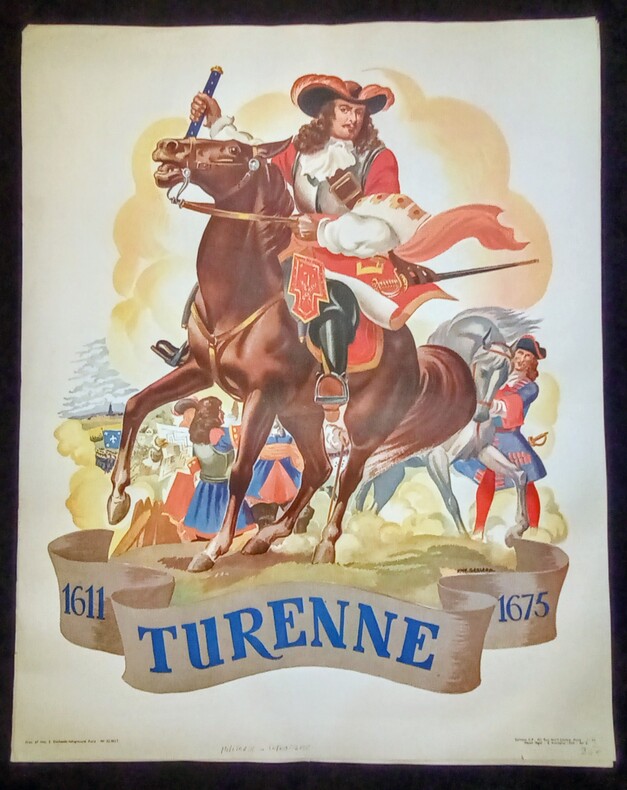
1943WOC-2432Affiche originale de Emm. Gaillard 1943. Hauteur: 57,5cm. Largeur:46cm. Gravure et Imprimerie E. Desfossés-Néogravure, Paris – N° 32.0017. Éditions G.P., 80. Rue Saint-Lazare , Paris – 11-43. Depôt légal – 4è trimestre 1943 – N°5.
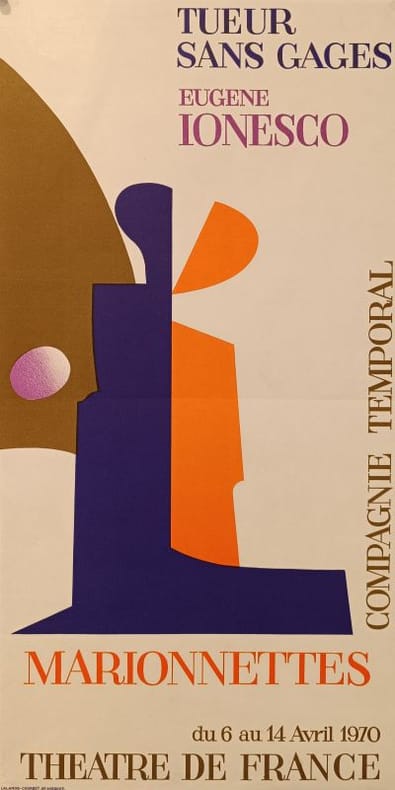
3909Affiche originale. Théâtre de France. Imprimerie Lalande-Courbet, Wissous. 1970. Impression en lithographie. Dim : 590 x 300 mm.
3909Affiche originale. Théâtre de France. Imprimerie Lalande-Courbet, Wissous. 1970. Impression en lithographie. Dim : 590 x 300 mm.
- Lucien Vogel éditeur, Paris Mars 1914, 19x24,5cm, une feuille. - Original color print, printed on vergé paper, signed in the plate. An original print used to illustrate the Gazette du bon ton, one of the most attractive and influential 20th century fashion magazines, featuring the talents of French artists and other contributors from the burgeoning Art Deco movement. A celebrated fashion magazine established in 1912 by Lucien Vogel, La Gazette du bon ton appeared until 1925, with a hiatus from 1915 to 1920 due to the war (the editor-in-chief having been called up for service). It consisted of 69 issues printed in only 2,000 copies each and notably illustrated with 573 color plates and 148 sketches of the models of the great designers. Right from the start, this sumptuous publication "was aimed at bibliophiles and fashionable society," (Françoise Tétart-Vittu, "La Gazette du bon ton", in Dictionnaire de la mode, 2016) and was printed on fine vergé paper using a type cut specially for the magazine by Georges Peignot, known as Cochin, later used (in 1946) by Christian Dior. The prints were made using stencils, heightened in colors, some highlighted in gold or palladium. The story began in 1912, when Lucien Vogel, a man of the world involved in fashion (he had already been part of the fashion magazine Femina) decided, with his wife Cosette de Brunhoff - the sister of Jean, creator of Babar - to set up the Gazette du bon ton, subtitled at the time: "Art, fashion, frivolities." Georges Charensol noted the reasoning of the editor-in-chief: "'In 1910,' he observed, 'there was no really artistic fashion magazine, nothing representative of the spirit of the time. My dream was therefore to make a luxury magazine with truly modern artists...I was assured of success, because when it comes to fashion, no country on earth can compete with France.'" ("Un grand éditeur d'art. Lucien Vogel" in Les Nouvelles littéraires, no. 133, May 1925). The magazine was immediately successful, not only in France but also in the United States and Latin America. At first, Vogel put together a team of seven artists: André-Édouard Marty and Pierre Brissaud, followed by Georges Lepape and Dammicourt, as well as eventually his friends from school and the School of Fine Arts, like George Barbier, Bernard Boutet de Monvel and Charles Martin. Other talented people soon came flocking to join the team: Guy Arnoux, Léon Bakst, Benito, Boutet de Monvel, Umberto Brunelleschi, Chas Laborde, Jean-Gabriel Domergue, Raoul Dufy, Édouard Halouze, Alexandre Iacovleff, Jean Émile Laboureur, Charles Loupot, Chalres Martin, Maggie Salcedo. These artist, mostly unknown when Lucien Vogel sought them out, later became emblematic and sought-after artistic figures. It was also they who worked on the advertising drawings for the Gazette. The plates put the spotlight on, and celebrate, dresses by seven designers of the age: Lanvin, Doeuillet, Paquin, Poiret, Worth, Vionnet and Doucet. The designers provided exclusive models for each issue. Nonetheless, some of the illustrations are not based on real models, but simply on the illustrator's conception of the fashion of the day. The Gazette du bon ton was an important step in the history of fashion. Combining aesthetic demands with the physical whole, it brought together - for the first time - the great talents of the artistic, literary, and fashion worlds; and imposed, through this alchemy, a completely new image of women: slender, independent and daring, which was shared by the new generation of designers, including Coco Chanel, Jean Patou, Marcel Rochas, and so on... Taken over in 1920 by Condé Montrose Nast, the Gazette du bon ton was an important influence on the new layout and aesthetics of that "little dying paper" that Nast had bought a few years earlier: Vogue. [FRENCH VERSION FOLLOWS] Estampe originale en couleur, tirée sur papier vergé, signée en bas à droite de la planche. Gravure originale réalisée pour l'il
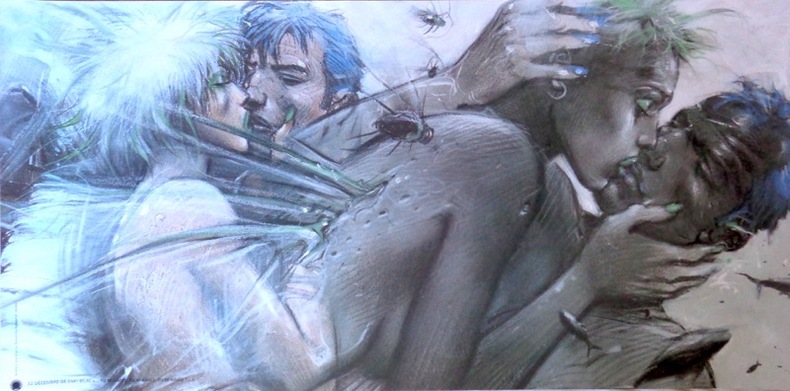
1134Christian Desbois éditions. Affiche au format 25 x 50, à l'état de neuf.
1242Christian Desbois éditions. Affiche au format 50 x 100, à l'état de neuf.
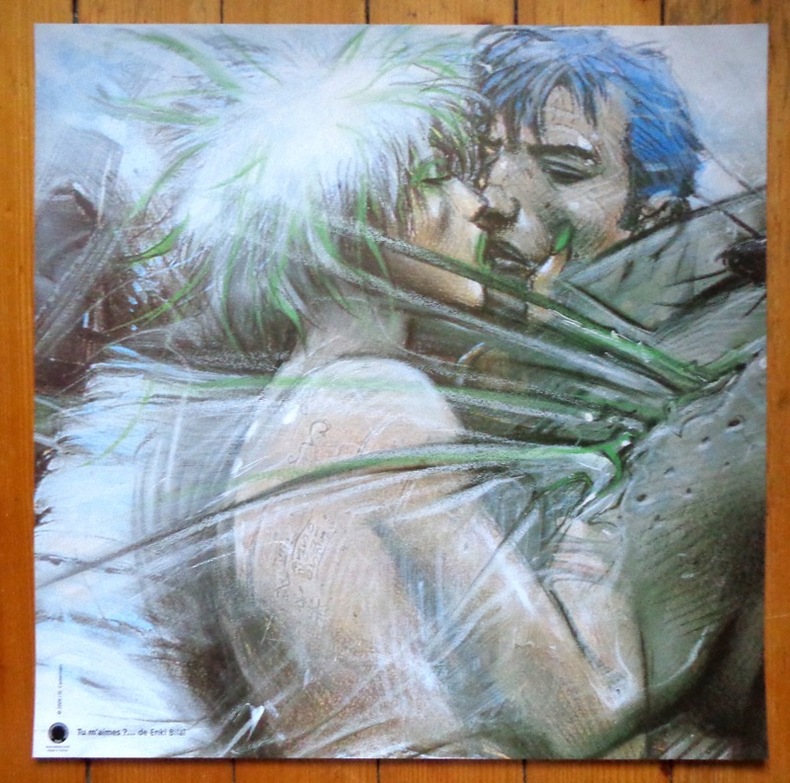
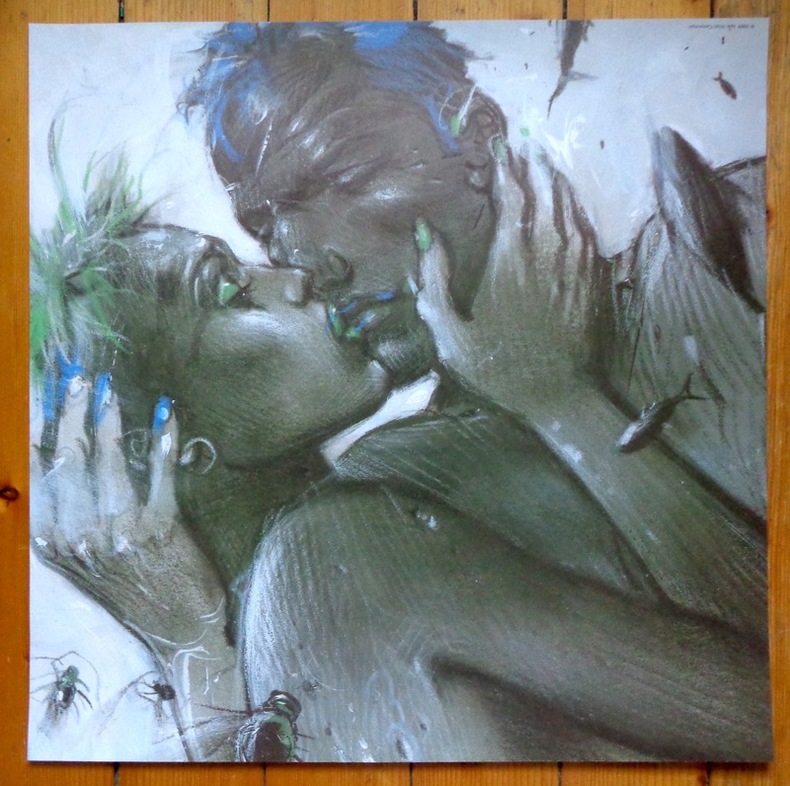
1256Christian Desbois éditions. Affiche au format 50 x 50, à l'état de neuf.
1257Christian Desbois éditions. Affiche au format 50 x 50, à l'état de neuf.
2015129279Printed in Italy. Palace Editions. 2015. 131, (1) pages. With a lot of illustrations, mostly in colour. Illustrated original hardcover binding with an illustrated dustjacket. New condition. 30x30 cm
64 pages. Features: The Secret of the Grosches - Virginia City; Wanted Posters - from a lawman's private collection; Three Seconds in Ekalaka - Marmarth, North Dakota; Hellish Years at Ashurst Run; This was Tahlequah; Razorbacks in Texas; Beholden to a Sheepholder - a cowboy gets help in Wyoming; Never by Chance - the saga of Signal Hill, California; Carl Collins could take it from Scratch; Wild Oats Days!. Average wear. Contents partially yellowed with age. Unmarked. A sound copy. Book