39 458 résultats
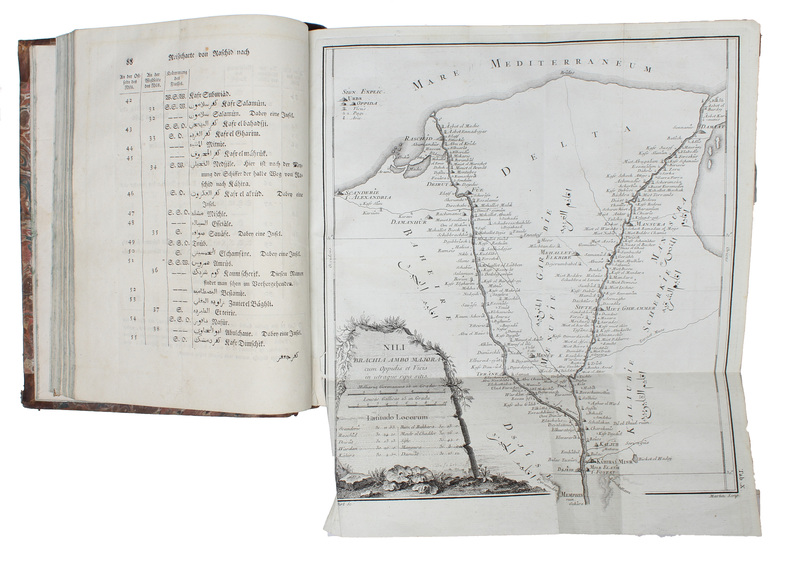
Kopenhagen, Nicolaus Möller, 1774-78. 4to. Bound in two contemporary full sprinkled calf bindings with five raised bands and richly gilt spines. Extremities with light wear. Spine on vol. 1 with wear with most of gilting worn off. Internally fine and clean. 2 engraved titlevignettes. Halftitles. XVI, (6), 505, (1) " (16), 479 pp. 1 large folded map, ""Tabula Iteneraria... Terrae Yemen... 1763."" and 124 engraved maps and plates (complete).
- Chez François Clouzier, à Paris 1664, in-4 (17x24cm), (24) 432pp., relié. - BIET Antoine Voyage de la France equinoxiale en l'isle de Cayenne, entrepris par les François en l'année MDCLII Chez François Clouzier, Paris 1664, in-4 (17 x 24 cm), (24) 432 pp.,contemporary calf First edition. Contemporary brown calf, spine in six compartments with blind-ruled compartments and gilt fleurons, remains of a manuscript title label. All edges speckled red, binding skillfully restored. Tear to lower margin of title skillfully restored, a few tiny stains. The work is divided into three parts: the first relates the establishment of the colony and its journey to Cayenne, the second is a collection of observations on the 15 months spent there by the author and the last is concerned with the country's climate, the fertility of the soil, and the customs and dress of the indigenous peoples. A last part is made up of a Franco-Amerindian dictionary, which is the very first appearance of a lexicon of the Galibi language. Some chapters also refer to Guadeloupe, Barbados and Martinique. Chaplain to the 700 colonists of the expedition sent to Guyana on the 18th May 1652, Antoine Biet gives a precise account of the second attempt at colonization. The attempt failed, and the hundred surviving colonists were forced to flee Cayenne for Surinam in January 1654 (and from there to Barbados), having suffered tropical illness and fierce resistance from the Galibi Indians. According to Boucher de La Richarderie, "no account other than Biet's sheds so much light on the natives of Guyana; he describes them in all their primitive simplicity." (Bibliothèque universelle des voyages, 1808). Manuscript ex-libris on front endpaper: "Ce livre appartient à Mr. Adam de Saron [This book belongs to Mr Adam de Saron]." [FRENCH VERSION FOLLOWS] Édition originale. Reliure de l'époque en plein veau brun. Dos à cinq nerfs orné de caissons et fleurons dorés, reste d'une étiquette de titre manuscrite. Toutes tranches mouchetées rouges. La reliure a été habilement restaurée. Déchirure marginale restaurée en marge basse de la page de titre. Quelques infimes salissures. L'ouvrage se divise en trois parties : la première relate l'établissement de la colonie et de son voyage jusqu'à Cayenne, la seconde est une suite d'observations sur les quinze mois passés par l'auteur là-bas et la dernière traite du tempérament du pays, de la fertilité de la terre, des us et coutumes des autochtones. Une dernière partie est constituée d'un dictionnaire franco-amérindien, c'est la toute première fois qu'un lexique galibi paraît. Certains chapitres évoquent également la Guadeloupe, la Barbade et la Martinique. Aumônier des 700 colons de l'expédition envoyée en Guyane le 18 mai 1652, Antoine Biet relate avec précision la deuxième tentative de colonisation. Cette expérience fut un échec, la centaine de colons qui y survécut fut contrainte de fuir Cayenne vers le Surinam en janvier 1654 puis vers la Barbade, après avoir souffert des maladies tropicales et de la farouche résistance des Indiens galibis. D'après Boucher de La Richarderie, « aucune relation ne donne autant de lumières que celle de Biet sur les naturels de la Guyane ; il les a dépeints dans toute leur simplicité primitive. Le vocabulaire de leur langue est fait avec soin » (Bibliothèque universelle des voyages, 1808). Ex-dono manuscrit sur la première page de garde : « Ce livre appartient à Mr. Adam de Saron. »
- San Francisco dimanche 28 et lundi 29 décembre 1902, 13x20cm, 8 pages sur 2 feuillets doubles. - Lettre autographe signée de Victor Segalen adressée à Emile Mignard, huit pages rédigées à l'encre noire sur deux doubles feuillets de papier blanc. Pliures transversales inhérentes à l'envoi. Trace d'onglet de papier blanc. Une petite tache en marge basse du dernier feuillet. Emile Mignard (1878-1966), lui aussi médecin et brestois, fut l'un des plus proches amis de jeunesse de Segalen qu'il rencontra au collège des Jésuites Notre-Dame-de-Bon-Secours, à Brest. L'écrivain entretint avec ce camarade une correspondance foisonnante et très suivie dans laquelle il décrivit avec humour et intimité son quotidien aux quatre coins du globe. C'est au mariage de Mignard, le 15 février 1905, que Segalen fit la connaissance de son épouse, Yvonne Hébert. Segalen, parti du Havre le 11 octobre 1902 en direction de Tahiti, voit son voyage interrompu par la contraction de la fièvre typhoïde qui l'immobilisera finalement deux mois à San Francisco. Cette convalescence, qui durera jusqu'à début janvier 1903 sera l'occasion pour Segalen de découvrir China Town. Pour l'heure, il écrit à Mignard cette longue lettre dans laquelle il lui fait part de rêves prémonitoires d'amis communs quant à sa maladie : « J'ai reçu à 24 d'intervalle les deux récits suivants : de Max [Prat] : a rêvé dans la nuit du 26 au 27 Nov[embre] de moi - m'a vu la tête entourée de bandelettes. Cauchemar et impression pénible persistante. Apprenait le jour même par une carte de ma famille, chez qui la nouvelle était arrivée le 26 au soir, ma maladie. De Madame Varenne ; a rêvé du 1er au 4 Déc[embre] environ, de façon obsédante de moi. [...] Le 5 je crois lui arrivait l'avis de mon incident typhique. » Très rationnel, Segalen conclut : « Tout ça pour mémoire seulement, car ça manque de rigueur. Les rêves télépathiques auraient coïncidé plutôt avec les nouvelles de ma maladie, qu'avec l'exacerbation de ma fièvre elle-même. » Désormais tout à fait remis de sa maladie, le jeune médecin poursuit : « Mon séjour Franciscain continue a être des plus « confortable » et complet. Je fais du cheval au Park, des poids et de la natation à L'Olympic club [...] » Il s'adonne également à un sport beaucoup plus charnel et « exécute des travaux pratiques sur la personne d'un sujet américain, prélevé avant [son] départ de l'hôpital parmi les très appétissantes « nurses » ». Pas avare de détails, il s'épanche sur cette nouvelle conquête : « Ledit sujet est une petite juive de 18 ans, métissée de Mexicain avec une pointe d'origine Allemande. Le résultat de ces croisements invraisemblables est purement exquis. [...] Moyenne de taille, très souple, des yeux et des cheveux d'un noir invraisemblable, très câline et très en-train. C'est tout. Rien en dessous, et, dans ce cur habillé d'un si joli manteau de chair, une néance absolue de nos plus élémentaires sentiments. C'est un type de maîtresse-camarade complet. Nos embrassements sont forcément polyglottes : elle pimente nos spasmes d'un « che t'aime » hébraïque et très joliment murmuré. Et je lui réponds des mots d'amour pêchés le matin dans Tennyson ou dans mes souvenirs. Je l'ai sous la main aux heures voulues. Elle fume énormément, adore l'eau de Seltz pure (!) et se tord à mes plaisanteries Franco-Américaines et à mes envolées audacieuses dans la langue du président Roosevelt. » Les lettres autographes de Victor Segalen sont d'une grande rareté. [ENGLISH DESCRIPTION ON DEMAND]
- J. Johnson & Th. Payne, London 1813, in-4 (20,5x26,5cm), xviii ; 423 pp. (4 p.) et (2 p.) iv ; 408 pp., 2 volumes reliés. - Narrative, of a five years' expedition, against the revolted negroes of Surinam, in Guiana, on the wild coast of South America J. Johnson & Th. Payne, London 1813, 4° (20,5x26,5cm), xviii; 423 pp. (4 p.) and (2 p.) iv; 408 pp., 2 volumes bound. Second edition, actually third. First published in 1796. Illustrated with 79 full-page plates and 3 folding maps. Sixteen prints engraved by William Blake after drawings by the author. Modern half roan, red and green morocco title and marbled endpapers. Light foxing to some pages, otherwise a good copy. The Anglo-Dutch officer Jean Gabriel Stedman (1744-1797) put down slave rebellions in Surinamen Dutch Guiana from 1772 to 1777. William Blake's impressive portraits of tortured slaves were widely distributed by the anti-slavery movement. Although in the service of the crown and therefore of the colonizers, Stedman was soon regarded as a prominent figure of the abolitionist movement. Publisher Joseph Johnson (1738-1809), one of the most important in the United Kingdom, became known for publishing the works of radical thinkers and dissidents such as Mary Wollstonecraft, Benjamin Franklin and Thomas Paine. As a member of the Society for Constitutional Information seeking to reform Parliament, he published numerous political works supporting the rights of slaves, Jewish people, women, prisoners, and other oppressed peoples around the world. [FRENCH VERSION FOLLOWS] "Seconde édition" en réalité troisième de cet ouvrage publié pour la première fois en 1796. Elle est illustrée de 79 planches hors-texte et 3 cartes dépliantes. Seize des estampes ont été gravées par William Blake d'après les dessins de Stedman. Reliure moderne en demi basane fauve à coins, dos à cinq faux nerfs sertis de doubles filets dorés, pièces de titre et de tomaisons de maroquin rouge et vert, plats de papier à la cuve. Quelques pages très légèrement roussies, sinon bel exemplaire. L'officier anglo-néerlandais Jean Gabriel Stedman (1744-1797) participa à la répression des révoltes d'esclaves au Surinam de 1772 à 1777. Les impressionnantes planches de William Blake décrivant les supplices infligés aux esclaves, furent reprises et largement diffusées par le courant anti-esclavagiste. Par ce témoignage Stedman, pourtant au service de la couronne royale et donc des colonisateurs, fut élevé au rang de héraut du mouvement abolitionniste. D'ailleurs, l'éditeur Joseph Johnson (1738-1809), l'un des plus importants du Royaume-Uni, était connu pour publier des travaux de penseurs radicaux et de dissidents tels que Mary Wollstonecraft, Benjamin Franklin et Thomas Paine. Membre de la Society for Constitutional Information, un groupe activiste visant à réformer le Parlement, il publia de nombreux ouvrages politiques soutenant les droits des esclaves, des juifs, des femmes, des prisonniers et d'autres peuples opprimés à travers le monde.
1913141950Librairie de L. Hachette et Cie 1913 54 volumes in-4, divers reliures demi-chagrin ou basane cerise, vert ou brun, dos lisses & à nerfs, filets et fleurons, toutes tranches dorées. Accroc de cuir au dos en tête pour les années 1913 & 1911, menus frottement, sinon très bon état général.
175366726De Imprimerie Royale | à Paris 1753 | 20 x 26 cm | relié
4to. Pts. I/1, II/1, and III/1 (= all published) in 1 vol. 47, 48, 16 pp. With 33 (30 coloured) engraved plates (some folding). Contemp. marbled boards. Only edition. "Now rare collection" (cf. Hayn/G.). Contains the Nuremberg "Schembart" play, a carnival masque with 20 coloured zinc engravings, edited from old mss. Other items include various treatises on the history of Nuremberg and a book of Nuremberg costumes (with 10 coloured engravings). Only the first issue of each of the three parts saw publication. - All costumes are pictured in beautiful original colour; also includes a facsimile of Martin Luther's "Praise of Music". - Some browning and brownstaining (mainly concerning the endpapers); 2 plates are loosened. No other complete copy listed in auction records of the last decades. Lipperheide Dfe 19. Hayn/Gotendorf V, 427. Pfeiffer 33848, 33792 und 33958.
Folio (212:324 mm). 188 (instead of 192), (18) pp. With engr. t. p. and 37 engr., folding views, maps, and plans. Contemp. vellum with ms. spine title. Remains of ties. First printing of the first edition (distinguished by the line break on p. 3, left column, last 2 lines: "... von // dem Lande den Namen/ gleich wie mit einer // Mauer/ umbgeben ..."). "The first and second edition are of a high quality: light-coloured paper, good impressions, and excellent engravings" (Nebehay/W.). - Hand-coloured title engraving. Occasional slight browning. Small edge defect to the view of Schlan (not touching the image) professionally restored; Hollar's four-page view of Prague somewhat wrinkled and assembled out of order. Wants pp. 163-166; plates complete including the plan of Trachenberg (not in the list of plates and often missing). From the library of the Regensburg jurist Sebastian Seelmann, a member of Harsdörffer's "Pegnesian Order of Flowers" since 1668 (under the name of "Silvius"), with his autogr. note of ownership on the engr. t. p . and the acquisition date "1704". VD 17, 23:301612X. Wüthrich IV, 51. Nebehay/Wagner 405. Schuchhard 14 A.
5 photo albums with more than 1,000 black-and-white original photographs (40 x 52 mm to 205 x 254 mm), 5 booklets of certificates, 2 driving licences, 4 identity cards, 1 passport, 1 membership book (navigators and engineer officers' union), 1 membership card (merchant navy officers' guild), 2 forms, 1 grade card. Intriguing material documenting the career of a Royal Navy officer serving aboard the oil tanker "Stanvac Manila", operated by the Socony Vacuum Oil Company, in the mid-20th century. Unusual in its extent, the collection reflects almost every step of his career, spanning more than 60 engagements on 20 different vessels from 1928 onwards. It includes Owen's continuous certificate of discharge up to 1957, giving the name of each ship he served on, the date and place of his engagement and discharge, his rating, a brief description of the voyage, and a report of his character, signed by a superior. Among the more remarkable entries are his engagement as third mate during "special operations for the liberation of Europe" in 1944, his service aboard the "Stanvac Manila", which he boarded for the fifth time in Bahrain in 1951, and his five years aboard the "Hua Heng", which he boarded and disembarked from several times in Singapore. - Further, the archive comprises identity cards featuring Owen's picture and fingerprints, as well as certificates of his advancement from lifeboatman (1937) to master of vessels of more than 1,600 gross register tonnage (1981). A certificate of proficiency in radiotelephony and a medical certificate deeming him "physically unfit for naval service" in 1940 are also included. - The collection is topped off by several photo albums mainly illustrating the voyage of the "Stanvac Manila", providing views of the places visited along the way, including Bombay, Sydney, Brisbane, Manila, San Francisco, Hong Kong, Istanbul, Madeira, New Zealand, Abadan, and the Panama Canal, depicting local ports and scenery, landmarks, coal workers, farmers, cattle and dolphins, as well as other vessels, including the SS Langleeridge in Portland, Maine, sailboats in Auckland, the "Stanvac Manila" crew, and impressive weather phenomena. - Signs of use; several photographs loose. A rare survival reflecting the eventful career of a British naval officer.
178020870Genève Pellet 1780 -in-4 plein-veau 4 volumes + 1 volume d'Atlas, reliure plein veau havane moucheté in-quarto (binding full calfskin in-4) (26,3 x 20,6 cm), POUR LES PREMIERS VOLUMES : dos à nerfs (spine with raised bands), décoré "or" avec filets et roulettes "or", titre et tomaison frappés "or", pièce de titre et pièce de tomaison sur fond vert olive avec double filets "or" en encadrement, couronne de lauriers "or" entourant les chiffres de tomaison, entre-nerfs à fleuron au fer évidé dans un encadrement à double filets "or" en encadrement avec rinceaux "or" aux angles, roulette "or" en place des nerfs avec un filet à froid de part et d'autre des nerfs, roulette "feuillage" "or" en tête et en pied, trés léger manque à la coiffe de tête du Tome I, la coiffe du Tome IV manque ainsi que 2 cm2 de cuir en tête et 1 cm2 de cuir à l'entre-nerfs, plats décorés "or" d'un triple filet "or" en encadrement, plats trés légèrement frottés, coins écornés, doubles filets "or" sur les coupes (gilt line on the cuts) avec manque de dorure (blurred gilding), toutes tranches lisses peignées rouges et bleues, POUR LE VOLUME D'ATLAS : dos long (spine whithout raised bands), décoré "or" avec filets et roulettes "or", pièce de titre et pièce de tomaison sur fond vert olive avec double filets "or" et roulette "or" en encadrement, (atlas relié à l'origine pour l'édition in octavo en 10 volumes + l'Atlas, c'est pourquoi il est noté Atlas Tome XI, mais c'est exactement le même que pour l'Edition in-4) titre et tomaison frappés "or", double filets "or" en place des nerfs, et en tête et en pied, entre-nerfs à fleuron "or" au fer évidé dans un encadrement à double filets or et roulette "or" avec rinceaux "or" aux angles, plats ornés d'un triple filet "or" en encadrement, filet "or" sur les coupes (gilt line on the cuts) avec manque de dorure (blurred gilding), toutes tranches lisses peignées rouges et bleues, 4 volumes de textes avec un portrait-frontispice au Tome 1 gravé sur cuivre par Nicolas de Launay d'après Charles-Nicolas COCHIN + 4 planches gravées sur cuivre par N. de Launay (t. 1 et 3), Jean-Louis Delignon (t. 2) et Jean-Baptiste Simonet (t. 4) d'après MOREAU-LE-JEUNE. - Vignettes gravées sur bois aux titres, + Un ATLAS avec 28 pp., 23 tableaux et 50 cartes hors-texte en noir par Rigobert BONNE, légère trace d'humidité claire en marge des 10 premières page du Tome II, 4 tomes (XVI-741-[1-2 bl.] p., [2] f. de pl. ; [4]-VIII-485-[1-2 bl.] p., [1] f. de pl. ; XV-[1]-629-[1-2 bl.] p., [1] f. de pl. ; [4]-VIII-770-[1-1 bl.] p., [1] f. de pl.) : ill. ; in-4 + atlas ([4]-28 p., [73] f. de pl. dépl.), 1780 A Geneve, chez Jean-Leonard Pellet, imprimeur de la Ville & de l'Academie Editeur,
394024 parties reliées en un volume in-8 (202 x 127 mm), demi-veau vert bronze, dos lisse orné de compartiments cloisonnés de triples filets dorés et dun fleuron à froid répété au centre, palette en pied, pièce de titre de maroquin bordeaux, tranches marbrées (reliure signée Laurenchet dans le goût de lépoque), (2), 186 pages [Cahiers I et II en pagination continue] ; (2), 8, 189 pages [Cahier III] ; (2), pages 191 à 236 [Cahier IV]. Paris, Imprimerie de Setier, décembre 1823 - juin 1824.
1789g9518London: John Stockdale and George Goulding. G : in good condition. Cover lightly rubbed with some edge wear. Respined with tape reinforcements at inner hinges. Offsetting from engravings. Tear at page 99. Final plate missing. Occasional light foxing otherwise contents VG. 1789. First Edition. Brown hardback half-leather marbled board cover. 310mm x 240mm 12" x 9". xii 384pp; xl. 19 of 20 engravings including 6 fold out charts. Heavy item - shipping supplement may apply for overseas. . John Stockdale and George Goulding hardcover
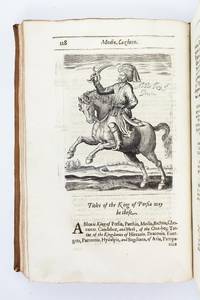
1634ST20186London: printed by William Stansby and Jacob Bloome 1634. FIRST EDITION. 290 x 195 mm. 11 1/2 x 7 3/4". 6 p.l. 225 15 pp. <br/> Contemporary sprinkled calf raised bands traces of old paper label to spine pastedowns lifted to reveal leather bands and manuscript document fragments used as sewing guards all edges sprinkled red expert repair to rear joint. With additional engraved title page featuring two figures of Persian dignitaries and three small travel vignettes signed at foot by William Marshall and 36 engravings in the text the majority vignettes but one full-page and nine more than half a page tall. Front endpaper with ink armorial stamp of Sir Walter John Trevelyan 8th Baronet of Nettlecombe and High Sheriff of Cornwall. Price inked in a contemporary hand to the front endpaper. Sabin 31471; STC 13190.3; ESTC S92948. Front board a bit splayed covers with three old dampstains and a few scars and tiny wormholes but a very pleasing original binding with almost no wear to the joints. A very few marginal smudges made during printing other quite trivial imperfections but AN ESPECIALLY FRESH BRIGHT AND CLEAN COPY INTERNALLY with rich impressions of the engravings.<br/> <br/> This is a contemporary copy in remarkably fresh internal condition of an important and entertaining account of the travels of a 17th century Englishman in exotic Asian and African territories particularly Persia. It is significant both for the ways it is accurate and for the ways it is fictitious. Sir Thomas Herbert 1606-82 left for Persia on a diplomatic mission to Shah Abbas in 1626 as part of the entourage of Sir Dodmore Cotton. The mission was not successful: Cotton and the mission's other leader Sir Robert Shirley both died in 1628 leaving their retinue at loose ends with the increasingly unimpressed Shah. Herbert made a slow return to England traveling through a large portion of Asia and Africa and even sailing up the coast of North America. He finally returned to England in 1630; four years later he published this account of his adventures. The text describes meetings with people of many cultures as well as encounters with exotic animals including the dodo flamingoes and flying fish. Herbert's accounts are of great importance for their details of early Asian travel by Westerners. At the same time the author was unable to resist the urge to embellish a good story and according to DNB gave implicitly first-person accounts of places he had not in fact visited. One such detour into the fanciful comes in the chapter involving the author's apparent visit to America. In it Herbert discusses the belief that the mythical Welsh king Madoc ap Owen-Gwyned had settled in North America in the 9th century for which he provides linguistic evidence that Sabin calls "entirely fanciful." DNB tells us that "this segment was apparently included to please the earl of Pembroke's own Welsh nationalist fancies. It also continued to help fuel various theories about Madoc's colonies and Welsh Indians in North America until the early years of the nineteenth century." Herbert's tale is profusely illustrated by William Marshall fl. 1617-49 with engravings that are sometimes more imaginative than accurate see for example the depiction of the shark on page 6 or the penguin on page 13. Despite these rather amusing inaccuracies the illustrations are lively and detailed providing a sense of the awe the early readers must have felt when imagining foreign places. Our copy in a period binding with part of a manuscript ledger used in the binding process visible is from the library of Walter John 1866-1933 8th baronet Trevelyan who as his inkstamp suggests served as High Sheriff of Cornwall from 1906-07. printed by William Stansby, and Jacob Bloome unknown
Folio (215 x 320 mm). 2 pts. in 1 vol. (24), 534, 559, (1) pp. (313-320 counted as columns). Title page printed in red and black. With 9 engr. plates. Contemp. blindstamped pigskin over wooden boards (wants clasps). First German edition of this history of the Jesuit mission in Japan, first published in 1689. Accounts of the country, its inhabitants, and their customs. The plates show costumes, buildings and scenes of martyrdom. Although the book was widely translated, the Catholic church curiously took exception to it: "Crasset's history was scarcely original, for it was drawn in great part from the work which Father Solier had issued in 1627; he merely retouched the style and continued the narrative from 1624 to 1658. The objection is made that the work lacks precision, is heavy, and is crowded with details. The author attributed the origin of the persecution of 1597 to the imprudence of the friars in making their religious ceremonies too public" (Cath. Ency. IV, 468). - Binding well-preserved. Title page and gutter near end show insignificant worming (no loss to text); slight brownstaining. From the library of the Canons Regular in Polling, Upper Bavaria, secularized in 1803 (their engr. bookplate, dated 1744); later stamp of the Bad Tölz Franciscan monastery (closed in 2008) on title page. Alt-Japan Kat. 379. Cordier 401. De Backer/Sommervogel II, 1641, 21. Fromm 6191. Laures 612. Streit VI, 1441.
17716000068London 1771. Quarto autograph manuscript in ink; single page on a bifolium with address panel; on paper watermarked "LVG" <p><p>Amusing original letter from Sandwich to John Hawkesworth ghostwriter of the official account of Cook's first voyage. Sandwich writes: "That I may be certain whether you are alive or dead I shall be obliged to you if you will either come yourself or send your ghost to dine with me tomorrow. I am most sincerely yours Sandwich." This witty communication dates from the period when Hawkesworth was preparing the Cook account during Sandwich's third term as First Lord of Admiralty 1771-82; of course it was during this appointment that James Cook discovered Hawaii on his third voyage and named them the Sandwich Islands in his honour. The letter probably dates from late 1771 while Hawkesworth was at work on the journal. He died in November 1773 not long after the book's publication. </p> <p>Hawkesworth was introduced to Sandwich by Charles Burney in September 1771 when "the First Lord was casting around for someone to 'write the voyage' - that is to take Cook's journal and put it into a form suitable for the reading of the polite world; and not only Cook's journal but those of the three other circumnavigators Byron Wallis and Carteret. Cook and Banks we remember were patriotically anxious that this should be done as soon as possible and it was all the more important to get something authentic on the market. Burney recommended his friend Dr John Hawkesworth who had time and could do with the money." Beaglehole. </p> <p>Fanny Burney recorded in her diary for 15 September 1771 that "My father has had a happy opportunity of extremely obliging Dr. Hawkesworth. During his stay in Norfolk he waited upon Lord Orford who had always been particularly friendly to him. He there among others met with Lord Sandwich. His Lordship was speaking of the late voyage round the world and mentioned his having the papers of it in his possession; for he is First Lord of the Admiralty; and said that they were not arranged but mere rough draughts and said that he should be much obliged to any one who could recommend a proper person to write the Voyage. My father directly named Dr. Hawkesworth and his Lordship did him the honour to accept his recommendation. I cannot but be amazed that a man of Lord Sandwich's power &ca. should be so in ignorance of men of learning and merit as to apply to an almost stranger.".</p> <p>The money was decent: Hawkesworth earned a substantial £6000 from the publishers Strahan and Cadell and completed the first two volumes in just four months. A landmark publication this would help to cement Cook's reputation in the eyes of the public serving Sandwich's official purpose.</p> </p> . unknown
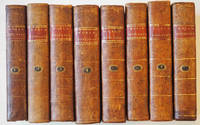
17965000964Philadelphia: Dobelbower Key and Simpson 1796. Rather age-toned and spotted a few small tears and chips but a good sound set. Eight volumes octavo engraved title pages 49 plates a couple closely trimmed includes list of subscribers in the final volume; contemporary marbled sheep bindings spines ruled in gilt and with red leather lettering and blue oval numbering pieces. <p><p>A good complete set of this early collection of voyage accounts rare when complete and in reasonable condition as here. This is the first American edition of these collected voyages from the Great Age of Exploration extensively illustrated. "The Philadelphia edition generally follows the text of the London edition published by T. Carman and F. Newbery 1769-1790 20 vols. though much abridged in content" Forbes. Individual volumes appear for sale but complete runs of the work are the exception rather than the rule.</p> <p>The first volume is devoted to the early discovery of America from Columbus to Pizarro; the second English French and Dutch settlements in America and the circumnavigations of Schouten and Le Maire and Dampier's voyages. The third volume is almost entirely East Indian voyages while the fourth includes an account of the Rogeveen voyage in search of Terra Australis Thomas James' and the Ellis voyages in search of the North West passage and voyages to the Middle East including the Thevenot voyage to the Levant. Volumes five to seven include voyages to East Asia Africa the Middle East Europe and Scandinavia. </p> <p>The final volume is dedicated to Cook's Third and final voyage to the Pacific including A Chart of the Southern Hemisphere Shewing the Tract of Capt. Cooks Last Voyage a finely engraved map filled with comments describing important details such as the northernmost position of the expedition before their progress was blocked by ice and some amusing yet less important notations pointing out the location of floating tree trunks and seaweed clusters. </p> <p>This was just the second map of the Pacific Ocean printed in America the first having been the extremely rare map which accompanied a very few copies of John Ledyard's Journal 1793 and on which it may have been based though some details suggest that it was also made in consultation with the "General Chart" from the official voyage account. Despite its title it shows all of the Pacific Ocean from 70° south to 70° north and from China in the East to the coast of North America in the West. The South Pacific and its islands are represented in detail as are the Alaskan and Asian coasts with Cook's route traced. It includes an early notice of Hawaii with the note 'Owhyhee here Capt Cook was killed 1779'.</p> <p>An additional six nicely engraved views are also featured including The Death of Captain Cook and several portraits of native inhabitants of the Sandwich Islands. </p> <p>---</p> <p>An interesting point is that unlike a set described some years ago which had 26 pages of subscribers listed the present set has specific subscribers' lists for Baltimore and New York the pages of which are numbered from 27 to 38. </p> <p>Not in the catalogue of the Hill collection.</p> </p> . Provenance: New York merchant and subscriber Charles Watkins' copy with his signature; Daniel Sylvester Tuttle 1837-1923 Bishop of Montana with his manuscript inscription in the final volume "Daniel S. Tuttle 1886". Dobelbower, Key, and Simpson unknown
177854207London, G. Robinson, 1778. 4to. Later (19th Century) hcalf. Raised bands, richly gilt spine. Fronthinge broken, but block fully intact. Stamps on title-page. (3),II,III,IV,(9-)649,(3) pp. 1 folded table, 1 folded chart. First leaves lightly brownspotted. Scattered faint marginal brownspots. Wide-margined.
177453620Kopenhagen, Nicolaus Möller, 1774-78. 4to. Bound in 2 contemp. hcalf. Gilt spines. Title-and tome-labels with gilt lettering. A paperlabel pasted on upper part of spines. Slightly rubbed. Stamps on title-pages. 2 engraved titlevignettes. Halftitles. XVI,(6),505,(1)"(16),479 pp. 1 large folded map, outlinecoloured ""Tabula Iteneraria... Terrae Yemen... 1763."" and 124 engraved maps and plates (complete). A dampstain on lower part of leaves in volume 2, increasing towards end. Printed on good paper. A few scattered brownspots.
London, G. Robinson, 1778. 4to. Later (19th Century) hcalf. Raised bands, richly gilt spine. Fronthinge broken, but block fully intact. Stamps on title-page. (3),II,III,IV,(9-)649,(3) pp. 1 folded table, 1 folded chart. First leaves lightly brownspotted. Scattered faint marginal brownspots. Wide-margined.
Kopenhagen, Nicolaus Möller, 1774-78. 4to. Bound in 2 contemp. hcalf. Gilt spines. Title-and tome-labels with gilt lettering. A paperlabel pasted on upper part of spines. Slightly rubbed. Stamps on title-pages. 2 engraved titlevignettes. Halftitles. XVI,(6),505,(1) "(16),479 pp. 1 large folded map, outlinecoloured ""Tabula Iteneraria... Terrae Yemen... 1763."" and 124 engraved maps and plates (complete). A dampstain on lower part of leaves in volume 2, increasing towards end. Printed on good paper. A few scattered brownspots.
182689870Jean-Jacques LEFÈVRE | Paris 1826-1831 | 13.3 x 22.3 cm | 21 volumes reliés
17225Shanghai, The Commercial Press, 1927. 154 pp., cartonnage éditeur de soie bleue ornée d'un encadrement brodé d'arabesques rouge et orange, et d'une représentation brodée d'un temple en couleurs en son centre, dos lisse orné d'idéogrammes brodés en jaune (effilochages, quelques taches, petites rousseurs, pâles décharges).
171190538Jean-Baptiste Machuel le Jeune la Veuve de Paul Marret | Rouen Amsterdam 1711 pour le tome II &1715 pourles tomes I, III, IV & V | 9.5 x 16.8 cm | Relié
- Chez Jean-Léonard Pellet, Genève 1781, in-8 (12,5x20cm), xvj ; 348pp. (1) et xij, 378pp. (1) et (4) VII (1) 372pp. (1) et xij, 308pp. (1) et (4) VII (1) 259pp. (2) et xij, 308pp. (1) et xvj, 359pp. (1) et XII, 352pp. (1) et viij, 262pp. (1) et VI, 348pp. (1), 10 volumes reliés. - Troisième et dernière édition, la meilleure et la plus complète quant au texte, portant le nombre de volumes à 10 contre 7 parus jusqu'alors, ici en titre de relais à la date de 1781 ; on trouve en effet des exemplaires avec des pages de titre aux 2 dates de 1780 et 1781. L'oeuvre parue dans une version luxueuse, in 4 et dans cette version in-8. L'illustration comporte un portrait de Raynal par Cochin (avec la mention : Le défenseur de la liberté, de la vérité...) au frontispice du tome I et 9 belles figures en frontispices des autres volumes, par Moreau le Jeune et gravés par De Launay, Delignon et Simonet. L'atlas in-4 est paru à part et pouvait se joindre à l'édition selon la volonté de l'acquéreur. Les volumes sont bien complets de tous les faux-titre et des 10 feuillets d'errata in fine. Reliure en plein maroquin vert d'époque. Dos lisse orné. Pièces de titre et de tomaison en maroquin rouge. Triple filet d'encadrement sur les plats. Dos uniformément éclaircis. Traces de frottement. Superbe exemplaire, très rare en maroquin vert. Ex libris Edmond et Jules de Goncourt dessiné et gravé par Gavarni. Signature d'Edmond de Goncourt au-dessus de l'ex libris. On notera que les beaux livres du XVIIIe sont rares dans la bibliothèque des Goncourt. Publiée pour la première fois en 1771 en 7 volumes, avec la collaboration de D'Holbach et Diderot, l'Histoire philosophique des deux Indes, a connu un succès fulgurant dans toute l'Europe et l'Amérique ; son succès est essentiellement dû à la critique sévère du colonialisme, de l'exploitation, de l'esclavage et du mercantilisme. Il fut condamné à être supprimé par arrêt du Conseil du 19 décembre 1779 et condamné au feu par arrêt du Parlement de Paris du 25 mai 1781. Livre emblème du siècle des lumières, se présentant comme une histoire du commerce international, L'oeuvre est avant tout un violent brûlot contre le colonialisme européen et son arrogance, l'esclavagisme et l'asservissement des peuples, contre l'église qui prête son concours à l'hypocrisie européenne. Le résultat ne se fit pas attendre, et le livre fut brûlé en place publique à Paris. On sait aujourd'hui que Diderot a collaboré dès la première édition et qu'il a supervisé l'organisation des textes, qu'il perfectionnera dans la troisième édition (en ajoutant de nombreux textes de sa plume et de celles d'autres collaborateurs, tel D'Holbach), transformant l'oeuvre initiale en une véritable machine de guerre du parti des philosophes. Le livre n'est d'ailleurs nullement qu'accusations, il cherche au contraire et implore même des solutions pacifiques, d'ententes entre les peuples. L'histoire ne s'y trompa pas puisqu'elle vit en Raynal un promoteur de la Révolution française. C'est une oeuvre extrèmement riche, une encyclopédie des voyages européens et une histoire coloniale de tous les continents et de tous les pays conquis et colonisés par les Européens. [ENGLISH DESCRIPTION ON DEMAND]
177757073London, Lockyer Davis, 1777. 4to. In recent marbled paper wrappers. Extracted from ""Philosophical Transactions"". Including title-page of volume 61 and 66. Leaves reinforced/mounted in margin. Light offsetting from folded plates as usual. Pp. (2), 401-406, 447-450, (4), 397-436 pp. + 3 folded plates.