39 448 résultats
Engraved map, 394 x 404 mm. Framed. Rare, early 19th century Italian engraved facsimile of the greatest medieval map of the world: the famous world map made around 1450 by Fra Mauro, "considered the greatest memorial of medieval cartography" (Almagià). At the time it was the most detailed representation of the world ever produced, and it remains one of the most important works in the history of cartography, marking the new embrace of scientific method which placed accuracy ahead of religious or traditional beliefs. Strikingly, it is oriented with south at the top, recalling the Arab tradition and more specifically al-Idrisi's famous 12th century world map, copies of which Fra Mauro may have known: Europe is shown at the bottom, and Africa and Asia dominate the image, with Arabia (not Jerusalem) at the centre and America as yet missing. Fra Mauro incorporated "the discoveries of Marco Polo and the Portuguese", also showing "many countries later known, which the learned monk doubtless shaped after ideas gathered from the oral narratives of occasional travellers" (Müller). Much of the map's novel information was lost to early modern cartographers when printed Ptolemy atlases proliferated in the final decades of the 15th century, replacing the manuscript mappamundi tradition. - Today the original Fra Mauro Map, drawn on vellum, is held by the Biblioteca Nazionale Marciana in Venice and shown at the Museo Correr. An impressive manuscript facsimile, now in the British Library, was prepared in 1804 by the British antiquarian William Frazer; a large engraving was made in Paris in 1849, and in 1869 the Venetian bookseller Münster produced the first photographic reproduction. The present edition of the map was issued with Placido Zurla's book "Il Mappamondo di Fra Mauro Camaldolese" (1806), the first study of Fra Mauro's map ever published and indeed the only substantial early work on the map. (Later, Zurla would also include the engraving in his 1818 study "Di Marco Polo e degli altri viaggiatori veneziani più illustri dissertazioni"). Rarely encountered on the market, this is at the same time a very early example of world map facsimiles in general. - A repaired tear to the left edge, touching the engraved border, otherwise in perfect condition. OCLC 163267775. For Zurla's book cf. Cicogna 3323. For the mappamundi cf. A. Müller, Venice. Her Art-Treasures and Historical Associations. A Guide to the City (Venice 1873), p. 113; R. Almagià, Monumenta cartographica vaticana, vol. 1 (Città del Vaticano, 1944); P. Falchetta, Storia del Mappamondo di Fra' Mauro (Rimini, 2016).
18 stiff card leaves with 61 black and white photographs, adhesive mounted on both sides, with a few items of ephemera. All photos have detailed captions on applied small sheets of typescript. An album depicting India with an emphasis on Hindus engaged in religious rituals, many of which appear quite painful. It was created by a missionary in Benares, India, W. K. Norton, who deemed these images "self-torture". His goal in creating the album was to raise funds for the mission by showing "the great need the Hindu people are in for 'something better', that is found only in accepting the Lord Jesus Christ as their personal Saviour". To further drive home the need for funds, one caption for a photo named "Devil Dancers in India" reads "worshiping the devil is a part of nearly all heathen religions". As of 1930, it seems Norton's fundraising efforts were suffering, as his newsletter included here shows that financial conditions were dire and that there was "a serious lack of interest which alarms us". - Around 25 photos show people engaged in self-suffering. These include men who held their arms above their heads for years, one who has moved his foot above his shoulder, and several which show people lying on beds of nails or spikes, including a young boy. Others show a man with his head buried in the ground, while another shows a man buried up to his head. One shows people lying on cacti, another shows a man who vowed he would never again lie down so he slept suspended by ropes under his arms. A couple show a man hanging by his feet, his head just over a fire. Two show a man getting hooked in his back and then suspended far above the ground to swing. Other views include street scenes in villages, people worshipping stone figures of snakes and the tulsi plant, and animal sacrifices. There are two shots of preparation for a cremation, one of a souvenir shop, another showing a crowd of thousands bathing in the Ganges, and more. Although more than one online reference states Norton was the photographer, four of the photos in the book are clearly commercial, and a few appear to be photographs of photographs. We know that Norton and his wife produced another original photograph book of 12 pages in the 1920s with two copies in institutions. OCLC locates no copies of this expanded work, but we note the online sales of two others since 2012 with 61 and 53 photographs respectively. - In very good condition: front wrapper with light foxing and surface abrasions, a couple of leaves with small stains; photos fine save for two with small losses. An outstanding album filled with arresting images, all described in great detail.
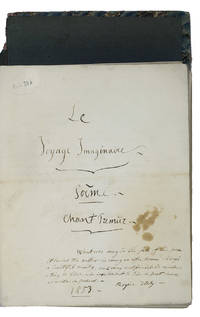
1853BC3EG701U79OAdegeest manor house at Voorschoten between The Hague and Leiden 1853. Loose quires in cover: marbled boards joined together by a spine of red painted sheepskin green ties. Large 4to 27 x 21.5 cm. Extensive autograph poetical work in four Chants provided with elaborate notes containing a romantic imaginary voyage in French verses. The anonymous author - indicating himself with his initials "J.F. v. H. St." - has composed the poem at the manor house Adegeest at Voorschoten between The Hague and Leiden and has dated his work: Mars deleted and 1 April 1853. At the time the manor house was in the possession of the very rich family Dorrepad. G.L. Dorrepad 1816-1883 was an entrepreneur who had gathered his wealth in the Dutch East Indies he was involved f.e. in a notorious financial scandal denounced by the famous Sicco Roorda van Eysinga. To all probability our anonymous author was the private teacher for his children at Adegeest.In the introduction the author states that he had never visited the countries and regions he describes so passionately "N'ayant jamais visité les lieux que je decrits". Citing Cicero Lord Byron Alexandre Dumas and many others he concentrates on classical Greece and Italy and the Mediterranean.Contents: pp. I-V; Avertissement; 1-53: Chant premier; 55-81: Notes; 1-61: Chant second; 63-120: Notes; I-VI Avertissement; 1-68: Chant trousième; 69-132: Notes; 1-76: Chant quatrième; 77-136: Notes.Cover rubbed and spine damaged otherwise in good condition. hardcover
Copper engraving. 295:356 mm. Matted. A depiction of the welcoming of the Dutch ambassador by the Chinese near the Beijing (Peking) city.
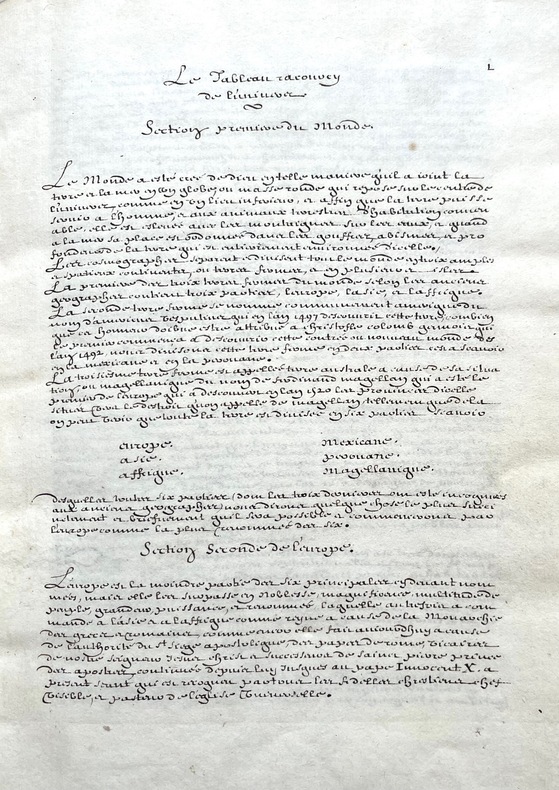
165146771651. 1651 1 vol in-12° manuscrit (230 x 170 mm) de : [1] f. (titre) ; 180 pp. Ex libris du baron Martineau des Chesnes collé au dos du premier plat. Plein veau raciné, dos à nerfs orné et titré, double encadrement de deux filets dorés et motifs sur les plats, gardes de papier marbré. (Reliure frottée, fente aux mors et manque une coiffe).
Oblong 8vo (234 x 146 mm). 59 uniforms, 16 horses and 4 mules on 41 plates. Watercolour raised in gilt, silver, and egg-white. Original embossed and illustrated cloth album. All edges gilt. Charming watercolour album depicting the uniforms of the French army in the late 19th century, including 16 plates of cavalry units, 4 of mules carrying ordnance and strongboxes, and several legendary colonial units such as the Chasseurs d'Afrique, the Spahis, Zouaves, Turcos, and Tirailleurs Tonkinois. - Paper slightly browned evenly; binding rubbed and bumped at extremeties but still very appealing.
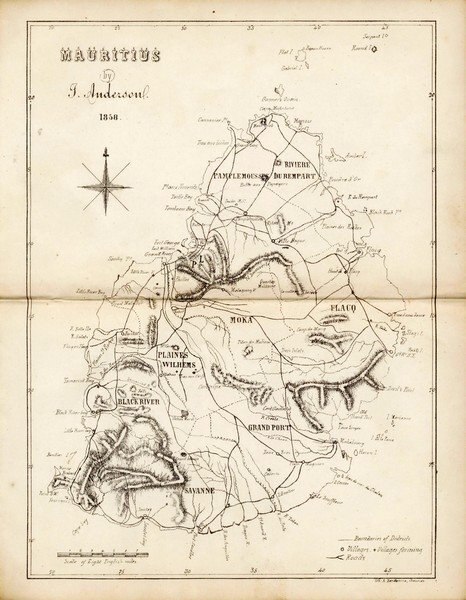
789Mauritius [Île Maurice] : L. A. Denny, 1858. L'EXEMPLAIRE D'EUGÈNE LE CLÉZIO, L'ARRIÈRE GRAND-PÈRE EXILÉ DE J. M. G. LE CLÉZIO
Folio (295 x 364 mm). (8), 93, (7) pp. With 38 (9 full-page) woodcuts in the text and 27 etched plates on China paper. Splendid original blue cloth binding; spine and front cover richly giltstamped; oval view of Peles Castle on front cover. All edges red. A perfect copy owned by Marie Therese of Austria-Este (1849-1919), gifted by King Carol I of Romania, with Marie Therese's autograph note on the front endpaper: "Erhalten vom Könige Karl von Rumänien. Pelesch, Montag, 9. 8. 1909. Marie Therese" ("Received from King Charles of Romania. Peles, Monday, 9 August 1909. Marie Therese"). Ultimately removed from the library of the Dukes of Bavaria at Tegernsee Castle. - Construction of Peles Castle commenced in 1873 under the Viennese architect Carl Wilhelm Christian Ritter von Doderer; after 1876 Doderer's assistant Johannes Schultz took over and changed the original plans. The building was inaugurated on 7 October 1883. Between 1893 and 1914, the Czech architect Karel Liman was commissioned to build the main tower. The castle served as the summer residence of the Romanian royal family until the death of King Carol in 1914.
178810521Paris De Bure 1788 5 volumes in-4, demi veau , dos lisse orné, pièces de titre et de tomaison, tranches marbrées, l'atlas a une reliure différente.
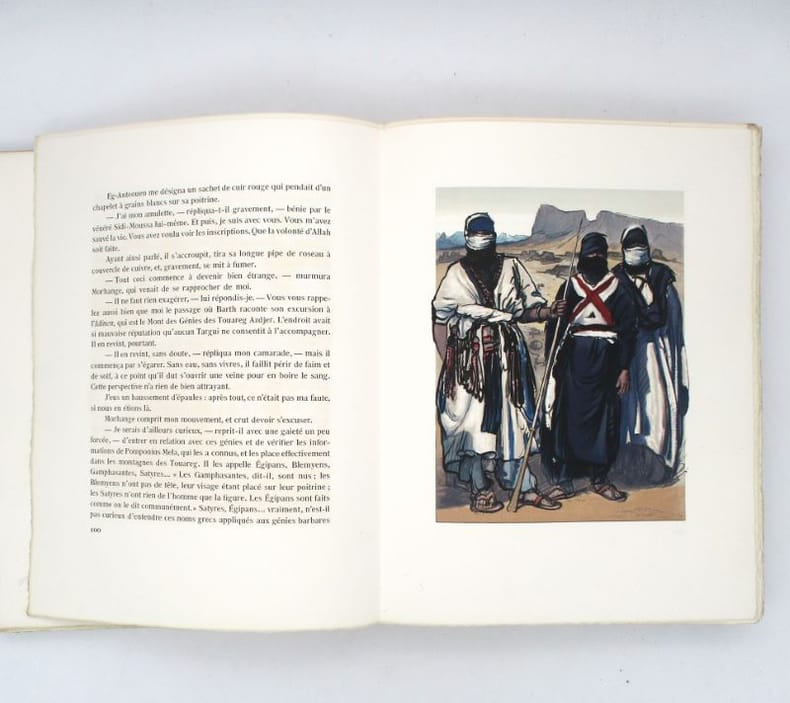
20153Lyon, Cercle lyonnais du livre, 1934. In-folio, 302 pp., en feuilles, couverture originale imprimée, étui et chemise cartonnés (couverture empoussiérée).
18982Amsterdam, NV Theatrum Orbis Terrarum, 1967-1968. 12 vol. in-folio, reliure de l'éditeur de parchemin ivoire, décor doré sur les plats, dos long orné, pièces de titre et de tomaison bleues (quelques taches, quelques accrocs aux reliures).
186582705s. d. [1865] | 30 x 19.30 cm | une photographie sous marie-louise
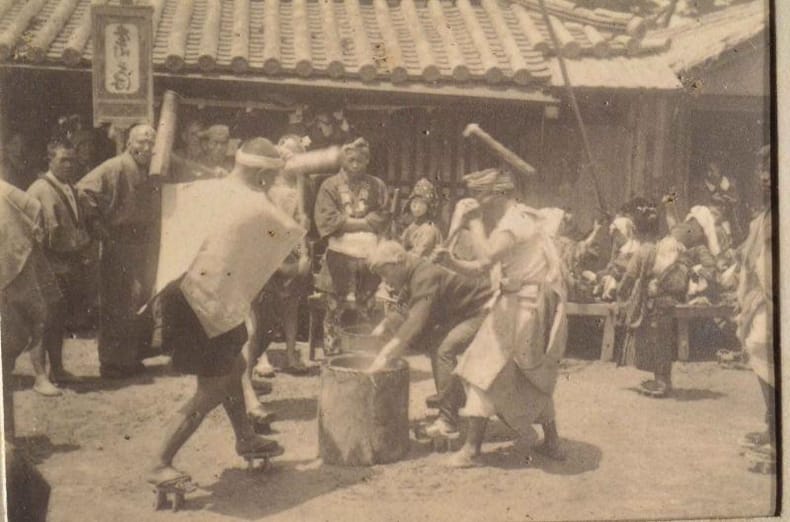
1599Album photographique in-folio à l’italienne, 21 x 26 cm. Contenant 186 photos de format 8 x 6 cm, montées sur onglet par ensemble de 4, recto-verso sur carton fort. Reliure de l'époque, demi-basane noire frottée à coins. Un passionnant et superbe album composé à la fin du XIXe siècle, témoignant d’un voyage touristique en Birmanie (72 photos), puis au Japon (114 photos). Par un parti-pris tout à fait moderne, le photographe dans cet album s’est attaché à rendre compte de la vie quotidienne : combats de sumos en plein air, pilonnage des céréales, rues commerçantes, paysans sur les flancs du Mont Fuji, jeunes femmes en kimono, pousse-pousse, pagodes et jardins, couchers de soleil, étendards et banderole, scènes de pêche en bord de grève, cimetière shintoïste, jonques, ponts suspendus, etc.Bien que de format modeste et de tirage visiblement amateur, il se dégage de cet ensemble une ambiance envoûtante et mystérieuse. Cet album est l’œuvre de Joachim Clary (1875-1918) (mention manuscrite, signature autographe sur le premier contre-plat), japoniste de la première génération, ami intime de Marcel Proust, Lucien Daudet, Robert de Montesquiou, inspirateur supposé de Marcel Proust pour la partie japonisante de La Recherche du Temps Perdu. Il vivait lui-même en compagnie d’un valet japonais, ramené d’un voyage à Kyoto où ce dernier travaillait comme garçon d’hôtel. Il est l’auteur de L’île du soleil couchant, paru chez Arthème Fayard en 1912, roman sur le Japon cité par Marcel Proust dans une de ses lettres de novembre 1912. Un important album s’inscrivant dans la mouvance japoniste de la fin du XIXe siècle. Le japonisme en France eut de nombreux adeptes : des impressionnistes à Toulouse-Lautrec, des frères Goncourt à Marcel Proust. Mais très rares sont les témoignages de première main qui nous sont parvenus du Japon lui-même. Cet album en est la parfaite illustration. Radicalement différent dans sa conception des classiques albums de souvenirs rapportés par des officiers en escale, il exprime la fascination qu’exerçait Cypango sur les jeunes créateurs de la fin du siècle.
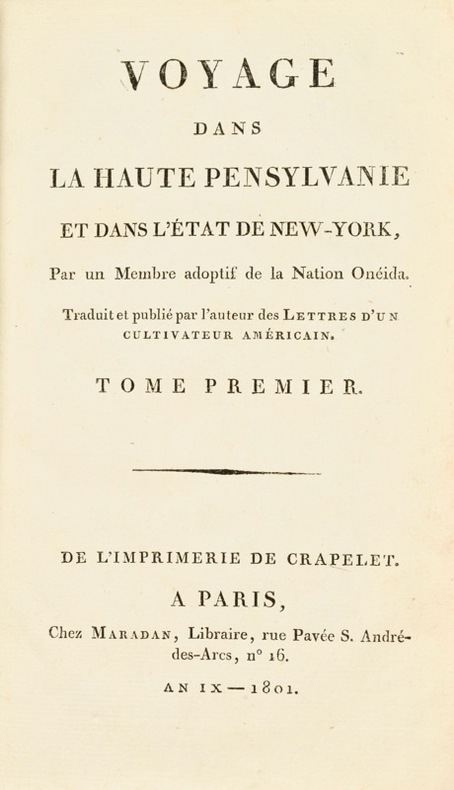
180141330Paris, Maradan, 1801. 3 vol. in-8 de XXXI-(1)-427 pp., 5 planches hors texte dont la carte de la partie septentrionale des États-Unis ; XIII-(1)-434 pp. 4 planches hors texte dont le plan de la cataracte du Niagara et la carte de la partie méridionale des États-Unis ; XII-409-(1) pp., 2 planches repliées hors texte et 4 tableaux, veau marbré, dos lisse orné, pièces de titre et de tomaison en maroquin rouge, filet et frise dorés d'encadrement sur les plats, tranches marbrées (reliure de l'époque).
Royal 8vo. XLVIII, IV, 1478 pp. + (2), 8 pp. of publisher's catalogue. With 11 folded maps and charts. Publisher's original full cloth, blindstamped and with gilt lettering. Third edition of Findlay's monumental navigational directory of Eastern Asia, including the Straits of Malacca, Sunda, and Singapore, the east coast of Sumatra, the Gulf of Siam (now Thailand), the coasts of Cochin China, Tonkin, Borneo, the Philippines, the China Sea, Java and the Java Sea, the islands, the coast of China, Hong Kong, Formosa (Taiwan), Shanghai, and Korea. - Inner front hinge reinforced, but clean and fine. Stamps of the Royal Danish Navy Library and the Royal Danish Maps and Charts Archive on title-page. Rare: OCLC lists a single copy (in the National Library of Sweden). OCLC 940735103.
165814782Paris Pierre Lamy 1658 2 parties en un volume in-4, 12 ff. lim. n.ch., 384 pages pour la première partie - 9 ff. n.ch., 42 pages pour la deuxième partie. Plein maroquin vert, dos à nerfs orné, double encadrements de filets dorés avec fleurons aux angles sur les plats, double filet doré sur les coupes, dentelle dorée intérieure, tranche dorée (Petit, successeur de Simier).
1768386231768 In-12 (152 x 98 mm), demi-veau marbré de l'époque, dos lisse orné de compartiments garnis de fleurons et filets dorés, pièce de titre de maroquin brun, tranches rouges, (2) f., (8), 188 p. Genève, 1768.
171614783Paris Nyon, Ganeau & Quillau 1716 In-4 veau havane de l’époque, dos à nerfs ornés de fers dorés, pièce de titre rouge, tranches rouges. XIV-298 pp. (Coins et coiffes usés, épidermures, quelques rousseurs).
Oblong 4to. Album with 50 albumen prints, each measuring ca. 117 x 167 mm, mounted on cardboard. Contemporary blindstamped full cloth with giltstamped cover-title. Charming compilation of photographs capturing Algerian scenery, by the Swiss photographer Geiser, who ran a photo studio in Algiers since 1867 and was particularly famous for his oriental portraits of women. His present works show vast landscapes (including a mirage), buildings, and local inhabitants going about their work in the environs of the Le Kreider military camp near Oran, the villages of Mécheria, Ain Sefra, Tiout, Beni-Ounif, Taght, Beni-Abbes, and Figuig. Includes the widely distributed photograph of Emir Abd-el-Kader as well as a depiction of the guard of the Pasha of Figuig. Other photographs show caravans, tents, a French doctor treating locals, French colonial soldiers, a group of people praying to a marabout, and the gardens in the oasis of Igli. All pictures with handwritten captions in French. - Handwritten ink ownership by Johannes Berg, dated Lüdenscheid 1906, to flyleaf. Extremities somewhat bumped, hinges a little worn. Backing cardboard slightly warped. A well-compiled selection of remarkable photographs from French North Africa in the 1870s. For Geiser cf. Pouillon, Dictionnaire des orientalistes de langue française.
4to (263 x 213 mm). 3 parts in one volume. (2), IX, (1), 69, (1), 111, (1), 84 pp. With a general title-page and 3 part-titles, with an occasional decorated rule or cast fleuron. Set in roman and Javanese type with incidental italic and Arabic. Contemporary shell-marbled boards, sewn on 2 cords. Rebacked in later red cloth. Since the endpapers (including the pastedowns) come from the same stock as many of the printed leaves, the book was probably bound in Jakarta. First and only edition, printed in Batavia in the Dutch East Indies (now Jakarta, Indonesia): one of the earliest, best and most extensive introductions to the Javanese language, written and compiled by Johann Friedrich Carl Gericke (1798-1857) for Dutch speakers who wished to learn Javanese. Part 1 ("Eerste gronden der Javaansche taal", 69 pp.) gives a general introduction to the language and writing system, discussing the origin of the language, its scripts, the various parts of speech and the numbers. Part 2 ("Javaansch leer- en leesboek", 111 pp.) gives sample texts: conversations, letters, stories, legal documents (including ones on adultery and on abducting women for marriage), the "Dhoso-nomo" (a moral or religious text) and the "Papali" (a 16th century poem). The sample texts appear in the Javanese script on the rectos with a phonetic transcription in roman type on the facing versos. Part 3 ("Woordenlijst, ...", 84 pp.) is a Javanese-Dutch lexicon, also giving Arabic equivalents for some words. - Gericke, born in Brandenburg, Prussia, was director of the Javaansch Instituut at Surakarta and worked more than 30 years for the Nederlandsche Bibelsgenootschap, making the Javanese language his principal field of study. - As early as in 1820 the governor-general of the Dutch East Indies had given P. van Vlissingen at Surakarta the task of establishing Javanese printing, and Van Vlissingen found the young Cornets de Groot to advise him. No Javanese type had ever been produced before, so together they developed a system for rendering the complicated Javanese writing system into typographic form. Joh. Enschedé & Zonen in Haarlem took the order to produce the type in 1822, and their punchcutter Martinus Hübner finished cutting it in 1824. The first specimen appeared in 1825. The occasional Arabic is a rare example of a modern use of Nicolaes Briot's large Arabic typeface, cut for Willem Jansz. Blaeu shortly before Briot's death in 1626 and first extensively used in 1635. It was also cast by Enschedé. - Provenance: bookseller's ticket of Maisonneuve et Cie. of Paris, ca. 1840: Jean-Claude Maissonneuve set up in 1838 by acquiring the business of Théophile Barrois, and the ticket notes the succession. Also with a ca. 1890 (?) armorial bookplate of the "Bibliotheca Lindesiana" assembled by Alexander Lindsay (1812-80) and his son James Lindsay (1847-1913), 25th and 26th Earls of Crawford, near Manchester, England. "The Bibliotheca Lindesiana was a vision of the human intellect, an ideal too high for any man to achieve, but one to which two men, father and son, both of remarkable attainments, came closer than anyone else, before or since" (N. Barker, Bibliotheca Lindesiana [1977], p. xiii). The elder Lindsay took an interest in oriental languages already in 1837/38, when he visited the Middle East, so he may have bought the present book from Maisonneuve not long after that, and it was certainly in his son's library in 1910. Finally with the 20th century letterpress bookplate of John Lawson on the front pastedown. - In very good condition and with generous margins. Binding rebacked and nearly separated from the book block at the front hinge (with one sewing support broken); marbled sides rubbed and scuffed. One of the earliest, best and most extensive introductions to the Javanese language, printed in the East Indies. Brunet II, 1551f. Bibliotheca Lindesiana (1910) 3825 (this copy). J. A. van Chijs, Catalogus der Bibliotheek van het Bataviaasch Genootschap van Kunsten en Weteneschappen (Jakarta 1864) 150. E. M. Uhlenbeck, A Critical Survey of Studies on the Languages of Java and Madura (The Hague 1964) 84.
173040115Chez Jacques Vincent | à Paris 1730 | 9.50 x 16.80 cm | relié
174783724chez Mérigot & Piget | à Paris 1747 | 20 x 25.50 cm | 2 volumes reliés
Oblong royal folio (610 x 780 mm). Lithographed title-page and 24 lithographed maps. Original lithographed wrappers, bound within contemporary half calf over marbled boards. Second edition of this large-scale atlas of the classical and mediaeval world, first issued in 1823, for use at schools in the Grand Duchy of Baden. - Binding rubbed and bumped at extremeties; spine chipped. Some waterstaining throughout, mainly confined to margins, but more pronounced near beginning with additional foxing and light inkstain to edge. A scarce ensemble. OCLC 54263143. Cf. Heinsius VIII, 408. Not in Phillips/Le Gear.
175114816Paris Imprimerie Royale, et Durand & Pissot 1751-54 4 parties en 2 volumes in-4, reliures disparates, les deux premiers textes en 1 volume, plein veau de l'époque, dos à nerfs orné de fers dorés, les 2 derniers en 1 volume légèrement plus petit, pleine basane de l'époque, dos à nerfs ornés. (Coiffes usées, deux mors fendus sur 4 cm. Tome I. XXXVI-280-XV pp. Tome II. (10)-266-X pp. Volume II. (6)-222-XXVIII-(2)-53 pp.
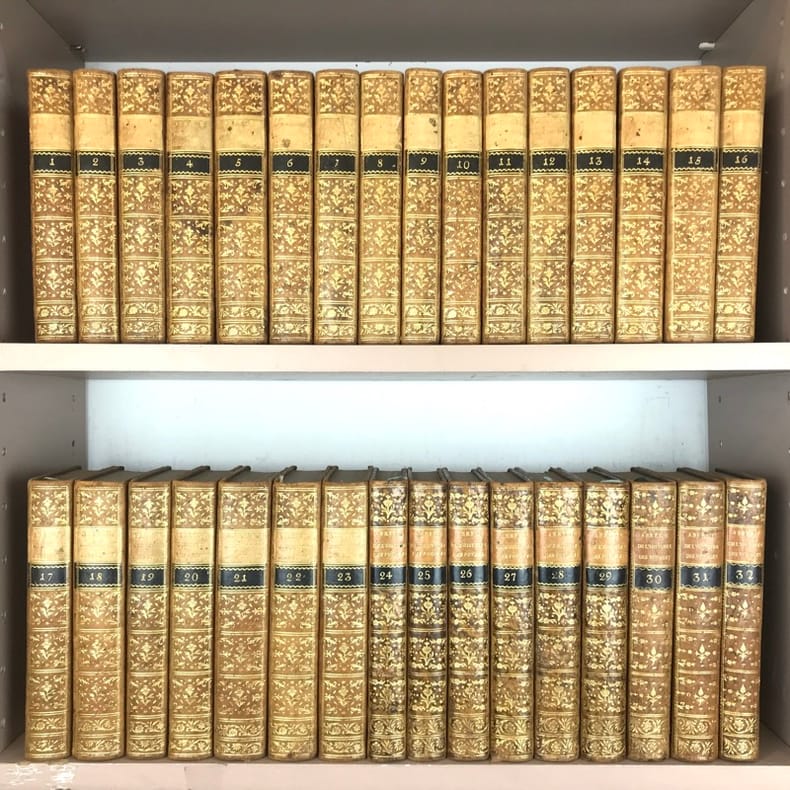
271780-1801 À Paris, Hôtel de Thou, 1780 ; tomes 1 à 21 - Chez Laporte, 1786 ; tomes 22 et 23 - Chez Moutardier, An VI-VIII-IX, 1798-1800-1801 ; tomes 24 à 32.