39 458 résultats
190280848San Francisco dimanche 22 novembre 1902 | 13.70 x 18 cm | 4 pages sur un feuillet double
4to [28 x 23 cm]; xii, 602, [i, directions to place plates], [i, ads] pp, 27 plates, (sepia aquatints), 6 folding including frontis panorama, hand colored folding map showing Great Lakes to Gulf of St. Lawrence. nineteenth century half blue morocco, gilt spine title lettering & decorations, raised bands, top edge gilted, light offsetting from plates, interesting bookplate of Robert Wetherill, some plates with shorter margins as issued, near fine, nicely bound. A First edition of what some have called the first Canadian coffee table book which underestimates its value as an important and comprehensive account of Canada. Heriot at postmaster-general of British North America 1799-1816, travelled extensively in the area, describing the fur trade, cod fishery, conditions, one of the best accounts of the loyalists settlements in Canada, voyage to the north, as well as a scholarly study of the indigenous peoples of north and south America, with a vocabulary of the Algonquin language. Prideaux 254: 'Illustrated books on North America are curiously few in the period with which we deal. By far the most interesting is Heriot's Travels Through the Canadas, interesting for its aquatints by Stadler and Lewis after Heriot'. The attractive plates from Heriot's fine paintings include: views of Quebec, St. Paul's Bay, Falls of Montmorenci, Falls of ChaudiÞre, Falls of La Puce, Ruins of ChÔteau Richer, Lake St. Charles, River Etchemin, Bridge on the Jacques Cartier, Montreal, Fort of Niagara, Whirlpool of the Saint Lawrence, Falls of Niagara, French Canadian dancing, an Indian encampment, Indian costume, etc. Hill 142: 'the earliest and the most important aquatint book published on Canada'. Sabin 31489. TPL 805. Streeter 3658. Lande 433. Field 687. Abbey Travel 618.
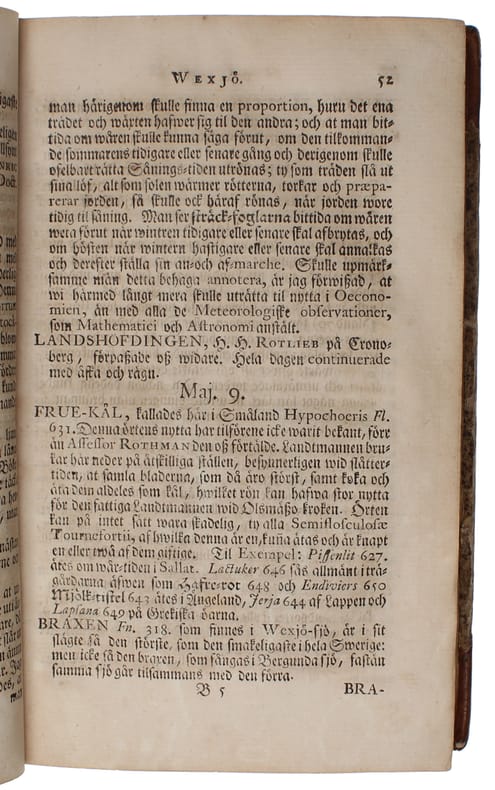
175160339Stockholm, Lars salvius, 1751. 8vo. In contemporary half calf with four raised bands and gilt lettering to spine. Ex-libris (Thore Virgin) pasted on to pasted down front end-paper and ""Thore Virgin / Stockholm d. 7. dec. 1912."" to upper outer corner of front free end-paper. Title-page with marginal browning, otherwise a fine copy. (10), XIV, 434, (34) pp. + 1 folded map and 6 plates.
xxiv, 384, viii pp. Recased in leather. Raised bands and periphery of boards decorated with gilt. Title page printed in red and black. Bookplate inside front board. Several incidents of peeling and sticker remnant to decorated front endpaper. Small, faint numeric ink stamp at bottom of title page. Call numbers on backstrip scarcely visible. Moderate wear. Binding firm. Book
181816209London: J. J. Stockdale; Longman Hurst Rees Orme and Brown. Good. 1818 1822. First Edition; First Printing. Hardcover. In contemporary three-quarter leather. Worn at the corners. The spine is very chipped and worn. The exterior hinges have cracked and the book has been reinforced internally to keep it tight. All four plates are present in the first work. Trimmed which does not affect the text or plates but did trim part of the titles on the plates. A pair of very scarce travelogues. Priced as-is. ; 16mo 6" - 7" tall; 228171 pages . J. J. Stockdale; Longman, Hurst, Rees, Orme and Brown hardcover
- s.d. (1865), cliché : 30x19,3cm / planche : 48x37cm, une photographie sous marie-louise. - n.d (1865), photo: 30x19,3 cm / mount: 48x37 cm, a photograph mounted. Original photograph printed on albumen paper, with a very sharp rendering thanks to the photographer's mastery of the difficult wet collodion technique. Rare and impressive photograph made by the very first photographer of Yosemite and featuring one of the pioneers of ecology. The American photographer Carleton Watkins first came to Yosemite in 1861 with his "mammoth" camera, where he took an impressive series of views of the valley. It was partly because of his splendid photographs that President Lincoln signed the Yosemite Valley Grant Act on June 30, 1864, declaring the site protected and thus initiating the national park service. Watkins continued to take photographs of Yosemite Valley and became acquainted with Galen Clark, pictured here at the foot of the 300-year-old "Grizzly Giant" redwood. Born in Quebec and carried away like many of his compatriots by the California gold rush, Galen Clark - whose doctor gave him no more than six months to live - was the first Westerner to discover the Mariposa Grove of giant sequoia trees. He never left the grove, becoming its first guardian in 1864 and remaining there for twenty-four years. Although Yosemite Valley attracted artists and wealthy travelers as early as the 1850s, Watkins' images did much to promote the site, especially after the completion of the transcontinental railroad in 1869. Watkins presented his photographs (displayed in redwood frames...) at the Paris World's Fair in 1867. They are now preserved in major American institutions such as the MoMa, the Getty Museum and the MET. [FRENCH VERSION FOLLOWS] Photographie originale tirée sur papier albuminé, d'une très grande netteté grâce à la maîtrise par le photographe de la difficile technique du collodion humide. Rare et impressionnant cliché réalisé par le tout premier photographe de Yosemite et mettant en scène l'un des pionniers de l'écologie. Le photographe américain Carleton Watkins se rendit pour la première fois en 1861 à Yosemite, armé de son appareil « mammouth », où il réalisa une superbe série de vues de la vallée. C'est en partie grâce à ses splendides clichés que le Président Lincoln signa le traité du 30 juin 1864, déclarant le site protégé et initiant ainsi le système des parcs nationaux. Watkins continua à prendre des photographies de la Yosemite Valley et fit la connaissance de Galen Clark, ici photographié au pied de l'immense séquoia de 300 ans baptisé Grizzly Giant. Natif du Québec et emporté comme nombre de ses compatriotes par la ruée vers l'or californienne, Galen Clark - à qui son médecin ne donnait pas plus de six mois à vivre - fut le premier occidental à découvrir la Mariposa Grove, bosquet de séquoias géants. Il ne le quitta dès lors plus et en devint en 1864, le premier gardien, poste qu'il occupa vingt-quatre ans. Bien que la vallée de Yosemite ait attiré des artistes et des voyageurs fortunés dès les années 1850, les images de Watkins contribuèrent largement à promouvoir la visite du site, en particulier après l'achèvement du chemin de fer transcontinental en 1869. Watkins présenta ses photographies (exposées dans des cadres en séquoia...) à l'Exposition universelle de Paris en 1867. Elles sont aujourd'hui conservées dans de grandes institutions américaines telles que le MoMa, le Getty Museum ou le Metropolitan Museum de New York.
- Lattré Graveur & Jean Thomas Herissant, Paris 1762, 3f. 36 cartes doubles (1f.), relié. - Edition originale illustrée d'un frontipice par Mounet et gravé par Prevost, d'une planche contenant plusieurs figures de sphère armillaire et 36 cartes rehaussées en couleurs sur double page. Table gravée. In fine catalogue de Lattré Graveur. La majorité des cartes sont l'oeuvre de Bonne et Rigobert, mais il y a quelques contributions de Janvier et Rizzi-Zannoni (la plupart sont datées entre 1761 et 1764). Reliure en pleine basane brune marbrée d'époque. Dos lisse joliment orné de fers à la lyre et aux roues dorées encadrés d'ornements. Pièce de titre refaite. Coiffes et mors habilement restaurés. Eraflures sur les plats. Rousseurs dans les marges. 4 trous de vers traversant les cartes dans la partie basse. 3 taches rouges sur la Russie dans la carte de l'Europe. En dehors des cartes européennes, on distinguera 3 cartes asiatiques, 3 africaines, 4 des Amériques, une des 12 tribus d'Israël et une de la terre sainte. Important atlas compilé des meilleurs cartographes du XVIIIe et qui donne un relevé exact du monde vers 1760. [ENGLISH DESCRIPTION ON DEMAND]
- Chez Jacques Le Febvre, à Paris 1688, in-4 (18x25,5cm), (20) 558pp. (11), relié. - Chez Jacques Le Febvre, in Paris 1688, in-4 (18 x 25.5 cm), (20) 558pp(11), bound New Edition. The author wrote this work in Italian and published it in Milan in 1674, he did the translation himself. Bound in full brown calf. Spine in decorated compartments. Title piece in brown morocco. Top spine end skillfully restored and redecorated. Title page mounted, as well as the first page of the foreword. Remnants of adhesive between the endpaper page and the title page. Good fresh paper, except on the pages of the epistle. A beautiful copy. The author, a Capuchin monk by the name of Justinien de Tours (he will have another pen name) lived for a long time in the Middle East and took many trips within the Turkish provinces. The work proposes to set the scene of the Turkish Empire's decadence and of its unrest. If the first chapters deal with Mohammedan religion by discrediting it, the whole book addresses the subjects of the most varied traditions and customs. [FRENCH VERSION FOLLOWS] Nouvelle édition. L'auteur écrivit cet ouvrage en italien et le fit paraître à Milan en 1674, il en fit lui-même la traduction. Reliure en plein veau brun. Dos à nerfs orné. Pièce de titre en maroquin brun. Coiffe de tête adroitement restaurée et redorée. Page de titre remontée, ainsi que la première page de l'avertissement. Décharges d'adhésif entre la page de garde et la page de titre. Bonne fraîcheur du papier, excepté sur les pages de l'épître. Bel exemplaire. L'auteur, un moine capucin du nom de Justinien de Tours (il prendra un autre nom de plume) résida longtemps au Moyen-Orient, et fit de nombreux voyages au sein des provinces turques. L'ouvrage se propose d'établir le tableau de la décadence de l'Empire turc et de ses désordres. Si les premiers chapitres traitent de la religion mahométane en la discréditant, l'ensemble du livre aborde les sujets de murs et coutumes les plus variés.
- San Francisco jeudi 10 décembre 1902, 11,2x17cm, 2 pages sur un feuillet. - Signed handwritten letter sent from San Francisco addressed to Emile Mignard on Asian wood paper San Francisco Thursday 10 December 1902, 11.2 x 17 cm, 2 pages on one leaf Handwritten signed letter from Victor Segalen addressed to Emile Mignard, two pages written in black ink on a leaf of Asian wood letter paper printed in the margin with blue Asian silhouettes and landscapes. Emile Mignard (1878-1966), also a doctor and Brest-born, was one of Segalen's closest friends of youth whom he met at the Jesuit Notre-Dame-de-Bon-Secours School in Brest. The writer interacted with this comrade in an abundant and closely followed correspondence in which he described, with humour and intimacy, his daily life in all corners of the world. It was at Mignard's wedding, on 15 February 1905, that Segalen met his wife, Yvonne Hébert. Segalen, who left Le Havre on 11 October 1902 for Tahiti, had his journey interrupted by contracting typhoid fever, which kept him in San Francisco for two months. This was the opportunity for the young man to discover China Town, the Asian quarter that he mentions in this letter: "Je t'ai déniché chez un petit singe à figure jaune du quartier japonais un petit porte-carte qui aura toujours, à défaut d'autre chose, l'intérêt de «venir de loin» et de son authenticité...et aussi peut-être celui d'être donné avec la plus profonde affection que je puisse dédier à un Ami." "I have unearthed you in a little yellow-faced monkey in the Japanese quarter, a little card wallet that will always have, in the absence of anything else, the interest of "coming from afar" and its authenticity...and also perhaps that of being given with the deepest affection that I can dedicate to a Friend." Segalen left San Francisco for Tahiti on 11 January 1903. Handwritten letters from Victor Segalen are very rare. [FRENCH VERSION FOLLOWS] Lettre autographe signée de Victor Segalen adressée à Emile Mignard, deux pages rédigées à l'encre bleue sur un feuillet de papier à lettre de papier bois asiatique imprimé en marge de silhouettes et paysages asiatiques bleus. Emile Mignard (1878-1966), lui aussi médecin et brestois, fut l'un des plus proches amis de jeunesse de Segalen qu'il rencontra au collège des Jésuites Notre-Dame-de-Bon-Secours, à Brest. L'écrivain entretint avec ce camarade une correspondance foisonnante et très suivie dans laquelle il décrivit avec humour et intimité son quotidien aux quatre coins du globe. C'est au mariage de Mignard, le 15 février 1905, que Segalen fit la connaissance de son épouse, Yvonne Hébert. Segalen, parti du Havre le 11 octobre 1902 en direction de Tahiti, voit son voyage interrompu par la contraction de la fièvre typhoïde qui l'immobilise deux mois à San Francisco. Ce sera l'occasion pour le jeune homme de découvrir China Town, le quartier asiatique qu'il évoque dans cette lettre : "Je t'ai déniché chez un petit singe à figure jaune du quartier japonais un petit porte-carte qui aura toujours, à défaut d'autre chose, l'intérêt de "venir de loin" et de son authenticité...et aussi peut-être celui d'être donné avec la plus profonde affection que je puisse dédier à un Ami." Segalen quittera San Francisco pour Tahiti le 11 janvier 1903. Les lettres autographes de Victor Segalen sont d'une grande rareté.
- Chez Jacques Vincent, à Paris 1730, Fort in-12 (9,5x16,8cm), (10) 647pp. (1), relié. - Edition originale, rare. Reliure en plein veau blond marbré d'époque. Dos à nerfs orné. Pièce de titre de chagrin rouge refaite. Un léger manque en tête. Coiffe de queue élimée. Coins émoussés. Relation de voyage établie par le père Nicolas Frizon sur des mémoires écrits par un missionnaire lors de son passage par la Turquie vers la Chine, Jacques Villotte. Le voyage par mer étant très dangereux, on choisit deux routes, une par la Moscovie, l'autre par la Turquie, les jésuites espérant convertir les peuples de Tartarie. Narration établie à la troisième personne commençant par le séjour de trois semaines du jésuite à Constantinople. Suit une ample description des voyages en caravane. Considérations sur les Perses. Ville d'Ispahan. Situation du paradis terrestre et considérations sur l'ancienne Babylone. Considérations sur les Perses et les Arméniens. C'est la vision éclairée et tolérante sur des murs étrangères par un jésuite s'attardant aussi sur les affaires et l'histoire de son ordre. Le Père jésuite, parti de Marseille en 1688, atteignit Ispahan en octobre 1689 où il se fixa durant douze années. Il ne parvint pas à passer en Chine et fut rappelé en France. [ENGLISH DESCRIPTION ON DEMAND]
Copper engraving. 285:720 mm. Matted. Top left notes to the letters (A-D) in English and Dutch. - After the Vereenigde Oostindische Compagnie was driven out of Taiwan in 1662, it tried to gain access to the porcelain and silk trade at the port of Fuzhou, then also known as Hocksiew, though the Company's attempts to trade there were hampered by a string of bureaucratic restrictions. As early as 1655 a Dutch delegation had visited the Imperial court in Beijing, but had had little opportunity to discuss trading conditions. A visit of this kind was regarded solely as a token of the respect to which the emperor was entitled. In 1666 a second delegation was sent to Beijing, led by the ambassador Pieter van Hoorn. But aside from some dazzling descriptions of China, this journey yielded nothing. Although the trading post at Fuzhou barely made a profit, the VOC kept it on until 1681.
187588763A.-L. Bancroft and C° (Imp. Eugène Heutte et Cie) Ernest Leroux | San Francisco (Saint-Germain-en-Laye) Paris 1875 | 27.5 x 36.3 cm | Relié
178790325Imprimerie Royale (1640-1792) | Paris 1787 - 1788 | 20.2 x 25.3 cm | 2 volumes reliés en 1
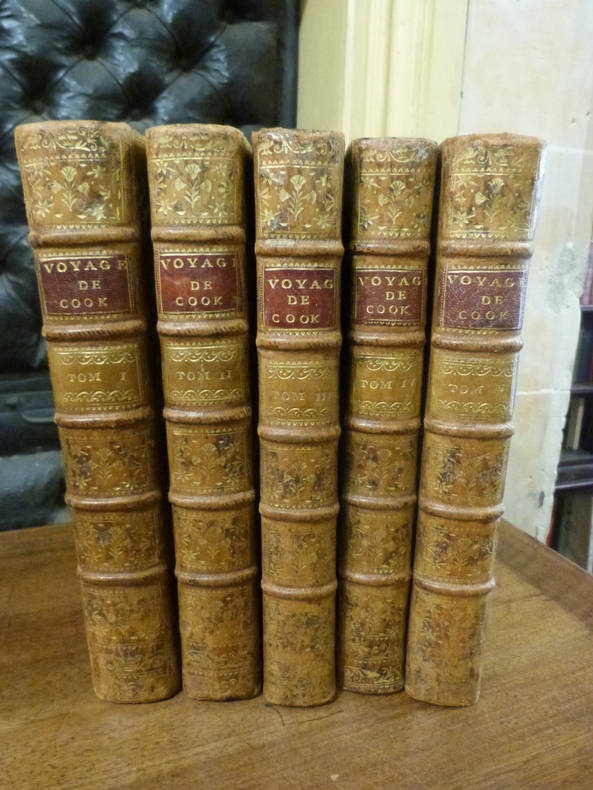
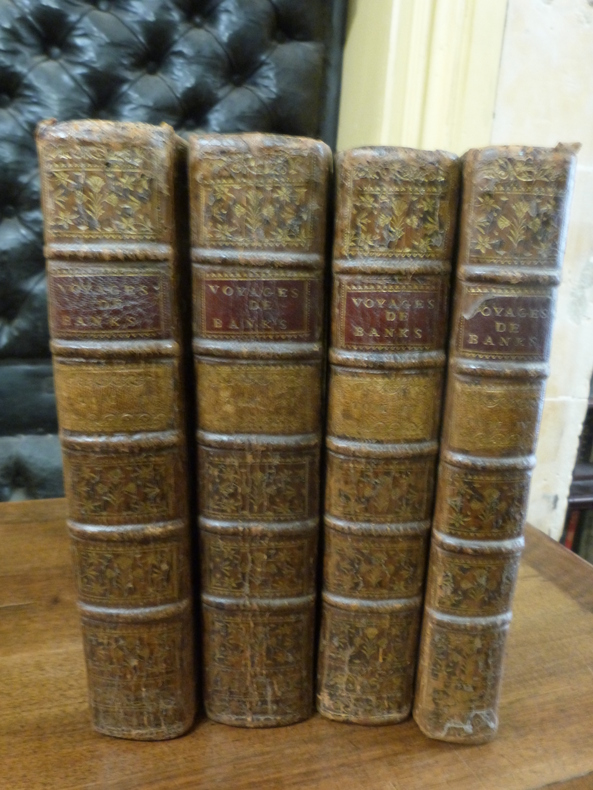
1778DEZ-8595Paris, Panckoucke, Hôtel de Thou, 1778. 5 volumes in-4 en plein veau blond marbré au dos à nerfs orné de filets d'encadrement et fleurons dorés. et aux plats encadrés d'un triple filet doré. Tome 1 : 1 f. blanc, XLIV, dont faux-titre, titre, avis au relieur, avertissement du traducteur et introduction, 460 pp, 1 f. blanc. 18 planches dont la 10 bis. Tome 2 : 1 f. blanc, VIII, dont faux-titre, titre et table des matières, 432 pp, planches numéros 18 à 37 Tome 3 : 1 f. blanc, VIII, faux-titre et titre et table des matières, 374 pp, 1 f.blanc, planches numéros 38 à 58. Tome 4 : 1 f. blanc, VIII, dont faux titre et titre et tables des chapitres, 413 pp, 3 pp non chiffrés dont approbation, privilèges et errata. planches numéro 39 à 65. Tome 5 : 1 f. blanc, XII, dont faux-titre, et titre, 510 pp, approbation et privilège du roi. 1 tableau dépliant et une carte dépliante. Bien complet des 68 planches dont le portait de Cook en frontispice, la 10 bis, le tableau et la carte du tome 5. Edition Originale française du second voyage de du Capitaine Cook. Mouillure claire sur une dizaine de feuillets en marge supérieure du tome 4, en marge extérieure du tome 2 et du tome 3. Frottements aux coins, aux coupes et aux coiffes, quelques légères épidermures sur les plats, 2 trous de ver sur le mors inférieur du tome I (sans gravité) et quelques très rares rousseurs sur le papier.
21821Paris, chez Comon et Cie, 1851. In-8, 200 pp., demi-basane blonde, dos long orné d'arabesques dorées, tranches mouchetées (petites taches, 1 mors fendu).
Folio. (8), 566, (2) pp. T. p. printed in red and black. With engr. title vignette, 3 folding maps, 1 full-page map in the text, and several engr. headpieces. Contemporary vellum with giltstamped red spine label. Edges sprinkled in red. First edition. - The only comprehensive account of the entire Via Appia, one of the main ancient roads through Italy. A standard work in spite of several shortcomings. "Travail important et rempli d'érudition" (Brunet). In the 19th c., the Italian priest and antiquary Francesco Maria Pratilli (1689-1763) was discovered to have been involved in a vast series of skilled forgeries. "Als Werk über die gesamte Via Appia ist immer noch einzig F. M. Pratilli Della via Appia riconosciuta da Roma a Brindisi, Napoli 1745, leider voller unzuverlässiger Angaben und Fälschungen" (Pauly, RE II, 242). - Old library stamps on t. p. and flyleaf; "Westdean Library" bookplate on pastedown. A good copy. Ebert 17903. Brunet IV, 857f.
179319106ABParis, Poignee, An VIII (1793). Four large folding engraved maps, six engraved foloding maps and one plan.
183788703J. Bernard | Strasbourg 1837 | 29 x 23.5 cm | Relié
8vo. 293, (1) pp. Ottoman Turkish in Arabic type. With 17 reproductions of pen-and-ink drawings, 15 of which full-page, a headpiece, as well as a folding map of India and a folding table of type specimens. Contemporary red half cloth with giltstamped spine and printed title to upper cover, table of contents to lower cover. First edition. - An informative account of diplomatic travel describing a journey by the Ottoman ambassador, Sirvanli, to India, illustrated by lithographic reproductions of pen-and-ink drawings. Rich in detail, they show Hindu temples, ports and city views, while the folding table of script specimens shows the alphabets of Sanskrit, Brahmi and Devangari and their pronunciations in Latin and Arabic alphabets. The travelogue begins with the journey from Istanbul to India by ferry, and goes on to describe Indian cities including Bombay, Poona, Jaipur, Calcutta, Delhi, Lahore, Ceylon, and Madras, as well as Kashmir, Afghanistan, and Kabul, and gives an account of Mecca, which the diplomat visited on his way home. Reflecting on the cities' names and origins as well as on peoples' customs and traditions, the book also mentions a meeting with Sayyid Ahmed Khan, the founder of Aligarh Muslim University, one of the first institutions of higher education in British India. - Extremities lightly bumped, paper evenly browned throughout. Merely 7 copies in libraries worldwide, only one in Turkey (KOC University Library). Özege 7654. Karatay I, 268. TBTK 1438. History of geographical literature during the Ottoman period I, 270. OCLC 030091889.
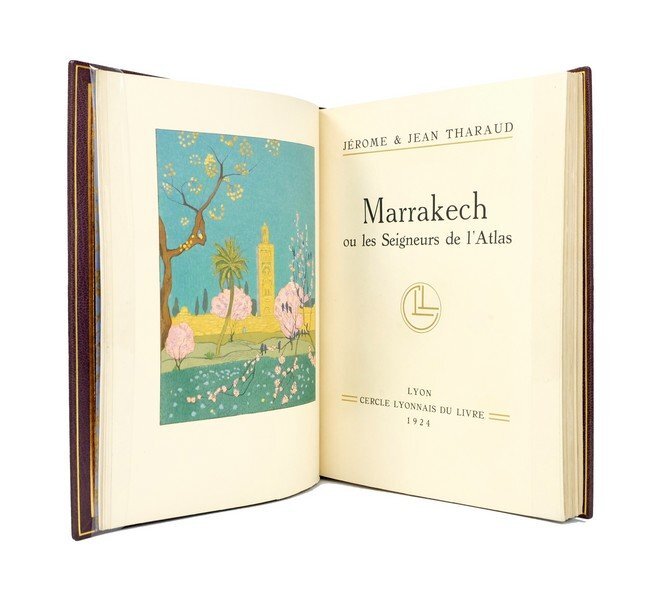
1151Lyon : Cercle lyonnais du livre, 1924. LE PEINTRE ORIENTALISTE ANDRÉ SURÉDA RENCONTRE FRANÇOIS-LOUIS SCHMIED, EXEMPLAIRE DE LA BIBLIOTHÈQUE PERSONNELLE DE RENÉ KIEFFER
(2), 24 colour lithographed plates in contemporary green blind-stamped cloth binding with gilt title to cover (18.5 x 15 cm). Presentation inscription to first blank leaf. Beautiful mid-19th c. introduction to the delights of Switzerland, depicting scenic views as well as charming inhabitants in their native costumes. The first work consists of 12 colour scenic plates after Deroy, lithographed by Muller or Aubrun (not found in Longchamp). The second work includes 12 plates of local costumes, signed "Charles Vallet" (Lonchamp attributing it to the publisher Bicherat). - First work not in Waeber, Barth, or Lonchamp. Lonchamp 2743.
4to [28 x 22 cm]; xiv, 487, [i, errata] pp, 20 fine hand colored stipple and line engravings (complete) on heavier paper, index, list of plates. contemporary full calf, new spine, spine title lettering on leather labels, original gilt decorated boards, marbled endpapers, light edge wear, few lower margins with light stain, short tear in margin of index pages, very good, clean in handsome binding. A comprehensive description of Peru including the territory, natural history, mineralogy, commerce, Lima, native peoples, topography, literature, climate, etc. The Longevity section describes Don Juan Modesto who lived to 133 years. Appendices describe missions to Caxamarquilla, travels to river Huallago, lake of Gran Cocama in 1790, rivers Maranon and Ucayali, and to Manoa tribes in 1791, travels in mountainous territories, itinerary from Chavin to Chicoplaya. The colored plates show the costume of various parts of Peruvian society, including nobility, natives, bullfighter, llamas, etc. Abbey Travel 723. Hiler 802. Sabin 81615. Palau 315564. Lipperheide I, 389. Skinner seems to have based the work on his translated portions from El Mercurio Peruano.
1813e6020London: James Cawthorn. G: in good condition. External joints cracked. Areas of wear to boards. Heraldic bookplate to front pastedown. Title page and first leaf of contents list frayed. Archival repairs to initial folding map. Inner hinges cracked. Contemporary marginalia to pp. 143. Scattered light foxing and offsetting. 1813. First Edition. Contemporary calf hardback leather cover. 280mm x 230mm 11" x 9". xix 1152pp. Engraved frontispiece 2 folding maps 3 engraved plates 17 hand-coloured aquatint plates 7 double-page 2 engraved leaves of music in-text illustrations. Heavy book extra shipping needed for overseas. Bound without advertisement to front. . James Cawthorn hardcover
1774DEZ-8597Paris, Chez Saillant et Nyon et Panckoucke, 1774. 4 tomes in-4 en plein veau marbrés au dos à nerfs ornés de filets et fleurons dorés et aux plats encadrés d'un triple filet doré. Tome 1 : 1 f. blanc, faux-titre et titre, XVI, 1 f. de nota, XXXII, 388 pp, 1 f. blanc. Tome 2 : 1 f. blanc, faux-titre et titre, 1 f. d'explication des planches, 536 pp, 1 f. blanc. 16 planches Tome 3 : 1 f. blanc, faux-titre et titre, 1 f. d'explication des planches, 394 pp 1 f. d'achever d'imprimer, 1 f. blanc, 17 planches Tome 4 : 1 f. blanc, VIII, dont faux-titre et titre, 1 f. d'explication de planches. 367 pp, 1 f. blanc. Edition originale française bien complet des 52 cartes planches. Quelques frottements et épidermures légères sur les reliures. trous de vers au dos du tome 1 et en fond de cahiers, coins émoussés, accrocs aux coiffes supérieures des tomes I et IV, déchirure sans manque à la première planche du tome 1.
163861229(London), Adam Islip, 1638. Folio. In contemporary full calf with six raised bands and double ruled fillets to boards. Small paper-label pasted on to top of spine. Wear to extremities, scratches to boards. Corner bumped, with loss of leather. Inner hinges split. Title-page chipped in outer margin and with two tears, with minor loss of text. Previous owner's name to title-page. Outer half of bookblock with waterstain. (10), 1500, (20), 31, (32) pp. The engraved title-page and 32 portraits included in the pagination. Wanting the first blank. A somewhat defective but text-wise complete copy.