PAPPUS OF ALEXANDRIABiblio.com
1 898 résultats
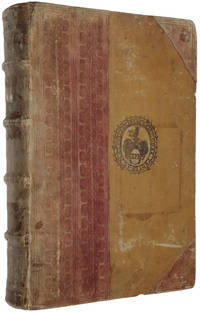
15885234Pesaro: Girolamo Concordia 1588. <p>First edition of Pappus' Collection translated with commentary by Federico Commandino a princely copy from the notable collection of the great Papal family and patrons of learning the Piccolomini Dukes of Amalfi thence by marriage to the German nobleman von Troilo. The Collection is "by far the most important of Pappus' works . without it much of the geometrical achievement of his predecessors would have been lost forever" DSB.</p>. GREEK GEOMETRY - A CRUCIAL INFLUENCE ON DESCARTES. <p>First edition of Pappus' Collection translated with commentary by Federico Commandino a princely copy from the notable collection of the great Papal family and patrons of learning the Piccolomini Dukes of Amalfi thence by marriage to the German nobleman von Troilo. The Collection is "by far the most important of Pappus' works . without it much of the geometrical achievement of his predecessors would have been lost forever . The Collection deals with the whole body of Greek geometry mostly in the form of commentaries on texts which it is assumed the reader has to hand. It reproduces known solutions to problems in geometry; but it also frequently gives Pappus' own solutions or improvements and extensions to existing solutions. Thus Pappus handles the problem of inscribing five regular solids in a sphere in a way quite different from Euclid; gives a broader generalization than Euclid to the famous Pythagorean theorem and provides a demonstration of squaring the circle which is quite different from the method of Archimedes who used a spiral or that of Nicomedes who used the conchoid.<br /> Perhaps the most interesting part of the Collection measured by its influence on modern mathematics is Book VII which is concerned with the problems of determining the locus with respect to three four five six or more than six lines. Pappus' work in this field was called 'Pappus' problem' by René Descartes who demonstrated that the difficulties which Pappus was unable to overcome could be got round by the use of his new algebraic symbols. Pappus thus came to play an important if minor role in the founding of Cartesian analytical geometry. And it is another mark of his originality and skill that he spent much time working on the problem of drawing a circle in such a way that it will touch three given circles a problem sophisticated enough to engage the interest centuries later of both François Viète and Isaac Newton. For his own originality even if his chief importance is as the preserver of Greek scientific knowledge Pappus stands with Diophantus as the last of the long and distinguished line of Alexandrian mathematicians" Hutchinson Dictionary of Scientific Biography. "He formally defined analysis and synthesis as they are still commonly applied in the solution of geometrical riders. Pappus stumbled upon the projective invariance of the cross-ratio of four collinear points and other related results reclaimed by modern projective geometry; and he gave the first recorded statement of the focus-directrix property of the three conic sections. He formulated the 'centrobaric' theorems frequently attributed to Paul Guldin 1577-1643 for calculating the volume and surface generated by a plane figure rotating about an axis in its own plane. He discussed theoretical mechanics the equilibrium of a heavy body on an inclined plane the use of the mechanical powers and the construction of mechanical toys" Biographical Dictionary of Scientists.</p> <br /> <p>Provenance: Ex libris inscription of Princess Maria Piccolomini and signature of Count Franz Gottfried von Troilo on title; shelfmark on front free endpaper.</p> <br /> <p>Pappus of Alexandria c.  290 - c.  350 AD was the most important mathematical author writing in Greek during the later Roman Empire. Other than that he was born at Alexandria in Egypt and that his career coincided with the first three decades of the 4th century AD little is known about his life.</p> <br /> <p>"In the silver age of Greek mathematics Pappus stands out as an accomplished and versatile geometer. His treatise known as the Synagoge or Collection is a chief and sometimes the only source for our knowledge of his predecessors' achievements. The Collection is in eight books perhaps originally in twelve of which the first and part of the second are missing . The several books of the Collection many well have been written as separate treatises at different dates and later brought together as the name suggests . A. Rome concludes that the Collection was put together about AD 340 but K. Ziegler states that . the Collection may have been compiled soon after AD 320. It has come down to us from a single twelfth-century manuscript Codex Vaticanus Graecus 218 from which all the other manuscripts are derived .</p> <br /> <p>"The portion of book II that survives beginning with proposition 14 expounds Apollonius' system of large numbers expressed as powers of 10000. It is probable that book I was also arithmetical.</p> <br /> <p>"Book III is in four parts. The first part deals with the problem of finding two mean proportionals between two given straight lines the second develops the theory of means the third sets out some 'paradoxes' of an otherwise unknown Erycinus and the fourth treats of the inscription of the five regular solids in a sphere but in a manner quite different from that of Euclid in his Elements XIII. 13-17.</p> <br /> <p>"Book IV is in five sections. The first section is a series of unrelated propositions of which the opening one is a generalization of Pythagoras' theorem even wider than that found in Euclid VI.31 . The second section deals with circles inscribed in the figure known as the άÏβηλος or 'shoemaker's knife.' It is formed when the diameter AC of a semicircle ABC is divided in any way at E and semicircles ADE EFC are erected. The space between these two semicircles and the semicircle ABC is the άÏβηλος. In a series of elegant theorems Pappus shows that if a circle with center G is drawn so as to touch all three semicircles and then a circle with center H to touch this circle and the semicircles ABC ADE and so on ad infinitum then the perpendicular from G to AC is equal to the diameter of the circle with center G the perpendicular from H to AC is double the diameter of the circle with center H the perpendicular from K to AC is triple the diameter of the circle with center K and so on indefinitely. Pappus records this as 'an ancient proposition' and proceeds to give variants. This section covers as particular cases propositions in the Book of Lemmas that Arabian tradition attributes to Archimedes.</p> <br /> <p>"In the third section Pappus turns to the squaring of the circle. He professes to give the solutions of Archimedes by means of a spiral and of Nicomedes by means of the conchoid and the solution by means of the quadratrix but his proof is different from that of Archimedes. To the traditional method of generating the quadratrix Pappus adds two further methods 'by means of surface loci' that is curves drawn on surfaces. As a digression he examines the properties of a spiral described on a sphere.</p> <br /> <p>"The fourth section is devoted to another famous problem in Greek mathematics the trisection of an angle. Pappus' first solution is by means of a νευσις or verging-the construction of a line that has to pass through a certain point-which involves the use of a hyperbola. He next proceeds to solve the problem directly by means of a hyperbola in two ways; on one occasion he uses the diameter-and-ordinate property as in Apollonius and on another he uses the focus-directrix property. This property is proved in book VII. Pappus then reproduces the solutions by means of the quadratrix and the spiral of Archimedes; he also gives the solution of νευσις which he believes Archimedes to have unnecessarily assumed in On Spirals proposition 8.</p> <br /> <p>"In the preface to book V which deals with isoperimetry Pappus praises the sagacity of bees who make the cells of the honeycomb hexagonal because of all the figures which can be fitted together the hexagon contains the greatest area. The literary quality of this preface has been warmly praised. Within the limits of his subject Pappus looks back to the great Attic writers from a world in which Greek had degenerated into Hellenistic. In the first part of the book Pappus appears to be reproducing Zenodorus fairly closely; in the second part he compares the volumes of solids that have equal surfaces. He gives an account of thirteen semiregular solids discovered and discussed by Archimedes but not in any surviving works of that mathematician that are contained by polygons all equilateral and equiangular but not all similar. He then shows following Zenodorus that the sphere is greater in volume than any of the regular solids that have surfaces equal to that of the sphere. He also proves independently that of the regular solids with equal surfaces that solid is greater which has the more faces.</p> <br /> <p>"Book VI is astronomical and deals with the books in the so-called Little Astronomy-the smaller treatises regarded as an introduction to Ptolemy's Syntaxis Almagest. In magisterial manner he reviews the works of Theodosius Autolycus Aristarchus and Euclid and he corrects common misrepresentations. In the section on Euclid's Optics Pappus examines the apparent form of a circle when seen from a point outside the plane in which it lies.</p> <br /> <p>"Book VII is the most fascinating in the whole Collection not merely by its intrinsic interest and by what it preserves of earlier writers but by its influence on modern mathematics. It gives an account of the following books in the so-called Treasury of Analysis those marked by an asterisk are lost works: Euclid's Data and Porisms Apollonius' Cutting Off of a Ratio Cutting Off of an Area Determinate Section TangenciesInclinationsPlane Loci and Conics. In his account of Apollonius' Conics Pappus makes a reference to the 'locus with respect to three or four lines' a conic section. He also adds a remarkable comment of his own. If he says there are more than four straight lines given in position and from a point straight lines are drawn to meet them at given angles the point will lie on a curve that cannot yet be identified. If there are five lines and the parallelepiped formed by the product of three of the lines drawn from the point at fixed angles bears a constant ratio to the parallelepiped formed by the product of the other two lines drawn from the point and a given length the point will be on a certain curve given in position. If there are six lines and the solid figure contained by three of the lines bears a constant ratio to the solid figure formed by the other three then the point will again lie on a curve given in position. If there are more than six lines it is not possible to conceive of solids formed by the product of more than three lines but Pappus surmounts the difficulty by means of compounded ratios. If from any point straight lines are drawn so as to meet at a given angle any number of straight lines given in position and the ratio of one of those lines to another is compounded with the ratio of a third to a fourth and so on or the ratio of the last to a given length if the number of lines is odd and the compounded ratio is a constant then the locus of the point will be one of the higher curves .</p> <br /> <p>"In 1631 Jacob Golius drew the attention of Descartes to this passage in Pappus and in 1637 'Pappus' problem' as Descartes called it formed a major part of his Géométrie. Descartes begins his work by showing how the problems of conceiving the product of more than three straight lines as geometrical entities which so troubled Pappus can be avoided by the use of his new algebraic symbols. He shows how the locus with respect to three or four lines may be represented as an equation of degree not higher than the second that is a conic section which may degenerate into a circle or straight line. Where there are five six seven or eight lines the required points lie on the next highest curve of degree after the conic sections that is a cubic; if there are nine ten eleven or twelve lines on a curve one degree still higher that is a quartic and so on to infinity. Pappus' problem thus inspired the new method of analytical geometry that has proved such a powerful tool in subsequent centuries.</p> <br /> <p>"In his Principia 1687 Newton also found inspiration in Pappus; he proved in a purely geometrical manner that the locus with respect to four lines is a conic section which may degenerate into a circle .</p> <br /> <p>"Pappus observes that the study of these curves had not attracted men comparable to the geometers of previous ages. But there were still great discoveries to be made and in order that he might not appear to have left the subject untouched Pappus would himself make a contribution. It turns out to be nothing less than an anticipation of what is commonly called 'Guldin's theorem.' Only the enunciations however were given which state:</p> <br /> <p>'Figures generated by complete revolutions of a plane figure about an axis are in a ratio compounded a of the ratio of the areas of the figures and b of the ratio of the straight lines similarly drawn to sc. drawn to meet at the same angles the axes of rotation from the respective centers of gravity. Figures generated by incomplete revolutions are in a ratio compounded a of the ratio of the areas of the figures and b of the ratio of the arcs described by the respective centers of gravity; it is clear that the ratio of the arcs is itself compounded 1 of the ratio of the straight lines similarly drawn from the respective centers of gravity to the axis of rotation and 2 of the ratio of the angles contained about the axes of rotation by the extremities of these straight lines.'</p> <br /> <p>"Pappus concludes this section by noting that these propositions which are virtually one cover many theorems of all kinds about curves surfaces and solids 'in particular those proved in the twelfth book of these elements.' This implies that the Collection originally ran to at least twelve books.</p> <br /> <p>"Pappus proceeds to give a series of lemmas to each of the books he has described except Euclid's Data presumably with a view to helping students to understand them. He was half a millennium from Apollonius and elucidation was probably necessary. It is mainly from these lemmas that we can form any knowledge of the contents of the missing works and they have enabled mathematicians to attempt reconstructions of Euclid's Porisms and Apollonius' Cutting Off of an Area Plane Loci Determinate Section Tangencies and Inclinations. It is from Pappus' lemmas that we can form some idea of the eighth book of Apollonius' Conics" DSB.</p> <br /> <p>Adams P223; Pietro and Bonelli Catalogo della Biblioteca Mediceo-Lorense 151; Riccardi I 364 11.</p> <br/> <br/> Folio 307 x 204 mm ff. 4 including blank 334 recte 332 with woodcut printer's device on title several historiated woodcut initials and numerous woodcut diagrams in text small wormhole through blank area of last two leaves. Contemporary German half-pigskin over yellow boards pigskin dyed rose pink somewhat faded small split in upper joint and small wormhole in lower board with blind floral rolls gilt silver arms of Count Franz Gottfried von Troilo on upper cover and a phoenix surrounded by flames within a wreath on lower cover. A fine clean crisp copy. Girolamo Concordia unknown
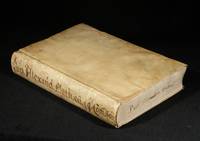
15883991588. Numerous woodcut illus. & diagrams in the text. 4 p.l. the last a blank 334 i.e. 332 pp. Folio cont. limp vellum title a bit soiled last two leaves with some light dampstaining ties gone. Pesaro: H. Concordia 1588.<br/> <br/> First edition and a very fine and fresh copy of this uncommon book; this edition providing the complete extant text was the final work to be edited by Commandino and completes his life's work of reviving Renaissance mathematics by making available the best mathematical writings of antiquity. <br/> <br/> "In the silver age of Greek mathematics Pappus stands out as an accomplished and versatile geometer. His treatise known as the Synagoge or Collection is a chief and sometimes the only source for our knowledge of his predecessors' achievements. The Collection is in eight books perhaps originally in twelve of which the first and part of the second are missing. <br/> <br/> "Book VII is the most fascinating in the whole Collection not merely by its intrinsic interest and by what it preserves of earlier writers but by its influence on modern mathematics."D.S.B. X p. 293-95and see pp. 294-98 for a full discussion of the contents. <br/> <br/> This concerns in a passage on Apollonius' Conics the attempt to conceive of the product of more than three straight lines as geometrical entities known as "Pappus' Problem." Descartes devoted a major part of his own Géométrie to this and solved it by the use of algebraic notation. "Pappus' problem thus inspired the new method of analytical geometry that has proved such a powerful tool in subsequent centuries. In his Principia 1687 Newton also found inspiration in Pappus; he proved in a purely geometrical manner that the locus with respect to four lines is a conic section which may degenerate into a circle."D.S.B. X p. 296. <br/> <br/> Topics discussed in the other books include astronomy and mechanics. <br/> <br/> A very fine copy preserved in a green morocco-backed box. <br/> <br/> Rose The Italian Renaissance of Mathematics p. 214"Within 25 years of Commandino's death the first step in founding the mechanics of the seventeenth century was to be taken by Galileo when in criticising the inclined plane theorem of Pappus the Tuscan mathematician adumbrated the notion of inertia. This step was not taken in an intellectual vacuum but represents the culmination of the mathematical renaissance that had been achieved by the Restauratores."& see the whole of Chap. 9 for Commandino and this book. Smith History of Mathematics I pp. 136-37. unknown
1987778340PN. New. 1987. Soft Cover. Date is original print. This is a reprint edition. . PN paperback
1980760274PN. New. 1980. Soft Cover. Date is original print. This is a reprint edition. . PN paperback
1668972921.Glibrary. Good. Access codes and supplements are not guaranteed with used items. May be an ex-library book. unknown
0875303919-7-1ADC The Map People. Acceptable. The item might be beaten up but readable. May contain markings or highlighting as well as stains bent corners or any other major defect but the text is not obscured in any way. ADC The Map People unknown
1603490159.Gpaperback. Good. Access codes and supplements are not guaranteed with used items. May be an ex-library book. paperback
45701556like new. unknown
1990236325PN. New. 1990. Soft Cover. Date is original print. This is a reprint edition . PN paperback
334121/2 page in4 - Bon état -
1987780370PN. New. 1987. Soft Cover. Date is original print. This is a reprint edition. . PN paperback
1987Q-0809461722Time Life 1987-01-01. Hardcover. New. In shrink wrap. Looks like an interesting title! Time Life hardcover
6128827399VDM Verlag Dr. Mueller Aktiengesellschaft & Co. KG pp. 404 . Papeback. New. VDM Verlag Dr. Mueller Aktiengesellschaft & Co. KG unknown
3844392130.Gpaperback. Good. Access codes and supplements are not guaranteed with used items. May be an ex-library book. paperback
1997299992PN. New. 1997. . Soft Cover. Date is original print. This is a reprint edition . PN paperback
1971741375PN. New. 1971. Soft Cover. Date is original print. This is a reprint edition. . PN paperback
1971741695PN. New. 1971. Soft Cover. Date is original print. This is a reprint edition. . PN paperback
1971741145PN. New. 1971. Soft Cover. Date is original print. This is a reprint edition. . PN paperback
1971741694PN. New. 1971. Soft Cover. Date is original print. This is a reprint edition. . PN paperback
1985774375PN. New. 1985. Soft Cover. Date is original print. This is a reprint edition. . PN paperback
195100285655Portland Maine: A Dirigo Edition / Falmouth Publishing House 1951 Red/gilt cloth. Signed on fep by Elizabeth Hamilton Hartsgrove Ruth Alexandria Forbes and Marguerite Donnell Barter. With pictures by Ralph F Blood Marguerite Donnell Frank Larrabee and Walter Creegan. Rare copy. 48 pgs. poetry. Signed by Authors. First Edition First Printing. Decorative Cloth. Very Good. A Dirigo Edition / Falmouth Publishing House hardcover
1985773852PN. New. 1985. Soft Cover. Date is original print. This is a reprint edition. . PN paperback
42959267like new. unknown
1925749479.Ghardcover. Good. Access codes and supplements are not guaranteed with used items. May be an ex-library book. hardcover
A clean, unmarked book with a tight binding. 317 pages.