CRAVEN Elizabeth BerkeleyLivre Rare Book
716 résultats
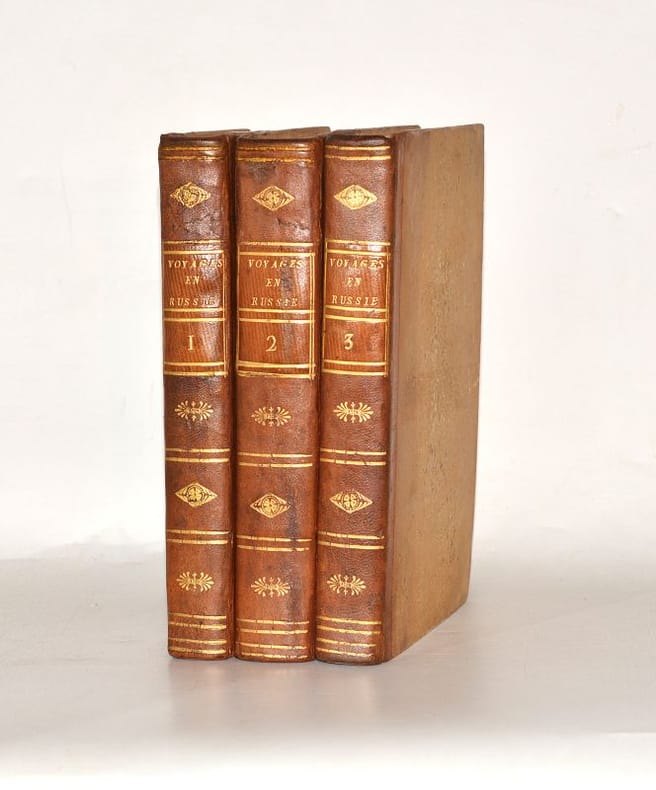
498255Chez Maradan Londres - paris 1789 In-8 ( 200 X 125 mm ) de ( 4 )-443-( 5 ) pages, demi-basane fauve, dos lisse orné de filets dorés, pièce de titre de maroquin noisette. ( Reliure de l'époque ). 1 carte et 5 planches dépliantes hors-texte ( sur 6, la planche 4 est manquante ): Vue de la source de la rivière Karason dans la Crimée - Bateau turc - Cimetière turc - Vue du Nord Ouest de Siphanto - Vue du Couvent de Panacrado prise de la Baye de Gabrio. - La carte dépliante des "Routes de la Crimée anciennement Chersonèse Taurique" a été gravée par P. F. TARDIEU. EDITION ORIGINALE publiée l'année de l'originale anglaise. Margravine d'ANSPACH, Elisabeth CRAVEN ( 1750-1828 ) épousa le Margrave d'ANSPACH BAIREUTH à qui elle adresse les lettres de cette relation. «Relation très recherchée» Chadenat II, 3180 Blackmer 527 ( pour l'édition originale anglaise ). Coins usés, bon exemplaire.
1962X114025[Bruxelles], 1962 338pp. Illustrated with some original bl/w drawings and some illustrations in colour tipped in (in and out of text), text in Hungarian, this work in typoscript has never been published (and so it does not appear in OCLC) and so it is most probably the author's copy, green half-cloth binding, gilt title on spine, marbled boards and endpapers, 22cm., good condition, unique copy, X114025
1802PHO-1118Paris, Maradan, 1802. In-8 broché, couv. d'attente (dos et dernier plat manquants).Dernière page salie et volante , une petite déchirure marginale sans manque, coins cornés sinon bon exemplaire en attente de reliure.
Very Good Tatar Original decorative cloth bdg. Cr. 8vo. (20 x 14 cm). In Tatar. 3 volumes set: (193, [2] p.; 959, [1] p.; 1013, [3] p.). Large and comprehensive collection of Tatar proverbs. 38670 registers in set. No copy in OCLC. Extremely rare. First and Only Edition.
4206031Short description: In Russian. Crimea Veniamin SKyivich. Mining Quantitative Analysis Manual. Kharkiv: Type. Peaceful Labor 1915. The image is provided for reference only. It may reflect condition of one of the available copies or only help in identifying the edition. Please feel free to contact us for a detailed description of the copies available. SKU4206031 unknown
4206031Short description: In Russian. Crimea, Veniamin SKyivich. Mining Quantitative Analysis Manual. Kharkiv: Type. Peaceful Labor, 1915. You are welcome to reach out to us for a detailed description of the copies currently available. Delivery of this book may take longer than usual including extended processing and pre-shipping time, no expedited shipping is available. Please advise us if you have a set date or a deadline to receive your order.SKU4206031
214491Ll. dd., 1844-1872 27 pièces in-4, en feuilles, cousues.
1854PHO-2122Paris, Ernest Bourdin & Cie, 1854. Grand in-8 (27,5x18,5cm), XIV-510pp.-2ff., demi chagrin époque, dos lisse avec auteur et titre, légères rousseurs, manque de papier sur le dernier plat Illustré de 27 gravures dont plusieurs en couleurs et 2 cartes repliées et en couleurs dans une pochette in-fine.
62pp + errata First (only) edition, in French, with Errata leaf at the end. Original printed wrappers, light signs of wear and dust, tiny loss (1cm) at upper spine, date and owner inscription on front cover, internally in G-to-VG conditions. Rare, little known first work by Tito Vanzetti, at that time doctor at the Wien General Hospital, describing his visit to Crimea and including a list of the surgical procedures performed. Prima (unica) edizione, in francese, con foglio di Errata in fine. Brossura editoriale originale, lievi segni di usura e piccola mancanza 1cm alla parte superiore del dorso, firma e data proprietario in copertina, internamente piu' che buone. Rara pubblicazione, primo lavoro del Dr. Vanzetti, medico all'Ospedale Generale di Vienna, sulla sua visita in Crimea, con la lista delle operazioni chirurgiche da lui eseguite durante la visita.
1893H120561S. Petersburg, Pantleev brothers 1893 CCCV + 129pp., 26cm., original softcover (spine bit repaired, well protected by an extra transparant cover), pages are still uncut, text is clean and bright, [Translation of title: "Russian-Byzantine Studies, part 2: The lives of saint George Amastris (Amastrida) and Stephen of Sourozh (Souros, Sudak)". Study in Russian with text editions in Greek and translation into Russian. A rare original Russian publication and critical study by the famous Russian byzantinist Vasily Vasilievsky on the lives of the byzantine saints George of Amastris and Stephen of Sourozh], H120561
Bella carta tratta dall'opera di Blaeu pubblicata attorno al 1640-dimensioni foglio61.5x47.5 cm- dimensione lastra cm 49.2x37.7- esemplare di fresca tiratura ed in buono stato di conservazione.
3913A Paris, Chez Durand, Père et Fils, 1789 ; in-8, reliure en veau havane raciné, dos orné de filets et fleurons dorés, pièce de titre, encadrements dorés sur les sur les plats, tranches mouchetées. Carte dépliante en frontispice (310x390cm) : Carte de la route de la Crimée anciennement Chersonèse Taurique, eau-forte gravée P.F. Tardieu et montée sur onglet. 6 eaux-fortes dépliantes : Vue de la Source de la rivière Karasan dans la Crimée ; Bateau Turc, Cimetière Turc, Grottes d’Antiporos et alias.
Very Good English Original autograph letter signed by Vladimir Fedorovich Minorsky, sent to Turkish professor and historian Osman Turan, (1914-1978), was born in year when World War I started. He had some bad conditions in his childhood. Being in Ankara in years when DTCF established was a great chance for him. He was trained by Fuat Köprülü. His studies in the first period were about pre-Islamic Turkish history. But his studies after he became associate-professor were about Seljukians. There isn't a better studying in this field yet than his studies. (Source: Osman Turan's Life (1914/17 - 1978) and Historiography, Tufantoz). Letter has 12 lines in front, and 4 lines on verso, in English completely. It has a plan of a library, probably in the UK which shows Trinity and Sydney Colleges, etc. Letter says: "Dear Dr. Turan, Very good. We shall be waiting for your on Friday. If you are not engaged come andd have lunch with us at 12.45. If you cannot come at 2.30 and I shall show you the Library. Looking forward to meeting you. Yours sinccerely, V. Minorsky'. "When you come to No 9 push the door in front of you...". Repaired margins. Minorsky was a Russian Orientalist best known for his contributions to the study of Persian and Kurdish history, geography, literature, and culture. Minorsky was born in Korcheva, in the Konakovsky District of the Russian oblast of Tver, northwest of Moscow on the upper Volga River, a town now submerged beneath the Ivankovo Reservoir. There he was a gold medallist of the Fourth Grammar School. In 1896 he entered Moscow University to study law, graduating in 1900, then entered the Lazarev Institute of Oriental Languages where he spent 3 years preparing for a diplomatic career. He made his first trip to Iran in 1902, where he collected material on the Ahl-e Haqq. In 1903 he entered the Russian Ministry of Foreign Affairs, serving 1904-1908 in Persia (now Iran), first in the Tabriz Consulate-General and then the Tehran Legation, and 1908-1912 in Saint Petersburg and Tashkent. In 1911, jointly the Four-Power (British, Russian, Turkish, and Persian) Commission, he carried out a mission in North-Western Persia to delimit the Turko-Persian border, and also published a monograph on the Ahl-i ?aqq religion for which he was awarded the Gold Medal of the Ethnography Section of the Imperial Society of Natural Sciences in Moscow. One of the most important Kurdish manuscripts he obtained during this period was The Forqan ol-Akhbar, by Hajj Nematollah, which he later wrote about in "Etudes sur les Ahl-I Haqq, I.", Revue de L'Histoire des Religions, tome XCVII, No. 1, Janvier 1928, pp. 90-105. His surveys in Iran also provided invaluable material for his 1915 work, Materialï dlya izucheniya vostoka (Materials for the Study of the East), published by the Imperial Russian Ministry of Foreign Affairs, St. Petersburg. From 1915-17 he served as Chargé d'affaires in the Russian Legation at Tehran. As the Bolshevik Revolution of 1917 made problematic his return to Russia, in 1919 he moved to Paris where he worked at the Russian Embassy. There his expertise in Middle Eastern and Caucasian affairs was useful during the Versaille and Trianon peace settlements. In 1923 he began to lecture on Persian literature at the École nationale des langues orientales vivantes, where he subsequently taught Turkish and Islamic history. In 1930 he was named Oriental Secretary to the 1931 International Exhibition of Persian Art at Burlington House, London, and in 1932 was made a lecturer in Persian at London's School of Oriental Studies. In 1933 he became Reader in Persian Literature and History, University of London; Professor of Persian in 1937; and in 1944 retired. During World War II, SOAS had evacuated to Christ's College, University of Cambridge, and there the Minorskys retired apart from a year (1948-49) at Fuad University, Cairo. In 1934 Minorsky was one of the distinguished participants in the Ferdowsi Millenary Celebration in Tehran. Minorsky received n
2448210 April 1874; from Hill Street Woolwich on letterhead of Hill House Woolwich S.E. An excellent letter casting light on the relationship between the editor of The Times and a senior correspondent. See the two men’s entries in the Oxford DNB. Brackenbury’s states that ‘During the Austro-Prussian War of 1866 Brackenbury was the Times correspondent with the Austrian army and was at the battle of Königgrätz Sadowa — riding with Benedek under fire at Chlum — and reported the naval battle of Lissa. He was the Times correspondent in the Franco-Prussian War accompanying Prince Frederick Charles in the Le Mans campaign; and in the Russo-Turkish War of 1877 when he crossed the Balkans with Count Gourko.’ 4pp 12mo. Bifolium. In very good condition folded twice. Thin strip from windowpane mount adhering to edges in not unpleasing way. Signed ‘C. B. Brackenbury’ and addressed to ‘My dear Delane’. The letter begins: ‘Captain Clarke brought me today the last number of his translation of the German War of 1870-71. He is sending you a copy and I hope you will find some one to review it in my place.’ Brackenbury has himself translated ‘the Report of the Committee on French Army re organization together with the law as proposed and passed’ which the War Office is publishing. ‘You shall have the first copy issued which I will mark myself.’ In his opinion a great deal of the report ‘bears upon much more than French re-organization’. He will be very glad if Delane finds it ‘worth a notice’. He continues: ‘Though I may not write more on military affairs I don’t see why I should not review other books if you can find any for me. Even if you have no space for them at present the reviews might stand over till the interest of the new parliament is over.’ It seems to him ‘unnatural to have no work in hand for you’. The postscript reads: ‘They say that my review of Clarke’s first number started the Intelligence Department.’ 10 April 1874; from Hill Street [Woolwich], on letterhead of Hill House, Woolwich, S.E. unknown
216012Paris, Lemercier, s.d. (1854) 3 cartes in-4 (32 x 44 cm), en feuilles.
217089Paris, Maradan, Imprimerie de Crapelet, an X - 1802 in-8, VIII-398 pp., un f. n. ch. (table des matières et errata), demi-basane brune, dos lisse (reliure postérieure). Modeste reliure d'amateur, sans pièce de titre. Coiffe abîmée. Petites mouillures marginales sans gravité. Non rogné.
3459710 pages 1/2 in8 - En tête: "Ministre d'Etat et de la Maison de l'Empereur" - bon état - (cette lettre date de 10 jours avant la Bataille de l'Alma le 20 septembre et de 19 jours avant la mort du Maréchal) -
1850G120591Paris, Musée Cosmopolite s.d. [1850's] Collection of 31 hand-coloured engraved plates (from a total of 37 plates published for the Russian costume section), depicting male and female figures in traditinal Russian dress, shown full lenght. Bound in a nice and solid modern hardcover (red half-cloth with gilt title on spine, marbled boards, 28x23cm.). Plates are clean and bright except for very few light foxing, Issued as part of the "Musée Cosmopolite" series published in Paris by Aubert & Cie. // The Russian plates are notable for their detailed rendering of textiles, embroidery and head-dress, illustrating a range of social and regional distinctions within the Russian Empire in the mid-19th century, as perceived by contemporary Western obervers, [CONTENT: Plate no.3: Bergère de Kouli Kovo (Gouvt. de Toula), 6: Tcherkess, 7: Charretier russe, 8: Paysanne de Serpoukoff, 9: Juif d'Epiphan (Gouvt. de Toula), 10: Juive d'Epiphan (Gouvt. de Toula), 11: Moine, 12: Religieuse, 13: Jeune fille russe, 14: Esthonien, 15: Esthonienne, 17: Laitière finlandaise, 19: Cocher de seigneur en petite tenue, 20: Paysan finnois (environs de St-Peterbourg), 21: Paysanne finoise (environ de St-Petersbourg), 22: Jeune paysan, 23: Femme tatar à Kapskhox (Crimée), 24: Paysan tatar (Crimée), 25: Femme de Yalta (Crimée), 26: Femme turque (à Bagtchi-Seraii Crimée), 27: Mollah, prêtre turc à Bagtchi-Seraii (Crimée), 28: Chef de village (Caucase), 29: Paysan russe (frontière de la Bessarabie), 30: Armée russe (Crimée), 31: Trigane ou Bohémien (frontières de la Crimée), 32: Femme Kalmouke (bords du Volga), 33: Kalmouk marchand (Russie méridionale), 34: Kalmouk d'Astrakan (Russie meridionale), 35: Prtre Kalmouk (Russie méridionale), 36: Prêtre desservant, Kalmouk (Russie méridionale), 37: Maitre d'école de St. Petersbourg], Very good condition, G120591
17850045381785 Amsterdam, sans nom d'éditeur [Paris], 1785. Quatre tomes reliés en deux volumes in-8 (132 X 201 mm) demi-chevrette vert lierre, dos lisse cloisonné de grecques et filets dorés, compartiments ornés à la grotesque, titre doré (reliure de l'époque). Tome I : XL pages (dont titre), 203 pages - Tome II : (2) ff. de faux-titre et titre, 220 pages - Tome III : (2) ff. de faux-titre et titre, 180 pages - Tome IV : (2) ff. de faux-titre et titre, 152 pages. Ex-libris collé sur le premier contreplat de chaque volume. Quelques épidermures, frottements aux plats, cerne de mouillure très claire en marge des 10 premiers feuillets du tome III, pointes de rousseurs très éparses.
Oblong roy. 4to., First Edition, with title in red and black, text and captions in red, blue and black, 34 splendid large plates in photo-collotype and full-page musical score in blue; original red cloth, upper board ruled and blocked with regimental badge in gilt, expertly recased, BUT WITH SOME AGE- OR DAMP-DAMAGE TO 22 OF THE LATER PLATES (mercifully restricted mainly to upper blank margins and only materially affecting around ten plates); nevertheless a valuable record and a very scarce work. An unusually lavish production for a single battalion, this work is distinguished by the quality of the plates, which (damage apart) varies from very good to magnificent. The photographs are superbly executed by F. Bremner, photographer, variously of Lahore, Simla & Quetta, and their rendering as collotypes preserves the quite extraordinary detail of faces, uniforms and equipment. The plates include fine portraits of Major-General Frederick Walter Kitchener (Commanding 3rd (Lahore) Division) and Colonel J.C. Yale (commanding 1st Battalion), together with close-ups of the Colours and mess plate. The main body of plates is devoted, of course, to group studies. These include the officers (individually captioned), the battalion on parade, the Colour and colour sergeants (individually captioned), the NCOs (individually captioned), corporals, companies A-H (each company photographed separately), and a fine series of the battalion's various support units, trades and sports teams. An unusual composition is the plate 'Regimental Types' and depicting eight members of the battalion in a variety of uniforms including officer's full dress and OR's marching order. In addition to the plates, there is a detailed account of the battalion's service from Tournay (1794) to its arrival at Lahore Cantonment in 1906, together with pages devoted to regimental marchess. Not the least importance of this work must be as a superbly detailed record of the appearance of a regular battalion of line infantry of the period - crucially, the last phase of Edwardian opulence and before the irreversible changes brought about by the Great War. EXTREMELY SCARCE. IT IS UNCLEAR HOW MANY OF THESE REMARKABLE PORTFOLIOS WERE PRODUCED; CERTAINLY NOT MANY, AND EVEN FEWER CAN HAVE SURVIVED. Sutcliife p.103; not recorded by White (1965).
Very Good Tatar Original wrappers. Roy. 8vo. (24 x 17 cm). In Tatar and Kiptchak Turkish with Arabic letters. 204, 4 p. Occasionally stains and foxing on covers, chipped upper margin on front cover. Otherwise a very good copy. First and only edition of Bigiev's work on fasting and feasts of Islam. In a broader sense, the book includes Muslim prayer and fasting in the northern regions of Russia, as well as ijtihad [i.e. Physical or mental effort, expended in a particular activity) is an Islamic legal term referring to independent reasoning or the thorough exertion of a jurist's mental faculty in finding a solution to a legal question], the creation of Adam, Dhu'l-Qarnayn [i.e. Alexander the Great], imitation, freedom of mind, comparison, and naskh issues are discussed. Bigiev (sometimes known as Luther of Islam), was a Tatar Hanafi Maturidi scholar, theologian philosopher, publicist, and one of the leaders of the Jadid movement. After receiving his education in Kazan, Bukhara, Istanbul, and Cairo, he became a political activist for the Ittifaq, the political organization of the Muslims of Russia. He also taught in Orenburg, wrote journalistic texts, and translated classic works into Tatar. After emigrating from the Soviet Union, he traveled Europe and the Middle and the Far East while writing and publishing. This is the early and one of his most important texts which include his ideas that have become his manifesto and thoughts as a leader of the Russian Muslims. In 1708, the Khanate of Kazan was abolished, and Kazan became the center of a guberniya. After Peter the Great's visit, the city became a center of shipbuilding for the Caspian fleet. The major Russian poet Gavrila Romanovich Derzhavin was born in Kazan in 1743, the son of a poor country squire of Tatar ancestry though himself having a thoroughly Russian identity. Kazan was largely destroyed in 1774 as a result of the Pugachev revolt, a revolt by border troops and peasants led by the Don Cossack ataman (captain) Yemelyan Pugachev, but was rebuilt soon afterward, during the reign of Catherine the Great. After the Russian Revolution of 1905, Tatars were allowed to revive Kazan as a Tatar cultural center. The first Tatar theater and the first Tatar newspaper appeared. On May 27, 1920, the Tatar Autonomous Soviet Socialist Republic of the RSFSR was declared. Under Joseph Stalin, the Soviet Union began to place restrictions on the use of the Tatar language, which used a variant of Arabic script. The Tatar alphabet switched to Cyrillic. OCLC 34253246, 83652445, 556971767.; TBTK 6143.; Özege 22332.
8225Paris, Ladvocat et Cie, 1837 pour les 4 premiers volumes et 1839 ( 3* edition ) pour le cinquieme. 5 volumes in-8° broches 402 pages, 396 pages, 406 pages, 384 pages et 372 pages. Il manque l'Atlas. Les dos des couvertures papier sont en mauvais etat, l'interieur est frais, les a-plat sont tres corrects.
18130056291813 Paris, Buisson, Arthus, 1813. Trois volumes in-8 (205 X 133 mm) demi-basane fauve, dos lisse cloisonné de filets dorés et orné de fleurons dorés, pièces de titre cuir de Russie fauve, tranches mouchetées en rouge (Reliure de l'époque). Tome I : (2) ff. de faux-titre et titre, XVI pages, 400 pages, 2 cartes dépliantes - Tome II : (2) ff. de faux-titre et titre, 514 pages, 3 cartes dépliantes - Tome III : (2) ff. de faux-titre et titre, 432 pages. Frottements à un plat, quelques habiles restaurations à la reliure, petit manque de papier en fond de cahier des feuillets de faux-titre, titre et plan du tome II, petit cerne de mouillure claire en tête de quelques feuillets du tome II, sans atteinte au texte ni au dessin, reports bruns aux premier et dernier feuillets de chaque ouvrage.
180813052P., Maradan, 1808-1809, 8 vol. in-8°, cviii-400,lxiv-451,458,lxxxiv-568,lxxii-427,507,lxxxviii-490 et 509 pp, reliures plein veau marbré lég. épidermées, dos lisses très ornés, plats encadrés de filets dorés (reliure de l'époque). Bon exemplaire
1806bn1357Paris, chez Bossange, Masson et Besson Inconnu 1806 In-8 relié plein veau raciné d'époque, dos lisse, pièce de titre, faux-titre, titre, deux feuillets non chiffré pour l'épitre dédicatoire, xix et 302 pages et un feuillet non chiffré in-fine contient l'errata, plan de Sévastopole, deux planches de monnaie, une planche reproduisant une cornaline, trois tableaux dépliants, une grande carte dépliante de la Crimée ; quelques petites rousseurs, petites déchirures marginales aux cartes (sans gravité), bon exemplaire en reliure d'époque. Livraison a domicile (La Poste) ou en Mondial Relay sur simple demande.