CAMUS (Armand-Gaston).Livre Rare Book
716 résultats
18020041271802 Paris, Baudouin, 1802. In-quarto (208 X 261) demi-veau fauve, dos lisse, frise et deux filets dorés en place des nerfs, pièce de titre maroquin rouge, tranches jaspées (reliure de l'époque); (2) ff. blancs, (2) ff. de faux-titre et titre, III pages de table, 401 pages, (2) pages d'errata, (3) ff. blancs.
Tre volumi di cm. 22; pp. 386; 481, (1); 492. Eelegante legatura coeva in mezzo marocchino verde con titoli, ricchi fregi in oro e iniziali del possessore in oro al dorso, piatti in carta marmorizzata, tagli a spruzzo. Al secondo volume tavola litografica raffigurante Sebastopoli. Tre frontespizi litografici, titoli in rosso e cornice floreale dorata. Spelndido esemplare. Prima ed unica edizione di opera assai rara sulla regione della Crimea che fu sotto l'influenza di Genova 923/P
210120Paris, A. J. Kilian, Paris, Ch. Picquet, 1826 in-8, 10-XX-381 pp., fac-similé dépl., basane brune cailloutée, dos lisse orné, tranches marbrées (reliure de l'époque).
36566Paris Chez Bossange, Masson et Besson 1806 in 8 1 volume broché, couverture d'attente de l'époque (dos fendu), XIX et 302 pages [1], avec 3 tableaux horstexte dépliants, 6 vignettes dessinées et gravées par J. Duplessi-Bertaux, et 5 planches hors-texte par Tardieu: 1 plan de Sébastopol dépliant, 1 grande carte repliée et 3 planches de médailles, monnaies et bas-relief. A la suite du même: DESCRIPTION DU TIBET, d'après la Relation des Lamas Tangoutes, établis parmi les Mongols. Traduit de l'Allemand avec des notes par J. Rouilly (Chez Bossange, Masson et Besson, 1808), XII et 89 pages, non rogné. Baron Jean de Reuilly, 1780-1810. Cachet ex-libris de du Salon littéraire du N°12 rue de l'Ecole de Médecine. Bel exemplaire ( Photographies sur demande / We can send pictures of this book on simple request )
Album in folio cm. 42 x 77,5, cartonato editoriale, pag. (10) più 25 tavole litografiche, alcune delle quali ripiegate. Straordinaria opera tecnica a descrizione della spedizione in Crimea, con accurate rappresentazioni degli accampamenti e spettacolari vedute tratte dai disegni dal vivo del pittore Gerolamo Induno arruolato nel corpo dei Bersaglieri. Le litografie furono eseguite da Luigi Bucco, Bartolomeo Giuliano e la splendida tavola "La R. Fregata ad elice Carl'Alberto in linea..." da Felice Cerutti su disegno dal vero di Vittorio Della Marmora. Arrossature ad alcune carte, nel complesso ottimo esempare.
Album oblungo (mm. 420 x 775), mz. tela mod. con ang., copertina figurata orig. applic. ai piatti. Il volume è costituito da 5 cc.nn. (frontesp., indice delle tavole, cenni sulla campagna d’Oriente, ordinamento del Corpo di spedizione in Oriente nell’aprile 1855) e da 25 tavole così suddivise: - 1 veduta rappresentante il ricevimento dei Generali in Capo degli Alleati all’Osservatorio Sardo il 31 agosto 1855, litografata in tinta. - 11 tavole (di cui 3 più volte ripieg.) che raffigurano “piani dei campi e stabilimenti” sardi in Crimea. - 8 sono stupendi panorami (Quartier Generale - campi delle varie divisioni - posizioni sarde viste dai campi russi - Balaklava e Kadi-Koi - La R. Fregata ad elice “Carlo Alberto” in linea colle flotte alleate l’8 sett. 1855), litografati in tinta, di cui 6 disegnati dal vero da Gerolamo Induno; 3 sono a doppia pag. - 5 sono dedicate alle “operazioni militari”. Con aloni o fioriture marginali ma certamente un buon esemplare.
3 voll. in 8, pp. VI + 351 + (1) con 1 tav f.t. rip. inc. all'acq. raff. monete, 1 tav. inc. all'acquatinta raff. due cosacchi a cavallo, 1 cartina f.t piu' volte rip. della Russia; 383 con 1 tav. f.t. all'acquatinta raff. una veduta del Caucaso, 1 cartina f.t. piu' volte rip. della Crimea; 347 + (1b) con 1 tav. f.t. raff. la piana di Odessa, 1 tav. f.t. piu' volte rip. raff. la piantina di Odessa, 1 tav. f.t. all'acquatinta raff. una veduta di Odessa, 1 tav. all'acquatinta raff. la piana del Tagangrog, 1 tav. all'acquatinta f.t. raff. una veduta dei laghi salati, 1 tav. all'acquatinta raff. una veduta di Kekeneis, 1 tav. all'acquatinta raff. una veduta d'Yourzouf. Usuali fioriture alle cc. Legatura in p. p. coeva di colore blu, tasselli ai dd. Edizione originale di questa importante opera del marchese di Castelnau che descrive Russia, Caucaso, Crimea e Odessa. Molte nozioni di carattere geografico-storico-politico arricchite da bell'apparato iconografico.
in-4 (mm 318x230) pp. 131, (1); pp. 78; leg. mezza pergamena, titolo oro su tassello al dorso. La prima opera è illustrata da 1 carta geografica su doppio foglio "Guerra nel Mar Baltico", 1 "Pianta militare di Cronstadt" e 13 vedute litografiche di V. Stranski: Capo Kullen, Cronstadt, Nuovo Osservatorio di Cronstadt, Cristianstadt, Pietroburgo, Reval, Abo, Abo veduta dal ponte, Isole Aland, Sveaborg, Gustavsvern, Barosund, Nargen. Nella seconda opera sono presenti 2 carte geografiche: "Guerra d'Oriente-Mar Nero" e "Guerra d'Oriente-Crimea"; 1 pianta militare di Sebastopoli e 10 tavole di vedute litografiche: Gallipoli, Varna, Kustungi, Odessa, Batum, Trebisonda, Sinope, Scutari, Sukhum Kalè, Anapa. Prima edizione di questa descrizione delle città che si affacciano sulle coste del Mar Baltico (Finlandia, Svezia, Stati baltici e Russia), pubblicata nel 1854 nel contesto della guerra di Crimea (da ottobre 1853 a febbraio 1856). Tutte le litografie, eccetto la mappa, sono firmate da V. Stranski e stampate da Colombo Coen. Buon esemplare con qualche macchietta rossa e lieve arrossatura. Uncommon set of two historical works related to the war in the Black Sea and in the Baltic Sea. . .
214785Paris, Louis Tirpenne, s.d. (1855) in-folio, un feuillet de notice historique, avec plan ; et 5 planches lithographiées sur fond teinté, en feuilles sous couverture crème imprimée, ébarbée. Couverture un peu défraichie.
In- 8 oblungo (mm 245 x 205), frontespizio, pp. 118 di testo e 40 tavole litografiche a colori (la n.39 dell'assedio di Peschiera non è mancante ma inserita come vignetta al frontespizio) e 2 carte delle battaglie di Magenta e Solferino comprese nel testo. Legatura mezza pelle, titolo e fregi oro al dorso.Titolo litografato a colori con vignetta, seguono la Prefazione, "Proclama di Napoleone III" stampato con caratteri oro su fondo blu. Testo descrittivo racchiuso entro cornice litografica (impressa in verde, blu, rosso, marrone) con motivi militareschi. Nell'indice dei ritratti al n.12 è indicato il Gen. Castelborgo, mentre al suo posto è presente il ritratto del Gen. Mollard. Edizione originale completa delle 62 incisioni (40 a colori, 20 ritratti su fondo ocra e 2 carte geografiche in b/n). Le belle tavole furono disegnate dal Bossoli ed eseguite in litografia da vari autori. Il ticinese Carlo Bossoli (1815-1884) pittore, disegnatore e litografo, fu inviato a seguito dell'esercito sardo nella guerra del 1859 e documentò con grande realismo gli episodi bellici. Il testo si basa sulle lettere dell'ungherese Nandor Eber, corrispondente per il Times. Questa importante raccolta di stampe a colori era stata pubblicata l'anno precedente a Londra con il titolo The war in Italy. Il successo di questo primo volume portò l'editore alla pubblicazione di una seconda parte, dedicata alle imprese di Garibaldi nelle due Sicilie e dell'Armata Piemontese di Vittorio Emanuele nelle Romagne e nel Napoletano.Qualche segno del tempo alla legatura, qualche macchietta e piccola arrossatura su alcune tavole, nel complesso ben conservato. . Abbey, J.R. Travel, 177 .
Very Good Turkish, Ottoman (1500-1928) Original b/w map from Kitab-i Cihannuma which is one of the most important Turkish incunabula. Oblong large 4to. (31 x 37 cm). In Ottoman script. It shows Venice and Venetian Bay and Algerian shores at North Africa (Maghrib). Toponyms are in Turkish with Arabic letters. Written directions (Simal, Cenûb, Sark and Garb) on corners of the map, and decorative compass on Mediterranean Sea. Scale can be seen at left upper side (El-mikyas: Mil-i Islâmiyân Mil-i Frençe, and Mil-i Italiya]. It's one of the thirteen maps and plates from the book of Cihannuma. The story of Cihannuma can be considered as an effort to keep up with the speed that knowledge spread around the world at a time when literacy was highly limited. Kâtip Çelebi began to rewrite Cihannuma in 1654. During the next six years, he added to his books the knowledge he gained from the books he read. Kâtip Çelebi was vastly influenced by nonreligious positive knowledge, especially by the Atlas and later the Atlas Minor of Gerardus Mercator. He had the book translated from Latin to Turkish by a French recruit andenriched his own book with the new information. He brought together in Cihannuma the knowledge of geography and astronomy existing in Western sources (1654). Cihannüma has 13 charts and 27 maps. Mercator's maps are distinguished by their distinct properties. However, there are such maps which depict Istanbul, Anatolia, the Caucasus and the Orient that have to have been borrowed from other sources and there are those with relatively less detail that might have been prepared by Muslim geographers. Sources cite Ahmed El Kirimî (Ahmed the Crimean) and Galatali Migirdich as mapmakers for Cihannüma. Their names are placed on the maps. Another name that is mentioned is Tophaneli Ibrahim. Researchers agree on the fact that he is Ibrahim Müteferrika. Perhaps he wished to hasten the printing of the book. Perhaps he enjoyed making this contribution to a book he half owned. There is one map in Cihannüma which definitely does not belong to Mercator. Nor is there any information that it was originally charted by Müteferrika's team. Historians state that the 'invertedness' can be found in other maps made by Muslim cartographers. Since it is amap of Turkey, the difference can easily be perceived. The Mediterranean coasts of Turkey are at the top of the map while the Black Sea coasts are at the bottom. The compass on the map correctly indicates the North. The map seems to be inverted but it is not considered scientifically wrong to draw maps in this fashion...". (Source: Boyut; Kitab-i Cihannuma). Extremely rare.
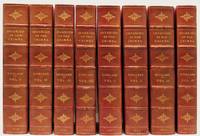
186330083Edinburgh and London: William Blackwood and Sons 1863-1887. 8 volumes. First Edition of each of the eight volumes. With a profusion of maps and plans throughout. 8vo handsomely bound in three-quarter red calf over red cloth covered boards the spines with raised bands central gilt ornamental tooling in the compartments two compartments lettered in gilt gilt rules to the joins marbled endleaves top edges gilt with the signification of the old Bournemouth bookseller of the late 1800's Horace G. Commin. A handsome set well preserved the text-blocks and illustrated portions all in very pleasing condition the bindings with very little evidence of wear hinges all strong and the bindings tight and sound. A COMPLETE SET OF THE FIRST EDITIONS OF THIS HISTORICALLY IMPORTANT AND WELL RESPECTED WORK. PERHAPS THE MOST IMPORTANT OF ALL WRITINGS ON THE CRIMEA. Alexander William Kinglake was an English travel writer and historian. He was educated at Eton College and Trinity College Cambridge. was called to the Bar in 1837 and built up a thriving legal practice which in 1856 he abandoned to devote himself to literature and public life. His magnum opus was this great work--The Invasion of Crimea: Its Origin and an Account of its Progress down to the Death of Lord Raglan in 8 volumes published from 1863 to 1887 by Blackwood Edinburgh one of the most effective works of its class. The History which Geoffrey Bocca describes as a book "by which no intelligent man can fail immediately to be fascinated no matter to what page he might open it" is presented here.<br> Kinglake's subject is the Crimean War of the mid-nineteenth century which was fought from October 1853 to February 1856 in which Russia lost to an alliance of the Ottoman Empire France the United Kingdom and Piedmont-Sardinia. The immediate cause of the war involved the rights of Christian minorities in Palestine then part of the Ottoman Empire with the French promoting the rights of Roman Catholics and Russia promoting those of the Eastern Orthodox Church. Longer-term causes involved the decline of the Ottoman Empire the expansion of the Russian Empire in the preceding Russo-Turkish Wars and the British and French preference to preserve the Ottoman Empire to maintain the balance of power in the Concert of Europe. <br> The churches worked out their differences with the Ottomans and came to an agreement but both the French Emperor Napoleon III and the Russian Tsar Nicholas I refused to back down. Nicholas issued an ultimatum that demanded the Orthodox subjects of the Ottoman Empire be placed under his protection. Britain attempted to mediate and arranged a compromise to which Nicholas agreed. When the Ottomans demanded changes to the agreement Nicholas recanted and prepared for war. <br> The Crimean War was one of the first conflicts in which military forces used modern technologies such as explosive naval shells railways and telegraphs and it was one of the first to be documented extensively in written reports and in photographs. The war quickly became a symbol of logistical medical and tactical failures and of mismanagement. The reaction in Britain led to a demand for the professionalizing of medicine most famously achieved by Florence Nightingale who gained worldwide attention for pioneering modern nursing while she treated the wounded.<br> The war also marked a turning point for the Russian Empire. The war weakened the Imperial Russian Army drained the treasury and undermined Russia's influence in Europe. The empire would take decades to recover. Russia's humiliation forced its educated elites to identify its problems and to recognize the need for fundamental reforms. They saw rapid modernization as the sole way to recover the empire's status as a European power. The war thus became a catalyst for reforms of Russia's social institutions including the abolition of serfdom and overhauls in the justice system local self-government education and military service. <br> As the Ottoman Empire steadily weakened during the 19th century the Russian Empire stood poised to take advantage by expanding southward. In the 1850s the British and the French Empires were allied with the Ottoman Empire and were determined to prevent that expansion. The historian A. J. P. Taylor argued that the war had resulted not from aggression but from the interacting fears of the major players:<br> "In some sense the Crimean war was predestined and had deep-seated causes. Neither Nicholas I nor Napoleon III nor the British government could retreat in the conflict for prestige once it was launched. Nicholas needed a subservient Turkey for the sake of Russian security; Napoleon needed success for the sake of his domestic position; the British government needed an independent Turkey for the security of the Eastern Mediterranean. Mutual fear not mutual aggression caused the Crimean war."<br> Field Marshal FitzRoy James Henry Somerset 1st Baron Raglan known before 1852 as Lord FitzRoy Somerset as a junior officer served in the Peninsular War and the Waterloo campaign latterly as military secretary to the Duke of Wellington. He also took part in politics as Tory Member of Parliament for Truro before becoming Master-General of the Ordnance.<br> He became commander of the British troops sent to the Crimea in 1854: his primary objective was to defend Constantinople and he was also ordered to besiege the Russian port of Sevastopol. After an early success at the Battle of Alma a failure to deliver orders with sufficient clarity caused the fateful Charge of the Light Brigade at the Battle of Balaclava. <br> Dissatisfaction with the conduct of the war was growing with the public in Britain and other countries and was worsened by reports of fiascos especially the devastating losses of the Charge of the Light Brigade at the Battle of Balaclava. On Sunday 21 January 1855 a "snowball riot" occurred in Trafalgar Square near St Martin-in-the-Fields in which 1500 people gathered to protest against the war by pelting buses cabs and pedestrians with snowballs. When the police intervened the snowballs were directed at the constables. The riot was finally put down by troops and police acting with truncheons. In Parliament the Conservatives demanded an accounting of all soldiers cavalry and sailors sent to the Crimea and accurate figures as to the number of casualties sustained by all British armed forces in Crimea especially concerning the Battle of Balaclava. When Parliament passed a bill to investigate by the vote of 305 to 148 Aberdeen said he had lost a vote of no confidence and resigned as prime ministe. The veteran former Foreign Secretary Lord Palmerston became prime minister and took a hard line wishing to expand the war foment unrest inside the Russian Empire and reduce the Russian threat to Europe permanently. Sweden–Norway and Prussia were willing to join Britain and France and Russia was isolated.<br> France which had sent far more soldiers to the war and suffered far more casualties than Britain had wanted the war to end as did Austria. Negotiations began in Paris in February 1856 about seven months after Lord Raglan's death and were surprisingly easy. France under the leadership of Napoleon III had no special interests in the Black Sea and so did not support the harsh British and Austrian proposals.<br> Peace negotiations at the Congress of Paris resulted in the signing of the Treaty of Paris on 30 March 1856. In compliance with Article III Russia restored to the Ottoman Empire the city and the citadel of Kars and "all other parts of the Ottoman territory of which the Russian troop were in possession". Russia returned the Southern Bessarabia to Moldavia. By Article IV Britain France Sardinia and Ottoman Empire restored to Russia "the towns and ports of Sevastopol Balaklava Kamish Eupatoria Kerch Jenikale Kinburn as well as all other territories occupied by the allied troops". In conformity with Articles XI and XIII the Tsar and the Sultan agreed not to establish any naval or military arsenal on the Black Sea coast. The Black Sea clauses weakened Russia which no longer posed a naval threat to the Ottomans. The Principalities of Moldavia and Wallachia were nominally returned to the Ottoman Empire and the Austrian Empire was forced to abandon its annexation and to end its occupation of them. The Treaty of Paris admitted the Ottoman Empire to the Concert of Europe and the great powers pledged to respect its independence and territorial integrity. wiki<br> Tuckwell wrote in 1902 that In 1854 Kinglake "accompanied Lord Raglan to the Crimea.He had hoped to go in an official position as non-combatant but this was refused by the authorities. His friend Lord Raglan whose acquaintance he had made while hunting with the Duke of Beaufort’s hounds took him as his private guest. Arrested for a time at Malta by an attack of fever he joined our army before hostilities began rode with Lord Raglan’s staff at the Alma fight and accompanied the chief in his visit of tenderness to the wounded when the fight was over. Throughout the campaign the two were much together. There are often slight but unmistakable signs of Kinglake’s presence as spectator and auditor of Lord Raglan’s deeds and words; his affection and reverence for the great general animate the whole; in outward composure and latent strength the two men resembled each other closely. The book is in fact a history of Lord Raglan’s share in the campaign; begun in 1856 at the request of Lady Raglan the narrative ends when the Caradoc with the general’s body on board steams out of the bay “Farewell†flying at her masthead the Russian batteries with generous recognition ceasing to fire till the ship was out of sight. “Lord Raglan is dead†said Kinglake as Vol. VIII. was sent to press “and my work is finished.â€<br> Tuckwell wrote that: "In order therefore rightly to appreciate The Invasion of the Crimea we must look upon it as a great prose epic; its argument machinery actors episodes subordinate to a predominant ever present hero. In its fine preamble Lord Raglan sits enthroned high above generals armies spectators conflicts; on the quality of his mind the fate of two great hosts and the fame of two great nations hang. He checks St. Arnaud’s wild ambition; overrules the waverings of the Allies; against his own judgment but in dutiful obedience to home instruction carries out the descent upon the Old Fort coast. The successful achievement of the perilous flank march is ascribed to the undivided command which during forty-eight hours accident had conferred upon him. From his presence in council French and English come away convinced and strengthened; his calm in action imparts itself to anxious generals and panic-stricken aides-de-camp. Through Alma fight from the high knoll to which happy audacity had carried him he rides the whirlwind and directs the storm. In the terrible crisis which sees the Russians breaking over the crest of Inkerman in the ill-fated attack on the Great Redan where Lacy Yea is killed his apparent freedom from anxiety infects all around him and achieves redemption from disaster. William Blackwood and Sons hardcover
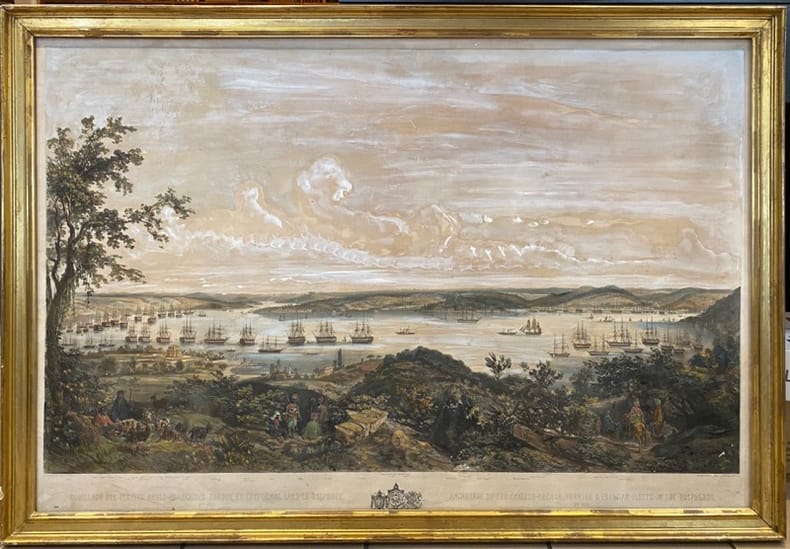
210664A Constantinople, A. Percheron et J. Schranz, Paris, Imp. de Jacomme & Cie, (1854) 89 x 129 cm, lithographie en deux tons, mise en coloris de l'époque, en feuille, sous cadre doré ancien. Sans verre.
Due volumi, folio (552 x 360). Volume I: titolo litografato, pagina di dedica, 12 pagine (descrizione delle tavole ) e 39 litografie a colori (alcune con esplicazioni ), numerate 2-40 (il numero 1 è la pagina del titolo); Volume II: titolo litografato, 12 pagine (descrizione delle tavole) e 40 litografie a colori (alcune con esplicazioni ), numerate 1-41 (la tavola numero 37 è la pagina del titolo). Legatura coeva in mezza pelle rossa, dorso riccamente ornato, piatti marmorizzati, tagli dorati (la parte inferiore del dorso del secondo volume abilmente restaurata). Qualche brunitura e piccole e macchie, ma ottimo esemplare. Prima edizione. Durante la guerra di Crimea William Simpson fu inviato dai tipografi Colnaghi e Son, su raccomandazione di Day. In Crimea e Balaklava divenne un artista di guerra pionieristico, registrando le battaglie navali e facendo schizzi accurati sul posto. I suoi disegni furono poi sottoposti a Lord Raglan e mostrati alla regina Vittoria dal ministro della guerra, il duca di Newcastle. Ottanta dei suoi disegni di Crimea sono stati litografati in The Seat of War in the East, dedicato con il permesso alla regina Vittoria. Di questa edizione vennero stampati esemplari di lusso con le tavole colorati a mano.. .
221827S.l., s.d. (vers 1860) in-4, titre (détaché), 202 pp., couvertes d'une écriture fine, régulière, extrêmement soignée (environ 25 lignes par page), présentant aussi des notes infra-paginales de la même main, des biffures et ajouts au crayon de bois semblent postérieurs à la rédaction, de même que quelques ajouts marginaux à l'encre d'une autre main, demi-chagrin Bradel bouteille, dos muet orné de filets à froid, encadrements de filets à froid sur les plats de toile chagrinée, titre poussé en lettres dorées au centre du plat supérieur, tranches jaunes (reliure de l'époque). Plat supérieur un peu taché.
1857B5185Torino: Del Ministro di Guerra c.1857. A fine example of this fascinating work in superbly decorative contemporary full gilt calf. Plates are crisp with occasional very mild browning. . Edition: First Edition. Binding: Contemporary decorative full calf. Gilt borders and ornamentation on top and bottom cover. Gilt title on top cover. Gilt dentelles on top and bottom cover. Textured Pink pasted and free endpapers. Notes: Large Oblong Folio 430x790mm<br>This book shows scenes from the Crimean War and is interesting both from the point of view of military history as it shows plans of battles fought depictions of the fortifications camps etc. and for large tables depicting landscapes and scenes of the theater of war. <br><br>The Crimean War October 1853 – February 1856 was a conflict in which Russia lost to an alliance of France Britain the Ottoman Empire and Sardinia. The immediate cause involved the rights of Christian minorities in the Holy Land which was controlled by the Ottoman Empire. The French promoted the rights of Catholics while Russia promoted those of the Orthodox Christians. The longer-term causes involved the decline of the Ottoman Empire and the unwillingness of Britain and France to allow Russia to gain territory and power at Ottoman expense <br><br>The Sardininan-Piedmont the predecessor to modern day Italy contribution to the allies in the Crimea was part of the Prime Minister’s Camillo Cavour diplomatic plan to secure French support for the notion of a united Italy the success of which resulted in the Austro-French war of 1859.<br> Size: Large Oblong Folio Illustration: Illustrated with twenty five lithographs; A beautiful frontispiece depicting a military procession 10 maps 4 are large fold-out maps 7 colour panoramas 3 are large fold-outs and 7 lithographs showing military scenes and diagrams of forts and inventions. All plates have embossed stamp of the Sardinian Office of the Minister of War “Real Corpo di Stato Maggiore.†Category: Book Military; Book Russia; Book Europe Italy; Book Europe Ukraine; Del Ministro di Guerra unknown