345 résultats
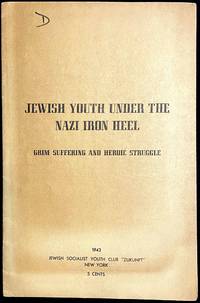
194243351New York: Jewish Socialist Youth Club 1942. Paper Wrappers. Illustrated by 2 Facimilie Illustrations. 1st edition Original Paper Wrappers 8vo 16 pages another variant we have seen has 15 pages. <br> From the year before the Warsaw Ghetto Uprising an early 1942 report by the American branch of the Bund on Jewish resistance by young people in Eastern Europe. <br> "Hand in hand with the underground organizations of the General Jewish Labor Union and in contact with the organization of the Polish socialists the Youth Union 'Zukunfst' conducts an untiring and ramified activity which is preparing the ground for the open struggle of tomorrow against Hitlerism" p. 13. <br> "Tsukunft or Cukunft or Zukunft Yiddish for future was the youth organization of the General Jewish Labor Union or Bund. It was founded in 1910 and in 1916 it was officially called Yugnt-Bund Tsukunft. Their newspaper was the Yugnt veker.<br> In 1922 the organization changed its name to Yugnt-bund "Tsukunft" in poyln 'Youth Bund "Tsukunft" in Poland'.At the time of the sixth Tsukunft conference in 1936 the last before the outbreak of the Second World War the organization counted with 184 local groups.<br> On the eve of the Second World War the organization had 15000 members. The Tsukunft took part in the Warsaw ghetto uprising as part of the Jewish Fighting Organization" Wikipedia.<br> SUBJECTS: Jewish youth -- Poland. Holocaust Jewish 1939-1945 -- Jewish resistance. World War 1939-1945 -- Atrocities. <br> OCLC: 6871875. <br> Covers toning with pen notation to cover otherwise Very Good Condition B Holo2-139-22A-XAECC-'l. Jewish Socialist Youth Club unknown
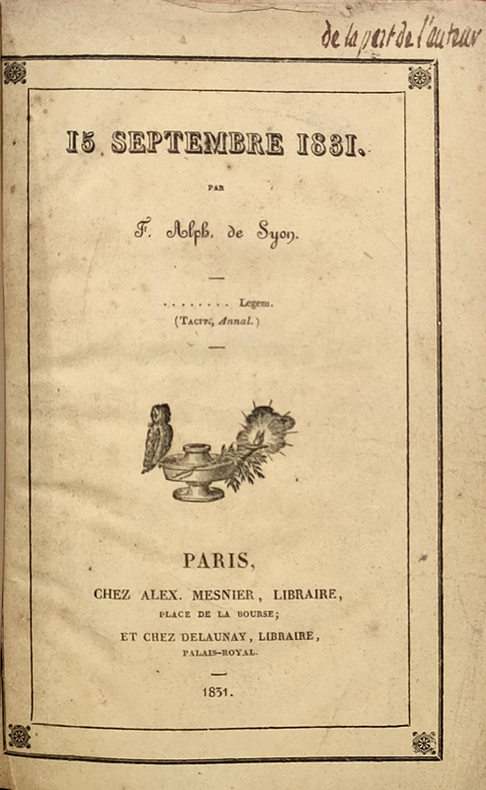
183122743Paris, Mesnier, Delaunay, 1831, in-8°, bradel percaline rouge, titre doré au dos en long, premier plat de couverture conservé avec envoi autographe "de la part de l'auteur", [4], 84 pp. et [1] f. d'errata.
1989230726k036xbvkOhne Druckvermerk, wohl Köln, 1989. Bedrucktes Titelblatt aus transparentem Plastik, 15 weisse DinA4-Kartons in farbigem Siebdruck, rückseitig mit Text. - Gelocht und 'abgelegt' in schlichtem Orig.-Ringordner 'CLASSIC' mit Griffloch (so erschienen!); Folio (ca. 32 x 29 x 4 cm).
Features: Great cover photo of men viewing Paris election news; What it is like to live in Warsaw - the daily struggle to achieve the ordinary wears a man out, physically and spiritually, but Poles have not yet quite lost their pride and hope, gaiety and individualtiy; France Chooses a new Assembly - with great photos; Big Three of Algeria's Rebels - Premier Ferhat Abbas, Foreign Minister Mohammed Lamine-Debaghine, and Belkacem Krim, Vice Premier; A 600 Billion Dollar Economy?; The Egghead vs. the Muttonhead - too few people dare to be themselves; Small Wonder Called the Gene - How will radioactive fallout affect human genetics?; Rodgers and Hammerstein Brand on a Musical; Real World in the Abstract - photos; He Calls the Signals for Pro Football - Article on NFL Commissioner Bert Bell; Fantastic two-page color-photo as for American Airlines promotes the first jet service in the U.S.A., 707 service scheduled to begin in January, New York to Los Angeles in 5.5 hours!; Impressionistic View of an Art Opening; When Cities Put Out the Welcome Mat to host conventions; Captains of the Subway - brief article on New York subway conductors, with photos; Two Movies - Two Audrey Hepburns; Stuffing recipes; Building the Child's Sense of Ethics; Fashion photos of two-piece swimwear for women; Photo-feature of new five-story Manhattan home designed by Felix Augenfeld and Jan H. Pokorny; Photos of "The Disenchanted" starring Jason Robarts; and more. 96 pages. Many fascinating black and white reproductions of photos plus sensational fashion ads, some of which are in color. Unmarked with average wear. A sound vintage copy. Book
Features: Greatest Navy on Earth provides a pageant of power for Truman policy outline - with photo of commissioning of giant carrier Franklin D. Roosevelt; Photo of a million people in Central Park listening to the President; Zionists assail 'ambiguity and delay' on Palestine at a New York Rally - with photo and text; Detroit Mayoralty Race - Gerald L.K. Smith, Jeffries, William Z. Foster, Frankensteen; Red Army's odd ways in peace tilt course of Russian Diplomacy; Photos of tough market life in Warsaw, Poland; Japanese Zaibatsu to be abolished; President Achmed Sukarno of Indonesia; Outer Mongolia now 'independent'; Services war unity flies apart under shock of the atom bomb; Discrimination against blacks in Britain; photo of car down lakefront ravine in Scarborough, Ontario; Labor-Management parley to fix labor strife re: wage-hour questions; Meter, Yard or EII? - Swedish compromise would shift measurement unit to end conflict; and more. Average wear. Address label on front cover. Evidence of moisture exposure to last ten pages or so. A sound copy. Book
1969ZB445382Warsaw: 1969-2000. volumes 10-11 14-15 21 23-26 37-41 complete volumes in original softcovers well illustrated some library markings passim PRICE IS FOR THE LOT. - If you are reading this this item is actually physically in our stock and ready for shipment once ordered. We are not bookjackers. Buyer is responsible for any additional duties taxes or fees required by recipient's country. Photos available upon request. Warsaw: paperback
2101744 Marylands Road Maida Hill W. London 25 March circa 1913. Malecka was born in England the daughter of a Polish father and English mother. In 1912 she was imprisoned in Warsaw by the Russians 'on a charge of conspiring against the Russian Government'. The matter was raised in the British parliament and reported widely for example in the Spectator and Russian Review. On her release she published 'Saved from Siberia: The True Story of my Treatment at the Hands of the Russian Police' London 1913. 2pp. 12mo. In good condition lightly aged. She would 'indeed very much like to pay her another weekend visit' on her return to England. 'I am afraid I shall hardly have time before I go away. The Bristol lecture went very well & I had a most sympathetic & enthusiastic audience.' She will 'however be very glad to leave off being “the prisoner of Warsawâ€'. 44 Marylands Road, Maida Hill, W. [London] 25 March [circa 1913]. unknown
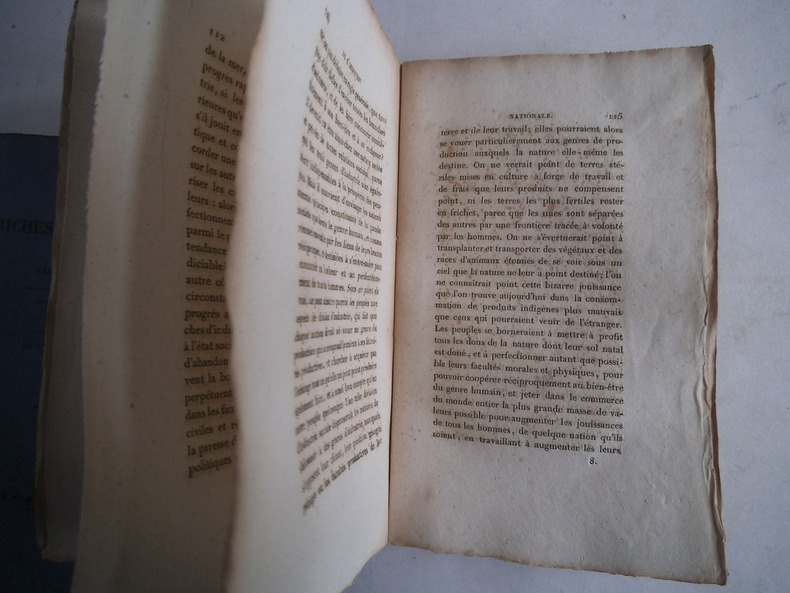
8359suivies d’une bibliographie de l’économie politique-seconde édition.Deux tomes en deux volumes in 8 broché, dos factice muet.Tome 1:faux-titre,titre-352 pages.Rousseurs éparse, fortes à certaines pages ainsi qu’en début et fin de volume.Tome2:faux-titre, titre,324 pages,rousseurs, plus ou moins fortes, plus concentrées en début et de volume. Paris Chez F.Bechey libraire 1839-1840. Bon exemplaire.
1955187431955. Photograph archive 1955 documenting the political leadership and military forces present at the establishment of the Warsaw Pact in Poland with direct relevance to the study of Cold War alliances Soviet influence in Eastern Europe and the organization of socialist military systems. Formed as a collective defense agreement among the Soviet Union Poland East Germany Czechoslovakia Hungary and Bulgaria the Warsaw Pact functioned as a counterpart to NATO and formalized military coordination within the Eastern Bloc. The photographs depict assembled leaders and officers alongside scenes of organized troops training exercises and public displays of military readiness reflecting the emphasis on unity and preparedness at the outset of the alliance. The archive captures the visual language of state power and coordination during a defining moment in early Cold War geopolitics.<br /> <br /> Archive of 28 black and white photographs each approximately 8 x 10 inches produced as professional press or official images with captions in Czech. The photographs include formal portraits and groupings of political and military leaders as well as images of soldiers in formation training exercises and urban assemblies associated with the founding events. The consistent format and captioning indicate coordinated production for documentation or dissemination within Eastern Bloc media or governmental contexts. Twenty-eight photographs with light wear consistent with handling; overall very good condition. A cohesive visual record of the formation and early presentation of the Warsaw Pact as a military and political alliance during the Cold War. The Warsaw Pact would persist until the end of the Cold War when it fractured as states throughout the Eastern Bloc broke with communism and no longer were programatically aligned. In very good condition overall. unknown
x, 214 pp. Index. Foldout map. Seven black and white plates. First published in the U.S. in 1942. "Compiled under the auspices of the Research Institute for Peace and Post War Problems of the American Jewish Committee, New York. [The author] is able to lay bare every step taken by the Nazis to impose their evil will upon Poland; he describes too the resistance and underground activities of the population in opposition to the invader. Poland is being used by the Nazis as a testing ground for their scheme for a future German colonial empire in Europe. This book is of the utmost importance as an analysis of the evil which the United Nations have to combat." - dust jacket. Moderate wear to publisher's black cloth which is lettered in silver with red trim upon backstrip. Binding sound. Gentle toning to clean and unmarked contents. Moderate wear to dust jacket now preserved in archival-grade Brodart. A quality copy of this important work compiled while the final outcome of WWII was unknown. Kehr & Langmaid 5414, Wiener Library Catalogue Seven 983. Book
1943STAN0084New-York: Spett Printing Company 1943. Second printing, December 1943. 40 S., darin eine Skizze des KZ Treblinka, auf dem Umschlag ein Übersichtsplan von Warschau, das Ghetto rot umrandet. Umschlag etwas gebräunt, sonst gut erhalten / 40 pages, in it a sketch of the Treblinka concentration camp, on the cover an overview map of Warsaw, the ghetto outlined in red. Cover a little browned, otherwise in good condition Testimonies from Ghettos in Poland, collected and translated into English by the "World Jewish Congress" and the "Representatives of Polish Jewry". With a drawing of Treblinka Extermination Camp. Very rare.
195555725Erskine MN Warsaw NY & Wyoming NY: Erskine Manufacturing Valley Implement Inc. Clayton Carlson ca. 1955-1957. Oblong 4to. 37 leaves unnumbered. all mylar sleeves including 20 silver gelatin photographs sized 8 x 10 in. all preserved in mylar sleeves 1 w/ photographer’s studio stamp on verso 9 printed sales cards on thick paper stock blue lettering sized 8 x 10 in. 8 silver print reproductions of ALS & sales documents. Recent 3-ring binder lettering stamped on front cover NF. This counter display photo catalogue extolled the virtues and advantages of the Champion Berger Rotary Snow Plow developed and produced by Erskine Manufacturing of Minnesota. Founded in 1948 following World War II they were one of the first companies to pioneer and manufacture rotary snow blowers and plows for farm tractors and proved to be an immediate hit. These photos show the rear rotary snow plow fitted to all popular 25 horsepower or more tractors such as Farmall Allis Chalmers Case International Harvester and other tractors. They could be easily installed in minutes rather than hours for front snow plow implements were used with ease with any snow removal job avoided the common problems of more powerful front snow blowers such as bucking and breakage to both tractor & plow and could be easily controlled from the tractor seat. According to contemporary newspaper and trade magazine advertisements as well as the reproduced sales contracts in this group the cost typically ran from $ 300.00 to $ 325.00 for the Champion Berger and the testimonial letters to Valley Implement in upstate New York between Buffalo & Rochester rave about the performance. Carlson 1926-2019 first began as a photographer at 15 years of age and after photographing his first wedding in 1950 ran Carlson’s Studio for 40 years shooting across the surrounding Genesee Wyoming and Orleans Counties of New York. Erskine Manufacturing, Valley Implement, Inc., Clayton Carlson, unknown
8vo., First Edition thus, with front and rear endpaper maps; handsomely bound in full dark red crushed morocco, sides with gilt frame borders, back with raised bands, second and fourth compartments lettered and ruled in gilt, all other compartments tooled in gilt, gilt top, hand-made endpapers, a most attractive copy ideal as a gift or for presentation. Detailed and inspiring history of the Polish Underground by its foremost leader. A cornerstone of the literature of Poland in WWII. VERY SCARCE. Enser, p.342.
2018BN127142Taylor & Francis Ltd 2018. 2018. Hardcover. Qualitative Marketing Research <br/><br/>Qualitative Marketing Research Dominika University of Warsaw Poland Maison Taylor & Francis Ltd hardcover
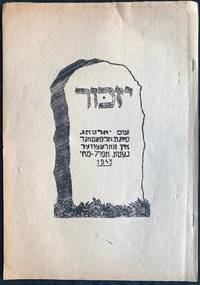
194443395Shvayts Switzerland: Undzer Vort Poale Tziyon Left 1944. May 1944. 1st edition. Original stapled printed paper cover 4to 2 25 pages. <br> In Yiddish. Title translates as "In Memoriam. On the Anniversary of the Uprising in the Warsaw Ghetto April-May 1943.<br> First Anniversary of the Warsaw Ghetto uprising published in Europe during the Holocaust by Jewish "Poale Tziyon Left" members in Switzerland. The organization's name which means "Workers of Zion" is sometimes also romanized as "Poale Zion" or "Poaley Syjon." <br> <br> The imprint "Undzer Vort" "Our Word" was a Left Poale Tziyon publisher in Switzerland which also published a mimeograph newspaper titled "Undzer Vort" OCLC: 232675203 during this same period. A fully underground version of the paper was also published in Nazi-Occupied Belgium see below.<br> <br> Indeed Poale Tsiyon Left was an important part of Jewish resistance throughout Europe most notably during the Warsaw Ghetto Uprising which this publication commemorates. <br> <br> "The Holocaust-era Jewish resistance group ZOB was formed from a coalition including Hashomer Hatzair Dror Bnei Akiva the Jewish Bund various Jewish Communist groups and both factions of Poale Zion. Poale Zion was also active in the Anti-Fascist Bloc.<br> Several notable Jewish resistance fighters during the Holocaust particularly those involved in the Warsaw Ghetto Uprising were members of Poale Zion. They include:<br> <br> Adolf Berman Warsaw ZOB fighter; Secretary of Zegota Poale Zion Left<br> Hersz Berlinski member of Warsaw ZOB Command Poale Zion Left<br> Yochanan Morgenstern member of Warsaw ZOB Command Poale Zion Right<br> Emanuel Ringelblum member of Warsaw ZOB; chronicler of the Warsaw Ghetto Poale Zion Left" Wikipedia.<br> <br> The booklet opens with the moving story of the start of the uprising:<br> <br> "It has been a year since the glorious uprising of the Jews in the Warsaw ghetto.<br> April 19 1943 - barely a few tens of thousands of Jews left in Warsaw after about half a million of their brothers and sisters were exterminated in the most gruesome way they rose up with organized resistance against the renewed attempts.that they too like the previous ones would be led out like sheep to the slaughter.<br> Forty thousand Jews weapons in hand opposed an enemy tenfold a hundred hundred times outnumbered.Women men and children the high class and the humble.<br> From the beginning they all knew without exception that they would be defeated that the outcome was not in doubt and that the enemy intended nothing but destruction for all of them.<br> But no Nazi expected to fall on such a battlefield.<br> And his was the biggest slap in the face which the proud Nazis.so hated when it was received from these these trampled down these unrefined these scorned these despised Jewish 'untermenchen'" Translated from the opening paragraphs on page 1.<br> <br> The publication later continues with a damnation of the "democracies" who did so little and a holding up of the comrades of Poale Tziyon who are doing so much fighting on all fronts:<br> <br> "The 'world democracies' didn't do anything.to save the Jewish victims and to stop the misery train they issued platonic statements about punishing the 'crimes' after the massacre. The warnings have so far helped little.<br> The.Sacrifices keep growing.The world that is fighting 'for justice' and that is busy with courts after the massacre has not found any means to rescue the few escaped heroes in the ghetto for a whole year.<br> This long eulogy is for dozens and hundreds of comrades who fell as loyal children of the nation and fighters for its working class on the fronts in the distant.north in the camps of France and Belgium. who went from one end of the world to the other - at their wounds and from hundreds of thousands of others - comrades of the Poale-Tziyon movement." page 24. <br> <br> Poale Zion.was a movement of Marxist-Zionist Jewish workers founded in various cities of Poland Europe and the Russian Empire at about the turn of the 20th century after the Bund rejected Zionism in 1901.<br> Poale Zion was torn between left-wing and right-wing factions in 1919-1920; the organization formally split at the Poale Zion fifth world congress in Vienna in 1920 following a similar division that occurred in the Second International.<br> The right wing was less Marxist and more nationalist and favoured a more moderate socialist program and supported the International Working Union of Socialist Parties to continue the work of the Second International essentially becoming a social democratic party. The left-wing faction did not consider the Second International radical enough and some accused its members of betraying Borochov's revolutionary principles although Borochov had begun to modify his ideology as early as 1914 and publicly identified as a social democrat the year before his death.<br> Poale Zion Left which supported the Bolshevik revolution continued to be sympathetic to Marxism and Communism and attended the second and third congresses of the Communist International in a consultative capacity. They lobbied for membership but their attempts were unsuccessful as the internationalist communist movement under Lenin and Trotsky was opposed to Zionist nationalism. The Comintern advised individual members of Left Poale Zion to join their national Communist parties as individuals; at their 1922 Danzig conference these terms were rejected by the party. The Comintern declared it an enemy of the workers' movement.<br> Poale Zion Left opposed the decision by Poale Zion to rejoin the World Zionist Organization viewing it as essentially bourgeois in character and viewed the Histadrut as reformist and non-socialist. Aside from differing attitudes towards Zionism and Stalinism the two wings of Poale Zion parted ways over Yiddish and Yiddish culture.<br> The Left was more supportive of the latter similar to the members of the Jewish Bund while the Right bloc identified strongly with the emerging modern Hebrew movement in the early 20th century.<br> In Poland for a brief period following World War I both factions of Poale Zion were reported as legal and functioning political parties. The Polish Left party was the largest Left Poale Zion party in the world. It worked closely with the Bund in developing Yiddish schools in Poland and supporting secular Yiddish culture although they had political differences e.g. the Bund was more supportive of the Polish Socialist Party than LPZ.<br> As part of the large-scale ban on Jewish political parties in post-World War II Poland by the Communist leadership both Poale Zion groups were disbanded in February 1950" Wikipedia.<br> <br> Interestingly the image on the front cover this distinctive gravestone with "Yizkor" in a specific heavy font was a frequent image for memorials to the victims of pogroms as well as the Shoah in particular for memorials to the Warsaw Ghetto Uprising. A few examples include:<br> • Hashin & Ben Gurion Yizkor tsum ondenken di gefalene vekhter un arbeiter in Erets Yisroel New York Poale Zion Palestine Committee 1917. Internal illustrated title page<br> • Hurbn Proskurov New York: Proskurover Relief Organization 1924. See image on JHU's online Yizkor Book Exhibit at www.library.jhu.edu/news/2025/06/yizkor-books-traveling-homelands-and-portable-memorials And from another memorial to the first anniversary of the Warsaw Ghetto Uprising:<br> • Tsum Yortog Funm Oyfshtand in Varshever Geto April-May 1943. Ramat Gan: Defus "liga" 1944. OCLC: 63647084. See Nr. 35 in our catalog 215 at danwymanbooks.cdn.bibliopolis.com/images/upload/catalog-215.pdf <br> <br> "Undzer Vort" also published similar underground Poale Tziyon Left newspapers and other materials in Nazi-occupied countries such as Belgium: <br> "'Linke Poale Zion' Left-wing Workers of Zion was a Zionist-Socialist party in Belgium and one of the initiators of the Jewish Defense Committee of Belgium. This committee managed to save about 3000 children and several thousand Jewish adults from the clutches of the Nazis.<br> With his party comrades Abusz Werber ensured the editing publication and distribution of 28 issues of a secret underground newspaper in Yiddish"Unzer Wort" Undzer Vort Our Word which appeared until the Liberation in September 1944 and even after" Werber The Word of Abusz Werber 2017. Note how the Yiddish documents on the cover of the book are similar to our Undzer Vort publication from Switzerland: https://m.media-/images/I/71sWHrhxgoL._SL1360_.jpg. <br> <br> SUBJECTS: Holocaust Jewish 1939-1945 -- Poland -- Warsaw -- Illustrations. <br> OCLC: 233365664. OCLC locates only 1 copy worldwide NLI.<br> <br> Final leaf in facsimile. Paper toning as expected but strong. About Very Good Condition thus. Rare and important. B Holo2-163-28-XX. Shvayts [Switzerland]: Undzer Vort [Poale Tziyon Left] unknown
1946MMRM1658Varsovie:: American Joint Distribution Committee 1946. 1946. 8vo. 264 4 pp. 11 black and white photographic plates 50 tables charts index. Original printed wrappers; scotch tape along spine front and rear covers age-darkened first 3 pages including half title and last three blank end-papers are loose. Main body of work remains bound and in good condition. Loose pages have some slight area of extremities missing. Some fading and foxing to pages. Thus wrappers poor but text good to good plus. First edition. SEMINAL WORK IN MEDICAL CLINICAL RESEARCH & A CRITICAL ARTIFACT OF THE WARSAW GHETTO AND HOLOCAUST. Copies of the book are uncommon in part because of the fragile nature of the paper used to publish the report. In the immediate aftermath of World War II paper ink and binding facilities in Europe were scarce. The published report was done with economy in mind and with a rushed sense of needing to reveal to the world what happened. / Six articles report on the clinical research by 28 Jewish physicians and a student intern the 1946 book only records the names of 21 physicians and the student – subsequent research in the 1960s revealed the additional names who conducted the studies on adults and children at the two Jewish hospitals in the Ghetto. Abbreviated biographies of the physicians can be found in The Uses of Adversity: Studies of Starvation in the Warsaw Ghetto by Leonard Tushnet published in 1966. The physicians hoped to study these patients to somehow benefit humanity perhaps in the spirit of the Jewish concept of tikkun olam - to repair the world. The studies were conducted in secret since any scientific research in the Ghetto was prohibited by the Nazi overseers. It is also quite possible that many if not all the clinical physicians believed that granting children and others the status of being a patient would protect them by preventing their transport out of the ghetto to death camps. Theories also suggest that the physicians wanted to preserve a record of the atrocities being committed as well as advance medical research. The studies remain the most comprehensive research of the effects and progression of starvation in part because any contemporary studies would largely be blunted by existing ethical guidelines for informed consent and subject welfare. Contemporary debates about the ethical wisdom of conducting these studies remains contentious. / The Warsaw Ghetto occupied approximately 1.3 square miles 3.4km2 and its population was as much as 500000 men women and children. The Ghetto was a staging area for transporting Polish and Eastern European Jews to the death camps and a locale for starving to death Jews prior to transport. The average daily caloric intake of a resident of the Ghetto was 600 to 800 calories of low-protein food for adults. This amount was calculated by Adolf Eichmann to starve-to-death most of the residents in approximately nine months. The physicians performing the research were no exception to the plan. All were starving as they performed their studies. Equipment for clinical research was smuggled into the hospitals. / Each article in the book is devoted to specific results of these studies. Chapter V offers autopsy results on 710 patients; 492 died of starvation and 218 died of complications of secondary conditions. Chapter VI offers clinical observations of one-hundred adults who died from starvation. Chapter VII offers clinical observations of 40 children who died of starvation. Chapter VIII examines the effects of starvation on the cardiovascular system in adults and children. Chapter IX discusses changes in peripheral blood and bone marrow. Ophthalmic responses to starvation are discussed in Chapter X. Only one doctor engaged in the research Emil Apfelbaum survived the war. He arranged to have the studies smuggled out of the Ghetto to a Polish professor of medicine who released the reports after the liberation of Warsaw. After the war Apfelbaum edited the report for publication by the Joint Distribution Committee. He died a week before the book was published. / Research was performed at the two hospitals in the Ghetto from late February to July 22 1942. On July 22 the hospitals were closed and any patients unable to be transported were summarily executed regardless of age. The attending and clinical physicians were fully aware of the fate awaiting transported patients and in many instances they performed euthanasia on elderly and child patients who were scheduled for transport. Some of the physicians committed suicide rather than face transport. Other physicians accompanied their patients to the death camps providing whatever aid they could. / The studies were smuggled out of the ghetto in a manner befitting a Ken Follet thriller. A Jewish physician Henryk Fenigstein played a crucial role. "Before the war Henryk was a stamp collector. In fact he had one of the largest collections of Polish stamps in the country. One day two SS members arrived at the hospital and told Henryk to come with them to Gestapo headquarters. Of course he was terrified. Jews taken to Gestapo headquarters did not return. On arrival he was taken to the office of a senior officer who told him that he himself was an avid stamp collector. He took out a list and handed it to Henryk. He wondered if Henryk had these stamps and if not if he knew where to procure them. Henryk told him that he had many of the stamps including some of the very rare ones. He told him that he thought he could procure the rest. In order to do this he would need a pass to get out of the ghetto for a few hours each week. And of course the SS officer was welcome to those that he had. The officer agreed and even gave Henryk his phone number in case he needed any help. Thus Henryk Fenigstein a key member of the study team was able to leave the ghetto" 2005 lecture Myron Winick. During such an outing Fenigstein arranged for the smuggling of the reports. A pregnant woman reportedly was used to hide the documents and transport them out of the ghetto. / The supervising physician of the project Israel Milejkowski wrote in his Introduction to the studies that each author refused to allow the Nazis to destroy their work and that through the research and the publication of that research "Nous avons termine nos Recherches et nous les conserverons bien comme c'etait Ton desir. Les paroles immortelles que Tu a jetees "Non omnius Moriar" doivent etre en premier lieu appliquees a Toi! Gloire eternelle a Ta Memoire !" / The research as well as results from the Minnesota Semi-Starvation studies of 1944-1945 continues to benefit the millions of persons facing starvation each year. The participants in the Minnesota study lost an average of 25% of pre-test body weight and the final phase of the study included recovery techniques and methods. The Warsaw studies measured effects until death. This artifact of scientific integrity individual bravery and resistance to oppression is a rare opportunity to truly own a small piece of history illuminating the courage of physicians determined to use their craft to help the world and advance the memory of atrocities. American Joint Distribution Committee, 1946. unknown books
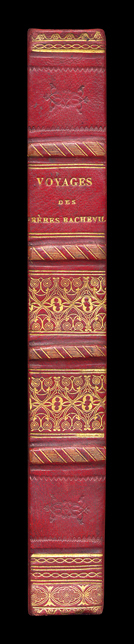
182215861Paris, Béchet Ainé et chez le Capitaine Bacheville, 1822 ; in-8 ; demi-veau glacé grenat à petits coins, dos à quatre nerfs plats décorés encadrant le titre et deux caissons décorés "à la cathédrale", palette et roulettes décoratives dorées, fleurons et roulettes à froid, tranches marbrées (reliure de l'époque) ; XII, 432, (2) pp., frontispice lithographié par G. Engelmann montrant les frères Bacheville se séparant pour toujours en Turquie d'Europe.
328 pages. "A significant document by which the author acquitted himself of the obligation bequeathed on the survivors of the Holocaust by its victims to tell the world what happened to the Jews during World War Two, when to be a Jew was a crime. The Memoirs based on the author's own experiences and reports told to him by his relatives and friends, survivors of the Holocaust, describe the fate of hundreds of thousands of Polish Jews, banished by the Russians to Siberia and in particular the lot of those who came under the Nazi regime... A rich source of first hand information about the life in the ghetto, the Judenrat, the Jewish Ghetto Police and the methods used by the Nazis in the destruction of the Jews." - dust jacket. Author lost his parents, wife and two sons in the Holocaust. Map endpapers. Black and white illustrations. Book clean and unmarked with light wear. Dust jacket lightly sunned at spine, bears several closed tears and is missing some small chips - now preserved in glossy new archival-grade Brodart cover. A sound copy.. Book
FIRST EDITION OF ELUARD'S RAREST BOOK, WITH AN ORIGINAL SIGNED DRAWING BY MAURICE MENDJIZKI. Includes a 5-page poem by Eluard and 31 extremely high-quality (Jacomet process?) full-page reproductions of drawings by Mendjizki depicting the suffering and heroism of the Warsaw Ghetto and the Uprising. Dedicated to the artist's son Claude, shot by the Nazis in 1944 for being a member of the Resistance. THIS FIRST EDITION STRICTLY LIMITED TO 100 COPIES, of which this is number 100, SIGNED BY ELUARD AND MENDJIZKY AND CONTAINING AN WONDERFUL ORIGINAL SIGNED DRAWING BY MENDJIZKY, depicting three people trying to sleep in very cramped quarters (200 additional unsigned copies were also printed, 100 in French and 100 in Yiddish, which are not part of the first edition.) Printed on fine wove paper. 4to. Original wraps FINE AND BRIGHT, LIKE NEW WITH NO DEFECTS, IN THE ORIGINAL BOARD CHEMISE AND SLIPCASE. A wonderful example of extremely rare and haunting 20th-century Judaica.
Signed and inscribed by Jan Karski upon front free endpaper. Karski [1914-2000] recounts his experiences when his homeland of Poland was rent asunder by the joint Nazi and Soviet invasion of 1939, and his harrowing subsequent life as a member of the Polish underground, during which he was captured by the Gestapo and severely tortured. Provides a ghastly eyewitness account of life in the Warsaw ghetto, into which Karski was smuggled so his observations could be reported to the outside world. Firearms advocates will cringe at Karski's account of what happened after he and a large group of Polish soldiers handed over their weapons to their 'comrades' from the Soviet Union. In 2012 Karski was posthumously awarded America's highest civilan honor, the Presidential Medal of Freedom, by President Obama. 391 pages. Moderate wear to publisher's red cloth. Dust jacket now preserved in archival-grade Brodart. Binding intact. A sound copy of this truly unforgettable WWII narrative. Laska 672, Kehr & Langmaid 5407, Weiner Library Catalogue Seven 997, Enser p.343. Book