34 274 résultats
193446502ABLondon Eyre & Spottiswoode 1934. 2 Bde. Gr.-8° XI/1269 S., Kart. OL, verg. Rü.-Tit. Rüä. minim. verbl., Schn. leicht fl., innen etwas gebr., einige Bleist.-Anstreich./Randbemerk., guter Zust.
No dust jacket. Hardcover. Gilt lettering on spine. Boards are a little worn and rubbed. Boards have two or three light stains and surface marks. Spine ends are worn, rubbed and bumped. Leading corners are worn, bumped and frayed. Considerable age - spotting on page block. Minor liquid staining to inner corners of front pastedown, front endpaper and first few pages. Moderate age - spotting on first and last few pages. Light liquid staining on lower edges of several pages near end of book. Binding is sound, pages are tight and text is clear throughout. AF Used
First UK edition translated from the French by Henry L. Binsse. No dust jacket and boards are sunned at spine and bumped at corners. Gift dedication penned to FEP. Spine is tight and pages are clean througout. AD Used
Hardcovers in acceptable condition. No jackets. Two volumes. Ancient Greece only. Ex - university library. From Brasenose College, Oxford. Boards and spines are marked. Volume one spine is blotched. Label residue on spines. Leading corners, edges and spines are worn, bumped and nicked. One inch tears on spine ends of volume one. Pages are tanned, foxed and rough - cut. Pages are detached from cover of volume one, but remain intact. BEP of volume one is nicked. Five centimetre tear on front pastedown hinge of volume two. Pen and library stamp on FEP of volume two. One or two pages are dog - eared. Hinges between one or two pages are split, but binding for volume two remains intact. Text remains clear throughout both volumes. HCW Ex - Library
Signed 'H Mark Luft' on title page. Previous owner's name on front end paper and title page. No other marks or inscriptions to contents. No creasing to covers or to spine. A very clean very tight copy with bright unmarked boards and no bumping to corners. The book is wrapped in a professionally printed removable plastic cover imprinted with the title and author. A little marking to the insides of the boards where this sleeve had been secured. 338pp. Detailed history of this Liverpool school with illustrations. Scarce with dust jacket.
8vo., First Edition, with a portrait frontispiece, some light age-staining, fore-edges mildly mottled; original red ribbed cloth, upper board blocked in blind, gilt back, a very good, bright copy. Sold from an institution with its bookplate on front paste-down and small inked Dewey on backstrip. Extremely scarce. No copy is listed in BLPC.
1988000630New York: Dorset Press 1988. Soft cover. Like New/Like New. <br/><br/> Dorset Press paperback books
350 pages including notes, bibliography and index. Describes the history of the Slovak nation from its arrival on the Danubian Plain and the valleys of the Tatra Mountains to its declaration of independence in 1993. Remarkably light wear. Usual library markings. Nice clean copy. Book
1908621298New York, Scribner's Sons, (1908). M. 5 (3 farb.) Ktn. u. 2 Abb. XIII, 468 S. OLwd. m. Rsign. Einbd. etwas fleckig. St. verso Tit.
In-4 p., 9 volumi (di cui 1 di Supplemento), mz. pelle coeva con ang., dorso a cordoni con filetti e tit. oro, tagli sup. dorati. L'opera, in 8 volumi, pubblicati nel 1871-1881, è cosi' composta: - Vol. 1°: pp. XIII (list of subscribers), III-XLVI,102 (prefatory matter and indices) /// Vol. 2°: pp. (2),VIII,644, con 95 tavv. /// Vol. III: pp. (2),VIII,620, con 86 tavv. /// Vol. 4°: pp. (2),VIII,636, con 92 tavv. di cui 1 (la 262) in b.n. /// Vol. 5°: pp. (2),VIII,668, con 90 tavv. /// Vol. 6°: pp. (2),VIII,708, con 92 tavv. /// Vol. 7°: pp. (2),VIII,660, con 89 tavv. di cui 1 (la 485) in b.n. /// Vol. 8°: pp. (2),VIII,666, con 90 tavv. (la 599 è bis). - Il "Supplement", vol. 9°, pubblicato nel 1895-96, pp. (2),XXV,441, con 89 tavv. Importante e ricercata opera di ornitologia, magnificamente illustrata da complessive 723 tavole litografate di cui: 721 con pregevole coloritura a mano e 2 in b.n. Le bibliografie citano 722 tavv. "Ediz. originale", rara. Cfr. Zimmer,I, p. 177/179: "A very thorough manual of the subject, beautifully illustrated by J.G. Keulemans, Joseph Wolf, E. Neale and others.. Vol. IX was intended to treat only of species not included in the original work, but offers occasional corrections to the original letterpress, also" - Nissen,DIV,267 - The British Museum (Natural History),I, p. 479. Cfr. anche Benezit,VII, p. 774 che dell'artista olandese precisa: "Johannes Gerardus Keulemans (1842-1912), peintre animalier, graveur, illustrateur. Passionné d'histoire naturelle, ornithologue, il représente, selon un graphisme très précis, toutes les sortes d'oiseaux qu'il connait". Benezit,XIV, p. 687, dell'illustratore tedesco Joseph Wolf (1820-1899) così precisa: "Il peignit un grand nombre de tableaux d'oiseaux, s'amusant à les représenter dans les mutations de l'éclairage". Solo nel 9° volume 4 cc. con alone al margine super. bianco, altrimenti bellissimo esemplare.
Top corner is bumped. Minor shelfwear. Former owner's bookplate. Dustjacket has chipping and a few tears. ; Completes the telling of the events of four centuries of the crusades, focusing upon the major currents of the period. Includes 21 informative maps. ; Vol. 3; 2.31 x 13.67 x 7.53 Inches; 836 pages
Hardcover with unclipped dust jacket, very good condition. Minor edgewear to jacket and faint marks to page block. No other notable flaws. AD Used
198610006ABLondon:, The Royal Numismatic Society, 1986. Gr.-8°. 5 Bll., 143 S., broschiert (Einband mit leichten Gebrauchsspuren und leicht angestaubt; gut erhalten)
Some wear to the dust jacket with one inch long tear to the back. Pages are clean and tight. Used
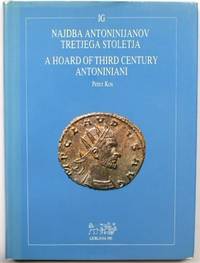
1991538277Ljubljana: Narodni Muzej 1991. Hardcover with unclipped dust jacket in very good condition from the collection of Dr Cathy E. King. Jacket spine is sunned and edges are creased and nicked. Board corners and spine ends are bumped and rubbed. Pages and text are clear and unmarked throughout. LW. Hardcover. Very Good/Very Good. Used. Narodni Muzej Hardcover
Hardcover with unclipped dust jacket in very good condition, from the collection of Dr Cathy E. King. Jacket spine is sunned, and edges are creased and nicked. Board corners and spine ends are bumped and rubbed. Pages and text are clear and unmarked throughout. LW Used
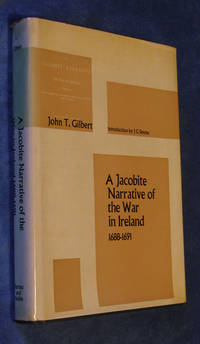
1971000876New York: Barnes & Noble 1971. Hardcover. Near Fine/very good . 4to 7.5 x 10 xii xviii 10 328 pages. Introduction by J. G. Sims Minor fading and chipping of dust jacket; else as issued. Barnes & Noble hardcover
Original Publisher's Cloth. 4to. Xxii, xvi, 32 plates. Illus. 31 cm. In English and Yidddish. Added title page and text in Yiddish: "A Yidish shtetl in holz skupltur. " Artist preserves the mode of life & types of the Jewish towns in Eastern Europe that were obliterated in the Holocaust. Includes loose program from exhibit. Minimal staining. Slight toning. Very good condition +. (SPEC-23-13B)
8vo., First English Edition, with an engraved plate (moderately spotted), 2 engraved plans on one plate, and two engraved facsimiles on one plate, rear free endpaper and one rear blank preliminary lightly spotted; attractively bound in nineteenth century half calf, marbled boards, back gilt extra with five raised bands, second compartment with red leather label lettered in gilt, all other compartments ruled and elaborately tooled in gilt to a floral design, all edges marbled, marbled endpapers, corners lightly bruised else a remarkably bright, crisp, clean copy in elegant binding. With the 16pp list of subscribers, which includes virtually every member of the Royal family extended to Prince William of Gloucester. This is the early issue with 'Bookselllers' in the publisher's imprint (see ESTCT110766). The plates depict the Temple tower, plans of the second and third floors and two facsimiles of Marie Antoinette's handwriting. Clery's family had been in the service of the French Royal Family since the time of Louis XIV. Together with his brother, he began his career with the Princesse de Guenenee, governess to the royal children, and became valet-de-chambre to the Duke of Normandy (later the Dauphin) in 1785. From 1789, he acted as valet to King Louis XVI and was permitted by Petion to continue to wait on the Royal Family during their imprisonment in the Temple. After the King's execution, Clery accompanied the Madame Royale (Marie-Therese de Bourbon) on her exile to Vienna where he continued to serve until his death. LOVELY COPY OF A KEY DOCUMENTARY RECORD IN THE HISTORY OF FRANCE, THE REVOLUTION AND THE TERROR, AND THE SINGLE MOST IMPORTANT CONTEMPORARY ACCOUNT OF THE IMPRISONMENT OF LOUIS XVI.
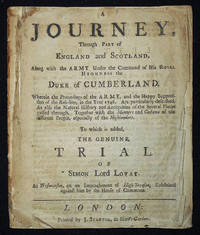
1746010356London: J. Stanton 1746. Good. Wherein the Proceedings of the Army and the Happy Suppression of the Rebellion in the Year 1746. Are particularly described. As also the Natural History and Antiquities of the Several Places passed through. Together with the Manners and Customs of the different People especially of the Highlanders. To which is added the Genuine Trial of Simon Lord Lovat. At Westminster on an Impeachment of High-Treason Exhibited against him by the House of Commons." 104 p.; 20 cm. Disbound. Lacking the 40-page supplement with the trial of Simon Lord Lovat. Composed of 9 letters by an anonymous soldier dated from 27 Nov. 1745 through 4 Oct. 1746 reporting on travel through England and Scotland during the suppression of the Jacobite rising of 1745 which culminated in the Battle of Culloden. No date of publication. Very scarce. In Good Condition: title page is browned lightly soiled and detached with minor loss along edges; small archival repair on p. 2 lower corner; old repair along upper gutter on p. 2; closed cut near upper gutter on several subsequent leaves; corners are creased; small stain at lower edge of pages 31-74; otherwise clean and solid. J. Stanton unknown
1970017179New York. Printed in Great Britain: Praeger Publisheers 1970. VERY HEAVY. Introduced by Ian Robertson. Vol I: viii 424pp iii index. portrait frontis; Vol II: 419pp iv. Cloth boards in dust-jacket. In the Series 'Travellers' Classics' editor James Morris. This reissue is from the 1770 edition. This was one of the first English narratives of travel in the Iberian peninsula during the 18th century. Travellers' Classics. Hard Cover. Very Good/Very Good. 4to. Praeger Publisheers Hardcover
1858300221ABLondon, Bentley, 1858. VIII, 311pp. Contemp. half calf with marbled endpapers and edges.
XI, 267 S., 2 gefalt. Tabellen. Mit gestoch. Frontispiz und 2 Tafeln. Leinwand d. Zt. mit geprägtem Deckel und Rückentitel. Berieben, Rücken leicht beschädigt. *With 3 lithogr. plates. Spnie with small defects. In all still a good copy. Bücher de
8vo. 22 pages, plus a large folding colour map for illustration. Missing the original spine. Bound with new black spine, otherwise in original condition with blue wrappers, titles to front, and containing all the ads. This is a complete issue, seldom found in such good and original condition. Not to be deceived by such a modest title, Austin's is a most vivid description of a deadly 2,400 mile journey through British Sudan to Kenya, encountering numerous hostile tribes. He recounts repeated instances, in the environs of Lake Rudolf, of expedition members being hunted and speared to death by indigenous tribesmen, of bold night attacks by warriors, and brutal devious killings of travelers wandering from camp. His expedition journal begins to resemble a diary of deaths. The survey party traversed swampy regions of the Nile through Sudan, to reach the magnificent highlands of British East Africa. The perilous overland journey endured not only shortage of food, illness, and dangerous encounters, but a most dramatic loss of 75 per cent of the party of sixty-two, at the hands of previously friendly tribes!
Title: A Journey in Aïr. Author: Francis Rodd Publisher: London: Edward Stanford, Royal Geographical Society, 1923. Pre-Dates Book! Item is in Original Condition, with Blue Wrappers - As Issued, Complete with All the Ads! Notes & Condition: Visiting the geographically breathtaking and ecological diverse Aïr Massif within the Sahara Desert, only five years after the devastation of French-Tuareg battle which annihilated numerous villages, Rodd provides an enlightening first-hand account of the Tuareg people groups, including the dominant Kel Owey. With the Cortier map in hand (the first map made of the Aïr, in 1912), and at times accompanied by a local guide, Rodd navigates through the vast mountain corridors and plains. He comes to previously thriving towns which had since been reduced to struggling villages, and also to newly emerging settlements. In the latter he learns a great deal about Tuareg custom including courting and marriage, child rearing, raiding practices, ongoing slavery, food preparation, construction of grass huts and stone houses, hunting which led to the extinction of the lion of Aïr, and more. A fascinating history of their origin also unfolds as he travels. Rodd's is a primary source account of previously unexplored places in Aïr, featuring an excellent and detailed account of the oasis village of Aouderas and some inhabitants whom he came to know well during his stay over the entire rainy season. References are made to Heinrich Barth, who had travelled through Northern Aïr in 1850, as Rodd follows Barth's route for part of his expedition. A lovely colour map illustrates his own route through mountains, plateaus, valleys and deserts, a most exciting journey. Rodd published the full account of this expedition in 1926, his book title being foreshadowed to in this paper, "People of the Veil: Being an Account of the Habits, Organisation and History of the Wandering Tuareg Tribes which Inhabit the Mountains of Aïr or Asben in the Central Sahara." 8vo. 22 pages, plus a fold-out colour map and photographic plate for illustration. Original condition with blue wrappers, titles to front, and containing all the ads. This is a complete issue, seldom found in such good and original condition. Excerpt from the text: "Aïr, apart from the fact that it is a comparatively unknown country, especially in England, is of particular interest to the traveller for two reasons. In the first place, it is a volcanic area of considerable extent in the Central Sahara, inhabited by an exceedingly interesting people, the Tuareg, or the people of the Veil; and in the second it occupies a prominent position on one of the oldest trade and cultural roads in the world...." "Between Kano and the south of Aïr we followed much the same road as Barth in 1850-1, but in the opposite direction... The country has been much deserted since the days when it was known as the "Granary of Aïr, subject to the Tuareg of the mountains, whose sultans ruled in Gamram, Jajiduna, Tademari, and Demmili, towns now either totally abandoned or reduced to small villages..." "T'in Wana and Eghalguen are two of a number of watering-points in this massif. The former is a ravine... arched sides carved with T'ifinagh inscriptions, the peculiar writing of the Tuareg, the use of which is almost extinct in Aïr." "The Tuareg in North Africa are divided into various groups... But they have no name for the totality of their people other than Kel Tagilmus, the People of the Veil." "... the Tuareg fall into very distinct categories of noble tribes, called Imajeghan, and seville tribes called Imghad, in addition, of course, to the slaves which they still possess, though the practice is forbidden; that is to say, there is no traffic in human beings, but master and slave continue to regard each other by mutual consent in the light of their original relationships." "Like most nomads, they are thieves and raiders by choice... they are poor... as tough as any race there is in the world. They can travel 120 miles twenty-four hours on one camel, and suffer the extremes of heat and cold alike... They never lose their temper..." "A Tuareg woman enjoys great freedom before her marriage, and has love affairs of a most romantic description. A man and girl will ride long distances to meet one another, and at no time are they subjected to censure or surveillance... children are admirably brought up..." "Auderas [Aouderas], especially famous for the magnificent grove of date palms, and the little village of Towar...Barth here records seeing a plough yoked to two slaves being used. The plough is not known in Aïr now." "The Kel T'intaghoda were Holy men, but that did not prevent them about the massacre of Barth's expedition on three occasions, when he camped here here..." End Excerpt. Major General Francis James Rennell Rodd, 2nd Baron Rennell KBE CB JP (1895-1978) was the second but eldest surviving son of the diplomat James Rennell Rodd, 1st Baron Rennell. Fluent in no less than four languages, during the First World War he was an intelligence officer in France, Italy, North Africa, Egypt, Libya, Palestine and Syria. He then made two great expeditions into the central Sahara (1922 and 1927). The Aïr Mountains or Aïr Massif (Tuareg: Ayar; Hausa: Eastern Azbin, Western Abzin) is a triangular massif, located in northern Niger, within the Sahara Desert. The town of Agadez in the heart of the Tuareg country is the capital of Aïr. Much of the Tuareg population of Aïr until recently led a nomadic life, relying essentially on camel and goats from which they take milk, meat and skins used in the production of local handicrafts. Most sedentary populations were either dependents of higher caste Tuareg pastoralists or the Ikelan (Bouzou in Hausa / Bella in Songhai), former slaves and captives of the Tuareg from Hausa and other southern peoples. These peoples were settled in northern oases, to tend the date palm plantations held by the noble clans. In 1591 came under rule of the traditional polity of the Tuareg Sultanate of Aïr, and remained so until it was conquered by the French in 1900. The emergence of the French weakened the Tuareg Kels and provoked both infighting and resistance to colonialism. From the 1880s, Toubu raids increased. During an uprising against the French in December 1916, led by Tuareg chief Ag Mohammed Wau Teguidda Kaocen on his way to the siege of Agadez, many towns were destroyed. When the French retook Agadez in December 1917 a brutal punitive expedition through the Aïr left many formerly populous places abandoned, razed by Kaosen and the French successively.