V M MENCHIKOV ] Fighting PencilMareMagnum

8 176 résultats
Leningrad, 1974. Affiche couleurs au format 56 * 42 cm et provenant de l'album "L'éducation" du groupe Fighting Pencil (Beovoy Karendash) de Leningrad. Petite déchirure sans manque au bas. C'est au cours de Décembre 1939 ques des artistes de leningrad décident de créer le groupe Fighting pencil et produisent des affiches de propagande ou des affiches de caricature. Ses membres fondateurs étaient les artistes graphiques Ivan Astapov, Orest Vireysky, Valentin Kirdov, Vladimir Galba, Nikolai Muratov et Boris Semionov. La première affiche collective a été publié sur le sujet de la Guerre d' Hiver contre la Finlande," arbre de Noël..." et entièrement peinte à la main. La première période de la "Bataille des Crayon" a pris fin avec la fin de la guerre avec la Finlande au printemps de 1940. En Octobre 1943, la première exposition du groupe Fighting Pencil s'ouvre à Moscou, à la Bibliothèque Lénine. Elle gagne l'attention du public, à la fois à Moscou et à Kouibychev ou l'exposition a été transporté. Après un arrêt de quelques années, le groupe reprend ses activités en 1956. Il produit à cette période, des affiches de satires sociales et politiques sur la vie interne en URSS et contre "l'impérialisme mondial", pour mener à bien la propagande politique visant à augmenter les taux de production et de la discipline du travail; à populariser le sport, l'hygiène et les règles de circulation; et la satire de la vie privée. L'association a continué à travailler jusqu'au début des années 1990, rejointe par des artistes tels que MS Belomlinsky, VA Galba, JV Efimovsky, VA Zavyalov, GV Kovenchuk, YP Lobachev et YV Trunev... D'autres affiches sont disponibles, envoi de photos sur demande.
1874RO40243625Librairie du Luxembourg, Paris. 1874. In-8. Broché. Etat d'usage, Couv. légèrement passée, Dos abîmé, Non coupé. 523 pages pour le tome I et 499 pages pour le tome II. Dos fendus, avec de petits manques. Plats partiellement jaunis. Quelques rousseurs.. . . . Classification Dewey : 947-Europe de l'Est, URSS
Librairie du Luxembourg, Paris. 1874. In-8 Carré. Broché. Etat d'usage. Couv. légèrement passée. Dos abîmé. Non coupé. 523 pages pour le tome I et 499 pages pour le tome II. Dos fendus, avec de petits manques. Plats partiellement jaunis. Quelques rousseurs. (Très rare) Luttes des Peuples léchites contre les Peuples finnois et touranes. Les Princes de Kiow. La Ruthénie. République de Pologne...
1807ROD0138407BERTRAND-POTTIER. 1807. In-8. Broché. Etat d'usage, Coins frottés, Dos abîmé, Intérieur frais. 268 pages -plats jaspés - mors fendus - coins emoussés - coiffes abimées - une étiquette collée au dos - annotations à l'encre sur la page de titre - 2 PHOTOS DISPONIBLES.. . . . Classification Dewey : 947-Europe de l'Est, URSS
1928R240094326ERNEST LEROUX. 1928. In-Folio. Relié. Bon état, Couv. convenable, Dos satisfaisant, Intérieur frais. VIII + 45 pages + 107 planches en phototypie - titre + auteur + filets dorés sur pièce de titre marron - couverture conservée - contre plats jaspés - 4 photos disponibles .. . . . Classification Dewey : 947-Europe de l'Est, URSS
RO80101787A LA LIBRAIRIE ILLUSTREE. Non daté. In-12. Relié demi-cuir. Etat d'usage, Couv. légèrement passée, Dos fané, Intérieur acceptable. 294 pages. Quelques illustrations en hors-texte, tête-de-chapitre et en culs-de-lampe. 1ère de couverture brochée, conservée. Etiquette de code sur la coiffe en-tête et tampons de bibliothèque sur la page de titre et dans quelques marges.. . . . Classification Dewey : 947-Europe de l'Est, URSS
1812R300323912Fournier/Ferra. 1812. In-8. Broché. Etat d'usage, Plats abîmés, Dos abîmé, Papier jauni. XXXII + 317 + 382 + 395 + 475 + 466 + 453 + 468 pages. Plats d'attente. Plats abîmés, pliés, déchirés. Dos pliés, mors fendus en coiffes. Renfort collé sur certains dos. Mouillures et rousseurs importantes dans certains volumes.. . . . Classification Dewey : 947-Europe de l'Est, URSS
RO80275593"Bureau de presse de l'exposition internationale ""le bolchevisme contre l'Europe"". non daté. In-8. Broché. Etat d'usage, Couv. défraîchie, Agrafes rouillées, Papier jauni. 31 pages agrafées - rousseurs sur les plats.. . . . Classification Dewey : 947-Europe de l'Est, URSS"
1937120207Moskau, Staatlicher Kunstverlag, 1937. (18) S., mit zahlreichen, teils ganzseitigen Abbildungen nach Fotografien. Original kartoniert, 2°. Die Nummer behandelt die Goldgewinnung in der Sowjetunion. Die Gestaltung dieser Nummer durch Aleksandr Rodtschenko und seine Frau Barbara Stepanowa. Die Monatsschrift «USSR im Bau» erschien von 1930 bis 1941 und noch einmal 1949, danach unter dem Titel «Sowjetunion». Zum Redaktionskollegium der von Maxim Gorkij gegründeten Zeitschrift gehörten unter anderen Georgij Pjatakov und Michail Kol?cov, einzelne Nummern erschienen unter der Leitung von Aleksandr Rod?enko oder El? Lisickij. Viele Nummern wurden von Nikolaj Stepanovi? Tro?in gestaltet. Hauptsächliches Gestaltungsmerkmal war die Fotomontage, mit Beiträgen von Fotografen wie Maks Al?pert, einem der Begründer der Fotoreportage, Arkadij ?ajchet und anderen. Jedes Heft war einem bestimmten Thema gewidmet. Softcover Rücken beschädigt. UdSSR im Bau, 5, 1937, Das Zwanzigste Jahr der Revolution
1936121016Moscou, Isogis, 1936. (20) Bll., mit zahlreichen, teils ganzseitigen Abbildungen nach Fotografien von Max Vladimirovic Alpert, einem der Begründer der sowjetischen Reportagefotografie. Or.kt., 2°. Das Heft behandelt die Fabrikation von Eisenbahnwagen im Ural. Gestaltung des Heftes Nikolaj Stepanovic Trosin (Trochine). Die Monatsschrift «URSS en construction» erschien von 1930 bis 1941 und noch einmal 1949, in vier Sprachen (deutsch, französisch, englisch, spanisch). Zum Redaktionskollegium der von Maxim Gorkij gegründeten Zeitschrift gehörten unter anderen Georgij Pjatakov und Michail Kol?cov, einzelne Nummern erschienen unter der Leitung von Aleksandr Rod?enko oder El? Lisickij. Viele Nummern wurden von Nikolaj Stepanovi? Tro?in gestaltet. Hauptsächliches Gestaltungsmerkmal war die Fotomontage, mit Beiträgen von Fotografen wie Maks Al?pert, einem der Begründer der Fotoreportage, Arkadij ?ajchet und anderen. Jedes Heft war einem bestimmten Thema gewidmet. Softcover Umschlag etwas angestaubt und gebrauchsspurig. URSS en construction; [UdSSR im Bau], 1935, No. 7
1930120215Moscou, Edition d'état de la RSFSR, 1930. 47, (1) S., mit zahlreichen, teils doppelseitigen Abbildungen nach Fotografien. Original-Broschur, 2°. Sonderheft mit einer 31seitigen Reportage über den Bau des Kraftwerks Dnieprostroi und einer 16seitigen Reportage über den Bau der "Turksib", der Eisenbahnlinie von Turkestan nach Sibieren (Frunse-Semipalatinsk). Gestaltung des Hefts Nikolaj Troschin (Trochine. Die Monatsschrift «USSR im Bau» = «URSS en construction» erschien in vier Sprachen (deutsch, französisch, englisch, spanisch) von 1930 bis 1941 und noch einmal 1949. Zum Redaktionskollegium der von Maxim Gorkij gegründeten Zeitschrift gehörten unter anderen Georgij Pjatakov und Michail Kol?cov, einzelne Nummern erschienen unter der Leitung von Aleksandr Rod?enko oder El? Lisickij. Viele Nummern wurden von Nikolaj Stepanovi? Tro?in gestaltet. Hauptsächliches Gestaltungsmerkmal war die Fotomontage, mit Beiträgen von Fotografen wie Maks Al?pert, einem der Begründer der Fotoreportage, Arkadij ?ajchet und anderen. Jedes Heft war einem bestimmten Thema gewidmet. Softcover Rücken mit Fehlstellen. Umschlag angestaubt und mit Randeinrissen. URSS en construction, 1930, No. 4
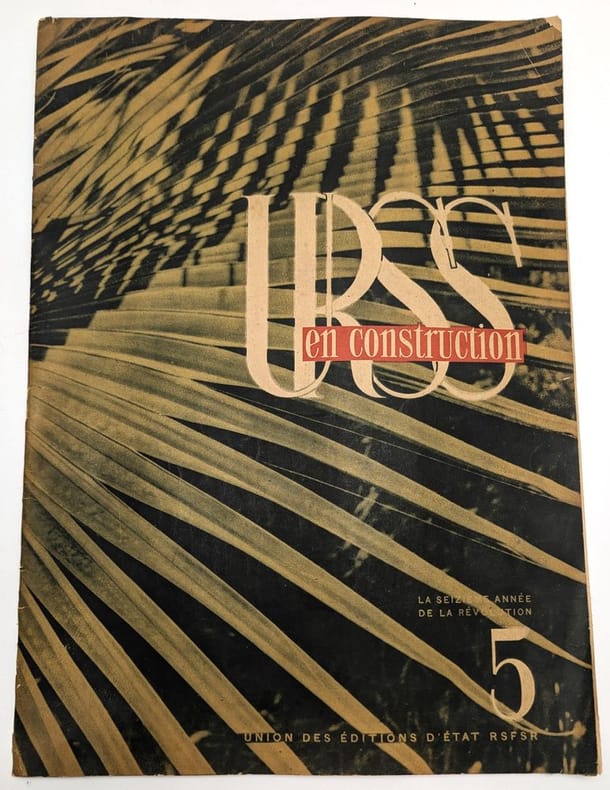
97848Moscou, Union des éditions d'état RSFSR, mai 1933, in-folio, [19] ff, Broché, couverture originale illustrée, Numéro 5 de la revue de propagande fondée en 1930 par Maxime Gorki. Il en sera d'ailleurs le principal rédacteur. Abondamment illustrée de reproductions photographiques à la gloire du réalisme soviétique de l'ère stalinienne, mais aussi très intéressant témoignage de l'art graphique constructiviste. Ce numéro est consacré à l'agriculture. Petites déchirures marginales. Couverture rigide
VOLUME TWO ONLY. RARE LIMITED EDITION of the memorial book dedicated to the Jews of the Bukovina district in southeastern Europe. The book uses authoritative sources to create a clear historical account of the Jewish community in Bukovina from the earliest records of its existence to the destruction during the Holocaust. Contains numerous b&w photographs and illustrations. 330x250mm. VIII+228 pages. Red leather Hardcover with dust-jacket. Gilt lettering on front cover and spine. Jacket yellowing, dirty, wrinkled and slightly age-stained. Jacket edges and corners worn/tattered. Front cover bottom edge peeling. Spine edges bumped. [SUMMARY]: Save for some external wear (mostly to jacket), this extremely rare volume is in good condition. PLEASE NOTE: This item is overweight. We may ask for extra shipping costs.
1968009699Leningrad: Hydrographic Directorate of the Ministry of Defence of the USSR 1968 4to 26 cm 440 pp with a loosely inserted pamphlet of corrections 14 pp. Publisher's cloth with gilt lettering and Soviet naval anchor-and-star emblem to upper cover binding slightly rubbed and dusted paper somewhat toned library stamps on the title. Publication No. 1244 copy No. 1433. Comprising a general survey navigational-geographical and hydrometeorological overviews and detailed coastal navigation in nine chapters covering the entire Black Sea littoral from the Kiliya mouth of the Danube to Cape Kaliakra; with a reference section including port and anchorage data distance tables and territorial waters information plus alphabetical index and correction notes. Stamped throughout “ДЛЯ СЛУЖЕБНОГО ПОЛЬЗОВАНИЯ” For Official Use Only with library stamp of the Technical Library of TsKB “Chernomorsudoproekt” Central Design Bureau for Black Sea Shipbuilding to the title page. Accompanied by the separately issued Сводная Корректура 1969 г. Consolidated Correction Supplement for 1969 copy No. 1535 a printed pamphlet with manuscript annotations in red ink updating the main volume in accordance with Notices to Mariners through September 1969. A complete and rare Soviet navigational publication for the Black Sea of considerable historical interest due to its restricted official-use classification and direct institutional provenance from a major Soviet shipbuilding design bureau. Hydrographic Directorate of the Ministry of Defence of the USSR hardcover
1st Edition. Original Illustrated 11 1/2 X 15 Inch Poster. Original Tongue-in-Cheek Fundraising Poster from the UJA's landmark "Operation Exodus" campaign to resettle Soviet Jews in Israel and America in the wake of rising Anti-Semitism in the USSR. "Their contribution to a strong, stable, culturally rich homeland is something in which we should all feel compelled to invest. " Very good condition. (AMR-52-29)
c2434Profizdat Publishers All-Union Central Council of Trade Unions Moscow 1982. Cream cloth large photographs text in English Russian Spanish German and French 222pp. A good copy. Jacket - small piece missing top rear panel edge tears. A signed presentation copy from two delegates of the trade unions of the USSR to the Australian Council of Trade Unions ACTU Melbourne ACTU Congress 10/08/83. hardcover
197812442Tbilisi USSR: Meisniereba Publishing House 1978. First Edition. Hardcover. Good/Good minus. Volumes I & II only. Good in good dust jackets worn and creased at edges. Shown without dj in photo. Large quarto 766 and 686 pages. Listed in "Essential Sources on the Nature of Consciousness" which notes: "The Russians have sponsored an internationalconference on unconscious processes; three volumes ofthe proceedings of this conference have been publishedcontaining articles by Russian American French German and other investigators". A Collective Monograph in Four Volumes on the Nature of the Unconscious with forewords preface introductory articles to all the sections of the monograph notes and conclusions. Volumes I & II ONLY. Meisniereba Publishing House hardcover
195925043Moscow U.S.S.R.: MVD Ministry of Internal Affairs USSR 1959. viii 191 pages; useful index. Very well-printed lithographed color maps and charts. With geographic maps maps and charts of the solar system physical features climate world and country-by-country maps; more than half of the atlas concerns the then-U.S.S.R; text entirely in Cyrillic. Laid-in is an article from the NY Times Jan. 28 1973: 'Chinese Names for Towns in Siberia are Eliminated.' The volume approx. 10 3/4" x 15" size; bound in red cloth gilt cover and spine titles dulled; some edge tips wear and rubbing to the boards; contents clean maps' coloring bright and in very good condition. . First Edition. Hard Cover. Very Good. MVD (Ministry of Internal Affairs USSR) hardcover books
Very Good Armenian Original half bound leather bdg. Large demy8vo. (22 x 15,5 cm). In Armenian. 675 p. Prior to Soviet rule, the Dashnaksutiun had governed the First Republic of Armenia. The Socialist Soviet Republic of Armenia was founded in 1920. Diaspora Armenians were divided about this: supporters of the nationalist Dashnaksutiun did not support the Soviet state, while supporters of the Armenian General Benevolent Union (AGBU) were more positive about the newly founded Soviet state. From 1828 with the Treaty of Turkmenchay to the October Revolution in 1917, Eastern Armenia had been part of the Russian Empire and partly confined to the borders of the Erivan Governorate. After the October Revolution, Bolshevik leader Vladimir Lenin's government announced that minorities in the empire could pursue a course of self-determination. Following the collapse of the empire, in May 1918 Armenia, and its neighbors Azerbaijan and Georgia, declared their independence from Russian rule and each established their respective republics. After the near-annihilation of the Armenians during the Armenian Genocide and the subsequent Turkish-Armenian War, the historic Armenian area in the Ottoman Empire was overrun with despair and devastation. A number of Armenians joined the advancing 11th Soviet Red Army. Afterward, Turkey and the newly proclaimed Soviet republics in the Caucasus negotiated the Treaty of Kars, in which Turkey resigned from its claims to Batumi to Georgia in exchange for the Kars territory, corresponding to the modern-day Turkish provinces of Kars, Igdir, and Ardahan. The medieval Armenian capital of Ani, as well as the cultural icon of the Armenian people Mount Ararat, were located in the ceded area. Additionally, Joseph Stalin, then acting Commissar for Nationalities, granted the areas of Nakhchivan and Nagorno-Karabakh (both of which were promised to Armenia by the Bolsheviks in 1920) to Azerbaijan. From 12 March 1922 to 5 December 1936, Armenia was a part of the Transcaucasian SFSR (TSFSR) together with the Georgian SSR and the Azerbaijan SSR. The policies of the first Soviet Armenian government, the Revolutionary Committee (Revkom), headed by young, inexperienced, and militant communists such as Sarkis Kasyan and Avis Nurijanyan, were implemented in a highhanded manner and did not take into consideration the poor conditions of the republic and the general weariness of the people after years of conflict and civil strife. Such was the degree and scale of the requisitioning and terror imposed by the local Cheka that in February 1921 the Armenians, led by former leaders of the republic, rose up in revolt and briefly unseated the communists in Yerevan. The Red Army, which was campaigning in Georgia at the time, returned to suppress the revolt and drove its leaders out of Armenia. Convinced that these heavy-handed tactics were the source of the alienation of the native population to Soviet rule, in 1921 Moscow appointed an experienced administrator, Alexander Miasnikian, to carry out a more moderate policy and one better attuned to Armenian sensibilities. With the introduction of the New Economic Policy (NEP), Armenians began to enjoy a period of relative stability. Life under the Soviet rule proved to be a soothing balm in contrast to the turbulent final years of the Ottoman Empire. The Armenians received medicine, food, as well as other provisions from the central government and extensive literacy reforms were carried [.] Only one copy is located in OCLC: 782028953 (National Library of Israel - Jewish National Library).
Very Good Russian Paperback. Demy 8vo. (22 x 15,5 cm). In Russian. 160 p., unnumbered b/w plates. Slightly chipped on extremities of wrappers. Faded gilded ills. on cover. Several small stains interior, on several pages. Interesting ex-library trace of a Russian bookseller in Contantinople (G. L. Pakhalova) on colophon with an ownership inscription in 1924. Otherwise a very good copy. Helmuth Maximilian Böttcher was the son of the writer Maximilian Böttcher. After attending the Königsstädtischer Realgymnasium in Berlin, Helmuth Maxmilian Böttcher studied law, economics and natural sciences at the universities in Berlin and Greifswald. He worked in the Prussian War Ministry during the WW1. Böttcher married a daughter of the industrialist Paul Reuss, founder of the Kyffhäuserhütte Artern and the Hörselwerke in Eisenach, with whom he had two daughters and a son. From 1924 to 1938 Böttcher was managing director of Hörselwerke, a company in Eisenach that specializes in the production of folding rules. After the Second World War Böttcher lived in the GDR, where his literary works were published at that time, but also had a residence in the Federal Republic. Towards the end of the 1950s he went to West Germany, where he lived in Sprendlingen in Hesse. Helmuth Maximilian Böttcher was the author of novels, short stories, plays and radio plays. Since the 1960s he has mainly published non-fiction books on cultural history and medical topics. (Wikipedia). Russian Edition was published in the same year, 1923 in Berlin. Only one institutional copy located in New York Public Library System NYPL according to OCLC: 70056062.
New New English Original bdg. Dust wrapper. In publisher's special slip-case. Roy. 8vo. (23 x 16 cm). In Turkish. Color and b/w ills., maps and tables. 4 volumes set: ([xx], 686 p.; [xx], 504 p.; [xi], 872 p.; [xxxiv], 302 p.). A very heavy set. Avrasya'da Yeniden Çizilen Sinirlar, Insa Edilen Kimlikler Projesi. 4 volumes set: Vol. I: Bagimsizliklarinin Yirminci yilinda Orta Asya Cumhuriyetleri. Türk dilli halklar - Türkiye ile iliskiler. Vol. II: Bagimsizliklarinin Yirminci yilinda Azerbaycan, Gürcistan ve Ukrayna. Türk dilli halklar - Türkiye ile iliskiler. Vol. III: Sovyetler Birligi'nin dagilmasindan Yirmi yil sonra Rusya Federasyonu. Türk dilli halklar - Türkiye ile iliskiler. Vol. IV: Sovyet sonrasi dönemde Türk dilli halklar, dil sorunu, yeniden biçimlenen kimlikler. [Ataturk Turkish Turkey Türkei Turquie Turchia Turquía Kalkun Turkish Türkisch Turc Turque Turco Tyrkisk of the Turkish language Linguistics Linguistic study Studies Work SSCB USSR The Russian Federation Central Asia Asian culture Foreign affairs Diplomacy Diplomats Diplomat International relations Azerbaijan Georgia Georgian Azerbaijani Ukraine Ukrainian History Social Historical Politics Politica Political Policy Caucasia Kaukasus Caucase Turcology Turcologie Turkic Turkica Turcica Turk Turks Crimea Crimean Kirim].
Saint Petersburg. 4to. 16 pages. In Russian. An official publication of bread and pastry bakers' trade union. Edited by K. N. Gorin, M. A. Novikov. Published with irregular frequency from 19101912. Includes: materials on internal workings of the union and its financial audit (Nr 9) , materials on internal workings of the union, report on the Second international congress of bread and pastry bakers, classifieds and works of fiction and poetry by obscure Russian authors (Nr 2 (13) ) . OCLC lists 2 copies worldwide (International Labour Offices in Washington, DC and in Switzerland) . Nr 9: fragile newsprint paper, otherwise in excellent unused condition (RUS-7-352) ; Nr 2(13) : Fragile newsprint paper, otherwise in excellent unused condition (RUS-7-351).
Original illustrated paper covers with constructivist font, 8vo, 66 pages. Includes text illustrations as well. In Yiddish. Young adult book. Title translates as In search of Food. OCLC lists only 2 copies worldwide (Columbia & Wayne State) . Cover stain and tears along spine; inside 1/2 inch of first and last leaves are stuck to covers at the gutter margin (from glue from later outer binding which is no longer present) . Attractive, rare Kultur-Lige imprint. (Yid-26-11)
1944012198Toulouse Comité National des Ecrivains. Centre des Intellectuels 1944 8 plaquettes in-16 Agrafé Edition originale