B Sergei IVANOV ] Fighting PencilLivre Rare Book

8 176 résultats
1974126399Leningrad, 1974. Affiche couleurs Leningrad, 1974. Affiche couleurs au format 42 * 56 cm et provenant de l'album "L'éducation" du groupe Fighting Pencil (Beovoy Karendash) de Leningrad. Petite manque en bord et à l'angle droit inférieur. C'est au cours de Décembre 1939 ques des artistes de leningrad décident de créer le groupe Fighting pencil et produisent des affiches de propagande ou des affiches de caricature. Ses membres fondateurs étaient les artistes graphiques Ivan Astapov, Orest Vireysky, Valentin Kirdov, Vladimir Galba, Nikolai Muratov et Boris Semionov. La première affiche collective a été publié sur le sujet de la Guerre d' Hiver contre la Finlande," arbre de Noël..." et entièrrment peinte à la main. La première période de la "Bataille des Crayon" a pris fin avec la fin de la guerre avec la Finlande au printemps de 1940. En Octobre 1943, la première exposition du groupe Fighting Pencil s'ouvre à Moscou, à la Bibliothèque Lénine. Elle gagne l'attention du public, à la fois à Moscou et à Kouibychev ou l'exposition a été transporté. Après un arrêt de quelques années, le groupe reprend ses activités en 1956. Il produit à cette période, des affiches de satires sociales et politiques sur la vie interne en URSS et contre "l'impérialisme mondial", pour mener à bien la propagande politique visant à augmenter les taux de production et de la discipline du travail; à populariser le sport, l'hygiène et les règles de circulation; et la satire de la vie privée. L'association a continué à travailler jusqu'au début des années 1990, rejointe par des artistes tels que MS Belomlinsky, VA Galba, JV Efimovsky, VA Zavyalov, GV Kovenchuk, YP Lobachev et YV Trunev... D'autres affiches sont disponibles, envoi de photos sur demande.
Leningrad, 1974. Affiche couleurs au format 42 * 56 cm et provenant de l'album "L'éducation" du groupe Fighting Pencil (Beovoy Karendash) de Leningrad. Petite manque en bord et à l'angle droit inférieur. C'est au cours de Décembre 1939 ques des artistes de leningrad décident de créer le groupe Fighting pencil et produisent des affiches de propagande ou des affiches de caricature. Ses membres fondateurs étaient les artistes graphiques Ivan Astapov, Orest Vireysky, Valentin Kirdov, Vladimir Galba, Nikolai Muratov et Boris Semionov. La première affiche collective a été publié sur le sujet de la Guerre d' Hiver contre la Finlande," arbre de Noël..." et entièrrment peinte à la main. La première période de la "Bataille des Crayon" a pris fin avec la fin de la guerre avec la Finlande au printemps de 1940. En Octobre 1943, la première exposition du groupe Fighting Pencil s'ouvre à Moscou, à la Bibliothèque Lénine. Elle gagne l'attention du public, à la fois à Moscou et à Kouibychev ou l'exposition a été transporté. Après un arrêt de quelques années, le groupe reprend ses activités en 1956. Il produit à cette période, des affiches de satires sociales et politiques sur la vie interne en URSS et contre "l'impérialisme mondial", pour mener à bien la propagande politique visant à augmenter les taux de production et de la discipline du travail; à populariser le sport, l'hygiène et les règles de circulation; et la satire de la vie privée. L'association a continué à travailler jusqu'au début des années 1990, rejointe par des artistes tels que MS Belomlinsky, VA Galba, JV Efimovsky, VA Zavyalov, GV Kovenchuk, YP Lobachev et YV Trunev... D'autres affiches sont disponibles, envoi de photos sur demande.
L10778Gallimard, 1936. In-12 br. E.O. ex. num. sur vélin pur fil (seul grand papier), n.c.
1st edition. Original boards. 8vo. 89, 111 pages, 23 cm. In Yiddish. Title translates to "Literature-Lore. " Two parts: Ershter teyl: Elementn fun ritm un stil -- Tsveyter tley: Geboy fun Kinstlerishn verk un literarishe zshanren. Hofstein (1889-1952) was a prominent Russian-Yiddish poet. He rose to prominence through his elegies of the Jewish communities that suffered during the White pogroms of 1922, many of which were illustrated by Marc Chagall. He emigrated to Palestine in 1923 as a result of the official banning of Hebrew and subsequent persecution of Hebrew writers. He ultimately returned in 1939 and joined the Communist Party. Hofstein was executed on the Night of the Murdered Poets in 1952, along with 12 other Yiddish writers and artists (Wikipedia, 2019) . SUBJECTS: Yiddish language -- Rhetoric. Poetics. OCLC lists 16 copies worldwide (OCLC: 19306025) . Spine rebacked. Boards are worn and browning. Contents very good. (YID-33-72-EJLXGG'o)
Covers show edgewear & are tape-repaired at spine. Internally Very Good & Solid. (R-1-1); 8vo; Zheneva [i.e. Geneva], Gruppa "Khlieb i volia," 1904. Paper Wrappers, 12mo, 75 pages. 17 cm. In Russian. This is the first separate appearance of Kropotkin's important essay on the state, and also its first appearance in his native Russian (The essay first appeared as a series of articles entitled "L'Etat: son rôle historique" in Les Temps nouveaux, December 19, 1896- July 3, 1897.) It was later translated and published in English as "The State: Its Historic Role" (London: Freedom Press, 1911). Kropotkin, in exile in Western Europe, "became the best-known propagandist in the international anarchist movement" and "participated in several attempts to direct anarchist propaganda into Russia ..Kropotkin was and remains the most widely read anarchist writer, and his version of anarchist theory was the most influential contribution to the anarchist movement in Russia and elsewhere " (Nicolas Walter in Shukman, 1988, pp. 334-335) OCLC lists 3 copies worldwide (Hoover, U of Kansas, Columbia). This is Alexander Granovsky's copy with his signature & bookplate. Granovsky was a leader of the Ukranian exile community in the US and was the founder, in 1941, of the Ukrainian Scientific Institute, which had a short life but was one of the forerunners of other efforts that followed World War II. He was a also a leader of the Organization for the Rebirth of Ukraine and a world famous entomologist, activist and poet as well. From the English Translation: "First of all, let us be agreed as to what we wish to include in the term the State. There is, of course, the German school which enjoys confusing "State" with "Society". The best German thinkers, and many among the French, are guilty of this confusion because they cannot conceive of society without a concentration of the State; and because of this anarchists are usually accused of wanting to ``destroy society'' and of advocating a return to ``the permanent war of each against all.'' Yet, to argue thus is to overlook altogether the advances made in the domain of history during the last thirty-odd years; it is to overlook the fact that humans lived in Societies for thousands of years before the State had been heard of; it is to forget that so far as Europe is concerned the State is of recent origin---it barely goes back to the sixteenth century; finally, it is to ignore that the most glorious periods in history are those in which civil liberties and communal life had not yet been destroyed by the State, and in which large numbers of people lived in communes and free federations. The State is only one of the forms adopted by society in the course of history. Why then make no distinction between what is permanent and what is accidental? Then again the "State" has also been confused with "Government". Since there can be no State without government, it has been sometimes said that what one must aim at is the absence of government and not the abolition of the State. However, it seems to me that in State and government we have two concepts of a different order. The State idea means something quite different from the idea of government. It not only includes the existence of a power situated above society, but also of a "territorial concentration" as well as the "concentration of many functions of the life of societies in the hands of a few". It carries with it some new relationships between members of society which did not exist before the establishment of the State. A whole mechanism of legislation and of policing has to be developed in order to subject some classes to the domination of others. This distinction, which at first sight might not be obvious, emerges especially when one studies the origins of the State. Indeed, there is only one way of really understanding the State, and that is to study its historic development, and this is what we will try to do." OCLC lists 3 copies worldwide (Hoover, Kansas, & Columbia). (RUS-10-1)
8vo; Paris, Izd. TSentr. kom-ta P.S.-R., 1908. Red Paper Wrappers, 8vo, 241 pages. 23 cm. In Russian. At head of title: Compte-rendu de la 1re conférence du parti Social.-Révol. Russe. SUBJECT(S): Partiia sotsialistov-revoliutsionerov -- Congresses. OCLC lists 17 copies worldwide. Light wear, faded institutional stamp on front cover, brighter stamp on title page (Bund Archives), Very Good Condition. Bright red cover remains sharp, a very nice copy. (mx-30-11)
(FT) Original Newspaper. Folio. Issues are about 8 pages each. 30 consecutive issues present here. In Russian. Subtitle translates to English as, The Organ of the Russian Saint Petersburg and Moscow Committees RSDRP. CONTENTS INCLUDES: Bankrotstvo Konstitutsii I Nashi Put [Bankruptcy of the Constitution and Our Path] -- Revolyutsiya I Yeya Mogil'schiki [Revolution and it's Gravediggers] -- Samoderzhavie v Grazhdanskoy Voine s Narodom [Autocray in a Civil War Against the People] -- Marksizm I Vcemirnoe Dvizhenie Proletariata [Marxism and the Worldwide Movement of the Proletariat] -- Kak Obyvateli Prevraschalis' v Revolyutsionerov [How Ordinary People Became Revolutionaries] -- Ob Obmane Naroda Liberalami [The Deception of the People by Liberals] -- Studencheskoe Dvizhenie I Sovremennoe Politicheskoe Polozhenie [The Student Movement and the Present Political Situation] -- Krakh Bezsmyslennykh Mechtaniy [The Collapse of Senseless Dreams]. Includes supplements for issues: 44, 46, 47-48, and 50. Note that the final pages of Number 45 are mislabeled No. 44 by printer. Pages darkened but not fragile, with edgewear but no loss of text. Good+ condition. (RUS-11-5) xxxxxxxx
1st Yiddish Edition. Original publishers decorated cloth, 12mo, 114 pages ; 18 cm. In Yiddish. The translator, Itzik Feffer (1900 1952) was a Soviet Yiddish poet executed on the Night of the Murdered Poets during Joseph Stalin's purges During the Second World War, he was a military reporter with the rank of colonel and was vice chairman of the Soviet Jewish Anti-Fascist Committee (JAC). He and Solomon Mikhoels traveled to the United States in 1943 in a well-documented fund-raising trip. In 1948, after the assassination of the JAC Chairman Solomon Mikhoels, Feffer, along with other JAC members, was arrested and accused of treason. Feffer had been an informer for the NKVD (predecessor of the KGB) since 1943. FeFfer reportedly cooperated with the investigation, providing false information that would lead to the arrest and indictment of over a hundred people, but at the trial, he made openly nationalistic statements and expressed pride in his Jewish identity. Feffer had also allegedly been one of the most loyal and conformist Yiddish poets, who had helped to enforce strict ideological control over other Yiddish writers, and had a history of denouncing colleagues for their nationalistic hysteria. However, in 1952, Feffer, along with other defendants, was tried at a closed JAC trial, and executed on August 12, 1952, at Lubyanka prison ..The American concert singer and actor Paul Robeson met Feffer on July 8, 1943, in New York during a Jewish Anti-Fascist Committee event chaired by Albert Einstein, one of the largest pro-Soviet rallies ever held in the United States. After the rally, Paul Robeson and his wife Eslanda Robeson, befriended Feffer and Mikhoels. Six years later, in June 1949, during the 150th anniversary celebration of the birth of Alexander Pushkin, Robeson visited the Soviet Union to sing in concert. According to David Horowitz: In America, the question "What happened to Itzik Feffer?" entered the currency of political debate. There was talk in intellectual circles that Jews were being killed in a new Soviet purge and that Feffer was one of them. It was to quell such rumors that Robeson asked to see his old friend, but he was told by Soviet officials that he would have to wait. Eventually, he was informed that the poet was vacationing in the Crimea and would see him as soon as he returned. The reality was that Feffer had already been in prison for a half year, and his Soviet captors did not want to bring him to Robeson immediately because he had become emaciated from lack of food. While Robeson waited in Moscow, Stalin's police brought Feffer out of prison, put him the care of doctors, and began fattening him up for the interview. When he looked sufficiently healthy, he was brought to Moscow. The two men met in a room that was under secret surveillance. Feffer knew he could not speak freely. When Robeson asked how he was, he drew his finger nervously across his throat and motioned with his eyes and lips to his American comrade. They're goin to kill us, he said. When you return to America you must speak out and save us. During his concert in Tchaikovsky Hall on June 14 - which was broadcast across the entire country - Robeson publicly paid tribute to Feffer and the late Mikhoels, singing the Vilna Partisan song Zog Nit Keynmol in both Russian and Yiddish .Feffer was a prolific poet who wrote almost exclusively in Yiddish, and his poems were widely translated into Russian and Ukrainian. He is considered one of the greatest Soviet poets in the Yiddish language and his poems were widely admired inside and outside Russia (Wikipedia, 2019). SUBJECT(S): Yiddish literature -- Translations from Russian. Russian literature. OCLC: 19304065. OCLC lists 15 copies worldwide, but 13 of these are in a listing which indicates Also issued online, so some (or many of these?) may be online access copies. Very Good Condition, a beautiful copy. (yid-41-82A)
L16604Moscou. Éditions " Zvenia ", 2000. Format 31 x 41 cm. reliure à spirale. Publication de l'ONG Mémorial. Texte de Igor Golomshtok en russe et en anglais. 68 dessins des camps russes par Boris Sveshnikov, photos, fac-similés. « Mémorial », est une organisation non gouvernementale russe, fondée en 1989, dissoute en 2021 par décret de la cour suprême russe. E.O.
Advanced Uncorrected Proof. 8vo. 173 pages ; 22 cm. A rare advanced proof of Wiesels 1974 Play, which was performed on Broadway in 1976 and later made into a full-length movie. As a marketing tool, publishers provide free copies of new book titles to booksellers, stores, PR people, journalists and even celebrities.
Pages 949-992. Features: Nice colour ad for Goodyear Eagle tires inside front cover shows eagle in flight holding fish; The Australian Prime Minister in London; Full page photo of the Queen's first official birthday photo; Excellent two-page photo of the finish of the 1952 Derby, won by Tulyar; One-page photo of the first Eucharistic Congress for fourteen years as seminarists enter the Montjuich Stadium in Barcelona; General Sir John Harding; Marie Noele Kelly and her travels in the Soviet Union; Photos of impressive Moscow buildings; Two pages of photos which penetrate the darkness behind the Iron Curtain - unofficial views of Moscow and scenes in the USSR 1949-1951 taken by the wife of the then British Ambassador; Two pages of illustrations of life on the new Amsterdam-Rhine Canal; Article on the intentions of the Soviet Union; Photos of the Signing of the European Defence Community (EDC) Treaty - towards a common European Army - with photos of M. Schuman, Mr. Eden and Dr. Adenauer signing; Centerfold illustration of the Old Court of Corpus Christi College, which celebrates the sixth century of its unique foundation on 12 June; Riots in Johannesburg; Photos of the discovery of a new step pyramid at Sakkara; Photos of personalities of the week, including General Sir Ouvry L. Roberts; Photos of foundation preservation work in the canals of Venice; Nice colour ad inside back cover for Ilford Colour Film 'D" features photos from the 1951 Everest expedition led by Eric Shipton; and more. Moderate wear. Unmarked. A quality vintage copy. Magazine
Pages 365-392. Features: Cover photo of the HMS Duke of York; Series of photos illustrate the "Mouse Trap Mechanics" of atomic science for the man in the street; Review of "Uttermost Part Of The Earth", by E. Lucas Bridges; One-page photo of HRH the Duke of Edinburgh at the tiller of Bluebottle; Photo of Signor Togliatti in Rome; Six photos of the last journey home by Count Folke Bernadotte, the United Nations' mediator in Palestine, who was assassinated in Jerusalem on September 17 - also killed was his French observer, Col. Serot; Review of the late Gen. George S. Patton, Jr's, book "War as I Knew It"; Five photos and text describe Hyderabad at the time of the surrender, and after; Article on the front line airpower of Great Britain today; Three excellent cutaway diagrams of Britain's front-line fighters of today, "Meteor" and "Vampire"; Fascinating centrefold illustrates seven jet aircraft of the USSR - fighters and bombers of the Soviet Air Force; Photo of Major R. Johnson, US Air Force, at Muroc Dry Lake, California, on September 15 after he established a new airspeed record of 670 mph in an F-86 jetfighter; Photo of the new Hillman Minx; Photo of new Standard Vanguard pickup truck; Five photos of hurricane striking Miami, Florida; Photo of Churchill's grandson, Julian Sandys, aboard light rail locomotive; Photo of Vijayalakasmi Pandit, sister of Pandit Nehru, at the United Nations; Photos of the "Parasite Fighter", US XF-85 leaving its parent aircraft and beginning a 20 minute flight; Photos of personalities of the week include Don Bradman, Lord Gowrie, David Woodford, John R. Nixon, G. S. Cansdale, Sir Warren Fisher, George Marshall, racehorse Brown Jack, Dr. Ralph Bunche, Mr. Vyshinsky, and King Frederick of Denmark with the Duke of Gloucester; Magnificent one-page photo of the interior of King's College Chapel, the finest flour of late Gothic architecture; Page of photos at Arnhem and at the Hague; Page of photos of bats in flight, as photographed by themselves. Advertising outer pages not included. Unmarked with average wear. A sound vintage copy. Magazine
1841R300289089Au bureau central. 1839-1841. In-12. Broché. Etat d'usage, Plats abîmés, Dos abîmé, Mouillures. 472 pages - nombreuses gravures en noir et blanc hors texte - une carte en couleurs dépliante en fin d'ouvrage. Texte sur deux colonnes. Traces de mouillures, sans conséquences sur la lecture. Plats abîmés par la mouillure. Mors fendus, dos décollé.. . . . Classification Dewey : 947-Europe de l'Est, URSS
1996R200076202SOCIETE DU BOTTON MONDAIN. VERS 1996. In-8. Relié toilé. Bon état, Couv. convenable, Dos satisfaisant, Intérieur frais. 315 pages. Quelques photos en noir et blanc, dans le texte.. . . . Classification Dewey : 947-Europe de l'Est, URSS
1992R100072944Alain de Gourcuff éditeur. 1992. In-4. Relié. Bon état, Couv. convenable, Dos satisfaisant, Intérieur frais. 4 pages en feuillets + 103 pages + 101 pages + 127 pages + 103 pages - nombreuses illustrations en couleurs et en noir et blanc dans et hors texte - sous emboitage relié toilé rigide gris augmenté d'une illustration en couleur en bon état.. . Sous Emboitage. . Classification Dewey : 947-Europe de l'Est, URSS
R160219954Marc Barbou et cie. non daté. In-4. Cartonnage d'éditeurs. Etat d'usage, Couv. convenable, Dos abîmé, Papier jauni. 320 pages - nombreuses gravures en noir et blanc dans et hors texte - gravure en noir et blanc en frontispice - bandeaux et culs de lampe en noir et blanc - tranches dorées - 1er plat illustré en couleur - accroc sur le dos.. . . . Classification Dewey : 947-Europe de l'Est, URSS
1858RO80105050DUMAINE J.. 1858. In-4. Relié. Etat d'usage, Coins frottés, Dos satisfaisant, Quelques rousseurs. 597 pages. Etiquette de code sur la coiffe en-tête et tampons de bibliothèque sur la page de titre et dans quelques marges.. . . . Classification Dewey : 947-Europe de l'Est, URSS
1854R300324797Paulin et le Chevalier. 1854. In-Folio. Relié toilé. Etat d'usage, 1er plat abîmé, Dos abîmé, Quelques rousseurs. 176 pages - nombreuses illustrations et cartes en noir et blanc dans et hors texte - une carte en couleurs hors texte - texte sur trois colonnes. Tampon en page de titre. Coiffes frottées, accroc sur le dos. Plats passés, 1er plat frotté, toile déchirée.. . . . Classification Dewey : 947-Europe de l'Est, URSS
1916RO80112009PERRIN et Cie. 1916. In-12. Broché. Bon état, Couv. légèrement passée, Dos satisfaisant, Intérieur frais. Ouvrage de bibliothèque : étiquette de code sur la coiffe en-tête et tampons sur la page de titre et dans quelques marges.. . . . Classification Dewey : 947-Europe de l'Est, URSS
1772RO80015395NEUCHATEL. 1772. In-12. Relié plein cuir. Etat d'usage, Couv. légèrement passée, Dos à nerfs, Intérieur frais. 338 pages. Frontispice en noir et blanc hors-texte. Bandeaux. Quelques illustrations en noir et blanc hors-texte. Relié plein cuir marron. Titre et caissons dorés sur le dos à 5 nerfs. Tranches rouges. Mors fendus. Dos craquelé. Epidermures. Coins frottés. Ouvrage légèrement déboité. Epidermures. Quelques traces d'humidité.. . . . Classification Dewey : 947-Europe de l'Est, URSS
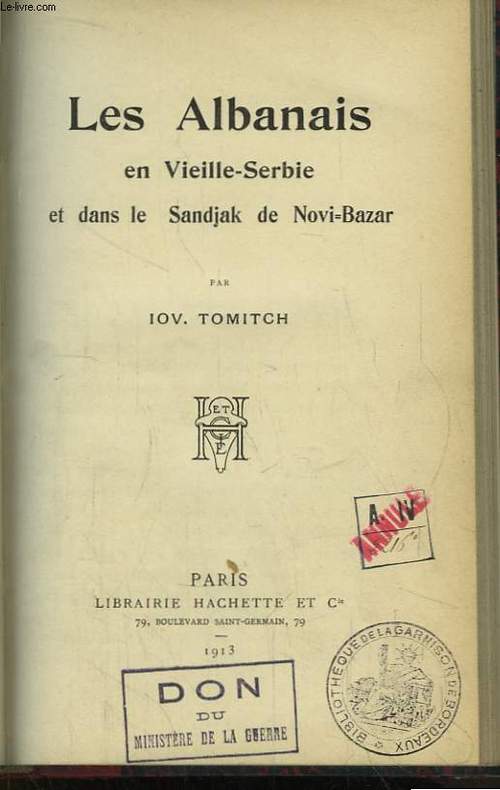
1913RO80100520HACHETTE et Cie. 1913. In-12. Relié demi-cuir. Bon état, Couv. légèrement passée, Dos fané, Intérieur frais. 81 pages. Titre doré sur demi-basane rouge. Etiquette de code sur le dos. Tampons de bibliothèque sur la page de titre.. . . . Classification Dewey : 947-Europe de l'Est, URSS
1950R160018682PLON Les Iles d'Or. 1950. In-12. Relié. Bon état, Couv. légèrement passée, Dos satisfaisant, Intérieur frais. 238 pages.. . . . Classification Dewey : 947-Europe de l'Est, URSS
A PRISTINE LARGE-PAPER COPY OF THE FIRST AND ONLY EDITION of this early, naively idealistic book about the Soviet Union (focusing on the educational system). 256 pp. ONE OF ONLY 20 SPECIAL NUMBERED COPIES PRINTED ON FINE LAFUMA WOVE PAPER (the rest of the edition was printed on cheap wood-pulp paper, now crurmbling into dust). 8vo. Original wraps. ENTIRELY UNCUT AND UNOPENED, FINE AND BRIGHT, LIKE NEW.
1937166991Moskau, Jourgaz, 1937. 2 Bände, je 6 Hefte, jedes Heft ca. 112 S., Halbleinwand, 8°. Maas 2, 614; 4, 197. - Seidel. 1936. Der zweite Jahrgang dieser wichiutgen Literaturzeitschrift des Exils. Sie erschien zwischen 1936 und 1939 in Moskau und stand sowohl kommunistischen als auch nichtkommunistischen Autoren offen. Mit Beiträgen von Georg Lukacs, Thomas Mann, Klaus Mann, Oskar Maria Graf, F. C. Weiskopf, Bodo Uhse, Lion Feuchtwanger, Egon Erwin Kisch, Arnold Zweig, Ernst Weiss und zahlreichen anderen. [2 Warenabbildungen] Hardcover Privater Einband mit Pappdeckeln und grünem Leinwandrücken. Die Umschläge wurden nicht mitgebunden. Einbände berieben, Kanten und Ecken bestossen. Leinwandrücken abgewetzt. Seiten vereinzelt etwas fleckig, Schnitt angestaubt. Das Wort, 2. Jahr 1937, Heft 1-12