163 résultats
187026858Berlin: N. Simrock, o. J. (ca. 1870). Format: 19 x 27,5 cm. (Reihe: Mendelssohns Werke für Pianoforte allein. In sechs Bänden. Erster Band). 65 Seiten. Fest gebunden in roten, stark skulpierten, üpppig ziergeprägten Orig. Leinen mit goldgepr. Deckeltitel und flächigem goldenem Deckelporträt. Getönte, gelackte (leicht altersspurige) Vorsätze. Kleiner Tuschefleck am fl. Vorsatz. Durchaus vom Alter gestreiftes, insg. jedoch gutes Exemplar.
186269739Leipzig, Mendelssohn 1862. VIII, 569 S.; ; 18 cm Halbwerkstoff [3 Warenabbildungen] 0
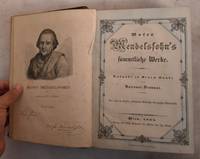
1838192514Wien: M. Schmidl's 1838. Hardcover. Good - Spine strip is peeling significantly; boards are heavily worn; corners are heavily worned; boards are heavily scuffed; inner hinge is cracked; pages are heavily age-toned; pages are foxed; frontispiece has a tear inside near hinge; text block is solid. Leather-bound with gilt lettering and illustration; frontispiece; text block edges are red; 1016 pp.; illustrated. Text in German. This is a interesting collection of the writings of Moses Mendelssohn. M. Schmidl's hardcover
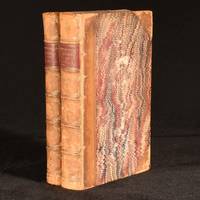
1899551Leipzig 1899. Hardcover. Very Good. 7th ed. In 2 parts one vol. Index. Marbled foredge. Cover slightly rubbed. Illus. with gilt cover & spine. Original binding. <br/><br/> hardcover
1899551Leipzig 1899. Hardcover. Very Good. 7th ed. In 2 parts one vol. Index. Marbled foredge. Cover slightly rubbed. Illus. with gilt cover & spine. Original binding. <br/><br/> hardcover books
1861Alibris.0034586Vienna Austria: M. Löwy's Sohn. 1861. 1/4 leather. Fair. No dust jacket. 611 p. ex-library cover is well-worn stamp on outside edge binding is completely split along hinges book block is taped to cover label inside front cover foxing age spots on pages label & stamp inside back cover M. Löwy's Sohn hardcover
1863Alibris.0034587Vienna Austria: M. Löwy's Sohn. 1863. 1/4 leather. Fair. No dust jacket. ex-library no dust jacket cover is well-worn stamp on outside edge label inside front cover front hinge is completely separated with tape holding book block to front cover back hinge is partly separated label & stamps. 360 p. M. Löwy's Sohn hardcover
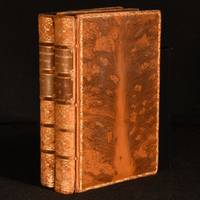
1890981T21London: Longmans Green & Co. 1890-1891. Leather. Good Only. 7.5" by 5". Not Stated. A smartly bound collection of letters from German composer and writer Felix Mendelssohn Bartholdy. Two volumes. The collected letters of Jakob Ludwig Felix Mendelssohn Bartholdy widely known as Felix Mendelssohn a German composer pianist organist and conductor of the early Romantic period. Mendelssohn's compositions include symphonies concertos piano music organ music and chamber music. These personal correspondences offer readers an intimate glimpse into the life thoughts and experiences of the renowned composer during a significant period of his career reflecting both his professional challenges and personal reflections related to music art and relationships. Translated by Lady Wallace Julie Amelie Charlotte Castelnau an English philanthropist best known today for her "bequest to the Nation" of about 5500 artworks that resulted in the Wallace Collection. This set contains: Letters from Italy and Switzerland 1891. Tenth edition. With a frontispiece. Letters of Felix Mendelssohn Bartholdy from 1833 to 1847 1890. New edition. Bound in full tree calf. Externally sound with light rubbing to the extremities and the light fading to the spine. Cracks to the joints with hinges tender. Internally firmly bound. Pages are very bright with light spotting predominantly to the first and last few pages. Contemporary ink inscriptions to the front free endpapers. Good Only Longmans, Green & Co. hardcover
183920885London: G. Berger 1839. First Edition. . Hardcover. Good. Folio. 416pp. Mus.exs. Spine and covers rubbed and bumped covers staind spine cocked title page creased sonme page edges frayed and corners bent. Consisting f Songs Duets and Glees with Accompaniments for the Pianoforte and Arrangements for the Pianoforte Harp Guitar Etc. by Bishop Barnet Bochsa Grantham Kalkbrenner Lee Lanza Loder Neukomm Phillips and Sola with Adaptations and~Arrangements from Bartholdy BNeethoven Haydn Hummel T. Kuhlan Lindpainter H. Marschner Mendelssohn Spohr Weber and All the old Masters. Embracing: Original Tales and Esays. - Posthumous Papers of Celebrated Authors. - Original Poetry. - Translations from the Spanish German Italian and French. - Sketches of Scenery. - Manners and Customs. - Biography of Celebrated Characters. - Choice Brief and Pointed Passages fromthe Best New Works. - Comments on Passing Events. - Original Correspondence. - The Fine Arts Poetry Paintng Music and Sculpture. - Criticisms on Meritorious Productions. - Reminiscences of Olden Times. - Strictures on the Drama and Other Amusements and a Variety of Miscellaneous Matter Pathetic Moral Humorous etc. <br/> <br/> G. Berger hardcover
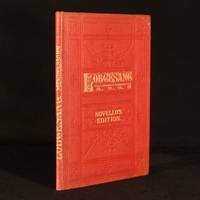
1885995H8London: Novello and Company Limited c1885. Cloth. Very Good. 10.5" by 7". None. The scarce Novello octavo edition score of Mendelssohn"s expansive choral-symphonic masterpiece "Hymn of Praise Lobgesang". In the publisher's original red cloth binding. Novello's original octavo edition. This copy is undated. Dated here using Jisc from copies held at the University of Edinburgh Libraries University of Leeds Library and University of Nottingham Library. A vocal score of Felix Mendelssohn"s Lobgesang "Hymn of Praise" a hybrid symphony cantata combining orchestral and sacred choral movements chorus soloists and piano. It sets biblical texts and includes the chorale "Nun danket alle Gott" in a richly lyrical Romantic idiom. In the publisher's original cloth binding. Externally smart. Slight fading and discolouration to extremities and spine. Slight shelf wear to extremities. Minor loss to cloth at top corner of front board. One or two very slight handling marks to boards. Internally firmly bound. Hinge slightly cracked at the title page but firm. Pages bright and clean. Previous owner's contemporary ink inscription to title page. The odd spot heavier to first and last few leaves. Very Good Novello and Company, Limited hardcover
1862955Y6London: Longman Green Longman Roberts and Green 1862-1863. First edition. Leather. Good. 7.5" by 5". None. Two volumes offering the letters of German composer Felix Mendelssohn Bartholdy uniformly bound in half calf. Comprising two first English editions of Felix Mendelssohn's letters translated by Lady Wallace. Includes 'Letters from Italy and Switzerland' 1862 and 'Letters of Felix Mendelssohn Bartholdy from 1833 to 1847' 1863. Uniformly bound in half calf with marbled paper covered boards. With a frontispiece to 'Mendelssohn's Letters'. Felix Mendelssohn was a German composer and conductor of the early Romantic period. These letters offer a delightful insight into his travels and artistic inspirations through Italy and Switzerland as well as his general correspondence including his thoughts on music for public worship on pianoforte playing and a proposal for an academy of music. Uniformly bound in half calf with marbled paper covered boards and gilt to the spines. Externally with rubbing to the extremities and a few scuffs to the boards. Internally firmly bound. Pages are generally bright and clean with the odd spot or handling mark and a minor tide mark to the frontispiece leaf. Good Longman, Green, Longman, Roberts, and Green hardcover
187835280Leipzig: Breitkopf & Härtel PN M.B. 85 1878. RIETZ Julius 1812-1877 ed. Folio. Original publisher's gray wrappers with titling within decorative border. 1f. recto title verso blank 1f. contents 328 pp. Engraved. Text in German.<br/><br/>In the series: "Felix Mendelssohn Bartholdy's Werke. Kritisch durchgesehene Ausgabe von Julius Reitz. Mit Genehmigung der Originalverleger. Serie 13. Oratorien. Partitur." From the Breitkopf edition of Mendelssohn's Complete Works No. 85. <br/><br/>From the library of composer Horace Middleton 1879-1961 with his small handstamp to upper wrapper and title. Small oval handstamp of Novello to upper wrapper and blank foot of title.<br/><br/>Wrappers rather worn; corner of upper lacking; lower detached. Occasional light foxing heavier to some leaves; edges somewhat soiled; some signatures split. Wehner MWV A 14 p. 19. <br/><br/>Paulus an oratorio to a libretto by Julius Schubring after Acts was first performed as part of the Niederrheinische Musikfest in Düsseldorf on 22 May 1836. Simrock printed the first edition of the piano-vocal score in December 1836 and the full score the following spring. <br/><br/>Mendelssohn distinguished himself in many fields and his contributions to sacred choral music are no exception. He was the most prominent advocate for the music of J.S. Bach reviving the St. Matthew Passion in 1829 and helped to reestablish the oratorio by providing two superb examples: St. Paul 1836 and Elijah 1846.<br/><br/>"From Bach's Passions and Handel's oratorios Mendelssohn borrowed the use of the traditional narrator to relate in recitatives the dramatic action of the work. Conspicuously Bachian are the chorales interspersed throughout the oratorio to demarcate the principal structural divisions diffusing according to Carl Klingemann 'a calmness through the whole'. On the other hand a debt to Handel is revealed in the rich variety of the choruses which include several that directly engage in the dramatic action and several cast in a variety of fugal styles. Prefacing the oratorio is an overture that evokes Paul's struggle for spiritual awakening by means of the chorale Wachet auf and a dissonant fugue with its subject derived from the first strain of the chorale." R. Larry Todd in Grove Music Online.<br/><br/>Horace Middleton was a British-born musician who served on the faculty of Bennett College from 1919 to the mid-1930s. He was best known for the music he composed for the Greek plays performed at the college. See obituary Millbrook Round Table November 23 1961. Breitkopf & Härtel [PN M.B. 85] unknown books
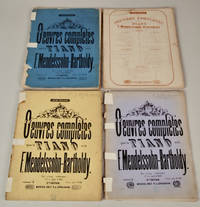
187536204Moscou: P.J. Jürgenson 1875. Folio. Original publisher's mid-blue decorative printed wrappers. <br/><br/>Vol. I: 125 pp. 3rd edition<br/>Vol. II: 126-262 pp. 2nd edition<br/>Vol. IV: 263-399 pp. 2nd edition<br/>Vol. V: 536-608 pp. 2nd edition<br/><br/>Each volume includes a collective title and index.<br/><br/>With the signature of the American composer and pianist Edward Julius Biedermann 1849-1933 to upper wrappers of three volumes inscribed "To my old friend Chas. B. Hughes."<br/><br/>Partially disbound; wrappers torn or lacking. 4 of 5 volumes lacking Vol. III. Some minor wear browning and staining. "One of the most gifted and versatile prodigies Mendelssohn stood at the forefront of German music during the 1830s and 40s as conductor pianist organist and above all composer. His musical style fully developed before he was 20 drew upon a variety of influences including the complex chromatic counterpoint of Bach the formal clarity and gracefulness of Mozart and the dramatic power of Beethoven and Weber.<br/><br/>Mendelssohn's emergence into the first rank of 19th-century German composers coincided with efforts by music historiographers to develop the concept of a Classic-Romantic dialectic in 18th and 19th-century music. To a large degree his music reflects a fundamental tension between Classicism and Romanticism in the generation of German composers after Beethoven." R. Larry Todd in Grove Music Online. P.J. Jürgenson unknown books
187536204Moscou: P.J. Jürgenson 1875. Folio. Original publisher's mid-blue decorative printed wrappers. <br /> <br /> Vol. I: 125 pp. Contains opp. 5 6 7 nos. 1 and 2 14 15 16 nos. 1-3 19 and 29<br /> Vol. II: 126-262 pp. Contains opp. 25 28 29 30 33 nos. 1-3 and 35 Book 1<br /> Vol. IV: 263-399 pp. Contains opp. 62 Book 5 67 Book 6 72 82 83 85 Book 7<br /> Vol. V: 536-608 pp. Contains opp. 102 Book 8 104 Books 1 and 2 105 and 106<br /> Each volume with a collective title and index.<br /> <br /> Provenance<br /> American composer and pianist Edward Julius Biedermann 1849-1933 with his signature to upper wrappers of three volumes inscribed "To my old friend Chas. B. Hughes."<br /> <br /> Partially disbound; wrappers torn or lacking. Four of 5 volumes lacking Vol. III. Some minor wear browning and staining. "One of the most gifted and versatile prodigies Mendelssohn stood at the forefront of German music during the 1830s and 40s as conductor pianist organist and above all composer. His musical style fully developed before he was 20 drew upon a variety of influences including the complex chromatic counterpoint of Bach the formal clarity and gracefulness of Mozart and the dramatic power of Beethoven and Weber.<br /> <br /> Mendelssohn's emergence into the first rank of 19th-century German composers coincided with efforts by music historiographers to develop the concept of a Classic-Romantic dialectic in 18th and 19th-century music. To a large degree his music reflects a fundamental tension between Classicism and Romanticism in the generation of German composers after Beethoven." R. Larry Todd in Grove Music Online. P.J. Jürgenson unknown
187835280Leipzig: Breitkopf & Härtel PN M.B. 85 1878. Folio. Original publisher's gray wrappers with titling within decorative border. 1f. recto title verso blank 1f. contents 328 pp. Engraved. Text in German.<br /> <br /> In the series: "Felix Mendelssohn Bartholdy's Werke. Kritisch durchgesehene Ausgabe von Julius Reitz. Mit Genehmigung der Originalverleger. Serie 13. Oratorien. Partitur." From the Breitkopf edition of Mendelssohn's Complete Works No. 85. <br /> <br /> Provenance<br /> Composer Horace Middleton 1879-1961 with his small handstamp to upper wrapper and title. Small oval handstamp of Novello to upper wrapper and blank foot of title.<br /> <br /> Wrappers rather worn; corner of upper lacking; lower detached. Occasional light foxing heavier to some leaves; edges somewhat soiled; some signatures split. MWV A14 p. 19. <br /> <br /> Paulus an oratorio to a libretto by Julius Schubring after Acts was first performed as part of the Niederrheinische Musikfest in Düsseldorf on 22 May 1836. Simrock printed the first edition of the piano-vocal score in December 1836 and the full score the following spring. <br /> <br /> "Mendelssohn distinguished himself in many fields and his contributions to sacred choral music are no exception. He was the most prominent advocate for the music of J.S. Bach reviving the St. Matthew Passion in 1829 and helped to reestablish the oratorio by providing two superb examples: St. Paul 1836 and Elijah 1846.<br /> <br /> From Bach's Passions and Handel's oratorios Mendelssohn borrowed the use of the traditional narrator to relate in recitatives the dramatic action of the work. Conspicuously Bachian are the chorales interspersed throughout the oratorio to demarcate the principal structural divisions diffusing according to Carl Klingemann 'a calmness through the whole'. On the other hand a debt to Handel is revealed in the rich variety of the choruses which include several that directly engage in the dramatic action and several cast in a variety of fugal styles. Prefacing the oratorio is an overture that evokes Paul's struggle for spiritual awakening by means of the chorale Wachet auf and a dissonant fugue with its subject derived from the first strain of the chorale." R. Larry Todd in Grove Music Online<br /> <br /> Middleton a British-born composer served on the faculty of Bennett College from 1919 to the mid-1930s; he was best known for the music he composed for the Greek plays performed at there. See his obituary Millbrook Round Table November 23 1961. Breitkopf & Härtel [PN M.B. 85] unknown
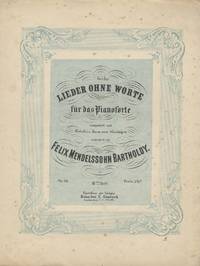
185140963Bonn . London: bei N. Simrock . bei J. A. Novello PN 3383 1851. Folio. Disbound. Contemporary dark blue paper wrappers with manuscript title label to upper. 1f. recto title verso blank 3-19 i blank pp.<br /> <br /> Wrappers worn and detached. Moderate foxing throughout heavier to margins. First German edition later issue. MWV SD 23 p. 478. Krause 227. Hoboken 10 222.<br /> <br /> "One of the most gifted and versatile prodigies Mendelssohn stood at the forefront of German music during the 1830s and 40s as conductor pianist organist and above all composer. His musical style fully developed before he was 20 drew upon a variety of influences including the complex chromatic counterpoint of Bach the formal clarity and gracefulness of Mozart and the dramatic power of Beethoven and Weber.<br /> Mendelssohn's emergence into the first rank of 19th-century German composers coincided with efforts by music historiographers to develop the concept of a Classic-Romantic dialectic in 18th and 19th-century music. To a large degree his music reflects a fundamental tension between Classicism and Romanticism in the generation of German composers after Beethoven . <br /> <br /> . The origins of the Lieder ohne Worte of which Mendelssohn published 36 pieces in six volumes between 1832 and 1845 two more volumes followed posthumously remain couched in mystery. Among his earliest piano lieder was one in E♭ written for Fanny's birthday in 1828 Fanny herself composed numerous examples of the genre; the idea of creating songlike piano pieces may have originated in a game Fanny and Felix played in which they apparently added texts to piano pieces. Then too the critical thought of A.B. Marx who explored in his writings of the 1820s the expressive potential and 'definiteness' of instrumental music was not without impact. Most of the lieder fall into three groups pianistic parallels to the vocal categories of solo songs duets and partsongs. The meaning of the new genre perplexed Mendelssohn's contemporaries. Schumann suggested that the composer had produced texted lieder but then suppressed the texts; when the composer's cousin Marc-André Souchay offered to give some of the lieder fanciful titles Mendelssohn replied that he had intended each lied 'just as it stands'. Only a small number of the lieder bear titles from Mendelssohn e.g. the three called Venetianisches Gondellied or his circle e.g. the 'Frühlingslied'; nevertheless later in the 19th century a host of insipid titles accrued to the lieder contributing to the view of Mendelssohn as a composer of overtly sentimental piano music for the parlour." R. Larry Todd in Grove Music Online. bei N. Simrock ... bei J. A. Novello [PN 3383] unknown
1842219654Verlag des Bibliographischen Instituts Hildburghausen und Amsterdam 1842. Hardcover mit Leinenrücken und -ecken ohne Schutzumschlag Eine Anthologie in 100 Bänden Zustand: Exemplare einer Privatbibliothek mit Kennungen. Rücken Ecken Kanten sehr gut. Innen leicht braunfleckig. Geruchsfrei. Verlag des Bibliographischen Instituts, Hildburghausen und Amsterdam, hardcover
1847012322NY: Mason Brothers 1847. 1st Edition. Hardcover. Near Fine. Oblong 8v0. green pebbled cloth blind stamp rule and garland surround to titles in gilt 128 pp. Uncommon 19thC American song book in uncommonly un- or little-used condiution. No ownership markings. Musical scores set by A. P. Kendrick music typographer 20 Devonshire St Boston. Mason Brothers hardcover
1847012322NY: Mason Brothers 1847. 1st Edition. Hardcover. Near Fine. Oblong 8v0. green pebbled cloth blind stamp rule and garland surround to titles in gilt 128 pp. Uncommon 19thC American song book in uncommonly un- or little-used condiution. No ownership markings. Musical scores set by A. P. Kendrick music typographer 20 Devonshire St Boston. Mason Brothers hardcover books
18607462616 pieces including Rossini's Overture to Il Tancredi duet; Belisario Grand Duet for Piano Forte; My Lodging is on the Cold Ground; Half Hours with the Best Composers- Meyerbeer and Mendelssohn; A Midsummer Night's Dream by Mendelssohn; Twelve sets of Brilliant Waltzes by Strauss set 3 and 5; Sur le Lac Barcarole by Ascher; Mabel by Godfrey; Air with variations by Cutler; Oesten's Souvenir de Norma Published by Boosey & Sons; Metzler & Co; Chappell; Addison; R. Cocks & Co hardcover
185035152Leipzig: Breitkopf & Härtel PN 5543 1850. Octavo. Dark ivory cloth-backed marbled boards with titling gilt to spine. 1f. recto title verso blank 52 pp. Engraved.<br/><br/>With small publisher's and Theune Amsterdam to foot of title. <br/><br/>Binding slightly worn. Minor internal wear browning soiling and foxing; contemporary signature illegible to blank upper margin of title. First Edition later issue. Wehner MWV P 7 p. 244; SD 10 pp. 472-3. Krause 141. Ward Jones III 401. Hoboken 10 167 first issue. <br/><br/>Mendelssohn began work on the Hebrides overture in August 1829 while on the west coast of Scotland. There he visited the famous Fingal's Cave in the Inner Hebrides named after the mythological Gaelic hero Fingal largely a creation of Scottish poet James Macpherson. Mendelssohn revised portions of the overture numerous times including the title. It was first performed as The Isles of Fingal by the Philharmonic Society in London 14 May 1832. Although Mendelssohn finally settled on Die Hebriden as the title the first editions were published as Fingals-Höhle.<br/><br/>One of the most gifted and versatile prodigies Mendelssohn stood at the forefront of German music during the 1830s and 40s as conductor pianist organist and above all composer. His musical style fully developed before he was 20 drew upon a variety of influences including the complex chromatic counterpoint of Bach the formal clarity and gracefulness of Mozart and the dramatic power of Beethoven and Weber.<br/><br/>Mendelssohn's emergence into the first rank of 19th-century German composers coincided with efforts by music historiographers to develop the concept of a Classic-Romantic dialectic in 18th and 19th-century music. To a large degree his music reflects a fundamental tension between Classicism and Romanticism in the generation of German composers after Beethoven." R. Larry Todd in Grove Music Online. Breitkopf & Härtel [PN 5543] unknown books
183835281Bonn: N. Simrock PN 3441 1838. Folio. 21 pp. 4 parts of 4 pp. each title and price to Soprano I part. Engraved. Text in Latin and German. <br/><br/>SSAA with organ.<br/><br/>From the library of composer E.J. Biedermann 1849-1933 with his signature in pencil to head of score and each part; small oval handstamp of G. Schirmer to foot of title and each part.<br/><br/>Split at spine; minor creasing; edges slightly worn and cockled. First Edition later issue. Wehner MWV B 23 p. 51. Not in Krause. Ward Jones III 488 490. Hoboken 10 193.<br/><br/>One of the most gifted and versatile prodigies Mendelssohn stood at the forefront of German music during the 1830s and 40s as conductor pianist organist and above all composer. His musical style fully developed before he was 20 drew upon a variety of influences including the complex chromatic counterpoint of Bach the formal clarity and gracefulness of Mozart and the dramatic power of Beethoven and Weber.<br/><br/>Mendelssohn's emergence into the first rank of 19th-century German composers coincided with efforts by music historiographers to develop the concept of a Classic-Romantic dialectic in 18th and 19th-century music. To a large degree his music reflects a fundamental tension between Classicism and Romanticism in the generation of German composers after Beethoven." R. Larry Todd in Grove Music Online. N. Simrock [PN 3441] unknown books
184418508Bonn: N. Simrock PN 4343 1844. Folio. Disbound. 19 pp. Engraved. <br/>Lithographic title with decorative blue background and border. <br/><br/>Moderate foxing and browning. First Edition later issue. Fuld p. 525. Krause 231. Hoboken 10 237. Mendelssohn Papers III 444. <br/><br/>This volume of the Songs Without Words contains Mendelssohn's "Spring Song. N. Simrock [PN 4343] unknown books
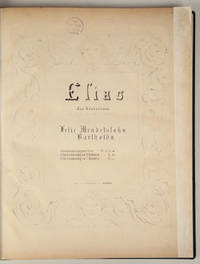
188035203Berlin: N. Simrock PN 4648 1880. Folio. Full black cloth with original publisher's light green printed wrapper with titling within decorative border laid down to upper board. 1f. recto title verso blank 3-207 i blank pp. Text in German.<br/><br/>Small circular handstamp of the Musik-schulen Kaiser Wien to wrapper title and several pages throughout.<br/><br/>Binding slightly worn rubbed and bumped; wrapper slightly trimmed and lightly foxed with several minor chips and abrasions to margins. Impression to title slightly light; title and final leaf reinforced with paper tape to gutter and outer edge. Light scattered foxing throughout. First German Edition later issue. Wehner MWV A 25 p. 35. Not in Krause. Ward Jones III 361 earlier issue. Hoboken 10 251 first issue.<br/><br/>Elias an oratorio to a libretto by Julius Schubring after Kings was first performed in Birmingham on 26 August 1846. Mendelssohn made major revisions to the work following this performance introducing the new and final version in London on 16 April 1847.<br/><br/>Mendelssohn distinguished himself in many fields and his contributions to sacred choral music are no exception. He was the most prominent advocate for the music of J.S. Bach reviving the St. Matthew Passion in 1829 and helped to reestablish the oratorio by providing two superb examples: St. Paul 1836 and Elijah 1846.<br/><br/>"Based largely on the account in 1 Kings Elijah relates the chief events in the prophet's life: the curse of the Lord and the seven-year drought Elijah's miraculous revival of the widow's son his confrontation with the Baal worshippers and the lifting of the drought his confrontation with Ahab and Jezebel his flight to the wilderness and encounter with the Lord and his journey to Mt Horeb and ascension to heaven in a flaming chariot. As in St Paul Mendelssohn employed chorales and relied heavily upon choral numbers; noteworthy is the sheer diversity of choruses . In contrast to St Paul Mendelssohn dispensed with the narrator allowing the characters themselves to deliver the dramatic action. Elijah diverges from St Paul too in its broadly conceived musical cohesiveness; in no other work did Mendelssohn concern himself with musical structure on such a large scale." R. Larry Todd in Grove Music Online. N. Simrock [PN 4648] unknown books
183835281Bonn: N. Simrock PN 3441 1838. Folio. 21 pp. 4 parts of 4 pp. each title and price to Soprano I part. Engraved. Text in Latin and German. <br /> <br /> SSAA with organ.<br /> <br /> Provenance<br /> Composer E.J. Biedermann 1849-1933 with his signature in pencil to head of score and each part; small oval handstamp of G. Schirmer to foot of title and each part.<br /> <br /> Split at spine; minor creasing; edges slightly worn and cockled. First Edition later issue. MWV B23 p. 51. Not in Krause. Ward Jones III 488 490. Hoboken 10 193.<br /> <br /> One of the most gifted and versatile prodigies Mendelssohn stood at the forefront of German music during the 1830s and 40s as conductor pianist organist and above all composer. His musical style fully developed before he was 20 drew upon a variety of influences including the complex chromatic counterpoint of Bach the formal clarity and gracefulness of Mozart and the dramatic power of Beethoven and Weber.<br /> <br /> Mendelssohn's emergence into the first rank of 19th-century German composers coincided with efforts by music historiographers to develop the concept of a Classic-Romantic dialectic in 18th and 19th-century music. To a large degree his music reflects a fundamental tension between Classicism and Romanticism in the generation of German composers after Beethoven." R. Larry Todd in Grove Music Online. N. Simrock [PN 3441] unknown