Whitsey, FredAntiquariat.de

3 191 résultats
200718150ABLondon, Frances Lincoln, 2007. 27,5 x 26 cm. mit 150 brillanten Farbfotos von Tony Lord und einem doppelseitigen Farbplan. Original Pappband (Hardcover), Fadenheftung. 1st. ed. Sehr schönes sauberes und festes Exemplar.
200418181ABLondon, Royal Collection Publ., 2004. 32 cm. 224 S. mit über 230 zumeist farb. Illustrationen, darunter zahlr. brillante Farbfotos von Christopher Simon Sykes, die den Verlauf des Gartenjahres dokumentieren. Original Pappband (Hardcover), Fadenheftung. Tadelloses gepflegtes Exemplar.
Opening times written on title page. No other marks or inscriptions and no creasing to covers. A very clean very tight copy with bright unmarked boards and no bumping to corners. 15pp. History and description of the gardens in the Conwy Valley in North Wales.
199318141ABLondon, Weidenfeld and Nicholson, 1993. 25 x 25 cm. 128 S. mit zahlr. Farbfotos von Andrew Lawson. Original Pappband (Hardcover), Fadenheftung. Sehr schönes sauberes und festes Exemplar. Mit einer Widmung der Verfasserin auf dem Titel.
198920308ABAshridge Bonar Law Memorial Trust, 1989. 21 cm. 20 S. mit 15 Farb- u. 3 Schwarzweißabb., 1 doppelseitiger Gartenplan. Illustrierte Originalbroschur (Softcover), Klammerheftung. Gutes Arbeitsexemplar. Durchgehend feuchtigkeitswellig. Am Kopf Einband u. wenige Seiten braunfleckig.
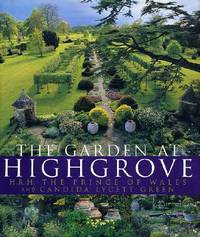
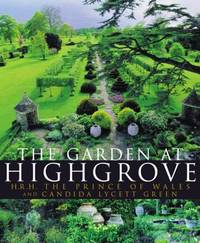
2000008251New York : St. Martin's Press 2000 2000. Hardcover. Fine/Fine. 176 pages : color illustrations ; 29 cm ; ISBN: 031227551X; 9780312275518; 9781841881423 LCCN: 2002-281759 ; LC: SB466.G8; Dewey: 712/.6/094241 ; OCLC: 46401271 ; purple cloth in color photographic dustjacket ; Contents: The setting -- The view from the house -- The cottage garden -- Wild flower meadow and woodland garden -- The arboretum and walled garden - Organic gardening at Highgrove. ; "When the marriage of Lady Di and Prince Charles fell apart rumor had it part of the problem had to do with his gardening obsession. Gossip columns claimed Charles paid more attention to his gardens than his wife. The Garden at Highgrove takes readers on a tour of Charles`s favorite creation--a maze-like garden surrounding the estate where he has primarily lived for the past 20 years. Various styles thrive within the boundaries of the property: wildflower meadows formal hedgerows outdoor rooms carefully plotted tapestries of Queen of Night tulips. If Diana complained of neglect Highgrove`s landscape looks like it has been lavishly doted on. In one series of photos we see the transformation of a large plot viewed from the house as it has been completely erased and re-created year to year. Who has time to complete and then entirely redo a garden on a regular basis A prince of course. Although the landscape glows with a vibrant almost artificial green Charles has long been a committed organic gardener. In the introduction he recalls the period when he came around to the cause of environmentalism. While driving through a declining English countryside in the 1960s and 1970s "I remember longing to heal the countryside to bind up its wounds and to reclothe it in its rightful form." The Garden at Highgrove will inspire gardeners even those who don`t live in palaces who are looking for images of elegance and can`t afford a staff to keep the hedges perfect. --Emily White" ; Candida Rose Lycett Green was a British author who wrote sixteen books including English Cottages Goodbye London The Perfect English House Over the Hills and Far Away and The Dangerous Edge of Things. Her television documentaries included The Englishwoman and the Horse and The Front Garden. Unwrecked England based on a regular column of the same name she wrote for The Oldie since 1992 was published in 2009. ; FINE/FINE <br/> <br/> New York : St. Martin's Press, 2000 hardcover
20011-031227551XSt. Martin's Press 2001. Hardcover. New. 5th edition. 176 pages. 12.00x10.00x1.00 inches. St. Martin's Press hardcover
2012Q-0297825445Orion Publishing 2012-10-01. Hardcover. New. New. In shrink wrap. Looks like an interesting title! Orion Publishing hardcover
2012DADAX0297825445Brand: Orion Publishing 2012-10-01. Reissue. hardcover. New. 9.50x0.80x11.50. Buy with confidence. Excellent Customer Service & Return policy. Brand: Orion Publishing hardcover
2012102276Orion Publishing. New. 2012. Hardcover. 0297825445 . FREE UPGRADE to Courier/Priority Shipping Upon Request - IN STOCK AND IMMEDIATELY AVAILABLE FOR SHIPMENT - Flawless copy brand new pristine never opened -- Originally published in 2000 this reprint edition is 176 pages long and has 198 illustrations most in color. -- with a bonus offer-- . Orion Publishing hardcover
20121-0297825445Orion Publ. Grp 2012. Hardcover. New. reissue edition. 176 pages. 11.50x9.50x0.75 inches. Orion Publ. Grp hardcover
1898176660Brecon: Printed and Published by David Jenkins "Brecon and Radnor Express" Office 1898. First and only edition of an immediate reprint with additions of a local newspaper account detailing the ceremony and celebrations for the dedication of a memorial to "the non-commissioned officers and men. who fell in action during the Zulu Campaign of 1879". Ten men from the regiment won Victoria Crosses for the campaign and six of them attended the ceremony. No institutional copies have been traced. The 24th Regiment gained legendary status for their actions following one of the greatest military disasters in British history when the unfortified camp at Isandlwana was overwhelmed by a massive Zulu force. Five of the men present in 1898 had won their VCs for their bravery in the desperate defence of Rorke's Drift events depicted in the 1964 film Zulu although not entirely accurately. These men were Frederick Hitch Henry Hook Robert and William Jones and John Williams. Edward Stephenson Browne received his VC for the later Battle of Hlobane. In 1907 after a sustained campaign lieutenants Melvill and Coghill were the first to receive posthumous VCs for their attempts to save the regiment's colours at Isandlwana. Another VC winner from the 24th David Bell also attended. He had earned his medal in 1867 in the Andaman Islands for rescuing several comrades from dangerous surf when their boat capsized during a storm. Octavo pp. 34. Double-page plate of the brass tablet loosely inserted 7 half-tone portrait plates group and individual. Wire-stitched in original red paper printed wrappers. Lightly rubbed small chip from front panel of wrappers a few minor splits and chips to the spine fold; folding plate with light crumpling at the edges else contents clean and sound; a very good copy. unknown
1989V34573London (Macdonald & Co.) 1989 (= Black Cat, 4.Auflage). 4°, illustrierter Originalkarton mit illustriertem Originalumchlag (Hardcover) 176 S,. Zahlreiche Abbildungen und Wegbeschreibungen, ISBN 0748102272 4
18804504264Sydney: Turner & Henderson 1880. In remarkable original condition. Duodecimo pp. 22 ii; original wrappers preserved in a folding cloth box. <p><p>The rare catalogue of the Society's inaugural exhibition held at the Garden Palace which had been purpose-built for the Sydney International Exhibition in 1879. An impressive two hundred and twenty oils watercolours and drawings were hung: Mrs. Alfred Williams' painting Ophelia the most expensive at £75 was highly praised by the Bulletin art critic at the time. Her identification as Mrs. Florence E. Williams gives more understanding of the high price as she had exhibited under that version of her name at the Royal Academy since her teens before coming to Australia. </p> <p>Her inclusion was significant for as Joan Kerr has noted "Florence's paintings seem unique for Australia at the time when domestic genre paintings are almost unknown." Florence was a founding member of the Art Society and had been a friend and pupil of and much influenced by Millais. As one of the very few figure paintings in the exhibition Ophelia gained most attention but she also had four other oils in the exhibition. An earlier painting not in this exhibition of a crimson Rosella set against lush vegetation and Mount Wellington was sold for a record $90000 in 2015.</p> <p>As well the catalogue notes W. C. Piguenit's Sydney Harbour from North Shore priced at £52.10.0 in modern times it reached $198000 at Melbourne auction. The catalogue also records works by Collingridge Halstead and Short as well as seven New Zealand watercolours by J C Hoyte the President of the Society. The list of "Working Members" names 80 artists and the Honorary and subscribing Members 47 notably Sir Henry Parkes.</p> <p>From 1871 the New South Wales Academy of Art had held annual exhibitions and had urged the establishment of a Public Art Gallery. This had as much to do with inter colonial rivalry - Melbourne had opened its Gallery in 1861 - as it did about fine art. Once a permanent home for the collection had been found the New South Wales Academy of Art dissolved in 1880 and it was acknowledged that an "artists' society" was needed: a society of professional artists rather than the more inclusive Academy. Artists led by Arthur and George Collingridge sought to establish an Australian school of painting and the first exhibition of The Art Society of New South Wales was held in December 1880 following its formation in July of that year. </p> <p>This catalogue notes that the Society was established for the "promotion and preservation of the Fine Arts in Sydney" and to "enable professional artists to exhibit their works advantageously." Further aims of the Society were lectures on art and a sketching club. The Life Class already established will "give rise to a greater variety in the works."</p> <p>This catalogue is a rare surviving record of the Art Society's first exhibition and succinctly captures the impressive depth of Australian Art in the late nineteenth century.</p> </p> . Provenance: John Chapman collection. Turner & Henderson unknown
21160HMSO London. The Major Graham document dated from the General Register Office Somerset House London 7 December 1848. The Grey circular dated from Downing Street 20 January 1849. Two printed documents: the first carrying Major Graham's 'Memorandum' of 'suggestions respecting the mode of taking a Census in each of our Colonial Posssessions' together with his observations on the making up of 'Statistical Abstracts' a specimen 'Form of Return' and a covering letter; the second a circular letter from Earl Grey instructing colonial governors 'to cause a Return of the Population of the Colony under your Government to be prepared'. For the background to these two documents see A. J. Christopher 'The quest for a census of the British Empire c.1840-1940' Journal of Historical Geography April 2008. No other copies of the present documents which were privately printed by Her Majesty's Stationery Office for Grey as Secretary of State for War and the Colonies have been discovered. This printing was intended for direct distribution to civil servants and MPs and certainly pre-dates the first publication of the items in for example the journals of the legislative councils of Prince Edward Island and New Brunswick both in 1849. Disbound from a collection of parliamentary papers assembled by Sir Frederick Peel 1823-1906 Liberal MP for Leominster who was Under-Secretary of State for War and the Colonies 1851-1854; and Under-Secretary of State for the Colonies 1854-1855. No printed pagination but the volume as a whole was paginated in Peel's hand. Both items are in good condition. ONE: The 'Copy of Major Graham's Letter together with a Copy of the Memorandum to which it refers' referred to by Grey in Item Two below. 4pp foolscap 8vo. Paginated by Peel 163-166. Bifolium on grey paper. The first page carries a transcript including a facsimile signature of a letter from George Graham to 'B. Hawes Esq. M.P.' 1797-1862 later Sir Benjamin Hawes of the Colonial Office. Graham suggests 'that it may perhaps be expedient that steps should be taken to secure a Census being made in each of our Colonies in 1851 on or about the same day that Parliament may fix for its being taken in this Country' and begins his letter with reference to 'some suggestions respecting the mode of taking a Census in each of our Colonial Possessions' which six year before Graham 'transmitted for the use of the Secretary of State for the Colonies some suggestions respecting the mode of taking a Census in each of our Colonial Possessions as requested by Lord Stanley'. Graham is now 'about to publish the Population of England and Wales' and has 'also been furnished with the latest returns of the Population in several Countries in Europe'. It occurs to Graham 'that it might be desirable also to publish the Population of our Colonial Possessions' and he asks Hawes to 'have the goodness to call the attention of Earl Grey to this subject' and to request 'that I may be furnished with Abstracts of the Population of such of our Colonies as may have made returns upon the subject to the Colonial Office'. The letter contains two references to Graham's brother and the man who appointed him to his post 'Secretary Sir James Graham'. The second page headed 'Memorandum' of what he describes in the letter to Hawes as 'some suggestions respecting the mode of taking a Census in each of our Colonial Possessions'. The third page headed 'Statistical Abstracts' again carries a facsimile of Graham's signature to a document dated 5 August 1842 addressed from the General Register Office Somerset House. The communication begins: 'The enumerators should not be called upon to make the Abstract but should transmit the Schedules in books of a convenient form to the seat of Government; where the Abstracts should be made on an uniform plan under proper supervision.' Three examples are given of 'the great variety of ways' by which 'the facts might be combined'. The final page is headed 'Form of Return' and gives the fictitious example of the return for the family of 'John Bromley' 'English 'Farmer' who entered the colony 'COLONY. District – County Town or Parish Ward' in June 1827. TWO: Transcript of 'Circular' letter from Earl Grey to the governors of colonies directing that colonial censuses should be prepared. Peel has written the word 'Census' at the head of the page. Downing Street 20 January 1849. 1p foolscap 8vo. Paginated by Peel 161. Signed by Grey: '/sd/ Grey' why Grey would himself write '/sd/' is not clear. Printed in type imitating copperplate handwriting. The letter begins: 'A Census of the Population of England and Wales will be taken in the year 1851 and the Registrar General has suggested to me that it would be desirable to publish a similar Return for all Her Majesty's Colonial Possessions.' He is transmitting Item One above in margin: '7th December. Memo. 1842. Form.'. The letter continues: 'I have to instruct you to cause a Return of the Population of the Colony under your Government to be prepared in the manner prescribed in the annexed Form as far as may be practicable without incurring expenditure which cannot be conveniently provided for.' Graham's suggestion 'that it would be desirable that a Census in each of the Colonies should if possible be taken on or about the same day as that on which it may be fixed to be taken in this Country … can of course only be acted upon in the event of the Legislature of blank space here having it in contemplation to direct such a Return to be made'. He suggests that in such cases Graham's 'recommendation' be submitted to the consideration of the legislatures. It seems see Wikipedia that Australia didn't have a NATIONAL census until 1911 though states submitted figures before Canada in 1871 etc. Clause 4 of the Memorandum sates: "It will be desirable where there is a difficulty in obtaining information respecting the Aborigines to confine the enquiry to males aged 20 years and upwards - the 'fighting men . The supposed number of females of all ages and males under the age of 20 may however be stated." [HMSO, London.] The Major Graham document, dated from the General Register Office [Somerset House, London], 7 December 1848. The unknown
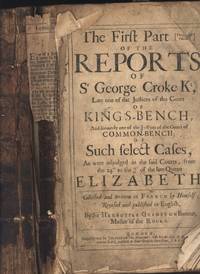
1661009117Printed by and for John Field and Tho. Newcomb also for W. Lee D. Pakeman and Gabriel Bedell . London 1661 1661. 1st Edition 1st Printing. Hardcover. Fair. 10 920 64 pages : portrait missing ; 30 cm OCLC 13205839 ; full leather with five bands. rebound ; this is the first of the three volumes of the first impression;interestingly a copy of the later third impression was owned by Thomas Jefferson in Monticello & is now in the Jefferson Exhibit collection of the Library of Congress ; Croke was brought into Parliament for Bere Alston by his relative Charles Blount 8th Lord Mountjoy. He served on the committees concerning tillage 13 Dec. 1597 lewd & wandering persons 20 Dec. costs in civil lawsuits 27 Jan. 1598 & on two conferences with the Lords 16 Jan. on defence and 3 Feb. on wine casks. He was probably the 'Mr. George Cooke' who was appointed to the committee on tellers and receivers on 12 Dec. Croke began reporting law cases in 1581& is mentioned as an advocate in his own reports in 1588. He established a lucrative practice & built up estates in Oxfordshire & Buckinghamshire. He was associated with the Hampden family was named as overseer in the will of William Hampden & must have known John Hampden for whom he later gave judgment in the ship-money case. Croke's marriage 'fell out unexpected to his friends that conceived a purpose in him never to have married' she being some 20 years of age & he 'an ancient bachelor'. Croke's law reports published after his death in a translation from the law French by Harbottle Grimston his son-in-law soon occupied a considerable place in the authoritative literature of the common law. The 12 active years which he spent on the King's bench coincided with some of the great constitutional cases of the century. He is best remembered in connexion with ship-money. In 1637 Charles submitted the question to the judges all of whom-save for Croke and Sir Richard Hutton-agreed that the King could demand such financial aid from his subjects in time of danger. The two dissidents signed this general statement in the belief that they were bound to yield to the majority opinion. However when the problem came before him judicially in the Hampden case he made an outright statement declaring that there was no precedent for such a prosecution and that only Parliament might set a charge upon a subject. 'The King has ship money by hook but not by Croke' said the wits. In 1641 Croke retired retaining the title salary & allowances of a judge. He died at Waterstock 16 Feb. 1642 leaving two wills the first being concerned with the disposal of land to his wife and son Thomas. In the second made 1640 and proved 3 May 1642 he asked to be buried without 'heraldry' hearse or any 'unnecessary ceremonies'. The widow was appointed sole executrix.--historyofparliamentonline ; Sir Harbottle Grimston 1603-1685 English politician second son of Sir Harbottle Grimston Bart. d. 1648 was born at Bradfield Hall near Manningtree on the 27th of January 1603. Educated at Emmanuel College Cambridge he became a barrister of Lincoln's Inn then recorder of Harwich & recorder of Colchester. As member for Colchester Grimston sat in the Short Parliament of 1640 & he represented the same borough during the Long Parliament speedily becoming a leading member of the popular party. He attacked Archbishop Laud with great vigour; was a member of the important committees of the parliament including the one appointed in consequence of the attempted seizure of the five members; & became deputy-lieutenant of Essex after the passing of the militia ordinance in January 1642. He disliked taking up arms against the king but remained nominally an adherent of the parliamentary party during the Civil War. In the words of Clarendon he "continued rather than concurred with them." .He translated the law reports of his father-in-law the judge Sir George Croke 1560-1642 which were written in Norman-French & five editions of this work have appeared.-1911 Britannica ; thick volume; marginalia; FAIR <br/> <br/> Printed by and for John Field and Tho. Newcomb, also for W. Lee, D. Pakeman, and Gabriel Bedell ..., London, 1661 hardcover
198214637ABCambridge [u.a.], Cambridge Univ. Press, 1982. 23 cm. XII, 447 S. mit zahlr. Abb. und Verbreitungskarten. Illustrierter Originalkarton (Softcover). Kunststoffbeschichtung am Kopfgelenk einseitig etwa 3 cm eingerissen.
198018113ABLondon, Chatto & Windus, 1980. 28,5 cm. 156 S. mit zahlr. Farbfotos und Strichzeichnungen. Original Pappband (Hardcover), Fadenheftung. Gutes Exemplar. Name auf Titel, hinteres Vorsatzblatt und letzte 2 Blatt mit einem kleinen Fleck am Schnitt.
198518115ABHarmondsworth, Penguin, 1985. 27 cm. 154 S. mit 146 Farbfotos, 39 Schwarzweißabb. und 33 Strichzeichnungen. Illustrierter Originalkarton (Softcover). Gutes Exemplar. Minimal bestoßen und beschabt. Hinterer Deckel mit einem Eck-Knick. Fußschnitt mit einem oberflächlichen Fleck.
198320102ABHarmondsworth, Penguin, 1983. 27 cm-10?". 154 S. mit 146 Farbfotos, 39 Schwarzweißabb. und 33 Strichzeichnungen. Original Pappband (Hardcover), Fadenheftung. Repr. Gutes Exemplar.
197820059ABLondon, Academy Editions, ©1978. 29 cm. 144 S. Mit über 150 teils farbigen Abb. Original Pappband (Hardcover), Fadenheftung. Sehr schönes sauberes und festes Exemplar. Name auf Titel.
195016887ABLondon-Malvern Wells, Batsford, 1950. 22 cm. Farb. Frontispiz, 122 S. mit zahlr. Abb. u. Plänen im Text, 106 Schwarzweißtafeln mit 157 Abb. auf Kunstdruckpapier. Original Leinen (Hardcover), Fadenheftung. 2. ed., rev. Noch gut. Einband randgedunkelt, durchgehend braunfleckig. The "British Heritage" Series.
197920101ABLondon, Spring Books, 1979. 28 cm. VI, 255 S. mit rd. 350 Abb., (44) Farbtafeln. Original Pappband (Hardcover), Fadenheftung. Kopfschnitt braunfleckig, sonst sehr gutes gepflegtes Exemplar.
19907574ABLondon, John Calmann and King, 1990. 27,5 x 24,5 cm. 312 S. Mit 240 zumeist farbigen Abb. u. Plänen. Original Pappband (Hardcover). Schnitt mit 3 kl. Flecken, grafisches Ex Libris a. Titel. Schutzumschlag schwach berieben.