CanadaABAA
175 résultats
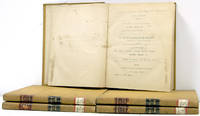
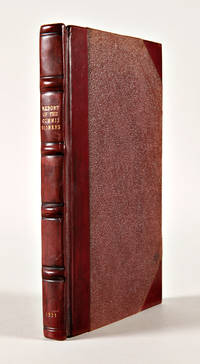
1831WRCAM50737Quebec: Ordered by the Assembly to the printed 1831. Four volumes bound in one. 56; 61; 47; 50pp. 20th-century red three-quarter calf and cloth spine gilt. Bookplates on front pastedown. Some minor foxing and soiling. Very good. Two government reports each printed in English and then French regarding the exploration of Lower Canada. Scarce; not cited in TPL Lande or Gangon. Relatively early for Canadian imprints. Ordered by the Assembly to the printed hardcover books
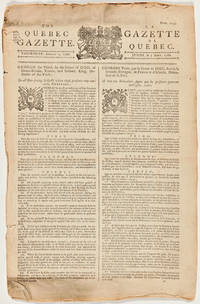
1788WRCAM12524Quebec: William Brown 1788. 4pp. printed in double-column format in parallel English and French. Folio. Dbd. some dust soiling at top and bottom else very good. Contains a proclamation by Lord Dorchester for the regulation of the civil courts of Canada as well as general news of the town ship arrivals etc. William Brown unknown books
1881547Ottawa 1881. Very good. Broadside 18.5 x 6 inches. One horizontal fold. Small chip at left edge not affecting printed area. Light tanning. A rare illustrated railroad broadside that advertises an 1881 voyage from Ottawa and several other towns in Ontario via the Canada Central Railroad to Iowa the Dakotas and Minnesota for the purpose of locating and purchasing an American homestead. "Now is the time to Possess Yourselves of the CHEAP LANDS being offered by the Government and Railroad Co's. The extraordinary emigration to the West from the Old Countries promised for the coming summer will be no myth and another year where now you can accommodate yourself to a Splendid Farm fine location for Work Shops &c. will be occupied by the more energetic foreigner. So arrange your business matters and go with us on May 31 1881." The advertised route involves two legs to Chicago on the Canada Central and Michigan Central and thence on connecting lines to Lemars Iowa; and Watertown Yankton and Huron in the Dakota Territory. A fascinating confluence of railroad excursion promotion homestead land advertisement enticement to international emigration and xenophobia. We locate copies at Yale and the Toronto Public Library. unknown books
WALTER-FILM001023No binding. Very Good. Photo Set of eight 8 vintage original 8 x 10"" 20 x 25 cm. photos USA. Bob Dylan Joan Baez dir: D.A. Pennebaker; Leacock-Pennebaker. Extremely scarce set of photos from legendary Bob Dylan documentary. All photos have stamp on verso of Canadian distributor Film Canada. There are some tape stains on verso which do not show up on front and some scattered creases VERY GOOD. unknown books
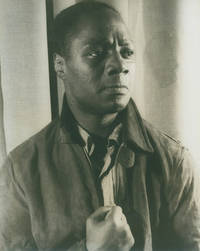
1941220931New York 1941. Gelatin silver print. Large bust portrait of Lee in shirt and jacket fist clenched. 1 vols. 35 x 27.5 cm. 13-7/8 x 10-7/8 inches. Docketed on rear in pencil with the date of the session name of the sitter Van Vechten's id number of the negative "xviii t.14" and note to printer for reduction. Gelatin silver print. Large bust portrait of Lee in shirt and jacket fist clenched. 1 vols. 35 x 27.5 cm. 13-7/8 x 10-7/8 inches. Canada Lee as Bigger Thomas 1941. Lee was acclaimed for his portrayal of Bigger Thomas in Orson Welles' 1941 stage adaptation of the Richard Wright' s NATIVE SON. Brooks Atkinson in the New York Times called his performance "the most vital piece of acting on the current stage." Reproduced in Mauriber's PORTRAITS 1978 unknown books
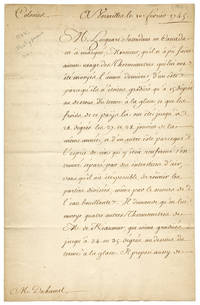
1745WRCAM51842Paris 1745. 2pp. on a folded sheet. In French. Previously folded. Two small holes along folds of blank leaf. Light foxing and tanning. Very good. An entertaining letter written in 1745 by French minister Jean-Frédéric Phélypeaux Comte de Maurepas to scientist Henri-Louis Duhamel du Monceau at Versailles requesting on behalf of Gilles Hocquart the Intendant of New France in Canada that new thermometers and other scientific instruments be sent to Quebec. The author notes that although the old thermometers were graded to measure temperatures down to -15° on the Réaumur scale it had in fact only recently been -27° or -28°. Even if the thermometers had been able to measure temperatures that low according to Maurepas the cold had caused the measuring liquid inside the instruments to separate permanently rendering them useless in any event. He therefore asks that four new Réaumur thermometers capable of measuring down to - 35° be sent along with several astronomical instruments for making navigational observations. unknown books
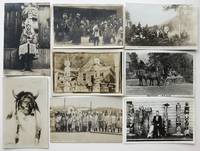
19221349Various places in British Columbia & Alaska 1922. Very good. Fifteen real photo postcards. Light wear and soiling. Several with manuscript notations and/or postmarks on verso. A collection of real photo postcards depicting First Peoples and indigenous life in British Columbia with two images depicting similar scenes in Alaska. Taken by various photographers over the course of several years these images show native people in towns across the province. Identified locations include Radium Kitwanga Vernon Prince Rupert Victoria and Alert Bay. Identified photographers include W.W. Wrathall active in Prince Rupert in 1916; Henry Twidle Granite Bay 1922-1924; Trio Victoria 1914-1925; Vernon Photo Co. Vernon 1910-1920; Gowan-Sutton Co. Vancouver 1920-1925; and Elliott & Baglow North Vancouver 1907-1908. The Alaska photographs are attributed to Otto Schallerer who was active in Seward and later Ketchikan in the 1920s. An unidentified photograph shows a group of ten Inuit -- two men five women and three children -- smiling into the camera. The man wear traditional clothing made from skins while the women have on cotton dresses with gloves and fur hoods likely worn over their warmer clothes. An image attributed to Elliott & Baglow of North Vancouver depicts a large group titled "Indian Chiefs B.C." It shows nearly three dozen men arrayed for the camera outdoors all dressed in traditional headdresses and robes. Another striking image taken at Radium shows a family of Kootenay Indians posed in their buggy possibly outside their home. Several of the postcards show totem poles. Though a bit eclectic a nice grouping of images from British Columbia. unknown books
1937321935Fort Madison Iowa: W. J. McGiffin Newspaper Company Democrat Job Printing 1937. Illustrated by Dobby Blank. 18 unnumbered leaves printed rectos only on stiff wood-grained paper. 1 vols. 12mo 7 x 6-1/4 inches. Self wrappers gathered with cord. Tan cloth folding box with morocco spine label. Fine. Illustrated by Dobby Blank. 18 unnumbered leaves printed rectos only on stiff wood-grained paper. 1 vols. 12mo 7 x 6-1/4 inches. Whimsical illustrated account of a fishing trip in the North Woods of Ontario. Bill McGiffin proprietor of the Fort Madison Iowa Evening Democrat and colleagues from the newspaper travelled to Crow Lake Lodge north of Nestor Falls. Each member of the party comes under the satirical eye of cartoonist Dobby Blank whose pen captures fishing mishaps outdoor fun and some carousing. The final page is a cartoon of a fish snapping the leader marked with the journalist's concluding "30".<br/>McGiffin 1893-1955 bought the Evening Democrat in 1919 and later built up substantial newspaper holdings. This work is unrecorded. Not in Bruns Biscotti Heller. Not in OCLC W. J. McGiffin Newspaper Company, Democrat Job Printing unknown books
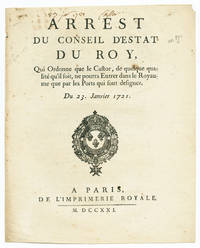
1721WRCAM13347Paris 1721. 4pp. Quarto on a folded folio sheet. Light soiling. Contemporary inscription. Very good. A French royal decree concerning the importation of Canadian beaver pelts into France. This is a variant of the issue listed by Wroth; OCLC locates only one copy at Harvard which appears to be Wroth 890. Not in EUROPEAN AMERICANA. Rare. <br> <br> From the library of Cardinal Étienne Charles de Loménie de Brienne 1727-94 Minister of Louis XVI Archbishop of Toulouse and of Sens. A friend of Voltaire and a member of the Académie Française Brienne wielded significant power as as head of the Finance Ministry which earned him many enemies. He died in prison during the French Revolution despite having renounced Catholicism in 1793 presumably as an attempt to save his life. WROTH ACTS OF FRENCH ROYAL ADMINISTRATION 890 ref. MAGGS FRENCH COLONIZATION OF AMERICA 224 this copy. OCLC 70682396 ref. unknown books
1830WRCAM33087Quebec 1830. Two volumes bound in one printed alternately in English and French. 7288; 410- 13934-1958pp. Quarto. Antique-style half calf and marbled boards Very good. A reprint of the first collection of Canadian statutes as it appeared in 1795 to which has been added the first printings of the provincial statutes for 1797 to 1800. The first 186 pages of the first volume of statutes appear here as original sheets remaindered from the first edition. According to Tremaine these sheets were occasionally offered as "complementary sections" of the 1830 reissue. In the second volume statute titles appear only for those statutes no longer in force. The series ceased publication in 1831. In all a useful resource for early Canadian laws. TPL 644. GAGNON 2:2046. SABIN 10497. TREMAINE 943 1053. hardcover books
1864WRCAM47423London 1864. 162pp. Folio. String-tied as issued. A bit tanned some small chips at the edges. Very good. The Thomas W. Streeter copy with his pencil notes on the titlepage. This House of Commons working paper is a continuation of their return dated July 10 1863 on the subject of constructing a telegraph line to British Columbia and the Pacific. The Hudson's Bay Company unsurprisingly was intimately involved in the machinations for the building of the line. They had made an agreement with the Canadian government to build the telegraph line from the Red River to the Pacific themselves but when they failed to do so a group of English bankers proposed to step in and do the job. The papers included herein provide much information on the qualities of the land between Lake Superior and British Columbia and the need for swift communication throughout and across the vast region. Also included is a memorial from the people of the Red River Settlement discussing their urgent need for the telegraph. <br> <br> The Streeter copy sold to Nebenzahl for $30 in 1969 and was still in his stock when the Reese Company bought the last of it in 2013; here it is. STREETER SALE 3436 this copy. SOLIDAY I:1207. LOWTHER 228. unknown books
1911WRCAM55081Ontario Canada 1911. 108pp. approximately 13000 words overall. Oblong 12mo. Original limp burgundy calf. Some rubbing to covers chipping at extremities. Minor tanning a few ink smudges. Very good overall. An entertaining diary chronicling a seven- week camping and canoeing trip in the Ontario wilderness by four Yale University students during the summer of 1911. <br> <br> We believe the author of this diary to be Henry Eldridge Perry a Yale student who was accompanied on this adventure by three friends: Jo Dugas Edward Bancroft Twombly a member of the Yale class of 1912 and of Skull and Bones and Jeff Jeffery. They met at North Bay Ontario and took the train to Cochrane and then on to Low Bush where their journey began. Their purported mission was to search for fossils minerals and other geological samples but the diary reveals they were mostly searching for adventure. <br> <br> Perry's daily entries detail their progress on the water portaging from lake to lake setting up numerous campsites in difficult territory battling the weather hunting and fishing and chance meetings with lumberjacks and Indians among other excitement. They regularly shot partridges for breakfast and caught pickerel and pike for dinner when they could "I kidded myself into thinking I was fishing but I really only held a pole" - July 20. <br> <br> The hunting highlight of the trip was the downing of a black bear on August 10: <br> <br> "This afternoon Jeff & I went out to Baker Lake to hunt for an outlet.we didn't see much some Indian wigwams a log house & all the skeletons hides & utensils they discard upon departure. Farther up we happened to run into a bear. Heard a big crashing in the bush & that we'd pinch a wild beast or two so I paddled nearer while Jeff adjusted his rifle. Just then the old brute broke thru the bush & trotted along the shore without seeing us. Then he began to swim across & I paddled after him like the dickens. Jeff began to shoot & the first shot the bear saw us & turned for shore. Jeff shot twice more & the third time pinked him under the ear. He flopped and after a few kicks was dead floating on the surface. How we vibrated! We tied a rope around his neck & towed him ashore. Then we got out in about two feet of water & lifted him clear of the water into the canoe. How we did it we'll never know. He weighs about 400 lbs is 6 ft 8 in from nose to hind foot 5 ft. 3 in. from nose to tail 44 inches round abdomen 40 round chest & 30 round neck. Jo says he's the biggest black bear he's ever seen." <br> <br> Perry is an amusing and self-effacing narrator never holding back his complaints about mosquitos or leaking tents and giving each campsite a new and clever name such as: "Camp Hang-over" "Camp Gloom" "Camp Larger Gloom" "Camp Hellgate" and "Camp Where the - are We Or - if I Know." Although he only refers to himself by his last name our Perry is likely Henry Eldridge Perry who roomed with Twombly during their last two years at Yale. A native of Crete Nebraska Perry may also have provided the backwoods expertise for this outing. A delightful glimpse of a substantial trip by four amateur outdoorsmen. Mortimer Robinson Proctor HISTORY OF THE CLASS OF 1912 YALE COLLEGE New Haven Ct.: Yale University 1912 Vol. 1. unknown books
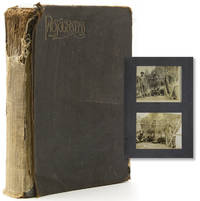
1890319445Newfoundland and Labrador 1890. 91 photographs. Most photos measure 4 x 5 inches. A few captioned in manuscript on verso. Black cloth spine perished. 91 photographs. Most photos measure 4 x 5 inches. A few captioned in manuscript on verso. The images include several aboard ship and arriving at the dock as well as images along the river and campsite including scenic views as well as images of the unidentified travellers. Other Humber River images depict villages salmon fishing with women participating including one holding a rifle. A number of photos depict indigenous peoples possibly Inuit Innu Mi'kng or So. Innit of Nu nath Kavut. The travellers must have taken another passage north with images of Labrador cliffs and even an iceberg. unknown books
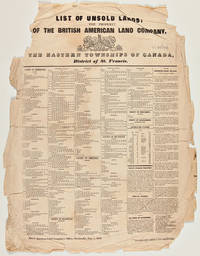
1842WRCAM39134Montreal: Printed by John C. Becket 1842. Broadside 22 1/2 x 17 3/4 inches. Printed in six columns. Small tears and creasing at all margins affecting a few words of text; significant loss at upper corners not affecting text. Good. A Canadian broadside advertising lands available in the Eastern Townships printed at the beginning of the region's transformation into a French-speaking area. In the early 1800s the Eastern Townships were an almost exclusively Anglophone region of Quebec. The American Revolution precipitated the flight of over 40000 Loyalists to Canada in the 1780s including a small handful to the largely unsettled region of Quebec between the St. Lawrence River and the U.S. border known as the Eastern Townships. The Loyalists cleared much of the rich land for farming which attracted a large number of immigrants from New England in the first decades of the 19th century. In the 1840s a rapid shift occurred in the region as French- speaking Quebecois from poorer areas began pouring in and the English speakers began emigrating to the U.S. and other parts of Canada. Francophones became a majority in the 1870s and today constitute over 85% of the population. <br> <br> The present broadside printed in English lists hundreds of lots for sale by the British American Land Company and includes over a column's worth of detailed descriptions of lands open for purchase. The following towns and areas are represented: Ascot Auckland Brompton Compton Clifton Clinton Ditton Dudswell Eaton Hereford Melbourne Newport Orford Shipton Stoke Weedon Westbury and Windsor in the County of Sherbrooke; Barford Barnston Bolton Hatley Potton and Stanstead in the County of Stanstead; Brome Ely Farnham Granby Milton Roxton Shefford and Stukeley in the County of Shefford; Acton Aston Chester Durhan Grantham Ham Kingsley Simpson Tingwock Warwick Wendover and Wickham in the County of Drummond; Sutton in the County of Missisquoi; Hemmingford in the County of Beauharnois; and improved farms in the district of St. Francis Territory Port St. Francis and the town of Sherbrooke. Not listed on OCLC and apparently unrecorded. Very rare. Printed by John C. Becket unknown books
1840WRCAM32893Montreal 1840. Five volumes of six. 10030; 621; 10510; 16178; 20222130pp. Quarto. Later cloth red and black gilt morocco labels. Moderate soiling on covers library labels at toe of spines. Uniform light toning. Perforated library stamps on titlepages occasional additional library markings. First twenty pages of last volume in typescript facsimile. Overall very good. Lacks the sixth volume. An important collection of Canadian laws as passed by the Special Council of Lower Canada from 1838 to 1840. When the Patriot Uprising of 1838 caused Canadian officials to suspend the 1791 constitution which had divided Canada into the Upper and Lower Provinces each with their own legislature and establish martial law the provincial judiciary assumed administrative control in the form of the Special Council. The Special Council continued in an administrative capacity until the Union Act of 1840 which reunited the provinces with a single legislature. A fundamental cause of the Patriot Uprising was the ambiguous extent of judiciary power; based on the reign of the Special Council recorded in detail here judicial powers were more clearly defined via the Union Act. TPL calls for six volumes bound in three. The present set features each volume bound separately lacking the sixth volume. The large portions of unnumbered pages at the end of each contain sessional papers appendices and indices. <br> <br> Key insight into a tumultuous period of Canadian legal history. The journals were also issued in French. OCLC locates only five copies none of which appear to be complete. TPL 2173. GAGNON I:1830. OCLC 12010933 63013527. hardcover books
191030781<p>N.p. 1910 Large manuscript map measuring 40 x 103 ¾ inches pen and ink with pencil additions on drafting linen some minor soiling to edges else in very good clean condition.</p><p> Large scale manuscript map which delineates the territory from Skagway portions of British Columbia the Yukon and Klondike Country as far north as the Porcupine River. The map shows the rivers creeks settlements rail roads N.W.M.P. barracks timber berths and reserves. </p> books
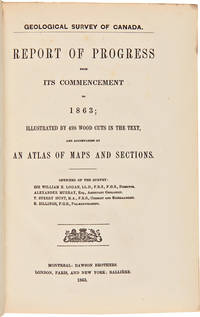
1906WRCAM50950Montreal Toronto Quebec & Ottawa 1906. Seventy-seven works including numerous maps. Some original wrappers some volumes in contemporary leather bindings some in later yellow buckram. Some map volumes supplied at least in part in facsimile. Overall very good. A long run of the geological survey of Canada with some works printed in English and some in French. Comprises the progress reports and maps for the Canadian geological survey for a period of about fifty years. Includes the rare large folio atlas PLAN OF VARIOUS LAKES AND RIVERS BETWEEN LAKE HURON AND THE RIVER OTTAWA. Toronto 1857 listed as numbers 16-38 in Ferrier's ANNOTATED CATALOGUE.OF THE GEOLOGICAL SURVEY CANADA. The atlas is usually encountered in quarto format with the maps folded to conform to the smaller size. A copy of the Ferrier bibliography is also included with the collection. A complete detailed list of the works is available upon request. hardcover books
190338161Washington D.C.: Privately printed 1903. 11 x 8 1/2 inches. 29 leaves of text printed double-column on rectos only with occasional manuscript ink corrections; 62 mounted photographs mostly 3 1/2 x 4 1/2 inches facing text on versos of printed leaves or on separate thicker paper. Original red ribbon tied green printed green wrapper.<br/> <br/>Likely privately printed account of an August 1903 camping and fishing trip into Canada's Muskoka region by fourteen people from the Indian Territory Arkansas Mississippi Kentucky Tennessee Washington DC and Northampton and Boston Massachusetts.<br/> <br/>Hosted by Major Breckenridge this trip was a follow-up to a 1902 trip ruined by bad weather and other problems and cut short. This 1903 trip was better organized and with a larger party. The group assembled at a cottage on Lake Rousseau north of Toronto and took canoes to camps on Lakes Blackstone and Crane near Parry Sound. The first four chapters relay descriptions of their travels camping gear fishing tackle boats the scenery local farms and preparations for various activities among many other details. The final chapter of the book "August 1903" was written by Mary Breckenridge and provides a detailed account of the fishing: "We now had a plentiful supply of fish. Luck was good for nearly everyone.to the major rested the honor of the largest fish a wall-eyed pike with a really ferocious countenance." The photographs closely track the narrative with the images reflecting the text opposite and show docks and buildings along the traveled routes scenes of the Canadian backwoods camps and members of the party engaged in various activities including swimming boating fishing cooking etc. Major Breckeridge wished to "provide a trip which would make his girls permanent lovers of fishing and camping and willing companions of his future expeditions for.none are too tender to cultivate the angler's art." He bought a small number of maple leaf pins which he distributed to the party and which became the badge of the Maple Leaf Club. Privately printed unknown books
1795E0029<b>Samuel Hearne was the first European to make an overland excursion across northern Canada to the Arctic Ocean</b><br /><br />xliv458 pages with two of four engraved plates after drawings by the author both folding and four of five folding engraved maps. Quarto 11 3/4" x 9 3/4" bound in full leather with raised spine bands and gilt lettering to spine. HillI page 141. Sabin 31181 First edition.<br /><br />Manuscript journal was found by La Pérouse when he captured Fort Albany; later one of his conditions of surrender was that it be published. Samuel Hearne 1745 – November 1792 was an explorer fur-trader author and naturalist. He was the first European to make an overland excursion across northern Canada to the Arctic Ocean In 1774 Hearne built Cumberland House for the Hudson's Bay Company its first interior trading post and the first permanent settlement in present Saskatchewan. From 1769 to 1772 Hearne was employed in north-western discovery searching especially for certain copper mines described by Indians as "Far-Away-Metal River". These copper mines were found in the Barren Lands where the ground is permanently frozen to within a few inches of the surface creating in many areas vast stretches of mosquito- and fly-infested swamp during the summer thaw. For this reason it was decided that travel in winter was preferable. His first attempt began on 6 November 1769. The large size of the expedition and too much European equipment being carried led to the desertion of his Indian guides and the failure of the expedition. His second commencing 23 February 1770 failed because his quadrant was broken and much of his equipment was stolen. Learning from the mistakes of the first two expeditions Hearne contrived to travel as the only European with a group of Indians led by the great chief Matonabbee. The group also included eight of Matonabbee's wives to act as beasts of burden in the sledge traces camp servants and cooks. This third expedition set out in December 1770 in order to reach the Coppermine River in summer by which he could descend to the Arctic in canoes. Matonabbee kept a fast pace so fast they reached the great caribou traverse before provisions dwindled and in time for the spring hunt. Here all the Indian hunters of the north gathered to hunt the vast herds of caribou migrating north for summer. A store of meat was laid up for Hearne's voyage and a band of warriors joined the expedition. Matonabbee ordered the women to wait for his return in the Athabasca country to the west. The Chipewyans were generally a mild and peaceful people however they were in a state of conflict with the Inuit. A great number of Indians joined Hearne's party to accompany them to the Coppermine River with intent to murder Inuit who were understood to frequent that river in considerable numbers.2 On July 14 1771 they reached the Coppermine River a small stream flowing over a rocky bed in the "Barren Lands of the Little Sticks". A few miles down the river just above a cataract were the domed wigwams of an Eskimo camp. At 1am on July 17 1771 Matonabbee and the other Indians fell upon the sleeping Eskimo in a ruthless massacre. Approximately twenty men women and children were killed; this would be known as the Massacre at Bloody Falls. A few days later Hearne was the first European to reach the shore of the Arctic Ocean by an overland route. By tracing the Coppermine River to the Arctic Ocean he had established there was no northwest passage through the continent at lower latitudes. This expedition also proved successful in its primary goal by discovering copper in the Coppermine River basin. However an intensive search of the area yielded only one four-pound lump of copper and commercial mining was not considered viable. Matonabbee led Hearne back to Churchill by a wide westward circle past Bear Lake in Athabasca Country. In midwinter he became the first European to see and cross Great Slave Lake. Hearne returned to Fort Prince of Wales on 30 June 1772 having walked some 5000 miles and explored more than 250000 square miles.<br /><br />Condition:<br /><br />Rebound in attractive leather with raised spine bands. Lacks frontispiece map and two plates. Plate I A North West View of Prince of Wales's Fort and Plate IV A Winter view of the Athapuscow Lake. Some internal spotting. Small repair to title page and verso and front free end paper edge else a better than very good copy. Printed for A Strahan and T Cadell hardcover books
19053149821905. Illustrated with photographs mounted usually 2-4 on a page each captioned with over 80 leaves approximately 200 images. Printed recto only. 1 vols. Oblong 4to. Laid into a modern half green morocco backed clamshell dropbox. Illustrated with photographs mounted usually 2-4 on a page each captioned with over 80 leaves approximately 200 images. Printed recto only. 1 vols. Oblong 4to. unknown books
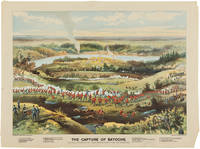
1885WRCAM54034Toronto: Toronto Lithographing Co. 1885. Three color lithographs. Cut Knife and Fish Creek: approximately 20 1/4 x 26 3/4 inches; Capture at Batoche: approximately 19 1/2 x 26 1/4 inches. Cut Knife and Fish Creek trimmed about 3/4 inch along the top margin and about 1 1/4 inches along left margin. Capture at Batoche trimmed slightly more but evenly in each margin and adhered to backing board. Overall good plus. A trio of rare battlefield views depicting three of the major skirmishes fought during the North-West Rebellion in Saskatchewan in 1885. This series of battles is also known by several other names including the Saskatchewan Rebellion the Northwest Uprising and the Second Riel Rebellion the first Riel Rebellion occurred near Manitoba in 1869 and is also known as the Red River Rebellion. Both the 1869 and 1885 actions were led by Louis Riel the leader of the Métis people. <br> <br> Chronologically the lithographs are as follows: <br> <br> 1 "Battle of Fish Creek." This battle occurred on April 24 1885 and resulted in a stunning victory when around 200 Métis soldiers overcame a superior force of 900 government soldiers and temporarily halted an advance on Batoche. <br> <br> 2 "Battle of Cut Knife." On May 2 1885 a force of Cree warriors held off a superior group of Canadian army units. <br> <br> 3 "The Capture of Batoche." Effectively the end of the rebellion the Métis were soundly defeated in the second week of May after they ran out of ammunition on the third day of fighting. This action forced Riel to surrender on May 15. <br> <br> The Métis are one of the recognized aboriginal groups in Canada who trace their roots to the first interaction between First Nations people and the earliest European settlers usually French and largely as a result of the fur trade. The Métis are among the earliest mixed-race people in Canada and developed a separate distinct culture based on their ancestral origins usually stemming from the coupling of an indigenous woman and a male European settler. <br> <br> By the 19th century the Métis were well- assimilated into French-Canadian culture and many worked as fur traders for the North-West Company or Hudson's Bay Company or supplied furs as independent trappers. When those companies pulled out of the Red River and Saskatchewan regions in the mid-to-late 1800s the Canadian government took over the land and began to enforce their will on the Métis people. <br> <br> The first armed conflict between the Métis and the Canadian provincial government occurred in 1869 in the Red River region where Louis Riel led an unsuccessful rebellion. Some fifteen years later the Métis formed their own provincial government in western Saskatchewan after hearing that the Canadian government was sending mounted police to enforce Canadian law in the region. This Second Riel Rebellion occurred in a series of skirmishes between the Métis and the Canadian armed forces between March 26 and May 12 1885. Though led by Louis Riel the Métis ultimately lost again to the Canadian government. Still both rebellions helped the Métis gain some measure of recognition and respect from the Canadian government that they would very likely not have earned otherwise. <br> <br> The lithographs were produced by the Toronto Lithographing Company purveyors of patriotic views of famous Canadian wars. In this case the company assigned W.D. Blatchly to paint the scenes for the 1885 conflicts; Blatchly was at the time one of the leading artists in all of Canada. <br> <br> An excellent series of lithographs illustrating three important events in the famous rebellion with outstanding display appeal. Toronto Lithographing Co. unknown books
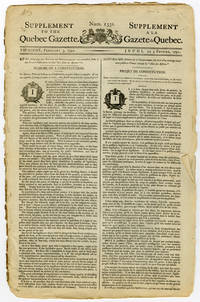
1791WRCAM12536Quebec: Samuel Nielson 1791. Four issues. 2; 2; 4; 4pp. Printed in double-column format in parallel English and French. Folio. Slightly ragged on left margin. Very good. This extraordinary series of supplements to the QUEBEC GAZETTE demonstrates the extent to which feeling for the French Revolution had permeated the French population of Canada and the degree to which the British government was prepared to tolerate the expression of such Revolutionary sentiments. Most of the text of each issue all of the first two and part of the third and fourth is devoted to a long "Scheme of a Constitution" extracted from a late French publication entitled "Les Actes des Apotres." While recognizing monarchy as the necessary executive branch the text calls for a balance of power between the courts legislatures and executive. A surprising and interesting series to find published in Canada at this time in the same year that the Constitutional Act granted the first representative government to Canada. Not listed separately by Tremaine nor are supplements recorded in the appendix devoted to the .GAZETTE; however she notes two runs which include "almost all" of the supplements. Samuel Nielson unknown books
1817WRCAM32892Quebec 1817. Twenty-four volumes. Later brown cloth red and black gilt morocco labels. Printed in alternating English and French. Slight wear to and moderate soiling on covers. Occasional foxing. First view leaves of first volume torn along lower blank margin. Occasional old institutional markings. Overall very good. A large and impressive archive of Canadian laws. In an effort to pacify the disparate French and British populations of Canada the Constitutional Act of 1791 divided Canada in two. Upper Canada was primarily populated by Loyalist emigrants of the American Revolution while the citizenry of Lower Canada which included Quebec was mostly of French descent. These are the laws of Lower Canada printed in English and French. Though the first volume appeared in 1793 it includes material from the first session of the first Parliament held in December 1792. The series continued till 1836. "Public accounts are included in the early numbers of the Journals and from 1809 to 1835-36 Sessional papers are published as appendices to the Journals" - TPL. Present here is a complete run from its inception to 1813 with an additional volume for 1817. The twenty- third twenty-fourth and twenty fifth volumes are lacking. Scarce. OCLC locates only six complete runs. <br> <br> A prime resource for the study of Canadian legal history. TPL 640. SABIN 10491. OCLC 11820245 48957532. TRÉMAINE 835. hardcover books
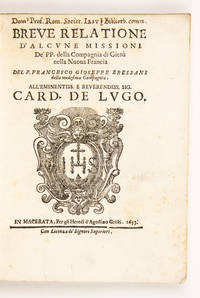
16532969Macerata: : Heirs of Agostino Grisei 1653. FIRST EDITION. . Quarto: . 21.5 x 15.5 cm. 4 8 pp. 9-10 ll. 11-127 1 pp. Collation: π2 A4 B4 ±B1.2 C-Q4 Bound in 17th c. limp sheepskin parchment. With a large woodcut Jesuit device on the title page woodcut initial and a factotum built up from fleurons. There is a neatly written contemporary inscription of a Roman Jesuit library on the title page; some leaves foxed or lightly browned; there is a minor ink stain on two leaves. In all a nice genuine copy with generous margins. FIRST EDITION of one of the most important eyewitness accounts of 17th-century Canada devoted primarily to the Huron Indians but also with accounts of other groups including the Jesuit author’s captivity and mutilation under the Iroquois. He also devotes 25 pages to a 1643 letter written by his Jesuit colleague Isaac Jogues 1607-1646 who was killed by the Mohawks. Bressani 1612-1672 an Italian Jesuit travelled to Canada as a missionary in 1642. After two years in Quebec and with the Algonquins on the St. Lawrence River he set off for the most distant outposts the missions on Lake Huron’s Georgian Bay deep in the interior. He was captured by the Iroquois who cut off his fingers and eventually sold him to the Dutch who helped him reach France. He returned to Canada in 1645 participated in peace talks with the Iroquois and finally reached the Huron missions where he remained until the Iroquois destroyed them in 1649 killing most of the Hurons and missionaries. On his return to Europe in 1650 he wrote the present Italian account. A riveting eyewitness account of Canadian Indians and Jesuits in the 1640s. Alden & Landis 653/15; De Backer & Sommervogel II col. 133; Walter Jesuit relations 43; Church 524; James Ford Bell Lib. B-407; JCB II p. 428; Lande Canadiana 57; McCoy Jesuit relations 82; Sabin 7734; not in Eberstadt; Streeter. Heirs of Agostino Grisei, unknown books
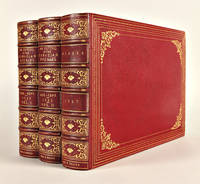
1937WRCAM54535Alaska & Canada 1937. Three albums with 601 photographs each approximately 3 3/4 x 5 3/4 inches with additional ephemera such as news clippings and a hunting license. Oblong folio. Contemporary full red morocco gilt tooled by the Harcourt Bindery. Photos mounted directly on stiff grey album leaves. Very light wear to hinges and spine ends. Contents generally fine. Very good overall. Two volumes in red cloth slipcases. A magnificent and massive collection of over 600 photographs compiled by William N. Beach famed big game hunter and author of IN THE SHADOW OF MOUNT McKINLEY. <br> <br> The first two albums here document a journey made by Beach through the Canadian Rockies in August and September 1933. The third album focuses on his excursion through Alaska in 1937. All three postdate the publication of MOUNT McKINLEY which established Beach as an important figure in the world of big game hunting. According to one of the contemporary newspaper clippings tipped into the album Beach's hunting party on his second trip documented here "was after specimens of Alaskan wild life to be placed in the Smithsonian" with W.L. Brown curator of the Institute accompanying the party. Shortly after the trip an article by Beach entitled "With Moose and Caribou in Alaska" was published in EXPLORATION AND FIELD-WORK OF THE SMITHSONIAN INSTITUTION IN 1937 and featured photography from the "Alaska" album present here. <br> <br> These expertly captured images of the Denali wilderness and the Rockies offer a rare and extraordinary glimpse not only into big game hunting but also into remote and pristine landscapes of these areas in the 1930s. An outstanding and impressive group of photographs. hardcover books