FREUCHEN PeterMareMagnum

1 282 résultats
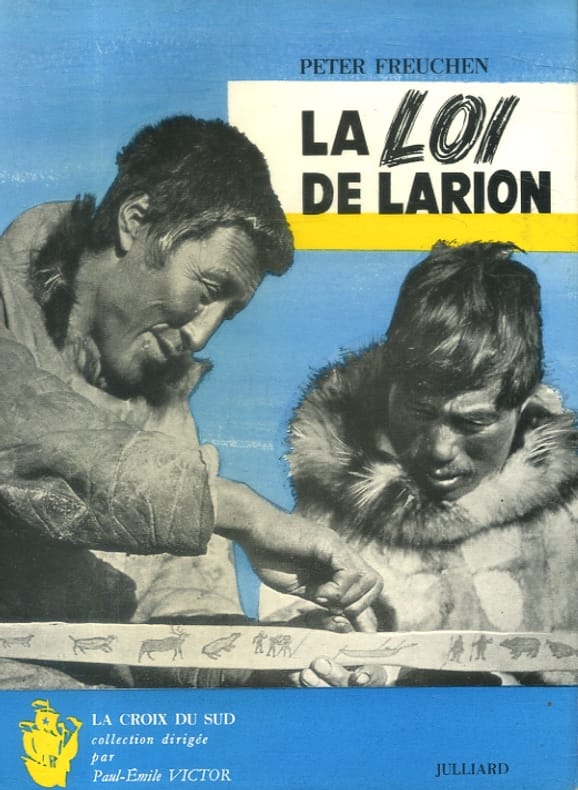
Paris, Julliard 1955. In-8 carré broché couverture illustrée rempliée de 320 pages. Collection la croix du sud dirigée par Paul Emile VICTOR. Bon état en service de presse
Book is in excellent condition in black cloth with gilt at spine, handsome map endpapers. Binding is solid and square, covers have sharp corners, exterior shows no blemishes, text/interior is clean and free of marking of any kind. Dust jacket shows the slightest signs of shelf wear only, no tears. 369 pages, heavily illustrated with maps, b&w photos of tools, persons, sites, line drawings.
1955144771Couverture souple. Broché. 320 pages.
185057677[Ca 1850]. 13 x 10,5cm. (Blattgröße 21 x 16,5 cm.) Unter Feinkartonpassepartout mit Farblinieneinfassung.
1850576031850]. 10 x 10 cm. (Blattgröße 22,5 x 17 cm). Unter Feinkartonpassepartout mit Farblinieneinfassung.
Book shows light wear only to oversize covers: two marks at spine on front cover, a little bit of corner wear, back upper corner is turned out slightly, covers show scuffing. Binding is solid and square, text/interior is clean and free of marking of any kind. 80 pages with usually four captioned b&w photos per oversize page, with chapter introductions, usually one page. Chapters include: Voyage of the North Star, Arrival of the Colonists, Drawing for the Land, Permanent program of construction, Colonial life, Farming, Personalities and personnel, Transient camp life. Signed by the author on the title page. Rare. In 1935, the Federal Emergency Relief Administration created an experimental farming community known as the Matanuska Valley Colony as part of the New Deal resettlement plan.[1] Situated in the Matanuska Valley, about 45 miles northeast of Anchorage, Alaska, the colony was settled by 203 families from Minnesota, Wisconsin and Michigan. The Matanuska Colony was part of Franklin D. Roosevelt's New Deal plan to help move the United States out of the Great Depression. It was one of many rural rehabilitation colonies to be established by the Federal Emergency Relief Administration (FERA). Others included Cherry Lake Farms in Florida, Dyess Colony in Arkansas, and the Pine Mountain Valley Rural Community in Georgia. In 1935, Americans in rural areas of northern states were among the worst sufferers of the Great Depression. In order to alleviate some of the pressures upon these areas, the FERA commissioned applicants from the northern states of Minnesota, Wisconsin, and Michigan to colonize a tract of land in the Territory of Alaska. The administration chose these three northern states because of their climate and belief that representatives would be well suited to survive harsh elements of subarctic winters. The hope was that the colony candidates would be good farmers with the necessary skills and hardiness required for self-sufficiency in the harsh Alaskan environment. Each family was to receive a 40-acre plot to turn into farmland. From conception to realization, the project progressed rapidly. A survey was made of the Matanuska Valley in June 1934 to ascertain its agricultural viability. Some of the information that would have proven to be useful in planning the colony was not even available until after colonization had begun. Nonetheless, the following January, FERA and Department of the Interior agreed to undertake the project. A few weeks later, 80,000 acres of land was set aside for the project and, by April, the first construction workers and colonists left for the valley. According to historian Orlando W. Miller, a total of 241,332 acres were initially set aside for the colony, with an additional 7,780 acres added later on to provide more continuity between the farms. After all, it was supposed to be a colony with startup assistance from the government. In effect, they wanted to keep the farms together in a single area as opposed to being spread out across the vast region reserved by President Roosevelt?s Executive Order 6957 of 4 February 1935. Colonists began to arrive to their new home in early May 1935. There was very little ready for them as far as housing and supplies. Colonists were forced to stay on the train until transient workers could complete their temporary tent housing. Plots of land were given out through a draw, with the majority of the plots still forested. The colonists quickly got to work clearing their land in order to comply with the government contracts they signed. The Alaska Rural Rehabilitation Corporation (ARRC) was the governing body of the colony. The ARRC regulated the commissary, what was planted, as well as the activities of the colonists. It was also in charge of removing colonists who did not continue to meet expectations. Colonists who were in poor health, broke major rules, or were bad farmers could be asked to leave. There were many major issues within this administration. Rules and regulations as well as administrators were constantly changing. Within a month of their arrival, the colonists were extremely unhappy with their conditions. Currently, the town of Palmer, Alaska, which descended from the Matanuska Valley colonists, is home to many of the children of the settlers. Some of the original structures from the colony, including a church and barn, have been moved to the Alaska State Fairgrounds. Other remnants of the colony include the lush crops of the valley. Although the colony was not a booming success, it did become stable enough to provide dairy and farming. It did not significantly increase the population of the area, but it did develop the Matanuska Valley as the primary agriculturally productive region within Alaska. During the latter part of the twentieth century, the Matanuska Valley saw continued success with dairies and farming for local consumption. However, a number of factors limited their commercial success. With the decline of air and refrigerated freight costs, milk and other dairy products from the Pacific Northwest could be obtained for less than locally produced products. In addition, as the population of Anchorage grew to make it the largest city in Alaska, residents began to look towards the Matanuska Valley to build homes. Farm land became more expensive and taxes increased. As a result, many farmers sold their land to developers. (from Wikipedia)
A clean, unmarked copy with a tight binding. Previous owner's name on dust jacket blurb. "The book first presents a concise summary of the health aspects of traditional Alaskan cultures, then reconstructs the best available picture of the various deseases from which the people suffered up to the time of the first European contact. Next, the narrative follows the often uneven growth of health services in Alaska, from the ships' surgeons on the earliest voyages of exploration and the unique health care system of the Russian-American Company to the American medical missions in the hectic times of the Gold Rush. The final section provides sketches of certain health problems having a profound impact on Alaska history, including smallpox, influenza, syphilis, tuberculosis, and alcohol abuse." 393 pages.
195953901ABNew York, The American Museum of Natural History, 1959. 8°. 272 S. und 13 Tafeln. Originalbroschur.
195953901ABNew York, The American Museum of Natural History 1959. 8°. 272 S. und 13 Tafeln. Originalbroschur.
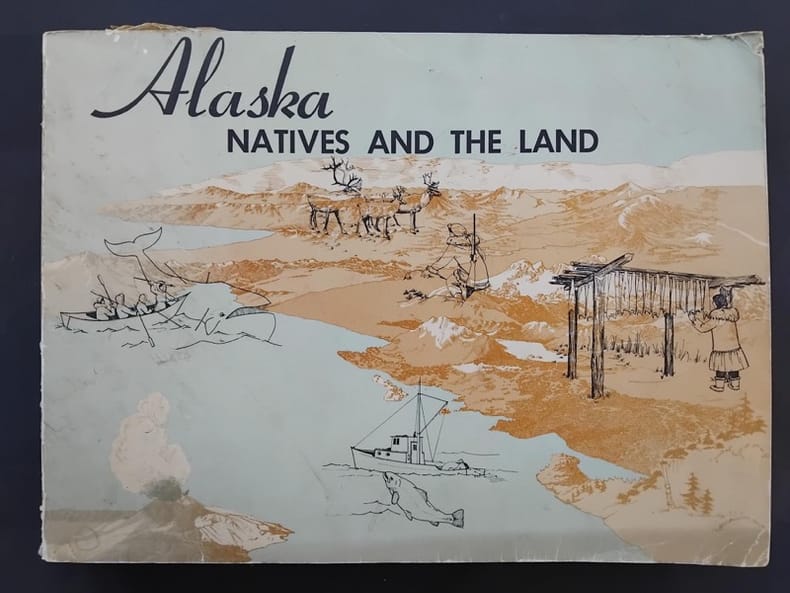
1968142615Federal Field Committee for Development Planning in Alaska 1968 Livre en anglais. In-4 broché 28 cm sur 38. 565 pages. Couverture défraïchie, dos passé, intérieur frais. État correct d’occasion.
198819824Smithsonian Institution Press, Washington, D.C.-Londres 1988 In-4, broché couv. illustrée, photographies en noir et en couleurs, 360 pp. En anglais.
Transboréal, 1997. In-8 broché de 429 pages. Photos hors texte. Parfait état
1997115556Transboréal Transboréal, 1997. In-8 broché de 429 pages. Photos hors texte. Parfait état
1932177173Alaska: 1932-3. The first Hollywood film to be shot in a Native American language A collection of behind-the-scenes photographs documenting the production of Eskimo 1933. With a mostly Native American cast it was the first feature film shot entirely on location in Alaska and the first to incorporate the Iñupiat language. Produced over a 17-month period it captured scenes of hunting and daily life with documentary realism. The photographs include images of the cast and crew among them the Iñupiaq lead Ray Mala Lotus Long Peter Freuchen and director W. S. Van Dyke as well as indigenous actors in traditional parkas and mukluks. Also shown are scenes of walrus and moose hunts extras posed in igloos animal processing and film equipment in use. Mala accompanied the Danish Arctic explorer Knud Rasmussen on an expedition from 1921 to 1924 collecting and describing Inuit songs and legends. The following year Mala commenced his career in Hollywood where he worked for almost 30 years. Eskimo later re-released as Mala the Magnificent was directed by Van Dyke and adapted from Freuchen's writings. Depicting encounters between Inuit communities and Western traders the film was not a commercial success. Still it was praised for its realism and awarded the inaugural Academy Award for Best Film Editing. Van Dyke known as "One Take Woody" for his efficient work made several other early sound films including Tarzan the Ape Man 1932 The Thin Man 1934 and San Francisco 1936. 48 silver gelatin prints from 64 x 88 to 87 x 105 mm. portrait and landscape format some stamped "Velox" on the verso others with pencilled numbers. A small number are copy prints. Some a little yellowed or with silver mirroring a few minor surface abrasions: a very good collection. Frank Javier Garcia Berumen American Indian Image Makers of Hollywood 2020; R. Bruce Macdonald Sisters of the Ice 2021. unknown
19004431Leipzig, Weber, 1900. XXI, 257 S. mit zahlr. Textabb. 34 Tafeln, 4 mehrfach gefalt. Panoramen und 2 separate mehrfach gefalt. farb. Karten. 4°OLwd. (gebräunt, etw. bestoßen, stärkere Gebrssprn.).
M14015Couverture rigide Ed Recto , 1992 , in4° cartonné à l' italienne , 90 pp. Splendides photos à pleine page. : Langue: Français
Copertina illustrata a colori in fascicolo originale completo de "La Domenica del Corriere" del 14/04/1946
193441889Stuttgart, Lutz, 1934. Halbleinen
1916257480Stuttgart, Lutz, 1916. Halbleinen
193313206Vannes 1933 338 pages in8. 1933. Cartonnage editeur. 338 pages. Biographie du frère Constantin-Marie (Désiré-Célestin Roulin 1874-1926) religieux éducateur des Frères de l'Instruction Chrétienne de Ploërmel. L'ouvrage relate ses missions chez les Peaux-Rouges des Montagnes Rocheuses chez les Esquimaux de l'Alaska et au noviciat de Bitterne Park en Angleterre
1286277353.Gpaperback. Good. Access codes and supplements are not guaranteed with used items. May be an ex-library book. paperback
1179226577.Gpaperback. Good. Access codes and supplements are not guaranteed with used items. May be an ex-library book. paperback
1179867734.Gpaperback. Good. Access codes and supplements are not guaranteed with used items. May be an ex-library book. paperback
1179753674.Gpaperback. Good. Access codes and supplements are not guaranteed with used items. May be an ex-library book. paperback
1179032926.Gpaperback. Good. Access codes and supplements are not guaranteed with used items. May be an ex-library book. paperback