6 880 résultats
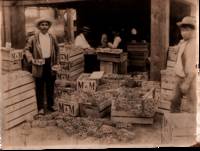
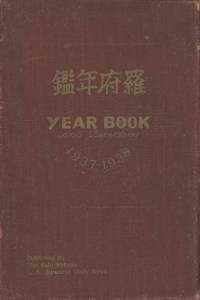
1922362523San Pedro CA: Nanka Mie Kenjinkai Southern California Mie Prefectural Society 1922. First Edition. Hardcover. Near fine. A very scarce Japanese-American history and Who's Who printed in Los Angeles in the Taisho era.<br /> <br /> Many Japanese immigrants to the US participated in organizations centered around their family's native prefecture. This book was published by the Mie Prefectural Association an organization of Japanese immigrants from the central southern coast of Japan. Not surprisingly given their coastal origins a chapter of this book is devoted to fishing. Immigrants from Mie prefecture were also very active in agriculture particularly growing nursery plants and cut flowers. The book includes a fold-out panoramic halftone of the Japanese produce market in Los Angeles.<br /> <br /> About two-thirds of the book is devoted to biographies of residents and their families; more so than other similar books the accompanying photographs often include entire families and not just the male head of household.<br /> <br /> Not in OCLC which records only modern facsimiles or A Buried Past or any other bibliography.<br /> <br /> 56 184 pages. First edition first printing. A near fine copy with minor wear to the publisher's cloth. Errata slip tipped to the rear free endpaper. Nanka Mie Kenjinkai [Southern California Mie Prefectural Society] hardcover
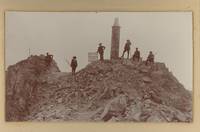
1890List2833Shasta County and Siskiyou County 1890. Fifteen photographs approximately 4 ½ x 7 ½ inches. Each mounted on heavy cardboard backing approximately 5 ½ x 8 ½ inches which is mounted on heavy cardboard of approximately 8 x 10 ½ inches. Unknown if photographs are stamped verso due to mounting. Some with recent captions on the largest mount; some captions likely incorrect see description. Fine contrast overall fine condition. Raper James Waters 1856–1937 was a professional photographer from Sacramento California. He was first active as a photographer in Gold Hill Nevada in the 1880s. Following this he returned to California and had studios in Berkeley and San Francisco between the late 1880s and mid-1920s. Offered here is a collection of fifteen of Waters’ photographs from around Mount Shasta likely from the late 1880s or 1890s.<br /> <br /> The photographs are mainly from places in Siskiyou County where Mount Shasta is located including shots of the towns of Sisson now Mount Shasta and Dunsmuir Sisson and Dunsmuir are on the Siskiyou Trail an ancient Native American footpath running from the San Francisco area to Portland Oregon. The Central Pacific Railroad Company completed a train line along the Siskiyou Trail in 1887; one shot from an unknown location shows railroad tracks rounding a curve among felled trees. Just outside of Dunsmuir is the Shasta Springs resort mislabeled here as Shasta Bottling Works famous for its springwater – the fountains of water in the photograph are from pressurized pipes coming from the springs.<br /> <br /> Other captioned photographs show Castle Crags hikers summiting Mount Shasta Mossbrae Falls and Castle Lake mislabeled as Crystal Lake. Photographs also show campers with their tent small houses a canoe on a lake and snowy winter scenes. Overall a striking set of photographs. unknown
190655705Del Monte CA & Detroit MI: Detroit Publishing Co. 1906. One large panoramic photocrom sized 14.25 x 42.5 in. mounted behind original 22 x 50 in. mat with original 27.5 x 55 in. quarter-sawn oak frame w/ original engraved brass plaque sized 1 x 4.5 in affixed to lower fore-edge retaining original glass. A superb example of this large photochrom panorama of the historic Gothic Revival Hotel Del Monte after it had been rebuilt in 1888 following a tragic fire. Charles Crocker and other members of the “Big Four†who had founded the Central Pacific and completed the transcontinental railroad formed the Pacific Improvement Co. in 1880 to develop the lavish Hotel Del Monte leisure resort immediately attracting thousands of annual visitors. The beauties of Monterey Bay groves of pine oak & cedar with well laid out roads were all designed to feed into the splendid hotel. The main building shown here in the image was 385 feet long by 115 feet wide with two deep wings and four stories with a tall tower containing choice suite with extended views of the countryside. The amenities included bars bowling alleys smoking rooms in detached buildings stables carriage houses ponds fountains and beautifully landscaped grounds. Occasionally mistaken for hand-coloured photographs these stunning images were created by a photolithographic process by which black and white negatives are applied to multiple lithographic stones and colours are added one stone at a time often requiring up to 19 different stones for these vividly coloured images. Jackson 1843-1942 was a noted artist and Western photographer who joined the company by selling his entire stock of 1000s of negatives to the Detroit Photographic Co. in 1897 providing the core images enabling the company to produce millions of images from postcards up to the large panoramas. In 1903 after the resignation of Edwin Husher Jackson took over the supervising and publishing of the images as well as supervising a crew of forty artisans and a dozen traveling salesman. See: Alan Michelson Pacific Improvement Company Hotel Del Monte #1 Monterey CA Pacific Coast Architecture Database 2018; Library of Congress Hotel Del Monte Detroit Publishing Co. No. 50228 Copyright Dec. 1906; Cynthia Read Miller & Rosalie Ehrlich Detroit Publishing Company Collection The Henry Ford 2001. Detroit Publishing Co., unknown
1910List2960Southern California 1910. Ten photographs measuring 8 x 10 inches and smaller with most measuring 5 x 7 inches. Brown Brothers stamps and manuscript captions verso; some with editorial overpainting; some mounted on heavy cardstock. Marginal damage with some tears and corners missing; very good. Japanese immigration to the US began at a large scale following the midcentury loosening of Japan’s emigration laws and the US’s 1882 Chinese Exclusion Act. Most Japanese immigrants entered through the west coast especially San Francisco Portland and Seattle and settled in central and southern California.<br /> <br /> Offered here are ten photographs of Japanese immigrants and laborers in California likely taken between 1900 and 1910 as one is dated 1903. Their work is mainly agricultural though one photograph possibly depicts miners: four men holding sledgehammers stand on a mountainside. Two show newly-arriving immigrants; in one women are lined up to receive a vaccine. Interestingly three of the photographs include women subjects—prior to the 1907 Gentlemen’s Agreement the Japanese population in some California counties had gender ratios of over 100 men to one woman and some simply had no female Japanese residents at all.1 One photograph that shows a woman at work in a cranberry field is identified as having been taken in Moneta California and the caption states that the cranberry farm was “leased by Japsâ€. Moneta actually had the least skewed gender ratio of any Japanese-American settlement at the time in part because its Issei residents were relatively economically better off and as the caption suggests could afford to lease or buy farmland.1<br /> <br /> Of interest to historians of Japanese immigration to California and the Japanese-American labor force around the turn of the century.<br /> <br /> 1 Lane Ryo Hirabayashi & George Tanaka “The Issei Community in Moneta and the Gardena Valley 1900–1920†Southern California Quarterly 70 no 2 Summer 1988: 127–158. unknown
1865List2438Camp Low 1865. Original partially printed document 26cm x 77cm. Printed on both sides of the sheet completed in manuscript. Darkening at folds from old tape repairs; partial splits to folds and extremities; complete and quite Good. Docketed verso signed in ink by Lieutenant Morgan Owen. Lists twelve enlisted soldiers most with Spanish surnames two with French surnames. Fine. The formation of the California Native Cavalry in 1863 marked a significant chapter in the state's history. Comprising primarily Mexican-American individuals colloquially referred to as "native" Californians the California Native Cavalry unit was formed 1863. Initially commanded by Maj. Andreas Pico a distinguished hero from the Mexican-American War and later under Salvador Vallejo the regiment drew its ranks from diverse backgrounds. Recruitment efforts began with vaqueros from southern California expanding to include individuals from San José and San Francisco. The unit boasted a varied composition encompassing not only Mexican-Americans but also Chilenos California and Yaqui Indians and even French legionnaires.<br /> Company "B" a contingent largely recruited from the northern part of the state is reflected in the existing muster roll. The company assembled at Camp Low near San Juan Bautista in 1865 making a striking entrance into the town. Described as "gay and gallant Spanish lancaroes" the cavalrymen presented a formidable sight with lances in hand and flags flying leaving a lasting impression on the townspeople who had never before encountered soldiers."The gay and gallant Spanish lancaroes sic came dashing through the town with the lances in their hand a flag flying from each of them. I assure you that they presented a war like appearance the people here had never seen a soldier in their lives – Yes Sir!." letter Maj. Michael O'Brien to Gov. Frederick Low January 1865; quoted in Prezelski "Lives of the Californio Lancers: the First Battalion of Native California Cavalry" in Journal of Arizona History v.40 no.1 Spring 1999. <br /> Under the command of Capt. Porfirio Jimeno Company B swiftly engaged in a critical mission: dismantling the notorious Mason-Henry Gang that had terrorized the San Juan region in the preceding months. Despite successfully wounding John Mason in early April 1865 the gang persisted for another month until Mason met his demise at the hands of a miner he sought to kidnap.<br /> However Company B faced challenges including low morale and a high rate of desertions with over 40 men leaving the company in 1865 alone. Transferred to Tubac Arizona Territory to confront the Apaches the company encountered further desertions along the way. The muster roll listing only twelve soldiers alongside Capt. Porfirio Jimeno reflects this tumultuous period. Overall the muster roll provides scarce documentation of the role of Mexican-Americans in the Civil War with few other examples in the trade or institutionally. unknown
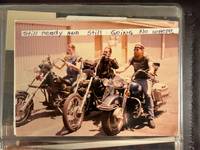
212731970. Biker Subculture Southern California biker community photo albums documenting motorcycle culture during the 1970s and 1980s a period when custom chopper building club rides and regional motorcycle gatherings characterized a flourishing biker subculture in the post Vietnam era. The photographs record a network of riders with heavily customized motorcycles participating in social gatherings and long distance desert rides across Southern California and neighboring states. Images emphasize the culture of the biker scene including extensively modified Harley Davidson Panhead and Shovelhead engines elongated front forks tall sissy bars and individualized paintwork that reflected the craftsmanship and identity of their owners. Named individuals appear repeatedly including riders identified in captions as "Horney" and "Fin' Flower of Carson" suggesting a tightly knit group whose members documented both travel and everyday social life.<br /> <br /> Two brown faux leather photograph albums containing 317 color photographs inserted in plastic sleeves. Images measure approximately 4 x 4 inches or 3.5 x 5 inches with approximately thirty wallet size reprints interspersed among the full size photographs and three loose photographs present in one album. The albums measure approximately 9.25 x 13 inches. The photographs depict custom motorcycles group rides desert landscapes roadside stops garage repair scenes and social gatherings including birthdays and informal parties. Several motorcycles appear repeatedly including a customized Harley Davidson Panhead referred to in captions as "Horney's Pan" often photographed in desert settings during group rides. The archive also includes images of vintage American automobiles such as a black Lincoln Continental referred to in captions as the "Incognito Car." Women appear frequently within the gatherings and rides participating in social events and group outings alongside male riders.<br /> <br /> The photographs document the culture surrounding American motorcycle clubs during a period when biker identity was taking shape across the American West. Southern California was a major center of motorcycle customization during the 1970s with communities forming around garages where riders modified engines frames and bodywork to produce personalized machines. Recurring captions and identifiable individuals suggest a cohesive social network whose activities combined a love of bike mechanics travel and community. Minor edge wear to album covers light toning to photographs and occasional creasing to sleeve inserts. Photographs generally well preserved with strong color overall very good condition. A substantial photographic record of Southern California motorcycle clubs during the late twentieth century. unknown
1880List2834Sears Township California 1880. 10 ½ x 16 inch ledger seventy-five pages. Staining and damage to corners not affecting legibility. Very good to excellent. A ledger of the Sears Township assessor documenting assessment of property values. Sears Township does not appear to exist anymore but a November 1891 census bulletin lists a Sears Township in Sierra County with a population of 400 in 1890 and 585 in 1880. This is likely the same Sears Township as many of the property locations in the ledger are within present-day Sierra County such as Scales St. Louis Howland Flat and others. A later pencil marking on the first page attributes the ledger to Plumas county; this is probably incorrect. The properties include homes businesses and mining claims – most are the latter. <br /> <br /> Chinese immigrants played a significant role in the California gold rush and the ledger indicates the presence of a number of Chinese people in the area particularly in the town of Scales – enough of a presence that according to the ledger Scales had a “Chinatown.†This is given as the location of Ah Toy’s house and a more precise location for Scales’ Chinatown could be found from the ledger’s description of Ah Toy’s residence. Many individuals listed under “Ah†owned property in Scales: Toy Hung Fook and Fon owned houses Tong owned a meat market and Chung owned a warehouse. In addition Hopsing Chung is listed as owning a storehouse in Scales and the first page notes the Ah Wok Mining Company’s claim in Council Hill. Note the possibility that those listed as “Ah†are not one family; “Ah†is not necessarily a surname but can be a sort of nickname-generating prefix similar to “cousin†or “uncle/auntie†that often ended up appended to Chinese immigrant’s names.<br /> <br /> Of interest as a detailed record of the former properties and residents of some of California’s mining ghost towns. unknown
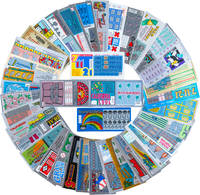
997California: California State Lottery Commission 1990. A complete and continuous unbroken run from the first 5 years of the California lottery a total of 40 tickets games 1 to 40 #26 is a proof. Each ticket is unscratched. Fine condition as new alluringly printed in glowing colors the silver coatings are unblemished. Rare. Though individual used scratched tickets are sometimes available we have seen only a couple of unused tickets from this vintage for sale in the last 35 years and we know of no one else offering a complete set. The lottery is adventure and romance finally reduced to their level of minimum effort and repute—hey you never know.<br /> <br /> Scratch-off lottery tickets embody a complex social phenomenon within contemporary society. They represent the commodification of hope where the state sanctions and profits from selling the possibility of economic transformation to citizens particularly those in vulnerable financial positions.<br /> <br /> These tickets function as symbols of pseudo-democratized wealth in a system of increasing inequality. The lottery mythology suggests anyone can instantly transcend economic barriers through pure chance while statistically serving as a regressive taxation mechanism.<br /> <br /> The scratch-off format specifically reduces risk-taking to its most minimal form—a momentary act requiring neither skill nor meaningful engagement. This mirrors broader social trends of simulating adventure rather than pursuing authentic experiences with genuine stakes and potential personal growth.<br /> <br /> Lottery tickets exist in a unique temporal space of perpetual potential until scratched creating a liminal experience that suspends the player between worthlessness and potentially life-changing value. This liminality captures how modern capitalism monetizes the space between aspiration and reality converting dreams into revenue while rarely delivering on its implicit promise. California State Lottery Commission unknown
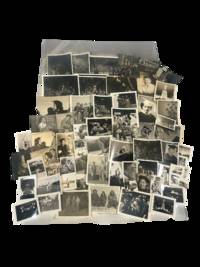
1937226661937. Japanese-American California Japanese American family photograph archive a mid-twentieth-century record of Japanese American community life in California before and after the wartime incarceration of people of Japanese ancestry under Executive Order 9066 during the Second World War. The photographs mostly date between 1937 and 1940 with a few dated 1952 and 1953 preserving decades in the lives of one family navigating forced removal wartime confinement and postwar resettlement. Captions identify "Sayoko" "Sayo" "Miyoshi" and a young boy named "Kenny" creating a generational thread between prewar Japanese American life in California internment and re-acclimation to civilian life after World War II. One photograph bears a wartime military postal censorship stamp reading "Passed by Army Examiner" indicating that at least one image circulated through military screening systems used to monitor correspondence connected to wartime detention camps or military service.<br /> <br /> Archive of over sixty black and white snapshot and studio photographs depicting members of a Japanese American family associated with California between the late 1930s and early 1950s. The images include studio portraits graduation photographs informal domestic scenes travel photographs and family group portraits. Several photographs depict recognizable locations in San Francisco and Los Angeles and one studio portrait bears a photography studio stamp from Oakland suggesting family connections across both Northern and Southern California. A signed graduation portrait dated 1937 identifies a young woman as "Sayoko" while photographs from the early 1950s show a young boy identified as "Kenny" with inscriptions referencing "Sayo" likely the same individual seen in earlier images suggesting the transition from young adulthood to motherhood across the intervening wartime decade. Additional images depict a recurring young Japanese American man in glasses and formal attire a young woman identified as "Miyoshi" couples photographed aboard boats likely operating as local ferries and extended family gatherings in domestic and social settings. Several larger format photographs show women performing traditional Japanese dance in kimono within a landscaped Japanese garden while another image shows a man with two sons posed before a United States Air Force B-36 Peacemaker bomber placing that photograph in the postwar period. Photographs measure approximately 1 x 1 inches to 5 x 7 inches with most around 3 x 4 inches.<br /> <br /> Japanese American communities in California during the late 1930s maintained extensive family educational and social networks centered in cities such as San Francisco Oakland and Los Angeles. After the attack on Pearl Harbor in December 1941 the federal government forcibly removed more than 120000 individuals of Japanese ancestry from the West Coast and confined them in inland detention centers administered by the War Relocation Authority. Personal mail entering and leaving the camps was subject to military censorship and photographs were sometimes stamped with inspection marks such as "Passed by Army Examiner." The presence of such a mark in this archive situates the photographs within the surveillance structures surrounding wartime incarceration and suggests that family communication continued through monitored correspondence. The continuity of portraits spanning youth education wartime absence and postwar family life provides a visual sequence documenting how Japanese American families maintained kinship networks and memory across the disruption of forced relocation and confinement. Minor edge wear and occasional corner creasing to several photographs; overall good to very good condition. A cohesive photographic record documenting Japanese American family continuity across one of the most consequential decades in twentieth century West Coast Asian American history. unknown
186329955Sacramento: Printed by A. Badlam 1863. 8vo. 8 13/16 x 5 5/8 inches. 26 iv 25-142 3 pp. Publisher's calf-backed printed paper boards. Preliminary ads printed on yellow red and green paper<br/> <br/> An early Sacramento business directory published in California during the Civil War.<br/> <br/> An invaluable source of information from the period with advertisements for a wide-range of businesses including shippers wine merchants surgeons dentists and druggists printers and bookbinders photographers grocers hardware dealers and more. Besides the alphabetical directory the work includes a brief history of Sacramento as well as information on the state county and city offices local institutions as well as post offices and stage routes. With a few pencil annotations by an early resident of Sacramento about the people and places mentioned in the text. Rare with only five examples cited by OCLC with only one being outside of California.<br/> <br/> Rocq 6528. Not in Cowan. Printed by A. Badlam unknown
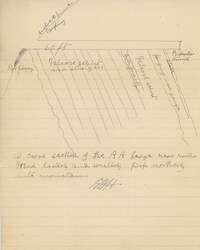
1921List3318California and Oregon 1921. 160 total items. Description of Pacific Coast Outlaws 32pp 8vo in cloth wraps; wraps excellent with some staining; contents very good to excellent with some water damage. Thirteen copies found on OCLC. Two business cards one with manuscript notes; 106 letters dating 1906 to 1911; twenty-two mailers circulars shareholder solicitations etc.; twenty-eight pieces of miscellaneous accounting records; and one Trinity Gold Dredging Company map measuring approximately 14 x 28 inches. Overall excellent. Harry N. Morse 1835–1912 was born in New York and came to San Francisco in 1849 seeking gold. After several odd jobs he became a deputy provost marshal in Oakland in 1862 was elected Sheriff of Alameda County in 1863 and held this office for fourteen years before establishing his private detective service in San Francisco. Morse is known for the arrests and killings of numerous California outlaws many of which Shinn’s booklet treats in great detail though with a focus on the Mexican-American contingent to the neglect of some of Morse’s more notable successes such as his role in the capture of Black Bart.<br /> <br /> The majority of the items in this archive concern Morse’s late-career foray back into gold mining first in Lewiston California and then in Applegate Oregon. John Marchand was Morse’s foreman in Lewiston and generally writes to him about the failures of their Lewiston enterprise. Many of the difficulties are attributed to troubles with a steam shovel though the claim itself turns out to be a dud. Marchand informs Morse near the end of their correspondence:<br /> <br /> “Things here I’m sorry to say have gone from bad to ‘very bad’. Y’day I got down to ‘bed-rock’ uncovered a piece 46 by 10 ft and increadible as it may read there was not 30¢ in there some pans in fact you could not get a color.†August 10 1906<br /> <br /> Morse then invests in a claim in Applegate Oregon with more success. The main setback in Applegate is that his mine is repeatedly sabotaged. His foreman E.B. Hawkins explains:<br /> <br /> “I realise things from this end must appear perhaps irregular or peculiar On or about the 17†of May the mine was dynamited I did not write you at that time because I thought I could catch up the ground in two or three days. It took nearer 20 and another thing you had sickness and later death in your family so I did not write about that first offence at all On June 17†we found the Star mine dynamited again good and plenty not less than 10 lbs of powder had been used for the job. They blew the h__l out of things blew the top off of the shaft and the gallows frame awry. I am almost certain I would have succeeded had I had only natures elements to contend with. I don’t know what in h__l will happen on the 17†of July This anarchy is beyond me. On the 17†of May I fired the distasteful element paying them off and I have fired the 17†of June element paying them off – I borrowed $50.00 from Jno. Pernoll to pay them there was 3 of them had not been working longâ€. June 19 1907<br /> <br /> Hawkins soon identifies the culprits:<br /> <br /> “On June 27†Jim Rock Sr. and Dick Rock came to me and offered to square the damages done at the star mine saying that if the mine was blasted their two boys were in on it On July 2†Dick Rock came to me and said his son Roy had confessed saying there were four in it namely Harry Gething Chas Brown Young Jimmy Rock and Roy Rock Dicks son They had all been working at the star. On July 4†Roy Rock confirmed to me same as above saying Harry Gething was leader and young Jimmy Rock was helper that they had a jig of whiskey on the ground that night Jimmy Rock furnished the whiskey Strange to say that every time I have gotten ready to take a certain good block of ore out of the star the mine has been blasted I propose to take that block of ore out if I live and can get grub while doing it†July 6 1907<br /> <br /> Hawkins has a few other confrontations with workers though none this severe and his letters are mainly providing Morse with in-depth updates on the status of the mine including many of Hawkins’ diagrams. The Star mine is never a roaring success and the pair consider trying cyanide mining—â€the salvation of southern Oregon†1908—and gravel mining in British Columbia.<br /> <br /> Of interest to historians of the post-Gold Rush west especially gold mining therein. unknown
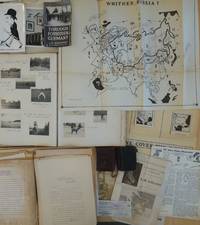
1950List2425Europe and California 1950. Includes two small diaries from 1901 and 1917 with sporadic entries a large photo album measuring 14 x 11 with appx. 400 small photographs from 1906-1909 attached to album pages most measuring 3 x 2 as well as a few larger format images laid in. With 100 plus pages of typed pages including retained correspondence story ideas and various other manuscripts. With eleven maps produced for his “Of Men and Maps†series including five copies of a large map entitled “Whither Russia†in varied states and in large sizes up to 30 by 36 inches and a handful of small ephemeral pieces. Generally near fine condition with the exception of the album which is missing its rear board and has some pages loose and torn. Very Good. J.M. de Beaufort a war correspondent for the London Daily Telegraph and New York American during World War I recounted his wartime adventures in the 1917 book "Behind the German Veil: A Record of a Journalistic War Pilgrimage." Originally arriving in Chicago in 1909 he married a steel magnate's daughter and pursued a career in show business. However by 1912 he had gone through a divorce and transitioned to newspaper work earning the moniker of the "Dude Reporter." Originally born in the Netherlands as Jacques Albert Uilenbroek he was thought to be a deserter. He spent the latter part of his life in the United States apparently jailed in San Francisco for a stint in the 1920s and eventually settled in Los Angeles. <br /> Offered here is an interesting smattering of material from the life of the mysterious De Beaufort which bookends his most unusual career and life with a large visual photographic record of his life in Europe as a young man and over a hundred pages of manuscript material from late in his life with a highlight being several maps in draft form for an apparently unpublished project called “Of Men and Maps.†As a group the material shows the work of an ex-con artist and war correspondent trying to regain his form while living in Los Angeles. He was still writing as a “Special Correspondent†at this point though the title seems to have been fully honorary. Also included are two small pocket journals with sporadic notations from his life in Europe in 1900 and in 1917. In its entirety the group gives an interesting visual and manuscript record of a literary fraudulent and imaginative transatlantic life and intellect. <br /> The cartographic highlight of the group is several iterations of a large map called “Whither Russia†in varied forms which show an interesting interpretation of the sphere of influence of the USSR and its growth from 1939 to 1946. Also included are two drafts of a map of Operation Market-Garden in the Netherlands in 1944 an unidentifed tactical map of a military battlefield a map called “Middle East Jackpot†showing the division of territory between the Allied and Axis powers a map called “Dawn’s Early Light some reproduced small format maps from the De Beaufort’s and a small map called “Gifts from Yalta.†De Beaufort was working on these maps for a column called “Of Men Maps and Memories†that was published in the East Los Angeles Tribune. He also sent the columns out in newsletter form from his address at 1635 N. Ogden Drive in Los Angeles. <br /> The collection of manuscripts drafts and retained correspondence tackle a range of subjects perhaps most interestingly those detailing De Beaufort’s creative process - drafts of stories lists of ideas for stories and letters. His over the top style is on display in a lot of the writings some of which are of unknown origin and purpose. The documents contain correspondence between De Beaufort and Edwin Pauley the oil man and presidential advisor. In one untitled essay he asks himself the question “What has been your most thrilling experience†and his reply is “ Silly questions. Who or at least what newspaperman of some 25 turbulent years standing - and falling - could answer such a question. A reporter’s life has a thousand thrills. There was that rainy day in Marcy 1915 in the fortress of Loetzen when I stood face to face with Hindenburg. Hm yes that was quite a thrill…†De Beaufort was entrenched in the Los Angeles journalistic scene at this point and the documents show the degree to which he relied on his former glories to attempt various career revitalizations endeavors. <br /> The album of photographs from 1906-1909 over 400 in total give a visual record of the young Uilenbroek’s life in Europe. The star of the collection is his bulldog Bob who travels throughout Europe with him and eventually comes to America by 1907. Mary who we presume to be his future wife is featured heavily in the images. It is unclear whether he was working at this point the images show affluent young people and their dog in varied cities and are purely of a personal nature. Other photographs laid in are relics from his war correspondent period. The loose photographs and ephemera are a mix of portraits from different periods from his life including two pictures of Sydney Turing Barlow Lawson one signed by his widow. The journals are sporadically filled and hard to decipher though one legible passage says “drinking all day.â€<br /> Overall the group gives evidence of this intriguing life and is the only extant group of material relating to Beaufort to our knowledge with the exception of a single journal from his time in Belgium during WWI that was sold at Bonhams and is still available in the trade as of this writing. unknown
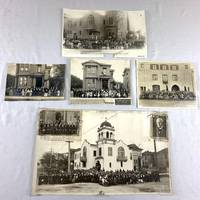
4750Oakland 1986. Good. Seven substantial photographs measuring between 6 x 9 inches and 7.5 x 36.75 inches plus approximately four linear inches of programs newspapers additional photographs holograph notes financial records and more. Varying levels of wear soiling chipping and repairs to the photographs. A rare collection of substantial images picturing members of the Oakland Japanese Methodist Episcopal Church in the early-to-mid 20th century first at what appears to be a converted home in the city and later at their larger more traditional church on West 10th St with an additional image of an outing to Piedmont. The incarceration of Japanese Americans during WWII led to the temporary closure of the church. During this time one of its halls was used to store the possessions of incarcerated Japanese and Japanese American citizens; after the war it served as a hostel for returning members. In 1967 the church sold the land and moved at the invitation of Lake Park Methodist Church to the latter's premises and in 1968 the two churches formally merged. The second portion of the archive relates to the Lake Park Methodist Church both before and after this merger. The photographs present here depicting the earlier years of the Japanese Methodist Episcopal Church are as follows in chronological order:<br /> <br /> 1 Oakland Japanese M.E. Church. Sept. 30 1917 caption title. 7.5 x 9.5 inches. A handsome black-and-white group photograph outside the church captioned in the plate in English. The wooden sign for the church is mounted above the entrance and reads "Japanese M.E. Church." An American flag flies above the sign. Evidence of construction paper adhesion to verso; clear tape to upper corner; light soiling.<br /> <br /> 2 Methodist Ministers' Conference caption title in pencil on verso. 6 x 9 inches. Similar setting to the photograph above this black-and-white group photograph features a group of almost forty ministers of the Methodist Church most of whom are not Japanese American but apparently met in conference at the Japanese Methodist Episcopal Church in Oakland circa 1917 though a pencil note on the verso reads "1912". Formerly mounted with tape remnants to verso and one corner some creasing a few short closed tears.<br /> <br /> 3 Japanese Methodist Episcopal Church of Oakland. Dedicated Feb. 24th 1918 caption title. 12 x 20 inches. A substantial black-and-white group photograph outside the church featuring a couple hundred members presumable posed for the church building's dedication. Two newspaper clippings of ministers of the church are taped to the upper corners small semicircle of loss and tape to middle of bottom margin tape to corners and verso. <br /> <br /> 4 Uncaptioned Panoramic Photograph Featuring Church Members in 1925. Tsuji Studios stamp on verso and embossed blind stamp in lower margin. 7.5 x 36.75 inches. Pictures the church membership of over a hundred Japanese American men women and children in the midst of the Roaring Twenties. Heavy dampstaining and damage to left side obscuring about five inches of the image. Accompanied by another example of the same photograph also with Tsuji Studios stamps this copy with damage to the right side. This second example has an ink inscription in Japanese on verso and a computer-printed date taped to the bottom margin and reading "1925." The chipping on each side of the two photographs obscure some of the subjects but taken together these two images record all of the information contained in the photograph.<br /> <br /> 5 Church Outdoor Ceremony at the Piedmont Hills caption title in Japanese. 8 x 32 inches. A striking sepia-toned panoramic photograph capturing an outdoor excursion to the Piedmont hills in 1927 four captions in the negative printed in Japanese. Tsuji Photo Studio stamp on verso along with a short manuscript caption in pencil in Japanese. Light marginal staining; toning.<br /> <br /> 6 Farewell Ceremony for Pastor Arima and His Family. January 8 1933 caption title in Japanese. Tsuji Photo Studio. 7.75 x 9.5 inches. Handsome sepia-toned group photograph of a farewell gathering for Pastor Arima and his family in early 1933 captioned in the plate in Japanese. An ink inscription on the verso confirms the caption in the negative and reads "Farewell photograph taken on January 8 1933 prior to the departure of Rev. Arima & family to Japan." Rough patch to lower corner and lower edge likely from tape removal slightly affecting the extremities of the image.<br /> <br /> 7 Final Service at the West 10th Methodist Sanctuary. Feb. 5 1967 caption title. Utsumi Studio. 8.5 x 14 inches. An informative black-and-white group photograph depicting the congregation at the West 10th Methodist Church location after it was sold in 1967. Small chip and closed tear to bottom margin affecting part of caption tape to verso.<br /> <br /> The later portion of the archive documents church life and activities at Lake Park Methodist Church the vast majority of which emanates from prior to the merger of the two churches. This earlier material includes a notebook of board meeting notes from 1967 numerous typed board meeting agendas from the 1960s two issues of the Lake Park Methodist Church newsletter called Spotlite church programs and fliers a few Methodist newspapers such as the United Methodist and Lake District Reporter and numerous photographs picturing Anglo-American members of the church. The post-merger material includes a dual-language newsletter and calendar for October 1972 listing the minister as George Uyemura a folder of financial records from the Lake Park United Methodist Church School from 1969-70 and two newsletters from November 1968.<br /> <br /> An important record of Japanese American religious life in Oakland before during and after the collective trauma of WWII incarceration as well as a peek into the development of a particular California Methodist Church later in the century. unknown
1937List3229Los Angeles California: The Rafu Shimpo / L.A. Japanese Daily News 1937. appx 90 485 pp. Limp cloth. With illustrations in color and black and white. Near Fine condition with some light wear to covers. A very scarce directory of the Japanese-American community with a focus on Los Angeles but also covering other areas of California including Terminal Island and San Pedro and San Francisco and other states such as Utah and Washington published by the Rafu Shimpo. The directory lists the physical addresses and phone numbers of the residents. The first ninety or so unpaginated pages show photographs of prominent businesses and residents and also include advertisements for Japanese-American businesses. Togo Tanaka an editor at the paper lobbied unsuccessfully for the paper’s continuation in the event of a war with Japan. He was eventually sent to Manzanar and the paper ceased publication in 1942. It would resume operations in 1946 due to the efforts of Akira Komai the son of owner Toyosaku Komai who stealthily hid the Japanese type under the floorboards of the office and paid the rent for the duration of the conflict. The directory continued until 1941. This issue presumably published in 1937 was the first in the series.<br /> <br /> Yokoi Iris September 19 1993 "LITTLE TOKYO - Extra! Extra! Rafu Shimpo Is 90" The Los Angeles Times. The Rafu Shimpo / L.A. Japanese Daily News unknown
1906200281906. Mexico Photography Vernacular photograph album documenting daily life labor and civic culture in Mexico and California 1906-1908 with substantial visual material from the late Porfirian era preceding the Mexican Revolution. The album records markets religious architecture rural labor and public spectacle across central Mexico alongside views of communities in the American South and Southern California. More than half of the photographs were made in Mexico and depict scenes in Mexico City Puebla Villa de Guadalupe Chapultepec and Guadalajara. <br /> <br /> Oblong large 8vo album in black cloth boards containing 179 silver gelatin and sepia photographs 1906-1908. Photographs measure approximately 3 x 3.5 inches to 5 x 9.5 inches. Subjects include vendors at flower markets rural families gathered outside stone dwellings laborers in straw sombreros working with pack donkeys to transport goods women selling fruit beneath shaded trees and a candid image captioned "Returning from market" showing a vendor walking with a crate strapped to his back. A bullfight before a full stadium documents a major form of popular entertainment. The photographs offer a record of the working economies religious practices and public gatherings that structured everyday Mexican life in the years immediately before the upheavals of 1910. Compiled as a personal album the sequence opens in Spartanburg South Carolina with street scenes and images of African American performers that document the social landscape of the Jim Crow South and includes intervening views from Atlanta Montgomery New Orleans and San Antonio before the album settles into its substantial Mexican content. Images mounted directly to album leaves with detailed contemporary manuscript captions. Nine larger-format photographs present panoramic views of Puebla and Villa de Guadalupe emphasizing the agricultural landscape and small-scale urban settlement that surrounded these communities. Architectural studies include the Mexico City Metropolitan Cathedral and an ornate café in Chapultepec with horse-drawn carriages and formally dressed patrons. California images from Redlands Santa Monica and Pasadena depict coastal landscapes mission-style and clay-roofed structures stone pathways ranch settings and equestrian travel documenting regional built environments and the lifeways of established Californian communities prior to large-scale suburban and automobile-driven development.<br /> The album records everyday labor commerce religious life and leisure in central Mexico during the final years of Porfirio Díaz's regime alongside monumental civic and religious architecture. Manuscript captions anchor the photographs to specific places in Mexico and the American West. Minor spine and edge wear to boards; some pages with slight warping; light fading to a small number of images; photographs generally clear and well preserved. Overall very good condition. A substantial early twentieth-century album documenting Mexican and Southern Californian life immediately prior to revolutionary and metropolitan change. unknown
1926321837Modoc County California 1926. 107 photographs most 3-1/4 x 5-1/4 inches but others ranging from 2-3/4 x 2 inches to 10 x 8 inches mounted to eleven card-stock leaves. About one-third of the photographs with manuscript captions in the lower margin or typed captions in the image. 1 vols. Oblong 11 x 14 inches. Contemporary three-quarter leather and patterned paper photo album string-tied. Boards quite rubbed and worn. The photographs in quite nice condition. Very good overall. 107 photographs most 3-1/4 x 5-1/4 inches but others ranging from 2-3/4 x 2 inches to 10 x 8 inches mounted to eleven card-stock leaves. About one-third of the photographs with manuscript captions in the lower margin or typed captions in the image. 1 vols. Oblong 11 x 14 inches. An evocative portrait of deer hunting and other outdoor activities in northern California in the mid-1920s. Many of the activities depicted took place in Modoc County in the far northeast of the state while other camps were made in Shasta National Forest. The album bears the ownership signature of Dr. John H. Brunings on the front pastedown. In a newspaper clipping affixed to one of the album leaves Brunings of San Francisco is identified as a "well known sportsman." Among those depicted in the album is a favored hunting partner of Bruning's Dr. L.N. Briones also of San Francisco.<br /> Much of the album depicts hunters in the field with numerous recent kills and trophies showing the deer field-dressed in place hanging from trees and camp poles draped over car hoods or horses or antlers affixed to other camp structures or car hoods 45 total photographs; duck hunters with daily kills some showing dozens 12; the deer hunters in the field or in camp 17; hunters in the field with a beautiful setter and shotguns 9; a hunter with recently killed rabbits 1; views of the hunting grounds in the Modoc County mountains 7; miscellaneous images of Dr. Brunings mostly with friends in the outdoors 13; Brunings in the U.S. Navy in China 1; view of main street in Adin California 1; and an image of a "pinto" deer a buck with distinct white patches killed by Brunings near Gualala California 1 photograph the 10 x 8 print.<br /> Typed captions appear either in the image or in the margins of twenty photographs mostly from Happy Camp and Horse Springs nineteen others have ink captions in the margins. The captions note locations as well as the names of many of those depicted. unknown
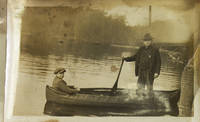
1927316594Oakland 1927. 28 gelatin silver photographs backed with canvas with a detailed typed caption on verso. 1 vols. Oblong 8vo. Ring-bound flexible leather boards. Some wear and crude repairs toning and minor wear to photographs. Very good. In a folding cloth box gilt leather spine label. 28 gelatin silver photographs backed with canvas with a detailed typed caption on verso. 1 vols. Oblong 8vo. An unusual album featuring boats and canoes manufactured by the King Boat Company of California. Many of the photographs are dated 1927 and the album serves not only as a visual catalogue of various boats available from the King Boat Company but also as a document of water travel in Alaska California and the Pacific Northwest in the 1920s.<br /> The canvas backing on the first and last images bears the inkstamped name of F.R. Frederick a distributor based in Boston. Whether this album was prepared by Frederick or by the King Boat Company is unclear. What is clear is that these are very interesting images of various King Boat Company boats and canoes in use.<br /> Nine are identified as having been photographed by "Lewis R. Freeman Noted Explorer and Writer for National Geographic Magazine on Thousand Mile Canadian Trip. Summer of 1927" a tenth is an image of Freeman with an Arrow Boat.<br /> Freeman a noted traveler explorer and writer published over twenty books on his travels. Other images reveal "Arrow Model on Heart Lakes in the High Sierra - 11500 Feet Elevation. Colonel H.G. Thompson at the Oars"; "Boat owned by T. Wherry Taxidermist Victoria B.C. was built in 1893 and in service for over 34 years up to November 1927 on display in King Boat Company Factory Oakland California"; a couple images of canoes loaded on pack horses; several of Henry W. Partridge "Noted Packer" navigating the Salmon River in Idaho; images of boats in Alaska and the Yukon; and several others of boats on shore in use as shelters or otherwise employed. unknown
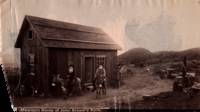
1880List2900Los Angeles California 1880. Two photographs measuring approximately 4 ½ x 7 ½ inches. Pasadena Historical Society stamps verso. One with manuscript caption verso including “Mtn Home of John Brown’s Sons Located just south of Brown’s Peak between Millards Cañon arroyo secoâ€. Wrinkling and marginal tearing with some missing corners. One photograph with tape residue. Very good. Owen Brown 1824–1889 and Jason Brown 1823–1912 were two of abolitionist John Brown’s twenty children. Owen Brown participated in both the Pottawatomie massacre and the Harpers Ferry raid. Following the unsuccessful raid he led the party of escapees to Pennsylvania. He lived in Put-in-Bay Ohio until 1885 when he joined his brother Jason—who was not involved in his father’s activities—in Pasadena. The two lived in poverty in mountain cabins several miles outside the city; offered here are two photographs of the brothers standing outside their cabins. In their time in Pasadena they were described as eccentric and hermetic but were liked and respected by those in town. Several obituaries of Owen Brown describe how witnessing the growing anti-Chinese sentiment in the region the brothers hired two Chinese men from the area to work for them “for the sake of the principle although they had no need†of the workers.1 One of these laborers may be the third man standing behind Jason Brown in the photograph where the brothers are astride donkeys.<br /> <br /> Of interest to scholars of the Brown family and their legacy.<br /> <br /> 1 “The Late Owen Brown. The Peculiar Life of the Son of the Abolitionist Ends in California.†Indianapolis Journal January 13 1889 8. unknown
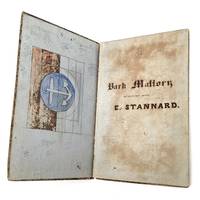
80034A logbook of accounts kept by Captain Elbert Stannard for two of the ships he commanded out of the port of San Francisco in the late 1850s and '60s the Bark Mallory and the Bark Daniel Webster. The latter was sold in 1861 to the government of Japan and became the first warship in the Japanese navy.<br /> <br /> The account book contains 22 pages related to the Bark Mallory and approximately 70 pages of accounts concerning the Daniel Webster. On the first page is written: "Bark Mallory in Account with E. Stannard".<br /> <br /> The blue-lined pages are written on in ink and pencil. Much of the spine has perished the marbled boards are detached and it appears a few pages have been removed from the logbook.<br /> <br /> The accounts concerning the Daniel Webster are dated between 1859 and 1861 and begin with the cost of repairs for its voyage from New York to San Francisco. It then traveled to Victoria and Perth from San Francisco and traveled from San Francisco to Shanghai and Kanagawa Japan and back.<br /> <br /> According to newspaper records Stannard 1828–1907 was in command of the first steamboat to enter Japanese and Chinese waters trading between these ports and San Francisco. He made his home in Westbrook Connecticut.<br /> <br /> Historical records indicate the Bark Mallory had been plying the coastal trade since the 1850s. The ship was hired by Snohomish Mills to transport lumber from Washington to San Francisco since there was not enough demand in the local lumber trade. On one of her voyages the Mallory took on water near Cape Flattery and was beached at Neah Bay. The windfall of lumber wound up in many local buildings.<br /> <br /> The log from 1857 for the Bark Mallory includes a line for payment of “Chinamen pumping†for $18.50. By 1848 when the first Chinese arrived in San Francisco they had already established a pattern of leaving China to work in other parts of the world.<br /> <br /> This logbook also contains an untitled handwritten 2 ½ page poem about mining with no attribution. unknown
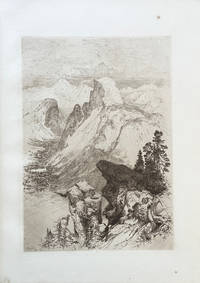
188763320San Francisco & New York: The J.ames Dewing Company Publishers J. Dewing Publshing Co. changeover in 1888 1887-1888 i.e. 1890. Ten vols. Folio. 8 48; 2 49-96; 2 97-144; 2 145-192; 2 193-240; 2 241-288; 2 289-336; 2 337-384; 2 385-432; 2 433-478 8 pp. with titles Div. 1 & end of Div. 10 in red & black. With 120 sepia- and aqua-tinted photogravures and etchings along with illustrated printed tissue guards and 100’s of woodcut engravings etchings and tinted text engravings. Pictorial gray-blue publisher’s cloth cover art illustration of the Sierras and inset California Mission scene Div. 7 w/ ffep. as the original wrappers front & back covers couple minor closed tears to fore-edges minor gouge & chip to fore-edge of front cover Div. 4 occasional closed tears to a few leaves fore-edges occasional minor age toning some soiling & faint tide marks to a couple of the volumes dustsoiling & minor wear to a couple spines still a VG bright set. First edition thus of this version of John Muir’s Picturesque California which was originally issued in 30 monthly parts featuring hundreds of etchings photogravures and wood etchings of California and Western scenery drawing inspiration from Bryant’s Picturesque America. Featuring such authors alongside Muir as Joquin Miller Kate Field George Hamlin Titch Ernest Ingersoll Albert Gray C.C. Goodwin and others this wonderfully illustrated set fulfills “the mission of this work is to make the best possible representation of the marvelous scenery and sublime natural wonders of†California and West. Of additional interest is that this version includes Muir’s article on “Alaska†which appeared in all the 1888 editions but was omitted later in the 1894 printings. The array of artists and their photogravure’s opens with Thomas Moran’s “The Half Dome†and others of his as well as etchings and gravures from art by Keith Julian Rix Frederick Remington Arthir I. Keller John Durkin Frank Tabor Charles Dorman Robinson and more. See: Kimes John Muir: A Reading Bibliography by Kimes 187. The J.[ames] Dewing Company, Publishers, J. Dewing Publshing Co. (changeover in 1888), hardcover
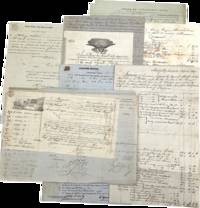
80111A group of 13 Gold Rush-era shipping documents recording the import of international goods to the port of San Francisco between 1849 and 1857.<br /> <br /> The news of gold at Sutter’s Mill in 1847 lured more than 300000 people from the rest of the United States and abroad to San Francisco which then had a population of just 459 residents. These new emigrants brought only small amounts of goods with them and there was little farming in California to support the '49ers. Most American merchants who sold provisions and amenities during the California Gold Rush dealt in imported goods such as dried fish and beef jerky canvas and clothing tools lumber candles coffee and livestock from points abroad.<br /> <br /> One invoice dated May 3 1850 is for 100 tons of coal shipped from Duffryn Steam Coal in Liverpool to G.W. Aspinwall a prominent businessman and co-founder of both the Pacific Mail Steamship Company and Panama Canal Railway companies which revolutionized the migration of goods and people to the West Coast.<br /> <br /> Another four-page handwritten invoice in this group dated September 15 1849 lists sundries shipped on the Steamer Clyde from Jamaica to the merchants Jewett and Melhado in San Francisco. It includes cases of jams jellies pickles Brandy seasoning salt and more. In addition to supplying miners Jewett and Melhado provided monthly reports in the Alta California newspaper on the price and flow of goods in Northern California. Other receipts record everything from the import of cigars to bales of twine and canvas cloth. unknown
1894008457San Francisco: H. S. Crocker 1894 Book. Fine. Hardcover. MIDWINTER FAIR. Oblong quarto. 10x13 inches. Three parts bound together. Illustrated with 8 full-page lithographed color plates by Dickman-Jones Co. of San Francisco plus the full set of 24 full-page lithographed color plates by H. S. Crocker Co. plus over 213 full-page black & white photographs with extensive descriptive text including 13 of 14 double-page panoramas. Publisher's binding of three-quarter brown morocco darker cloth sides gilt lettering and pictorial element on cloth cover gilt-lettered spine. Outer hinges and spine ends rubbed 3 corners show light wear. A fine clean copy. First edition. With the bookplate of Thomas Wayne Norris and included in the famous Norris Catalogue. An incredibly scarce tile with the full complement of 24 full-page color lithographs Series I & II of scenes and buildings at the Midwinter Fair also issued by H. S. Crocker Co. and the addition of the souvenir grouping Glimpses of the Midwinter Fair issued by Dickman-Jones Co. to their customers with 8 full-page color lithographs of the Fair bound in with its original wrappers. Sunset City and Sunset Scenes is usually found only with the Taber black & white reproductions. We have never had a copy bound with the full series of color lithographs although over the years we've seen a few odd plates. The large number of black and white photographic reproductions include a number of views of the buildings and grounds of the Midwinter Fair held in Golden Gate Park; they are interspersed with select views of the natural wonders of the State. Nearly all the photographs are by Isaiah W. Taber official photographer of the Fair. The text for the non-Fair images was written by J. M. Hutchings; the twenty-four lithographs issued by Crocker were drawn by the famous western artist H. W. Hansen. Norris Norris Catalogue this copy: 3493; Rocq Glimpses of the Midwinter Fair: 11355; Rocq Sunset City: 11359; no Auction Records that include the color plates. . H. S. Crocker hardcover
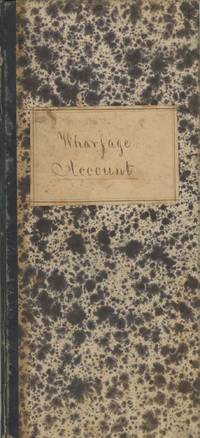
1873List2825Eureka California 1873. Single 5 ½ x 12 inch ledger book with five small pages of notes and one short letter. Forty-two pages of the ledger filled out with many more blank. Some damage to spine on exterior otherwise very good to excellent. Offered here is a wharfage fee account ledger from Eureka California with dates between 1868 and 1873. The first Euro-American settlement at what is now Eureka on the Humboldt Bay was founded in 1850. It became a hub for bringing supplies to the Trinity Klamath and Salmon River mines both by water and over land and a major lumber manufacturing town with seven sawmills by 1858.1 Lumber vessels sent lumber down the Pacific coast as far as Chile. By the 1860s and 70s Eureka’s main exports were lumber and produce including pork and seafood via sailing vessels and there was also regular steamer service taking people and goods between there and San Francisco. Wharfage would have been paid at the port at Eureka for loading or unloading cargo; the ledger tracks ship names alongside either the names of men who loaded the cargo or the cargo type quantities and prices.<br /> <br /> 1 Owen Cochran Coy The Humboldt Bay Region 1850–1875 California State Historical Association 1929. unknown
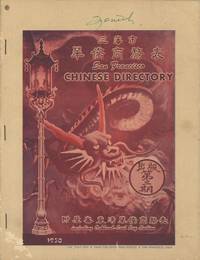
1950List3323San Francisco California: Jimmy Lum Advertising Service 1950. 107 pp directory measuring 8 ½ x 11 inches. Normal wear with some manuscript markings on wraps; contents excellent with some markings and wear. Overall very good to excellent. The 1950 edition of the San Francisco Chinese Directory published by the Jimmy Lum Advertising Service. The directory contains telephone listings of Chinese residents and advertisements for businesses—appliance and furniture stores restaurants clothiers driving schools and more—around the city. The advertisements are mainly in both English and Chinese though some are without English. Not all the businesses are Chinese-owned with the exception of the medical practitioners and vendors. The directory also includes a two-page map of San Francisco’s Chinatown neighborhood between Hyde and Sansome Streets. <br /> <br /> Before World War II the Chinese Exclusion Act and other laws restricting Chinese immigration kept San Francisco’s Chinese population low and majority male with most concentrated in Chinatown. Discrimination and violence further reduced the population into the 1920s. Wartime alliance with China and Chinese Americans’ participation in the war effort began to soften public attitudes and led to the 1943 repeal of the Chinese Exclusion Act; though new quotas following the repeal were extremely strict they allowed families to reunite—or form—and by 1950 people of Chinese descent made up about 3% of the city’s population a significant rebound from previous decades.<br /> <br /> OCLC locates two physical copies of the directory. Jimmy Lum Advertising Service unknown
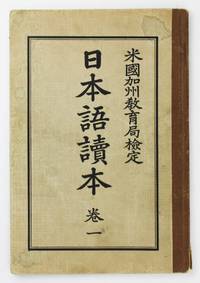
19296347San Francisco & Japan: Aoki Taisei-Do 1929. Very good. 56pp. In Japanese. Original printed stiff wrappers cloth-backed. Minor wear and scattered staining to wraps. Light tanning internally. A fascinating and scarce Japanese-language textbook intended for use by Japanese-American children in California during the late 1920s. The work was published by Aoki Taisei-Do a San Francisco book and stationery store that catered to Japanese immigrants. The inside rear wrapper states that this was was "Approved by the California State Board of Education. August 1923. Published Aoki Taisei-do. San Francisco California. Printed in Japan together with a 1929 date code. The book contains numerous illustrations throughout of young children animals plants and more accompanied by Japanese text and seems to have been a primer for learning to read and write Japanese for children born to immigrants in the United States. A illustration of Santa Claus and one of a English teatime table setting belie a bit of Western influence. Despite the printed discrepancy between approval and publication dates we locate no other editions and only one copy of the present one at the Bancroft. Aoki Taisei-Do unknown