8 987 résultats
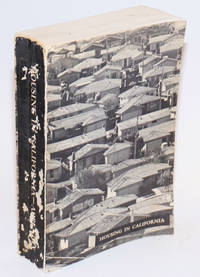
1963136142San Francisco: the Commission 1963. 816p. black & white pictorial wraps ugly silverfish damage to spine interior clean. the Commission unknown books
1993Q-156426050XCalifornia Culinary Academy 1993-06-01. Paperback. New. In shrink wrap. Looks like an interesting title! California Culinary Academy paperback
ria9781420054231_inpHardback. New. New Book; Fast Shipping from UK; Not signed; Not First Edition; Explores a wide range of applications in fields including electronics telecommunications sensing medical instrumentation and data storage. This book includes a practical user's guide and explores key areas in which artificial materi hardcover
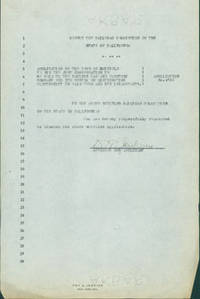
63-3807Mayfield California: 1919. 13" x 8.5" Carbon Copy Typed Page Signed by D. T. Jenkins Good with marginal tear creasing light staining. D. T. Jenkins was the attorney representing the City of Mayfield of the law firm Fry & Jenkins of San Jose CA. The town of Mayfield was annexed by Palo Alto in 1925. Mayfield, California: 1919. unknown
ria9781009308076_inpHardback. New. New Book; Fast Shipping from UK; Not signed; Not First Edition; With new coverage of quantum engineering and quantum information processing the third edition of this bestseller provides a uniquely practical introduction to quantum mechanics. Updated throughout and supported by Matlab code and inst hardcover
0364710861.Gpaperback. Good. Access codes and supplements are not guaranteed with used items. May be an ex-library book. paperback
0084091001. Hardcover. Fine. Publisher: Department of Boating & Waterways FINE Unbound Soft Cover Shrink Wrapped hardcover
0364790563.Gpaperback. Good. Access codes and supplements are not guaranteed with used items. May be an ex-library book. paperback
0364790911.Ghardcover. Good. Access codes and supplements are not guaranteed with used items. May be an ex-library book. hardcover
2026x-1108481876Cambridge University Press 2026. Hardcover. New. 350 pages. 7.00x0.94x10.00 inches. Cambridge University Press hardcover
52462420like new. unknown
52462420-nnew. unknown
mon0000069109California Redwood Assoc. ring_bound. Very Good. . Architect's Redwood File by the California Redwood Association ring bound ediition in very good condition. Comes with all sections which include: Conservation Properties & Grades Architectural Uses Garden Uses and Fastenings & Finishes All pages are in great shape. Minor shelf wear to the brown plastic cover. California Redwood Assoc. unknown
1991248208PN. New. 1991. Soft Cover. Date is original print. This is a reprint edition . PN paperback
252 pages. Features: Art and Colour Brighten an East Side Apartment; Gwathmey Siegel - a modernist villa set into the hills near Zurich; California colonialism - Anglo-Indian elements flavor a west coast residence; Apsley House Restored - inside the Duke of Wellington's London Mansion; Olson Sundberg - Echoing prairie house traditions outside of Chicago; Fantasy at Twin Farms - five new cottages enhance this Vermont inn; Journalist Tom Wicker and television producer Pamela Hill's Brownstone; Ike & Kligerman - A Pacific Northwest retreat for producers Richard Donner and Lauren Shuler Donner; Fifth Avenue Formalism - richly detailed spaces for a Manhattan pied-a-terre. Moderate wear. Clean and unmarked. A quality copy. Magazine
232 pages. Features: Serene life for Dennis Quaid amid the rolling hills of Montana; Susan and Jerry Lauren's Folk Art Collection in New York; National Gallery Director Earl A. Powell III in Virginia; Les Jolies Eaux - new life for Princess Margaret's Mustique retreat; Star Jones gets her dream apartment in New York; A Southern California residence embraces the elements; Susan Sullivan and Connell Cowan find calm near Santa Barbara; The ever-evolving MicroMultiple House puts a twist on the concept of unbuilt houses; The Wyndham Martineau Bay Resort & Spa on Vieques; Jaquelin T. Robertson; Eureka Springs - the Victorian era lives on; Luis Barragan's San Cristobal in Mexico; Karl Springer - his exotic furniture; San Francisco design centrer; Villa Serbelloni on Lake Como; Properties for sale around the world. Moderate wear. Unmarked. A sound copy. Magazine
220 pages. Contents include: The Today Show's Jill Rappaport Goes Western on Long Island; Adapting to its site, a Massachusetts Home Nestles into the Land; On the Eastern Shore of Lake Michigan, a Home is Memorably Shaped by Colour and Geometry; Modern Lines and Muted Hues Lend Quiet Glamour to a Wyoming Retreat; Lee F. Mindel's Progressive Country House in the Hamptons; A Los Angeles Couple Yield to the Charms of Nantucket and a House Filled with Folk Art; A Whimsical Boathouse Reminiscent of Norwegian Stave Churches; An Elegant Design is Grounded by Informal Touches at a Country Estate in Virginia; In Northern California, a Fourth-Generation Farmer Builds a Thoughtful Home That Speaks to the Past; The Bounty of Nature Serves as an Exquisite Muse for Six Jewelry Makers; Angela Lansbury - Simplicity is the key in her Traditional Farmhouse on the Coast of Ireland. Clean and unmarked with moderate wear. ne-inch opening to front cover at top of spine. A quality copy. Book
858Archive. 11 pieces. 1956-1957. California. An archive of several GOP pieces addressed to Ken Ladd President of the Young Republicans of San Joaquin County. It includes two typed letters signed by Governor Goodwin J. Knight as well as a typed letter signed by United States Senator Thomas H. Kuchel. There is also a letter from Lieutenant Governor Harold J. Powers and a signed photograph from Lieutenant Governor Bob Finch. The grouping also contains two typewritten documents; one lists the delegation from the San Joaquin County Young Republicans who will attend the State Young Republicans Convention and the other has the by-laws of the Young Republicans of San Joaquin County. There are also a couple of form letters with GOP content unknown
1921160171Los Angeles: California Theatre 1921. Archive of 41 vintage photographs of the elaborate stage sets and live performers which supported silent film screenings at the California Theatre in Los Angeles taken during the theatre's first three years in operation 1919-1921. 20 photographs with blindstamps crediting photographer Dick Stagg and 14 with blindstamps crediting photographer J.C. Milligan.<br /> <br /> Photographs housed in an album with typed labels on the versos of the adjacent pages identifying the film screening dates performers and musical numbers. <br /> <br /> The first two photographs in the archive feature a day shot and a striking night shot of the theatre's beautifully elaborate facade followed by a photograph of the "original installation" of the stage and grand staircase. The balance of the photographs however show theatre sets usually with performers present occasionally with the orchestra present and always without the audience present likely taken during rehearsals or after the completion of the set designs. <br /> <br /> The earliest dated photographs in the archive only two and a half weeks after the theatre's opening on December 24 1918 show two different sets for the screening of the 1918 film "Eye for an Eye." The last and latest photograph in the archive shows a parlor set with five costumed actors for the 1921 screening of the 1920 film "Billions." All in all 29 films are represented in the archive.<br /> <br /> Interestingly many of the screening dates of the films represented in the archive coincide with-or date earlier than-the currently believed premiere dates of the films some of which may have had their premiere at the California Theatre. <br /> <br /> Fred Miller opened the California Theatre at 810 S. Main Street in downtown Los Angeles on December 24 1918. The majestic Beaux-Arts cinema housed a capacity of 2000 and was designed by architect Alex B. Rosenthal who also designed the Granada Theatre in Santa Barbara. In 1919 the theatre was bought by Goldwyn Pictures and in 1935 operated as Teatro California often showing Spanish language films until 1983 after which it operated as a grindhouse and pornographic theater. The theater closed in 1987 and was demolished in 1990.<br /> <br /> Photographs: 8 x 10 inches. Very Good plus to Near Fine overall with some faint toning with one photograph with two vertical creases.<br /> <br /> Album: 13.75 x 10.25 inches. Very Good plus. California Theatre unknown
18744492Various locations in California 1874. Good. Ninety-four letters totaling 153pp. Mostly octavo. Leaves lightly dampstained and toned some faded. Old folds some separation and brittleness a few small areas of loss or tearing. An extensive archive documenting the activities of the Bridgeport Gold and Silver Mining Company in Sweetland California. Sweetland is in Nevada County about sixty miles north of Sacramento in the heart of the Sierra Nevada gold fields. At its peak it was home to a few hundred souls; today it is essentially defunct. In the present archive V.G. Bell secretary for the company writes to John Spencer in Nevada an agent for the company. John Spencer 1818-1891 emigrated to California in 1850 where he had some success at placer mining. After moving to Nevada in the early 1860s he became a successful rancher and public servant. We find Bell listed as a "ditching agent" in an 1867 directory for Bridgeport Township. Writing from by turns from Sweetland Birchville French Corral and North San Juan he apprises Spencer of the business activities of various mines including receipt of rent payments sent by Spencer reports of shareholders and trustees property upkeep and mine management. Specific mines mentioned include the Vineyard Mine the Bunker Hill Mine and the Baltimore Mine. Over half of the letters date to the period from 1864 to 1867. Though they have been exposed to water at some point they are mostly legible and are written in a neat hand.<br /> <br /> In the first letter here dated August 8 1864 Bell discusses the Trustees of the company as well as financing options available for the venture. He writes in part: "Dear Sir I have rec'd three reports from you the last of which was perfectly satisfactory; and had our supt. taken the same trouble during the latter part of last year to have made his reports as clean there would have been none of that bickering that took place between himself & the Co. In short the Trustees express themselves as well pleased with your mode of doing business. . It seems to be the desire of the Co. to husband our means in the territory as much as possible and make it a self sustaining institution as it is out of the question to raise means without resorting to borrowing; even at the rates of interest we could get money on this side for would soon eat the vitals out & have a dead concern on our hands."<br /> <br /> Much of the correspondence seems to include concern over the company's struggling finances. In a letter from February 1865 Bell asks Spencer to cut his salary writing "After a consultation of the trustees I was asked to write you in reference to a reduction in your salary to a less figure say seventy five dollars. The company is in debt here to a little over two thousand dollars borrowed money & they feel the necessity of reducing their expenses as much as possible and as there is so little doing with the company's business that it seems like a large salary to pay. . For one to look after this business without any thing else to occupy their time they are ready to admit is none too much and if your time is wholly taken up with their business do you not think it would be advisable to employ some competent person who could take time enough from other employment to see to our affairs." Bell assures Spencer that the Trustees are not unhappy with his work -- just his expense.<br /> <br /> A letter later that year in July discusses the hiring of a man as a second engineer also capable of blacksmith work. Other missives discuss the upkeep and refurbishment of a house as well as the means to rent it out. By October Bell has moved to discussion of the dispersal of some property as well as the difficulty of continually raising funds. "Your suggestion to levy an assessment in the Vineyard Co. to pay it out of debt meets with the approbation of our Co. which I presume was done at your last meeting. It is the wish of some of the members of our Co. to put our property in R into market & sell at some price & close the concern up. The Board is somewhat uncertain as to the course to pursue but the pressure is so great against the continuance of raising money by assessment that they will have to abandon that method for the time being."<br /> <br /> These excerpts are a mere sampling of the content. Some of the later letters are shorter asking for updates or indicating monies received though the bulk of the archive comprises letters that are two to four pages. An interesting and important snapshot of the activities of a large mining operation in the Sierra Nevada in the 1860s and 1870s and worthy of further research. unknown
19384491Primarily Los Angeles 1938. Overall about very good. Thirty-four printed items varying lengths; forty-eight postcards; eighty-four loose photographs mostly larger formats; string tied oblong folio album with sixty-six medium and large format images. Some wear with scattered chipping and closed tears to printed items. Occasional chipping and creasing to photo mounts. A few images beginning to fade but mostly crisp and clean. An extensive collection of photographs and ephemera related to the Mount Lowe Railway and various hotels and attractions that operated on Echo Mountain at the crest of the San Gabriel Mountains at the turn of the 20th century and the first part of the 1900s. The mountain was the site of a popular funicular that was originally engineered by Professor Thaddeus S.C. Lowe and opened as the Pasadena & Mt. Wilson Railroad Company in 1893. It was the only scenic mountain electric traction railroad ever built in the U.S. and it remained in operation until 1938 although its heyday was primarily the 1890s and the early-20th century. The railway consisted of nearly seven miles of track beginning in Altadena at a station called Mountain Junction and ending atop Echo Mountain at a magnificent seventy-room Victorian hotel called the Echo Mountain House. Only a few yards away stood the forty-room Echo Chalet which opened in conjunction with the railway. Other buildings on the peak over the years included an astronomical observatory car barns repair facilities dormitories a casino and a dance hall. Mount Lowe's operation was hit by a number of disasters which brought about a slow and ultimately terminal decline. The first was a kitchen fire that destroyed the Echo Mountain House in 1900. Further fires and floods eventually destroyed all remaining facilities and the railway was completely abandoned in 1938 after a storm cleared the mountainside and washed away nearly everything that remained.<br /> <br /> The collection includes thirty-four railway brochures pamphlets and other promotional items; two issues of the promotional Mount Lowe Daily News and a piece of sheet music in honor of the line; a collection of forty-eight postcards; eighty-seven loose photos mostly large format and mounted images; as well as a photograph album containing another sixty-six mid- to large format photos of this ingenious and precipitous tourist railway. The line was broken into three sections. The first was a fairly straightforward section that traversed the hillside residential sections of Altadena to the upper base of Echo Mountain. In order to reach the peak of Mount Lowe however passengers would have to transfer to a steeply graded and narrow funicular that travelled up 2200 feet on the "Great Incline" to the top of Echo before transferring again to wind up a further 3.5 miles on trolley cars over sharp switchbacks and curved viaducts with nicknames like "Cape of Good Hope." Because of the repeated setbacks caused by fire and storm the original owners sold the railroad and its mountain top attractions to Henry Huntington in 1905 after which the line operated as part of the Pacific Electric Railway for another thirty years. <br /> <br /> Amongst the printed matter here highlights include a program from the opening of the railway on August 23 1893 featuring a portrait of Thaddeus Lowe and an image of the Great Incline; a pair of extremely scarce copies of the illustrated promotional newspaper the "Mount Lowe Echo" from the early years of operation; three unrecorded broadsides advertising Mount Lowe excursions around the turn of the century; and a detailed and extensively illustrated pamphlet "Scenes on the Line of the Pasadena Mountain Railway." Also present are a clutch of nearly a dozen scarce color- and photo-illustrated brochures from the Pacific Electric era several illustrated leaflets including one with a bird's-eye view of Echo Mountain and Mount Lowe timetables and other promotional and review materials. The group of over fifty colorized photographic postcards were produced by a variety of publishers but a great number emanate from the shop of M. Rieder who produced numerous viewbooks of California towns in both English and Spanish-language editions during the early-20th century.<br /> <br /> The almost ninety larger format loose and individually mounted photographs show a variety of scenes depicting the railroad tourist facilities and environs across the span of its operation. Most are sized 8"x10" 5"x8" or in the vicinity of said measurements. The first group of photos shows early observation parties and other excursions including one mounted image by the Hill studio of Pasadena showing Professor Lowe guiding a party during the construction of the railway. The following considerate group comprises about twelve posed photos of children and families engaged in winter activities on Mt Lowe and clearly intended for an advertising campaign for year-round tourism to the peak and includes an idyllic image of children on a horse-drawn sleigh in the snow mounted on the card of LA studio Graham & Morill. Other studios represented here include C.B. Waite Putnam Studios and George Wharton James. There are also a number of images from the photo department of the Mt. Lowe Railway itself including numerous photos of the funicular and large souvenir images of tourists riding the open cars on the Great Incline. On the whole the images are often accompanied by manuscript or typed captions and in some cases by lengthy printed texts on the versos of card mounts.<br /> <br /> The terrific album of sixty-six photographs is focused for the most part on the early period of the railroad under the operation of Pacific Electric Railway following its purchase by Huntington in 1905. The professional photographer of these images is unidentified here but several conform to known photographs by C.C. Pierce who heavily documented the railway during this period and the group as a whole is heavily reminiscent of his work. The photos for the most part focus on the operation of the line and its dramatic setting and engineering with images of deep and narrow cuts along through the mountainside hairpin turns on precarious looking trestles the steep incline of the funicular and the astonishingly unfazed passengers. Mixed in with these are shots of the tourist facilities as they existed at that point and the mechanical and structural plant of the rail line. Similar to the loose photographs in the collection the album prints are mostly 8"x10" 5"x8" or thereabouts.<br /> <br /> In all a compelling and rich multi-format archive of one of the most interesting and spectacularly engineered tourist railroads of the late-19th and early-20th centuries. unknown
1935List2835California Texas Illinois and others 1935. 369 pieces: fourteen empty envelopes 108 pieces of unsorted ephemera and 247 letters. Of the letters twenty-one are undated; three date from 1851–1909; nineteen from 1910–11; thirty-five from 1912; thirteen from 1913–17; forty-two from 1921; thirteen from 1922–24; sixty-eight from 1934; and thirty-three from 1935. Overall very good to near fine. The Beaumans were a family from southern Texas who relocated to East St. Louis Illinois some time before 1908 and some of whom would later live in California. Captain Loui Beauman 1868–1921 was a military engineer Mason and member of the Society of American Military Engineers. He and his wife Kittie Woodruff 1867–1959 had three children survive to adulthood: Carrie Beauman 1893–1982 Second Lieutenant Loui Beauman 1894–1918—a Marine killed at 23 in a seaplane accident—and Julia Frances “Gally†Beauman 1908–1974. <br /> <br /> Offered here is a large correspondence archive belonging to the Beaumans; mainly addressed to Gally 119 letters the younger Loui seventy letters and Kitty fifty-two letters; and written by a wide variety of friends and family including Kitty fifty-one letters Carrie eighteen letters Katharyn Owen of San Antonio sixteen letters and Gally’s future husband Edwin J. Regan of Weaverville California twenty-three letters. Regan 1906–1996 was at the time running for District Attorney of Trinity County and would go on to hold that position before resigning in 1948 in favor of a State Senatorship followed by a judgeship on the Third Appellate Court of Appeal.<br /> <br /> Most of the early letters in the group are addressed to the younger Loui Beauman and their concerns include his friends’ jobs constructing railroads hiding their controversial “ragging†dancing from chaperones and which fraternity Beauman should join at the University of California. The fraternity issue is particularly contentious within the family; the elder Beauman tells his son that “I will not be pleased to hear that you have joined any of the fraternities†September 20 1912. The younger Beauman settled on Zeta Psi.<br /> <br /> After the passing of both father and son most of the letters are addressed to Kitty and Gally Beauman. Edwin Regan writes to Gally about his campaign for District Attorney which made him “worried and discouraged and down on the world†August 3 1934; Regan felt that “ability means nothing to the voters the sole issue is whether or not I am a ‘city guy’ or not†July 30 1934. Another common topic is the family’s concern for Carrie Beauman whose marriage to Arthur Levefre Jr. was becoming increasingly abusive. The couple lived in Houston far from the remaining family who were now in Berkeley and Weaverville.<br /> <br /> Though the family very rarely commented on politics—even including the Great Depression which was in full swing during the writing of nearly half of these letters—there is one event that enthused Carrie Beauman too much for her not to mention. This was the suppression by the KKK of alleged brewing race riots in Houston:<br /> <br /> “We came near a bad race riot last week. All the militia residents Light Guards ex-soldiers were called out. There were over 5000 armed white men on the main streets negro sections. Arthur slept with his clothes on 4 loaded guns. We all piled in one room. Believe me the Ku Klux Klan is doing efficient work. That’s twice in the last 10 days that they’ve ‘operated on’ the beasts. I’m tickled to death to know that there are a few fearless just honorable men left to meet sic out justice to these criminals. By the time this happens half a dozen times some of this crime wave will subside. If the paid officers of the law wont meet the emergency – then it’s time for the upright citizens to take a hand. I am tickled to death over this!†May 1 1921<br /> <br /> Overall an intimate look at the lives and affairs of an ordinary American family in the early twentieth century. unknown
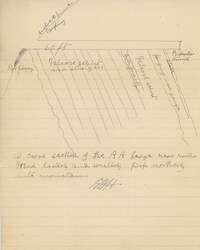
1921List3318California and Oregon 1921. 160 total items. Description of Pacific Coast Outlaws 32pp 8vo in cloth wraps; wraps excellent with some staining; contents very good to excellent with some water damage. Thirteen copies found on OCLC. Two business cards one with manuscript notes; 106 letters dating 1906 to 1911; twenty-two mailers circulars shareholder solicitations etc.; twenty-eight pieces of miscellaneous accounting records; and one Trinity Gold Dredging Company map measuring approximately 14 x 28 inches. Overall excellent. Harry N. Morse 1835–1912 was born in New York and came to San Francisco in 1849 seeking gold. After several odd jobs he became a deputy provost marshal in Oakland in 1862 was elected Sheriff of Alameda County in 1863 and held this office for fourteen years before establishing his private detective service in San Francisco. Morse is known for the arrests and killings of numerous California outlaws many of which Shinn’s booklet treats in great detail though with a focus on the Mexican-American contingent to the neglect of some of Morse’s more notable successes such as his role in the capture of Black Bart.<br /> <br /> The majority of the items in this archive concern Morse’s late-career foray back into gold mining first in Lewiston California and then in Applegate Oregon. John Marchand was Morse’s foreman in Lewiston and generally writes to him about the failures of their Lewiston enterprise. Many of the difficulties are attributed to troubles with a steam shovel though the claim itself turns out to be a dud. Marchand informs Morse near the end of their correspondence:<br /> <br /> “Things here I’m sorry to say have gone from bad to ‘very bad’. Y’day I got down to ‘bed-rock’ uncovered a piece 46 by 10 ft and increadible as it may read there was not 30¢ in there some pans in fact you could not get a color.†August 10 1906<br /> <br /> Morse then invests in a claim in Applegate Oregon with more success. The main setback in Applegate is that his mine is repeatedly sabotaged. His foreman E.B. Hawkins explains:<br /> <br /> “I realise things from this end must appear perhaps irregular or peculiar On or about the 17†of May the mine was dynamited I did not write you at that time because I thought I could catch up the ground in two or three days. It took nearer 20 and another thing you had sickness and later death in your family so I did not write about that first offence at all On June 17†we found the Star mine dynamited again good and plenty not less than 10 lbs of powder had been used for the job. They blew the h__l out of things blew the top off of the shaft and the gallows frame awry. I am almost certain I would have succeeded had I had only natures elements to contend with. I don’t know what in h__l will happen on the 17†of July This anarchy is beyond me. On the 17†of May I fired the distasteful element paying them off and I have fired the 17†of June element paying them off – I borrowed $50.00 from Jno. Pernoll to pay them there was 3 of them had not been working longâ€. June 19 1907<br /> <br /> Hawkins soon identifies the culprits:<br /> <br /> “On June 27†Jim Rock Sr. and Dick Rock came to me and offered to square the damages done at the star mine saying that if the mine was blasted their two boys were in on it On July 2†Dick Rock came to me and said his son Roy had confessed saying there were four in it namely Harry Gething Chas Brown Young Jimmy Rock and Roy Rock Dicks son They had all been working at the star. On July 4†Roy Rock confirmed to me same as above saying Harry Gething was leader and young Jimmy Rock was helper that they had a jig of whiskey on the ground that night Jimmy Rock furnished the whiskey Strange to say that every time I have gotten ready to take a certain good block of ore out of the star the mine has been blasted I propose to take that block of ore out if I live and can get grub while doing it†July 6 1907<br /> <br /> Hawkins has a few other confrontations with workers though none this severe and his letters are mainly providing Morse with in-depth updates on the status of the mine including many of Hawkins’ diagrams. The Star mine is never a roaring success and the pair consider trying cyanide mining—â€the salvation of southern Oregon†1908—and gravel mining in British Columbia.<br /> <br /> Of interest to historians of the post-Gold Rush west especially gold mining therein. unknown
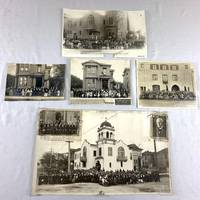
4750Oakland 1986. Good. Seven substantial photographs measuring between 6 x 9 inches and 7.5 x 36.75 inches plus approximately four linear inches of programs newspapers additional photographs holograph notes financial records and more. Varying levels of wear soiling chipping and repairs to the photographs. A rare collection of substantial images picturing members of the Oakland Japanese Methodist Episcopal Church in the early-to-mid 20th century first at what appears to be a converted home in the city and later at their larger more traditional church on West 10th St with an additional image of an outing to Piedmont. The incarceration of Japanese Americans during WWII led to the temporary closure of the church. During this time one of its halls was used to store the possessions of incarcerated Japanese and Japanese American citizens; after the war it served as a hostel for returning members. In 1967 the church sold the land and moved at the invitation of Lake Park Methodist Church to the latter's premises and in 1968 the two churches formally merged. The second portion of the archive relates to the Lake Park Methodist Church both before and after this merger. The photographs present here depicting the earlier years of the Japanese Methodist Episcopal Church are as follows in chronological order:<br /> <br /> 1 Oakland Japanese M.E. Church. Sept. 30 1917 caption title. 7.5 x 9.5 inches. A handsome black-and-white group photograph outside the church captioned in the plate in English. The wooden sign for the church is mounted above the entrance and reads "Japanese M.E. Church." An American flag flies above the sign. Evidence of construction paper adhesion to verso; clear tape to upper corner; light soiling.<br /> <br /> 2 Methodist Ministers' Conference caption title in pencil on verso. 6 x 9 inches. Similar setting to the photograph above this black-and-white group photograph features a group of almost forty ministers of the Methodist Church most of whom are not Japanese American but apparently met in conference at the Japanese Methodist Episcopal Church in Oakland circa 1917 though a pencil note on the verso reads "1912". Formerly mounted with tape remnants to verso and one corner some creasing a few short closed tears.<br /> <br /> 3 Japanese Methodist Episcopal Church of Oakland. Dedicated Feb. 24th 1918 caption title. 12 x 20 inches. A substantial black-and-white group photograph outside the church featuring a couple hundred members presumable posed for the church building's dedication. Two newspaper clippings of ministers of the church are taped to the upper corners small semicircle of loss and tape to middle of bottom margin tape to corners and verso. <br /> <br /> 4 Uncaptioned Panoramic Photograph Featuring Church Members in 1925. Tsuji Studios stamp on verso and embossed blind stamp in lower margin. 7.5 x 36.75 inches. Pictures the church membership of over a hundred Japanese American men women and children in the midst of the Roaring Twenties. Heavy dampstaining and damage to left side obscuring about five inches of the image. Accompanied by another example of the same photograph also with Tsuji Studios stamps this copy with damage to the right side. This second example has an ink inscription in Japanese on verso and a computer-printed date taped to the bottom margin and reading "1925." The chipping on each side of the two photographs obscure some of the subjects but taken together these two images record all of the information contained in the photograph.<br /> <br /> 5 Church Outdoor Ceremony at the Piedmont Hills caption title in Japanese. 8 x 32 inches. A striking sepia-toned panoramic photograph capturing an outdoor excursion to the Piedmont hills in 1927 four captions in the negative printed in Japanese. Tsuji Photo Studio stamp on verso along with a short manuscript caption in pencil in Japanese. Light marginal staining; toning.<br /> <br /> 6 Farewell Ceremony for Pastor Arima and His Family. January 8 1933 caption title in Japanese. Tsuji Photo Studio. 7.75 x 9.5 inches. Handsome sepia-toned group photograph of a farewell gathering for Pastor Arima and his family in early 1933 captioned in the plate in Japanese. An ink inscription on the verso confirms the caption in the negative and reads "Farewell photograph taken on January 8 1933 prior to the departure of Rev. Arima & family to Japan." Rough patch to lower corner and lower edge likely from tape removal slightly affecting the extremities of the image.<br /> <br /> 7 Final Service at the West 10th Methodist Sanctuary. Feb. 5 1967 caption title. Utsumi Studio. 8.5 x 14 inches. An informative black-and-white group photograph depicting the congregation at the West 10th Methodist Church location after it was sold in 1967. Small chip and closed tear to bottom margin affecting part of caption tape to verso.<br /> <br /> The later portion of the archive documents church life and activities at Lake Park Methodist Church the vast majority of which emanates from prior to the merger of the two churches. This earlier material includes a notebook of board meeting notes from 1967 numerous typed board meeting agendas from the 1960s two issues of the Lake Park Methodist Church newsletter called Spotlite church programs and fliers a few Methodist newspapers such as the United Methodist and Lake District Reporter and numerous photographs picturing Anglo-American members of the church. The post-merger material includes a dual-language newsletter and calendar for October 1972 listing the minister as George Uyemura a folder of financial records from the Lake Park United Methodist Church School from 1969-70 and two newsletters from November 1968.<br /> <br /> An important record of Japanese American religious life in Oakland before during and after the collective trauma of WWII incarceration as well as a peek into the development of a particular California Methodist Church later in the century. unknown
229637of California miners by William Wax Studios Redding California. All on the original photographer's printed mount. Each approximately 7 3/4" x 4 3/4". 1. Two men a woman and three young children standing in front of a miner's cabin. 2. Group of eight miners and two Chinese men standing in front of a miner's cabin. 3. Group of 15 miners and a dog dressed in their Sunday's best clothes standing and seated in front of a cabin. 4. Group of 18 men and 1 child standing and seated in front of the general store. 5. Group of 23 men mostly dressed in boots and work clothes standing and seated in front of a shed. A few smoking pipes one holding an ax. 6. Group of 22 men dressed in work clothes boots with lantern on their hats outside of the mine. Provenance: from the estate of Charles H. Segerstrom. No Binding. Very Good/No Jacket. hardcover