Marine Society of BostonBiblio.com
9 266 résultats
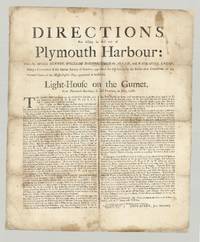
9850Boston: Commonwealth of Massachusetts 1785. Broadside 16.125†x 13.25â€. Title above two columns of text. CONDITION: Good old folds with a few small losses to lettering and ornamental border along folds mostly reinstated by hand. <p>One of only two known copies of an eighteenth-century broadside consisting of sailing directions centering around the Gurnet Light on the north side of Plymouth Bay to guide ships entering and leaving one of the most historic harbors in the United States—the site of the Mayflower’s landing. </p> <p>This pilot was originally published in 1768 in connection with the construction of what is thought to have been the second lighthouse “on the Gurnet head†which included twin beacons or “two lanthorns†as noted in the directions distinguishing it from the Boston Light and making it the first twin lighthouse in America. It was built on land rented from John and Hannah Thomas for five shillings a year and John served as its first keeper. During the Revolutionary War John Thomas raised and served with a regiment of volunteers from Plymouth County. Following his departure from home Hannah took over his lighthouse duties making her the first female lighthouse keeper in America. John died from smallpox in Quebec in 1776 and Hannah continued to serve as keeper until 1786.</p> <p>The Gurnet or Gurnet Point is located at the end of a long narrow peninsula that together with Saquish Neck forms the northern boundary of Plymouth Bay and protects it from some of the sea’s mightiest swells. The Gurnet lighthouse served as a critical aid in navigation through much of the latter half of the eighteenth century. These sailing directions advise “to the southward you may bring them the twin lights in one which is a very good Mark to clear you of Brown’s Island or Sand Bank.†Mariners “coming from the northward bound into Plymouth†are warned “you must not bring the Lights more Southerly than S. by W. to avoid High Pine Ledge which lays N. from the Gurnet Head about two and a half and three miles…†A number of other navigational hazards are mentioned throughout these very detailed directions including the Gurnet Rock Dick’s Flat Muscle Banks etc. While printed from a different typesetting the text of this second edition is nearly identical to that of the first edition suggesting that the directions had proven quite reliable.</p> <p>The Boston Marine Society began as a fellowship of mariners in 1742 and was incorporated in 1754. Among its founders was Moses Bennet the first of the committee members mentioned in this broadside’s title. The Society was founded to “make navigation more safe†1754 charter and to provide relief for the families of mariners lost at sea. “The construction of lighthouses and placement of buoys and markers has often been accomplished with the advice of the Society. Of particular concern to the Society was the appointment of pilots to see to the safe passage of vessels in and out of the port†The Boston Marine Society.</p> <p>While OCLC appears to indicate eight holdings for the 1768 edition consultation of the catalogs of the libraries listed reveals that just two have physical copies Harvard and AAS. The Boston Public Library is also listed as having a copy of the 1768 but theirs is actually the 1785 edition. The OCLC records for the 1785 edition are similarly misleading showing what initially appears to be five physical holdings but all of these turn out to be digital or microform. Bristol and Ford record only the BPL copy. In short there are just two recorded examples of the 1768 edition and one of the 1785.</p> <p>An exceptionally rare and vital New England maritime broadside of the eighteenth-century.</p> <p>REFERENCES: Bristol R.P. Supplement to Charles Evans’ American bibliography B6058; Shipton C.K. National index of American imprints through 1800 44677; Ford 2408; Rink Technical Americana 3876; ESTC W24527; “Plymouth Gurnet Lighthouse†at lighthousefriends online; “The Boston Marine Society†at The Boston Marine Society online.</p> <p>Offered in partnership with Ten Pound Island Books of Gloucester Mass.</p> Boston: [Commonwealth of Massachusetts,] 1785 unknown
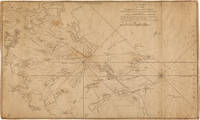
1800WRCAM52103London: R. Laurie and J. Whittle 1800. Engraved map sheet size approximately 21 x 34 3/4 inches. Backed with linen. Mid-19th-century ownership inscription near title. A few small chips and minor closed tears at edges light soiling and scattered faint foxing. Very good. Framed. An extremely scarce nautical chart of Boston Harbor from the second edition of the important 18th-century American atlas the NORTH AMERICAN PILOT. The chart depicts the state of the harbor just after the start of the Revolution having been reprinted from the first edition published in 1776 and 1777. The Boston peninsula and the "Ruins of Charlestown" are located in the west / far left of the chart area which follows the mainland coast as far south as Dorchester and Milton and out to Point Shirley and the Shirley Cut to the northeast in the upper center of the image; the Hull peninsula and Point Allerton are also visible in the lower right-hand quadrant of the map. In the center of the chart are the numerous islands that dot Boston Harbor as well as depth measurements and clearly marked shallow areas such as the shoals formerly known as the Dorchester Flats now a populated area of reclaimed land. Additionally there are a number of guidelines showing the best routes through the harbour to various points and markings for various points on land to aid in navigation. <br> <br> The second edition of the PILOT contained seven more maps than the first for a total of seventeen charts of which this plan of Boston Harbor was the seventh. The first edition was published by Robert Sayer and John Bennett who were succeeded by Laurie and Whittle before the publication of this atlas. The original chart engravings were executed by Thomas Jefferys. Rare in any form or edition OCLC traces only one copy of this individual map from the 1800 printing located at the State Library of Massachusetts. OCLC 843954569. PHILLIPS ATLASES 1220 ref. HOWES J84 ref. SABIN 55557 ref. R. Laurie and J. Whittle unknown books
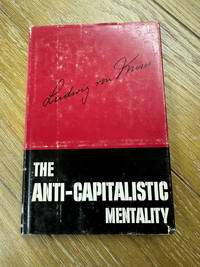
1956052024<p>Hardcover. Condition: Very Good. Dust Jacket Condition: Very Good. 1st Edition. D. Van Nostrand Company 1956. Rare first edition copy SIGNED BY AUTHOR. Jacket is in excellent shape with just very minor shelf wear. Pages are crisp clean and unmarked.</p> D. Van Nostrand Company, 1956 hardcover
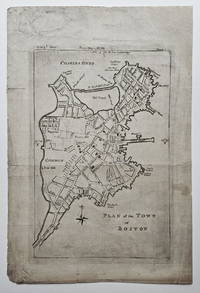
17843834<p>This extremely scarce map of Boston appeared as part of the <em>Geographical Gazetteer of the Towns in the Commonwealth of Massachusetts</em> a work issued in parts as a supplement to <em>The Boston Magazine</em> from October 1784 through December 1785. The map appeared with the October 1784 issue of <em>The Boston Magazine</em>.</p><p>Wheat & Brun note that this map is based largely on Norman's <strong>Plan of the Town of Boston with the Attack on Bunkers-Hill.</strong> published in the Boston edition of <em>An Impartial History of the War in America</em> in 1781. The present map covers a somewhat smaller geographic area and on a modestly larger scale than the map that appeared in <em>An Impartial History</em>. It also adds/eliminates/changes some street names and landmarks making it more than a direct re-engraving and suggesting the involvement of a cartographer -- perhaps Osgood Carleton with whom Norman collaborated on several maps and charts in the late 18th and early 19th centuries. Norman's 1781 <strong>Plan</strong> was itself sourced directly from the map appearing in the English edition of <em>An Impartial History </em>1778.</p><p>Although the present map is not listed in the Boston Engineering Department's <em>List of Maps of Boston Published Subsequent to 1600</em> 1904 it is referenced in the listing for a 1789 version of the map that had apparently been re-engraved for Norman's <em>Boston Directory</em> 1789. Very scarce. No examples listed for sale in the <em>Antique Map Price Record </em>1983-2011 and we not aware of any other examples being offered in the past twenty years.</p><p>A lovely example of one of the most uncommon 18th century maps of Boston.</p><p><strong>References:</strong> Wheat & Brun <em>Maps and Charts Published in America before 1800</em>: 242. Jolly<em> Maps of America in Periodicals before 1800</em>: 402. Lewis: <em>A Guide to Engravings in American Magazines 1741-1810</em>: p. 3. Stauffer <em>American Engravers Upon Copper and Steel</em>: 2361.</p><p><strong>Condition: </strong>A strong image. Soiling and some darkening to plate area apparently as printed. Blank area of upper right corner skillfully replaced and three short fold separations repaired on the reverse.</p><p>ICN 7760.</p> [Greenleaf and Freeman].
180131356Boston: D. Bowen 1801. Letterpress broadside woodcut coffin and urn decoration 23 x 18 1/4 inches. Minor losses in the margins at sheet edges not affecting text. A remarkably early American museum broadside.<br/> <br/>A broadside advertisement for the Columbian Museum in Boston one of the earliest American museum publications extant. Opened by Daniel Bowen in 1795 the museum specialized in the exhibition of fine art as well as curiosities. The museum was an expansion on Boston's first such institution also founded by Bowen in 1791 which was dedicated primarily to the exhibition of wax figures. The Columbian also played host to a variety of public performances and lectures. "One exhibit more suggestive of P. T. Barnum than the sedate offerings of a modern museum featured a bibulous elephant who consumed vast quantities of spiritous liquor the museum's advertising assuring the public that 'thirty bottles of porter of which he draws the corks himself is not an uncommon allowance.' . Despite such vulgarities Bowen's Museum is said to have had a significant influence on the history of American painting. The works of art on display there especially those of Robert Edge Pine formed the only public art gallery in Boston. Art historians credit this collection with influencing three major painters: Washington Allston the great Romantic painter Samuel F. B. Morse better known as the inventor of the telegraph and Edward Greene Malbone a miniaturist of note all of whom resided in the Boston area in the 1790s" W.P. Marchione Allston-Brighton Historical Society. This broadside advertises Bowen's wax sculptures of famous figures such as John Adams George Washington and Benjamin Franklin but further promotes a much more eclectic range of exhibited items. First among these are a collection of "large historical paintings" which depict a wide array of subjects including "Mrs. Yates in the character of Medea" "Time clipping Cupid's wings" and "His Excellency John Hancock late Governor of Massachusetts painted by Mr. Copeley." Prominently placed in the center of the broadside is an announcement that a "Monument to the Memory of General Washington has lately been erected in the centre of the Museum" with a small woodcut purporting to be the object in question. Also advertised are a collection of "automaton and musical clocks" and a concert organ "one of the most elegant Instruments of the kind ever imported" as well as a number of "natural curiosities" consisting mostly of birds snakes and a very large fish "12 feet in length" caught in Boston harbor. "The Museum has been established in Boston about five years during which time the collection of natural and artificial Curiosities elegant Paintings Wax Figures &c. have been constantly increasing and is now universally visited as one of the most rational and entertaining places of amusement in the United States: -- And will be removed from Boston at the expiration of the lease. Music on the Concert Organ. -- Admittance Fifty Cents." Though several editions of advertisements for the Columbian Museum have been noted by OCLC ESTC and Evans this particular broadside is apparently unrecorded. D. Bowen unknown books
2012L3 box257 a1os<p>Masterpieces of Early Chinese Painting and Calligraphy in American Collections From Chinese Five Dynasties 907-960; Song Dynasty 960-1279; Yuan Dynasty 1271-1368. Sponsored by The Metropolitan Museum of Art Museum of Fine Arts Boston The Cleveland Museum of Art The Nelson-Atkins Museum of Art Shanghai Museum. Edited by Shanghai Museum Editors-in-Chief: Chen Xiejun Chen Kelun. Published by Shanghai Fine Arts Publishing House 2012. Burgundy red buckram cloth hardcover 600 pages. This book is oversize and heavy: 17" x 12.5" x 3". This book includes: Five Forewords and Dedication by the five Museum Directors in Chinese and English; Six introductory articles in Chinese and English; Sixty pieces of painting and calligraphy collections: 52 painting 8 calligraphy with brief introduction in Chinese and English detailed introduction in Chinese.</p> Shanghai Fine Arts Publishing House. hardcover
Very Good Turkish, Ottoman (1500-1928) Original dark brown handsome full leather bdg. with a traditional flap. Folio. (32 x 22 cm). In Ottoman script (Old Turkish with Arabic letters). [9], 288 leaves. The size of the text block in red borders: 25 x 14.5 cm. 33 lines on each page. Printed on paper with European watermarks. Handwritten title on bottom edge. Marginal cutting on the first page. Overall a very good copy. The 20th incunable of the Islamic world, printed by Ibrahim Müteferrika's legendary Basmahane. Süleymân Izzî succeeded Mehmed Subhî Efendi (ca. 1711 - 1769) in 1745 as an official court historian (vaka'nüvis) and held this office until 1753, and is known as one of the three chroniclers for coherent historiography, representing the events in the Ottoman history from 1730 to 1744 and is a particularly valuable source on the Habsburg-Ottoman War between 1736 and 1739, as proven by his chronicle titled "Tevârîh-i Sâmî ve Sâkir ve Subhî", published in 1784. During this time, he recorded the contemporary events taking place between 1744 and 1753 in the Ottoman Empire. This work was the last item in a series of chronicles published by the printing house founded by Müteferrika. Franz Babinger writes that some parts of the book have been translated into German. Hammer translated one of the parts in question into German. All published, Izzi has planned the third part of his work, but this third part was never published. Contents: "Ahd-i Hümâyûn".; "Zikr-i iâde-i fenn-i tiba'at" [i.e. On the book pressing and publishing with a preface by Ahmed Vâsif Efendi].; "Fihrist-i Târîh-i Izzî" [i.e. Content of Izzi's history].; Izzî tarihinin birinci bölümü [i.e. The first chapter].; Izzî tarihinin ikinci bölümü [The second chapter]. The workshop of Müteferrika began its historical mission in 1728. They published 17 works in 22 volumes. The printing house served as a means to the long-term goal of Müteferrika, his efforts to broaden the horizon and modernize the knowledge of Ottoman society and Islamic civilization. This is evidenced by the subjects of the books selected for publishing, the motivations put forth in the publisher's introductions, as well as by the documents illuminating the background of the publication of each book, also published in print. In 1742, with the publication of the Persian dictionary of Hasan Suûrî, a chapter of Ottoman book printing came to an end. With the death of Müteferrika, the printing of Turkish books was temporarily interrupted. The first generation of Ottoman-Turkish prints was soon followed by a new series, when in 1756 Ahmed and Ibrâhîm Efendi (the latter perhaps the founder's son, according to speculative sources) made an attempt to resurrect the legacy of Müteferrika through the possession of a decree obtained from the Sultan. However, this experiment did not prove to be lasting, as it did not last longer than the new edition of the first Turkish printed book, the Lugat-i Vankûlî. After this for several decades there was no continuation to the Turkish book printing established by Müteferrika, until in 1783 the workshop was put in operation again for the publication of six more works. The subjects of these late 18th century works were dominated by history and military technology, thus Müteferrika's strategy of book distribution made its way hand in hand with the efforts of modernization of the Ottoman state. The second edition of Lugat-i Vankûlî followed the principles of the first edition, and its introduction was composed on the model of the introductory pages of the two last books published under Müteferrika's supervision. The works published after 1783 display a noticeable development in typography not only as to its somewhat refined visual impression, but also in its structure. For example, the d+h and r+h ligatures, characteristic of the first generation of Müteferrika's printed books, are replaced by separate letters. This extremely rare presented book is from the seven publications of this late period of the
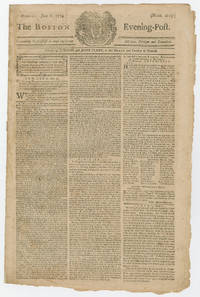
177424806<p>Early report in the local Boston newspaper on implementation of Parliament's Boston Port Act the first of the Intolerable Acts and the reaction to it in Massachusetts and beyond. Taking effect on June 1 1774 rather than punishing individuals the Act besieged the entire city until the colonists paid for the tea destroyed in the Tea Party December 16 1773.</p><p>"<i>the Act of Parliament for blocking up the Port of Boston is now in all its Parts carrying into Execution with the greatest Severity many Vessels being already prevented from coming in and Fishing boats and other small Craft strictly search'd; so that we have reason to expect that in a little time this Town will be in a truly distressed and melancholy Situation.</i>" p3/c1</p> <b>BOSTON PORT ACT.</b>Newspaper. <i>The Boston Evening-Post</i> June 6 1774 No. 2019. Boston: Thomas and John Fleet. 4 pp. 9¾ x 15⅜ in.<p><br /></p><p>The majority of this paper is devoted to patriotic content. The front page features a series of Questions and Answers from New York "<i>being conceived in some measure calculated to advance the cause of freedom in the present critical situation of affairs.</i>" It goes on to note that "<i>A Congress of Deputies from the several Colonies is thought to be absolutely necessary to devise means of restoring harmony between Great Britain and the Colonies and prevent matters from com</i>ing <i>to extremities</i>" p1/c1-2.</p><p>"<i>A Friend to Mankind</i>" wrote to the publishers "<i>When I first read the barbarous Act for shutting up the port of Boston; an act made with the pious design to starve the poor; make the industrious idle; the happy miserable; and as an entering wedge to the horrid purpose of enslaving America although I was transported beyond measure I could not help reflecting that bitter as it was for the present it would absolutely be of happy tendency to America in the result.</i>" p2/c1.</p><p>This issue prints a May 25 address from 33 Marblehead loyalists congratulating Massachusetts Gov. Thomas Hutchinson on his administration and wishing him a safe return trip to Great Britain p1/c3. On the other hand a public meeting in Marblehead denounced the address and declared Hutchinson "<i>an inveterate Enemy to the Liberties of the Province</i>" p2/c3.</p><p>This issue also announces from Boston "<i>the Corporation of <b>Harvard College</b>have voted that considering the present dark Aspect of our public Affairs—There be no public Commencement this Year—and that the Candidates for the first and second Degrees shall receive their Degrees in a general Diploma</i>" p3/c1. On May 1 1775 less than two weeks after the Battles of Lexington and Concord the faculty of Harvard dismissed the undergraduates early for the summer vacation again without a public commencement. Classes did not resume until October in Concord twenty miles away where students boarded with local residents and college courses were held in a deserted grammar school the courthouse and the First Parish meetinghouse. Meanwhile the five buildings of the college's campus in Cambridge housed 1600 American soldiers. After the British surrendered Boston in March 1776 and the American troops moved south to defend New York the college was permitted to reoccupy its buildings in June. Of 190 freshmen entering between 1775 and 1778 only 30 left prior to graduation.</p><p>An advertisement is included for a just-published pamphlet <i>Observations on the Act of Parliament commonly called the Boston Port Bill with Thoughts on Civil Society and Standing Armies</i>p2/c1. From September 1774 to March 1775 Josiah Quincy II 1744-1775 was in England arguing the American cause to sympathetic British politicians. He died of tuberculosis on the return voyage within sight of Massachusetts.</p><p><b>Historic Background</b></p><p>Relief for Boston was sent from as far away as South Carolina and the First Continental Congress convened in Philadelphia three months later to coordinate a colonial response to the Intolerable Acts.</p><p>Parliament finally repealed the Boston Port Act in 1783 after fighting ceased in the American Revolutionary War but before the Treaty of Paris officially ended the war and recognized American independence.</p><p><b>Condition</b></p><p>Near fine; several professional mends to gutter margin. A bright and attractive issue of an important colonial newspaper.</p> Thomas and John Fleet books
17793689<b>Scarce Contemporary Stony Point Battle Plan</b><br /><br />This rather crude woodcut depicts a battle plan of General "Mad Anthony" Wayne's daring and dramatic capture of the British fortification at Stony Point about 30 miles up the Hudson River from New York City. The battle planned in detail by Washington took place around midnight on July 16 1779. <br /><br /> The lower portion of the battle plan includes a four item key: "A. The British Fortress B. Abattes abatis in front C. The Reserve D. The detached Party who stormed the Works." Nebenzahl's <i>A Bibliography of Printed Battle Plans of the American Revolution 1775-1795</i> cites only a 1784 London-printed battle plan by Faden for the Stony Point engagement #145. The offered plan is not noted by Nebenzahl was published in America and was issued five years earlier than the Faden plan. The<i> Bickerstaff's Boston Almanack</i> for 1780 would almost certainly have been published in November or December of 1779 – within six months of the actual battle. <br /><br /> A very scarce almanac in the trade. Auction records indicate the most recent copy sold at the Gutman sale in 2005 for $4800. Prior to that Swann sold an example in 1979. <br /><br /><b>References:</b> For the almanac: Evans: 16287; Drake: 3290. For the map: Cresswell: 309. <br /><br /><b>Condition: </b>Map appears on verso of title page and measures about 6 ½ x 3 ¾." Almanac is complete in 24 pp. Slight loss of road table text at upper tip of final leaf.<br /><br />ICN 7643. Printed and sold by Draper and Folsom, and John Mycall of Newbury.
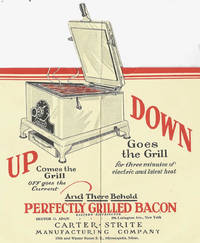
192910268Boston: various 1929. Archive. One medium-sized file box containing approximately six hundred twenty-five items including: commercial brochures 121 samples 11 posters 3 typed letters signed/TLS 304 autograph letters signed/ALS 149 postcards & telegrams 29 and periodicals 5. The commercial or trade brochures are mostly small booklets bi-folds and tri-folds graphically illustrated with images of the equipment on offer and frequently printed in two colors or in duotone. A small but deeply engaging archive depicting the business activities of the Boston Massachusetts kitchen equipment supply firm W.H. Davenhall. The supply company serviced businesses with food production and serving needs far beyond the traditional restaurants and hotels. There are in fact few of those represented therein. The company's stock in trade seemed to have been the many "secondary" food establishments growing in number in the early twentieth century including soda fountains candy shops tea rooms diners cafeterias educational dining facilities gas stations with food offerings cafes lunch shops beauty parlors fraternity houses and military bases. The types of equipment depicted in the archive represents changes in food production for a population rapidly moving away from traditional home dining and increasingly consuming food in new types of establishments. The rapid economic expansion that made all this change possible came to a halt with the Crash of 1929 and the Great Depression. The archive illustrates the experience of a small business in the years leading up to the Crash with issues collecting debts bankruptcy of suppliers and clients etc. The correspondence includes offers of new equipment or supplies often the line between brochure and correspondence is blurred orders inquiries demands for payments complaints requests for new supplier arrangements bankruptcy notices of former customers and more. In addition to the typed and handwritten letters there are postcards and telegrams. A handful of label samples and posters are included as well. Finally there are materials produced by trade periodicals including: Institutional Merchandising Hot Off the Griddle published by Westinghouse American Restaurant Magazine and The Soda Fountain. A wide range of business topics is visible in this archive: bill collection disputes about what was delivered or when disputes about salesmen adding items to an order bankruptcy of a client price changes a UNH fraternity orders a half dozen aluminum pitchers surprised complicated returns of defective merchandise development of school cafeterias the Crash of '29 deliveries abandoned or rejected and more. Condition is generally very good or better. A more detailed description including complete lists of suppliers and clients is available by request. various unknown
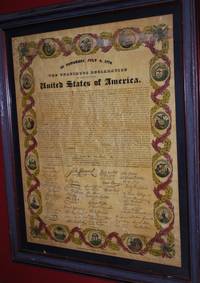
183590478Boston MA: Prentiss Whitney / Boston Bewick Company 1835. Broadside. Fine. 26 x 21 x 1.0. Broadside. Condition: Fine. Prentiss Whitney / Boston Bewick Company Boston MA 1835. 1 pages. Paper on cloth backing hand-colored covered with a thin ancient layer of protective lacquer or varnish. No folds or tears. Short wrinkles on the untaut paper surface. Framed in glass. Size: 26 x 21 x 1.0. An imposing and beautiful broadside document! Prentiss Whitney of Boston Massachusetts published this beautiful copy of the Declaration of Independence. It is approximately 26"" tall by 21"" wide. It has a four-line title printed in 4 different fonts. The text of the document is primarily in a handscript font with some words enlarged and bolded in print type of four different fonts. Bottom section contains the signature replicas. The entire document is surrounded by two intertwined vines which encircle 13 state medallions filled with symbolic vignettes and an eagle and shield Federal medallion. Vines and medallions are fully hand-colored. At the very bottom is printed: 'STEREOTYPED BY THE BOSTON BEWICK COMPANY. PUBLISHED BY PRENTISS WHITNEY 30 WASHINGTON STREET.' It is undated but probably published in 1835. Prentiss Whitney 1787-1870 was an auctioneer publisher of historic patriotic American prints and an entrepreneurial investor at 30 Washington St. Boston in the 1830's and 1840's. His ancestor Rev. Peter Whitney of Northborough Ma was one of the first to call for publishing the Declaration of Independence 'American independence vindicated. A sermon delivered September 12 1776. At a lecture appointed for publishing the Declaration of Independence passed July 4 1776. By the representatives of the United States of America in general congress assembled'. The Boston Bewick Company no. 47 Court Street Boston was an association of authors artists printers and bookbinders which was in existence from 1834-1838. It is mostly known for producing engravings and for hiring Nathaniel Hawthorne as editor of the 'American Magazine of Useful and Entertaining Knowledge'. The Act to incorporate the Boston Bewick Company states it is founded for: 'the purpose of employing improving and extending the art of engraving polytyping embossing and printing and carrying on the business thereof.' 1835 Boston Bewick ad: 'Engraving Stereotyping and Printing.: Boston Bewick Company. The Boston Bewick Company Respectfully Give Notice that They are Ready to Receive Orders for Engraving on Wood Steel and Copper; and for Copper-plate Letter Press and Xylographic Printing in All Their Branches.' Prentiss Whitney's prints are excessively scarce. The only other known copy of Whitney's 'Declaration' is in the Albert H. Small Declaration of Independence Collection University of Virginia. Whitney's other prints include an 1835 engraving titled 'Destruction of Tea in Boston Harbor in 1773' which was painted by artist George Loring Brown and engraved by Richard P. Mallory Collection of the Boston Athenaeum. 'The Capture of H.B.M. Sloop of War Frolic Capn. Whinyates by the U.S. Sloop of War Wasp Capn. Jab Jones on the 18th of Oct. 1812' Aquatint drawn and engraved by F. Kearny from a sketch by Lieutenant Claxton of the Wasp U.S. Naval Academy Annapolis. 'The Battle at Bunker's Hill or the Death of General Warren' Painted by John Trumbull and engraved by J. Norman. History::U.S.A.::Pre-Civil War Military History::USA::Revolutionary War History::U.S.A.::General/Other RBRoffice RBRoffice Prentiss Whitney / Boston Bewick Company unknown
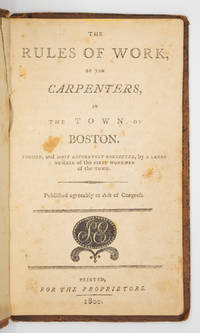
1800100845Boston: Printed for the proprietors by Samuel Etheridge 1800. 8vo. 34 pp. Contemporary sheep; upper board detached ffep removed in a custom chemise and slipcase. Scarce American price book for Boston carpenters in contemporary sheep. Signed as usual by Thomas Stutson secretary of the committee that drew up the rules which were devised to establish a fair system of charges for services rendered. Prices are an early example of the use of dollars and cents. Rink lists previous editions from 1774 1 copy 1794 no copy known & 1795 2 copies.PROVENANCE: William Reese book-label on chemiseREFERENCE: Evans 37003; Rink 1760 Printed for the proprietors [by Samuel Etheridge] unknown
B306408-1Boston 1985-2000. 77 exhibition catalogues each 6pp. printed on a single sheet as follows: 84 Peterborough St. in order by date: Alex Katz: 'Twelve Hours'. Nov. 1985. Eric Fischl: The Works on Glassine 1979-80. Dec. 1985-Jan. 1986. Ross Bleckner. Jan.-Feb. 1986. Brett De Palma. Feb.-March 1986. Lucio Pozzi. March-April 1986. David Bowes Michael Byron Chuck Connelly McDermott&McGough. April-May 1986. David Salle. May 1986. Marcel Odenbach. June 1986. With Karen Meyerhoff. Frank Egloff. Oct.-Nov. 1986. Julian Schnabel. Nov.-Dec. 1986. Enzo Cucchi: L'elefante di Giotto. Jan. 1987. Michael Byron. Feb. 1987. Sandro Chia. April-May 1987. Terry Winters. May 1987. Nicos Baikos. Sept.-Oct. 1987. 4pp. Philip Taaffe. Oct.-Nov. 1987. David McDermott. Peter McGough. Nov.-Dec. 1987. Claudio Parmiggiani: A lume spento. Jan. 1988. Ray Smith. Feb.-March 1988. Francesco Clemente. April-May 1988. Ceccobelli. Pizzi Cannella. May-June 1988. David Bowes: A Painter's Lexicon. Sept.-Oct. 1988. Roni Horn. Oct.-Nov. 1988. Sherrie Levine. Nov.-Dec. 1988. Ross Bleckner. Jan.-Feb. 1989. Matt Mullican. Feb.-March 1989. Gerhard Merz. March-April 1989. Richmond Burton. April-May 1989. Alex Katz. Sept.-Oct. 1989. Meyer Vaisman. Nov. 1989. Baselitz. Dec. 1989. . 207 South St. in order by date: David Salle. March-April 1990. Richmond Burton. Moira Dryer. April-May 1990. Lucio Pozzi: "for the Sexes." May-June 1990 Annette Lemieux. October 1990. Peter Halley Nov. 1990. Peter Halley. Nov.-Dec. 1990. Günther Förg. Dec. 1990-Jan. 1991. Moira Dryer. Feb.-March 1991. Rosemarie Trockel. April 1991. Richmond Burton. May-June 1991. Frank Egloff.Sept.-Oct. 1991. Ray Smith. Nov. 1991. Meyer Vaisman. Dec. 1991-Jan. 1992. David Dupuis Christopher Lucas Carl Ostendarp Matthew Weinstein. Jan-Feb. 1992. Nicola De Maria. April-May 1994. Mimmo Paladino. Dec. 1994-Jan. 1995 with: invitation card for the exhibition. Scott Grodesky. Jan.-Feb. 1995 with: invitation card for the exhibition. Richmond Burton. April-May 1995 with: invitation card for the exhibition. Ophrah Shemesh. Sept.-Oct. 1995 with: invitation card for the exhibition. Peter Halley. Nov.-Dec 1995 with: invitation card for the exhibition. Jaqueline Humphries. March-April 1996 with: invitation card for the exhibition. Annette Lemieux. April-May 1996. Ray Smith. Oct.-Nov. 1996 with: invitation card for the exhibition. Tom Sachs. Nov.-Dec. 1996 with: invitation card for the exhibition. The Body of Painting: Ellen Gallagher Christopher Lucas Matthew Ritchie. Jan. 18 1997. Single folio sheet. Matthew Antezzo. March-April 1997 with: invitation card for the exhibition. Barry X Ball. April-May 1997 with: invitation card for the exhibition. Magdalena Campos-Pons. Sept.-Oct. 1997 with: invitation card for the exhibition. Philip Taaffe. Oct.-Nov. 1997 with: invitation card for the exhibition. Michael Craig-Martin. Nov.-Dec. 1997 with: invitation card for the exhibition. Nicky Hoberman. Jan.-Feb. 1998 with: invitation card for the exhibition. Donna Moylan. Feb-March 1998 with: invitation card for the exhibition. Ellen Phelan: Through Dolls and Flowers. April 1998 with: invitation card for the exhibition. Fabian Marcaccio. May 1998 with: invitation card for the exhibition. Joan Banach. Sept.-Oct. 1998. Peter Halley. Oct.-Nov. 1998 with: invitation card for the exhibition. Matthew Ritchie. Nov.-Dec. 1998 with: invitation card for the exhibition. William Wood. Jan.-Feb. 1999 with: invitation card for the exhibition. Tom Sachs. March-April 1999 with: invitation card for the exhibition. Alex Katz: February 5:30 PM. April-May 1999 with: invitation card for the exhibition. Ellen Gallagher. May-July 1999 with: invitation card for the exhibition. Cyber/Cypher: Pedro Barbieto Matthew Ritchie James Siena Joh Simon. Sept.-Oct. 1999 with: invitation card for the exhibition. Richard Patterson. Nov.-Dec. 1999 with: invitation card for the exhibition. Eric Fischl. Dec. 1999-Jan. 2000 with: invitation card for the exhibition. Ross Bleckner. Jan.-Feb.2000 with: invitation card for the exhibition. Annette Lemieux: Crossing the Rubicon. Feb.-March 2000 with: invitation card for the exhibition. 4to. Wraps. Mario Diacono came from Italy in 1968 to teach Italian literature at the University of California Berkeley and at Sarah Lawrence College. He returned to Italy to found his first art gallery in Bologna. There from 1978-1979 he showed young Arte Povera and Conceptual Italian artists like Jannis Kounellis and Vito Acconci. From 1980-1984 Diacono had a gallery in Rome showing mostly American artists including Julian Schnabel David Salle Joseph Kosuth Eric Fischl and Jean-Michel Basquiat in 1982. Mario Diacono opened his first gallery in Boston in 1985 at 84 Peterborough Street which had been the Starn Twins studio. In the spring of 1990 the gallery moved to 207 South Street a building that contained other art galleries as the area showed promise to be a new arts district. Diacono showed Alex Katz Eric Fischl Ross Bleckner David Salle Julian Schnabel Enzo Cucchi Sandro Chia Francesco Clemente Philip Taaffe Richmond Burton Roni Horn Ross Bleckner Rosemary Trockel Annette Lemieux and Baselitz among many others. However once the Gulf War broke out the art market collapsed and Diacono closed his South Street gallery in 1992. Diacono then moved to New York City for a short period of time and from early 1992 to the summer of 1993 he held exhibitions there together with Perry Rubenstein showing Ross Bleckner Philip Taaffe Richmond Burton and others. Upon his return to Boston he held exhibitions at 207 South Street again from 1994 to 2000. Artists he showed included David Salle Richmond Burton Peter Halley Rosemarie Trockel Annette Lemieux Barry X. Ball Matthew Ritchie Ross Bleckner and Günter Förg. Boston, 1985-2000. paperback
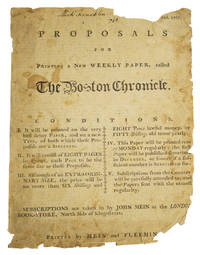
1767313300Boston: Printed by Mein and Fleeming 1767. 2 pp. prospectus printed recto and verso of a single sheet. 4to 10-1/2 x 8 inches. Damage at edges with loss to text month October missing from heading lower corner torn away with loss to"G" in Fleeming in imprint a few letters lost from right margin on recto and 12 lines affected on verso toned and stained. Signed "Mich. Franklin 1768" at top of recto. 2 pp. prospectus printed recto and verso of a single sheet. 4to 10-1/2 x 8 inches. Rare early American newspaper prospectus announcing publication of The Boston Chronicle a weekly Loyalist paper. "John Mein a bookseller was the publisher and John Fleeming the printer. With the beginning of the second year the size of the paper was enlarged to folio and it was publihsed every Monday and Thursday and was the first newspaper to be published twice a week in New-England. To avoid popular resentment of his political views Mein was forced to leave the country before the close of its second year and the paper was continued by Fleeming in the name of the firm until its publication ceased on the 25th of June 1770" Evans.<br /> <br /> The five "conditions" listed on the recto detail the general design of the paper - that it will be printed on high quality demy paper with specially designed type 8 pages in quarto priced at 6 shillings and 8 pence printed every Monday and delivered to subscrribers with care. The verso with text in three columns outlines a plan of the contents of the paper including coverage of current events and issues essays on moral subjects notices on newly published books poetry etc. Ford Broadsides 1418; Shipton-Mooney 41736; Bristol B2787 recording 4 copie; Evans 10565 for newspaper Printed by Mein and Fleemin[g] unknown
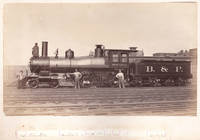
5490Rhode Island and Massachusetts: Boston & Providence Railroad 1880s. 2 oblong 8vo photograph albums 7.5" x 10.5" brown cloth over boards gilt titles at front-cover; 1 8vo disbound album. 62 bromide print photos 4.5" x 8" with printed and manuscript labels mounted on paperboard leaves; all photos numbered and arranged in sequence: 1-23 in Album 1 19 total lacking 12 13 15 and 20; 26-49 on loose leaves from disbound album 2 23 total lacking #24 #25 and #40; 50-64 plus 5 unnumbered and unlabeled images in album 3 20 total. <p>An impressive photo archive documenting a range of locomotives built for the Boston & Providence Railroad by the Rhode Island Locomotive Works; the Taunton Locomotive Mfg. Co.; Mason Machine Works; the Hinkley & Williams Works and the Boston & Providence itself.</p> <br /> <br /> <p>Forty-two of the various engines pictured were produced between 1867 and 1887 by the R. I. Lo. Works; seven by the Bos. & Prov. from 1854-1873; six by Taunton L. M. C. from 1868-1886; two by Hinkley & Williams from 1868-1887; and one by Mason Machine Works in 1884. Also included here are images of the Highland and Mount Hope train stations as well as an unidentified railroad bridge. A typical label reads: "26. Squantum. Taunton L. Mfg. Co. 1886. 37.5 / 16 / 20 / 4.5 / 59564 Outside." The engineers and others who operated the trains appear in many photos enlivening the scenes.</p> <br /> <br /> <p>Incorporated 1831 the Boston and Providence Railroad was built in two sections in 1834 and 1835 and was acquired in 1888 with a ninety-nine year lease by Old Colony Railroad. Of particular note was Master Mechanic George S. Griggs 1905-1970 who was hired in 1834 at age twenty-nine to organize the department and improve the early engines built in the Roxbury shops. As Charles E. Fisher details "Perhaps the highest compliment that can be paid him was that his work on the locomotive was closely followed by the Taunton Locomotive Works and Hinkley & Drury. Mr. Griggs continued to build inside connected locomotives long after the other roads had discarded them and they were a common sight on this road as late as the seventies."</p> <br /> <br /> <p>Given the date of the Old Colony's acquisition of the Boston & Providence these photos may relate to the takeover.</p> <br /> <br /> <p>A valuable record of the Boston & Providence fleet of locomotives.</p> <br /> <br /> <p>REFERENCES: Fisher Chas. E. "Locomotives of the New Haven R.R." The Railway and Locomotive Historical Society Bulletin No. 47 September 1938 pp. 79-89.</p> <br /> <br /> <p>CONDITION: Spine perished on one album some images and mounts toned or foxed damp stains to edges of some leaves bindings worn at extremities photos with generally good tonality.</p> Rhode Island and Massachusetts: Boston & Providence Railroad, 1880s unknown
1767313300Boston: Printed by Mein and Fleeming 1767. 2 pp. prospectus printed recto and verso of a single sheet. 4to 10-1/2 x 8 inches. Damage at edges with loss to text month October missing from heading lower corner torn away with loss to"G" in Fleeming in imprint a few letters lost from right margin on recto and 12 lines affected on verso toned and stained. Signed "Mich. Franklin 1768" at top of recto. 2 pp. prospectus printed recto and verso of a single sheet. 4to 10-1/2 x 8 inches. Early American newspaper prospectus. Rare early American newspaper prospectus announcing publication of The Boston Chronicle a weekly Loyalist paper. "John Mein a bookseller was the publisher and John Fleeming the printer. With the beginning of the second year the size of the paper was enlarged to folio and it was publihsed every Monday and Thursday and was the first newspaper to be published twice a week in New-England. To avoid popular resentment of his political views Mein was forced to leave the country before the close of its second year and the paper was continued by Fleeming in the name of the firm until its publication ceased on the 25th of June 1770" Evans.<br/><br/>The five "conditions" listed on the recto detail the general design of the paper - that it will be printed on high quality demy paper with specially designed type 8 pages in quarto priced at 6 shillings and 8 pence printed every Monday and delivered to subscrribers with care. The verso with text in three columns outlines a plan of the contents of the paper including coverage of current events and issues essays on moral subjects notices on newly published books poetry etc. Ford Broadsides 1418; Shipton-Mooney 41736; Bristol B2787 recording 4 copie; Evans 10565 for newspaper Printed by Mein and Fleemin[g] unknown books
198485069New York: Simon & Schuster. As New. 1984. Paperback. 0671460889 . FREE UPGRADE to Courier/Priority Shipping Upon Request - IN STOCK AND IMMEDIATELY AVAILABLE FOR SHIPMENT - AS NEW THE TEXT BLOCK IS PRISTINE CLEAN UNMARKED AND IN EXCELLENT CONDITION - - 647 pages. -- with a bonus offer--; 4to - over 9¾" - 12" tall . Simon & Schuster paperback
Very Good Turkish Original wrappers. Cr. 8vo. (19 x 13 cm). In Turkish. 305, [1] p., errata. Extremely rare in this condition and in original wrappers. Fading on spine, slight stains on cover. Untrimmed. Otherwise a very good copy. Repaired by tape on the front cover's bottom corner. Yorulmaz's rare first Turkish translation of 'Das Kapital' has been the subject of many 'translation studies'. The most important work in the entrepreneurship of Yorulmaz's left thought repertoire that was published within his cultural series was 'Sermaye [= Das Kapital]'. Published as the 7th book of 'the Capital Culture Series', an abridged translation of Das Kapital by Karl Marx. Yorulmaz wrote about his translation: "I had an experience on these empty days and I am translating and publishing a loyal story of 14 volumes, "Das Kapital", collected by Gabriel Dövil. If this abridged edition is requested, I will finally begin with these 14 volumes, starting in June 1937, and translating four every year." Yorulmaz had translated 'Das Kapital' to Turkish from Gabrielle Deville's French translation which was an abridged edition. According to his comments, the purpose of Yorulmaz was, if this abridged edition is requested or demanded he would translate full text of 'Das Kapital'. However, he couldn't realize this dream. Nevertheless, the effect of the 'Sermaye' in the Turkish leftist thought had been considerable. As "Capital" was the first translation of "Das Kapital" into Turkish, it functioned at that time to fill the gap that existed in terms of socialist thought. He was concerned with knowing Karl Marx's thoughts, and therefore in his preface to 'Sermaye', he described his intellectual approach as "[one] sect which is one of the deepest thoughts and has made the biggest earthquake in the world in social and political life". In his preface, he wrote: "We have nothing but a small realized interference about Karl Marx's study in the law school in Ankara by Cavit Bey and the Turkish attorney Sükrü Kaya Bey, five to ten pages of translations." (Source: Haydar Rifat Yorulmaz'in çevirileri, (1908-1940): Bir sol düsünce 'repertuvari'nin kurulusu, Bilal Çelik). In the preface of the 1888 English Edition of 'Das Kapital', Engels says "I was told that the Armenian translation, which was expected to be published in Istanbul a few months ago, did not see the light of day because the publisher was afraid to release a book bearing the name of Marx, while the translator refused to show it as his own work.". (Das Kapital in Turkey, Savran & Tonak). Haydar Rifat was a Turkish lawyer, intellectual, translator and author. He brought the works of world-famous writers such as Emil Ludwig, Lenin, Gustav, Balzac, Tolstoy, Dostoevsky and Karl Marx into Turkish; he published his translations under the series titled 'Dün ve Yarin Tercüme Külliyati' [i.e. Yesterday and Tomorrow as Translation]. In addition, many articles he wrote in the fields of law and literature appeared in various newspapers and magazines. Not in OCLC.
119866Roma: Edizioni Eos 2012. Brossura wrappers. Perfetto Mint. Un testo poetico e 13 fotografie originali in bianco e nero del 1962 di Mario Diacono. 8vo. pp. 32. Perfetto Mint. Edizione originale di 71 es. numerati e firmati. Edizioni Eos, unknown
1868150997Boston: Alfred Mudge & Son City Printers 1868. The land of Washington has greeted the land of Confucius First edition in wrappers of this work commemorating the August 1868 visit to Boston by the first Chinese embassy to the United States. The contents includes the text of a banquet speech by Ralph Waldo Emerson articulating Confucianism's contribution to notions of human goodness. In 1867 the Qing court appointed the Bostonian Anson Burlingame 1820-1870 as its envoy extraordinary to the Western powers and the following year Burlingame led China's first official embassy to the United States and Europe. Burlingame was the ideal choice for such a task possessing "a frank noble disposition habits of industry a charming and persuasive manner and promising talents as an orator" quoted in the ANB. With the Chinese ministers Zhigang and Sun Jiagu at his side Burlingame landed on America's Pacific Coast in March 1868 before city-hopping eastwards and reaching Washington in June. There after extended negotiations the two parties concluded the landmark Burlingame-Seward Treaty the first time a foreign power explicitly recognized China's sovereignty. Following these negotiations the embassy journeyed to Boston staying between 20 August and 2 September. The present commemorative volume prints the full text of speeches given at the welcome reception and grand banquet. Other sections detail the engagements laid on for Burlingame and his party such as visits to the governor's mansion and local manufacturing sites. Burlingame's effusive and somewhat hyperbolic words at the banquet capture the historical importance of the embassy: "the presence here of my associates with the sunshine of the Orient upon their faces and the warmth of its fires in their hearts arouses more emotions than the most eloquent tongue can express. The land of Washington has greeted the land of Confucius. The great thoughts of the one have been wedded to the great deeds of the other" p. 20. Pages 52-55 contain the text of a speech by Ralph Waldo Emerson who was invited to address the welcome banquet. To attendees Emerson extolled the longevity of China's culture and its scientific technological and cultural successes achieved long before those of European countries. Discussing Chinese philosophy Emerson praised Confucius as having anticipated Jesus' teachings of goodness towards others by five hundred years - an expression of Confucianism's sustained influence on Emerson's transcendentalism. "Confucianism reinforced Emerson's emphasis on the moral imperative for every individual and. the Confucian ideal of the ethical solitary learned and decorous man certainly appealed to Emerson's sense of himself" Versluis p. 70. The speech was later reprinted in his Miscellanies 1904. Copies of the present work were also bound in cloth with no stated priority between the two bindings. Octavo. Emblem of the city of Boston to title page. Original blue coated card wrappers title and emblem of the city of Boston to front cover in black. Small pencilled annotation to front cover library stamp of Tufts College to title page. Wrappers lightly soiled and rubbed in places with one small chip slight colour bleed to verso of wrappers internally clean and bright. A very good copy of this fragile publication. BAL III 23. Arthur Versluis American Transcendentalism and Asian Religions 1993. hardcover
190427836Boston: Art Galleries of Leonard & Co. As New. 1904. Paperback. FREE UPGRADE to Courier/Priority Shipping Upon Request - IN STOCK AND IMMEDIATELY AVAILABLE FOR SHIPMENT - Fair. Puncture to cover and approx. First 25 pages text not affected; spotty discoloration and yellowing to cover. Several pages dog-eared. Not illustrated. Among the artists whose works were sold in this auction: Trouillebert Maes Isabey Jacque Daubigny and Chintreuil. -- with a bonus offer-- . Art Galleries of Leonard & Co. paperback
197584480Museum; New York Graphic Society. As New. 1975. Hardcover. FREE UPGRADE to Courier/Priority Shipping Upon Request - IN STOCK AND IMMEDIATELY AVAILABLE FOR SHIPMENT - AS NEW THE TEXT BLOCK IS PRISTINE CLEAN UNMARKED AND IN EXCELLENT CONDITION - - - Corresponds to ASIN: B000MXFTKG. 233 pages; many illustrations; oblong 8vo. -- with a bonus offer-- . Museum; New York Graphic Society hardcover
198774189Museum of Fine Arts. New. 1987. Paperback. 0878462872 . FREE UPGRADE to Courier/Priority Shipping Upon Request - IN STOCK AND IMMEDIATELY AVAILABLE FOR SHIPMENT - Flawless copy brand new pristine never opened -- 40 pp. With 22 ills. 31 x 23 cm. -- with a bonus offer-- . Museum of Fine Arts paperback
190436109Boston: Bates and Guild Company. As New. 1904. Paperback. FREE UPGRADE to Courier/Priority Shipping Upon Request IN STOCK AND IMMEDIATELY AVAILABLE FOR SHIPMENT - Mild cover shelfwear; else fine. 12 black and white plates iincluding a photo of the artist followed by a 20 page essay with bibliography. -- with a bonus offer-- . Bates and Guild Company paperback
196959664New York Graphic Society. As New. 1969. Paperback. FREE UPGRADE to Courier/Priority Shipping Upon Request IN STOCK AND IMMEDIATELY AVAILABLE FOR SHIPMENT - AS NEW THE TEXT BLOCK IS PRISTINE CLEAN UNMARKED AND IN EXCELLENT CONDITION - - 222 pp. With 460 ills. 30 x 21 cm. -- with a bonus offer-- . New York Graphic Society paperback