Collectif ; Ecole PolytechniqueLivre Rare Book
19 492 résultats
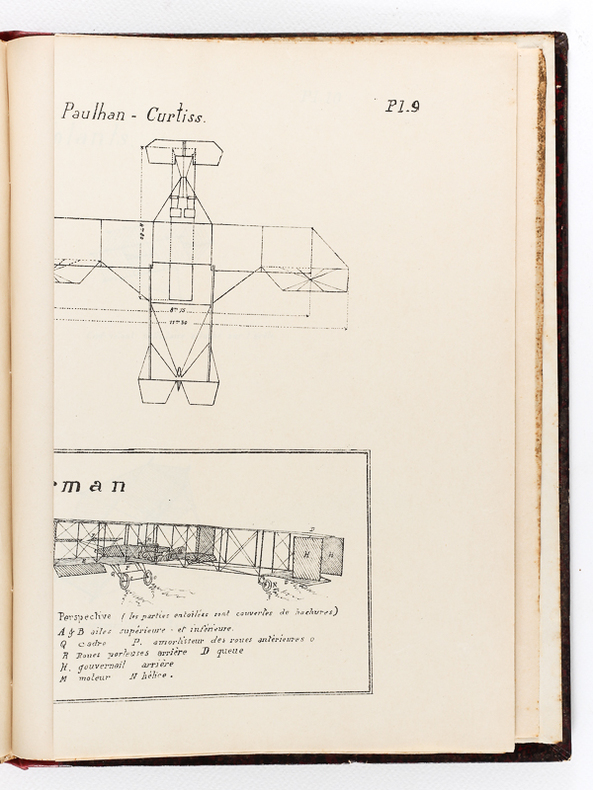
1913477241 vol. grand in-4 reliure demi-basane rouge, Cours d'Art Militaire. Ecole Polytechnique Instruction Militaire. Année 1913-1914 : Génie. Travaux de Campagne. 2 Conférences. Août 1913, 89 pp. [ Capitaine Piquet ] - Aéronautique. Août 1913, 69 pp. [Capitaine Barré ] - Administration. 2 Conférences. Novembre 1913 [ Capitaine Pesseaud ], 43 pp. - Service des Armées en Campagne. 2 Conférences, Novembre 1913, 43 pp. [ Capitaine Morellet ] - Cours d'Artillerie. 3e Partie 3 Conférences, Août 1913, 28-29-42 pp. [ Capitaine Morellet ] - L'Officier dans la Nation Armée. Décembre 1913, 55 pp. [ Capitaine Cattin ] - Conférence d'Education Physique. Avril 1914, 20 pp. [ Capitaine Menjaud ] - Conférences à l'Ecole Polytechnique destinées à mettre en évidence les relations qui existent entre la théorie et les application, 14-30-19-19-29-40 pp. [ Sur les Sous-Marins, avec 2 grandes planches dépliantes ] et 8 planches puis 11 planches dépliantes [ Soit pour l'ensemble de l'ouvrage 21 planches dépliantes ]
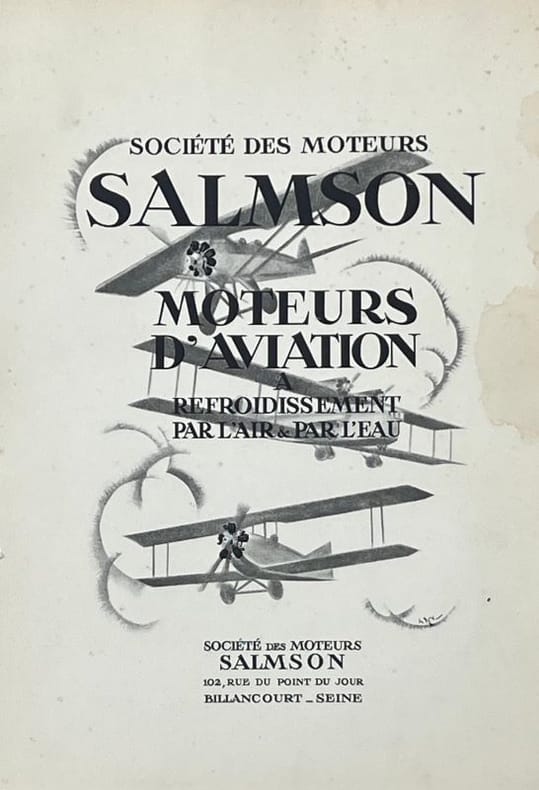
97911 Malakoff, Société des Moteurs Salmson, Atelier d'Héliochromie, Théo Brugiere, 1932, in-4, broché, couverture rempliée imprimée en noir.
4 vols., oblong 4to., First Edition, with very numerous photographs throughout (colour section in third volume); black cloth, gilt backs, a near fine set in unclipped dustwrapper. The set comprises: Vol.I (1999); Vol.II (2000); Vol. III (2000); Vol. IV: (2001). Sarkar's lifelong fascination with the events of Summer 1940 has culminated in a unique photographic record derived largely from private sources. COMPLETE SETS ARE EXTREMELY SCARCE.
8vo., First Edition, on laid paper, with portrait frontispiece and plates; handsomely bound in navy full crushed morocco, sides with gilt frame border, back with raised bands ruled in gilt, second and fourth compartments lettered in gilt, all other compartments tooled in gilt, gilt top, hand-made endpapers, a most attractive copy ideal as a gift or for presentation. THIS COPY WAS FORMERLY IN THE LIBRARY OF A WWI RFC SERVICEMAN. A LIST IN MS OF HIS POSTINGS 1918-1920 IS MOUNTED ON NEW LEAF AT FRONT. Substantial account of the WWI period including much about the air war on submarines. SCARCE. Noffsinger 1336.
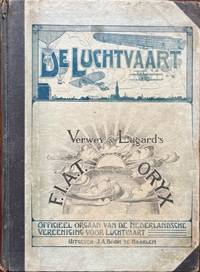
191059028Haarlem: Gedrukt bij J.A. Boom 1910. 4to. Twenty-six issues in one vol. iv 460 pp. With 100’s of photo illustrations text illustrations digrams charts maps. Quarter-black cloth over publisher’s illustrated boards blue & black lettering illustration on front cover minor scuffing wear dustsoiling wear to corners slight fraying head & foot of spine and light uniform interior toning ex-lib markings on title endpapers still VG- copy w/ perforated stamp at foot of title w/ withdrawn stamp and ownership stamp of Bill Rhode b. 1915 Aeronautical Collection was the owner of a large clipping service for aviation and flying subjects and worked for the legendary Gates’ Flying Circus was a stunt parachute jumper B-17 tail gunner during World War II and later acrobatics instructor. First edition of all 26 issues of the second volume in this pioneering Dutch aviation magazine. These exceedingly scarce early illustrated magazines provide an essential visual and textual documentary record of aviation within the first decade of the Wright Brothers first powered flight. Articles encompass early balloon trips barrage military balloons lighter-than-air airships descriptions and illustrations of the latest Wright airplanes Maxim’s new plane Etrich’s monoplane and many early aviators air races crashes and more. Issued biweekly from 1909-1913 this magazine was the official publication of the Dutch Aviation Association & 1910-1913 for Dutch East Indies Association for Aviation. [Gedrukt bij J.A. Boom, hardcover
194762513Derby: Rolls-Royce Ltd. 1947-1952. Three vols. Oblong 4to. 20 unpaginated. printed in orange & black; 32 unpaginated. printed in green & black; 3rd. is 4to. 14 2 pp. Numerous photo illustrations & diagrams tipped-in colour plate for vol. 2. Dark burgundy textured softcovers w/ yapp edges embossed on front cover in white & black w/ company logo sewn w/ silk braid as issued; 2nd vol. with tan textured softcovers w/ yapp edges embossed & raised gilt purple & beige lettering w/ company logo punch-sewn w/ silk braid as issued slight shelfwear; 3rd. vol. w/ colour-illustrated self-printed softcovers NF set. First edition of the 2nd volume 2nd edition of 1st & 3rd of these excellent post-World War II promotional catalogue for Rolls Royce aviation engines which are quite scarce. The first begins by describing the making of engines for Bristol Fighters in World War I producing Schneider Trophy engines in 1929-1931 and later development of the Merlin Engine which was vital for the Spitfire during World War II. Illustrations are included for the engines as well as the Hawker Fury Fairey Battle Hawker Hurricane Supermarine Spitfire De Havilland Hornet Avro Lancaster Bomber and of particular interest the Lancastrian VH742 -- the first jet airliner. It also details the early development of jet engines for the Gloster Meteor the Trent engine for jet fighter aircraft and the Derwent V for the first jet airliner. The second catalogue details the jet age engines by Rolls-Royce including the Nene the Tay Derwent V the Avon which powered Canberras and the prototype Avro Vulcan the Supermarine Swift and the Meteor IV jet fighter which first flew in 1945 and became an operational production aircraft in 1947 and was a successful combat fighter. Worldcat locates 1 copy of 1st catalogue Ingenium; 2 copies of the 2nd Ingenium Library & NYPL; 1 copy of the 3rd Ingenium. Rolls-Royce Ltd., paperback
195761454Burbank CA: California Division of Lockheed Aircraft Corporation; Resort Airlines Inc. 1957. Thick 4to. 11 x 11.5 x 2.5 in. 310 pp sections separately paginated some removed some updated. With 100’s of illustrations diagrams charts tables thumb-tabs at fore-edges of section dividers. Green publisher’s cloth 7-ring binder gilt lettering stamped on front cover & spine rounded corners some agewear rubbing minor soiling still VG- exemplar. First edition thus of this exceedingly scarce flight manual for the popular L-1049H Super Constellation from Lockheed affectionately referred to as the “Super Connie†or “Super H†and “Husky†was the competitor airliner to the popular DC-6 and popular with Quantas Airlines Northwest Orient Flying Tiger Lines and as in the case for this manual Resort Airlines Inc. The L-1049H entered service in Nov. 1956 and mated a C-121C fuselage with a L-1049G providing a convertible passenger/freight aircraft whose cargo hold had a volume of 565 cubic feet and could carry up to 120 people with seats luggage lockers and bathroom facilities. The Super Constellations were popular aricraft and favorted by many Latin American airlines continuing in service until 1966 when the Boeing 707 and Douglas DC-8 basically rendered them obsolete. A total of 56 were built in various configurations and as with most flight manuals these were ever-changing with sections added revised and/or removed by the airline as specifications changed. In this case Resort Airlines Inc. which operated out of Oakland CA from 1949-1961 has added several sections with mimeographed updates to the Lockheed installments including Emergency Procedures Landing Instructions Runway Analysis and Spare Parts Kit. Of particular interest are the Runway Analysis for such airports as Atsugi Agana Guam Honolulu Int. Hawaii McChord AFB Manila P.I. Oakland Int. California Wake Island and others. No copies in Worldcat. California Division of Lockheed Aircraft Corporation; Resort Airlines, Inc.], hardcover
194061912Burbank CA: Lockheed Aircraft Corporation 1940-1941. 4to. 9 x 11.5 in. 4 xiv 3 192 pp. With diagrams tables photos suite of 45 cyanotype blueprints added Jan. 1941. Brown linen post-binder lettering & Lockheed logo front cover in dark brown dark brown lettering minor foxing to title some edgewear minor shelfwear still VG copy numbered on ownership page. First edition of this exceedingly rare Lockheed Aircraft Corp. service manual for the Lockheed Lodestar 18 which was a substantial enhancement from the earlier Lockheed 14 Super Electra featuring sections on the fuselage wings wing flaps landing gear stabilizers instruments and more. The Lodestar was developed to compete with the popular Douglas DC-3 but even with its’ greater capabilities in cruising speed range and altitude performance allowing it to easily cross the Rocky Mountains it was not until the Lodestar 18 was enhanced with 5 additional feet and 18 seats which made it profitable. It first entered service with Mid-Continent Airlines and Continental in the United States along with one for United Airlines and several overseas customers. In 1942 most of the domestic models were seized for the war effort and were converted into the very popular and C-46 and later C-60 Lodestars which proved indispensable during World War II. Worldcat locates 1 copy w/o the cyanotype blueprints Ingenium Library & Archives ONT Canada. Lockheed Aircraft Corporation, unknown
194263318Dayton OH: The Material Center Experimental Engineering Section Wright Field Aug. 1942; Sept. 4 1942. Two vols. 4to. 40; 11 1 pp. mimeograph typescript. First with photo illustrations both with text illustrations diagrams. 1st w/ blue-tinted printed softcovers Rising Sun motif on front cover blue lettering minor age toning to fore-edges minor bumping to couple corners edgewear still VG copy former ownership markings of O.G. Hoffman front cover; 2nd w/ self-printed mimeograph softcovers uniform light toning red restricted stamps pencil marking faint remnants of staple marks at gutter margin still VG copy. First editions of this very rare original Restricted Wartime reports on the flight and combat capabilities of the famed and innovative Japanese aircraft less just 9 months after the attack on Pearl Harbor and one month after the US was able to secure a Mitsubishi A6M2 Type Zero which had crashed during the Aleutians campaign in Alaska in July 1942. The longer 1st report focuses on the Mitsubishi Aichi Kawanishi and Nakajima bombers fighters reconnaissance aircraft torpedo bombers dive bombers flying boats and float planes. The second exceedingly scarce original report focuses entirely on the famed Zero. Although the Chinese had secured two Zero’s as early as late November 1941 those rebuilt aircraft would not reach Wright Airfield until late 1943. Worldcat locates 1 copy of 1st Defense Bibliothek NL; No copies of 2nd are located An expanded No. 85 Report issued at the end of 1942 in 25 leaves is located at USAF Academy Smithsonian Emory Museum of Flight WA Australian Defence Force Academy Lib. The Material Center, Experimental Engineering Section, Wright Field, paperback
76640Various places; various dates. Generally fine condition. unknown
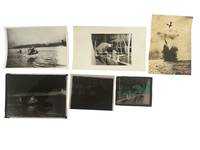
1912225241912. Unknown photographer Wright hydroaeroplane and early biplane models photo archive circa 1912 to 1913 documents early American seaplane experimentation during the period when the Wright Company adapted its pusher aircraft technology for water takeoff alighting and military use. The photographs capture a hydroaeroplane on or near water a dramatic water-impact or alighting scene and a hangar interior where men work over the open framework of a Wright-type machine providing visual evidence of experimental aircraft handling float design rigging and workshop adjustment. Wright State University's Wright Brothers Collection identifies a 1913 photograph of Orville Wright standing in the Miami River between the pontoons of a Wright Model CH Flyer confirming the Great Miami River as a documented site for Wright Model CH hydroaeroplane testing in this period.<br /> <br /> Six pieces total comprising three silver gelatin prints each approximately 7 x 5 inches and three contemporaneous negatives including two large-format film negatives and one smaller glass or film negative likely made in the Dayton Ohio area and a Wright Company hangar. The largest print shows a pusher-type biplane with forward elevator and floats partly submerged near a piling giving the aircraft an unmistakable hydroaeroplane profile. A second sepia-toned print captures a tall column of spray in open water as a small aircraft passes overhead or just beyond the splash likely recording a hard alighting water-impact or test-run sequence. A third print shows an interior hangar scene with two mechanics or engineers in caps and a man in a straw boater leaning over the exposed structure of a Wright machine; visible details include struts bracing wires control runs open framework and fittings along the central bay. The three negatives correspond to the water-impact and hangar views preserving additional technical detail of the rigging geometry float or skid attachments and pusher layout.<br /> <br /> The visual evidence aligns closely with Orville Wright's 1913 Model C-H hydroaeroplane work on the Miami River south of Dayton though attribution to a specific flight or photographer should remain cautious without inscriptions or provenance beyond the images themselves. Contemporary and local Wright histories describe the Model C-H as a hydroaeroplane tested by Orville on the Miami River in 1913 and one Dayton aviation history account states that in May 1913 he resumed testing the Model C-H at a secluded Miami River site and made 100 flights carrying up to 800 pounds of payload. The photographs matter because they show the Wright enterprise after Wilbur Wright's death in 1912 when Orville continued technical experimentation even as competitors especially Glenn Curtiss pressed forward in flying-boat development. Light edge creases and small corner bumps to the prints one print with faint silvering and toning negatives with light emulsion scuffing and edge tape remnants but strong density and detail very good overall. Focused early aviation archive preserving both river testing and workshop evidence from the moment Wright biplane design was being adapted to hydroaeroplane use on the eve of World War I. unknown
192713487Marshall MO: Nicholas-Beazley Airplane Co. Near Fine. 1927. First Edition. Softcover. A light stain to the topof the first couple of pages. Colorful cover and lots of pictures of parts planes instrument panels etc. ; 16mo 6" - 7" tall; 96 pages . Nicholas-Beazley Airplane Co. paperback
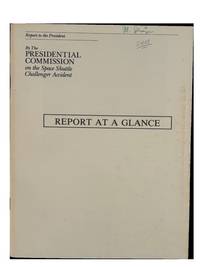
1986224261986. Space and Aviation Presidential Commission on the Space Shuttle Challenger Accident. Report to the President: Report at a Glance. Washington D.C.: U.S. Government Printing Office 1986. First edition. Volume I totaling approximately 30 pages which includes the main findings. This abbreviated summary of the Report to the President by the Presidential Commission on the Space Shuttle Challenger Accident offers a concise and accessible overview of the findings surrounding the catastrophic failure of STS-51-L which disintegrated 73 seconds after liftoff on January 28 1986 killing all seven crew members aboard. <br /> <br /> Commonly known as the Rogers Commission Report this document distills the conclusions of a body convened by President Ronald Reagan and chaired by former Secretary of State William P. Rogers with members including astronauts Neil Armstrong and Sally Ride. This "Report at a Glance" was issued for broader circulation and comprehension a key part of the Commission's goal "to document our findings and make recommendations for your consideration." The pamphlet opens with a solemn "In Memoriam" page bearing the official crew portrait of the Challenger astronauts including Commander Francis R. Dick Scobee Pilot Michael J. Smith Mission Specialists Ellison S. Onizuka Judith Resnik and Ronald E. McNair and Payload Specialists Christa McAuliffe and Gregory B. Jarvis. Beneath the image appears a poignant quote from Reagan's televised address: "The future is not free: the story of all human progress is one of a struggle against all odds. It was built by men and women like our seven star voyagers who answered a call beyond duty." A letter from Rogers to President Reagan dated June 6 1986 reaffirms the national pain and resolve: "The nation's task now is to move ahead to return to safe space flight. There could be no more fitting tribute to the Challenger crew than to do so."<br /> <br /> The core of the report identifies a systemic failure in NASA's risk assessment and engineering culture. The immediate cause of the explosion detailed in Chapter IV was "a combustion gas leak through the right Solid Rocket Motor at field joint" attributed to O-ring failure exacerbated by the unusually cold temperatures on launch day. The report states bluntly: "The consensus of the Commission. is that the loss of the Space Shuttle Challenger was caused by a failure in the joint between the two lower segments of the right Solid Rocket Motor." A diagram on the facing page maps acronyms and component systems central to understanding the shuttle's propulsion including ET External Tank LOX Liquid Oxygen and SSME Space Shuttle Main Engine. Findings were unflinching: "Launch site activities. were not considered as direct causes of the accident" yet "weaknesses in NASA's decision-making structure" were. This offering Volume I contains the report which summarizes the main findings and appendices A-D while Volumes II and III contain the rest of the appendices and Volumes IV and V contain hearings of the Presidential Commission. Light foxing to cover small owner's name written on upper right. Interior pages clean and well-preserved. Overall very good condition. unknown
192511234Boston: Houghton and Mifflin. Fine with no dust jacket. 1925. Limited/Numbered Edition; First Printing. Hardcover. Bound in cloth with a vellum spine there is some foxing of the spine & the title page. Numbered copie one of 525 signed by all the aviators & Lowell Thomas. ; tall 8vo 9" - 10" tall . Houghton and Mifflin hardcover
191814931New Brunswick NJ: Wright-Martin Aircraft Corporation. Very Good. 1918. First Edition. Hardcover. Book appears to be "fine" with clean contents & tight hinges remains of an old sticker upper right on the front cover. However some of the six plates have been misfolded and have some splitting at the folds as a result. ; Small 8vo 7½" - 8" tall; 216plates pages . Wright-Martin Aircraft Corporation hardcover
12 vols., 8vo., Mixed Editions, with illustrated titles, very numerous illustrations and maps in the text and pictorial endpapers; cloth, gilt backs, a near fine extended set in dustwrapper. Splendid extended set of the most comprehensive survey of the UK's WWII military airfields ever published and an invaluable tool for historians and scholars alike. The ten volumes of the original series, together with the two complementary works, form a milestone in WWII aviation history. The extended set comprises (first impressions unless otherwise stated):Bowyer (M.J.F). Action Stations 1, [third impression, 1980] [East Anglia]; Halpenny (B.B). Action Stations 2, [1981] [Lincolnshire and East Midlands]; Smith (D.J). Action Stations 3, [1981] [Wales and the North West]; Halpenny (B.B). Action Stations 4, [1982] [Yorkshire]; Ashworth (C). Action Stations 5, [fourth impression, 1982] [South-West]; Bowyer (M.J.F). Action Stations 6, [1983] [Cotswolds and Central Midlands]; Smith (D.J). Action Stations 7, [1983] [Scotland, the North-East and Northern Ireland]; Halpenny (B.B). Action Stations 8, [second impression, 1984] [Greater London]; Ashworth (C. Action Stations 9, [second impression, 1985] [Central South and South-East]; Quarrie (B). Action Stations 10, [1987] [Supplement and Index]; Fairbairn (A). Action Stations Overseas, [1991]; Smith (D.J). Britain's Military Airfields 1939-1945, [1989]. EXTENDED SETS IN DUSTWRAPPERS ARE SELDOM AVAILABLE FOR SALE.
8vo., First Edition, with 56 plates on 24; handsomely bound in full navy crushed morocco, sides with gilt frame border, back with raised bands, second and fourth compartments lettered and ruled in gilt, all other compartments tooled in gilt with a propellor motif, gilt top, hand-made endpapers, a most attractive copy ideal as a gift or for presentation. Elegant copy of the first full account, published to mark the battle's twentieth anniversary. Valuable also for its well-chosen and wide-ranging selection of photographs, which include a number from German sources. Enser, p.56.
8vo., First Edition, handsomely bound in blue full morocco, sides with gilt frame border, back with raised bands, second and fourth compartments lettered in gilt, all other compartments ruled and tooled in gilt, gilt top, hand-made endpapers, an elegant copy ideal as a gift or for presentation.
8vo., First Edition thus, with portrait frontispiece and plates, title very lightly spotted; handsomely bound in full navy crushed morocco, sides with gilt frame border, back with raised bands, second and fourth compartments ruled and lettered in gilt, all other compartments tooled in gilt with 'propeller' motif, gilt top, hand-made endpapers, uncut, a most atractive copy ideal as a gift or for presentation. Enser, p.154; Noffsinger 755.
8vo., First Edition, with plates; handsomely bound in full navy crushed morocco, sides with gilt frame border, back with raised bands, second and fourth compartments lettered and ruled in gilt, all other compartments tooled with propeller motif in gilt, gilt top, hand-made endpapers, ribbon marker, a most attractive copy ideal as a gift or for presentation. Enser, p.57.
8vo., First Edition, with plates and a double-page map; handsomely bound in full burgundy crushed morocco, sides with gilt frame border, back with raised bands, second and fourth compartments lettered and ruled in gilt, all other compartments tooled in gilt with a propellor motif, gilt top, hand-made endpapers, a most attractive copy ideal as a gift or for presentation.
8vo., First Edition, with portrait frontispiece and plates; handsomely bound in burgundy full crushed morocco, sides with gilt frame border, back with raised bands ruled in gilt, second and fourth compartments lettered in gilt, all other compartments tooled in gilt, gilt top, hand-made endpapers, a most attractive copy ideal as a gift or for presentation.
8vo., First Edition, text in German, with portrait frontispiece and numerous photographs (a number full-page) throughout; ivory wrappers printed in brown, sewed as issued, covers split along upper half of backstrip (but sewing wholly sound), covers lightly dust-soiled else a very good, bright, clean copy. A PRESENTATION COPY FROM EULER WITH HIS LONG SIGNED HOLOGRAPH INSCRIPTION ON INSIDE FRONT WRAPPER. LOOSELY INSERTED ARE TWO OBITUARIES IN TYPSCRIPT: a) approx. 700 words by Eduard Bauer dated 2 July 1957 on Interpress Kultur stationery; b) approx. 350 words by an anonymous writer. August Euler (1868-1957) was an important pioneer German aviator, aircraft constructor and holder of the first German Pilot's license, issued in 1909. After WWI he became German Secretary of State for Air, but retired in 1922 due to the restrictions resulting from ratification of the Treaty of Versailles. With the outbreak of WWII his services were requested by the Nazi government but he resisted due to his age and remained in retirement. With personal stamp on front wrapper. EXTREMELY SCARCE.
8058Affiche, lithographie 62,5 x 100. Direction artistique Jean Carlu. Imprimerie de Vasselais, Paris.
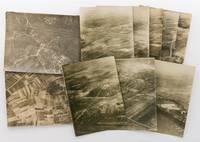
118696Very Good. All are gelatin silver prints on thick stock; eight are oblique photographs 207 × 154 mm; two are vertical views approximately 165 × 220 mm; the larger ones are slightly creased at the corners one of them a little more so; the others are in excellent condition. All images are captioned in the negative. All eight oblique views carry the same date 25 June 1918 preceded by 'A3 AEO 62°' ranges from 110 to 121. Place names on them are Hamel Hamel Wood Somme Accroche Wood Tailloux Wood and Vaire Wood. The vertical images are dated 3 May and 27 June 1918 and carry a larger set of alpha-numeric references commencing 'A3 AE A 715' and '35 AE B 929' respectively. All ten prints have the signature 'Capt Sexton' in indelible pencil on the verso. Digitised service records indicate the signature is that of Eric James Sexton of the Adelaide suburb of Hindmarsh; he enlisted on 14 August 1914 shortly before his 21st birthday and was appointed to the 10th Battalion with the rank of lieutenant. He was wounded at the landing at Gallipoli promoted to captain the following day and later invalided back to Australia disembarking on 6 August 1915. By January 1916 he was declared fit again for active service and re-embarked in April for England where he performed various training roles. On 14 February 1917 he transferred to the Australian Machine Gun Training Depot with the rank of major. He embarked for Australia on 12 March 1918 arriving in Melbourne on 22 May 1918. Accordingly Sexton did not serve in France and was a major not a captain by the time these photographs were produced. We cannot explain the anomalies but will let the photographs speak for themselves. Significantly they show the area where the important Battle of Hamel was fought on 4 July 1918. <p>'Hamel was a big battle in miniature involving the experimentation of tanks and small ammunition drops as part of a broader all-arms offensive. While a coordinated offensive was not a new approach to warfare Hamel represented the culmination of three years of learning and innovation on the Western Front testing an all-inclusive approach to mobile warfare. The flawless execution of the operation resulted in Hamel becoming a model for future operations on the Western Front. In his account of the event Monash famously wrote that "the perfected modern battle plan is like nothing so much as a score for an orchestral composition where the various arms and units are the instruments and the tasks they perform are their respective musical phrases' Ellen Cresswell: 'The Experiment - Innovations at the Battle of Hamel' Australian War Memorial website. 10 items. unknown