[Aviation]Biblio.com
2 041 résultats
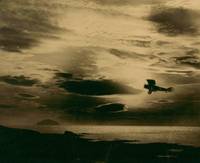
107816Fine. The sepia-toned print image size 232 × 289 mm is behind glass in its original timber frame 425 × 475 mm; the window mat is wood-grained possibly cut from a veneer sheet. Remnants of the contemporary Adelaide framer's label 'Dimond Bros' are on the verso along with the pencilled details of the job. Small scratch to the bottom portion of the image; one tiny spot; otherwise in fine condition. The framer's pencilled notes indicate that the original client's name was Butler almost certainly Harry Butler himself during his brief years in Adelaide between the war and his early death in 1924. An article from the Adelaide 'Advertiser' for Tuesday 21 May 1946 records Butler's own description of this scene in a pencilled note dated 2 February 1918 uncovered on the verso of another example of this photograph. 'It was taken by our school photographer as I was on a Bristol Fighter about sunset to do a submarine patrol. You notice the Christmas card-looking island in the distance. That is known as Ailsa Craige in fact Ailsa Craig and is about halfway between here and Belfast'. <p>'Harry Butler 1889-1924 showed his enthusiasm and aptitude for mechanics by building models of primitive aircraft while still at school in Koolywurtie; he later accorded farm-work a lower priority than collaboration with a neighbour and lifelong mentor S.C. Crawford in building and flying one of Australia's early aeroplanes. Among the February 1915 candidates Butler alone gained entrance as an aeromechanic to the Australian Flying School at Point Cook Victoria. Commissioned three weeks after joining the Royal Flying Corps in 1916 he became fighting-instructor at Turnberry Scotland in 1917 and chief fighting-instructor at No. 2 Yorkshire School of Aerial Fighting in 1918. He alternated teaching with studying German aerial combat tactics over France and he received the Air Force Cross in 1918' 'Australian Dictionary of Biography'. <p>Our thanks to Mr Les Parsons for providing us with many important details regarding this image. unknown
1917000103Good. 1917. Hardcover. On offer is a very unique diary from World War I that begins on Dec.151917 until Aug 1 1919. The Corpsman that kept this diary is unidentified but he enlisted in the Aviation Section Signal Corp and was assigned to the 15th Co. In total approximately 40 pages of writing on twenty leaves. Many interesting things happened to this soldier and he writes about leaving the U.S.A. on June 30th with a "convoy of 8 ships sub chasers and Dirigable follows us". He mentions the ships SS Henderson USS Mongolia Von Stuben Cruiser Fredrick and others: On July 4th "Cruiser Frederick fired 21 gun salute and all ships broke out colors. At noon Colonel of the Engrs. spoke." "Drew a 10 day restriction thanks to Lieutenant Mary-Ellen." "SS Henderson on fire. Von Stuben standing by." "Elmer Fisher of California was killed by accident." "Fiat Accident. Pat Warden killed. attempted to fly plane without permission." "Mixed it with a frog and broke my hand." four days later; "made a Sergeant." then a couple of days later; "Restricted for 3 weeks for missing drill." "Another fete day for the frogs." My favorite: "Still at Le Mans. Have been decootiezed and are awaiting orders." Talks about many French towns. The diary is in good condition but someone has removed a few pages July 9th to July 20th. The rear cover has some trauma and something glued it. Mentions the names of several guys that were killed on "liberty". Has a postcard glued on the front and the last few pages have peoples names and addresses.; Manuscript; 16mo - over 5¾" - 6¾" tall; HANDWRITTEN MANUSCRIPT DOCUMENT LETTER AUTOGRAPH DIARY JOURNAL LOG KEEPSAKE WRITER HAND WRITTEN DOCUMENTS SIGNED LETTERS MANUSCRIPTS HISTORICAL HOLOGRAPH WRITERS DIARIES JOURNALS LOGS AUTOGRAPHS PERSONAL MEMOIR MEMORIAL PERSONAL HISTORY AMERICANA World War I WW I Navy Naval Signal Corp Infantry Army ASSC . hardcover
191174260San Antonio: H. Rudolph Fox Photographer 1911. Original photograph measuring 48 x 7 1/2 inches. Large panoramic photo depicting the March 1911 United States Army maneuvers which featured 20000 troops with early US military aircraft such as the Wright Model B biplane as well as two others by Robert McCormick and Ben Johnson a San Antonio inventor flying above the camp. . captions scratched into negative at lower margin minor restoration to small portion at the very lower far right fore-edge minor creasing still a a wonderfully clean and clear image.This exceedingly scarce original panoramic photograph features the United States Army maneuvers in March 1911 and was one of the earliest such camps to coordinate with US Army fliers. Within the image the YMCA tent is identified as well as the placement of the field hospital field artillery the Signal Corps as well as the Depot Commissary in the foreground. Above three different biplanes are shown flying maneuvers including the Wright Model B flown by Lt. Benjamin D. Foulois who along with Phil Parmalee flew the first military reconnaissance scouting missions in a fixed-wing aircraft along the US-Mexico border; as well as planes flown by Robert McCormic an early Chicago aviator and inventor who would later construct and house several experimental aircraft at Fort Sam Houston as well as Ben Johnson a San Antonio inventor who flew a Johnson Wright Model B airplane. The Wright Model B was the Wright brothers’ most successful aircraft produced from 1910 to 1914 and they were shipping nearly 4 aircraft a month. Unfortunately the rear elevator made the Model B more tail heavy and prone to stall and within two years faster propeller first aircraft with drag-reducing fuselages began appearing. Fort Sam Houston was a very popular experimental airfield for flying meets air races because it occupied 800 acres annd the field was unbroken by no hills of real prominence. Established in 1890 as a post the War Department began expanding the Fort after the Spanish-American War adding Cavalry and Light Artillery from 1905-1912 and also served as the birth of military aviation. Lt. Foulois had made his first solo flight the year before in March 1910. See: Edmond Percy Noel America Now Has Forty Flying Fields San Antonio Tex. Aero and Hydro 1912 Vol. 4 pp. 59 66; McFarland The Papers of Wilbur and Orville Wright 1953 p. 1183. H. Rudolph, Fox Photographer unknown
171961835Akron OH: The Goodyear Tire & Rubber Co. 1917-1918. Three parts in one vol. 4to. 68 pp; 13 leaves typescript on onion-skin paper; 14 pp unpaginated. in ink manuscript on ruled paper. With 16 cyanotype blueprint leaves of hydrogen gas plants water bags equipment numerous tables diagrams 2 original linen-backed silver gelatin photo plates on linen hinges. Black-ribbed cloth split-pin post binder as issued gilt lettering & Goodyear winged logo on front cover marbled pastedowns minor soiling to edgewear fraying minor splitting to cloth at spine minor bumping to corners still a VG- exemplar with many annotations from the library of Arthur Sewell 1880-1973 longtime specialist with Goodyear Tire & Rubber instructor at the Airship Training School during World War I which also specialized in training U.S. Navy and U.S. Army ground crews for blimps balloons and dirigibles and Lt. Steven B.aker Hagadorn 1920-2007 who was serving during the Korean War at the U.S. Naval Air Station Ocean City New Jersey in 1950-1954. First edition of this exceedingly scarce manual written to train and educate Navy Balloonists before the U.S. entered World War I after the Goodyear Tire & Rubber Company secured a contract to train 20 men in free ballooning in May 1917. This work describes the free balloon how to construct and use various parts of the balloon details the physical properties of gases used for lift the physics behind the gases and atmosphere preparations for flight the proper methods of handling the balloon in the air as well as on the ground as well as advising the balloonist to exercise care in using gasoline to remove oil from balloon fabrics by avoiding the seams because it will cause the seam to deteriorate. The illustrations and photos at the end show a balloon being laid out for inflation inflated setting the sandbags rigging and ascension of the balloon. The Jan. 28 1918 typescript by Lieut. Comm. Teed specifically outlines the technical advantages and uses of employing hydrogen in the free balloons with specific equations and calculations for volume lift and more. Goodyear had established its Aeronautics Department in 1910 to market rubber impregnated fabrics and coatings for airplanes and lighter-than-air craft and began buildings its first balloons in 1912. In 1916 Goodyear bought 720 acres of land southeast of Akron to serve as their flying school and manufacturing site. Around the same time they began building their first airship in March 1917 they were also negotiating for a contract with the government to train balloonists for the Navy. Of particular interest in this work are the presence of the original manuscript “Free Balloon Log Sheets†documenting free flights starting in Winfoot Lake OH and landing in East Lewistown Homeworth Youngstown & Minerva OH; Sagerstown & Hallston PA Columbia Station. Several of the sheets note weather conditions flight altitudes how they landed and manuscript observations taken during the flights. Roth 1885-1950 was a noted sport balloonist before and after World War I up through the 1930s was a balloon instructor during World War I for Goodyear Tire & Rubber Co. and also was a pilot in the U.S. National Balloon race in 1930. Original editions of this early Goodyear aviation work are quite scarce. No copies in Worldcat for the First Edition several located for the 77 pp. 2nd edition varying number of blueprints plans; No copies located of Typescript MS by Teed or printed version of Lift of Hydrogen Technical Note No. 21; See Hamlen First Lighter-than-air Class at Akron; Goodyear Blimp History. The Goodyear Tire & Rubber Co., hardcover
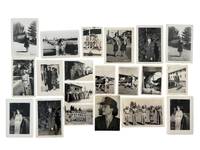
1943213501943. Women's Army Corps service and female aviation training during World War II documented in photographs dating from approximately 1943 to 1945. The images record the wartime expansion of women's participation in the United States military following the establishment of the Women's Army Corps in 1943 and the parallel development of programs that placed women in aviation related roles supporting the war effort. The photographs depict women in uniform participating in military drill training activities and aviation work around small aircraft illustrating the increasing presence of women in technical and logistical positions that supported military operations during the war. One image taken at Treasure Island in San Francisco situates part of the archive within one of the major naval training and transit centers used by the United States during the conflict.<br /> <br /> Archive of 20 original black and white silver gelatin photographs dating from the World War II years. Several images show members of the Women's Army Corps posing in formation saluting and participating in organized training exercises. Other photographs depict women standing beside small aircraft preparing for flight or seated in cockpits suggesting involvement in aviation training or aircraft support work connected to wartime flight programs. Informal photographs show servicewomen gathered outside wooden barracks relaxing in flight gear and posing beside aircraft. One photograph identifies the location as Treasure Island San Francisco. Several prints contain handwritten inscriptions on the reverse identifying individuals and dates including notes such as "Sincerely Leona" along with named individuals including Sensabough Bash Braughton Rogers Mazie Paula and June and Kay Gallagher with Bud Sterthors and Donley.<br /> <br /> During World War II the Women's Army Corps allowed women to serve in uniform in administrative mechanical and communications positions that had previously been reserved for men while aviation related programs trained women to ferry aircraft and assist in technical flight operations. These initiatives formed part of the broader mobilization of American women into wartime labor and military service during the 1940s. Photographic documentation of female service members provides important visual evidence of the changing roles of women within the armed forces during the war. Photographs measure approximately 3.5 x 5 inches and are preserved as loose prints. Minor edge wear and light creasing visible on several photographs; overall very good condition. The archive offers concise visual documentation of women's military and aviation participation during the Second World War. unknown
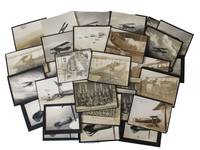
1918177171918. World War I military aviation. Primary-source photographs documenting early United States military aviation training at Henry Post Airfield Fort Sill Oklahoma during the formative period of the U.S. Army Air Service following its establishment in May 1918. The images record the first generation of American military pilots operating within a rapidly developing aviation program built in response to World War I supporting research into the expansion of U.S. airpower pilot training infrastructure and the integration of aircraft into military operations. The presence of DH-4 two-seat biplane bombers the principal American-built combat aircraft of the war situates the archive within the transition from experimental aviation units to operational military squadrons. A dated caption identifying "October 29 1918 Sergeant Schauble" flying at 3700 feet further anchors the material within the final phase of the war.<br /> <br /> Archive of 26 silver gelatin photographs Fort Sill Oklahoma circa 1917-1918 each measuring approximately 7.25 x 5.25 inches. The archive includes many photos of the biplanes in the air one photo shows several DH-4 bombers soaring in the clouds in a Flying-V formation. A handwritten caption on one image "October 29 1918 Sergeant Schauble " is depicted flying in a DH-4 at 3700 feet as well as going on a "parachute trip". One photo shows a serious plane crash with two DH-4s biplanes nose down in the ground. The pilots are also depicted in hot air balloons. Fort Sill was home to several US Army Balloon Companies during this period which were still primarily used for reconnaissance and directing aerial bombardment during World War I. The photo archive includes many shots of biplanes in the clouds or on runways with pilots in goggles including 4 images of pilots or troops in group shots. Most photos show the planes or balloons in mid air. . Army balloon companies stationed at Fort Sill for reconnaissance and artillery observation. Several images capture aircraft at altitude among cloud formations while others document runway activity and pre-flight staging. Versos of many prints retain remnants of black album paper indicating removal from a compiled photographic album.<br /> <br /> The archive documents the early operational environment of American military aviation at a moment when the United States was rapidly expanding its aerial capabilities following limited prewar development including the Army's first acquisition of aircraft from the Wright brothers in 1909. Henry Post Airfield functioned as a central training site for pilots entering service during World War I and the inclusion of both airplane and balloon units reflects the continued reliance on multiple aerial technologies for reconnaissance and combat support. The photographs provide visual evidence of training practices aircraft deployment and the material conditions of early air service operations during a period of institutional formation. Minor edge wear and surface wear are present with album residue on versos; overall very good condition. A cohesive photographic record of early U.S. military aviation training and aircraft use during World War I. unknown
192113582Dayton OH: The Otterbein Press. Fine. 1921. First Edition; First Printing. Hardcover. You would find less shelf wear on a new book at the corner bookshop. A beautiful copy of the very scarce first edition of this amazingly complete compendium of all the engines available in 1921. You will never see a better copy of this book. Although I will admit you may find a lesser one cheaper. I simply could not pass it up . ; 8vo 8" - 9" tall; 547 pages . The Otterbein Press hardcover
193015835Berlin: W. E. Harich. Good. 1930. First Edition. Hardcover. Text is in German. The covers are soiled and worn the spine is gone. The binding is still intact held by the sewing and endpapers. Drawings of aircraft. Includes a 6 language dictionary of aircraft technical terms. Includes drawing of seats various elevations of the aircraft landing gear etc. Pretty neat book. The contents are very good to fine. ; Oblong Small 4to 9" - 11" tall; 168 pages . W. E. Harich hardcover
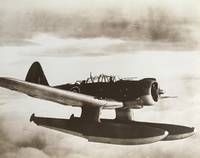
57475Hawthorne CA: Northrop Corporation Aircraft Division 1979-1980. Two vols. 4to. 54 pp some plates numbered; 68 pp unpaginated. With 64 photographs nearly all 8 x 10 in. photographs many dry-mounted on plates all others inserted in archival mylar sleeves many w/ annotations either on verso or text w/in negative most are drawn from Northrop factory photo archive printed on 1979-1980 era Kodak black & white and colour glossy photo paper stock while a couple appear to be earlier Northrop in-house factory press photos. First vol. in 20-ring faux leather binder grass cloth endpapers printed label on front pastedown brass plate mounted front cover rounded corners 2nd vol. in 3-ring brown simulated calf all images in excellent condition NF from the library of David H. Kenyon 1918-2011 former Lockheed engineer & military sales manager as well as aviation consultant for Pan American TWA and the Venezuelan Airlines and later President of the Southern California Wing of the OX5 Aviation Pioneers. An extraordinary pre-publication souvenir album for the Northrop Corporation’s recovery and restoration of the N-3PB floatplane which was Jack Northrop’s first produced aircraft after he had established his company upon leaving Douglas in 1939. March 12 1940 the Norwegian government had contracted with Northrop to build 24 seagoing patrol bombers and he was able to design and build the prototype in less than eight months unfortunately test flying Nov. 1 1940 at Lake Elsinore CA 6 1/2 months after the Nazi German invasion and occupation of Norway by the end of June 1940. These exceptional images show the prototype N-3PB the flexible machine gun in the rear cockpit flight operations in Iceland and Wolford’s photos of test flights on Lake Elsinore. The first album’s photos include a list of plate captions detailing the photo showing Nos. 321 324 320 the restored plane and 315 in flight; N3PB’s packed on the beach; ground crew handling an N-3PB at the dock in Fossvogur and more. Although never delivered to Norway Norwegian pilots in the 330 Squadron flew out of Iceland controlled by Britain at the time and flew missions and fought against German Focke-Wulf FW 200 long range reconnaissance bombers and Blohm & Voss BV 138 Flying Boats. The remainder of both albums focus on the discovery recovery and restoration of No. 320 GS-U an N-3PB from 330 Squadron’s satellite base at Budareiry which was caught in a heavy snow shower and forced down in 1943. Discovered and then salvaged in 1979 through the efforts of a team of Icelandic Norwegian British and American volunteers led by Ragnar J. Ragnarsson vice president of the Icelandic Aviation Historical Society. These images show the lifting of the plane the restoration after its return to Northrop’s Hawthorne Factory where over 300 volunteers of the Western Museum of Flight’s staff and former Northrop employees rebuilt it to its 1943 appearance and rolled it out Nov. 10 1980. Many of the images included here augment those mounted within the souvenir albums showing more stages and some include black & white as well as colour images. The floatplane was displayed in Reykjavik at its’ former Icelandic home base and finally installed at the Norwegian Armed Forces Museum at Gardermoen Airport. It was believed to be the only known survivor until 2003 when another was discovered in the waters off Reykjavik and may eventually be recovered. Roy Wolford 1915-2013 began as an aircraft mechanic and followed Northrop when he set up his corporation becoming the company’s official photographer and head of the photography department. Although unsigned many of these images are attributed to Wolford. No similar examples located in Worldcat; See: Back Matter Aerospace Historian Vol. 28 No. 2 1981; Robert Guttman Northrop’s Norwegian Floatplane Faced the Nazi Invasion Aviation History January 2011; Northrop Corporation, Aircraft Division, paperback
151955380Inglewood CA: North American Aviation Inc. January 15 1944. 8vo. Approx. 250 pp sections all separately paginated. Sepia-tinted illustrated title w/ mylar printed overlay with Restricted & Report No. With 100s of text illustrations plates 1 large folding of P-51C diagrams several large folding many illustrations in colour colour charts graphs each section w/ tan thumb tabs. Publisher’s brown simulated leather 6-ring binder gilt stamping on front cover rounded corners yapp edges slight shelfwear very slight interior toning still NF copy. First edition of this remarkably scarce flight manual for the famed Mustang P-51B and P-51C fighter which established Allied air superiority over Nazi Germany in World War II. The P-51B/C the Mustang Mk III was outfitted with a Rolls Royce Merlin engine allowing it to achieve remarkable performance at altitudes above 15000 feet and beginning in late 1943 were the key bomber escort fighters for the US Army Air Force 8th Air Force in raids over Germany. This flight manual prepared for Mustang pilots and ground personnel contained general descriptions of the airplane sequence of operations to be followed operation of guns bombs and radio emergency operating instructions and charts designed for long-range flying and auxiliary fuel tanks. No copies located in Worldcat; See: Gardner Hatch & Frank Winter P-51 Mustang 1993. North American Aviation, Inc., hardcover
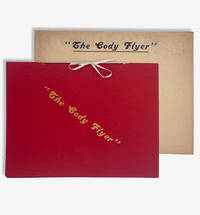
191221208461912. Aldershot: Gale and Polden. 1912. 4to. Original red card wrappers lettered in gilt original printed envelope preserved; pp. 11 1 highly illustrated after photographs and drawings printed on yellow blue and white coated paper; wire-stitching removed and replaced with new ties traces of oxidation along gutters final page with a little offsetting from red wrappers; a rare survival with the original printed envelope this a little spotted.Extremely rare trade catalogue for the Cody mono- and biplanes as well as a manned war kite. 'Samuel Franklin Cowdery was born in 1867 in Davenport Iowa was a Wild West showman and early pioneer of manned flight. He changed his name to Cody at age 21 when he was part of a touring Wild West show not to be confused with that of Buffalo Bill Cody. He is most famous for his work on the large kites known as Cody War-Kites that were used by the British in World War I as a smaller alternative to balloons for artillery spotting. Financed by his Wild West shows Cody's unusual interest in manned kites advanced significantly when he enlarged upon Lawrence Hargrave's double-cell box kite to increase its lifting power especially by adding wings on either side. He patented his design in 1901 and it became known as the Cody kite. Cody eventually managed to interest the British Army in his kites. In 1906 he was appointed Chief Instructor of Kiting for the Balloon School in Aldershot and soon after joined the new Army Balloon Factory down the road at Farnborough. The Factory would eventually become the Royal Aircraft Establishment. In 1908 the War Office officially adopted Cody's kites for the Balloon Companies he had been training. This group would in due course evolve into the Air Battalion of the Royal Engineers No. 1 Company of which later became No. 1 Squadron Royal Flying Corps and eventually No. 1 Squadron Royal Air Force. During 1907 he was given full authority as the designer of the the British governments dirigible understructure and propulsion system. On 5 October 1907 Britain's first powered airship British Army Dirigible No 1 and using Cody's engine the Nulli Secundus flew from Farnburough to London. In 1907 the British Army decided to back the development of Cody's powered aeroplane the British Army Aeroplane No 1. His flight of 16 October 1908 is recognized as the first official flight of a piloted heavier-than-air machine in Great Britain. He went on to win a number of aeronautical awards and started developing his own aircraft company. That company produced the Cody Flyer a monoplane for which this pamphlet was issued. On 7 August 1913 he was test flying his latest design the Cody Floatplane when it broke up at 200 feet and he and his passenger the cricketer William Evans were killed' Nat DesMarais Rare Books. The 1908 British Army Aeroplane No.1 was actually Cody's biplane sometimes called Cody 1 later officialy referred to as The Cody Flyer. 'On 16 October at Farnborough it made what is recognised officially as the first sustained powered flight in Great Britain by a heavier-than-air machine covering 423.7m before crash-landing' Virtual Aircraft Museum online.Library Hub locates a single copy in the National Aerospace Library. unknown
2011SBS-9780754628873ASHGATE 2011. Hardcover. New. ASHGATE hardcover
2011SBS-9780754628873ASHGATE 2011. Hardcover. New. ASHGATE hardcover
180544123Halle Rengerschen Buchhandlung 1805. Without wrappers. In "Annalen der Physik. Herausgegeben von Ludwig Wilhelm Gilbert" Bd. 20 Fünftes Stück. The entire issue offered. Titlepage to vol. 20. Pp. 1-128. Biot's paper: pp. 1-18. - Gay-Lussac: pp. 19-37 - Humboldt & Gay-Lussac: pp. 38-92. - Sacharow: pp. 107-124. <br/><br/><em>These 4 accounts of the earliest scientific ascents with balloons had the same purposes namely to make observations on the composition of the air pressure and the earth's magnetic force. Brockett "Bibliography of Aeronautics" Nos 1856 a 6303 a a. 10654 a. </em> unknown
198256847Saudi Arabia: Ministry/Defense & Aviation 1982. good. Quarto approx. 150 3-ring plastic binder with customized front and spine text 3-hole punched color illus. color figures. Slight wear and soiling to binder. In early 1981 the Saudi government requested American assistance in providing meteorological support to the Kingdom's military forces. This request was accepted. This document constitutes a visionary organizational arrangement for the Kingdom. Weather morale and logistics are three imponderables of warfare with morale and logistics significantly affected by weather. This plan considers the unique position of the Kingdom the sophisticated armaments in the region command and control requirements economy of force and responsiveness to external contingencies among other factors. The plan represents the then state of the art technology and equipment and required a military-civil mix of personnel to execute and to understand and respond to military needs. This plan was prepared by a joint Saudi and U.S. team comprised of highly-skilled professionals including a number from the U.S. Department of Defense and the military services. This plan was deemed to meet military requirements standardize the service emphasize safety and operations response and to aid in decisions affecting the rules of engagement. Ministry/Defense & Aviation unknown
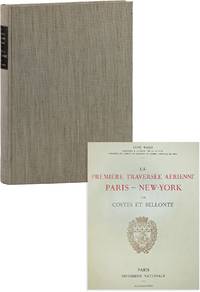
193185868Paris: Imprimerie Nationale 1931. First Edition. Small folio. 34cm. Later heavy grain oatmeal cloth with black leather title label to spine. 258pp.; 1. Clean and strong minor bumping to spine ends; internally clean and fresh illustrated throughout with photographs color images and charts all with captioned tissue guards. A near fine copy.<br /> <br /> <br /> From the library of Nathaniel Tarn noted poet translator and anthropologist bearing his bookplate to the front pastedown. A lavish and justifiably celebratory account of the first aerial crossing from Paris to New York performed in 1930 as the second traversal attempt by Costes and Bellonte with the first having to be abandoned in 1929 due to bad weather. The duo successfully made the crossing of 3850 miles in 37 hours and 18 minutes to international fanfare in their Breguet 19 Super Bidon named "Point D'Interrogation" or "Question Mark". Bellonte's rather lush and impressive account is quite scarce in trade and considering the importance of Costes and Bellonte's singular achievement seems sparse in institiutional holdings. Imprimerie Nationale unknown
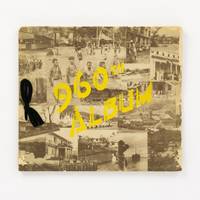
1945138169The Philippines: 960th Engineer Aviation Topographic Company 1945. First Edition. Paperback. Very Good. The Philippines 960th Engineer Aviation Topographic Company 1945. Oblong quarto 255 × 288 mm 45 leaves printed rectos only comprising the title-cover on a background of a collage of some two dozen illustrations and 44 leaves containing 133 illustrations with all illustrations reproduced from photographs. Shoelace-bound three-colour pictorial card cover a little worn at the extremities with trifling surface loss to silverfish; two leaves a little soiled; expert conservation to small chips and tears to the edges of four leaves; minor signs of age and use including some annotations - see below; overall a very good copy. The first leaf contains a large illustration of a Lockheed P-38 Lightning designed as a fighter but used in a variety of roles including aerial reconnaissance. An inscription in ink on the illustration identifies the pilot as '1st. Lt. Alexander Roberts Dec. 1943 New Guinea'. Written in the margin below the illustration is '960th Photo Recon. Dobodura New Guinea Non. sic 1943 - Feb. 1944 Ie Shima April 1945 P.I. Feb. 44 - Ap. 1945 Honolulu Sept 1945 deact.'. The servicemen in the four illustrations on the fourth leaf are identified: from left to right top to bottom they are 'MSgt. Burts' 'Ingelmann' 'Johnson' and '"Jesse" James and Samualson'. The dog on the next page is 'Killer'. At the rear Ernie Pyle's grave is identified. <p>'The second phase of the Okinawa Campaign consisted of the objectives of Ie Shima which housed the big airfield of the islands and Motobu Peninsula. With Rear Admiral Lawrence F. Reifsnider USN commanding the attack group the U.S. Army's 77th division landed on April 16 1945. The invading force thought that the Japanese had abandoned the airfield due to aerial photo reconnaissance but they met about 3000 men as they moved towards the center of the island. Not unlike the Battle for Iwo Jima the island had networks of underground tunnels enhanced by Mt. Gosuki but the island was secured on April 21. Famed War Correspondent Ernie Pyle was killed on Ie Shima while covering the occupation. To repair the destruction caused by prior bombing and naval gunfire support U.S. Navy Seabees repaired the airstrips. Of note the island was utilized by the Japanese Surrender delegation in mid-August 1945 as a stop point between Japan and Manila Bay Philippines for negotiations with General Douglas A. McArthur USA' National Museum of the United States Navy online. <p>The illustrations in this rare souvenir cover a wide range of the activities of the 960th in the Pacific theatre during the Second World War. 960th Engineer Aviation Topographic Company paperback
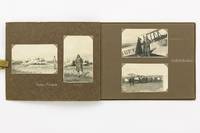
1929142560Adelaide: Harry Carew Nott 1929. Fine. Adelaide Harry Carew Nott 1929. A commercial photograph album oblong quarto 230 × 318 mm comprising 4 card leaves cord-bound in overlapping card covers with 21 gelatin silver photographs 84 × 136 mm or the reverse loosely attached with photocorners on both sides of the leaves and the inside surface of the covers; all photographs are captioned in white ink on the mount. Cord-bound commercial album stamped in blind 'Portraiture'; covers slightly marked and a little worn at the corners; the contents are in fine condition the last photograph is creased and cracked at one corner. A lengthy article related to this event appeared in 'The Advertiser' Thursday 23 May 1929: 'The Victorian section of the Australian Aero Club will conduct an aerial pageant at the Essendon Aerodrome near Melbourne on Saturday afternoon. The programme of events includes the Aerial Derby for which over 20 machines have been entered. Of these about eight will represent New South Wales and eight Victoria. South Australia will also have a strong representation. <p>Seven planes will leave the Parafield Aerodrome for Melbourne this morning at 9.30 if the weather permits. The following planes will comprise the formation: D.H. 60 Gipsy Moth G-AUIB D.H. Moth V-HUAM D.H. Moth V-EUAR D.H. Gipsy Moth G-AUIV D.H. Gipsy Moth G-AUKO Avro Avian G-AUSY and probably the De Havilland "Old Gold" passenger machine. The first three are Aero Club planes and the others are privately owned. <p>Flying-Officer J.A. Mollison Aero Club instructor will be leader of the formation and Mr. C.A. Hewitt will be deputy-leader. Others making the flight to Melbourne are Messrs. N. Birks J.A. Jukes A.H. Wilkins E.B. Lawson P. Knapman F. Wellington S. Hamilton L. Wood J. Churchill Smith secretary of Aero Club and Dr. H.C. Nott. The flight to Essendon will be made via Nhill Victoria. Friday will be spent by the airmen in tuning up engines for the races on the following day'. <p>The first eight photographs were taken at Parafield Aerodrome in outer-suburban Adelaide with portraits of Nott and Wood identified. These are followed by two at Nhill Aerodrome 'Mollison refuelling' and 'Lawson'; two at Ararat Aerodrome 'on Racecourse'; and eight taken at Rockbank 28 kms west of Melbourne. These are captioned 'Mollison taking off in "1B"'; 'Hewitt'; 'Nott in "A5"'; Lawson Mollison Hewitt & Wellington éxamining "A17"'; 'Hewitt Mollison Lawson & Wellington'; 'Nott Mollison Lawson & Wellington'; and 'Mollison Lawson & Hewitt'. <p>The last one taken from the air is captioned 'Crashed Aero at Nhill'. The Nhill Aviation Heritage Centre website records that on 23 May 1929 'J.A. Mollison arrived from Adelaide with 6 aircraft. One crash-landed at old Dimboola road aerodrome instead of landing at New site at Halpin Park'. The pilot was possibly Lin Wood. Harry Carew Nott unknown
010438Inglewood CA: North American Aviation Inc 251pp ix index 12pp emergency; num bw ills. Or green leather look 'vinyl' covers. Ring binding with 2 sets of 3 rings. Some darkening and rubbing to covers some binding holes pulled moderate notations throughout. From writing on title page appears to be an engineers copy. Front cover states 'Not to be removed from airplane' accounting for the extreme scarcity of this wartime bomber flight manual. From title page:This document contains information affecting the security of the United States within the meaning of the espionage Act USC 50-31 and 32. Its transmission or the revelation of its contents in any manner to any unauthorized person is prohibited by law'. This statement now obsolete under 50 year public access ruling. Comprehensive WWII flight manual for B-25C and D bombers of the utmost scarcity. First Edition. Hard Cover. Very Good. Large 8vo. North American Aviation Inc Hardcover
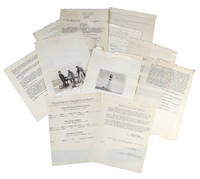
1923175141923. Wright Orville. Archive of aeronautical speed record trials 1923 a documentary record of early aviation competition and the formalization of international standards for measuring and certifying flight performance. Centered on trials conducted at McCook Field and Wilbur Wright Field in Dayton Ohio the material documents world record attempts over one kilometer 500 kilometers and 1000 kilometers under the supervision of Orville Wright who served as directing official. The archive captures a transitional moment in aviation history when experimental flight gave way to regulated competition with standardized timing calibrated instruments and formal reporting procedures required for international recognition by the Fédération Aéronautique Internationale.<br /> <br /> Archive comprising 14 manuscript and typed documents in English and French accompanied by two original black and white photographs. Materials include official reports submitted to the National Aeronautic Association and to the Fédération Aéronautique Internationale correspondence addressed to Secretary General Paul Tissandier technical certification documents from the Bureau of Standards and timing sheets recording individual pilot performance. A report dated March 29 1923 details speed trials conducted over 500 and 1000 kilometer courses while related documentation records the surveying and marking of one and three kilometer straightaway courses at Wilbur Wright Field. The bilingual nature of the archive reflects the FAI's use of French as its official language with parallel documentation measuring distinct record categories. Recorded achievements include Lt. R. L. Maughan's one kilometer speed of 380.751 kilometers per hour in a Curtiss R 6 Racer Lt. Alex Pearson's 500 kilometer record at 270.06 kilometers per hour and the 1000 kilometer endurance speed of 205 kilometers per hour achieved by Lts. H. R. Harris and R. Lockwood. Photographs depict course pylons at Wilbur Wright Field and official timer Odis A. Porter observing aircraft performance during timed runs.<br /> <br /> The archive documents the institutionalization of aviation record keeping in the early twentieth century when governing bodies such as the Fédération Aéronautique Internationale established uniform procedures for homologating records across national contexts. The involvement of Orville Wright alongside officials including Lorin Wright and Odis A. Porter situates the trials within the Dayton aviation community that had been central to powered flight since 1903. These materials illustrate the convergence of engineering innovation military aviation through the U.S. Army Air Service and international oversight demonstrating how record setting functioned both as technological advancement and as a structured competitive discipline. Minor handling wear to documents; photographs well preserved with strong contrast. Overall very good condition. unknown
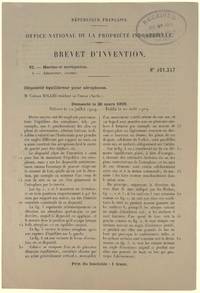
1909221611909. Bollée Camille. Dispositif équilibreur pour aéroplanes 1909 documents early efforts to solve the problem of aircraft stability in the immediate years following the Wright brothers first powered flight when engineers in Europe and the United States sought mechanical solutions to controlled flight. Issued by the French government this patent establishes a technical approach to maintaining equilibrium through adjustable aerodynamic surfaces mounted on a rotating vertical shaft shifting emphasis from pilot skill to engineered stabilization. The document supports research into early aviation engineering international patent exchange and the rapid development of aeronautical control systems in the pre-World War I period.<br /> <br /> Bollée Camille. Dispositif équilibreur pour aéroplanes. Paris: Office National de la Propriété Industrielle 1909. Three pages with one illustrated plate containing six technical diagrams; original printed paper wrapper measuring approximately 11 x 7.5 inches. Patent submitted March 26 1909 granted July 12 and published August 21. The text describes a stabilization system "composed of a generally vertical shaft. capable of a rotating motion around its axis upon which one or several surfaces are mounted" designed to counterbalance lateral instability through adjustable aerodynamic elements. Diagrams illustrate variable positioning of these surfaces to alter lift and drag with the stated objective "to maintain the balance of airplanes. for example during lateral gusts or slips." Front page bears a Chicago patent office stamp dated July 27 1910 indicating circulation and review within American patent or engineering contexts.<br /> <br /> This patent was produced during a period of intense international experimentation in powered flight when inventors across France Germany and the United States pursued competing methods to improve control safety and maneuverability. Bollée's design reflects early recognition of the need for mechanical stabilization systems that could respond dynamically to environmental forces anticipating later developments in controlled flight technologies. The presence of an American stamp demonstrates transatlantic interest in aeronautical innovation at a moment when aviation knowledge circulated rapidly through patent systems and technical publications. Light age toning with faint crease to upper corner; document remains clean and legible; overall near fine condition. This item provides direct evidence of early twentieth century engineering approaches to flight stability and the global exchange of aviation technology. unknown
116420Many of the photographs appear to have been taken at Vickers' Brooklands factory near Weybridge Surrey the famous banked race track is visible in many images and possibly also at the nearby Royal Aircraft Establishment Farnborough Hampshire. Nearly all are dated ranging from 1937 to 1946. The gelatin silver prints have been cropped to highlight the stationary aircraft; the resulting photographs are in a visually appealing panoramic format with most of them between 55 and 75 mm high some smaller some larger and approximately 190 mm wide. They are loosely mounted from three to five per page under clear celluloid sheets in a later commercial photograph album. The album is neither here nor there; apart from a crease near a short edge of one print the photographs are in excellent condition. Approximately 35 different aircraft are shown each represented by between two and five photographs taken from different angles. The verso of each print carries the inkstamp of the RTP Research and Technical Publications Photographic Section of variously the Air Ministry Ministry of Aircraft Production or Ministry of Supply. These stamps restricting reproduction are completed in manuscript with a reference number and date; at least one image is also stamped 'Secret'. <p>The aircraft shown are: Vickers Wellesley Production; Armstrong Whitworth Whitley; Vickers B1/35 1939 1940 and 1941 models - these are prototypes for the Warwick; Vickers Wellington Mk II with and without experimental turret Mk III Mk IV Mk V Mk VIII an unidentified model with an experimental turret Mk X Mk XI Mk XII Gr Mk IV Mk XVI Mk XVII Mk XVIII and T Mk X; Vickers Warwick Mk I Mk I freighter Mk II ASR Mk I ASR Mk I Tropical C Mk I C Mk III Gr Mk II and Gr Mk V; De Havilland Vampire Mk I Mk II Prototype; Westland Welkin Prototype F Mk I F Mk 2; and Vultee Vengeance Mk I. unknown
19692110502150903106Jijitsushinsha 1969. Soft Cover. Fine. Number of books: 4 Jijitsushinsha paperback
3234Archive. 7 pieces. 1938 to 1939. A grouping of seven pieces concerning Frederic E. Humphreys the first Army officer to fly solo. These pieces arranged in chronological order mention the thirtieth anniversary of Humphreys first flight.1 TLS. 1pp. 8 x 10. July 18 1938. War Department. A typed letter signed J Totten on War Department letterhead concerning Special Recognition for Colonel F.E. Humphreys: Reference is made to your letter of November 12 1937 recommending that some form of special recognition be awarded Colonel Frederic E. Humphreys New York National Guard for being the first officer of the United States Regular Army to fly a plane aloneit is proposed to make a suitable award to Colonel Humphreys. By order of the Secretary of War.2 TL. 1pp. 8 x 10. July 18 1938. War Department. A typed letter that is an unsigned copy of #1.3 TDS. 1pp. 8 x 10. August 3 1938. No place. A typed letter signed Ames T. Brown indicating that he mailed a letter to Louis L. Pendleton concerning the 30th anniversary of the flight.4 TD. 1pp. 8 x 10. August 4 1938. Camp Smith Peekskill. A typed document mentioning that it is to be addressed to Colonel Louis L. Pendleton.5 ALS. 1pp. 8 x 10. August 23 38. New York City. An autograph letter signed L.L. Pendleton Colonel addressed to Lieutenant Humphreys: Please not attached papers which please return to me at your convenience. The Mills of the Gods grind slow it would seem but better late than never also applies. I hope I will be around next summer to see what they really do then!6 TLS. 1pp. 7 x 9. April 5 1939. Aberdeen Proving Ground. A typed letter signed C.M. on Office of the Commanding Officer Aberdeen Proving Ground stationery. He wrote to Humphreys: It certainly was nice to get your pleasant letter of April 3rdmy memory is quite clear as to the time you and Lahm were trying out the first Wright airplane. I am glad you enjoyed the bulletin or class letter but I prepared it quite a while before it was issued and made some serious omissionsThere is a good article in the Sperryscope Vol 8 no 10 just out by Lahm which mentions the trying experience of your pamphlet. Call up the Sperryscope Co. and get a copy from Gillmor who is an old friend of mine. Lahm received the first flying lesson but Humphreys made the first solo flight just before Lahm made his flight.7 Card. 1pp. No date. Governors Island NY. A card imprinted Colonel Earl McFarland and written on in pencil My best wishes and I hope to see you soon. Governors Island NY. unknown
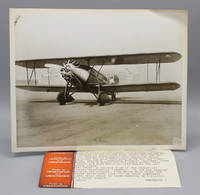
192917575<p>Underwood and Underwood n.d. 1929 On January 2 1929 Evelyn "Bobbi" Trout 1906 – 2003 set the women's endurance flight record with a time of twelve hours and eleven minutes. The record didn't last a month however before being beaten by Elinor Smith 1911 – 2010 by over an hour. The next month Trout reclaimed the record with a seventeen-hour flight; in April Smith smashed the record with a time of twenty-six hours. Trout and Smith's rivalry led them to collaboration: while participating in the Women's Transcontinental Air Derby in the summer of 1929 they agreed to attempt a month-long endurance flight. The present photo commemorates their first attempt which took place in November of 1929. Though Trout and Smith were able to successfully refuel the plane while in the air three times mechanical issues grounded them after forty-two hours. They set the women's endurance flight record with the time. The photograph shows aviator Bobbi Trout warming up the motor of a Commercial Aircraft Corporation "Sunbeam" plane at the Los Angeles Metropolitan Airport where Trout and Elinor Smith took off on their refueling endurance flight. The typewritten commentary suggests the headline "BOBBIE sic TROUT AND ELEANOR sic SMITH BURY THE HATCHET IN PREPARATION FOR REFUELING ENDURANCE FLIGHT. Photograph 10" x 8" with leaf of typewritten commentary by Underwood and Underwood adhered to verso at bottom edge. Some toning to edges and verso and some wear to the commentary leaf. Very good. Both Trout and Smith had illustrious aviation careers. Trout set an altitude record for light-class aircraft in June of 1929 and set another women's endurance flight record in 1931 by spending over 122 hours in the air with actress Edna Mae Cooper. Alongside Amelia Earhart Phoebe Omlie Louise Thaden and Blanche Noyes Trout co-founded the Ninety-Nines an organization for women pilots. Trout also co-founded founded the Women's Air Reserve with Pancho Barnes.</p> Underwood and Underwood,