3 640 résultats
19384454Berlin, Buchmeister, 1938. 199 S. mit zahlr. Abb. im Text und auf Tafeln. Gr.-8°. OLwd. (fleckig und kl. Gebrssprn.) mit OU.
195306050Frankfurt, Scheffler, 1953. Ln, 223S, Lichtrand, sonst gut
195023075Himalaja-Expeditionen 1921-1948. Zürich, Büchergilde, 1950. Mit zahlreichen Abbildungen im Text u. auf Tafeln. 193 S., 3 Bl. Or.-Lwd.; gering stockfleckig, Schutzumschlag mit Gebrauchsspuren liegt bei. [4 Warenabbildungen]
195098284Himalaja-Expeditionen 1921-1948. (Wien), Büchergilde Gutenberg, 1950. Mit zahlreichen Abbildungen u. Karten im Text u. auf Tafeln. 196 S., 3 Bl. Illustrierter Or.-Lwd.; gering stockfleckig. [4 Warenabbildungen]
In 8ø (cm. 23 x 15); pagg. 157; con numer. illustraz. n.t.; leggera carton. origin. figur. a colori. VG.
Disponiamo dal volume 19 al 27. Parte dell'opera uscita in 30 volumi). ) volumi, In-8°, legature coeve in piena pergamena per i volumi XIX e XXVI, gli altri sono stati rilegati in piena pergamena vegetale moderna, e sono leggermente più alti essendo in barbe, tutti con titoli ai dorsi. Oltre 3000 pagine con complessivamente 87 incisioni in rame tra carte geografiche,vedute ripiegate e stampe di costume a piena pagina. Tutti i volumi proposti trattano viaggi in Asia e soprattutto in Cina e Tibet. (Qualche fioritura sparsa e altre marginali tracce del tempo, nell'insieme ottima raccolta).
Introduzione del Dalai Lama,prefazione di Richard Gere.Prima edizione.Storia della donna che subì 25 anni di prigionia per la causa del Tibet.Quasi come nuovo.Pp.311
Book shows light wear to covers only. Binding is solid and square, covers have sharp corners, text/interior is clean and free of marking of any kind. Dust jacket has light wear, edge wear, no tears.
1996259922Stuttgart : Wissenschaftliche Verlags-Gesellschaft, 1996. 111 Seiten mit Abbidungen ; 24 cm Originalbroschur.
(Codice VO/0745) In 16° 202 pp. Guida turistica, varie piante e cartine, 2 ripiegate. Brossura editoriale. Buono stato. ~~~ SPEDIZIONE IN ITALIA SEMPRE TRACCIATA
1927249685London: Richard Cobden-Sanderson Thavies Inn 1927. First edition. With frontispiece and 44 plates from photographs most with images recto and verso. Large folding map in pocket at back. xvi 262 pp. 1 vols. 8vo. Original black cloth. Minor rubbing and soiling name cut away from top corner of flyleaf else a fresh copy. Very good plus. First edition. With frontispiece and 44 plates from photographs most with images recto and verso. Large folding map in pocket at back. xvi 262 pp. 1 vols. 8vo. Czech Asia p. 101 Richard Cobden-Sanderson, Thavies Inn unknown books
français In-12 de 128 pp.; broché, couverture imprimée. Collection "Les trois lotus".
1973Khe04802Zürich (Buddhist Publications - Institute for Buddhist Psychology and Central Asian Studies) 1973 (= Erste Ausgabe, mehrsprachige Ausgabe). 8°, goldgeprägtes Originalleder (Hardcover), 223 S., mehrsprachige Ausgabe (tibetisch - englisch - deutsch) 1
1995RO40202093Le Lombard. 1995. In-4. Relié. Etat d'usage, Coins frottés, Dos abîmé, Intérieur frais. 80 pages. Illustré de nombreux dessins en couleur. Scotch sur le dos.. . . . Classification Dewey : 843.06-Bande dessinée
Le livre de poche, 1962. 2 volumes in-12 brochés de 512 + 511 pages. Bon état
Peking, Lazarist Press, 1931. 2 volumes in-8 carrés brochés de XXVI + 361 + VIII + 448 pages. Illustrations dans et hors texte, photos. New edition annoted and illustrated by J M Planchet CM. Figures dans le texte et planches hors-texte. Rousseurs à la couverture, intérieur très frais.
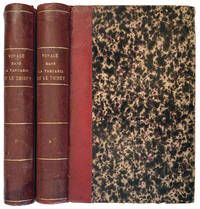
1857AB1069Paris:: Gaume freres 1857. 1857. 2 volumes. 12mo. xv 1 430; iv 524 pp. Early quarter red gilt-stamped calf marbled boards; rubbed. Bookplate; binder’s rubber-stamp of L. Brisset Valognes. A folding map is expected with this title other issues not present here. In fact there are different issues of this work with different paginations. "French missionary-traveller was born at Toulouse on the 1st of August 1813. In his twenty-fourth year he entered the congregation of the Lazarists at Paris and shortly after receiving holy orders in 1839 went out to China. At Macao he spent some eighteen months in the Lazarist seminary preparing himself for the regular work of a missionary. Having acquired some command of the Chinese tongue and modified his personal appearance and dress in accordance with Chinese taste he started from Canton. He at first superintended a Christian mission in the southern provinces and then passing to Peking where he perfected his knowledge of the language eventually settled in the Valley of Black Waters or He Shuy a little to the north of the capital and just within the borders of Mongolia. There beyond the Great Wall a large but scattered population of native Christians had found a refuge from the persecutions of Kia-King to be united half a century later in a vast but vague apostolic vicariate. The assiduity with which Huc devoted himself to the study of the dialects and customs of the Tatars for whom at the cost of much labour he translated various religious works was an admirable preparation for undertaking in 1844 at the instigation of the vicar apostolic of Mongolia an expedition whose object was to dissipate the obscurity which hung over the country and habits of the Tibetans. September of that year found the missionary at Dolon Nor occupied with the final arrangements for his journey and shortly afterwards accompanied by his fellow-Lazarist Joseph Gabet and a young Tibetan priest who had embraced Christianity he set out. To escape attention the little party assumed the dress of lamas or priests. Crossing the Hwang-ho they advanced into the terrible sandy tract known as the Ordos Desert. After suffering dreadfully from want of water and fuel they entered Kansu having recrossed the flooded Hwang-ho but it was not till January 1845 that they reached Tang-Kiul on the boundary. Rather than encounter alone the horrors of a four months’ journey to Lhasa they resolved to wait for eight months till the arrival of a Tibetan embassy on its return from Peking. Under an intelligent teacher they meanwhile studied the Tibetan language and Buddhist literature and during three months of their stay they resided in the famous Kunbum Lamasery which was reported to accommodate 4000 persons. Towards the end of September they joined the returning embassy which comprised 2000 men and 3700 animals. Crossing the deserts of Koko Nor they passed the great lake of that name with its island of contemplative lamas and following a difficult and tortuous track across snow-covered mountains they at last entered Lhasa on the 29th of January 1846. Favourably received by the regent they opened a little chapel and were in a fair way to establish an important mission when the Chinese ambassador interfered and had the two missionaries conveyed back to Canton where they arrived in October of the same year. For nearly three years Huc remained at Canton but Gabet returning to Europe proceeded thence to Rio de Janeiro and died there shortly afterwards. Huc returned to Europe in shattered health in 1852 visiting India Egypt and Palestine on his way and after a prolonged residence in Paris died on the 31st of March 1860." / "His writings comprise besides numerous letters and memoirs in the Annales de la propagation de la foi the famous Souvenirs d’un voyage dans la Tartarie le Thibet et la Chine pendant les annees 1844-1846 2 vols. Paris 1850; Eng. trans. by W. Hazlitt 1851 abbreviated by M. Jones London 1867; its supplement crowned by the Academy entitled L’Empire chinois 2 vols. Paris 1854; Eng. trans. London 1859; and an elaborate historical work Le Christianisme en Chine &c. 4 vols. Paris 1857-1858; Eng. trans. London 1857-1858. These works are written written in a lucid racy picturesque style which secured for them an unusual degree of popularity. The Souvenirs is a narrative of a remarkable feat of travel and contains passages of so singular a character as in the absence of corroborative testimony to stir up a feeling of incredulity. That Huc was suspected unjustly was amply proved by later research. But he was by no means a practical geographer and the record of his travels loses greatly in value from the want of precise scientific data." Britannica. Gaume freres, 1857. hardcover books
Opera in 2 volumi in 8°, brossure editoriali, titolo ai piatti ed ai dorsi, occhielli, frontespizi, prefazione, XV, 430, 524 pp., grande carta ft., 8 cc. di pubblicità editoriale. Interessante viaggio con partenza dalla missione francese di Pechino attraverso la terra mongola e tartara, feste, riti funebri, leggi, personaggi illustri e luoghi sacri all'ombra della Grande Muraglia. il secondo tomo è dedicato al Tibet ed alla profonda spiritualità che da sempre lo contraddistingue malgrado l'antica e perenne guerra con la Cina. Bellissime descrizioni della flora e fauna tibetana accompagnate dalle illustrazioni degl'usi e costumi. Restauri e minime mancanze alle brossure, in bello stato, carta ancor fresca e frusciante, in barbe, colmo di curiose notizie, entusiasmante.
Complet en 4 tomes, reliés en 2 volumes: xiii,301 + xiii,318 + xi,322 + 324pp., avec frontispice dans tomes 1-2 et une carte dépliante dans les tomes 1-2-3, Nouvelle édition publiée et préfacée par H. D'Ardenne de Tizac, 20cm., reliures cart. uniformes, bon état, X99332
2 voll. (21,5 x 13,5 cm). 440, 518 pp. 1 carta f.t. ripiegata. Mezza pelle coeva con nervi, fregi e titoli oro al dorso. La prima edizione fu stampata dallo stesso editore nel 1850. Le discusse memorie del celebre padre Huc (1813-1860), missionario francese della Congragazione dei Lazzaristi.
In-8, 414p. Edition hors commerce numérotée 1/3500 exemplaires. Illustré de nombreux documents.
1857AB1069Paris:: Gaume freres 1857. 1857. 2 volumes. 12mo. xv 1 430; iv 524 pp. Early quarter red gilt-stamped calf marbled boards; rubbed. Bookplate; binder's rubber-stamp of L. Brisset Valognes. A folding map is expected with this title other issues not present here. In fact there are different issues of this work with different paginations. "French missionary-traveller was born at Toulouse on the 1st of August 1813. In his twenty-fourth year he entered the congregation of the Lazarists at Paris and shortly after receiving holy orders in 1839 went out to China. At Macao he spent some eighteen months in the Lazarist seminary preparing himself for the regular work of a missionary. Having acquired some command of the Chinese tongue and modified his personal appearance and dress in accordance with Chinese taste he started from Canton. He at first superintended a Christian mission in the southern provinces and then passing to Peking where he perfected his knowledge of the language eventually settled in the Valley of Black Waters or He Shuy a little to the north of the capital and just within the borders of Mongolia. There beyond the Great Wall a large but scattered population of native Christians had found a refuge from the persecutions of Kia-King to be united half a century later in a vast but vague apostolic vicariate. The assiduity with which Huc devoted himself to the study of the dialects and customs of the Tatars for whom at the cost of much labour he translated various religious works was an admirable preparation for undertaking in 1844 at the instigation of the vicar apostolic of Mongolia an expedition whose object was to dissipate the obscurity which hung over the country and habits of the Tibetans. September of that year found the missionary at Dolon Nor occupied with the final arrangements for his journey and shortly afterwards accompanied by his fellow-Lazarist Joseph Gabet and a young Tibetan priest who had embraced Christianity he set out. To escape attention the little party assumed the dress of lamas or priests. Crossing the Hwang-ho they advanced into the terrible sandy tract known as the Ordos Desert. After suffering dreadfully from want of water and fuel they entered Kansu having recrossed the flooded Hwang-ho but it was not till January 1845 that they reached Tang-Kiul on the boundary. Rather than encounter alone the horrors of a four months' journey to Lhasa they resolved to wait for eight months till the arrival of a Tibetan embassy on its return from Peking. Under an intelligent teacher they meanwhile studied the Tibetan language and Buddhist literature and during three months of their stay they resided in the famous Kunbum Lamasery which was reported to accommodate 4000 persons. Towards the end of September they joined the returning embassy which comprised 2000 men and 3700 animals. Crossing the deserts of Koko Nor they passed the great lake of that name with its island of contemplative lamas and following a difficult and tortuous track across snow-covered mountains they at last entered Lhasa on the 29th of January 1846. Favourably received by the regent they opened a little chapel and were in a fair way to establish an important mission when the Chinese ambassador interfered and had the two missionaries conveyed back to Canton where they arrived in October of the same year. For nearly three years Huc remained at Canton but Gabet returning to Europe proceeded thence to Rio de Janeiro and died there shortly afterwards. Huc returned to Europe in shattered health in 1852 visiting India Egypt and Palestine on his way and after a prolonged residence in Paris died on the 31st of March 1860." / "His writings comprise besides numerous letters and memoirs in the Annales de la propagation de la foi the famous Souvenirs d'un voyage dans la Tartarie le Thibet et la Chine pendant les annees 1844-1846 2 vols. Paris 1850; Eng. trans. by W. Hazlitt 1851 abbreviated by M. Jones London 1867; its supplement crowned by the Academy entitled L'Empire chinois 2 vols. Paris 1854; Eng. trans. London 1859; and an elaborate historical work Le Christianisme en Chine &c. 4 vols. Paris 1857-1858; Eng. trans. London 1857-1858. These works are written written in a lucid racy picturesque style which secured for them an unusual degree of popularity. The Souvenirs is a narrative of a remarkable feat of travel and contains passages of so singular a character as in the absence of corroborative testimony to stir up a feeling of incredulity. That Huc was suspected unjustly was amply proved by later research. But he was by no means a practical geographer and the record of his travels loses greatly in value from the want of precise scientific data." Britannica. Gaume freres, 1857. hardcover
P.? Le Clere, 1850. In-8 relié demi basane chagriné, dos à nerfs souligné de filets à froid, 516 pages. quelques rousseurs.
in-8°, III-280 pages, carte depliante hors-texte, broche, couverture imprimee.— E.O. (mention fictive de 6e edition) Bel exemplaire [PH-3]
34877P., Plon, 1947, in 8° broché, III-281 pages ; couverture très légèrement fanée ; bien complet de la carte dépliante.