(PERIODICAL - China)Biblio.com
3 141 résultats
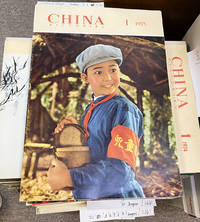
19591007<p><b><i>China Pictorial 219 issues</i></b></p><p>Beijing: China Pictorial distributed by Guozi Shudian; printed in the People's Republic of China comprising 219 issues covering the years 1959–1984 each measuring approx. 10-3/16 x 14-1/2 inches 26 × 37 cm overall condition is very good plus to near-fine. Because of the weight shipping will be by FedEx Ground</p><p>China Pictorial is a monthly magazine bi-weekly thru 1960 illustrated with photographs and essays about current events <b>highlighting the development and progress in modern PRC</b> the People's Republic of China. It doubled as a <i>propaganda tool of the Chinese government</i> and was issued in 19 languages including Korean Russian German French Spanish and Italian. Several issues include various supplements calendars and flyers laid inside. Except for the one duplicate issue covering the funeral of Chairman Mao 1976.11 which is in Chinese all remaining 218 issues are the English-Language version. Quite rare thus.</p><p>1959: No. 2-22; 1960: No. 2-14 16-24; 1961: No. 1-12; 1962: No. 1 3 4 5 6 7 8 10 11; 1963: No. 1-12; 1964 No. 1-5 7-12; 1965: No. 1-4; 1966: No. 1-10; 1968: No. 1-9 11-12; 1969: No. 1-8 10-12; 1971: No. 1-9 11-12 1972: No. 1-12; 1973: No. 1-12; 1974: No. 1-6 8-11; 1975: No. 1-6 8 10; 1976: No. 1-9 11; 1978: No. 1 7; 1979: No. 1-9 12 1980: No.1 3 4 5 7 11 12; 1981: No.1 3 4 7 8 9 10; 1982: No. 2 4 9 11; 1983: No. 12; 1984: No. 12; </p><p><i>Important events detailed: Modern woodcuts in China; Hard-Stone Carving-A Special Craft of Peking; Stamp collection; the Propaganda Poster—A Fighting Art; Works of Art by PLA Men; Peking Peasants Hold Sports Meeting; Wrought Iron Pictures; The Museum of the Chinese Revolution; In Commemoration of the 50th Anniversary of the 1911 Revolution; Tea Drink in China; Mei Lan-fang and His School of Art; The people of Tibet for the first time in history in the midst of electing their local representatives; A Great People's Fighter—Lei Feng & Lei Feng's Dairy; The First GANEFO; Guo Lan-ying A Well-Known Singer; Box-Wood Carving; Painting Illustrating Chairman Mao's Poem; New Stamps</i><i>ï¼›</i><i>China Successfully Explodes Her First Atom Bomb; A Splendid Revolutionary Oil Painting "Chairman Mao Goes To Anyuan"; Piano Music "The Red Lantern" with Peking Opera Singing; Ping Pang Ball Spreads Friendship: Chuang Tse-tung of China with Glenn Cowan of the US.; Ancient Chinese Silk and the Silk Road; President Nixon Visits China: Chairman Mao Meets President Nixon in Peking; Photographs Taken by Edgar Snow in China in 1936; Choukoutien-Home of Peking Ape-Man; Peking Duck; Jade in China; Yellow River Valley-Cradle of Ancient Chinese Civilization; Evergreen Friendship Between the Chinese and Japanese People; Criticize the Fallacies of Lin Piao and Confucius in Peiking and Tsinghua University; A Madman's Diary by Lu Hsun; Chin Shih Huang's Progressive Role in History; the Shang Yang Reform; Lu Shun a Pictorial Series in Gouache; the Chen Sheng-Wu Kuang Uprising; More Ancient Treasures Excavated at Mawangtui: Books Copied on Silk; Wang Chung Against Confucius; Tsao Tsao; Vice Premier Deng Visits The United States; The Silk Road; Painting of Wu Guanzhong; The Chinese Muslim; How an Ancient Chinese Painting Was Reproduced; Fan Zeng's Figure Painting; The Museum of Qin Dynasty Terracotta Warriors and Horses; The Ma Haide I Know; Colored Paintings on Ancient Architecture; Lu Xun: His Life and Works</i>; <i>Confucius Temple; Traditional Chinese Painting Watercolor; Oil Painting—Li Huaji Style; Wushu; Modern Porcelain</i><i>Special Issue About Cultural Revolution: Decision of the Central Committee of The Chinese Communist Party Concerning the Great Proletarian Cultural Revolution; Revolutionary Ballet: White-Haired Girl; Chairman Mao Joins a Million People in Celebrating the Great Cultural Revolution; Comrade Lin Piao and Chou En-lai's Speech; Supplement: In Memory of Lu Hsun—Comments from Chairman Mao; Comrade Chu Teh's Life Was One of Fighting for Cause of Communism; Bamboo Slips from the Chin Dynasty Unearthed; Chairman Mao Meets Former U.S. President Nixon in February; People Throughout China March to Against Teng Hsiao-ping's Crimes of Reverting Capitalism; Children's Paintings; Death of Comrade Chou En-lai; Chairman Mao's Funeral: Eternal Glory to the Great Leader and Great Teacher Chairman Mao Tsetung; Message to the Whole Party the Whole Army and the People of All Nationalities Throughout the Country; Memorial Speech by Comrade Hua Kuo-feng with original photo of Hua Kuo-feng's delivering memorial speech &c</i>.</p><p>《人民画报》æ‚志,本组涵盖1959年到1984年(具体期刊è§åˆ—表),ä¸åŽäººæ°‘共和国出版,国å书店å‘行。本组包括219期,å“相éžå¸¸å¥½ã€‚</p><p>《人民画报》是月刊,通过照片ã€æ–‡å—ç‰æ–¹å¼æ¥å±•ç¤ºä¸å›½çš„å‘展和进æ¥ï¼Œå®ƒåŒæ—¶è¿˜å‘行了包括韩è¯ï¼Œä¿„è¯ï¼Œå¾·è¯ï¼Œæ³•è¯ï¼Œè¥¿ç牙è¯ï¼Œæ„大利è¯ç‰å¤šç§è¯è¨€æ¥ä½œä¸ºä¸å›½æ”¿åºœå‘ä¸–ç•Œå®£ä¼ ä¸å›½çš„é‡è¦å·¥å…·ã€‚内部还包括多个增刊ã€æ—¥åŽ†å’Œå®£ä¼ å•ã€‚</p><p>出版社:外国è¯è¨€å‡ºç‰ˆç¤¾ ä¸å›½Â·åŒ—京</p><p><br /></p> distributed by Guozi Shudian; printed in the People's Republic of China, paperback
193471Some wears as shown many photo plates color maps of Concession. Concession Francaise de Changhai (Shanghai) paperback
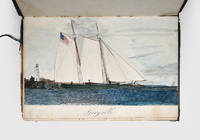
1842170558At sea & China: 1842-48. This ground is under English control though their authority is might makes right An American second mate's illustrated eyewitness account of China in the immediate aftermath of the First Opium War. Sailing east on a Jardine Matheson specie and opium runner he becomes an old China hand and a sharp observer of early colonial Hong Kong and Shanghai coastal trade and maritime life. The opening section consists of diary entries kept during the outward voyage from the United States describing a life of adventure entered almost by accident. "On the 1st of Sept. 1842 being in Boston and out of employ I shipped in the Schr Gazell" p. 1. The Gazelle - an Aberdeen-built schooner illustrated in watercolour at the front of the manuscript - sailed on 19 September 1842 with guns muskets and nine boxes of specie. Some 30 pages trace the passage with detailed daily entries including latitudes and longitudes weather hazards marine life shipboard routines and the rituals of crossing the Equator. After rounding the Cape the vessel encounters American traders off China and reaches Macao on 22 February 1843. The remainder of the manuscript comprises reflective recollections written later in the 1840s. Macao is judged healthy and pleasant but eclipsed after the war by Hong Kong now the hub of British trade. The Gazelle is reassigned to opium running along the coast bringing higher pay and extended travel. The author recalls Hong Kong in 1844: the nightly curfew gunshot the opium fleet at Whampoa and the crowded Pearl River illustrated with pencil sketches of local craft. His view of the Chinese population is unsympathetic though he offers a vivid portrait of "Boston Jack" a wealthy comprador and indispensable intermediary to American ships. Further chapters describe Canton the forts of the Bogue Amoy and its junks and Chusan praised for its industry and abundance. Shanghai emerges as a newly important centre of opium exchange its foreign settlement firmly under British control. The author sketches the harbour notes the thousands of junks and contrasts the city's "civil and obliging" inhabitants with those of Canton. The manuscript breaks off mid-sentence on page 50 leaving the writer's later life unknown but preserving a detailed first-hand record of a China on the threshold of colonial modernity. Octavo notebook 252 x 165 mm. Opening full-page watercolour 12 illustrations and plan in pencil. Original blue linen pink patterned endpapers edges sprinkled blue 49 pages neatly written in black ink 38 unused blanks. Notebook worn and shaken with sewing loose a few closed tears internally touching a few letters only. A very good example. unknown
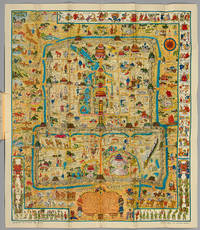
CBF24<p>Lithographed & Published by The Peiyang Press Ltd. Tientsin-Peiping 1936.</p><p>8vo 181 x 132 mm of 1 title-page 22 pp. of explanatory text and a folded map in colors measuring 86 x 74 cm. Two small tears in the white margin of the map. Preserved in the original publisher's wrappers and slipcase.</p><p><b>Very rare first edition complete with the folded map and the booklet preserved in the publisher's illustrated folder.</b></p><p><b>Finely executed pictorial map of Beijing published by Frank Dorn and the Peiyang Press. Ltd. of Tientsin and Peiping in 1936.</b></p><p><b>Dorn's map is perhaps the best known and most iconic pictorial map of Beijing published in the 20th Century offering a host of interesting ethnographic and iconographic information about Beijing and its environs while retaining the whimsical qualities of the great pictorial maps of the first half the 20th Century.</b></p><p><b>Dorn's map is considered one of the great maps of the golden era of pictorial mapmaking. </b></p><p>The map is ringed with a series of cartoon vignettes illustrating the history of the city from ancient times to 1936. Dorn was a friend and admirer of the pictorial mapmaker Jo Mora 1876-1847 and was clearly influenced by Mora's style of combining accurate pictorial details bright colors and a bit of whimsy along with vignettes providing an illustrated history of the place.</p><p>The cartouche is decorated with names and dates of historical events and this legend in the center.</p><p>Frank Dorn was an artist writer and military officer. Growing up in San Francisco he attended the San Francisco Art Institute and became an accomplished cartoonist. After graduation from West Point he was assigned a post in the Philippines and as a side project wrote a book about a clan of tribal people he got to know there. An acquaintance of California artist Jo Mora Dorn began making his own maps; an early one depicted Camp Strassenbourg in the Philippines.</p><p>While living in China Dorn made his popular pictorial map of "Peiping". He later served in the field as advisor to a Chinese army. A fluent speaker of Chinese Dorn's most important military role was in the China-Burma-India theater during World War II. There he served with Deputy Chief of Staff of the U.S. Army forces General "Uncle Joe" Stilwell during the Burma campaign from 1942 to 1944 and served as a commanding officer in 1944-45. A 1942 Life Magazine article about the Burma mission stated that "Dorn an artist drew Stilwell's campaign maps." </p><p>Dorn eventually attained the rank of Brigadier-General and retired in 1953. He settled in Carmel California living what his friend John Thompson describes as "a semi-bohemian life writing and painting. In the Sixties he did some amazing psychedelic paintings wondered if he was the incarnation of a Buddhist painter and held progressive civil rights and antiwar views." In the 1970s Dorn authored two highly-regarded scholarly books on the Chinese and Burmese theaters of World War II. </p><p><b>A fascinating pictorial map of Beijing drawn by an American officer who was a military attaché in China during the 1930s. </b></p><p><b>It features vignettes of Chinese history from 1100 BC to 1927 as well as modern tourist attractions</b> including golf and race courses. </p><p>Hints to the political situation include the 'Kuomintang Headquarters'; and the German swastika and the Japanese 'Rising Sun' flags flying in the 'Legation Quarter' the year before the official start of the Second Sino-Japanese War in 1937. </p><p>Frank Dorn 1901-81 was a graduate of West Point where he picked up the life-long nickname of 'Pinky' before being posted to Beijing in 1934 to help gather intelligence on Japanese aggression. He immersed himself in the language and culture of the city researching the Forbidden City and collecting antiquities. When war with Japan broke out Dorn became chief-of-staff to L.t General Joseph Stilwell with a rank of Colonel. At one point relations between the Americans and the leader of the Chinese Kuomintang Chiang Kai-shek were so bad that Dorn was ordered to prepare a plan to assassinate him. Although Dorn suggested giving Chiang a faulty parachute and sabotaging his plane authorization was never given. </p><p>The plan is packed full of wonderful illustrations from the border that covers the city's history from its inception in 1100B.C. its numerous dynasties - including the 'decadant period under the Ch'Ings' - through to the revolution of 1911 and the movement of the capital to Nanking in 1927. Also to the borders are illustrations of a wedding and a funeral. </p><p>The plan itself not only shows all the historic landmarks including the Forbidden City and the Temple and Altar of Heaven but also the racecourse zoo old execution ground and cocks fighting. </p><p>The color printed map is accompanied by a 22 page booklet which gives a potted history of the city together with a list of points of interest that are shown on the map.</p><p><br /></p><p><u>Français</u></p><p>Lithographed & Published by The Peiyang Press Ltd. Tientsin-Peiping 1936.</p><p>In-8 de 1 f. de titre 22 pp. de texte explicatif et carte repliée en couleurs de 86 x 74 cm. Deux petites déchirures dans la marge blanche de la carte. Conservé dans la brochure et dans l'étui d'origine.</p><p>Dimensions du livret : 181 x 132 mm.</p><p>Dimensions de la carte : 860 x 740 mm.</p><p><b>Très rare édition originale complète de la très belle carte repliée de Pékin et du fascicule de présentation accompagnant la carte le tout sous chemise illustrée d'éditeur.</b></p><p><b>La carte de Frank Dorn est sans doute la plus célèbre et la plus emblématique carte picturale de Pékin publiée au XXe siècle. </b></p><p><b>Elle offre une foule d'informations ethnographiques et iconographiques du plus haut intérêt sur Pékin et ses environs</b> tout en conservant les qualités fantaisistes des grandes cartes picturales de la première moitié du XXe siècle.</p><p>Elle présente une suite de vignettes illustrant l'histoire de la ville de Pékin aux temps anciens. La bordure de la carte regorge d'illustrations formidables qui retracent l'histoire de la ville depuis sa création en 1100 av. J.C. à travers ses nombreuses dynasties jusqu'à la révolution de 1911 et le déplacement de la capitale à Nankin en 1927. Un mariage et un enterrement sont également représentés dans cette bordure. Le cartouche comporte d'ailleurs des noms et des dates d'événements historiques majeurs. </p><p>La carte ne montre pas seulement les lieux historiques comme la Cité interdite ou le Temple du Ciel mais aussi des attractions touristiques plus récentes comme l'hippodrome le zoo les combats de coq… Elle révèle également les occupations des habitants.</p><p><b>La carte de Dorn est considérée comme une des grandes cartes de l'âge d'or de la cartographie illustrée.</b> </p><p>Frank Dorn 1901-81 était un ami et un admirateur du cartographe Jo Mora 1876-1947. Il a été clairement influencé par le style de Mora qui combinait l'illustration précise par des couleurs brillantes et un peu d'humour avec des vignettes fournissant une histoire illustrée du lieu étudié. Frank Dorn est un artiste auteur et officier militaire. En grandissant à San Francisco il a étudié à la San Francisco Art Institute et est devenu un dessinateur accompli. Après l'obtention de son diplôme d'officier à West Point il a été assigné à un poste aux Philippines. A côté de son travail militaire il a écrit un livre sur les tribus autochtones qu'il a appris à connaître là-bas. Proche de Jo Mora Dorn a commencé à faire ses propres cartes. </p><p>Plus tard vivant en Chine Dorn a réalisé sa carte illustrée de "Peiping" après s'être immergé dans la culture locale faisant des recherches sur la cité interdite et accumulant des antiquités. Il a servi dans ce pays comme conseiller militaire de l'armée chinoise. </p><p>Pendant la Deuxième Guerre mondiale il a été attaché au Chef d'Etat-Major Adjoint des Forces de l'Armée de Terre des États-Unis le Général Stilwell pendant la Campagne de Birmanie de 1942 à 1944. Un article de Life Magazine daté de 1942 a par ailleurs déclaré que "Dorn un artiste a dessiné les cartes de campagne de Stilwell." Dorn a finalement atteint le grade de Général de Brigade et est parti en retraite en 1953. Il s'est installé à Carmel en Californie vivant une semi-vie de bohème écrivant et peignant. Dans les années 1960 il a réalisé quelques peintures psychédéliques étonnantes. Dans les années 1970 Dorn a écrit deux livres savants sur les théâtres chinois et birmans pendant la Deuxième Guerre mondiale.</p><p>La carte accompagne un fascicule de 22 pages qui retrace l'histoire de la ville et présente une liste des lieux et monuments représentés sur la carte.</p><p><b>Fascinante carte picturale de Pékin dessinée par un officier Américain envoyé en Chine dans les années 1930.</b></p>
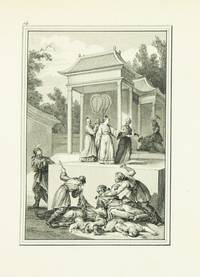
1788ST20889Paris: Chez l'Auteur 1788 1788. FIRST EDITION. 565 x 400 mm. 22 1/4 x 15 3/4". 50 leaves. Two separately published works bound in one. <br/> Modern retrospective calf-backed tan paste paper boards smooth spine profusely gilt with a repeating pattern of grape vines red morocco label lettered in gilt vellum tips. ENGRAVED THROUGHOUT WITH A TOTAL OF 48 FULL-PAGE ILLUSTRATED PLATES each accompanied by either one or two plates of engraved text. SHEETS UNCUT AND UNFOLDED the first work printed only on the recto; the second with three sheets printed on both sides. Reed and Dematté China on Paper 20 21; Cohen-de Ricci 479. Edges and lower corners slightly worn but the binding with only just minor signs of use; free endpaper in front and back with vertical crease one sheet with an early marginal repair isolated inconsequential faint spotting but still AN EXTREMELY FINE COPY the wide-margined sheets exceptionally fresh and bright and with strong impressions of the engravings.<br/> <br/> This pair of lavishly illustrated fully engraved works produced by a talented French engraver after earlier Chinese artworks are here presented in an enormous volume made up of uncut and unfolded sheets. According to Benzit Parisian engraver and print seller Isidore Stanislas Henri Helman 1743 - ca. 1809 "stands out among the engravers of the end of the 18th century" and his skill is evident in the two works bound together here. The first is a pictorial history of the Chinese emperors from the earliest mythical rulers to the Northern Song dynasty 960-1126. It is based on the Dijian Tushuo composed in 1573 to educate the Ming-dynasty Wanli Emperor 1563-1620 who had ascended to the throne at the age of nine. In accordance with its didactic aims it presents the very best and worst of imperial behavior and the original handwritten album was published as a block-printed book to great popularity. Two centuries later the Qing-dynasty Qianlong Emperor 1711-99 commissioned a Western-style edition of the famous work which was executed by two French artists the Jesuit painter Jean-Denis Attiret and the engraver Charles-Nicolas Cochin II. The enterprising Helman was able to see the Attiret-Cochin book in the collection of French statesman Henri Léonard Jean Baptiste Bertin 1720-92 and having had great success with a previous reproduction of a Chinese work Conquêtes de l'Empereur de la Chine ca. 1783 he created the present reproduction. The second work the life of Confucius was also reproduced from plates in Bertin's collection. The source material in this case was the biography of Confucius assembled by the Jesuit Joseph-Marie Amiot 1718-93 as part of his informational series on China meant to educate missionaries. Amiot was a correspondent of Bertin and had sent him the biography and accompanying album of drawings which were based on the Shenji tu Illustrated Traces of the Sage a popular Confucian work throughout the Ming and Qing dynasties. Helman selected 24 scenes from each creating books that balance serene scenes of mountainous landscapes and temples with dramatic fight scenes and dragons. The quality of the engravings is excellent with delicate linework creating faint wisps of smoke and subtle shadows. These two works apparently both published in 1788 were released in several formats. The format here with the engravings laid out on the recto of large uncut sheets appears at auction very infrequently: we have been able to trace only two copies of both works in this format since 2004 and neither in such fine condition as the present example. Chez l'Auteur unknown
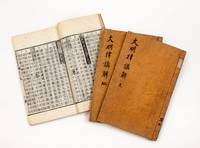
913569; 84; 102 folding leaves. 30 parts in three vols. Large 8vo 306 x 202 mm. orig. patterned yellow-brown wrappers new stitching. Korea: final volume with date 1903.<br /> <BR> <BR> A rare metal movable type edition printed at the Ministry of Justice in Seoul in 1903 using a font cut in 1816. The text was originally compiled in ChosÅn Korea on royal command in ca. 1440. The earliest edition that can be confidently dated was printed by woodblocks in KyÅngju in 1536.<br /> <BR> <BR> The text explains the descriptions of crimes and punishments contained in the Great Ming Code which was the penal code of the Chinese Ming empire 1368-1644. This book in the form in which we now have it is the result of a series of revisions in the late 14th century. It represents an important moment in Chinese legal history as a kind of legal Renaissance in that it was deliberately modeled on the centuries-old Tang code whereas the preceding Mongol Yuan empire had not had an official Chinese legal code. <br /> <BR> <BR> The Ming legal code was very influential in East Asia. In Korea the Ming code’s influence can be discerned already in the second half of the 15th century when we see references in the penal section in the official collection of statutes specifying that certain matters should be handled according to the Ming code. Even in the last Korean code issued before the advent of Japanese rule dated 1905 the influence of the Ming code is still discernable.<br /> <BR> <BR> Our edition of the book belongs to the uncertain period in the late 19th and early 20th centuries when the Korean leadership tried to navigate between the surrounding empires and establish the country as an independent state. The laws of Ming China which had collapsed more than two and a half centuries earlier were still being studied by prospective officials in the Korean judiciary on the eve of the Russo-Japanese War which made Korea a Japanese protectorate.<br /> <BR> <BR> Our edition was printed with metal movable type using the chÅnsaja å…¨å²å— set. This copper font of approximately 20000 characters was cast privately in 1816 by Pak ChonggyÅng 朴宗慶.<br /> <BR> <BR> Fine and handsome set. A seal states that this set belonged to the collection of the Institute for the Training of Officials for the Judiciary PÅpkwan YangsÅngso 法官養æˆæ‰€ in Seoul founded in 1895 as part of an attempt to modernize the civil service. It was intended as a textbook for the institute’s students.<br /> <BR> <BR> "At the end of the book is a double leaf of errata a novelty among Korean government publications" Fang The Asami Library 18.45 <br /> <br> <br> <br /> References<br /> <br> <br> <br /> Fang Chaoying. The Asami Library: A Descriptive Catalog. Edited by Elizabeth Huff. Berkeley: University of California Press 1969.<br /> <br> <br> Jiang Yonglin trans. The Great Ming Code. Seattle: University of Washington Press 2014.<br /> <br> <br> Tanaka Toshimitsu ç”°ä¸ä¿Šå…‰. “ChÅsen kan Daiminritsu kÅkai†æœé®®åˆŠã€Žå¤§æ˜Žå¾‹è¬›è§£ã€ã«ã¤ã„㦠TÅyÅ hÅseishi kenkyÅ«kai tsÅ«shin æ±æ´‹æ³•åˆ¶å²ç ”究会通信 no. 28 2015. unknown
biblio21<p>Size:24.520.5cm. Good a little creased as shown. With Consular Service Shanghai stamps as shown.</p>
20002091502135401362Not Available 2000. Soft Cover. Fine. Volume: 163 Not Available paperback
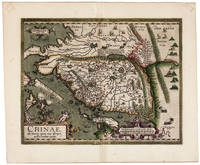
1606602014 3/8 x 18 3/8 inches. Fine original hand color; slight split at centerfold fine condition. <br /><br /><p>A brilliant example in rich original hand color of the rare and only English language edition of the earliest printed folio-size western map specifically of China and "the first to show the Great Wall"Nebenzahl. "This map remained the standard type for the interior of China for over sixty years" Tooley. Although 2 pocket-sized English language editions of an abbreviated version of Ortelius' <i>Theatrum</i> entitled <i>Epitome</i> were published previously in 1601 and 1603 with brief texts in English the English text in the present edition runs to 2 large folio pages printed on the back of the map giving an extensive description of China drawn from recent publications of observations by European travelers to the area particularly Jesuits. With its three lushly designed cartouches and many illustrations of indigenous shelters modes of transportation i.e. the famous wind wagons and animals this is one of Ortelius's richest engravings and among his rarest. </p><p>Nebenzahl <i>Mapping the Silk Road and Beyond </i>4.6; van der Krogt 8410:31:051; Tooley <i>Maps and Mapmakers</i> p. 106 pl. 78 p. 108; Walter <i>Japan: A Cartographic Vision</i> 11F p. 186.</p>
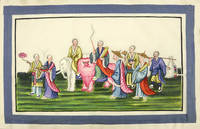
91713Canton 2nd half of 19th century. . A set of 10 watercolour and gouache studies on pith paper; one with a long horizontal closed tear. Contemporary red patterned silk binding; upper hinge broken and upper cover detached.<br /> <br />Pith seems not to have been adopted for painting until about 1820. Some European museums claim that their paintings on pith often erroneously called "rice paper" or "mulberry pith" come from the end of the eighteenth century but there do not seem to be any dateable examples that are so early. There is a record of the Kaiser Franz of Austria buying some albums from an English Consul-General Watts in 1826. We know of an Italian Count who visited Canton in 1828 and had over 350 paintings on pith in his baggage when he died in Ambon two years later. In the British Library there is a scrap-book containing six pith paintings and a journal entry by a serving British officer who sent them home from India in 1829. These examples and contemporary accounts by visitors to Canton suggest that there was a flourishing trade in pith paintings by the early 1830s.<br /><br />Pith presumably came into use for painting to satisfy the increasing demand for small inexpensive and easily transported souvenirs following the massive growth in the China Trade in the first quarter of the nineteenth century. Paintings in oils on board and canvas were costly and difficult to carry home. Earlier and more prestigious export water-colours had often been on a larger scale and painted on fine Chinese paper or on paper imported from Europe. The albums of pith paintings and later the little glass-fronted boxes were inexpensive light easy to pack and gave the pictures some protection on the long voyage home. Because many were sold in albums and hence protected from the light they retain their bright colours to this day.<br /><br />Pith comes from the central column of spongy cellular tissue in the stem of a small tree called Tetrapanax Papyrifera native to south-west China. It has had a variety of uses some going back many centuries. At the imperial court both men and women wore coloured flowers made from pith in their hair. For use in painting it is cut by hand with a knife into thin sheets from short lengths of the spongy tissue. Cutting is highly skilled and the constraints of the process mean that the finished sheets for painting seldom if ever measure more than about 30cms by 20cms. The sheets are dried trimmed and used for painting without any further processing.<br /><br />Because of the nature of pith and its cellular structure the gouache used by the Chinese sat on the surface and produced a bright and even sparkling effect. Very fine detail could be achieved but pith did not lend itself to the flat wash of colour favoured for European watercolours. <br /><br />Carl Crossman in his book The Decorative Arts of the China Trade originally published under the title The China Trade gives an excellent list of export painters with a note of those known to have painted on pith. These include Tingqua Sunqua and Youqua. From 1757 until 1842 Canton was the only Chinese port open to trade with the west and it is no surprise that of the eight studios identified by Crossman as producing works on pith six were in Canton. <br /><br />It seems that the 1830s and 1840s may have been the heyday of pith painting. The international trading bases the waterfront 'factories' on the 'Hongs' in Canton where they were produced were partially burnt during the First Opium War 1839-41 and totally destroyed in a fire of 1856. The foreign trading companies then moved to Honan and subsequently put up splendid new offices on reclaimed land at Shamian Island a little up river. As the result of the Treaty of Nanking in 1842 additional Chinese ports were opened up for foreign trade and Hong Kong was established as a major trading centre. <br /><br />By 1860 references to China in the Illustrated London News plentiful three years earlier were few and far between. That is not to say that painting on pith ceased. Nicholas the second was given paintings on pith when he visited Canton in 1891 and the last Emperor is said to have sent him a gift which included pith paintings in 1907 though these could have been examples of much earlier work. <br /><br />Painters on pith did not in general sign their work the sole exception is Sunqua whose name can be found on the face of three paintings on pith. <br /><br />There are collections of paintings on pith in the Ashmolean the British Museum the Fitzwilliam the Hermitage the Peabody/Essex Museum in Massachusetts and the Hong Kong Museum of Art. However because paintings on pith are not in general regarded as fine art they are usually to be found in ethnographic or specialised collections.<br /> Canton, 2nd half of 19th century]. unknown
20162081502111906025Chinese book office 2016. Soft Cover. Fine. The book is in fine condition. Chinese book office paperback
162134518Lisbon and Hangzhou China: Manuscripts ca.1623 and 1621. Very Rare A Similar Manuscript Exists in Brussels. We know of no others. The Latin text of both letters is written in a neat uniform cursive hand in brown. Folio leaves 33 x 20.5 cm The transcripts bound in 18th Century stiff blue wrappers the blank paste-downs and endpapers are late 18th century most likely the third quarter between 1745/1753 and 1776 since they contain a clear "lion/vryheit/pro patria" watermark with a crowned GR countermark which resembles Heawood 3148 3149 and 3154. The paper used for the manuscript contains a faint double-headed eagle watermark and it has been reinforced in the gutters. A very pleasing survival very well preserved edges slightly mellowed the wrappers show some signs of wear. VERY RARE MANUSCRIPT TRANSCRIPTS. Chrysostomus Johann Gall 1586-1643 was a German Jesuit and scholar. He left Ingolstadt Germany to teach astronomy mathematics and navigation in Lisbon fro 1620to 1627 before leaving to work in the Jesuit missions in India. The Colégio de Santo Antŕo benefitted from the arrival of many foreign mathematicians and other scholars as Lisbon serves as a gateway for all missionaries departing for Asia. The original letter by Gall was written in Lisbon September 1623 and concerns a newspaper style description of various events including details of the perseution of Christians in Japan particularly the execution of large numbers of the Christian community in Nagasaki in 1622.<br> The second letter in the present work is especially interesting as the original was written by Johannes Terentius also known as Johannes Schreck an Deng Yuhan Hanpo 1576-1630. Terentius was a prominent Jesuit scholar specialized in natural science and mathematics. Before joining the Jesuits as a novice1611 he already enjoyed a grea reputation in Germany as a scholar. In 1621 Terentius left for China to join the Jesuit mission. The original letter by Terentius was written in Hangzhou China on 30 August 1621 to the rector of teh Jesuit College in Munich Jakob Keller 1568-1631. He discusses his journey to China which he started in 1618 his intentions to participate in the planned calendar reform in China and his impressions of the city of Hangzhou which he reached in 1621 Terentius wrote several works on european medicine mathematics and technology in Chinese and together with Johann Adam Schall von Bell and G. Roho introduced European tigonometry and European astronomical instruments to China. In 1629 he began to reform the calendar which J.A. Schall von Bell ocmpleted after Terentius' early death a year later.<br><br>Backer & Sommervogel VII col. 1929-F<br> Manuscripts unknown
2081502111907398Koryo Shosha N.A. Soft Cover. Fine. Size: Hardcover Koryo Shosha paperback
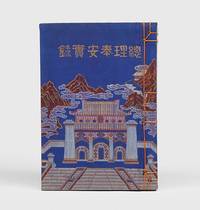
1929172181Nanjing: Zongli fengan huakan bianzuan weiyuanhui 1929. Bidding China's "National Father" farewell First and only edition and printing of the official commemorative publication for Sun Yat-Sen's state burial distributed as a gift by the Chinese Ministry of Foreign Affairs. Over one hundred photographic illustrations record the elaborate multi-day ceremony and the appearance of Sun's mausoleum; these are accompanied by several folding architectural plans. Loosely inserted is the ministry's printed presentation card. Following Sun's death on 12 March 1925 the Kuomintang formed a 12-man committee tasked with overseeing the construction of a massive mausoleum on Mount Zijin in Nanjing. The stakes were high: amidst the breakdown of the Kuomintang's relations with the Chinese Communist Party and Chiang Kai-Shek's tightening grip on the party-state exerting control over Sun's legacy and image was paramount. The design of the site was opened to public tender the committee requiring the winning design to combine traditional Chinese styles with modern concepts of adaptive architecture. The winning architect Lu Yanzhi 1894-1929 died before construction finished and his vision was seen through to completion by his colleague Poy Gum Lee 1900-1968. Lu and Poy's American training is reflected in such design elements as the layout of the site which draws on the Mall in Washington and the Liberty Bell and the design of a statue of Sun seated in Lincoln-esque fashion. In spring 1929 the internment ceremony began with the transfer of Sun's body from Beiping to Nanjing on a special train named the "Soul Train" in Chinese. "The transfer was designed as a long drawn-out mobile media event that was to spiritually mobilize modernize and unify the population around the spirit and body of Sun Yat-sen". The internment ceremony held on 1 June 1929 after the body had lain in state for three days was a lavish and highly regulated spectacle. The body was escorted by a 3-mile-long procession to the echoes of a 101-gun salute from a gunboat moored on the Yangtze River. At midday as Song Qingling and Sun Ke Sun's wife and son closed the metal door on the tomb the ceremony closed with a national three-minutes silence. This is the most important printed record of one of 20th-century China's defining political events. The majority of copies are now housed in institutional collections and we have traced no others in commerce. Accompanying this copy are two contemporary typescript translations into English of the book's captions. Large octavo. With 73 plates 4 collotype and 35 half-tone plates 7 maps and plans 6 folding ornate title page after calligraphy by Han Minjing. Original lavish silk brocade lettered in gold orange thread xianzhuang stitching spine and covers lined with tan silk. With original blue cloth folding case xylographic label on front panel reproducing calligraphy by Chiang Kai-Shek lined with decorative blue paper bone toggles. Brocade bright some losses to silk on spine rear cover silk lining worn and feathering where sometime damp text and illustrations very well preserved one folding plan with small hole not affecting printed area: a very good copy the binding having lost none of its lustre in very good case with rubbing a little soiling and cockling to lining. Rudolph G. Wagner "1925-1928: Enshrining the Father of the Republic" China Heritage Annual available online. hardcover
20212081502111904391commercial stamp office 2021. Soft Cover. Fine. The book is in fine condition. commercial stamp office paperback
19432092902144201915Daiichishobo 1943. Soft Cover. Fine. The book is in fine condition. Daiichishobo paperback
1873312749Shanghai: Printed at The "North China Herald" Office 1873. First edition. Presentation copy inscribed from the author to Douglas Jones on first blank. Title-page printed preface and text with holograph manuscript by Jones on the Index and Game Register. Pp. vii 116 Diary & Game Register accomplished in ink 4 pages unused; 1-50. 1 vols. 4to 10-1/8 x 8 inches; 257 x 203 mm. Contemporary full brown roan upper cover titled in gilt. Spine neatly rebacked notes on front endsheets. Quarter black morocco slipcase and cloth chemises. First edition. Presentation copy inscribed from the author to Douglas Jones on first blank. Title-page printed preface and text with holograph manuscript by Jones on the Index and Game Register. Pp. vii 116 Diary & Game Register accomplished in ink 4 pages unused; 1-50. 1 vols. 4to 10-1/8 x 8 inches; 257 x 203 mm. "The immense tracts of country available for purposes of sport and well stocked with game the entire absence of game laws and the friendly disposition of the natives combine to render Keang-soo and the adjoining provinces a very Paradise for sportsmen ." Groom from the Preface. <br /> <br /> Early work on hunting in China with a partly printed dairy and "Register of Game Bagged" here accomplished with an extensive and detailed manuscript of expeditions from 1878 to 1892 recounting trips on the Merlin and other boats after deer waterfowl and other game listing participants names of dogs and game bags. The manuscript is followed by the printed text with notes on boats guns and kit "The Medicine Chest" cookery and chapters on various types of game pheasant snipe wild pig and a printed Vocabulary with Chinese/English translations and phonetic transcriptions.<br /> <br /> Among the hunting companions of Jones in the 1885 season was Bell-Irving author of Diary of the Ewo Party 1890. Both Jones and Bell-Irving are quoted frequently in Wade's With Boat and Gun in the Yangtze Valley 2nd ed. 1910.<br /> <br /> Some interesting ephemera has been preserved including printed Chinese broadside shooting permits for Jones for the years 1884 and 1885 a shooting permit for Hong Kong and the New Territories 1894; fivee sketch maps of Kiang Su Le Yang and Kashing; four small photographs of Hong Kong mounted on the verso of a Victorian photographic portrait of Douglas Jones; a manuscript translations of Chinese verse by one of Jones' companions and four autograph letters on sporting topics or introductions and requests to assist Jones in his up country trips; and a stray sheet of printed letterhead of the Union Insurance Society of Canton Shanghai where Jones was Secretary.<br /> <br /> A UNIQUE AND SUBSTANTIAL RECORD OF SPORT IN CHINA. Czech Asia p. 93. Not in OCLC Printed at The "North China Herald" Office unknown
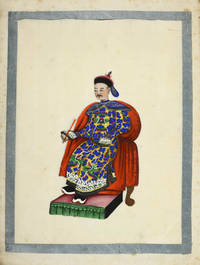
90282Canton ca. 1860. . Album 29.5 x 21.5 cm with 12 watercolour and gouache on pith paper each laid on paper with a light blue ribbon; one a bit stained in brown. Contemporary binding of patterned brown paper; very rubbed.<br /> A lovely variety of Chinese official costumes in fine condition and bright colours.<br /><br />Pith seems not to have been adopted for painting until about 1820. Some European museums claim that their paintings on pith often erroneously called "rice paper" or "mulberry pith" come from the end of the eighteenth century but there do not seem to be any dateable examples that are so early. There is a record of the Kaiser Franz of Austria buying some albums from an English Consul-General Watts in 1826. We know of an Italian Count who visited Canton in 1828 and had over 350 paintings on pith in his baggage when he died in Ambon two years later. In the British Library there is a scrap-book containing six pith paintings and a journal entry by a serving British officer who sent them home from India in 1829. These examples and contemporary accounts by visitors to Canton suggest that there was a flourishing trade in pith paintings by the early 1830s.<br /><br />Pith presumably came into use for painting to satisfy the increasing demand for small inexpensive and easily transported souvenirs following the massive growth in the China Trade in the first quarter of the nineteenth century. Paintings in oils on board and canvas were costly and difficult to carry home. Earlier and more prestigious export water-colours had often been on a larger scale and painted on fine Chinese paper or on paper imported from Europe. The albums of pith paintings and later the little glass-fronted boxes were inexpensive light easy to pack and gave the pictures some protection on the long voyage home. Because many were sold in albums and hence protected from the light they retain their bright colours to this day.<br /><br />Pith comes from the central column of spongy cellular tissue in the stem of a small tree called Tetrapanax Papyrifera native to south-west China. It has had a variety of uses some going back many centuries. At the imperial court both men and women wore coloured flowers made from pith in their hair. For use in painting it is cut by hand with a knife into thin sheets from short lengths of the spongy tissue. Cutting is highly skilled and the constraints of the process mean that the finished sheets for painting seldom if ever measure more than about 30cms by 20cms. The sheets are dried trimmed and used for painting without any further processing.<br /><br />Because of the nature of pith and its cellular structure the gouache used by the Chinese sat on the surface and produced a bright and even sparkling effect. Very fine detail could be achieved but pith did not lend itself to the flat wash of colour favoured for European watercolours. <br /><br />Carl Crossman in his book The Decorative Arts of the China Trade originally published under the title The China Trade gives an excellent list of export painters with a note of those known to have painted on pith. These include Tingqua Sunqua and Youqua. From 1757 until 1842 Canton was the only Chinese port open to trade with the west and it is no surprise that of the eight studios identified by Crossman as producing works on pith six were in Canton. <br /><br />It seems that the 1830s and 1840s may have been the heyday of pith painting. The international trading bases the waterfront 'factories' on the 'Hongs' in Canton where they were produced were partially burnt during the First Opium War 1839-41 and totally destroyed in a fire of 1856. The foreign trading companies then moved to Honan and subsequently put up splendid new offices on reclaimed land at Shamian Island a little up river. As the result of the Treaty of Nanking in 1842 additional Chinese ports were opened up for foreign trade and Hong Kong was established as a major trading centre. <br /><br />By 1860 references to China in the Illustrated London News plentiful three years earlier were few and far between. That is not to say that painting on pith ceased. Nicholas the second was given paintings on pith when he visited Canton in 1891 and the last Emperor is said to have sent him a gift which included pith paintings in 1907 though these could have been examples of much earlier work. <br /><br />Painters on pith did not in general sign their work the sole exception is Sunqua whose name can be found on the face of three paintings on pith. <br /><br />There are collections of paintings on pith in the Ashmolean the British Museum the Fitzwilliam the Hermitage the Peabody/Essex Museum in Massachusetts and the Hong Kong Museum of Art. However because paintings on pith are not in general regarded as fine art they are usually to be found in ethnographic or specialised collections.<br /> Canton, ca. 1860]. unknown
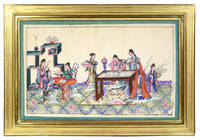
94512Canton 2nd half of 19th century. . Six watercolour and gouache studies on pith paper edged in turquoise silk ribbon and laid on paper; framed glazed and overall size: 27 x 39.4 x 2 cm.<br /> An exquisite group of interior scenes exclusively of noblewomen and ladies in waiting engaging in various genteel activities such as flower arranging painting poetry reading and writing surrounded by elegant Qing dynasty furniture and ornaments including unusual asymmetrical display cabinets exotic bird swings and porcelain vases all standing or sitting on elaborately patterned silk carpets.<br /><br />Pith seems not to have been adopted for painting until about 1820. Some European museums claim that their paintings on pith often erroneously called 'rice paper' or 'mulberry pith' come from the end of the eighteenth century but there do not seem to be any dateable examples that are so early. There is a record of the Kaiser Franz of Austria buying some albums from an English Consul-General Watts in 1826. We know of an Italian Count who visited Canton in 1828 and had over 350 paintings on pith in his baggage when he died in Ambon two years later. In the British Library there is a scrap-book containing six pith paintings and a journal entry by a serving British officer who sent them home from India in 1829. These examples and contemporary accounts by visitors to Canton suggest that there was a flourishing trade in pith paintings by the early 1830s.<br /><br />Pith presumably came into use for painting to satisfy the increasing demand for small inexpensive and easily transported souvenirs following the massive growth in the China Trade in the first quarter of the nineteenth century. Paintings in oils on board and canvas were costly and difficult to carry home. Earlier and more prestigious export water-colours had often been on a larger scale and painted on fine Chinese paper or on paper imported from Europe. The albums of pith paintings and later the little glass-fronted boxes were inexpensive light easy to pack and gave the pictures some protection on the long voyage home. Because many were sold in albums and hence protected from the light they retain their bright colours to this day.<br /><br />Pith comes from the central column of spongy cellular tissue in the stem of a small tree called Tetrapanax Papyrifera native to south-west China. It has had a variety of uses some going back many centuries. At the imperial court both men and women wore coloured flowers made from pith in their hair. For use in painting it is cut by hand with a knife into thin sheets from short lengths of the spongy tissue. Cutting is highly skilled and the constraints of the process mean that the finished sheets for painting seldom if ever measure more than about 30 by 20 cm. The sheets are dried trimmed and used for painting without any further processing.<br /><br />Because of the nature of pith and its cellular structure the gouache used by the Chinese sat on the surface and produced a bright and even sparkling effect. Very fine detail could be achieved but pith did not lend itself to the flat wash of colour favoured for European watercolours. <br /><br />Carl Crossman in his book The Decorative Arts of the China Trade originally published under the title The China Trade gives an excellent list of export painters with a note of those known to have painted on pith. These include Tingqua Sunqua and Youqua. From 1757 until 1842 Canton was the only Chinese port open to trade with the west and it is no surprise that of the eight studios identified by Crossman as producing works on pith six were in Canton. <br /><br />It seems that the 1830s and 1840s may have been the heyday of pith painting. The international trading bases the waterfront 'factories' on the 'Hongs' in Canton where they were produced were partially burnt during the First Opium War 1839-41 and totally destroyed in a fire of 1856. The foreign trading companies then moved to Honan and subsequently put up splendid new offices on reclaimed land at Shamian Island a little up river. As the result of the Treaty of Nanking in 1842 additional Chinese ports were opened up for foreign trade and Hong Kong was established as a major trading centre. <br /><br />By 1860 references to China in the Illustrated London News plentiful three years earlier were few and far between. That is not to say that painting on pith ceased. Nicholas the second was given paintings on pith when he visited Canton in 1891 and the last Emperor is said to have sent him a gift which included pith paintings in 1907 though these could have been examples of much earlier work. <br /><br />Painters on pith did not in general sign their work the sole exception is Sunqua whose name can be found on the face of three paintings on pith. <br /><br />There are collections of paintings on pith in the Ashmolean the British Museum the Fitzwilliam the Hermitage the Peabody/Essex Museum in Massachusetts and the Hong Kong Museum of Art. However because paintings on pith are not in general regarded as fine art they are usually to be found in ethnographic or specialised collections.<br /> [Canton, 2nd half of 19th century]. unknown
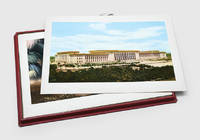
1959168629Beijing: Renmin meishu chubanshe c.1959. Monumentality and the weight of state power First edition first printing of this grand portfolio. Occupying 170000 square metres on the western flank of Tiananmen Square the Great Hall of the People was one of ten architectural projects completed in 1959 to celebrate the tenth anniversary of the founding of the People's Republic of China. The design combines classical and neoclassical styles with Chinese aesthetics. For example the total number of columns in the main gate colonnade equals the number found inside the most important hall in the Forbidden City and these columns are spaced at receding widths away from the central point - a long-held Chinese architectural practice. The decision to build the hall was enacted by the Politburo in 1958 and a force of 30000 builders and technicians finished the project in just ten months. For the last six decades the Great Hall's main ceremonial space capable of holding 10000 people has served as the venue for Chinese Communist Party meetings and lavish state events. Its corridors and many smaller rooms have also played host to political intrigues contentious meetings and important diplomatic dialogues. In 2003 Riverdance became the first Western show to perform on the hall's main stage selling out 11 performances. Copies were also issued in a dark red vinyl box with no priority established. Landscape folio. Title leaf printed in red and black. 20 colour photographic plates c. 292 x 465 mm printed on glossy paper each tipped onto loose 372 x 525 stiff card sheet together with loose single title leaf printed both sides all housed in original red cloth box lid with calligraphic title in gilt and blind-stamped decoration. Plates bright a little soiling and foxing to card sheets; bright box lightly rubbed and soiled abrasions to base sides of tray a little tender: a fine set in well-preserved box. Parr & WassinkLundgren The Chinese Photobook: From the 1900s to the Present pp. 183-5. Chang-tai Hung Mao's New World: Political Culture in the Early People's Republic 2011. hardcover
19802091202133212040Nigensha 1980. Soft Cover. Fine. Volume: 1 Nigensha paperback
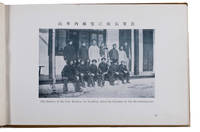
1912ABC_47646Shanghai: Commercial Press Limited 1912. Original publisher's orange-brown pictorial cloth marbled endpapers. Oblong 8vo 15 x 22.5 cm. 160 black-and-white photographic illustrations all protected by tissue paper guards. First and only edition of a very rare work with photographic illustrations of the Chinese Revolution of 1911 with captions in Chinese and English. It was published specifically for circulation in the West and consists of 14 parts. The present work contains the first 4. However any volume in this series is exceptionally rare as we have not been able to find another copy in sales records of the past 100 years.The Chinese Revolution of 1911 is an important event in Chinese history as it resulted in the establishment of the Republic of China. The Revolution was preceded by decade of revolts since Chinese citizens had already been dissatisfied with the rule of the Qing dynasty 1636-1912 for some time. The Revolution started in October 1911 with the Wuchang Uprising after which similar revolts broke out across the country. The Qing court then initiated negotiations with the revolutionaries. Both parties came to the agreement that the emperor who was just 6-years old had to abdicate in February 1912. Revolutionary statesman Sun Yat-Sen 1866-1925 became the first provisional president.The present work offers an authentic pictorial record of the first revolts. The work contains numerous portraits of important leaders of the Revolution and members of the Qing court grim photographic illustrations of the battlefields in Wuchang now the Wuchang District of Wuhan and Hankow or Hankou and images of the attack on Nanking now Nanjing including the preparations and the aftermath.The binding shows very slight signs of wear the gutters of the front and back endpapers are weakened causing the binding to be wobbly but the boards are still attached. The tissue paper between the photographic illustrations has browned throughout. Otherwise in very good condition.l WorldCat 891342401 2 copies. Commercial Press, Limited, hardcover
1890312761London: Printed at the Army-Navy Cooperative Society Limited 1890. 3 mounted albumen photographs of the shooting party with their trophies head- and tailpieces. xii 170 pp. 1 vols. 8vo 7-3/4 x 5 -3/8 inches; 196 x 137 mm. Contemporary full black morocco over stiff card covers ruled in silver upper cover with text in blindstamp edges silvered decorative endpapers. Finely rebacked to style; edges rubbed. Black morocco backed slipcase and chemise. 3 mounted albumen photographs of the shooting party with their trophies head- and tailpieces. xii 170 pp. 1 vols. 8vo 7-3/4 x 5 -3/8 inches; 196 x 137 mm. A signed presentation copy from the author John Bell-Irving to Douglas Jones. <br /> Bell-Irving was a Scottish businessman and partner in the Hong Kong trading firm Jardine Matheson and a director of the Hong Kong Electric Company. Jones was Secretary of the Union Insurance Society of Canton of Shanghai. <br /> "The greatest pleasure in up-country shooting trips" Bell-Irving claims "is the idea of perfect freedom far removed from business cares and beyond the reach of letters and telegrams." Succinct account of many hunting trips after pheasant waterfowl deer and other game with observations on weather and conditions and game bag. Bell-Irving and Jones are quoted frequently in Wade's With Boat and Gun in the Yangtze Valley 2nd ed. 1910.<br /> <br /> A SUSTANTIAL ACCOUNT OF SPORT ALONG THE YANGTZE OVER THREE DECADES.<br /> <br /> EXCEEDINGLY RARE. OCLC 42241800 Princeton Printed at the Army-Navy Cooperative Society Limited unknown
20212081502111902865Tianjin People's Art Publishing House 2021. Soft Cover. Fine. The book is in fine condition. Tianjin People's Art Publishing House paperback
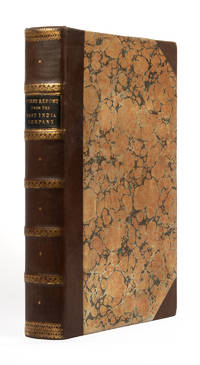
121050London Ordered by the House of Commons to be Printed 8 July 1830. . First edition; 4to 34 x 22 cm; numerous tables in text some very light occasional spotting; later half-calf to style marbled boards gilt spine in six compartments with gilt black lettering piece all edges marbled a very good copy; xxiii 500 173 pp.<br /> This was the final large-scale inquiry into the East India Company in China before their monopoly was revoked in 1833. Since the revocation of their monopoly in India twenty years prior the Company's trading power had been more and more heavily relying on tea exports through which they were able to control prices. The six sessions of the parliamentary Select Committee between February 15th and June 3rd clearly laid out the inadequacies of the Company supplying the potential trade on offer with China and more importantly the additional costs upon the British consumer through the inefficiencies associated with the Company. After 1833 the East India Company was a purely administrative body whose army was used as part of the British force in the First Opium War.<br /><br />Opium was one of the issues raised early on in the sessions in particular in regards to its legality and whether it therefore laid under the jurisdiction of the Company: 'is not the opium trade in China. entirely an illicit trade'. Part of the reason for revoking the Company's monopoly was that the stance they had to take in regards to opium that it was a prohibited product precluded both themselves and any other private merchants from profiting from a 'trade which is open to the rest of the world'. <br /><br />The rest of the report is largely concerned with the primary export from China: tea. The charts in the appendices helpfully lay clear the extent of the trade showing that on average the Company exported nearly 130000 tonnes of tea to England and America every year and the duties paid by the Company on tea to the Crown alone exceeded £3000000 a year. In large part the inquiry concerned itself with the high prices for the end English consumer resulting from the inefficiencies and protectionist practices inherent in a monopoly. The difference between the cost of tea in America versus England is highlighted with some teas being double the price in England compared to America as well as costs of ship production when compared with both America and the Crown. One of the witnesses states that 'the Company has been always anxious to promote the consumption of tea' knowing they would struggle to provide 'an adequate supply for any increased demand'.<br /><br />Rare in commerce with none at auction in the last 30 years.<br /> [London], Ordered, by the House of Commons, to be Printed, 8 July 1830. hardcover