25 870 résultats
19371006EAST ASIA<br /><i>Zuijin zhi Dongya Xingshi Tujie </i><i>Map Explaining the Latest Situation in East Asia</i>. Mainichi Shimbun Osaka Office Japan Showa period 1937.<br />Highly pictorial Japanese propaganda map of East Asia issued just six months before the outbreak of the second Sino-Japanese War. The map focuses on China's military situation and shows a separate Manchuria and Jidong Autonomous Region. Heavy industry military communication and supply lines airfields and foreign military bases are delineated with the note that there are '200000 Communists' at the Chinese Communist Party's northern Shaanxi base. The projection of the map is such that it illustrates the 'horseshoe formation' showing Manchuria 'the lifeline of Japan' as being surrounded by Japan's enemies.<br /><br />Chomo-lithographic map of East Asia 780 x 1065 mm. Territories in yellow and identified with a red cross other parts of the globe colored in green or red explanatory title at foot inset world map at lower left labelled mainly in Japanese and Chinese characters. Mild toning long closed tear repaired with old tape some other tears edgewear. Mainichi Shimbun Osaka Office, Japan, Showa period,
2 vols.in 8vo, orig. blue wrappers, Texte: 140pp (b/w plates)+10pp., Traduction:xii+93pp., excellent condition. Contents : v. 1. Texte--v. 2. Traduction. Subject : Tibetan drama -- Translations into French. Manuscripts, Tibetan. en français.
200732523-ym3181Hong Kong: ILove Art Gallery 2007. 106 pages. Original Hardcover (something bumped, otherwise a very good and clean copy). 28,5 x 28,5 cm. [2 Warenabbildungen] fest gebunden
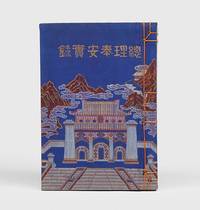
1929172181Nanjing: Zongli fengan huakan bianzuan weiyuanhui 1929. Bidding China's "National Father" farewell First and only edition and printing of the official commemorative publication for Sun Yat-Sen's state burial distributed as a gift by the Chinese Ministry of Foreign Affairs. Over one hundred photographic illustrations record the elaborate multi-day ceremony and the appearance of Sun's mausoleum; these are accompanied by several folding architectural plans. Loosely inserted is the ministry's printed presentation card. Following Sun's death on 12 March 1925 the Kuomintang formed a 12-man committee tasked with overseeing the construction of a massive mausoleum on Mount Zijin in Nanjing. The stakes were high: amidst the breakdown of the Kuomintang's relations with the Chinese Communist Party and Chiang Kai-Shek's tightening grip on the party-state exerting control over Sun's legacy and image was paramount. The design of the site was opened to public tender the committee requiring the winning design to combine traditional Chinese styles with modern concepts of adaptive architecture. The winning architect Lu Yanzhi 1894-1929 died before construction finished and his vision was seen through to completion by his colleague Poy Gum Lee 1900-1968. Lu and Poy's American training is reflected in such design elements as the layout of the site which draws on the Mall in Washington and the Liberty Bell and the design of a statue of Sun seated in Lincoln-esque fashion. In spring 1929 the internment ceremony began with the transfer of Sun's body from Beiping to Nanjing on a special train named the "Soul Train" in Chinese. "The transfer was designed as a long drawn-out mobile media event that was to spiritually mobilize modernize and unify the population around the spirit and body of Sun Yat-sen". The internment ceremony held on 1 June 1929 after the body had lain in state for three days was a lavish and highly regulated spectacle. The body was escorted by a 3-mile-long procession to the echoes of a 101-gun salute from a gunboat moored on the Yangtze River. At midday as Song Qingling and Sun Ke Sun's wife and son closed the metal door on the tomb the ceremony closed with a national three-minutes silence. This is the most important printed record of one of 20th-century China's defining political events. The majority of copies are now housed in institutional collections and we have traced no others in commerce. Accompanying this copy are two contemporary typescript translations into English of the book's captions. Large octavo. With 73 plates 4 collotype and 35 half-tone plates 7 maps and plans 6 folding ornate title page after calligraphy by Han Minjing. Original lavish silk brocade lettered in gold orange thread xianzhuang stitching spine and covers lined with tan silk. With original blue cloth folding case xylographic label on front panel reproducing calligraphy by Chiang Kai-Shek lined with decorative blue paper bone toggles. Brocade bright some losses to silk on spine rear cover silk lining worn and feathering where sometime damp text and illustrations very well preserved one folding plan with small hole not affecting printed area: a very good copy the binding having lost none of its lustre in very good case with rubbing a little soiling and cockling to lining. Rudolph G. Wagner "1925-1928: Enshrining the Father of the Republic" China Heritage Annual available online. hardcover
in-12°, 164 pp., figures, broché. Bon état. [BL-9]
8vo, br. ed 760pp. Zizhi tongjian Vol 1-8 – Warring States and Qin – Translated by Joseph P Yap Sima Guang (1019-1086 CE) completed his Zizhi tongjian (Comprehensive Mirror in Aid of Governance) in 1084, a monumental historiography that commences in 403 BCE and ends in 959 CE, covering a span of 1362 years of ancient and medieval Chinese history. Qin Mu the eminent contemporary Chinese historian remarks, “Sima Guang successfully merged the three disciplines of literature, history, and philosophy into one entity.” The Zizhi tongjian is about historical experience, and Sima Guang maintains that the heads-of-states can learn so much by studying history. The book has earned high acclaim among Chinese and Asian scholars ever since its publication. However, only a very small part of the work has been translated into English; hence, the work is not widely read. This volume of this translation begins in 403 BCE and concludes with the fall of the Qin Dynasty in 207 BCE. The Zizhi tongian assimilated the exceptional attributes and defining qualities of the Zuozhuan (the Commentary of Zuo) and the Shiji (Records of the Grand Historian). Since its publication, it has held a very special and esteemed position among Chinese scholars and historians. Although the work was principally sponsored and financed by the Song Imperial Court, it was organized and written by private individuals; it, therefore, deviated significantly from historical texts prepared by court officials during previous dynasties. In 403 BCE, the once powerful Jin hegemonic state was partitioned into Hann, Wei, and Zhao. Together with Qi, Qin, Chu and Yan they came to be known as the seven warring states. Sima Guang in his annotation on the enfeoffment of the three fief lords by the King of Zhou laments over the breakdown of li (rites). He says, ‘It was not the three Jin ministers who bankrupted the instituted rites; rather, the Son of Heaven brought on the collapse.’ He contends that as the illegitimate act of partitioning a state by its subjects was legitimized by the Son of Heaven - the Zhou king was wholly accountable for the demise. Sima Guang thus chose to commence his chronicle of Zizhi tongjian during the 23rd year of King Weilei of Zhou, 403 BCE, when the Son of Heaven enfeoffed the Jin ministers. The times of the Warring States was about reforms, political strategies, intrigue, warfares, conquests and wholesale massacres when the major states vied for control of China. Wei was the first state that made reforms and enjoyed of decades of prosperity and military strength; it was followed by others in varying forms. The tide turned when Duke Xiao of Qin ascended to the throne; he made resolve to strengthen his state, and it was the turning point of the Warring States. Through Shang Yang’s reform, Qin basically laid down the foundation for the final conquest of the six states. This volume offers the readers a glimpse of the political struggles between the seven states culuminating in the final unification of China by by the First Emperor Qin Shihuang in 221 BCE. The book ends with the demise of Qin. When Sima Qian (145?-90 BCE) composed the Shiji (Records of the Grand Historian) he used all the information that was available to him, numerous errors were incorporated. Sima Guang, while conducted extensive research, drew copiously on the information from Shiji on the parts of Warring States, Qin, and early Han, and his work included many of the mistakes made. Ever since much textual and archaeological information on the Warring States have become available. Yang Kuan, one of the most eminent contemporary scholars, had conducted extensive textual and archaeological research on the Warring States, shedding much light on the errors on Shiji, Zhanguoce (Warring States Strategies) and Zizhi tongjian. The author translated some of his more outstanding articles. Joseph P. Yap is a self-educated historian. Having spent many years in the business community as a corporate executive, he decided to turn his attention to translating ancient Chinese texts into English. He believes that there is certainly no shortage of excellent translators, particularly from the academic world. However the literature we inherit from the ancient Chinese are so vast that numerous books and texts are still left unattended, and he believes that these valuable texts and chronicles should be made available to a wider English readers. He published his first book the Wars with the Xiongnu in 2009. He is presently working on Volume 2 and 3 of Zizhi tongjian – The Han Empire.
347 pages. Index. Signed and inscribed by author upon half-title page. Chapters include: The Motivation of Zionism; Zionism in Action; The Process of Rejection; China and India Turn their backs; The Alien almost at Home; Asia draws back; Israel - a colony or a coloniser. Average wear. Unmarked. Binding intact. A sound copy. Book
22432Bruxelles, Fonds Mercator/ Mercatorfonds , 2009 Softcover met flappen, 208p, Afmetingen: 28 x 24 cm,200 illustraties in kleur, nieuwstaat . ISBN 9789061538912.
24391P., Corrêa (Collection "L'Esprit Vivant"), 1952, in 8° broché, 248pp. ; couverture illustrée (fanée).
195280571952 broché in-octavo, dos crème, couverture recto ornée d'une illustration photographique, long papier, très légères piqûres, 248 pages, 1952 à Paris Editions Corréa,
1991721ABFrankfurt, Umschau, 1991. 21 cm. 158 S. mit181 Abbildungen, davon 150 farbig und 4 Karten. Illustrierter Originalkarton (Softcover). Sonderausgabe. Tadelloses gepflegtes Exemplar.
1994q9b2701goGu Wu Xuan Publishing House (Suzhou, Jiangsu), 1994. Contents: An outline map of the humble administrator's garden. The Small Flying Rainbow Bridge. Spring. Summer Autumn. The Hall of drifting fragrance. Fragrant Isle. Spring scene round the mountain. A pool of lotuses in summer. Snowy scene. Bonsai Garden. Shu Xiang Hall etc. Photographers: Chen Jiangxing, Zheng Kejun, Zhou Rende, Zheng Xiang. 129 S. Chinesisch / Englisch / Japanisch. Auflage: 5000 Expl. Umschlag sehr leicht berieben, sauber, Einband und Rücken gut und sauber, Schnitt und Seiten sauber, sehr guter Zustand. Erstauflage. 4° Querformat [5 Warenabbildungen] Pappband
200727968BShanghai:, Bo Yin Contemporary International Artists Gallery., (2007-2010). 26cm x 21cm. 58; 18; 18 p. Original wrappers with coloured illustrated title to cover. 3 catalogues. Boards with some staining, inside in very good condition.
3 catalogues. 26cm x 21cm. 58; 18; 18 p. Original wrappers with coloured illustrated title to cover. Boards with some staining, inside in very good condition. With numerous coloured illustrations of the paintings on plates. Introductory texts in Chinese and English.
in-8°, 358 pages, portrait, broche, couverture plastifiee. Bel exemplaire [CA32-4]
1 portfolio . (loose-leaf), 16 col. plates ; 37 cm.
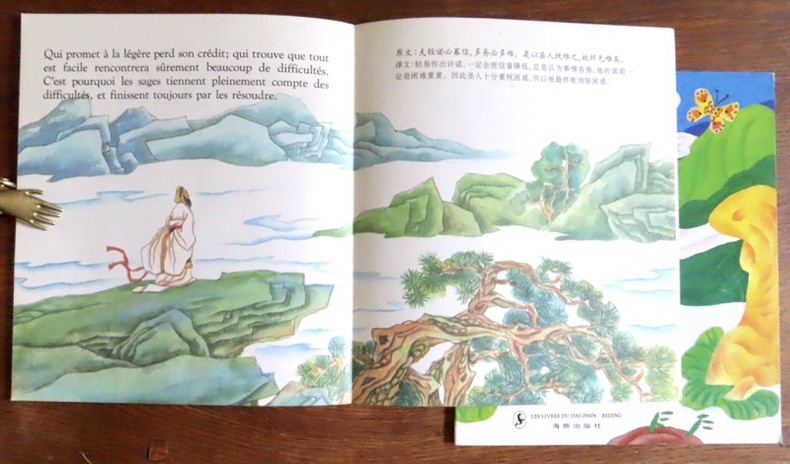
199614249Beijing, Les livres du Dauphin, 1996. 2 volumes in-8 brochés sur agraphes, couvertures couleurs. A l'état de neuf.
1 vol. in-8 br., col. cover, color. pictures, IVPP - Institute of Vertebrate Paleontology and Paleoanthropology, Chinese Academy of Sciences, 1994, 63 p. Very nice copy of this brochure on the Man of Peking (paleoanthropology). Anglais
198914630Beijing, Editions en Langues Etrangeres, 1989. 300 S. Broschur mit Deckelklappen / Fadenheftung
34038901Beijing 1977Beijing Xinhua Shu Dian.Stiff pictorial wrs. large format 23.2 x 26 cm. Chinese text 60p. many b. w. photographs small mend to first fly edge & back cover upper right corner covers a bit dusty2nd printing. FIRST EDITION . . . EXCELLENT PICTORIAL MONOGRAPH ABOUT ZHOU ENLAI . . . WITH PHOTOGRAPHS FROM 1919 THROUGH 1977 . . . AN EARLY SUPPORTER OF THE "HONG WEI BING" "RED GUARDS" . . . AND THE CHINESE CULTURAL REVOLUTION WENGA . . . A BIOGRAPHICAL HISTORY . This is a biography of Zhou from his early times in France & Germany as a student. His role with Mao in the war against Chiang Kai-shek Jiang Jieshi World War 2 period his marriage and a record of several politically important events in his life including meeting Richard Nixon the American President. Written in Chinese. . On page 54 is an excellent photo of Zhou and Chen Boda at the Beijing mass rally of "Red Guards" "Hong Wei Bing" on August 16 1966 where Zhou wears a "Hong Wei Bing" red armband while he and Chen address the crowd of "Red Guards" in the mass rally in Beijing from the podium. . Although Mao forced Zhou to be "caretaker' of the "Hong Wei Bing" it was not something he relished although he did cooperate with Mao. . Excellent primary resource on one of the most influential intellectual progressive and highest of Chinese leaders after Mao. . Zhou was the first and highest member of the party after Mao be responsible for the "Hong Wei Bing" or "Red Guards" from the very first day of their welcome by Mao at the August 1966 mass rally. . WHO WAS ZHOU ENLAI 1898-1976: Zhou Enlai was the first Premier of the People's Republic of China serving from October 1949 until his death in January 1976. Zhou served under Mao Zedong and was instrumental in consolidating the control of the Communist Party's rise to power forming foreign policy and developing the Chinese economy. . A skilled and able diplomat Zhou served as the Chinese foreign minister from 1949 to 1958. Advocating peaceful coexistence with the West after the stalemated Korean War he participated in the 1954 Geneva Conference the 1955 Bandung Conference and helped orchestrate Richard Nixon's 1972 visit to China. He helped devise policies regarding the bitter disputes with the U.S. Taiwan the Soviet Union after 1960 India and Vietnam. . PHOTOGRAPHS: The work is lavishly illustrated with 60 period black and white photographs. Each has a Chinese caption. . CONDITION: This item is complete as issued in the RARE original stiff wrappers with red-printed title. The covers are a bit dusty minor wear to the spine with minor restoration to the hinged spine A bit of wear to the leading edges else a solid example stapled. . The contents are very clean and solid with no issues to the excellent large-size photographs. See images posted to our website. . REFERENCE: . en-wikipedia-org/wiki/Zhou_Enlai . Color photos are posted to our website. . . unknown
19952092902141207069Peking University 1995. Soft Cover. Fine. Volume: 1 Peking University paperback
199841469ABHong Kong, Naga, 1998. 20 cm, x, 206 Seiten, mit Farbfotos und graphischen Darstellungen (teilweise zum Ausklappen), kartoniert. leichte Gebrauchsspuren, gute Erhaltung.
Relais France-Chine. 2003. In-4 Carré. Broché. Bon état. Couv. convenable. Dos satisfaisant. Intérieur frais. Plaquette de 11 pages. Le bulletin des chrétiens concernés par la Chine. Le poids de la Chine dans la paix mondiale, Jean Charbonnier. La Chine, terre riche en confessions de foi...
Relais France-Chine. 2002. In-4 Carré. Broché. Bon état. Couv. convenable. Dos satisfaisant. Intérieur frais. Plaquette de 11 pages. Le bulletin des chrétiens concernés par la Chine. Religions et universalisme en Chine, Jean Charbonnier. Echos d'un voyage en Chine...
197717929ABZhongguo, Beijing, Ditu-chubanshe; Frankfurt [Main] : China heute, Reise- und Buchhandelsges, 1977. Lex.-8°. [200], 174 S., überwiegend Karten, Kunstleder (Hanyu-pinyinban), 1. ban. (Schutzumschlag mit Randläsuren; Papierbedingt leicht gebräunt; gut erhalten)