[Philippines]. [Promotionals]Biblio.com
821 résultats
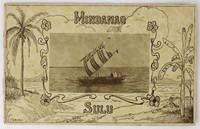
19055045Manila: Sugar News Press 1905. Very good. 22pp. Photographically illustrated. Oblong quarto. Original pictorial wrappers stapled. Moderate dust-soiling and edge wear. Light even toning to text. An early and seemingly-unrecorded promotional touting the people and scenery in Mindanao and Sulu in the southern Philippines in the first decade of the 20th century. The work opens with a Foreword detailing the positive aspects of Mindanao particularly its principal city described here as the "Metropolis of Mindanao and Sulu" with "a population of more than thirty thousand a mixture of Moros or Mohammedan Filipinos Christian Filipinos Chinese Japanese and Europeans." Following the Foreword the remainder of the work is mostly comprised of thirty-four duotone photographs printed mostly two per page but occasionally with from one to five per page. The photographs feature numerous scenic and street views in and around Zamboanga including various "Moro houses" and about fifteen portraits of indigenous Filipinos such as a "Moro woman weaving materials for head-turbans and sarongs" a view inside a "weaving school" "Yakan Moros on the island of Basilan" "Muhammad Jamallul Sultan of Sulu" "Joloano Warriors" "Moro Kulintang" and their musical instruments Bogobo and Cotabato warriors "Bajaos - the sea gypsies of Sulu" and "Bogobo musicians."<br /> <br /> The final two pages of the work are taken up with two poems -- the first is a traditional Filipino poem entitled "No Te Vayas" noted as "Zamboanga's 'Auld Lang Syne" and one titled simply "Zamboanga" by Susan Hart Dyer. The front cover is decorated with a central photograph of an indigenous sailing vessel surrounded by an illustrated beach scene signed at bottom left "Jh. Mendoza." The inside front cover contains an illustration of the Philippine Islands from Batanes down to Sulu. We could locate no other copies of the work by title and imprint information in OCLC. Sugar News Press unknown
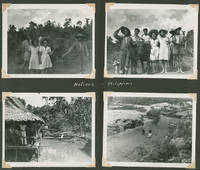
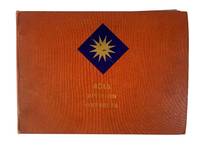
1945WRCAM54321Philippines; Okinawa; San Diego 1945. 133 silver gelatin photographs most 2 1/2 x 4 inches but ranging from 2 1/2 x 2 1/2 to several 10 x 7 inches. Oblong folio. Black leatherette album strong tied. Light wear. Photos in corner mounts with many captions. Very good. A fascinating photographic account of military service in the Philippines compiled by a member of the 142nd U.S. Naval Construction Battalion the Seabees in 1945. Most of the images approximately three- quarters of the album were taken in Guiuan on Samar Island in the central Philippines where the photographer was stationed. Guiuan city square the Seabees' camp numerous portraits of local girls who sometimes pose with American soldiers local families and their activities native architecture and other local scenes. They also show the Immaculate Conception Church with shots of the exterior and detailed views of the silver altar - built in 1595 to 1844 but completely destroyed by Typhoon Haiyan in 2013. Several other photos evidently portray the album's compiler posing next to an American fighter plane while boiling sea shells in front of his tent etc. <br> <br> The final portion of the album contains photos taken during the operations aboard the USS "Monrovia" and "President Harris" in October-November 1945 including views of Okinawa on the way to China and snapshots of soldiers unloading cargo in the Yellow Sea China before returning to Manila. There are also eight clear views of Manila showing destroyed Japanese cranes and boats in the harbor American army headquarters and a warehouse. The album concludes with a few photos of the homeward voyage and shows soldiers discharged in San Pedro California. <br> <br> Overall a very good album depicting local life and the activities of the 142nd U.S. Naval Construction Battalion in the Philippines and Yellow Sea in the last months of the World War II. hardcover books
1798PHO-1110Paris, F. Buisson, An 6 de la République (1798). Cinq volumes in-8 (21x13,5cm) , relié plein cuir époque , dos lisse orné avec pièces de titre et de tomaison , filet en torsade sur les plats, coins et coiffes usés , charnières frottées (fente sur le tome 1) , (4) viij, 515pp. et (4) 412pp. et (4) 399pp. et (4) 326pp. et (4) ij, 402pp. ; (2) , illustré de 29 gravures (32) , 4 frontispices et 3 grandes cartes dépliantes gravés par Tardieu l’Ainé , pages de titre brunis . Édition originale du voyage de Macartney avec le 5eme volume ,en seconde édition, contenant le précis de l’histoire de Chine par Huttner (1-184) et la relation de son voyage (187-358) dans une reliure uniforme .
1725PHO-1468Rouen & Amsterdam, Jean Baptiste Machuel le jeune , (T1, Étienne Roger,T2&8 Pierre le Boucher, Rouen) 1725 . 10 volumes in-12, ,relié plein veau époque , dos orné, pièces de titre et de tomaison rouges, tranches rouges , reliures tome 1 et 2 légèrement différentes, défauts d’usures, illustré de 5 frontispices et 42 gravures , la plupart dépliantes ,quelques défauts d’usages.
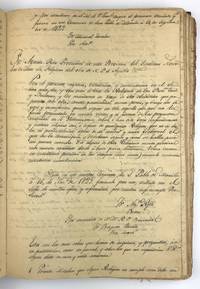
Manila, La Oceanía Española, 1878, 20 x 14,5 cm., holandesa piel moderna, IX + 430 págs. (sello en portada de José Paredes Rodríguez, médico de sanidad militar. Rara obra de la que solo hemos localizado 3 ejemplares en en Catálogo Colectivo. "Advierte el editor en el Prólogo que quedándole 400 ejemplares de la edición de 1877, le añadió nuevos pliegos, con notas, para hacer un paralelo entre 1809 y 1878" Retana).
1782PHO-2291A Paris, chez l'Auteur, Froulé, Nyon, Barrois, 1782.- 2 volumes in-4 (26x20,5cm) de XV, (8), 317, (1) pp., 80 pl. h.t. pour le tome 1 ; VIII, 298 pp., 60 pl. h.t. pour le tome 2 ; basane époque, dos lisse orné avec pièces de titre et tomaison vertes, frises aux plats. Frottements et épidermures, début de fentes (3cm) tome 2, coins et coupes usés, vieille mouillure claire, rousseurs et brunissures, 2 feuillets détachés, page 145 déchirée sans manque.
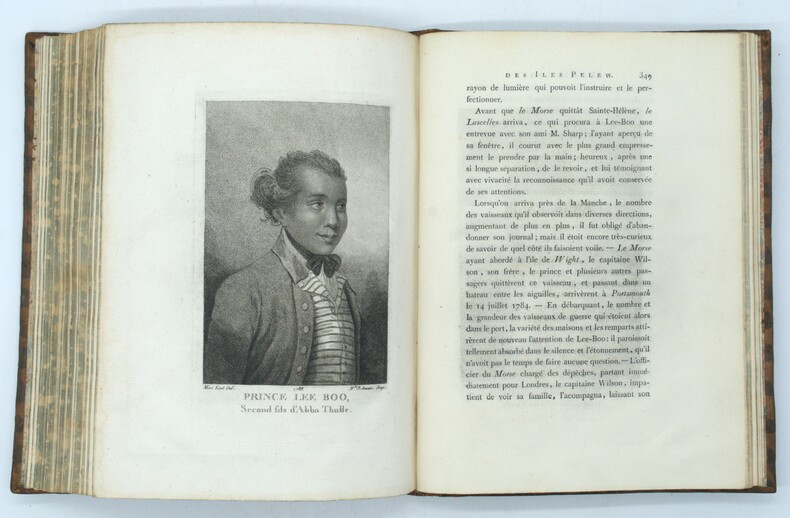
1788PHO-1658Paris, Le Jay & Maradan, 1788, in-4, relié plein veau moucheté époque, dos à nerfs avec pièce de titre, XIV-(1)-384 pp., illustré d’un frontispice ,1 gde carte h.-t. et 14 pl. h.-t., petit travail de ver en marge sur 3 feuillets.
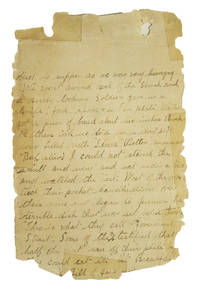
1902311327np 1902. 5-67 manuscript pages on the rectos of unbound sheets. 8 x 5 inches. Lacking the first 4 leaves and an indeterminate number at end several leaves quite worn each crudely taped or pasted to modern paper and then crudely cropped at the top edge without loss of text. 5-67 manuscript pages on the rectos of unbound sheets. 8 x 5 inches. This account consists of pages five to sixty-seven of what appears to be a diary or copied letters of an unnamed soldier in the 21st United States Infantry. The author who may have been a corporal remains unidentified by name. The account begins in August 1898 at Camp Hobson Lithia Springs GA; in September he is transferred to Plattsburgh NY rejoining the bulk of his regiment which had suffered heavy losses in Cuba. <br /> <br /> The Philippine-American war ran from February 1899 to July 1902 and was regarded as a continuation of a war for independence by the Philippines and as an insurrection by the United States of America. This account spans the duration of it providing rich detail on topics ranging from food to the war-ravaged environment and American-Philippino interactions both on and off the battlefield. <br /> <br /> An epic train ride across the country and then a boat from San Francisco brought the 21st US Infantry to Manila on 11 May 1899 in the fourth month of the conflict. The author mentions shipboard conditions an engine breaking down and comments "We caught 4 sharks in our trip. The largest was 12 feet long and took the whole crowd to land him aboard. the men used the bones for rings and pen holders and in fact every thing you could think."<br /> <br /> Their first combat was the capture of an insurgent outpost at Guadaloupa Ridge on 9 June 1899 where they "joined General Lauter's Flying Column . with eight chinamen to carry our rations."<br /> <br /> The description of this combat and its aftermath pages 33-41 is the most dramatic passage in the memoir. The writer was sent with another soldier to gather up some supplies that had been left behind but they were separated from the regiment with no food or water. They made a makeshift fort from some old haversacks and brush when they were unable to return to the trenches that night. The author describes scavenging after battle as follows: "About 10:00 oclock there was several chinamen came looking around and picking up what-ever they seen. They came to close to us to suit me and we shot 4 and the rest ran away."<br /> <br /> Going out in search of water at about four in the morning despite ongoing fire the author found several dead and mortally wounded soldiers from a black regiment including a graphic description of one man who had been shot at close range and had a hole the size of a fist in his belly and was covered in blood. Of the only survivor the author says: "Found one poor cuss shot through the hip. He could not move. I gave him some hard tack and he gave me water then I went back to our haversacks." Another disoriented soldier whom the author names as H. McBain was found wandering without most of his clothing brandishing a bottle of wine and an axe. <br /> <br /> After waiting until the 11th for a reclamation detail the author and his companion crawled through the brush for a mile to San Peter McCarty and eventually rejoined their regiment at Los Penes where their captain threatened to have them court-martialed for losing their haversacks. <br /> <br /> Later while hospitalized the author was befriended by Señora Edna Luna cousin of an insurgent general who took him out riding daily: "She was stuck on me and that is no lie. I think I ought to go back and hook up with her as she has all that is required. She is hansome & plenty of money" page 45. <br /> <br /> The author -- first too ill to be moved then put in a wheel chair and with trouble with his vision -- was transferred back to the States on 15 May 1900 page 48 by way of Nagasaki May 21 1900 and Yokohama arrived in San Francisco on June 9 1900 then was sent to recover at Hot Springs Arkansas concluding in Vancouver Barracks Washington circa July 1901. <br /> <br /> Some of the pages are torn and some text is lost at the bottom edges due to wear but the handwriting is clear and the voice of the author shines through. This narrative though it took place before World War One reads more akin to a Vietnam War narrative than a Civil War diary in tone and disregard for authority and the morality of war. unknown
1898231301898. Spanish-American War stereoview archive circa 1898-1899 documenting how the war was pictured through mass-produced photographic views that followed U.S. mobilization battlefield action occupation and military life across both Cuba and the Philippines. These stereoviews preserves the visual system by which the war was circulated to American audiences showcasing camp organization troop movement burial hospital care naval power and overseas deployment. Particularly notable is the archive's coverage of the Rough Riders the Santiago campaign in Cuba and U.S. presence in Manila and Malate showing how stereoview photography helped normalize the war's expansion from anti-Spanish conflict into a broader American imperial presence.<br /> <br /> Archive of 21 stereoviews Various publishers. Spanish-American War stereoview archive. Cuba the Philippines and the United States circa 1898-1899. each measuring 3" x 7". The views are drawn from multiple phases and theaters of the war including camp and drill scenes in the United States embarkation and troop arrivals at Tampa battlefield and occupation imagery from Cuba and extensive and some grisly scenes from Manila and surrounding areas in the Philippines. Captions and images show soldiers in formation cavalry drill military reviews naval artillery hospital interiors encampments burial grounds and troops in active position. Cuban views include Morro Castle after bombardment dead and wounded on the battlefield of Santiago U.S. soldiers preparing to invade Cuba and troops dining near Cabañas Fortress. Philippine views include a departure for Manila American pickets routing a Filipino reconnoitering party the 18th Infantry engaged by Filipino outposts volunteers awaiting orders under the tropical sun Army Hospital Manila and "Our Boys in Camp at Malate P.I." One stereoview identifies Roosevelt's Rough Riders in the mobilization phase linking the archive to one of the war's most publicly mythologized units.<br /> <br /> As a group the stereoviews demonstrate the process by which the Spanish-American War was framed not simply as a short military victory over Spain but as a sustained structure of U.S. troop deployment and occupation extending from Cuba into the Philippines. The Manila and Malate scenes are especially important in this regard since they place American soldiers within the opening phase of the Philippine conflict where U.S. military presence quickly moved beyond liberation rhetoric into imperial control. The archive's mixture of battlefield casualties camp routine naval spectacle and celebratory review scenes shows how stereoscopic publishing converted war into a domestic viewing experience while reinforcing the legitimacy of American expansion abroad. Wear to mounts some toning; overall very good condition. A strong cross-theater visual archive of the Spanish-American War and the emergence of U.S. imperial power in Cuba and the Philippines. unknown
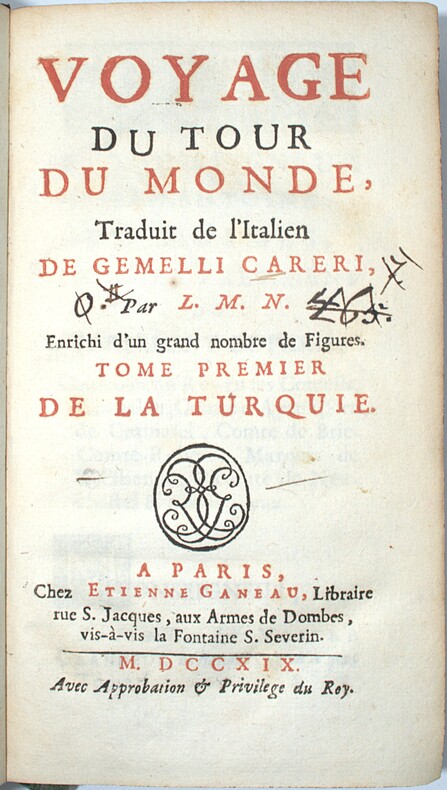
1727PHO-2344Paris, chez E. Ganeau, 1727. 6 vol. in-12 (17x9,5cm), 3ff.-xvii-592pp.-3ff. (table), 4ff.-512pp., 4ff.-426pp.-3ff., 4ff.-537pp.- 4ff., 4ff.-444pp.-3ff., veau havane tacheté, dos à nerfs orné avec tomaison et pièce de titre grenat, tranches rouges, quelques coiffes accrochées, quelques coins usés, déchirure à 1 planche au pli. Nouvelle édition de cette première traduction en français qui parut initialement en 1719. L'illustration entièrement gravée sur cuivre h.-t. se compose d'un frontispice, un portrait, et 62 planches (63 ?), dont 9 dépliantes. Sabin signale 60 planches sans mentionner le frontispice et le portrait. I ; De la Turquie : Frontispice, portrait, 4 pl. dont 1 dépliante ; II. De la Perse : 5 pl. dont 2 dépliantes ; III. L'Indostan, 25 pl. dont 1 dépliante ; IV. De la Chine 8 pl. dont 2 dépliantes ; V. Des Isles Philippines 2 pl. ; VI. De la Nouvelle Espagne, 18 pl. dont 3 dépliantes.
1944220931944. 40th Infantry Division Pacific campaign photograph album documenting combat operations and daily military life of U.S. Army forces during World War II. The 40th Infantry Division served extensively in the Southwest Pacific Theater participating in campaigns across New Guinea New Britain and the Philippines as Allied forces advanced against Japanese defensive positions. The photographs record amphibious landings artillery operations destroyed towns and the collaboration between American troops and Filipino guerrilla forces during the campaign to liberate the Philippines. The album therefore documents the operational environment of Pacific warfare including jungle terrain fortified Japanese defensive networks and the logistical systems required to sustain prolonged combat across island battlefields.<br /> <br /> Photograph album containing approximately 200 original black and white photographs documenting operations of the 40th Infantry Division during the Pacific campaigns of World War II. Each photograph is sequentially numbered in white ink at the lower corner and corresponds to descriptive entries in a photographic index within the album. Early images depict American Red Cross workers disembarking from landing craft and greeted by U.S. soldiers illustrating the presence of female support personnel assigned to medical and relief operations. Additional photographs record amphibious landing scenes aerial views of destroyed towns in Luzon artillery and tank operations and soldiers operating mounted machine guns overlooking jungle valleys. Several images depict Japanese military casualties reflecting the intense close combat that characterized fighting across the Pacific islands. A printed military map within the album shows Japanese tunnel and cave fortifications in the Zambales Mountains illustrating defensive positions encountered during operations in the Philippines.<br /> <br /> The album also documents logistical and civilian dimensions of the campaign. Photographs show ships unloading cargo Filipino guerrilla units marching through urban streets and groups of local porters assisting Allied forces in moving supplies through mountainous terrain. Weapons and equipment visible in the images include field artillery pieces mortars and armored vehicles such as the M4 Sherman. One photograph depicts African American soldiers accompanied by scout dogs operating in jungle terrain illustrating the presence of Black servicemen serving within the segregated structure of the wartime U.S. Army. Other photographs show tent encampments mess areas interactions with local populations and the recovery of prisoners of war following combat operations. The photographs collectively present a visual record of combat logistics and daily military life during the Pacific campaigns. Album contains approximately 200 photographs with indexed numbering. Light handling wear visible to album and photographs consistent with wartime field compilation. Overall condition very good. unknown
1719PHO-2391Paris, chez Étienne Ganeau, 1719. 6 vol. in-12 (17x9,5cm), 4ff.-xxvii-2ff.-454pp.-5ff. (table), 4ff.-354pp.-3ff., 4ff.-402pp., 4ff.-532pp., 4ff.-374pp., 4ff.-512pp., veau moucheté, dos à nerfs orné avec tomaison et pièce de titre, tranches jaspées, exlibris verso 1er plat, écritures aux titre, dos et charnières frottés, coins usés, petit manque plat tome 1 Édition originale L'illustration entièrement gravée sur cuivre h.-t. se compose d'un frontispice, un portrait, et 60 planches, dont dépliantes. Sabin signale 60 planches sans mentionner le frontispice et le portrait. I ; De la Turquie : Frontispice, portrait, mappemonde, 4 pl. dont 1 dépliante ; II. De la Perse : 3 pl. ; III. L'Indostan, 24 pl. ; IV. De la Chine 8 pl. dont 2 dépliantes ; V. Des Isles Philippines 2 pl. ; VI. De la Nouvelle Espagne, 18 pl. dont 3 dépliantes.
240267Lisbonne, monastère de S. Vincent hors les murs, 1749 2 vol. in-folio, [3] ff. n. ch. (titre avec belles armes des Bragance, avertissement, autorisations), 326 pp., un f. vierge, 80 pp. d'index, texte sur deux colonnes ; [4] ff. n. ch. (titre, avertissement, approbations), 498 pp., un f. n. ch. d'errata, avec une belle vignette en-tête gravée par O. Cor d'après Debrie, demi-basane fauve à coins, dos à nerfs ornés de fleurons et guirlandes dorés, pièces de titre cerise, tranches rouges (reliure de l'époque). Une coiffe rognée, coins abîmés.
17641400London: J. Dodsley 1764. Scare first edition of this document relating to the British occupation of Manila during the Anglo-Spanish War of 1762-3 and an interesting case of international law. In September of 1762 under the command of Draper and Cornish a British fleet of 13 ships containing over 6000 men attacked Manila and following a difficult landing quickly dispatched the Spanish garrison which they outnumbered 10 to 1.They entered the city on October 5 and part of the terms of capitulation was that Spain would pay the British an indemnity of 4 million pesos roughly a million pounds for not pillaging the city. The British evacuated in 1764 when hostilities ceased and Draper enjoyed the highly unusual privilege of presenting the standards of Spain taken in Manila to his alma mater Kings College Cambridge. But the Spanish did not honor this gentlemans agreement claiming that Draper dealt with an unauthorized agent that he himself broke the terms of the agreement etc. In order to press his claim which amounted to £25000 he published the present tract to pressure his government to collect. The tract contains a brief letter to the British Secretary of State outlining his grievance; a bilingual summary in English and French of the Spanish ambassadors grounds for not complying with the terms of the agreement; extracts from the treaty; a refutation by Draper of the claim that he dealt with an unauthorized agent; and an English language treaty signed by the original parties in Manila. But with hostilities over and their attention occupied by other foreign adventures chief among them America the British were in no position to insist and the suit was eventually abandoned.Griffin Bibliography of the Philippines p. 125; Dictionary of National Biography compact ed. I.573. 8vo. 43 pp. Bound in blue wrappers and housed in protective buckram case with title gilt on spine. Minor foxing in margins of final leaves but otherwise absolutely mint. J. Dodsley hardcover
17641400London: J. Dodsley 1764. Scare first edition of this document relating to the British occupation of Manila during the Anglo-Spanish War of 1762-3 and an interesting case of international law. In September of 1762 under the command of Draper and Cornish a British fleet of 13 ships containing over 6000 men attacked Manila and following a difficult landing quickly dispatched the Spanish garrison which they outnumbered 10 to 1.They entered the city on October 5 and part of the terms of capitulation was that Spain would pay the British an indemnity of 4 million pesos roughly a million pounds for not pillaging the city. The British evacuated in 1764 when hostilities ceased and Draper enjoyed the highly unusual privilege of presenting the standards of Spain taken in Manila to his alma mater Kings College Cambridge. But the Spanish did not honor this gentlemans agreement claiming that Draper dealt with an unauthorized agent that he himself broke the terms of the agreement etc. In order to press his claim which amounted to £25000 he published the present tract to pressure his government to collect. The tract contains a brief letter to the British Secretary of State outlining his grievance; a bilingual summary in English and French of the Spanish ambassadors grounds for not complying with the terms of the agreement; extracts from the treaty; a refutation by Draper of the claim that he dealt with an unauthorized agent; and an English language treaty signed by the original parties in Manila. But with hostilities over and their attention occupied by other foreign adventures chief among them America the British were in no position to insist and the suit was eventually abandoned.Griffin Bibliography of the Philippines p. 125; Dictionary of National Biography compact ed. I.573. 8vo. 43 pp. Bound in blue wrappers and housed in protective buckram case with title gilt on spine. Minor foxing in margins of final leaves but otherwise absolutely mint. J. Dodsley hardcover books
1822PHO-1375Paris, Leblanc, 1822 ,2 volumes in-8 de texte et un Atlas , petit in-folio (27,5x37,5cm) Texte ; 2 volumes in-8 , 2ff.-xxx-452pp. , 2ff.-506pp. , relié toile , dos lisse avec titre et tomaison. Atlas ; un volume in-folio ,2ffnch (Titre et liste des planches) et 26 planches dessinées par l’auteur dont une carte et 12 planches en couleurs d’époque, relié demi maroquin vert , dos orné avec titre et les armes royales et chiffre de Louis-Philippe, timbre de sa bibliothèque sur le titre (Neuilly) , ex-libris , exemplaire sur grand papier, frottements aux plats avec petit manque de papier , coins et coupes usés , quelques rousseurs.
17504284Genève, Barillot et Fils, 1750. In-4 de XXIV-363p., pleine basane brune. Dos à nerfs orné de filets et fleurons dorés.
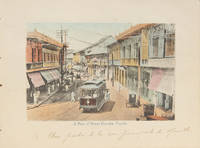
111950N.p. n.d. but early 20th century. . Lacquered album; landscape 8vo 19.5 x 15 cm; 22 coloured photograph illustrations printed captions in English below image French manuscript annotations in ink in an early hand below caption single horizontal splits to lacquer on both boards a very good copy.<br /> An evocative series of colour photographs of the Philippines ranging from views of Manilla harbour to domestic scenes such as a butcher's shop washer-women market scenes rice cleaning and a cock fight.<br /> N.p., n.d. [but early 20th century]. hardcover
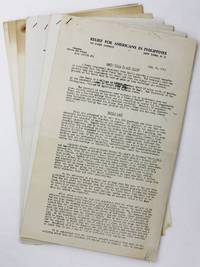
19454668New York 1945. Very good. Sixteen issues totaling 75pp. Legal-size sheets stapled. Previously folded. Light wear and toning. An extensive run of newsletters by a New York-based aid group Relief for Americans in the Philippines. Included here are issues 9 12 14 through 18 and 20 through 28 which were published between 1942 and 1945. The organization was devoted to the support of Americans who were imprisoned at San Tomas Gabuio and other camps after Japan occupied the Philippines during World War II. At the outset of the war the Philippines were a commonwealth of the United States but within three weeks of the attack on Pearl Harbor the Japanese seized control. The 20000 American and 80000 Filipino troops on the ground departed and any remaining American or British citizens were rounded up in Manila and transferred to the University of Santo Tomas where they were left to fend for themselves. The only exceptions were a 7:30 pm roll call each night and the use of room monitors. The background of the captives varied wildly from business executives and retired soldiers to prostitutes. At the end of the war the total number of prisoners liberated was 3785 2870 of which were American.<br />  <br /> Issue 14 remarks on the first anniversary of the non-profit organization: “On May 8th 1942 just a year ago and two days after the fall of Corregidor our organization came into being for furthering plans for the shipment of food medical supplies and other necessities for the internees and also to serve as a clearing house and point of dissemination for information concerning the welfare of these internees.†The monthly newsletter prints news and developments from the camps in the Pacific and documents the efforts of the organization to provide aid to the prisoners there. The issues also print a running list of all those believed to be in the Philippines “solely for the purpose of obtaining names and addresses of the nearest relatives of who we have no record.†A scarce record of this little-known relief effort during World War II. unknown
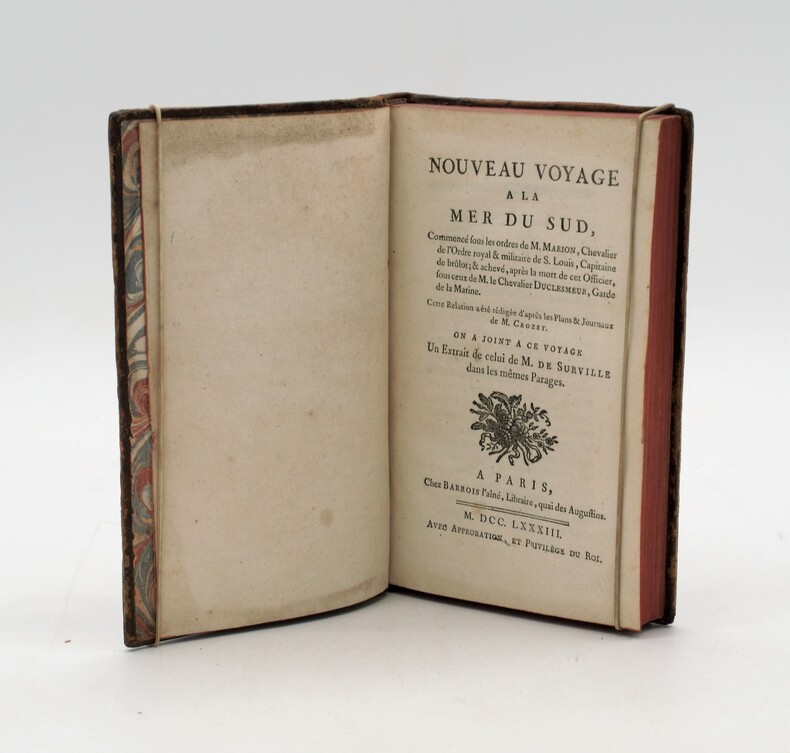
1783PHO-2039A Paris, Chez Barrois l’aîné, 1783. In-8° (195x120) Relié plein veau époque, pièce de titre rouge, dos lisse orné, tranches rouges. VIII, 290 pp, illustré de 2 cartes dont 1 repliée h.-t. et 5 pl. h.-t., Complet du dernier feuillet, extrait du privilège à la date du 11 mai 1782, établi par Condorcet secrétaire de l’Académie des sciences. Quelques frottements aux charnières.
18601570Quingua i.e. Plaridel 1860. Good plus. 428pp. Folio. Original limp calf manuscript cover title. Edges and spine worn; head of spine and upper corner of front wrap chipped. Text block loose at front hinge broken in a couple of places internally. A few leaves loose; scattered chipping and tears occasionally affecting text. Evenly tanned; occasional dust soiling. Completed in several hands; highly legible scripts. A valuable manuscript compilation of Catholic documents recorded by the local religious authorities at Quingua in the Philippines over much of the early- and mid-19th century. The present volume includes over 425 pages of decrees acts directives and elections that affected how religious life and instruction were carried out by the Catholic Church in the Philippines during the 1800s. Quingua now the municipality of Plaridel was founded by the Augustinian friars of Malolos who established a chapel in the village located on the banks of the Angat River on the north side of Manila Bay in 1581. The documents compiled here span from 1827 to 1860 and are recorded on leaves of native rice paper in a locally produced volume. The most basic and indeed most integral documents transcribed here are the chapter acts of the Augustinian order in the Philippines which transmit the orders and directives by which the friars led their daily lives. These include the results of yearly elections by which individuals were made bishops assigned to parishes and chosen for other significant church positions. Also included are annual "Actas y Determinanciones" as issued by central church authorities at Manila which touch on numerous local issues and dictated how the friars lived and carried out their religious duties. The volume contains further individual decrees that affected Philippines parishes as a whole and those that dealt more specifically with the chapel at Quingua many of which were issued from Manila but also many that were promulgated by more local authorities such as those at the parish level in Bulacan in which Quingua was located as well as several orders recorded directly from Spanish church authorities and at least one Papal decree. The final major component of the present work comprises numerous sermons homilies and pastoral letters given by visiting priests or relating to specific occasions. In all the present manuscript volume contains hundreds of individual documents many of which likely do not survive or are not recorded in any other form and which serve to chronicle the lives of the friars of this small outpost at an incredibly granular and detailed level. Additionally these documents are signed or issued by many significant figures in the history of the Catholic Church in the Philippines. The book as indicated in the manuscript title was initiated by Friar Santos Gomez Marañon who spent over half of his life in the Philippines and eventually became the Bishop of Cebu. Many of the documents from the 1830s are signed by Friar Francisco Manuel Blanco who began his church career in the Philippines in nearby Angat and became renowned as a botanist with his authorship of the first comprehensive flora of the islands. An outstanding and extensive manuscript volume on Catholic law administration and practice in the rural Philippines spanning over thirty years of the 19th century. unknown books