827 résultats
1373575Paris: Musée de l'Homme, Museum National d'Histoire Naturelle, 1974 in-4, nombreuses illustrations. Broché, très bon état. Sommaire: Bernard DUPAIGNE, Un artisan d'Afghanistan. Sa vie, ses problèmes, ses espoirs. - Monique GESSAIN, Des abeilles et des dieux chez les Bassari du Sénégal oriental. - Solange THIERRY, La collection Robert LINGAT. - Lionel BALOUT, Un buste de l'abbé Breuil. - Ethnomusicologie.
1373582Paris: Musée de l'Homme, Museum National d'Histoire Naturelle, 1968 in-4, nombreuses illustrations. Broché, bon état. Sommaire: Edit FEL, Exposition d'art populaire hongrois. - Bernard DUPAIGNE, Aperçus sur quelques techniques afghanes.
1963LFA-126728720Revue mensuelle de 72 pages, format 140 x 210 mm, illustrée, brochée, Impr. de Sceaux, bon état
201008744Paris, Petite bibliothèque payot - voyageurs, 1991 ; grand in-12, 372 pp., broché, couverture illustr. Très bon état.
1825PHO-1571Paris, Nepveu,1825.- XXXIV-233 pp., illustré d’une gravure en frontispice, relié demi basane époque, dos lisse orné avec titre, ex-libris, charnières fendues, frottements, rousseurs au titre.
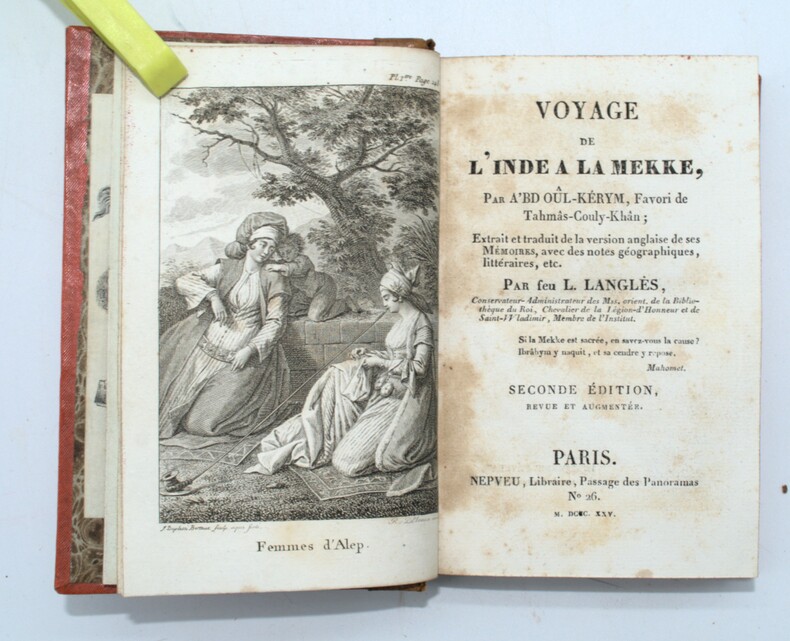
1 Vol. In-8 p pag. 306 24 ill. e 3 cartine f. t. Copt. ill PROG 36441 CATT_ATT 48
13519Paris, Editions Balland, 1985 14 x 22, 361 pp., broché, bon état
Broch?. 361 pages.
1969G59792Misr, Dar al-Katib al-Arabi li-t-Tiba'a wa-'n-Nasr 1969 522pp., hardback (black cloth, spine in black leather with engilded title), 24cm., VG, [text entirely in arabic], OCLC: 258341391, [content: Afghanistan inbetween today and tomorrow]
522pp., hardback (black cloth, spine in black leather with engilded title), 24cm., VG, [text entirely in arabic], OCLC: 258341391, [content: Afghanistan inbetween today and tomorrow]
197385282Graz: Akademische Druck- u. Verlagsanst. 1973. 540 S. Text, 51 S. mit s/w Ktn. Reg. Lex 8° Ln.mS. *Das wahrscheinlich umfassendste Nachschlagewerk über Afghanistan 1914 als geheime Informationsquelle zusammengetragen vom britisch-indischen Geheimdienst enthält alle damlas erhältlichen Informationen. Die vorliegende Ausgabe umfasst das damalige Werk mit Korrekturen und Ergänzungen über die Entwicklung bis 1970*
198561591Graz, Akademische Druck- u. Verlagsanstalt, 1972-1985. 4°. Mit rund 400 Karten im Text, einigen gefalt. Tabellen u. einer mehrf. gefalt. farb. Karte als Beilage. Zus. ca. 3.500 S., OLwd.-Bde. m. illustr. OUmschlägen.
055314Graz - Austria., Akademische Druck- und Verlagsanstalt. Volume I: Badakhshan Province and Northeastern Afghanistan. 1972. XIII, 255 Seiten, 49(2) Seiten Karten-Abbildungen im Anhang.; Volume II: Farah And Southwestern Atghanistan. 1973. XV, 372(1) Seiten und ca. 80 Kartenseiten im Anhang. Volume III: Herat And Northwestern Afghanistan. 1975. XVI, 521 Seiten, ca. 70 Kartenseiten im Anhang. (ISBN: 3201009423).;; Keine Schutzumschläge - Alle drei Bände in gutem Zustand. 4° OLeinen.
Fine English Paperback. Cr. 8vo. (20 x 14 cm). In English. 32 p., color an b/w ills. National archives of Afghanistan.
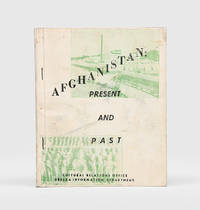
1958180912Kabul: Bureau of Afghan Publicity Cultural Relations Office Department of Press and Information 1958. First edition of this guide to Mohammad Zahir Shah's modernizing state with chapters on politics and diplomacy industry mineral deposits and many other topics. In the year of publication Prime Minister Daoud Khan became the first Afghan to address to the US Congress and President Eisenhower made a formal visit in 1959. Octavo. With 24 photographic half-tone plates. Original illustrated card wrappers wire-stitched as issued front cover lettered in black and with green half-tone illustrations. Occasional contemporary green ink marks in margin. Covers marked contents evenly toned: very good. unknown
2011BN258342Taylor & Francis 2011. 2011. Afghanistan: to 2015 and Beyond Adelphi Text: english <br/><br/>Afghanistan: to 2015 and Beyond Adelphi Text: english Afghanistan / Krieg / Politik / USA - Dodge Toby Taylor & Francis unknown
19362111902160501196same club 1936. Soft Cover. Fine. Number of pages: B5 type printing 85p Northern Arabia map same club paperback
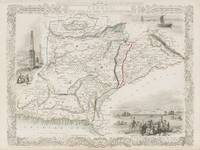
18512047AG1851. London & New York J & F. Tallis 1851. Original steel engraving / Vintage map. Drawn and engraved by John Rapkin. Partly hand-coloured. Plate Size: 33.7 cm x 26 cm. Sheet Size: 37.5 cm x 27.2 cm. Vintage 19th century map in very good condition. John Tallis 7 November 1817 3 June 1876 was an English cartographic publisher. His company John Tallis and Company published views maps and atlases in London from roughly 1838 to 1851. Tallis set up as a publisher with Frederick Tallis in Cripplegate in 1842; the business moved to Smithfield in 1846 and was dissolved in 1849. From 1851 to 1854 Tallis operated as John Tallis and Company. He started The illustrated news of the world and national portrait gallery of eminent personages in 1858 selling it for £1370 in 1861; it folded in 1863. Wikipedia The most important project John Tallis undertook was the 'Illustrated Atlas' from 1851. The original map we offer here was part of this exceptional Atlas and all the maps it contained are still today considered as the last reminder of an era of lavish map production. Tallis worked the project together with John Rapkin 1815-1876 and it was Rapkin's style and talent that we have to thank for when we marvel at these maps today. What makes these maps so special is the detail of engraved vignettes that surround the map and often show indigenous scenes people in their environment and even more so historical buildings or historical views of towns and cities architecture and landscape. The project of 'The Illustrated Atlas' was designed to be finished just in time for the anxiously awaited "Great Exhibition of the Works of Industry of All Nations" or The Great Exhibition sometimes referred to as the Crystal Palace Exhibition in reference to the temporary structure in which it was held was an international exhibition that took place in Hyde Park London from 1 May to 11 October 1851. It was the first in a series of World's Fairs exhibitions of culture and industry that became popular in the 19th century and it was a much anticipated event. The Great Exhibition was organized by Henry Cole and Prince Albert husband of the reigning monarch Queen Victoria. It was attended by numerous notable figures of the time including Charles Darwin Samuel Colt members of the Orléanist Royal Family and the writers Charlotte Brontë Charles Dickens Lewis Carroll George Eliot and Alfred Tennyson. Music for the opening was under the direction of Sir George Thomas Smart and the continuous music from the exhibited organs for the Queen's procession was "under the superintendence of William Sterndale Bennett". Wikipedia unknown
195686306Kabul; Munic: Royal Afghan Ministry of Education; Afghan Cultural Board 1956. Paperback. Octavo in orange-red wrappaers; b&w illus maps ports.; 95 pp. 21 cm.; very good copy; spine is sunned; wrappers are lightly to moderately worn; some soil and creases from handling; leaves are very lightly bumped at the bottom open corner; o/w pages are clean bright and free of marks and creases; a solid handsome copy. Scarce. In English. Royal Afghan Ministry of Education; Afghan Cultural Board paperback
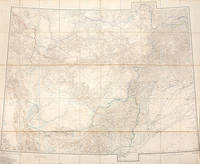
1901129882Dehra Dún: Office of the Trigonometrical Branch Survey of India 1901. Rare and superb Great Game map of Afghanistan Rare and very striking wall map of Afghanistan dated June 1901 compiled under the orders of the Surveyors General of India Major-General Charles Strahan 1895-99 and Colonel St. George Corbet Gore 1899-1904: an online search of institutional libraries records copies at just 3 institutional libraries world-wide British Library Wisconsin and Bayerische Staatsbibliothek. Included is a useful list of "Additional Authorities Consulted" among them maps of Karataghin and Darwaz 1882 by the Russian military topographer P. E. Kossiakoff Kafiristan 1884 by Surgeon-Major G. S. Robertson "Map illustrating the Havildar's and the Mulla's Routes in Wakhan Kolab and Darwaz by Captain H. Trotter RE" 1876 Henry Trotter was part of the Forsyth Mission of 1873-74 Routes in Persia 1893 by Sir Percy Sykes four Russian maps two of the Trans-Caspian "sources of the Amu Dariya" the Oxus "Tehran Askabad &c" and the Pamirs and Upper Oxus Regions 1894 by Ney Elias 1844-1897 an important figure in the Great Game. The present copy has a number of interesting contemporary annotations showing a certain familiarity with the country some in red and blue pencil underlining place names other pencillings connecting towns and the frequent use of a discreet symbol in purple ink that we have not been able to identify but may be the location of way points or sangars temporary fortified positions established by the British; alternatively they may show known or suspected positions of Afghan tribesmen. The most prominent annotation is the manuscript addition of the name "Jani Khel" and an arrow pointing to the area on the map marked as Katawaz the Pashto name for the town of Zarghun Shar but also the plain to the south of the town. It was a raid by Waziri Mahsuds on the flocks of the Jani Khel tribe that precipitated the Mahsud Blockade of 1900-02; the official report of operations notes that a garrison of sepoys was stationed at Jani Khel. "The blockade came into force on 1 December 1900. To enforce the blockade intended to prevent the Mashuds having any contact outside their tribal area a line of posts was established between Bannu highlighted here in red pencil and Dera Ismail Khan. Some eight battalions of infantry two regiments of cavalry and four sections of mountain artillery were initially employed. Some payments of the fine imposed by the British were made but outrages still continued troops and Militia were killed and rifles and mail stolen. Originally the blockade had been seen as a relatively cheap alternative to a punitive expedition but after twelve months results were meagre and recourse was had in November 1901 to a number of small mobile columns. the columns harassed the Mahsuds from all directions simultaneously destroying defences capturing men and cattle and destroying grain and crops. The tribe eventually sued for peace in January 1902. It was a sad commentary on British policy that no better method could be found to curb Mahsud intransigence" Brian Robson Crisis on the Frontier: The Third Afghan War and the Campaign in Waziristan 1919-1920 2004 pp. 159-60. Large coloured heliozincographed wall map 4 sheets 1285 x 1615 mm dissected into 50 panels and mounted on linen brass suspension rings at some time removed folding into a purplish-brown sand-grain cloth map case 263 x 172 mm paper cartouche label of Edward Stanford Long Acre. Case a little sunned only minor wear to extremities. Map in excellent condition. See C. Collin Davies The Problem of the North-West Frontier 1890-1908 Cambridge UP 1932; East India North-West Frontier: Mahsud-Waziri Operations London: HMSO 1902. hardcover
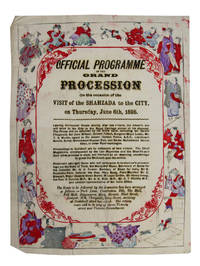
102631London n.p. 1895. . Broadside on japan paper 42 x 32.5 cm. decorative borders with Japanese motifs enclosing details of the procession. light wear to edges and corners a well preserved example.<br /> The Shahzada Nasrullah Khan spent several months in England deputising for his father Emir Abdur Rahman Khan who had intended to visit Queen Victoria but had fallen ill. The visit was part of the new rapprochement between Afghanistan and Great Britain after the end of the British occupation of Afghanistan in 1880 which saw Abdur Rahman Khan installed as head of state.<br /><br />Strange though it might seem to have the broadsheet printed with Japanese illustrations on the surround it was a stock sheet used for various programmes and reflects the British fascination with Orientalism at the time.<br /> London, n.p. 1895. unknown
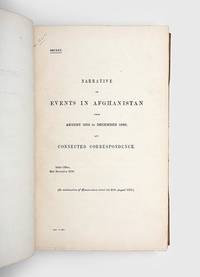
1878166983London & Simla: 1878-82. Confidential India Office archive revealing British decision-making in the final phase of the Second Anglo-Afghan War An exceptional archive of confidential India Office and Government of India papers this collection offers an unusually detailed view of the diplomatic and bureaucratic manoeuvring that accompanied the final stages of the Second Anglo-Afghan War and the negotiation of Britain's withdrawal. Bringing together Foreign Department memoranda from Simla Cabinet papers printed at the Foreign Office and India Office material that seldom survives outside official files it reconstructs policy formation across two administrations and two continents. Running through the papers is the early career of Reginald Baliol Brett later 2nd Viscount Esher who became private secretary to Lord Hartington in 1878. As Hartington and the new Liberal government sought to reverse Lord Lytton's "forward" policy and disengage from Afghanistan the India Office and the Government of India frequently disagreed over strategy intelligence and the limits of influence. The archive captures these tensions vividly and shows Brett learning to operate as an assertive intermediary whose probing questionnaires marginalia and attempts to synthesize rival views already marked him out as a rising - and at times unsettling - force within the department. The documentary foundation of the dossier lies in A. W. Moore's two major surveys of Afghan affairs annotated by Brett and widely regarded as the most authoritative India Office narratives of the conflict. These are complemented by a sequence of extremely restricted Simla-printed papers and a run of Cabinet memoranda from Thomas Harrison's private press together charting the shift from aggressive frontier ambition to the more pragmatic Liberal policy of withdrawal and the recognition of Abdur Rahman as Amir. High-level submissions by Hartington Ripon and Evelyn Baring illuminate the arguments over the retention of Kandahar and Pishin while the "Aide-Mémoire" on negotiations with Abdur Rahman documents the decisive recalibration of British aims. Other materials probe the immediate crises of the war: memoranda assessing Yakub Khan's responsibility for the Kabul Residency attack; correspondence among Griffin Stewart and Lyall on the deteriorating northern situation; and the substantial "Very Confidential" dossier of Russian correspondence between General von Kaufmann and Shere Ali which exposes the diplomatic pressures of the "Great Game". Operational detail appears in the viceroy's secret telegrams of early 1880 field reports from Kandahar and Kabul Wilson's military sketch of the campaign and manuscript troop returns. Among the most revealing personal items is General Charles Gordon's autograph draft of a letter to The Times opposing the retention of Kandahar heavily revised and ultimately suppressed by Brett who feared it would damage Gordon's standing. His decision and later grief at Gordon's death lend an unexpected human dimension to a collection otherwise dominated by official policy and statecraft. Only a handful of the documents can be traced in institutional collections and few survive in private hands. Gathered here in a coherent sequence with close associations they provide a rare high-resolution record of how British officials interpreted the war navigated clashing doctrines and personalities and ultimately engineered their exit from Afghanistan. A full list of the contents is available on request. Folio 339 x 215 mm comprising 37 printed and manuscript items: full listing with titles paginations and outline content given in the note. Contemporary light olive brown diagonal zigzag-grain cloth boards rebacked and cornered in brownish orange morocco in the mid-20th century red morocco label original moderate bluish green endpapers retained matching linen hinges. Esher armorial bookplate. Cloth starting to lift a little from the edges of spine; contents variably browned margins a little fragile in places with a few consequent chips and splits one title page torn across and neatly repaired with archival tape: overall very good. James Lees-Milne The Enigmatic Edwardian: The Life of Reginald 2nd Viscount Esher 1986. hardcover