24 761 résultats
1700ABC_49540Japan 1700. 104 x 272 cm each illustrated panel: ca. 90.5 x 44.5 cm. Ink watercolours gold paint and gold leaf on paper. The image is surrounded by a frame of silk brocade a narrow frame in burgundy and gold and a wider frame in yellow gold and black with a clear floral pattern; together the frame is 5 cm wide the whole is mounted on six roiro black lacquered wood panels with gilt metal fittings on the outer corners of the outer panels. The panels are backed with decorative paper. A remarkable example of a Nanban byobu literal translation: Southern Barbarian screen a type of Japanese folding screen byobu depicting the arrival of Europeans especially the Portuguese in Japan during the late 16th- and early 17th centuries. It shows the vast expanse of the Portuguese seaborne empire. From their possessions along the coast of the Indian subcontinent and their lease of Macau individual Portuguese reached Japan in 1542 and were followed by traders and missionaries the most famous being Francis Xavier. Nanban art provides a unique glimpse into a period of significant cultural exchange and the Japanese perspective on the arrival of the Portuguese in their islands. While inspired by the arrival of and trade with the Portuguese in Japan before the enforcement of the isolationist foreign policy commonly known as Sakoku by the Japanese Tokugawa shogunate from 1633/1639 onwards it remained a popular subject to depict on these folding screens and in other artworks during the Edo period and beyond. The image on the present folding screen shows a large four-masted ship probably approaching the port of Nagasaki. Crew members both Portuguese and people from Portuguese possessions in the Indian subcontinent are seen furling the sails and performing remarkable acrobatic feats in the ship's rigging. The artist emphasises the balloon-like bagginess of their bombacha trousers typically associated with the Portuguese and other Europeans but focuses also on distinctive details such as heavy gold necklaces facial hair hats capes frilly white handkerchiefs and ruffled collars. The foreigners are depicted as being exotic but not scary or very "other" they are depicted as being different while still simply being human. The decoration and colours of the flags flown at the top of each mast are reminiscent of Christian symbols the Cross of Christ and Portugal's colours green and red. Cargo and passengers are offloaded into small boats that pull alongside the ship the top right corner shows a 12-point wind rose including a depiction of the globe. The whole scene is enschrouded in gold clouds.After the Sengoku period a period of practically consecutive and almost continuous civil wars and social upheavals in the 15th- and 16th centuries Japan entered a more peaceful and prosperous period. Folding screens such as the present example were used to divide larger homes and generally show of the growing wealth and prosperity of the warrior and merchant classes. The screens are finely executed in detail and using vibrant colours and copious amounts of gold paint and/or gold leaf. Thematically the painting here continues a tradition of now-lost screens of Chinese trade ships that were in vogue during the 15th- and 16th centuries at the peak of the Sino-Japanese tribute missions that brought entourages numbering in the thousands from the Ming court. The precise subject of these paintings had since shifted from Chinese trade ships to Chinese- or more general Southeast Asian-style ships carrying European including men from the European possessions in Africa and Asia crews. The scene illustrates the dynamic convergence of Eastern and Western cultures through trade around 1600. Portuguese traders first arrived in Japan in 1543 and by 1570 they had established the Bay of Nagasaki as a strategic hub for their commercial operations which were largely unregulated. They generated significant profits by exchanging Chinese silk for Japanese silver although some European goods were also part of the trade. The Portuguese carracks massive three-decked vessels weighing up to 1600 tons captivated local observers with their impressive scale unfamiliar crews and exotic cargo.Alongside these traders Jesuit missionaries sought to spread Christianity finding particular success in Kyushu where many local daimyo converted. However a Christian-led rebellion in 1638 alarmed the Tokugawa authorities raising fears of European colonial interference. As a result the Portuguese were expelled in 1639. When a Portuguese delegation attempted to restore diplomatic relations the following year all sixty members were executed. In 1640 the shogunate instituted a policy of national seclusion restricting foreign contact to limited trade with Chinese merchants a small number of Dutch traders and occasional Korean envoys. By 1650 Christianity was outlawed and any missionary work was punishable by death. The present screen is a slightly later example and the focus of the scene lies mostly on trade and the ship's crew itself and not directly on any Christian identity of the foreigners arriving on Japanese shores.This screen belongs to approximately ninety surviving Nanban screens ranking second only to capital city scenes in popularity among Japanese patrons. The earliest examples date to the 1590s and their continued production throughout the Edo period demonstrates the lasting impact of the Portuguese encounter on Japanese culture.Some minor flaking of the gold paint/gold leaf barely any soiling the decorative paper back of the work shows some traces of wear and use. The image remains clear and the colours vibrant. Overall in very good condition. This exceptional screen offers collectors an important historical document that captures both Portuguese maritime exploration and the Jesuit mission to Japan-a unique period of cultural exchange between East and West. unknown
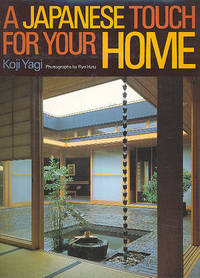
19913487Tokyo : Kodansha International ; New York : Distributed by Kodansha America 1991 ©1982. 1991. Hardcover. Very Good/Fine. 1st edition 9th printing ; 84 pp. ; illustrated some in color ; floor plans ; 31 cm. ; ISBN: 477001015X ; OCLC: 27762699 ; LC: NA7205 ; textured creme-tan cloth in color photographic dustjacket; textured paper endpapers ; ex-library stamps donation label ; remains of original Japanese quarter-sized label laid in ; sensitive photos ; text in English ; "Shows how to adapt aspects of Japanese home design: formal entranceways alcoves screens partitions and diffuse lighting into Western style homes" ; VG/FINE <br/> <br/> Tokyo : Kodansha International ; New York : Distributed by Kodansha America, 1991, ©1982. hardcover
1971237782Tokyo: Tokyo News Service 1971. 192 S., überaus zahlr. Abb, Ln.mS. *Japanische Gärten, Japan, Gartenanlage*.
19041143-16New York, American Stereoscopic Company 1904. 2 Orig.-Photographien (Albumen) zu einer Stereophotographie auf Karton mont. 9 x 17, 8 cm. In gutem Zustand.
2006130199Berlin: Museum für Ostasiatische Kunst, 2006. 160 S. ; 30,5 x 22,5 cm ; Leinen.
1987100045Tokyo Kodansha 1987 1 vol. relié grand in-8, cartonnage sous jaquette illustrée, 136 pp., nombreux dessins et photos en noir. Texte en anglais. Très bon état.
1987100045Tokyo Kodansha 1987 1 vol. relié grand in-8, cartonnage sous jaquette illustrée, 136 pp., nombreux dessins et photos en noir. Texte en anglais. Très bon état.
84 pages. Index. Bibliography. Colour photography and black and white diagrams abound. "Give your home a fresh, captivating look with ideas from this superb interior design tradition." - from dust jacket. Prior owner's details upon front free endpaper else clean, bright and unmarked with very light wear. Lovely copy of this attractive work. Book
A clean, unmarked book with a tight binding. 8 3/4"w x11 7/8"h. 84 pages. Many color photos by Ryo Hata and many black and white illustrations, floor plans, and a section of do-it-yourself projects.
IXY-197Photographs by Ryo Hata, Kodansha International Ldt, Tokyo, New York, San Francisco, 7e éd., 1987 [1982], 84 p. ill. 121 photos couleurs et illustrations n&b, bibliographie, index. Cartonnage éditeur, jaquette contrepliée, 22,7 x 30,5 cm.
199231197ABTokyo, Kodansha, 1992. 4to. 84pp. With numerous illustrations. Orig.-Paperback.
19109941London: Blackie & Sons Limited. Very Good. 1910. First Edition. Hardcover. Clean white cloth with black lettering. Text tight clean & intact. Pictorial frontispiece. B/W photo illustrations. A few pages very lightly foxed. Prior owners signature. Asia Japan; B&W Photographs; 8vo 8" - 9" tall; 280 pages . Blackie & Sons Limited hardcover
19812090502124701355Kokinshoin 1981. Soft Cover. Fine. Number of books: 1 Kokinshoin paperback
Un disque 45 tours et 12 diapositives.
ROD0015391Victor Attinger. Non daté. In-12. Broché. Bon état, Couv. partiel. décollorée, Dos fané, Intérieur frais. 427 pages. Dos plié.. . . . Classification Dewey : 952-Japon et ses îles
1985R100059925Londreys. 1985. In-8. Broché. Etat d'usage, Couv. convenable, Dos plié, Papier jauni. 243 pages - quelques planches en noir et blanc.. . . . Classification Dewey : 952-Japon et ses îles
201825780Genève, Editions Notari, 2018. In-8 broché, couverture décorée. Flambant neuf. Illustré "avec tendresse et ironie par le génial Quesniaux".
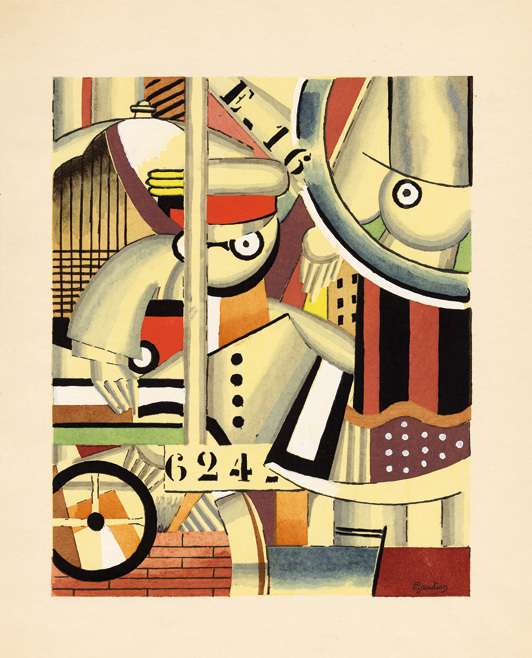
192713077Toulouse, Editions Richard, 1927 ; in-4, broché, étui de papier marbré de l'éditeur ; (4), 177, [178] pp., (1) f. achevé d'imprimer, 20 planches hors-texte en couleurs de Georges Gaudion, à la manière de : Laboureur, Marie Laurencin, Utrillo, Joseph Hémard, Henri Rousseau, Le Brun, Hermine David, Rouault, Picasso, Victor Hugo, Fernand Léger, Modigliani, Chas Laborde, Van Dongen, Gus Bofa, Henri Matisse, Cézanne, Vlaminck et Charles Martin ; couverture crème rempliée, imprimée en rouge et noir.
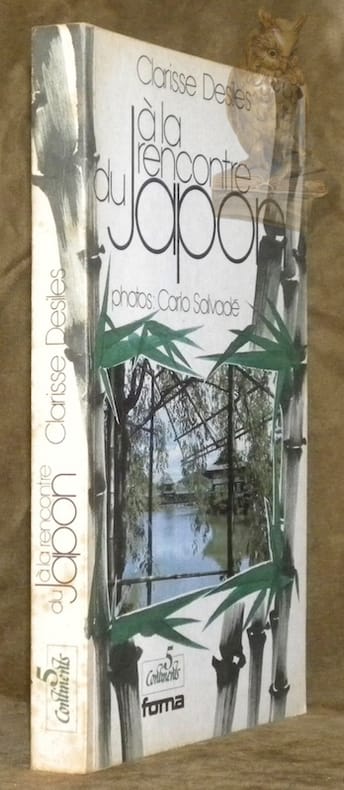
119362Renens-Lausanne, Editions FOMA “5 Continents” 1981, 210x130mm, 247pages, broché. Petites rousseurs sur le bas du dos et cachet de possesseur sur le bas du coin de la page de titre, autrement intérieur propre. Bel exemplaire.
1981430Genève, Editions nomades, 1981. In-8 en feuilles, sous chemise Arches recouverte de Kaji-kami (mûrier) fait à la main, gravure rouge au dos, étui crème. Etui un brin poussiéreux, pour le reste en parfaite condition.
110834Maps of the four main islands of Japan and the Korean Peninsula are surrounded by borders of cherry blossom and bamboo with scenes of Mt Fuji a pagoda and birds on the wing. Major cities are shown on the maps; Korea has Pyongyang Seoul and Pusan with '38° LINE' in a much larger font across the centre. The album 275 × 390 mm contains three series of commercially produced small photographic views loosely inserted behind photo-corners 40 hand-coloured views of Japan; 56 black and white views of Tokyo; and 40 black and white views of the Kure-Hiro district as well as 11 larger personal photographs of Bangkok. The last three items in the album are more significant: they are professionally produced photographs of two destroyers of the RAN - HMAS 'Anzac' D59 and HMAS 'Warramunga' D123 - and a large group portrait of three officers and twelve sailors of the 'Warramunga'. Both these ships served in the Korean War. The album and its contents appear to have been purchased by one of the crew members of the 'Warramunga' after she became one of the first Australian warships assigned to the Far East Strategic Reserve in 1955. unknown
199115850Tokyo, The Japan Times, 1991. Essays on contemporary Japan. 8°. 245,3 S. OKarton mit Schutzumschlag. Minimal gebraucht.
199110260Tokyo, The Japan Times, 1991. Essays on contemporary Japan. 8°. 245,3 S. OKarton mit Schutzumschlag. Kleine Notiz auf Vorsatz.
19772090202120415829Nikkan Kogyo Shimbun 1977. Soft Cover. Fine. Number of books: 1 Nikkan Kogyo Shimbun paperback
20042091502133534968Futabasha 2004. Soft Cover. Fine. Number of books: 1 Futabasha paperback