Valentine, DouglasMareMagnum

2 905 résultats
479 pages. Glossary. Footnotes. Index. Black and white reproductions of photos. "Phoenix was the final solution to the problem posed by those Vietnamese civilians who supported the armed Vietcong insurgents. In the end, an estimated 40,000 Vietnamese were killed and countless atrocities were perpetrated in the name of 'neutralizing' the Vietcong 'infrastructure'. This work is nothing less than a meticulous historical narrative of Phoenix from its roots through its tragic conclusions, based upon four years of research and interviews with over one-hundred program participants." - dust jacket. "Outlines in careful detail how the CIA ran a computerized assassination and torture program in Vietnam, violating laws and especially human morality." - John Prados. In 2014 NYU media studies professor Mark Crispin Miller selected this as one of the top five books actively suppressed and hidden from Americans. - RT. Unmarked with light wear. Tight and square. Dust jacket now preserved in archival-grade Brodart. A quality copy. Book
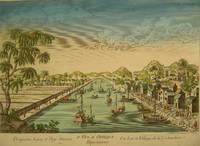
#[34149]Paris Daumont ca.1760. Contemporary handcoloured perspective view vue d'optique or Guckkastenbild depicting a view of the village of Yang-ka in Cochin with legend in Latin and French. Ca.285 x 39 cm. Handsome optical harbour view of a village with figures and canal with sailing-ships in Vietnam. unknown
19515789Service Presse Information 1951 67 photographies d'époque noir et blanc, du Service Presse Information, format 18 x 24 sauf 4 format 18 x 12, étiquettes avec légendes tapuscrites au verso, relatant la formation et le développement de l'Armée Nationale Vietnamienne (ANV) en 1951-1952, ainsi que l'après général de Lattre. Les photos sont les suivantes : Apprentissage de la lecture des cartes / Chargement des obus / La tyrolienne / Observation aux jumelles / Baptême de la 7e Promotion des Officiers Vietnamiens - Ecole de Dalat promotion Ngo Vuong Huyen, les hautes personnalités déposent des gerbes de fleurs au monument aux morts de l'Ecole / Visite de S.M. Bao Dai au Tonkin, prise d'armes à Hanoi le 20 décembre 1951 / Prise d'armes, salut sabre au clair / Prise d'armes, régiment des tirailleurs / Prise d'armes, bataillon d'infanterie, les élèves officiers / idem, présentation de l'unité de blindés / idem, régiment de parachutistes / idem, soldats équipés du fusil MAS 36 / idem, bataillons d'infanterie, les 2ème classes / Un Morane-Saulnier MS 341 roulant sur la piste d'atterrissage / Maquette d'aérodrome / Revue à Haiphong sur le golfe du Tonkin - Les LCM (Landing Craft Infantery) / ibid., la Brigade Marine d'Extrême-Orient (BMEO) / Nguyen Van Tam remet un sabre à un soldat de l'Ecole d'ECR à Saïgon en présence d'un officier parachutiste français / Nguyen Van Tam, 1er ministre, décore le drapeau de l'école d'ECR à Saigon, 1953/ Phan Huy Quat [ministre de la Défense) remettant une coupe à un soldat de l'ANV / Après les combats / Construction d'abris / Arrestation d'un groupe de combattants vietminh / Interrogatoire d'un chef de village / Un officier devant un véhicule blindé léger M8 / Bivouac au bord d'une rivière / Construction de défenses au bord d'une rivière / Mise à l'eau d'un radeau / Tirs d'obusier au bord d'une rivière / Positionnement au bord d'une rivière / Une patrouille dans la jungle / Des artilleurs en action sur un promontoire (plan rapproché) / idem, dans la jungle / Des artilleurs en action dans une cache / Transmission radio et observation des lignes ennemies / Voiture blindée de l'ANV à Ninh Binh / Char modèle M 8 / Unité mobile en action / Transport de troupes / Transmission dans la jungle / Campement dans la brousse et combats au loin / Un obusier, à l'arrière-plan le général Nguyen Van Hinh et des conseillers militaires français / Un commando de marine, mise en place d'un bazooka / Un commando de marine / Un obusier en action / Découverte d'une cache dans la maison d'un village / Arrivée à Mâu Giang / Rassemblement des habitants d'un village pour interrogatoire / Arrestation d'un combattant vietminh dans un village / Prisonniers vietminh / Découverte d'une cache à Ninh Binh / Bivouac, détente en musique / Bivouac, la préparation du riz / Concert au mess / Deux enfants vietnamiens mutilés / Stade Renault, les supplétifs prêtent serment, plan large / ibid., idem plan rapproché / Jean Letourneau, s'adressant à un écolier vietnamien dans une école à Saigon, 31-10-50 / Letourneau Ministre des Etats Associés rend visite aux blessés de l'hôpital Lanessan, Hanoi, le 27-1-52, Caporal Daer Hammerlan de Mostaganem (Oran) / Entretien de M. Letourneau avec sa majesté Sisavang Vong roi du Laos / Le général Raoul Salan et le général Mark Clark en compagnie d'officiers français assistent à la réparation d'un fusil mitrailleur / Le général Raoul Salan saluant le drapeau de l'armée vietnamienne / Visite de S.M. Bao Daï au Tonkin, prise d'armes à Hanoi le 20 décembre 1951 / Opération Brochet, la messe sur le front 10-17 octobre 1953, dans une paillotte du village de Kessate, aumônier vietnamien / Le général d'aviation Bodet et le général Bondis, avec le capitaine Deviras, réception en l'honneur du départ des pèlerins pour la Mecque le 16 juillet 1953, reportage Camus / Le général Bondis inaugure la route de Cao Lanh le 31 juillet 1953 et la stèle à la mémoire du général Chanson / Malcolm Mac Donald, Commissaire pour l'Asie du Sud-Est. Les accords de 1949 entre la France et les territoires de l'Indochine créent les Etats associés du Cambodge, du Laos et du Vietnam. L'Indépendance du Vietnam dans le cadre de l'Union française est reconnue le 8 mars 1949 (Accords de l'Elysée avec l'ex-empereur d'Annam Bao-Dai). La convention du 30 décembre 1949 prévoit notamment le développement d'une Armée nationale (ANV) et le transfert des Forces Terrestres d'Extrême Orient (FTEO), mais dont le commandement restera sous l'autorité du général commandant en chef en Indochine. Les années 1949-1950 sont un tournant marqué par la victoire de Mao en Chine, l'appui de cette dernière au Vietminh et la défaire française de Cao Bang en décembre 1950. C'est le général de Lattre, nommé en décembre 1950 haut-commissaire de France en Indochine et commandant en chef en Indochine, qui donnera l'impulsion décisive pour le développement de l'ANV. Une véritable conscription est lancée. Des centres d'instruction sont créés (Dalat, Thu Duc, Hanoï, une école de l'air à Nha-Trang...). L'aide américaine est négociée. L'organisation est calquée sur le modèle de l'armée française. Malgré de multiples problèmes, au départ de de Lattre (novembre 1951), l'ANV compte environ 130 000 hommes. Le général de Lattre meurt à Paris le 11 janvier 1952. Deux hommes succèdent au général de Lattre après sa mort à Paris en Janvier 1952: Jean Letourneau, qui cumule son portefeuille de ministre chargés des Etats Associés avec le poste de Haut-Commissaire en Indochine et le général Raoul Salan, adjoint militaire de de Lattre entre décembre 1950 et janvier 1952, puis Commandant en chef en Indochine jusqu'en mai 1953. La dimension politique n'est pas absente: le général Clark, à la suite de sa visite et des échanges avec Salan en mars 1953, appuiera les demandes pressantes de matériels à Washington. En mars 1952, le général Nguyen Van Hinh (1915-2004) est nommé chef d'Etat-Major de l'Armée Nationale Vietnamienne. Il est le fils de Nguyen Van Tam, chef de gouvernement de l'Etat du Vietnam sous Bao Daï de 1952 à 1954. Intéressante série de photos de l'ANV qui illustrent une des modalités du processus de "désengagement" de la France et le travail de communication du Service Presse Information, complètement réorganisé par de Lattre. Photographies
19515789Service Presse Information 1951 67 photographies d'époque noir et blanc, du Service Presse Information, format 18 x 24 sauf 4 format 18 x 12, étiquettes avec légendes tapuscrites au verso, relatant la formation et le développement de l'Armée Nationale Vietnamienne (ANV) en 1951-1952, ainsi que l'après général de Lattre. Les photos sont les suivantes : Apprentissage de la lecture des cartes / Chargement des obus / La tyrolienne / Observation aux jumelles / Baptême de la 7e Promotion des Officiers Vietnamiens - Ecole de Dalat promotion Ngo Vuong Huyen, les hautes personnalités déposent des gerbes de fleurs au monument aux morts de l'Ecole / Visite de S.M. Bao Dai au Tonkin, prise d'armes à Hanoi le 20 décembre 1951 / Prise d'armes, salut sabre au clair / Prise d'armes, régiment des tirailleurs / Prise d'armes, bataillon d'infanterie, les élèves officiers / idem, présentation de l'unité de blindés / idem, régiment de parachutistes / idem, soldats équipés du fusil MAS 36 / idem, bataillons d'infanterie, les 2ème classes / Un Morane-Saulnier MS 341 roulant sur la piste d'atterrissage / Maquette d'aérodrome / Revue à Haiphong sur le golfe du Tonkin - Les LCM (Landing Craft Infantery) / ibid., la Brigade Marine d'Extrême-Orient (BMEO) / Nguyen Van Tam remet un sabre à un soldat de l'Ecole d'ECR à Saïgon en présence d'un officier parachutiste français / Nguyen Van Tam, 1er ministre, décore le drapeau de l'école d'ECR à Saigon, 1953/ Phan Huy Quat [ministre de la Défense) remettant une coupe à un soldat de l'ANV / Après les combats / Construction d'abris / Arrestation d'un groupe de combattants vietminh / Interrogatoire d'un chef de village / Un officier devant un véhicule blindé léger M8 / Bivouac au bord d'une rivière / Construction de défenses au bord d'une rivière / Mise à l'eau d'un radeau / Tirs d'obusier au bord d'une rivière / Positionnement au bord d'une rivière / Une patrouille dans la jungle / Des artilleurs en action sur un promontoire (plan rapproché) / idem, dans la jungle / Des artilleurs en action dans une cache / Transmission radio et observation des lignes ennemies / Voiture blindée de l'ANV à Ninh Binh / Char modèle M 8 / Unité mobile en action / Transport de troupes / Transmission dans la jungle / Campement dans la brousse et combats au loin / Un obusier, à l'arrière-plan le général Nguyen Van Hinh et des conseillers militaires français / Un commando de marine, mise en place d'un bazooka / Un commando de marine / Un obusier en action / Découverte d'une cache dans la maison d'un village / Arrivée à Mâu Giang / Rassemblement des habitants d'un village pour interrogatoire / Arrestation d'un combattant vietminh dans un village / Prisonniers vietminh / Découverte d'une cache à Ninh Binh / Bivouac, détente en musique / Bivouac, la préparation du riz / Concert au mess / Deux enfants vietnamiens mutilés / Stade Renault, les supplétifs prêtent serment, plan large / ibid., idem plan rapproché / Jean Letourneau, s'adressant à un écolier vietnamien dans une école à Saigon, 31-10-50 / Letourneau Ministre des Etats Associés rend visite aux blessés de l'hôpital Lanessan, Hanoi, le 27-1-52, Caporal Daer Hammerlan de Mostaganem (Oran) / Entretien de M. Letourneau avec sa majesté Sisavang Vong roi du Laos / Le général Raoul Salan et le général Mark Clark en compagnie d'officiers français assistent à la réparation d'un fusil mitrailleur / Le général Raoul Salan saluant le drapeau de l'armée vietnamienne / Visite de S.M. Bao Daï au Tonkin, prise d'armes à Hanoi le 20 décembre 1951 / Opération Brochet, la messe sur le front 10-17 octobre 1953, dans une paillotte du village de Kessate, aumônier vietnamien / Le général d'aviation Bodet et le général Bondis, avec le capitaine Deviras, réception en l'honneur du départ des pèlerins pour la Mecque le 16 juillet 1953, reportage Camus / Le général Bondis inaugure la route de Cao Lanh le 31 juillet 1953 et la stèle à la mémoire du général Chanson / Malcolm Mac Donald, Commissaire pour l'Asie du Sud-Est. Les accords de 1949 entre la France et les territoires de l'Indochine créent les Etats associés du Cambodge, du Laos et du Vietnam. L'Indépendance du Vietnam dans le cadre de l'Union française est reconnue le 8 mars 1949 (Accords de l'Elysée avec l'ex-empereur d'Annam Bao-Dai). La convention du 30 décembre 1949 prévoit notamment le développement d'une Armée nationale (ANV) et le transfert des Forces Terrestres d'Extrême Orient (FTEO), mais dont le commandement restera sous l'autorité du général commandant en chef en Indochine. Les années 1949-1950 sont un tournant marqué par la victoire de Mao en Chine, l'appui de cette dernière au Vietminh et la défaire française de Cao Bang en décembre 1950. C'est le général de Lattre, nommé en décembre 1950 haut-commissaire de France en Indochine et commandant en chef en Indochine, qui donnera l'impulsion décisive pour le développement de l'ANV. Une véritable conscription est lancée. Des centres d'instruction sont créés (Dalat, Thu Duc, Hanoï, une école de l'air à Nha-Trang...). L'aide américaine est négociée. L'organisation est calquée sur le modèle de l'armée française. Malgré de multiples problèmes, au départ de de Lattre (novembre 1951), l'ANV compte environ 130 000 hommes. Le général de Lattre meurt à Paris le 11 janvier 1952. Deux hommes succèdent au général de Lattre après sa mort à Paris en Janvier 1952: Jean Letourneau, qui cumule son portefeuille de ministre chargés des Etats Associés avec le poste de Haut-Commissaire en Indochine et le général Raoul Salan, adjoint militaire de de Lattre entre décembre 1950 et janvier 1952, puis Commandant en chef en Indochine jusqu'en mai 1953. La dimension politique n'est pas absente: le général Clark, à la suite de sa visite et des échanges avec Salan en mars 1953, appuiera les demandes pressantes de matériels à Washington. En mars 1952, le général Nguyen Van Hinh (1915-2004) est nommé chef d'Etat-Major de l'Armée Nationale Vietnamienne. Il est le fils de Nguyen Van Tam, chef de gouvernement de l'Etat du Vietnam sous Bao Daï de 1952 à 1954. Intéressante série de photos de l'ANV qui illustrent une des modalités du processus de "désengagement" de la France et le travail de communication du Service Presse Information, complètement réorganisé par de Lattre. Photographies
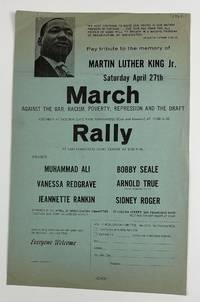
19683397San Francisco 1968. Very good. Broadsheet on blue paper 13.5 x 8.5 inches. Slight discoloration along top and bottom edges minor edge wear a few soft creases old horizontal folds. An exceedingly rare broadsheet advertising a multi-faceted public march and rally against the Vietnam War and "racism poverty and repression" which took place in San Francisco California about three weeks after the assassination of Martin Luther King Jr. The organizers of the event the April 27 Mobilization Committee framed the day's activities around Dr. King's opposition to the Vietnam War; the broadside calls for the protesters to "pay tribute to the memory" of Dr. King his portrait is printed at the top of the front side of the broadsheet and the entirety of the verso prints excerpts of an April 4 1967 speech by Dr. King railing against the Vietnam War. Particularly interesting is the eclectic list of speakers who participated in the day's events on April 27 1968 which included Muhammad Ali Vanessa Redgrave Jeanette Rankin Bobby Seale Arnold True and Sidney Roger. Ali was in the midst of his appeal after his conviction for draft evasion the previous year and was a natural candidate to speak against the injustices of the Vietnam War. Bobby Seale co-founder of the Black Panthers was four months away from participating in protests at the 1968 Chicago Democratic Convention after which he was arrested and tried as part of the sham Chicago Eight fiasco.<br /> <br /> The diversity of the speakers echoes the quantity of different issues represented by the current broadsheet: Civil Rights the Vietnam War the recent assassination of Dr. King Muhammad Ali's legal fight against the war Bobby Seale's controversial role with the Bay Area Black Panthers women's rights and the role of the American military. We could locate no other copies of this broadsheet in auction history or OCLC. unknown
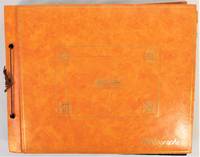
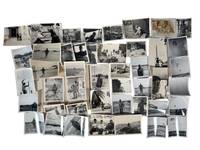
1970190661970. U.S. Army Engineer Company photo album early 1970s documents logistical operations base life and personnel composition at Oakland Army Base during the Vietnam War providing visual evidence of military transportation infrastructure and the integration of a diverse workforce within a key Pacific transit hub. The material records the functioning of an engineer unit responsible for vehicle maintenance cargo handling and operational readiness while also capturing the presence of African American servicemen and female personnel within the same working and ceremonial environments. It supports research into military logistics on the U.S. home front race and gender integration in the armed forces and the institutional processes that sustained overseas deployment during the Vietnam War.<br /> <br /> Album containing 369 photographs including 353 color and 16 black and white images most measuring approximately 5 x 3.5 inches compiled at Oakland Army Base and the adjacent Port of Oakland. The contents document heavy machinery and vehicle maintenance including bulldozers cranes transport trucks and military jeeps with numerous images showing mechanics engaged in repair work. Additional photographs depict combat training exercises including rifle instruction with M16 firearms alongside formal ceremonies in which soldiers of varied racial backgrounds and both genders receive promotions commendations and instruction from commanding officers. Several images show administrative office environments providing insight into the clerical and organizational functions supporting base operations. Group scenes include family-oriented gatherings and meals indicating the social dimension of service life within the base setting. Produced at a time when Oakland Army Base operated as a principal embarkation and return point for U.S. forces traveling to and from Vietnam and other locations in East Asia the album documents the domestic infrastructure underpinning overseas military engagement. The emphasis on machinery cargo movement and personnel readiness reflects the scale and complexity of logistical coordination required during the conflict. The visible diversity within the unit corresponds with broader transformations in the U.S. military following desegregation and evolving roles for women making the album relevant to studies of institutional change during the late stages of the Vietnam War. Light wear to album edges and corners photographs well-preserved with minor handling marks; overall very good. A substantial visual record of engineer operations and base life at a critical West Coast military installation during wartime. unknown
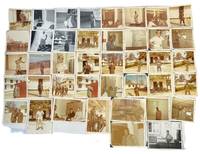
1968197531968. Photographic archive 1968-1969 documenting African American enlisted personnel in the United States Army Transportation Corps during the Vietnam War era with emphasis on training environments unit structure and daily life on base prior to overseas deployment. The material captures soldiers in both formal and informal settings providing visual evidence of military preparation racial composition within units and interpersonal dynamics among predominantly Black troops during a period of significant racial tension within the U.S. armed forces. The archive supports research into African American military service segregation and integration practices and the lived experience of soldiers during the late 1960s.<br /> <br /> Archive of 41 original vintage photographs primarily color with several black-and-white images ranging in size from approximately 3.5 x 3.5 inches to 3.5 x 5 inches. The photographs depict soldiers in a range of uniform styles including standard fatigues seasonal dress variations and Transportation Corps-specific elements such as white belts shoulder cords red scarves and helmets with distinctive markings. Several images show troops in formation with rifles raised while others capture training environments featuring sandbag trenches artillery placements and fortified structures resembling pillboxes. Interior scenes document barracks life including soldiers playing cards maintaining uniforms and interacting in relaxed settings. A black-and-white image shows an African American soldier posed near signage for a "Leadership School and Honor Guard" at a U.S. Transportation Center while another identifies a seated "battery clerk" labeled informally as "Johnny my Running Mate." Additional photographs include racially integrated groupings with Black and white soldiers appearing together in casual and structured contexts.<br /> <br /> Produced during the height of the Vietnam War this archive provides insight into the transitional phase between training and deployment emphasizing both institutional structure and personal experience within military life. The presence of both formal drills and informal social scenes allows for examination of hierarchy camaraderie and daily routine among enlisted men. Light handling wear and minor surface marks; overall very good condition. A substantial visual record of African American military experience within the U.S. Army during a pivotal period of twentieth-century conflict. unknown
1965212871965. Archive of original photographs documenting African American soldiers serving in the Vietnam War during the early phase of large-scale United States military escalation in Southeast Asia. The material captures the daily experiences military operations and interpersonal relationships of Black servicemen stationed at Bien Hoa Air Base circa 1965 including members of the 173rd Airborne Brigade Combat Team. The photographs provide primary-source visual evidence of integrated military life during a period when African American troops served disproportionately in frontline combat roles while racial inequality and civil rights struggles intensified in the United States. Particularly significant is the candid nature of the images which were apparently taken by an African American serviceman identified by the surname Thomas offering an unusually personal perspective on Black military experience during the Vietnam conflict.<br /> Collection consists of 56 original black-and-white silver gelatin photographs measuring approximately 3.5 x 3.5 to 3.5 x 5.5 inches primarily loose with two mounted to an album page. The photographs depict African American soldiers at Bien Hoa Air Base near Saigon identifiable through a photographed base sign and visible 173rd Airborne Brigade insignia on soldiers' uniforms. Numerous images portray Black servicemen posing casually outside tents reading letters socializing in small groups smoking resting and interacting with fellow soldiers emphasizing camaraderie and the routines of military life between operations. Several photographs document airborne training exercises with parachutists descending beneath open canopies over the surrounding landscape. Other images depict military infrastructure and equipment including jeeps sandbag fortifications stacked munitions barracks areas and transport zones associated with the logistical operations of the base. The archive also includes photographs taken during off-duty excursions into Vietnamese civilian areas including a riverside marketplace crowded with vendors boats and local residents. Additional images show soldiers posed before local monuments and religious sites including one photograph of Thomas with a white serviceman in front of a Buddhist temple and another featuring a tall obelisk monument surrounded by military statuary.<br /> The archive documents the lived experience of African American servicemen within integrated combat units during one of the most consequential military conflicts of the twentieth century. Bien Hoa Air Base served as a major operational center for airborne and aerial missions during the early years of sustained U.S. intervention and the presence of Black paratroopers within these photographs provides important visual evidence of African American military participation during the Civil Rights era. Unlike official military photography the informal and personal nature of the images preserves moments of friendship boredom training and interaction with Vietnamese civilians that are often absent from institutional wartime records. Minor edge wear and light handling wear throughout; photographs remain sharp and well-preserved overall in very good condition. A substantial and historically valuable photographic record of African American military life in Vietnam during the mid-1960s. unknown
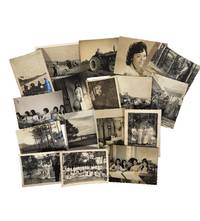
1960210781960. Vietnam War Photography Personal photograph album containing 17 silver gelatin photographs documenting civilian life education family and military service in South Vietnam during the 1960s. Original brown vinyl album measuring approximately 3.5" x 4.5"; photographs approximately 2.5" x 3.25".<br /> <br /> The album offers an intimate glimpse into the everyday experiences of South Vietnamese men and women during a period more often documented through the lens of war. Rather than combat scenes the photographs focus primarily on family friendship education courtship and community life creating a personal record of a society navigating rapid social change amid the conflict. Several photographs depict young Vietnamese women wearing traditional áo dài dresses both in formal portraits and informal outdoor settings. One particularly attractive image shows three smiling women walking along a path in patterned áo dài framed by a mixture of traditional and modern architecture. Another studio portrait captures a young woman posed alone and smiling toward the camera suggesting a family member friend or perhaps the album owner's sweetheart.<br /> <br /> Education and youth culture are prominently represented. Multiple photographs show school-aged girls gathered in classrooms and assembled outdoors in large group portraits. The students wear white áo dài and traditional conical hats illustrating the continued importance of educational institutions and cultural traditions during the war years. Several candid classroom scenes preserve moments of ordinary student life rarely encountered in wartime photographic archives. The album also documents changing fashions and modernization in South Vietnam. Young men and women appear in contemporary 1960s clothing posing in parks forests and rural landscapes. One photograph shows a young Vietnamese man seated proudly atop a large tractor reflecting the agricultural modernization efforts underway throughout much of South Vietnam during the period.<br /> <br /> Military service appears in several images. One photograph depicts a South Vietnamese serviceman standing beside an automobile with military vehicles visible in the background suggesting that the album may have belonged to a soldier or military family. Unlike official military photographs however the image emphasizes personal identity rather than military operations reinforcing the album's character as a private keepsake rather than a wartime record. Additional photographs show fishing boats riverside scenes rural landscapes and groups of family members and friends creating a portrait of everyday life that existed alongside the broader conflict. Together the photographs reveal the coexistence of tradition and modernity documenting a generation of South Vietnamese men and women whose lives were shaped by both enduring cultural customs and the upheavals of the Vietnam War era. Photographs appear to have been removed from a larger album at some point with remnants of mounting paper and adhesive visible on versos. Minor wear and handling marks; overall very good condition. A compelling personal archive documenting civilian life education culture and military service in South Vietnam during the 1960s. unknown
Edizione: Prima edizione . Pagine: 320 . Illustrazioni: 40 foto e due carte più volte ripiegate, in copertina, dorata, la più grande pepita ritrovata nell'Eldorado di kg 1,309 . Formato: 16° . Rilegatura: Brossura originale . Stato: Buono . Caratteristiche: Bruniture. Copertina con piccoli strappi. Raro.Foto disponibili . Note epoca: B
197341784N.p.: Vietnam Veterans Against the War 1973. First Edition. Original offset lithographed poster in colors 56cm x 43cm 22" x 17". Fine fresh apparently unused example. Poster sold as a fundraiser for the defense of the Gainesville Eight a group of Florida Vietnam veterans who were accused on dubious evidence of conspiracy to disrupt the 1972 Republican National Convention in Miami Beach. All eight defendants including the reputed ringleader Scott Camil were eventually acquitted. A rare poster and this is a lovely fresh example. Not catalogued in OCLC; we note only one institutionally-held copy Library of Congress. Vietnam Veterans Against the War unknown
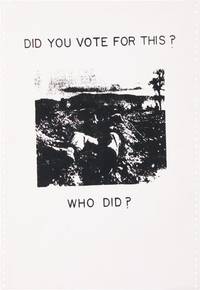
197035425Berkeley: Berkeley Political Poster Workshop 1970. Original illustrated poster silkscreened in black on white repurposed computer listing paper with perforated tractor strips measuring ca.38cm x 56cm 15" x 22". A Fine copy / A. A simple powerful anti-war image by an uncredited Berkeley student. The image is reproduced from a 1968 AP photograph of the bodies of US Marines on Hill 689 in Khe Sanh South Vietnam. The poster "is an indirect invocation of the political order in the United States and for those who remember a reminder that both Lyndon Johnson in 1964 and Richard Nixon in 1968 won the presidency with promises of peace - which were then contradicted by their actions." Benson Thomas W. Posters for Peace: Visual Rhetoric and Civic Action. One of some 600 designs created by Berkeley student members of the Political Poster Workshop in 1970; on average fewer than 100 copies of each design were printed for distribution on and around campus. Not individually listed in OCLC though we note copies held at Yale and Penn State. WILLIAMS 28. Berkeley Political Poster Workshop unknown books
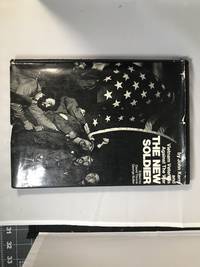
197108-29-2022-10This hardcover has black boards with a fine detailed silver gilt image with the US flag and Vietnam Veterans from a photo by George Butler. All lettering and image in silver is in fine condition. All pages and the numerous photos are clean and unmarked.<br />INSCRIBED on the title page as seen in photo. <br />we believe that the David Putnam to whom the inscription is dedicated is or was a Massachusetts friend of Mr. Kerry but we are unable to verify this.<br /> DJ condition is Good-. Chipping along top and bottom margins Two tiny closed tears repaired with tape several others untaped. She creases in DJ flaps. Not price clipped.<br /> This work is a photographic essay of the Anti-War movement and the Vietnam Veterans that culminated in a march of the Capital Building in 1971. An important text for anyone interested in American History and the climate of the Country during the Vietnam War. The Macmillan Company hardcover
197341784N.p.: Vietnam Veterans Against the War 1973. First Edition. Original offset lithographed poster in colors 56cm x 43cm 22" x 17". Fine fresh apparently unused example. Poster sold as a fundraiser for the defense of the Gainesville Eight a group of Florida Vietnam veterans who were accused on dubious evidence of conspiracy to disrupt the 1972 Republican National Convention in Miami Beach. All eight defendants including the reputed ringleader Scott Camil were eventually acquitted. A rare poster and this is a lovely fresh example. Not catalogued in OCLC; we note only one institutionally-held copy Library of Congress. Vietnam Veterans Against the War unknown books
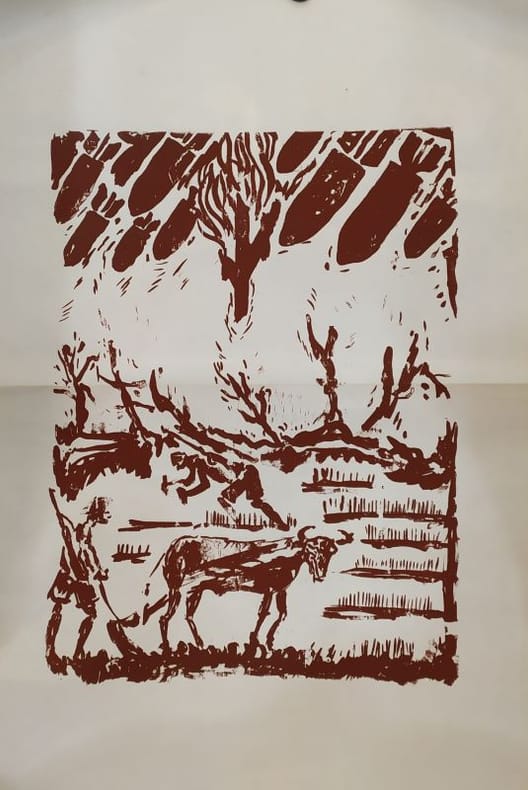
3128Impression en sérigraphie marron. Ca. 1973. Dim : 990 x 650 mm. Pliure dorigine.
3128Impression en sérigraphie marron. Ca. 1973. Dim : 990 x 650 mm. Pliure dorigine.
Legatura coeva in piena pelle (difetti), sguardie marmorizzate e tagli spruzzati azzurri, 8vo cm 11x17, pp (4) 422 234 52 32. Tracce d’uso sulla legatura che presenta piccole mancanze di pelle sui bordi dei piatti, fessure lungo le cerniere e scuffiature, uno strappo sulla carta di guardia posteriore, antiche firme di possesso su frontespizio e prima carta bianca. Discreto esemplare nel complesso. La prima parte dell’opera è dedicata alla Cina, sua storia, religione e istituzioni, con capitoli dedicati alla produzione della seta e alle tecniche di manifattura della porcellana; il secondo trattato è diviso in capitoli dedicati ad anni significativi per la storia del Giappone e dei suoi rapporti con l’Occidente; concludono l’opera brevi trattati dedicati alla Tailandia (Anecdotes Siamoises) e al Vietnam (- Tonquinoises et Cochinchinoises), e un’ultima parte intitolata A. de la presqu’isle au-dela du Gange con notizie su Laos, Cambogia, Tibet e altri paesi dell’Asia. Brunet VI, 28295.
1909109009Paris, Louis Michaud, impr. Bussières, Saint-Amand (Cher) 1909 In-12 19 x 11,5 cm. Reliure demi-percaline vert foncé, filets dorés, dos lisse, pièces auteur et titre maroquin rouge, tête dorée, couverture illustrée par Robida conservée, 348 pp., table des matières.
12196New York, New York American Library, A Signet special Broadside, N3546, 1 $, First priniting April 1968 petit in 8 broché (paperback), non paginé
12196New York, New York American Library, A Signet special Broadside, N3546, 1 $, First priniting April 1968 petit in 8 broché (paperback), non paginé
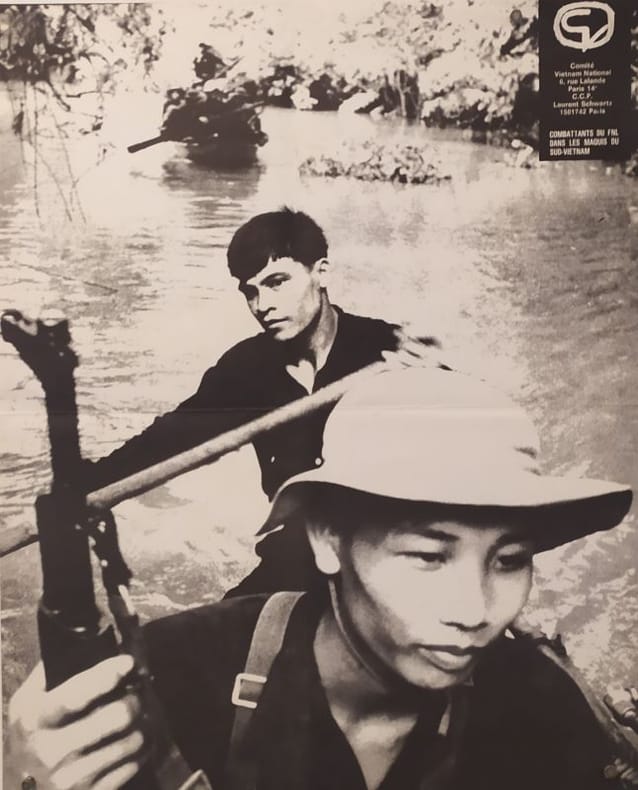
3355Ensemble de 3 affiches. Imp E. L. E. 28 rue Geoffroy St. Hilaire - Paris 5e. ca.1970. Impression offset en noir et blanc. 1°. " Cette salle d'opération fonctionne en permanence pour sauver les vies des combattants du FNL en pleine jungle du Sud-Vietnam". Dim: 485 x 375 mm. 2°. "Combattants du FNL dans les maquis du Vietnam". Dim: 485 x 390 mm. 3°. " Les restes de l'opération Junction-City servent de salle de classe aux combattants dans les maquis du Sud-Vietnam". Dim: 380 x 490 mm.
3355Ensemble de 3 affiches. Imp E. L. E. 28 rue Geoffroy St. Hilaire - Paris 5e. ca.1970. Impression offset en noir et blanc. 1°. " Cette salle d'opération fonctionne en permanence pour sauver les vies des combattants du FNL en pleine jungle du Sud-Vietnam". Dim: 485 x 375 mm. 2°. "Combattants du FNL dans les maquis du Vietnam". Dim: 485 x 390 mm. 3°. " Les restes de l'opération Junction-City servent de salle de classe aux combattants dans les maquis du Sud-Vietnam". Dim: 380 x 490 mm.
6641Saïgon, Ecole Française d'Extrême-Orient, 1944 (tome 1), 1ère édition, tirage limité à 825 exemplaires sur papier biblio, 1955 (tome 2), 1957 (tome 3). Ensemble de 2 volumes, reliure demi-chagrin, couvertures imprimées conservées, XIV-241 p. (T1), 343 p. (T2), 258 pp. (T3), enrichis de nombreuses planches et figures, très bon état.
1373734Paris: Vigot Frères, 1907 in-8, x-viii-292 pages, 2 planches dépliantes (dont "Graphique chinois d'anatomie humaine d'après les modèles authentiques provenant d'une pharmacie de Quan-Tchéou-Wan"), 21 figures dans le texte, 5 index (latin, chinois, annamite, japonais, cambodgien). Demi reliure toile, dos muet. Envoi à M. Chambon, très nombreuses et enrichissantes annotations au crayon.
[14], 231 pages. Footnotes. Glossary. Index. "The CIA is not now nor has it ever been a central intelligence agency. It is the covert action arm of the president's foreign policy advisers. In that capacity it overthrows or supports foreign governments while reporting 'intelligence' justifying those activities. It shapes its intelligence to support presidential policy. Disinformation is a large part of its covert action responsibility, and the American people are the primary target of its lies." - Ralph McGehee. "McGehee spent 25 years in the CIA from 1952-77. He entered a super-patriot at the height of the Cold War; he left disillusioned and shattered by what he had seen and learned, especially in Vietnam where he saw a tragic and senseless war develop." - back cover. Unmarked with moderate wear. Tight and square. A sound copy. One of twenty-three books selected for inclusion on the 'Forbidden Bookshelf' which highlights titles disparately policed, and imperceptibly contained, by state and corporate entities well-placed and perfectly equipped to wipe out wayward writings Book