502 résultats
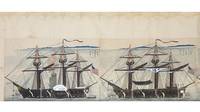
11288Japan: ca. 1854-55.<br /> <br> <br> An impressively assembled scroll that portrays the second American expedition to Japan February-March 1854 led by Commodore Perry; much of it is focused on the American vessels that anchored menacingly off the coast. Seven of the nine ships in the American fleet are carefully portrayed with notes on the estimated numbers of cannons and crewmembers. Steam-powered ships with black smoke gushing from the stacks and rows of powerful cannons shocked the Japanese most of whom had never seen such a demonstration of advanced military technology. The observations in this scroll must have been crucial to inform the decision-making of Japanese officials.<br /> <br> <br> "Black Ship Scrolls" conveying eyewitness reports were disseminated among the Japanese elite and kept top secret. Our scroll was presumably created for a high-ranking Japanese official since any information on the American interlopers was carefully controlled by the local authorities to maintain public order in the face of an anticipated foreign invasion. Compared to other depictions of the foreigners which frequently showed them as caricatures hairy oversized red-faced and blue-eyed the more dignified portraits in our scroll demonstrate the increasing familiarity between the Japanese and American contingents.<br /> <br> <br> In the years following Japan's opening to the West Japanese artisans produced countless scrolls commemorating the American expeditions catering to the tourist trade and as gifts to visiting dignitaries. Mass-produced with foreigners' preferences in mind these scrolls took liberties with the events that transpired straying far from the earliest accounts and sketches. They pale in comparison with the elaborate and scrupulous illustrations found in this early scroll. Though the later mass-produced scrolls are easily found on the market examples like ours presumably created for a Japanese official or nobleman remain greatly treasured for their revealing depictions.<br /> <br> <br> We have ordered the scroll into 15 individual scenes most of which have a contemporary manuscript caption translated below:<br /> <br> <br> I. Three sailors in the American marching band two of whom are uniformed drummer boys. The band led the American march to Yokohama where negotiations between the two nations were held in a newly constructed reception hall. The Japanese manuscript caption reads: "Illustration of musicians."<br /> <br> <br> II. Two sailors with swords sheathed are holding their muskets with bayonets fixed. A fine indigo ink has been employed to depict the uniform on the left. Caption: "Rank: Sergeant/Soldier."<br /> <br> <br> III. Commodore Perry on the right faces a sailor who may be the conductor of the American expedition's marching band. Perry is depicted rather sympathetically compared to exaggerated and even outlandish portraits that depict him as quite large hairy and red-faced. The artist has once more used a deep indigo to capture the color of the uniforms. Caption: "Ambassador Perry/Conductor Commandant."<br /> <br> <br> IV. A larger portrait of a lone sailor probably an officer clutching his sheathed sword and clenching his fist. Caption: "Foreigner Captain landed near Kanagawa."<br /> <br> <br> V. An elaborate and realistic portrait of Perry capturing even the individual hairs on his head and the wrinkles on his face. Caption: "American Envoy Perry."<br /> <br> <br> VI. A portrait of Perry's chief-of-staff Henry A. Adams done by the same artist as Perry's portrait. Caption: "American Vice Envoy Adams."<br /> <br> <br> VII. upper portion A very long horizontal painting of the American column marching to the Yokohama reception hall for negotiations regarding the opening of Japan to American trade. There are more than 100 armed Americans soldiers following the marching band. The top of this sheet has been slightly cropped cutting off part of the American flag in the middle. Caption: "Illustration of American landing column."<br /> <br> <br> VIII. lower right A sizable rendering of the USS Vandalia a sloop-of-war that joined the Perry Expedition in late 1853. Caption: "Name of ship: Vandalia 20 cannons 200 crewmembers." Minuscule mended wormholes to the image.<br /> <br> <br> IX. lower left The USS Saratoga another sloop-of-war. Caption: "Name of ship: Saratoga 20 cannons 200 crewmembers." Expertly mended wormholes touching the image hardly visible.<br /> <br> <br> X. upper portion A panoramic view with a fleet of 23 American rowboats headed to shore. Mending to the top of the scroll.<br /> <br> <br> XI. right lower portion The USS Mississippi a steam frigate that was part of the first expedition. Caption: "Name of ship: Mississippi 8 cannons 240 crewmembers."<br /> <br> <br> XII. left lower portion The USS Southampton a storeship. Caption: "Name of ship: Southampton 6 cannons 50 crewmembers." Expert mending of wormholes affecting the image.<br /> <br> <br> XIII. USS Supply a supply ship. Caption: "Name of ship: Supply 6 cannons 40 crewmembers." Wormholes repaired and with some foxing.<br /> <br> <br> XIV. USS Lexington a supply ship. Caption: "Name of ship: Lexington 26 cannons 50 crewmembers." Repaired wormholes and small sections of the white wash used for the sails have come off.<br /> <br> <br> XV. USS Susquehanna a steam frigate. Caption: "Name of ship: Susquehanna 6 cannons 240 crewmembers." Careful mending of wormholes to head and tail of scroll.<br /> <br> <br> In very good condition; there are a number of wormholes all expertly restored to the point that most are invisible to the naked eye and some browning and speckles to blank segments of the scroll. Two unidentified ownership seals next to the illustration of the USS Vandalia no. VIII. Housed in a custom-made 20th-century wooden box.<br /> <br> <br> ⧠Renata V. Shaw "Japanese Picture Scrolls of the First Americans in Japan" in The Quarterly Journal of the Library of Congress Vol. 25 No. 2 April 1968 pp. 134-53. <br /> <br> <br> For helpful recapitulations of accounts from the Japanese and Americans William McOmie The Opening of Japan 1853-1855: A Comparative Study of the American British Dutch and Russian Naval Expeditions to Compel the Tokugawa Shogunate to Conclude Treaties and Open Ports to Their Ships 2006. unknown
H714an Bord der HMS Challenger 1872-1875. 4to. Band 1: 378 S. Band 2: 98 S. Mit zahlreichen Skizzen und Pl‰nen im Text. Halblederb‰nde der Zeit in neuer Lederbox. Sehr gut leserliche Handschrift meist in deutscher Sprache. Original-Tagebuch des deutschen Biologen von der Reise der HMS Challenger. Gestorben auf Tahiti. Die letzten Eintragungen des Biologen stammen vom 2.September 1875 auf Hilo Hawaii. Die Reise f¸hrte weiter Richtung Tahiti unterwegs am 13.September 1875 starb Willemoes-Suhm. Sein Tagebuch ist eine Fundgrube an Reisenotizen und wissenschaftlichen sowohl zoologischen als auch botanischen Eintragungen. Unterteilt ist sein Tagebuch nach den Stationen u.a. Azoren St. Paul Tristan-Inseln Pince Edwards Islands Crozet-Insel Kerguelen Antarktis Australien Neuseeland Tonga Fiji Ovalau Api Neue Hebriden Arafui Ari Ke¥Dulan Ternate Lamboanga Manilla Cebri Humboldt-Bai - Neu-Guinea Yeddo Yokohama Hiogo. Yokohama - Sandwich-Inseln Honolulu Hilo. 1872-1875. Important manuscript by one of the leading naturalists on the voyage. Original scientific travel journal titled "Challenger" Rudolph von Willemoes Suhm "Journal No." "I & II." Scientific Travel Journal of the German Explorer and Zoologists aboard HMS Challenger. Text in German but occasionally in English. 2 Vols. 21 Dec. 1872-6. Sept. 1875. 4to 378; 98 pp. illustrated with sketches and 1 photograph original half calf fitted half morocco case. Autograph journal kept by the German naturalist Rudolf v. Willemoes-Suhm during his 3-year journey with the Challenger. Suhm was mainly concerned with Crustaceans and several new species were named by him. His journal covers the entire voyage until his tragic death from erysipelas on 13th September1875 while the ship was at Tahiti in the Pacific. His travel report remains unpublished and is a leading yet apparently untapped source on the history of the Challenger Expedition as well as research and discovery of the sea. Suhm born on 11. September 1847 in Glu®ckstadt on the Elbe River studied in Bonn Munich and Go®ttingen already at the age of 24 years he was a Professor of Zoology at the University of Munich. in 1872 he was appointed by Sir Charles Wyville Thomson the Scientific Director of the Challenger Expedition as the only German on the staff of the research carried out on behalf of the Royal Society. The posthumous journal covers the entire period from Suhms trip to a few days before his death in which his illness forced him to stop writing. It contains a wealth of information particularly the geographical and zoological research of the "Challenger". Suhm illustrated his records with small designs including many maps and some small Zoological representations. Die britische Challenger-Expedition 1872-1876 war die erste rein wissenschaftliche Forschungsreise. Das Expeditionsschiff HMS Challenger legte bei Ihrer Reise ca. 130.000 km zur¸ck und durchzog damit beinahe das gesamte Weltmeer. Mit dieser Expedition wurde der Grundstein f¸r die Ozeanographie gelegt. Wichtige Forschungsstationen waren die Bahamas die Marion-Inseln im s¸dlichen Eismeer Neuseeland die Auckland-Inseln und Neu-Guinea. Die Ergebnisse wurden in 50 B‰nden verˆffentlicht. unknown