Flinders Petrie (Ed)Biblio.com
4 751 résultats
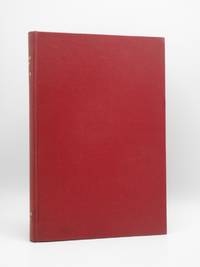
19231139E028London: British School of Archaeology in Egypt / Macmillan and Co. 1923. 1st Edition . Hardback. Printed pages: 136. Very Good Minus. 7.25 x 10.75 inches 18.5 x 27.5 cm. Ex library in a good quality library binding. Four issues retaining the original front cover for Part 1 only. Red buckram with gilt title to spine. Red speckled page edges. Barcode and stamp to front endpaper pocket and label to rear endpaper occasional stamps to margins. Clean text throughout. Includes an index for all issues 1920-1923. Overall condition is Very Good Minus. Please Note: This is a heavy item and international postage will be more than the standard rate for non-European destinations. Actual Royal Mail postage costs are: USA £21.00; Oceania £26.00; Rest of World £26.00. A postage supplement will be requested after the order has been placed. Size: 7.25 x 10.75 inches 18.5 x 27.5 cm. British School of Archaeology in Egypt / Macmillan and Co. hardcover
Folio (232 x 295 mm). (2), XIV, 196, 112 pp. Contemporary blindstamped cloth with giltstamped title to spine. First edition. - In 1837, Cureton (1808-64), assistant keeper of manuscripts in the British Museum and the only oriental scholar in the department, was commissioned to prepare a catalogue of the Arabic manuscripts, the first part of which appeared in 1846. "But a new study had already engaged Cureton's attention. During his official occupation at the British Museum immense additions had been made to the collection of Syriac manuscripts. When he entered the department these numbered about eighty; but the accession of numerous manuscripts of the highest importance from the Nitrian monasteries, which were purchased and brought over partly by the mediation of Dr. Tattam in 1841 and 1843, raised the total to nearly six hundred. Cureton, who knew nothing of Syriac when he came to the department, set himself zealously to work to conquer the not very serious difficulties of the language, and to set in order and classify the new acquisitions from the Nitrian valley. His labours while drawing up an outline catalogue were amply rewarded by the discovery of many manuscripts of the highest interest" (DNB). The present work was published, after his death following a railway accident, by William Wright (1830-89). - Occasional slight foxing; on the whole an excellent, unusually wide-margined copy. From the library of the Ducs de Luynes at the Château de Dampierre: their bookplate reproducing the arms of Charles Marie d'Albert de Luynes (1783-1839), 7th Duc de Luynes, on pastedown. DNB XII, 326. OCLC 4774167. Cf. Fück 190.
2000125St. Martin's Press/St. Antony's College 2000. Hardcover. Good/Very good. Dustjacket has some wear and a three-inch scratch on front. Cover has light wear. Light to moderate foxing on page edges. Light foxing on inside front and rear covers and front and rear endpapers. First printing. St. Martin's Press/St. Antony's College hardcover
New English Paperback. Pbo. Roy. 8vo. (24 x 17 cm). In Turkish. 128 p., color and b/w ills. Anilarla madencilik.
Large folio. Half morocco, retaining the original cloth covers and gilt cover label. 11 (instead of 21) plates. Author's Edition. Landmark collection of Muybridge's revolutionary "instantaneous photography", a self-developed technique that allowed for high-precision series of high shutter speed stop-motion photographs. He began his work with photographing horses, but in time it would also include athletes, birds, lions, and even camels. Muybridge first photographed a horse with all 4 hooves off the ground in 1872, after Leland Stanford (later the Governor of California) hired Muybridge to determine whether a horse leaves the ground completely when running, a hotly debated issue at the time. (Stanford believed they did, and Muybridge won Stanford a $25,000 bet.) By 1885, Muybridge had accumulated over 20,000 photographic negatives, or 781 sequential series of photo-plates, shot from multiple cameras at carefully planned locations and angles, each of which showed a human and/or animal engaged in a continuous motion. This required Muybridge to develop cameras for faster shutter closure. In cases where a human or animal moved any great distance, photographing the movement required a team of photographers, rather than a single photographer. Muybridge and H. Allen, a physiology professor at the University of Pennsylvania, published 37 eleven-volume sets which contained a collotype of every one of the 781 photographic series. This "Author's Edition" consists of a selection of the most important collotypes contained in the full work; the present set includes all the plates to show animals: No. 565. Horse trotting. - 616. Horse and rider, trotting more rapidly. - 626. A third horse and rider, running, including several frames with all 4 hooves off the ground. - 647. A horse jumping a hurdle at high speed, with a bareback jockey. - 659. Mule jumping and kicking with his hind limbs. - 710. Race hound at high speed, including frames with all 4 feet off the ground. - 721. Lion circling along the wall of a small enclosure. - 739. Camel walking. - 755. Bird flying, including swoops down. - 3. Runner. - 152. Runner jumping a hurdle. - The combined illustrated area of any given plate varies, but is typically about 21 x 30 cms. Muybridge had focused his early photographic work on San Francisco and Yosemite, but had later been sent by the Federal Government to photograph Alaska for the High Sierra Survey. (The latter project was in 1868, shortly after the territory was purchased. He was later sent on a second trip to Alaska to photograph the Tlingit tribe and the Modoc War.) During his time as a photographer, Muybridge owned a racetrack. Late in life, he invented the zoopraxiscope, a primitive forerunner of the motion picture camera. Analyses made possible by the technique later had a wide range of implications for sports, podiatry, physical therapy, vertebrate paleontology, and other fields. - Pastedowns and spine renewed, otherwise an excellent, clean copy in the original boards. Grolier, Truthful Lens, 123. Parr/Badger, The Photobook I, 52.
391321 volin-8 broché - 130 pages - 1988
Large 4to. X, (2), 134 pp. Contemporary green half calf over marbled boards with giltstamped spine title. Marbled endpapers. First edition. - History of the Muslim world and its rulers from Muhammad's flight (AD 622) to the year 1020 AH (AD 1611). The Danish oriental scholar Jan Larson (Jens Lassen) Rasmussen (1792-1826) had studied in Paris with de Sacy (cf. Fück 156). - Binding rubbed and bumped. Some browning and light dampstaining to interior, old shelfmark label to pastedown. Provenance: stamp of the oriental scholar Charles Barbier de Ménard (president of the École des Langues orientales from 1898 to 1908) on title, with additional Canadian library stamps of the Ottawa Commissariatus, Terrae Sanctae. Rare. OCLC 953808200.
Large 4to (230 x 280 mm). 2 parts in 4 volumes. (2), 144, (2) pp. (2), 145-281 pp. 360 pp. (8), XIV, 361-446 pp. Original printed blue wrappers. Arabic text with Latin translation and commentary of this chronicle of mediaeval Moroccan dynasties, including the Idrisids, Zanata, Almoravids, Almohads, and Merinids, by Zar al-Fasi (d. after 726/1326). - Somewhat wrinkled and dust-stained; untrimmed. GAL II, 240f. OCLC 682184610.
Small folio (232 x 280 mm). 36 ff. Contemporary marbled wrappers. All edges gilt. The Regulating Act of 1773, published in Persian and English on opposite pages. - British interest in Persia and the Arabian Gulf originated in the 16th century and steadily increased as British India’s importance rose in the 18th century. In the beginning, the agenda was primarily of a commercial character: realizing the region's significance, the British fleet supported Shah Abbas in expelling the Portuguese from Hormuz in 1622. In return, the British East India Company was permitted to establish a trading post in the coastal city of Bandar 'Abbas, which became their principal port in the Gulf. The Company became responsible for conducting British foreign policy in the region, and concluded various treaties, agreements and engagements with Gulf states. In 1763 the EIC established a permanent residency at Bushehr, on the Persian side of the Gulf. By the early 1770s, the East India Company was in severe financial straights due both to corruption and nepotism as well as from steeply declining tea sales to America and heavy annual payments made to maintain the trading monopoly. When approached for assistance, the government enacted legislation to supervise ("regulate") the activities of the Company. This "Act for establishing certain Regulations for the better Management of the Affairs of the East India Company" constituted the first step toward eventual British government control of India, thus radically limiting the role of EIC in the administration of India. In 1784, little more than a decade later, Pitt's India Act would take reforms even further. - Another issue in the same year is known, with identical typesetting, but in which each page of text is enclosed within an engraved frame (these copies are printed in a taller folio format ). Slight edge repairs; spine restored. From the library of William Aldersey, president of the board of trade in Bengal, with his ownership (dated 1774) to recto of f. 1. ESTC T145421. OCLC 560572771.
8vo. With portraits of His Majesty King Saud Ben Abdulaziz and Prince Faisal Ben Abdulaziz, and 10 maps, including 2 folding. Original publisher’s decorated wrappers. The annual report of the Ministry of Agriculture of the Kingdom of Saudi Arabia for the fiscal year 1382–1383 AH, with text in Arabic and English. The most important topic is hydrology, including the Abha Dam project, the related Wadi Jizan and Irrigation project and the Al-Qatif water drainage project. Other topics covered include locust control, fertilizers, soil quality etc. The results of many tests are displayed on 10 maps. - With library stamps. Some minor stains and a small tear to the wrappers, but internally in very good condition.
Small folio (27 x 18 cm). XVIII, 170 pp. (pp. VI and XVIII blank). With 14 sepia photographic plates, 1 folding facsimile letter, 2 folding graphs, a plate with 6 pie charts and 1 illustration (also in red) showing schematically a smuggling box. Original pink paper wrappers. Exceptionally rare work on drug trafficking in Egypt in the 1930s and an important example of the "war on drugs" of the author, who was director of the Central Narcotics Intelligence Bureau. Thomas Wentworth Russell (1879-1954), sometimes better known as Russell Pasha, was a police officer in service of Egypt who was appalled by the increasing drug trafficking in Egypt and the high amount of drug addicts in the country. He founded the Central Narcotics Intelligence Bureau (CNIB), making it his mission to rid Egypt of especially what he called "white drugs" (cocaine, morphine, heroin), but also of "black drugs" (hashish, opium). Russell can be considered as one of the most important anti-drug campaigners in Egypt in his time and after, as he really raised awareness for the rising problem. In this work, Russell describes how drugs are smuggled in large quantities from abroad to Egypt. In many chapters, he extensively describes the foreign sources of supply (discussing not only important drug barons, but also mentioning specific ships and other means of transport which smuggled drugs), cases in which weapons were used by traffickers, on people involved in the trade, on traffickers and their methods of smuggling (among others in shoes, camel saddles, etc.), on addiction and the social effects and death rates, and many more. It is a scarce and outstanding example of Russell's anti-drug campaign, extensively describing drug trafficking in Egypt in the 1930s, being well-illustrated with photographs of drug barons, users, traffickers and methods of concealment. - Presentation copy to the English poet and dramatist John Drinkwater with an inscription by Russelll on the front wrapper ("John Drinkwater / With compliments from the director / Tho Russell / 24/3/33" / [Arabic script]") and his red stamp next to the inscription. - Spine worn, front wrapper detached, covers with light residual dampstain. A highly uncommon survival. Not in WorldCat.
Pencil drawing on paper (168 x 252 mm), mounted on tawny backing with inked border, autogr. caption, and signatures. Matted (390 x 312 mm). A pretty view of the Austrian Embassy Palace in Constantinople (Istanbul). The background shows a mosque and the Bosporus with ships, with a few human figures in the foreground. Signed at the bottom right on the backing paper: "Albrecht Krafft mpr", with the signature of "Joh. von Wörndle mpr" opposite (probably the like-named construction administrator of Vienna's imperial palace, whose sons Edmund and August both were to become important painters trained at the Vienna Academy of Arts). - The Viennese orientalist Krafft was admitted to the famous Oriental Academy at the age of 19; here, he catalogued the library's oriental mss. and studied Armenian and Hebrew. His lasting achievement is considered to be his catalogue of Arabic, Persian, and Turkish mss. at the Academy. However, Albrecht Krafft, son of the Viennese portrait painter Peter Krafft (who had studied with Tischbein and Füger), was also a gifted dilettante painter who had attended the Academy of Arts simultaneously with grammar school, thus obliging his father's wishes before he followed his own inclinations and turned towards oriental scholarship (cf. Wurzbach XIII, 99). "Only the first volume of his projected 10-volume catalogue raisonnée of the Imperial Gallery at the Belvedere Palace was published (in 1837) - an excellent achievement for its time [...] Parthey, in his 'Deutscher Bildersaal', lists three paintings copied by the younger Krafft" (cf. Thieme/B. XXI, 384). - A few edge defects of the backing paper have been professionally restored.
R240147309Joseph Lewkowicz. Non daté. In-12. Broché. Bon état, Couv. convenable, Dos satisfaisant, Intérieur frais. 22 pages agrafées. Non daté.. . . . Classification Dewey : 320-Science politique
517461Bombay, The British India Press, 1929. In-8 rel. pleine toile verte éditeur, titre doré au dos et plat sup., XVI-239-XVI pp., index.
517644Bombay, The British India Press, [1911]. In-8 rel. pleine percaline verte éditeur, titre doré au dos et plat sup., XIV-365-XXI pp., index.
520122Bombay, The British India Press, 1918. In-8 rel. éditeur pleine toile verte, titre doré au dos et au plat sup., X-369 pp., index.
New English Paperback. Pbo. Roy. 8vo. (24 x 16 cm). In Turkish. Ills. [xii], 282 p. Antakya (Antiochos City) from the Islamic Conquest to the Crusaders. Antakya. Islâm fethinden haçlilara kadar M.S. 636-1098.
Small folio (214 x 286 mm). (22), 87, (1) pp. With engraved title-page, engraved vignette to printed title, and engraved head- and tailpieces to preliminaries. Late 19th century half calf, spine rebacked. A specimen from the Viennese Imperial Oriental Academy founded in 1754, published anonymously but probably edited by the school's most brilliant pupil of the time, Ignaz von Stürmer, who had access to the well-stocked library of Bernhard von Jenisch. It would seem that this publication is the first to offer a chrestomathy devoted specially to Persian literature. The work includes 22 fables from Jâmî's Bahâristân, a qasîda by Sa'dî, a selection from 'Attâr's Pand-nâmah, and 12 biographies from Jâmî's Bahâristân. The Persian text is faced by a Latin translation. This constitutes the first use of the improved Meninski types, then a century old but rediscovered in 1748. The types were revised, after designs by the Syrian merchant Yusuf Sasati, by the printer Joseph von Kurzböck, who expanded the font to 520 characters. The publication of the Anthology was intended as a test run both for the typesetter and the editors of the re-edition of Meninski's Thesaurus. - The engraved title-page depicts an allegory of Virtue against the backdrop of the Hagia Sophia, emphasizing the Turkish-Austrian relationship despite the work's Persian interest. In 1784 Stürmer would publish a Turkish work, the Tarih-i Fanai, with the Meninski types. - Binding professionally repaired. Some brownstaining throughout. Provenance: relief stamp of the British and Foreign Bible society to flyleaf. Zenker I, 47f., 383. Diba 16 (18 pp. of prelims?, citing Jenisch as author). Durstmüller I, 218. Weiss 1839, 9, 19 & 28.
8vo. Arabic manuscript on paper. 86 ff. 13 lines, per extensum, written in clear and thick Turkish naskh in black ink; single words marking the various textual sections are marked in red. Modern green half calf. A miscellany of works belonging to the genre of "nahw", or essays on grammatical topics, mainly focusing on the nominal and verbal morphology of Arabic. Contains parts of the "Marah al-Arwah" ("Abode of the Spirits") by the 14th century grammarian Ahmad Ibn Ali Ibn Masud (ff. 1-31) as well as "Sharh az Zanjani" (or "Serh ul Izzi fi't-Tasrîf", ff. 32-43) by Taftazani, a grammatical treatise (ff. 43-56); further, a treatise on the conjugation of the verb (ff. 56-66), and various forms of the verb with explanations, beginning with perfect, imperfect and infinitive of Nasara (ff. 66-86). - A detailed list of grammatical contents is given throughout, subdivided into seven sections (aqsam), each dealing extensively with (mostly) verbal morphology and derivation. The first work is dated AH [10]31 (= AD 1621/22) in the first colophon. Both on the front endpaper and immediately after this first colophon, respectively, are a short introduction and several notes in Ottoman Turkish, suggesting the manuscript’s provenance. - Some worming, browning and brownstaining. Cf. GAL II, 21 (for Masud); GAL I, 283 (for Taftazani).
8vo. (20), 211, (1), 129-487, (1) pp. Contemporary full calf with giltstamped arms of Michel Le Tellier. Leading edges gilt. Edges red. First edition. - Correspondence between the Oratorian Jean Morin (1591-1659) and Cardinal Barberini (and others) regarding the project of Pope Urban VIII to unite all schismatic churches of the orient with the Roman church, in which the learned orientalist Morin was instrumental. As such, this constitutes an early and important attempt to systematically address the relations between the Rome and the Christian communities established in Lebanon, Syria and in the rest of the Middle East, containing valuable observations on the Druze, Copt, and other local religious communities. Several portions printed in Greek, Hebrew, Arabic, and Syriac characters. The editor, R. Simon (1638-1712), has prefixed a Life of Morin which "amounts to a diatribe against not only Morin, but the entire Oratorian Congregation" (cf. Wetzer/W.). - From the library of the French statesman Michel III Le Tellier, marquis de Barbezieux (1603-85), minister of state after Mazarin, Chancellor and Keeper of the Seals of France. It was he who counter-signed (with Louis XIV) the Edict of Fontainebleau, revoking the Edict of Nantes and driving the Huguenots from France; he died but a week later. ESTC R5020. Wing M2764 & S3795. Arber's Term cat. I, 473. Jöcher/A. IV, 2125, 11. Wetzer/W. VIII, 1919. Hoefer XXXVI, 594. OCLC 26431901. Cover arms: Olivier pl. 1753, fer no. 4.
4to (227 x 163 mm). 1 bl. f., 66 pp. (counted as 43; numerous errors in pagination; some parts included in two variants). With woodcut title vignette. Contemporary limp vellum with ms. title to spine. Very rare polemical work, printed throughout in Arabic and Latin, that aims to compare and contrast Christian and Muslim scripture and doctrines. Dedicated to Cardinal Barberini. The editor Dominicus (1585-1670) taught Arabic at the Congregatio de Propaganda Fide since 1636 and collaborated on their Bible project. His magnum opus, one of the first literal Quran translations, was not rediscovered and published until 1883. In 1636 he published an Arabic grammar (the first publication of the Congregatio de Propaganda Fide press to use Arabic type); in 1639 he would produce a dictionary of vernacular Arabic. Four years in the Middle East had convinced him that a missionary must before everything else know the vernacular language (cf. Fück, p. 78). The present work was considered lost quite recently by Antonio García Masegosa in his study "Germán de Silesia, Interpretatio Alcorani Litteralis, Parte I: La traducción latina" (Madrid, 2009): "Por la misma época, publicó un tratado religioso en árabe y en latín titulado Antitheses fidei, que se encuentra perdido en la actualidad, o que al menos no ha podido ser localizado para este trabajo" (p. 14). - Marked brownstaining throughout with waterstain to upper corner. Still an appealing copy. Schnurrer 248. Encyclopaedia of the Qur'an IV, 237. OCLC 491545005, 54509800.
4to (180 x 236 mm). Arabic manuscript on polished oriental paper. 546 ff. (foliated in a somewhat later hand), 23 lines per extensum, written in black naskh, with chapter headings and emphases in red. Contemporary blindstamped full calf, restored and spine rebacked. Rare, complete late 16th century Arabic manuscript of the "Anwar al-Tanzil wa-Asrar al-Ta'wil" ("The Lights of Revelation and the Secrets of Interpretation"), better known as "Tafsir al-Baydawi". One of the most popular classical Sunni Qur'anic interpretational works (tafsir), it was composed by the 13th-century Muslim scholar al-Baydawi (d. 1319?), who flourished in Persia. The "Tafsir al-Baydawi" is considered to contain the most concise analysis of the Qur'anic use of Arabic grammar and style to date and was hailed early on by Muslims as the foremost demonstration of the Qur'an's essential and structural inimitability ("i'jaz ma'nawi wa-lughawi") in Sunni literature. Due to its fame and influence, the work has been selected by scholars as being culturally important and significant, and many commentaries have been written on Baydawi's work. According to the contemporary Islamic scholar Gibril Fouad Haddad, the work "became and remained for seven centuries the most studied of all tafsirs" and it is to be regarded as "the most important commentary on the Qur'an in the history of Islam". - Paper rather browned; some waterstaining to margins of the first 70-odd leaves and occasionally beyond. The first 130 pages are closely annotated in the margins by a near-contemporary owner with several additional annotated sheets (some folding) pasted in. Old waqf stamps to recto of first leaf. Restored binding uses original cover material, showing traces of worming. Removed from the Kutub Khana-i-Sultani (Sultani Library), one of the libraries the Nawabs of Bahawalpur, established in 1926 at Dera Nawab Sahib in south Punjab. GAL I, 417.
New English Paperback. Roy. 8vo. (24 x 17 cm). In English and Turkish. 188 p., ccolor and b/w ills. Any hopes for truth? A comparative analysis of enforced disappearances and the missing in the Middle East, North Africa and the Caucasus.= Hakikat için umut var mi? Kafkaslar, Ortadogu ve Kuzey Afrika'da zorla kaybetmeler ve kayip kisilere iliskin karsilastirmali bir analiz. INTRODUCTION.; RUSSIA. Ethno-political anxieties and unending cruelties: Where did all these people go in such a small place? ARMENIA, AZERBAIJAN AND GEORGIA: Competing Nationalities, Ethnic Confrontations and Unrecognized States: Cases of Armenia, Azerbaijan and Georgia.; IRAN. Forms of Authoritarianism and Resilience in the Middle Eastern Context: The Complex Picture of Iran's Forcibly Disappeared.; TURKEY. Looking for justice in times of perpetual conflict: Saturday Mothers and their beloved ones.; LEBANON. Violent confrontations of the local, sectarian and international actors: 'Institutionalized silence' of Lebanon and beyond.; CYPRUS. A Laboratory for Contradictions of Transitional Justice: Positive Aspects and Unresolved Disagreements in Cyprus.; ALGERIA. Massive Obstacles to Reckoning with the Remnants of les anne?es noirs: Impossible Truth, Justice and Recognition in Algeria.
4to. (12), 607, (1) pp. Contemporary vellum with handwritten spine title. First edition of this important polemical work by Guadagnoli (1596-1656), the first Italian to teach Arabic and Syriac at La Sapienza and one of the correctors for the enormous Arabic Bible which the Propaganda Fide press began work on in 1632. The present piece of theological disputation was "launched against the Safavid scholar Ahmad b. Zayn al-'Abidin. This fascinating dispute was provoked in the first instance by the anti-Muslim tract penned by the Navarrese Jesuit Jerónimo Javier [...] That work found its way to Safavid Persia, where Ahmad b. Zayn al-'Abidin wrote a polemic response that refuted Christianity; he sent it to Rome in hopes that his arguments would convince the Pope. Scholars in Rome, among them Guadagnoli, studied the Safavid text and prepared their own refutation of it, which was published in the Roman presses of the Congregation [...] The work enjoyed wide circulation and reached the Muslim East; we known that it was wielded as a tool of religious propaganda at the court of the Great Mughal, and that years later, in the eighteenth century, an occasional Christian missionary would study it as a valuable resource for religious disputation with Muslims [...] The 'Apologia' contains, for example, quotations from the Qur'an that are written in Arabic and always accompanied by Guadagnoli's own Latin translation [...] The 1631 [first] edition is intensely anti-Islamic and full of ad hominem attacks on the Prophet, while curiously the 1637 version shows an evolution toward a somewhat greater respect for the religion" (García/Rodríguez). - Binding a little loosened. Lightly browned and brownstained throughout, title-page somewhat more strongly. Lacks the lower margin of a2; repairs to the inner and outer margins of A3 (insignificant loss to text). M. García-Arenal and F. Rodríguez Mediano, The Orient in Spain [Leiden: Brill, 2013], p. 302f.
(8), 92 pp. With woodcut vignette to title-page. Modern green marbled wrappers. 4to. Second, expanded edition of this rare linguistic treatise by the Dutch oriental scholar Johannes van den Driesche (Drusius, 1550-1616): a collection of Hebrew and Arabic wisdom literature in Latin translation. The first edition had been produced by the same publisher in 1591; the present edition preserves the dedication to Thomas Bodley, dated 1 August 1591. - "In 1577 the University of Leiden entrusted Driesche with the chair of Hebrew, Chaldaean, and Syriac, which he relinquished in 1585 in favour of the better-endowed chair in Franeker. For thirty years he discharged his duties with great assiduity" (cf. ADB V, 489). - Occasional insignificant browning. OCLC 45974008.