4 751 résultats
Tall 4to (183 x 305 mm). 61 unnumbered ff. Complete Arabic manuscript with two intercalated sections (ff. 18v-23r, 53r-57r) in Ottoman Turkish. Page layout carefully organized; writing luxuriantly penned in an elegant hybrid style mixing tulut and tawqi, associated with manuscripts of highly dignified content or commissioned by a wealthy patron. Black ink, 9 lines per extensum within a gilt "gadwal" border. With a brightly coloured "sarlawh" headpiece (f. 3v) of illuminated bulb-shaped forms in gold, pink and light green, with vegetal twists unfolding on a bright blue background veined with green stems and dotted by reddish and golden buds. Contemporary giltstamped calf binding with fore-edge flap (repaired). A finely preserved manuscript comprising "'arqam" (official notes) related to the Great Mosque (Ulu Camii) of Erzurum in Eastern Turkey, occasioned by the successful completion of major restoration work on the building begun in AD 1639 under the appointed local governor Hüseyn Pasha. The manuscript's opening pages contain a summary of "the estates depending on the complex of the mosque", followed by a catalogue of places, buildings or factories belonging to or administrated by it, such as a "masbaga" (dye-works), a "mamlaha" (saltern), a "madbaga" (tannery, here given with the Turkish translation of the term, "bi't-Turki debag-hana"), etc. Leaf 2r lists both the Great Mosque's officials and contractors or stipendiaries, along with their respective wages ("li'l-mudarris asarat darahim fi kull yawm" - "to the principal of the madrasa: ten dirhams a day"; "li-'l waiz saba darahim fi kull yawm" - "to the (official) preacher of the Mosque: six dirhams a day"; to the first Imam of the Mosque four dirhams a day, etc.). The remainder of the text sets out detailed accounts for the summarized information, but also includes liturgical exaltations of Allah and the Prophet Muhammad, praised in Koran- and Sunan-derived eulogies. - Dated separately twice: first in Arabic, in the final three text lines of the Turkish section of f. 23r ("the first days [i.e. 1st/10th] of the month of Du'l-Higga of the Islamic year 1058", i.e., between 17 and 26 December 1648 AD); then at the end, last four lines of f. 60r, stating that the manuscript was completed on "the first days of the sacred month of Muharram of the year 1060"AH (i.e., between 4 and 13 January 1650 AD). - A well-preserved, complete 17th-century manuscript drawn up for the recently restored Erzurum Mosque and its extensive appurtenances, likely also in recognition of their status of inalienability, i.e. the establishment of an Islamic waqf, or mortmain regime. Thus, the manuscript records the mosque's administration in both legal and religious terms, in accordance with the Sunni law of the Ottoman Empire.
273p. + 8 pages of facsimiles. Uncut and unopened. Small 4to. Original orange printed wraps. Very good copy. ISLAM BOX 1
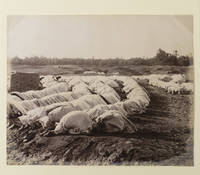
1880ABC_487231880. Tipped onto a stiff paper mount ca. 40 x 30 cm. Kept in a clear plastic sleeve. One albumen print ca. 22.5 x 27.5 cm. Striking image of a large group of Arabic men dressed in white engaged in prayer on a field. The large image was likely taken by a photographer who was active in the Middle East in the late 19th-century but is unfortunately unsigned.The edges are somewhat discoloured and the corners are creased from a past mounting method. Otherwise in good condition. unknown
8vo. 144 pp. Original printed wrappers. Pocket dictionary of Egyptian Arabic, providing "all sentences, phrases and a vocabulary of words that are in common use throughout Egypt, the Sudan and part of Palestine; and which are needed mostly by military men and tourists". - When the Lebanese-born Alec Cury sought the assistance of a British authority for the 1915 first edition of his work, "General Sir John Maxwell, GOC of British troops in Egypt, allowed his name to be put on the cover to give his solemn imprimatur to a work which was to go into no less than 34 editions by 1965" (McLoughlin). The present 32nd edition still proudly bears the phrase "officially approved by the late General Sir John Maxwell" on the front cover and title-page. - Aiming to enable English native speakers to learn Arabic without the help of a teacher, the manual includes useful terms and phrases for interactions at a restaurant, at the post office, with a taxi driver, or a "donkey boy", as well as terms of the oil industry, aviation and military. It provides brief observations on grammar and pronunciation as well as a table with the Arabic alphabet. - Wrappers and title-page somewhat brownstained. Otherwise well preserved. McLoughlin, In a Sea of Knowledge, 65. Cf. OCLC 487444386 (1950 ed.).
In-4, 138p. Edition originale numérotée. Avec de nombreuses photographies n/b et couleurs.
Hand-coloured engraved map (365 x 260 mm). Detailed map of Saudi Arabia, the Red Sea, Persian Gulf, etc. Rigobert Bonne was the Official Hydrographer to the French Depot De La Marine. - In good condition. Not in Tibbetts, Al Ankary and Al-Qasimi.
8vo. (2), XVI, 512 pp. With engraved title vignette, folding engr. map, and 4 engr. plates. Contemporary half calf with remains of spine labels. First edition, conceived as a continuation of Bergk's volume on Egypt. This copy includes the frequently lacking half-title "Aegypten. Erste Fortsezzung, enthaltend Arabien und Syrien [...]". - The map shows Syria; the plates depict Arabic costumes, household tools, and views of Haleb and Palmyra. The title vignette shows Mt. Sinai. Also discusses the history , topography, climate, illnesses etc. of the Arabian Peninsula (with chapters on the Nejd, Arabia Felix and Yemen, etc.) - Extremeties rubbed and bumped; some spine defects. Interior somewhat browned as usual. Contemp. ms. ownership "Ernst Hanns Dönig" on front flyleaf. Kayser I, 32. Holzmann/B. I, 2892. Hamberger/Meusel XXII/1, 216. OCLC 257668994. Not in Macro, Atabey or Blackmer.
8vo. XVI, 512 pp. With engraved title vignette, folding engraved map, and 4 engraved plates. Contemporary marbled boards. All edges red. First edition, conceived as a continuation of Bergk's volume on Egypt. The map shows Syria; the plates depict Arabic costumes, household tools, and views of Haleb, Mecca, and Medina. The title vignette shows Mt. Sinai. Also discusses the history , topography, climate, illnesses etc. of the Arabian Peninsula (with chapters on the Nejd, Arabia Felix and Yemen, etc.). - Some browning. From the library of the Kalksburg Jesuit college with their shelfmark label on pastedown. Kayser I, 32. Holzmann/B. I, 2892. Hamberger/Meusel XXII/1, 216. OCLC 257668994. Not in Macro, Atabey or Blackmer.
8vo. 31, (1) pp. With 4 black-and-white photographic illustrations and a double-page map of the Arabian Peninsula. Original printed wrappers. Stapled. Rare Arabian-themed issue of the popular "Lesebogen" series. It provides a brief introduction to Saudi Arabia and its history, focusing on the ascent of Abdulaziz Ibn Saud. With a portrait of Ibn Saud as well as images of the Ka'aba, an oil refinery, and a group of watchmen in the desert. The map shows international boundaries, pipelines and railroads, as well as several major cities including Riyadh, Medina, Mecca, Dhahran, Damaskus, Kuwait and Tehran. - Founded by the German publisher Sebastian Lux in 1946 as a series for young readers, the "Lesebogen" booklets quickly proved a sought-after collectible, reaching 4 million copies in the first 3 years of publication alone. When the final issue appeared in 1964, the Lux publishing house had sold a total of 25 million copies. The immense success of the series is considered the result of a demand for well-edited material on complex matters of the world after the intellectual vacuum of World War II among the German public. The writer Otto Zierer (1909-83) was the author of no fewer than 50 such booklets. - Extremities slightly rubbed. Interior in excellent condition. OCLC 804813770.
8vo. (2), 8, (III)-CXII, 136 (Arabic), 256 pp. Contemporary marbled limp boards with ms. title to spine. The final edition of the venerable Arabic grammar first published by Erpenius in 1613, the work that dominated Western instruction in the Arabic language for two centuries. After re-issues (with various amendments) by Deusing (1636), Golius (1656), and Schultens (1748 and 1767), the Göttingen Biblical scholar Michaelis produced a German translation in 1771. "In the long preface [...] Erpenius's grammar is characterised as still the best one in existence for Hebrew and Arabic, and as regards any Oriental language second only to the author's father's Syriac grammar" (Smitskamp, p. 278). This second edition, published a decade later, omits the name of Erpenius: "owing to the many additions (for the greater part unneccessary according to Schnurrer) the work may now be called Michaelis' own" (Smitskamp). It was not until 1810 that Silvestre de Sacy's "Grammaire Arabe" would produce an actual advance in the field. - Binding rubbed; occasional brownstaining to interior; several old ownerships and acquisition notes to insides of covers. A good, untrimmed copy. Schnurrer p. 83f., no. 120. Smitskamp, PO 283. Fück p. 65 & cf. 119f.
8vo. 2 parts in one volume. CXII, 256, (2), 136 (Arabic) pp. (2nd part interleaved). Contemporary papered boards with giltstamped spine label (chipped). All edges red. A Göttingen student's hand-annotated copy: the final edition of the venerable Arabic grammar first published by Erpenius in 1613, the work that dominated Western instruction in the Arabic language for two centuries. This copy was owned by the poet and pastor Hermann Bredenkamp (1760-1808), a native of Bremen, who had taken up his studies of theology and oriental languages at Göttingen in 1780. Among his teachers was not only Michaelis himself, but also the great Swedish orientalist Matthias Norberg (1747-1826), who in 1781 passed through Göttingen on his return journey from Constantinople, visiting Michaelis. Bredenkamp's annotations in the book's margins frequently refer to Norberg's personal comments on the grammatical matter and especially on the pronunciation of modern vernacular Arabic of Morocco. On the interleaves of the Arabic chrestomathy, Bredenkamp has occasionally noted vocabulary and word references, but this part does not appear to have been worked through in detail, and it is the grammar in which the most extensive annotations occur, all written in ink in Bredenkamp's meticulous and minute hand. - By the 18th century, Erpenius's grammar had seen several re-issues (with various amendments) by Deusing (1636), Golius (1656), and Schultens (1748 and 1767), before the Biblical scholar Michaelis produced a German translation in 1771. The present second edition, published a decade later, entirely omits the name of Erpenius: "owing to the many additions (for the greater part unneccessary according to Schnurrer) the work may now be called Michaelis' own" (Smitskamp, p. 278). This, of course, was the grammar of choice at the University of Göttingen under Michaelis' tutelage. It was not until 1810 that Silvestre de Sacy's "Grammaire Arabe" would produce an actual advance in the field. - Binding rubbed, extremeties severely bumped. Bredenkamp's handwritten ownership (dated 1781) to front flyleaf; title-page has early 19th century stamped ownership of G. J. Lorent. Schnurrer p. 83f., no. 120. Smitskamp, PO 283. Fück p. 65 & cf. 119f. For Norberg's stay in Göttingen cf. Chatzipanagioti-Sangmeister, p. 80.
Good German Paperback. Some underlined sentences. Demy 8vo. (21 x 15 cm). In German. 50, [1] p., b/w plates. Arabische Kultur (Grosse Sowjet-Enzyklopadie - Reihe Kultur und Literatur).
Large 8vo (172 x 240 mm). Scrapbook containing clippings of the newspaper series "Arabische Reise" and other articles on Arabia, along with various illustrations and music. 80 pp., each sheet covered on one side with coloured paper or cloth. Contemporary green library cloth with cover label. Original clippings of Muhammad Asad's "Arabian Journey", serialized in the "Neue Zürcher Zeitung" in 1927, and including other early newspaper articles by Asad (as well as an essay by Hermann Hesse). The handsome album, apparently assembled by a German or Swiss traveller, Georg Hartmann (whose ownership is inscribed on the pastedown and initialled to the upper cover), is decorated with numerous illustrations cut from contemporary magazines, including several showing camel-mounted bedouins in the desert, a view of Mecca, portraits of Abdul Aziz ibn Saud, the muezzin's call to prayer (arranged in musical notes), and the original business wrapping paper of the Istanbul confectioner Hajji Bekir, whom Hartmann seems to have visited during a 1928 visit to Turkey. On the pastedown, Hartmann has entered a table of contents (with a - possibly slightly later - portrait of Ibn Saud as King). - Muhammad Asad (previously, Leopold Weiss) was a leading traveller and journalist of the 20th century who, in 1926, converted to Islam from Judaism, eventually becoming a diplomat for Pakistan and a best-selling author. His enthusiasm for Wahhabism is evident from these early travel reports from the Arabian Peninsula, where Ibn Saud had just captured Mecca and proclaimed independence in the Hejaz and Nejd, but had not yet united his dominions into the Kingdom of Saudi Arabia. Indeed, Asad's feature on Ibn Saud (also included here) constitutes nothing less than a hagiographic portrait of the ideal ruler, and his incisive writings on Islam aim to familiarize western audiences with what he perceived as the purest and truest form of the religion he had come to embrace, criticizing occidental images of the Muslim faith gleaned from the Ottoman or Persian tradition, which he viewed as corruptions.
Engraving. 285 x 357 mm. Matted. An Arabian horse led by a bedouin, engraved by the young Martin Elias Ridinger after a drawing by his famous father.
In 8°, cop. edit. con ali ill., pp. 448,(10); buon es.. (m303/d) (spedizione standard SEMPRE tracciata con raccomandata-piego di libri, eventuale FATTURA da richiedere all'ordine)
53 min. Colour and black-and-white. NTSC VHS cassette. In original case. Promotional video celebrating Aramco's first 50 years in the oil business. The 53-minute film traces the development of the Arabian American Oil Company from the first team of engineers and researchers that braved the Saudi desert in search of oil in the mid-1930s to a company of 60,000 employees controlling a large share of the earth's reserves. Most valuable are early photos of exploration camps, regional topography, and the Arabian Peninsula before its development. The tape makes for a heroic tale, but as one might expect, fails to place American efforts in the larger context of oil exploration in the Arabian Peninsula, Iran and Iraq that began with the British in the 1890s and was joined by the Dutch, French and Americans in the next century. Briefly addressing the economics of oil and its effects on Saudi Arabia, the film prefers to concentrate on the good fortune and technological advances the oil boom brought to the kingdom. - The film premiered on Channel 3 on 29 May 1984, the anniversary of the Concession Agreement. - Very well preserved. OCLC 12825212.
Oblong 12mo (57 x 89 mm). 2 pp. Permit to use retail services in the Ras Tanura Camp. Issued to Mrs. O. O. Thomas, the wife of Aramco employee Orlin Orace Thomas. - Slightly creased.
2 large black-and-white photographic prints, 260 x 360 mm. Matted (500 x 400 mm). Rare views of Aramco facilities in Saudi Arabia. The set comprises a fine aerial view of worker accomodation complexes in the Eastern Province, as well as a street view showing office and residential buildings. The mattes bear a giltstamped caption "Aramco Photograph". - Corners lightly bumped; images in excellent condition.
Small folio (220 x 284 mm). (8), 343, (1) pp. With numerous black-and-white photographic illustrations, plans and charts. Contemporary full cloth with stamped title to cover and spine. Extensive handbook for employees of Aramco in the Middle East. The personal copy of Aramco official Robert King Hall, a director of training, with his handwritten ownership, dated Dhahran, June 1967, to title-page. - The work briefs American personnel for their service in an unfamiliar land, discussing the history of the Middle East as well as the development of the oil industry and the key role of Aramco. It includes observations on the Saudi government, the main cities and towns, and the climate, as well as "the culture and customs of the Arabs". The illustrations celebrate the advances of the modern oil industry and the achievements of Aramco, showing oil compounds and refineries as well as the harmonious collaboration of Americans and Saudis. Further images depict the rich Arabian culture in rugs and historical manuscripts, as well as desert landscapes and Middle Eastern wildlife, including falcons and horses. - Inner hinges broken, otherwise very well preserved. OCLC 1282106663.
4to. (8), 279, (1 blank) pp. Red cloth, with title on front board and on spine. Beautifully illustrated handbook on Aramco and Saudi Arabia for Aramco employees. - "The Aramco Handbook was originated to fill the void in comprehensive texts written in English about the Middle East. Employees of the Arabian American Oil Company coming to Saudi Arabia from abroad, principally Americans, needed reliable and fairly detailed knowledge of the kingdom. … In order to describe the Aramco venture in perspective, an unusual range of topics must be covered in the pages of this handbook: the history, culture, geography, geography, religion and economic development of Saudi Arabia; the fundamentals of the oil industry; Aramco's early history and its present operations" (introduction). It was first published in 1950 in five spiral-bound booklets. - A very good copy.
Small folio (220 x 282 mm). 2 vols. 12 issues each. Contemporary full cloth with giltstamped title to cover and spine. Two complete year runs of the popular Aramco magazine. In November 1949 the Arabian American Oil Company launched "Aramco World" as an interoffice newsletter that linked the company's U.S. offices with "the field" - primarily Dhahran, in the Eastern Province of Saudi Arabia. The journal quickly grew into a monthly (later bi-monthly) educational magazine featuring historical, geographical and cultural articles that helped the American employees and their families appreciate an unfamiliar land. - The present collection comprises vol. 8, nos. 1-12, and vol. 10, nos. 1-12. - Heads of spine somewhat worn. Interior in excellent condition.
Small folio (215 x 280 mm). 6 issues. Original printed wrappers. Stapled. Complete run of the popular Aramco magazine for the year 1976. In November 1949 the Arabian American Oil Company launched Aramco World as an interoffice newsletter that linked the company's U.S. offices with "the field" - primarily Dhahran, in the Eastern Province of Saudi Arabia. The journal quickly grew into a bi-monthly educational magazine featuring historical, geographical and cultural articles that helped the American employees and their families appreciate an unfamiliar land. - The present collection comprises vol. 27, issues no. 1-6. - Addressed to Michigan resident Florence E. Lostuzzi on verso.
Small folio (280 x 212 mm). 5 issues. Original illustrated wrappers. Five issues of Aramco World. In November 1949 the Arabian American Oil Company launched "Aramco World" as an interoffice newsletter that linked the company's U.S. offices with "the field" - primarily Dhahran, in the Eastern Province of Saudi Arabia. The journal quickly grew into a monthly (later bi-monthly) educational magazine featuring historical, geographical and cultural articles that helped the American employees and their families appreciate an unfamiliar land. - The present collection comprises vol. 3, nos. 2, 4, and 11; vol. 5, no, 10, and vol. 6, no. 7. - Heads of spine somewhat worn. Interior in excellent condition.
Small folio (215 x 280 mm). 12 issues. Original printed wrappers. Stapled. Set of 12 issues of the popular Aramco magazine. In November 1949 the Arabian American Oil Company launched "Aramco World" as an interoffice newsletter that linked the company's U.S. offices with "the field" - primarily Dhahran, in the Eastern Province of Saudi Arabia. The journal quickly grew into a bi-monthly educational magazine featuring historical, geographical and cultural articles that helped the American employees and their families appreciate an unfamiliar land. - The present collection comprises vol. 11, no. 5; vol. 14, nos. 5-8; vol. 15, nos. 1-3 and 5-6; vol. 16, nos. 1 and 2. - 11 issues addressed to Michigan resident Florence E. Lostuzzi on verso.
4to. 32 pp. Illustrated wrappers. The Arabic Superman issue of the Aramco World Magazine, with a charming illustration of Superman on the front and Batman and Robin on the back. An included article explains the history of these Arabic counterparts of these American superheroes. In 1964 the Arabic Superman was introduced into the Middle East operating under the guise of Nabil Fawzi instead of Clark Kent, followed a year later by Sobhi (Batman) and Zakkour (Robin). The comics of course read from right to left, as does the "S" on the costume of Superman. The article seems to be an important source on these Arabic comics. Other articles cover David Roberts, Cotton Castle, the history of Aramco and the journey of father Abd al-Masih. - A fine copy.